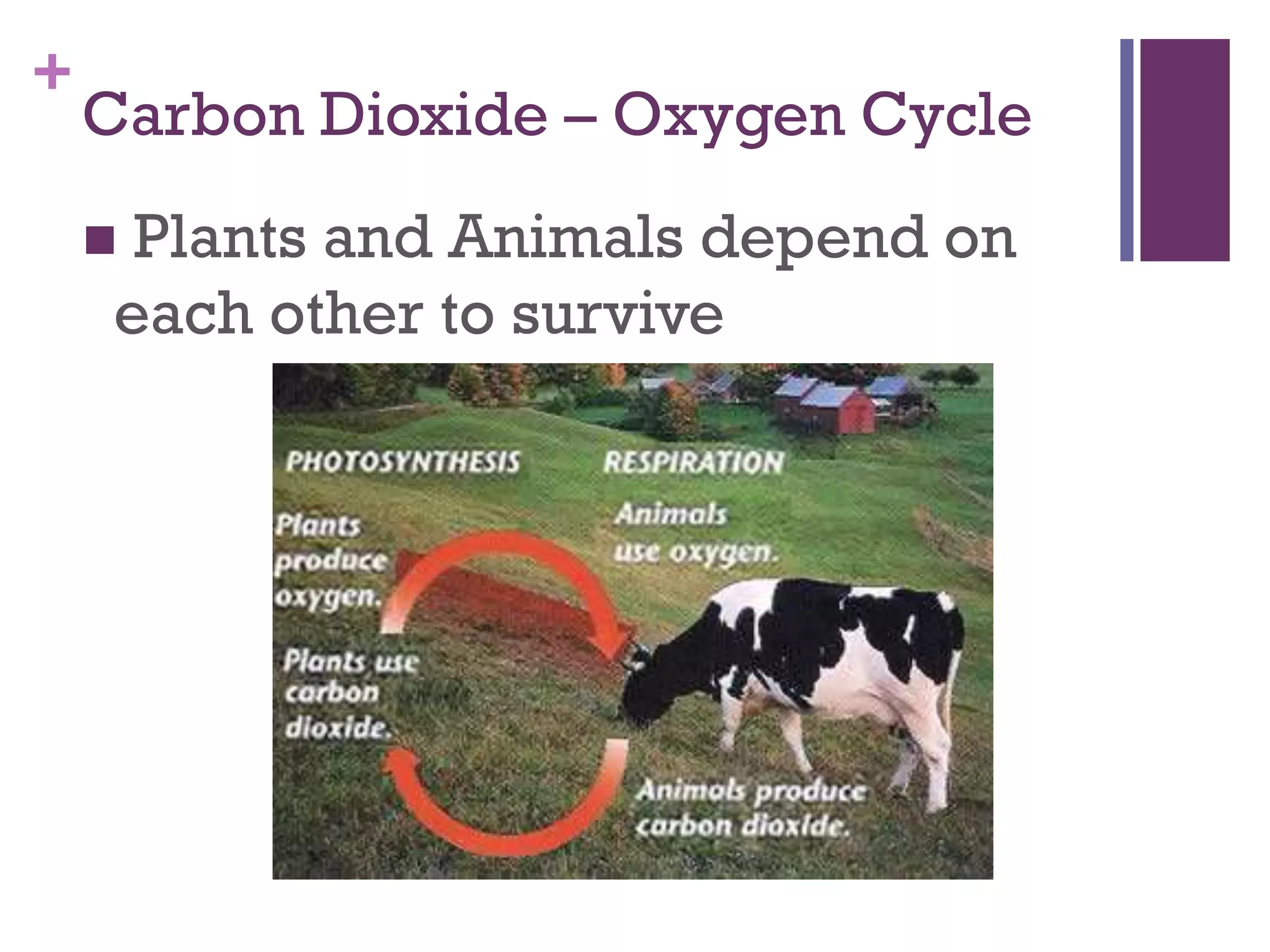
Plants and animals interact in ecosystems through carbon dioxide and oxygen cycles. Plants take in carbon dioxide and release oxygen through photosynthesis, while animals breathe in oxygen and release carbon dioxide. Populations of living things in an ecosystem interact to obtain resources like food, water, and shelter. Animals depend on plants for food and shelter, while plants rely on animals to distribute seeds and provide nutrients when they die.
Introduction to the relationship between living and nonliving components in ecosystems, focusing on how they interact and affect each other.
Highlighting the mutual dependence of plants and animals, particularly through the carbon dioxide and oxygen cycle essential for survival.
Discussion on how populations of living organisms interact to obtain essential resources like food, water, and sunlight in their environment.
Exploring the reciprocal relationships where animals depend on plants for food and shelter, while also contributing to plant reproduction and nutrients.
+
Carbon Dioxide –Oxygen Cycle
when things interact, they come
into contact with and affect one
another
living
things interact with nonliving things in their environment
3.
+
Carbon Dioxide –Oxygen Cycle
Plants and Animals depend on
each other to survive
4.
+
Carbon Dioxide –Oxygen Cycle
Plants need carbon dioxide to make
their own food
Plants
give off oxygen.
Animals
breathe
Animals
and Humans need oxygen to
and Humans breathe out
carbon dioxide
5.
+
Animal Plant Interactions
Inan ecosystem populations of
living things interact to get
resources
Population
– all the organisms of
a species living in the same area.
6.
+
Animal Plant Interactions
Resource– something that a
living thing needs to stay alive.
examples: food, water, living
space, sunlight
Plants
not only supply a source of
food but they also provide shelter
7.
+
Animal Plant Interactions
Animalsdepend on plants but
plants also depend on animals.
Animals
provide nutrients for
plants when animals die
Animals help plants reproduce
8.
+
Animal Plant Interactions
Changesthat affects plants also
affects animals
If
trees in a forest are cut down birds
& insects lose their shelter.