Environmental Science
A Study of Interrelationships
Thirteenth Edition

Enger & Smith

Chapter 5
Interactions: Environments and Organisms

Copyright © The McGraw-Hill Companies, Inc. Permission required for reproduction or display.
Interactions: Environments and
Organisms
5.1 Ecological Concepts
 Environment everything that affects an
organism during its lifetime.
• Abiotic factors: Nonliving things that influence an
organism
– energy, nonliving matter, living space, and ecological
processes
• Biotic factors: All forms of life with which the
organism interacts.
5.1 Ecological Concepts

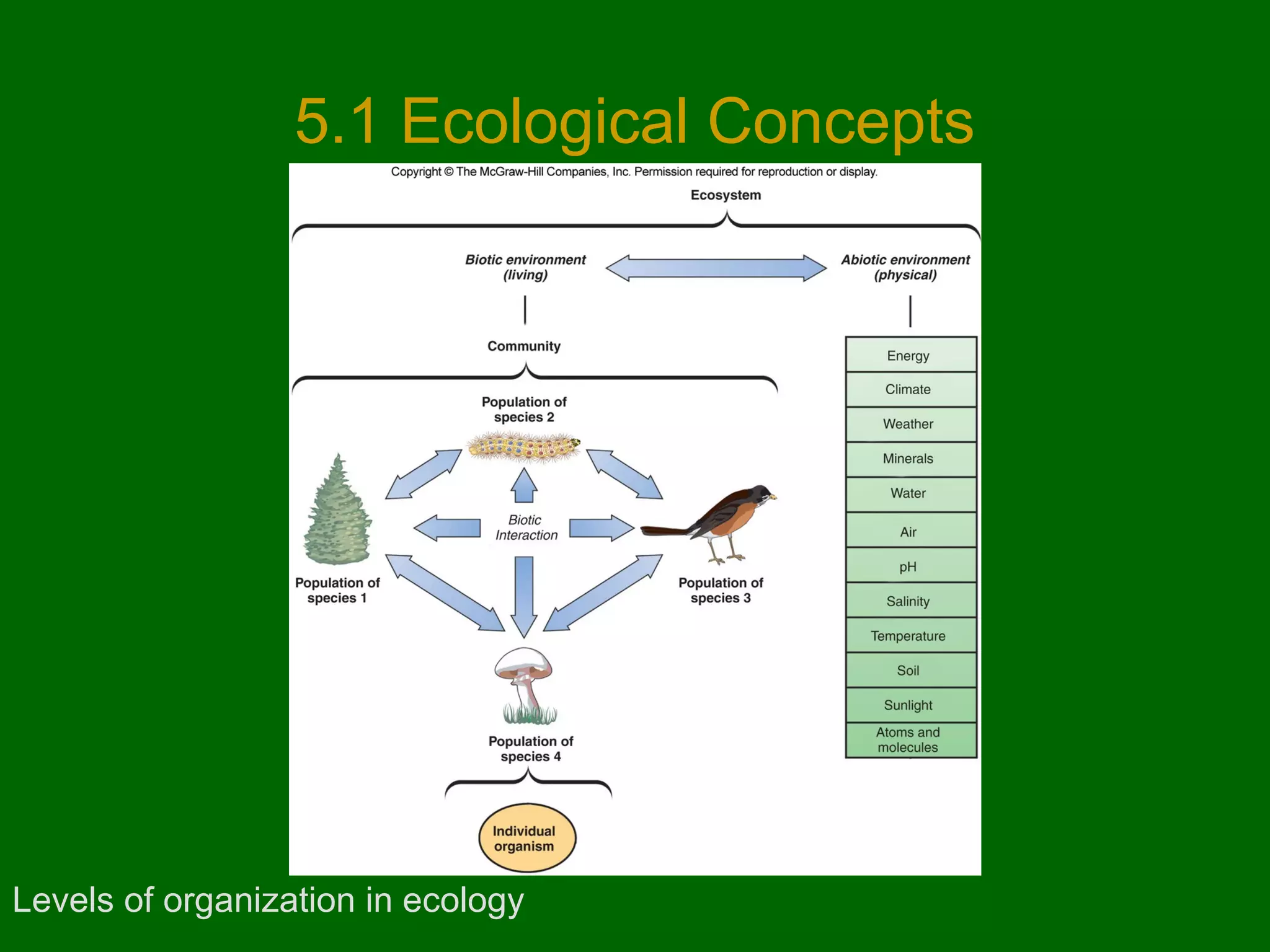
Levels of organization in ecology
Limiting Factors
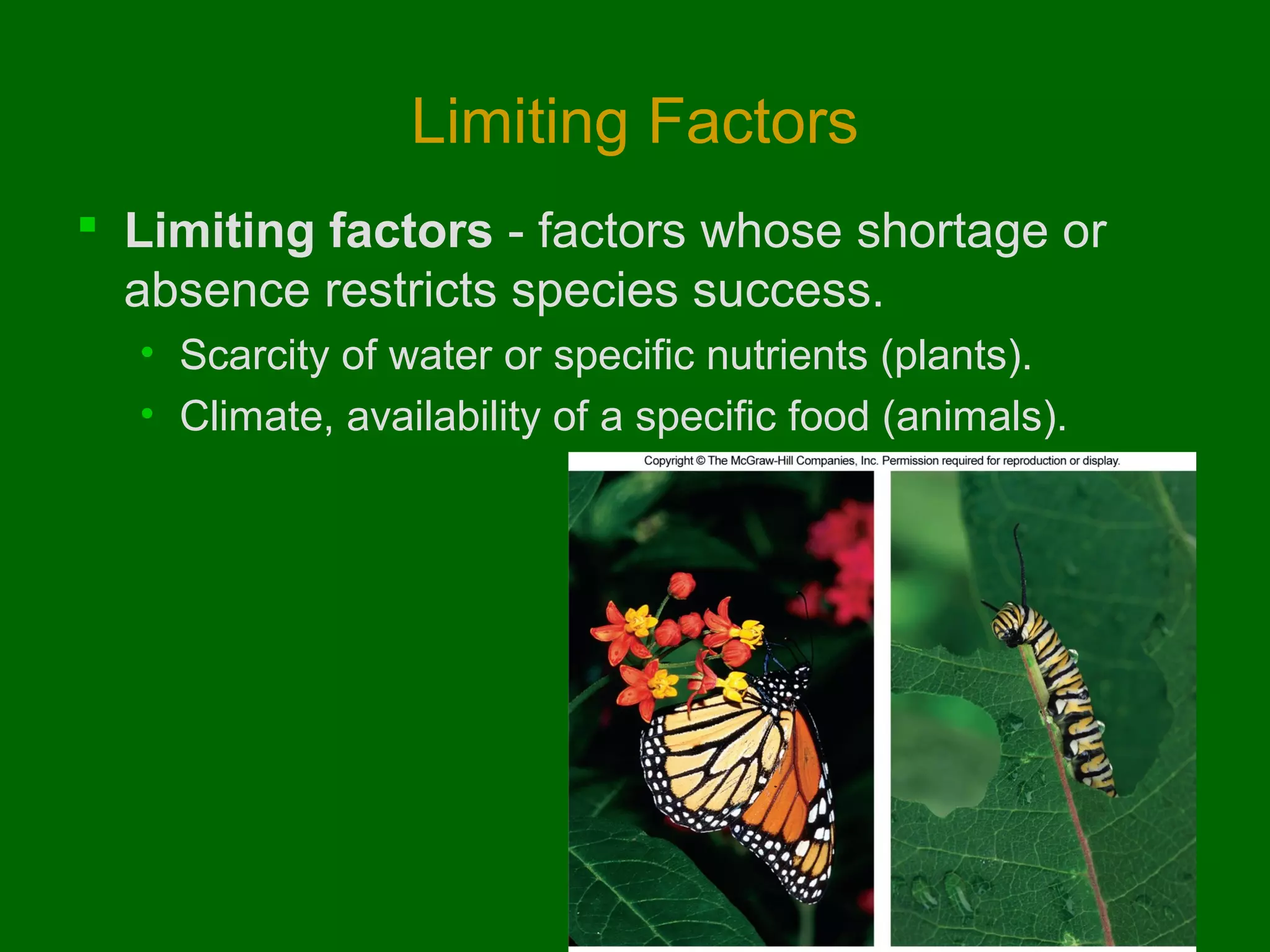
 Limiting factors - factors whose shortage or
absence restricts species success.
• Scarcity of water or specific nutrients (plants).
• Climate, availability of a specific food (animals).
Limiting Factors
 Range of tolerance - indicates a range of
conditions in which an organism can survive.
• Some species have a broad range of tolerance, while
others have a narrow range of tolerance.
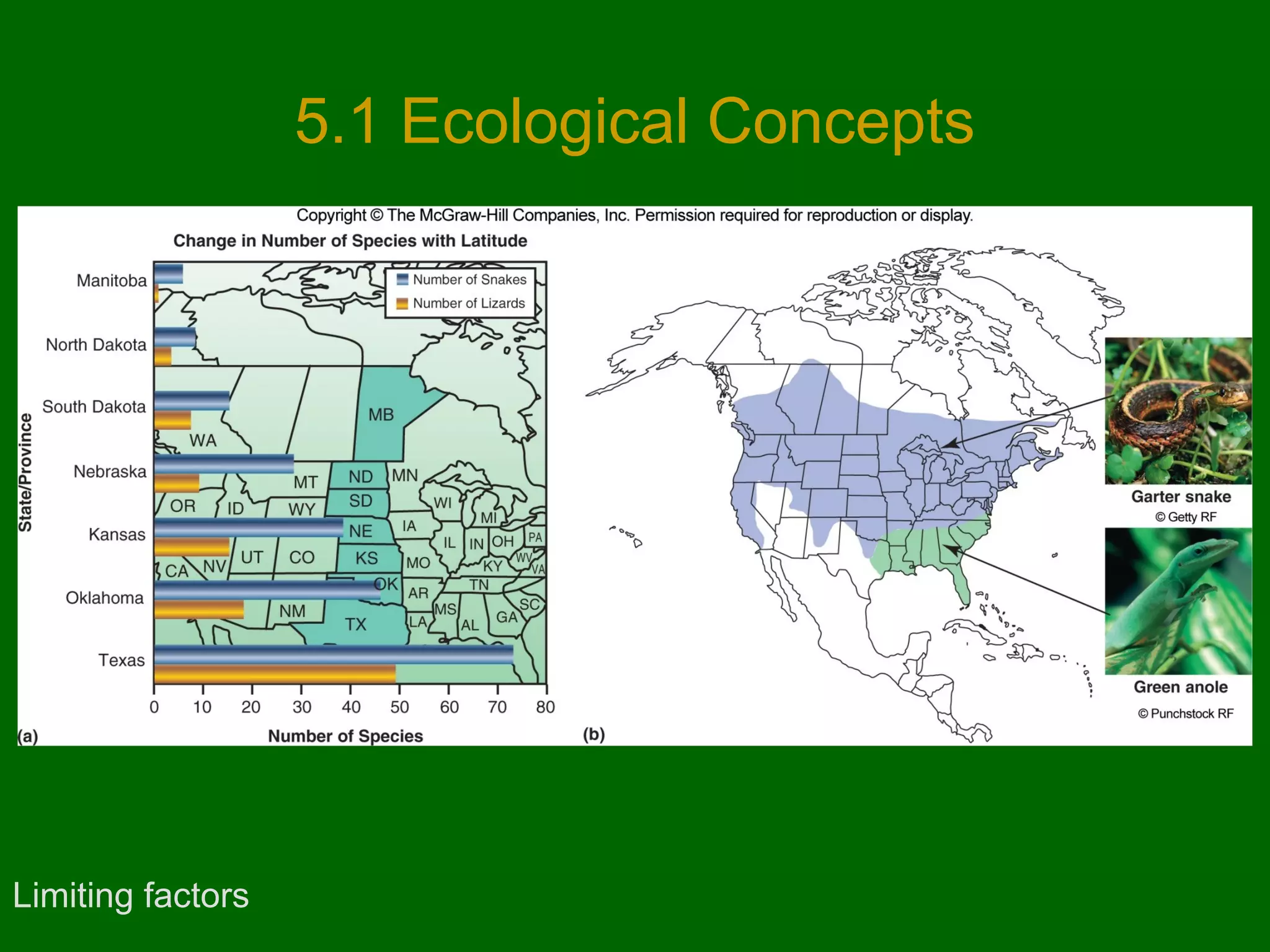
5.1 Ecological Concepts

Limiting factors
Habitat—place
 The habitat
• space in which an organism lives
• defined by the biological requirements of each particular
organism
• Usually highlighted by prominent physical or biological
features.
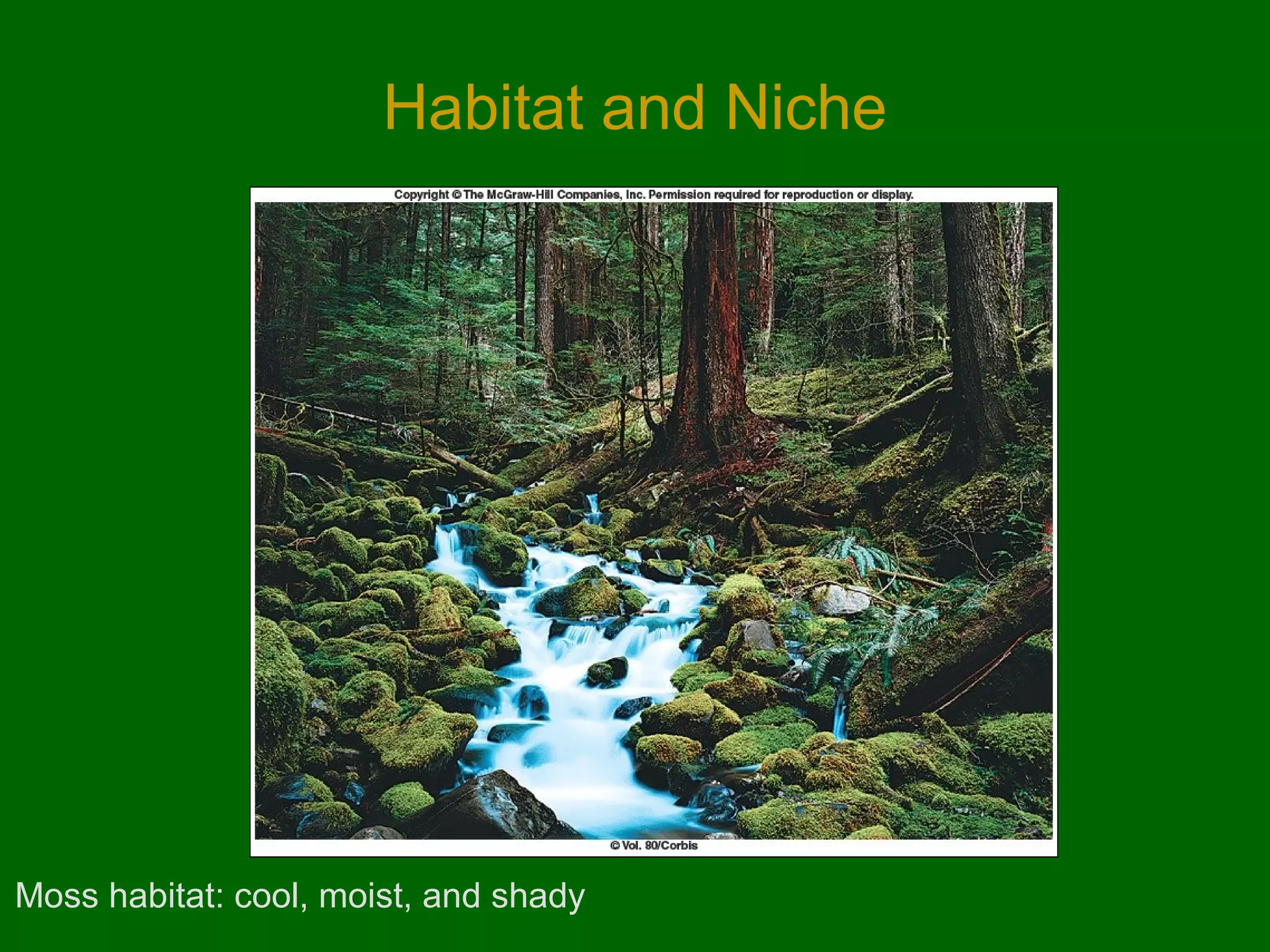
Habitat and Niche

Moss habitat: cool, moist, and shady
Niche--role
 The niche
• functional role (profession) the organism has in its
surroundings
• Includes:
– all the ways it affects other organisms
– how it modifies its physical surroundings
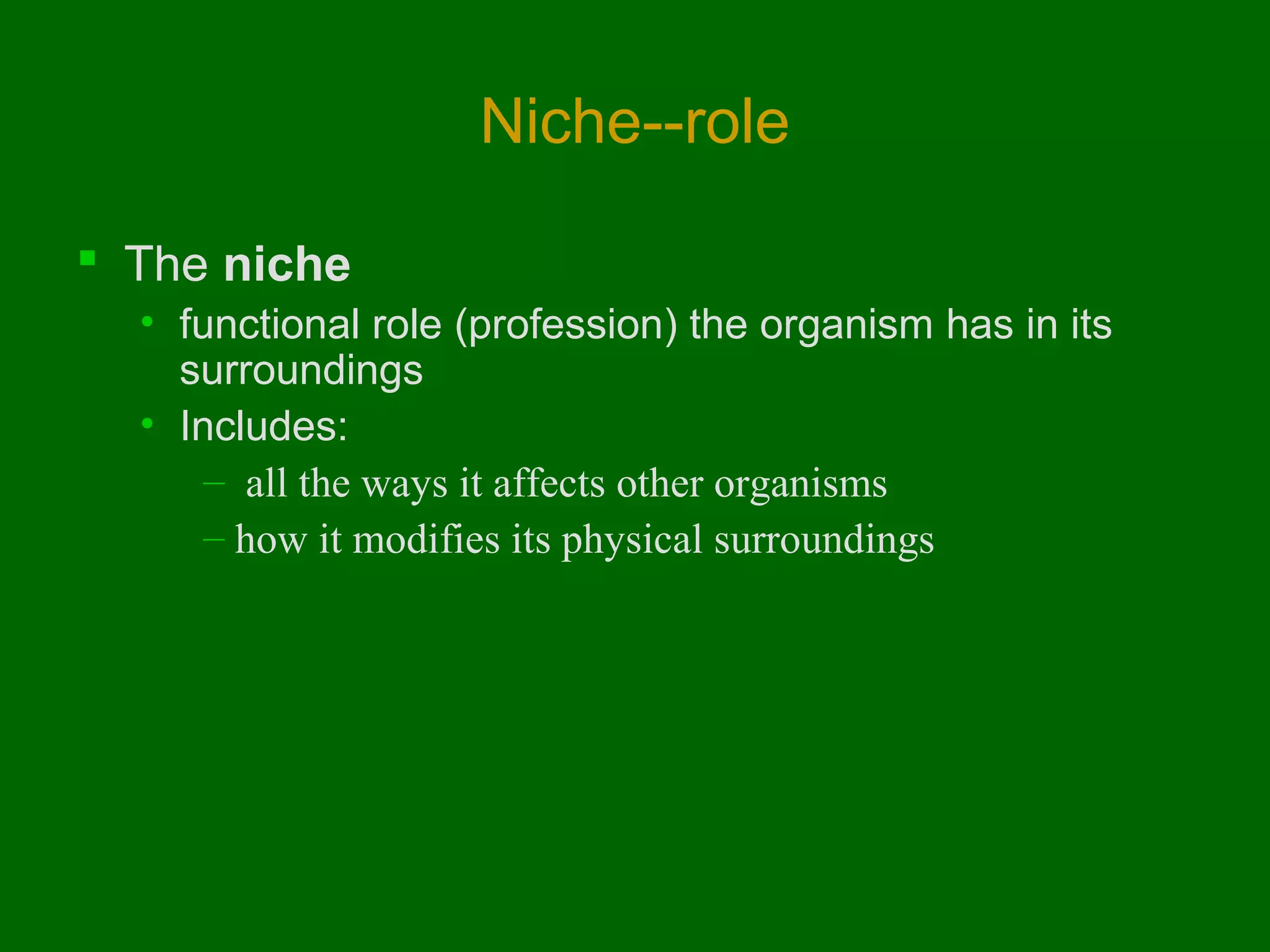
Habitat and Niche

Ecological niche of a beaver
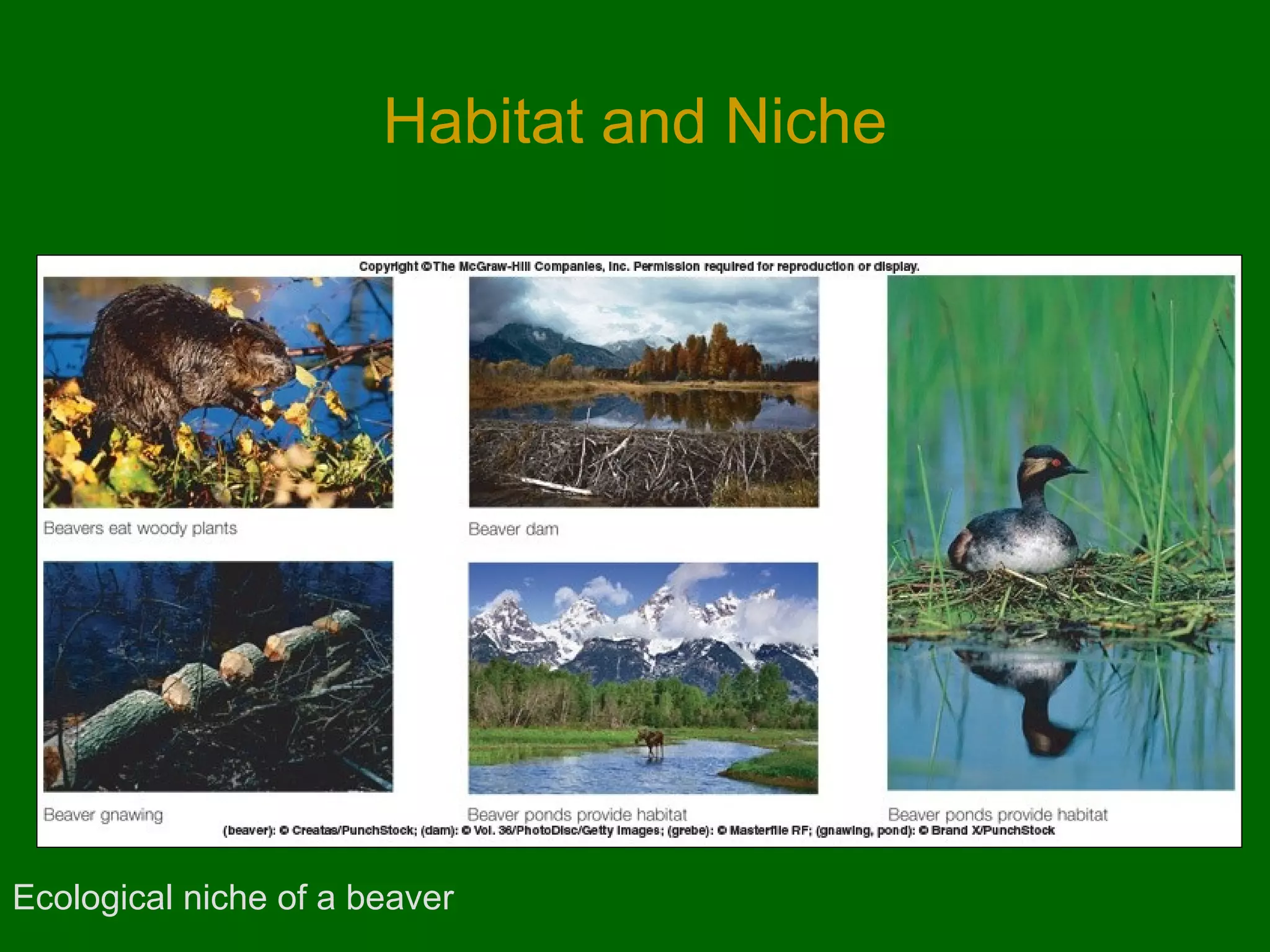
Populations
 A population
• all organisms of the same kind found within a specific
geographic region.
 A species

Species

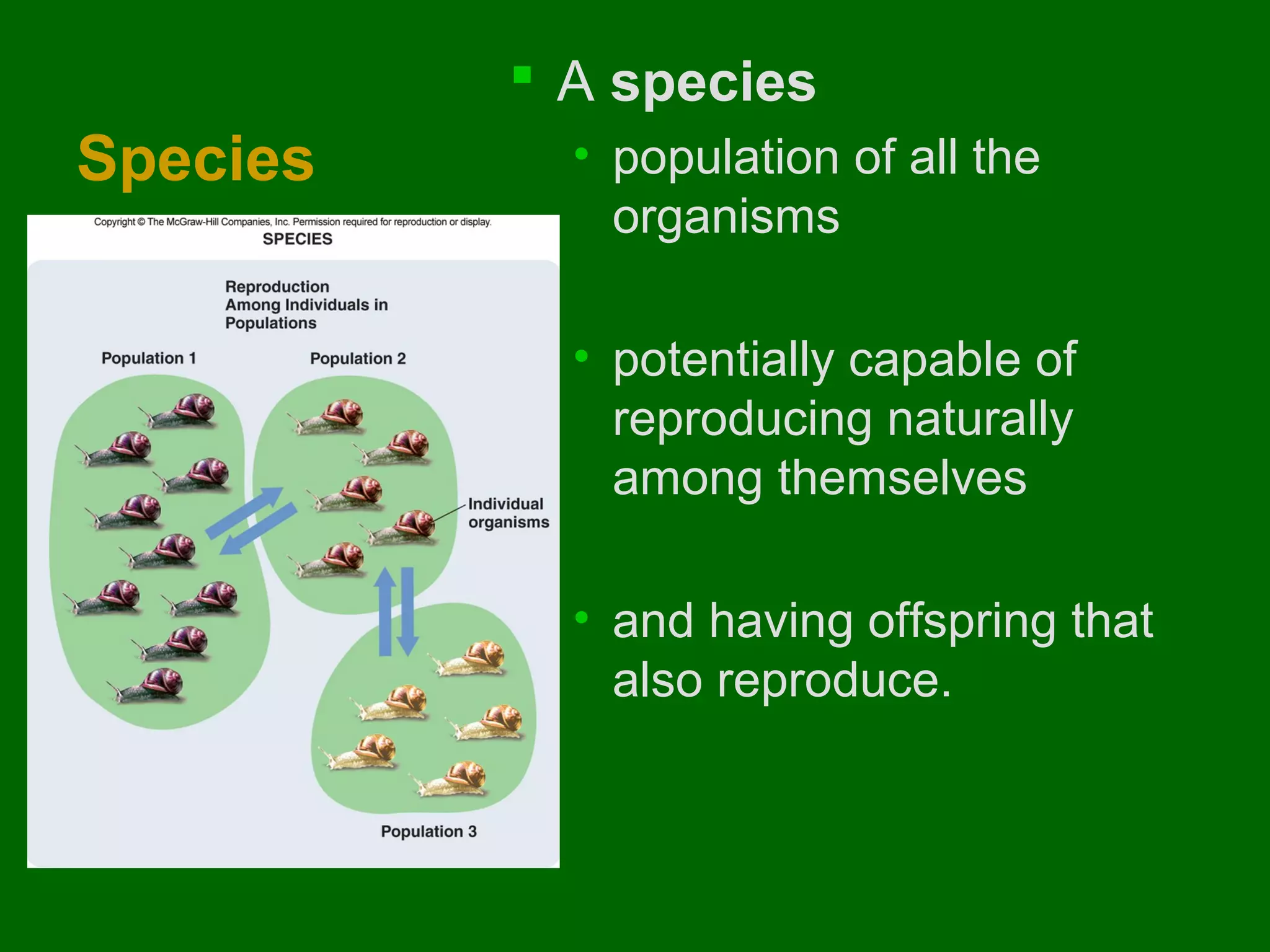
• population of all the
organisms
• potentially capable of
reproducing naturally
among themselves
• and having offspring that
also reproduce.
5.2 The Role of Natural Selection and
Evolution
 Natural selection
• process that determines which individuals within a
species will reproduce and pass their genes to the
next generation.
• Mechanism that causes Evolution

 Evolution
• Changes in genes and characteristics within
successive generations of a population over time
Natural Selection


Steps in natural selection:
Excess number of individuals
Results in a shortage of specific resources
Some individuals have a greater chance of obtaining
needed resources and
have a greater likelihood of surviving and reproducing than
others.
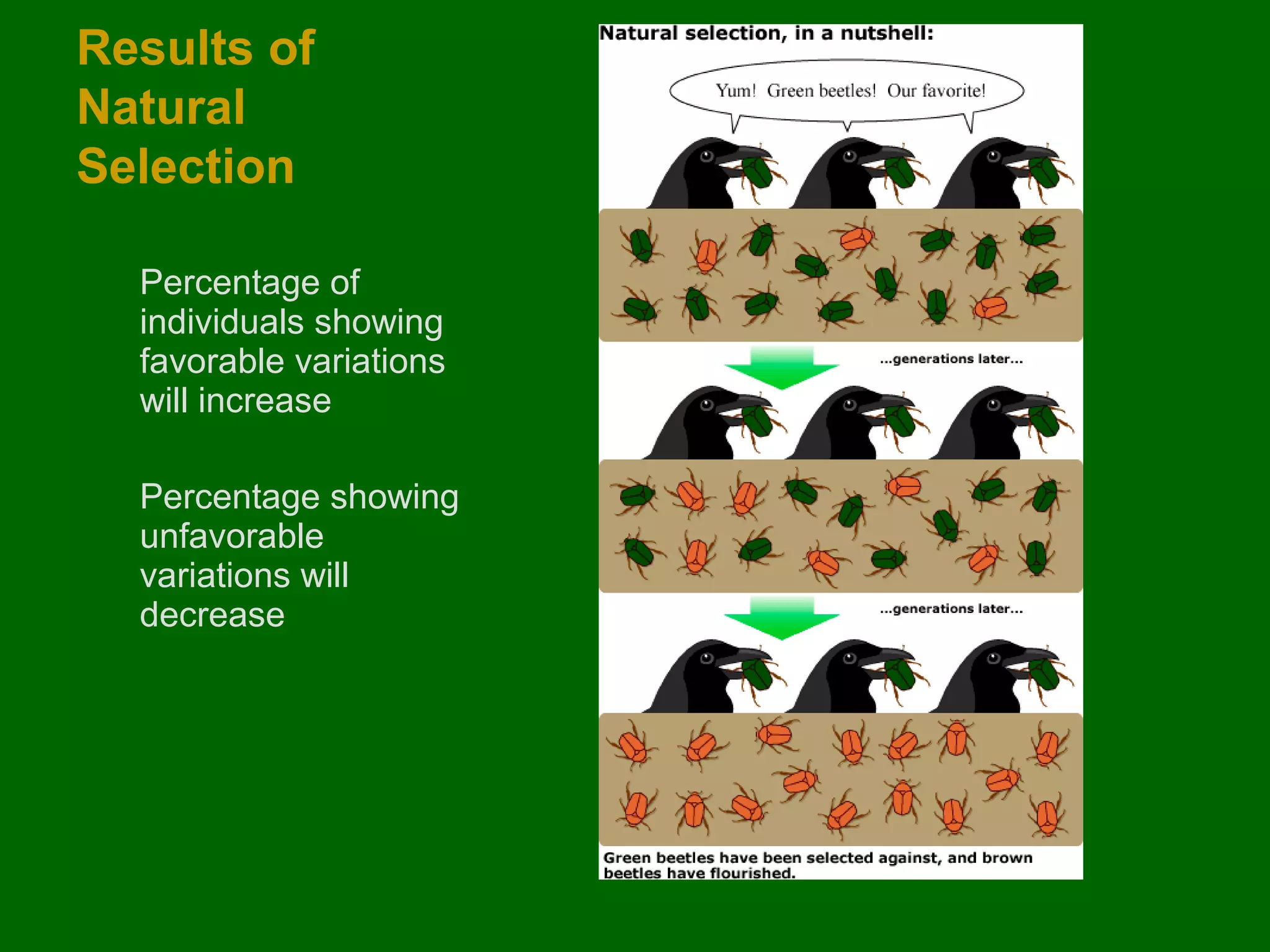
Results of
Natural
Selection
Percentage of
individuals showing
favorable variations
will increase
Percentage showing
unfavorable
variations will
decrease
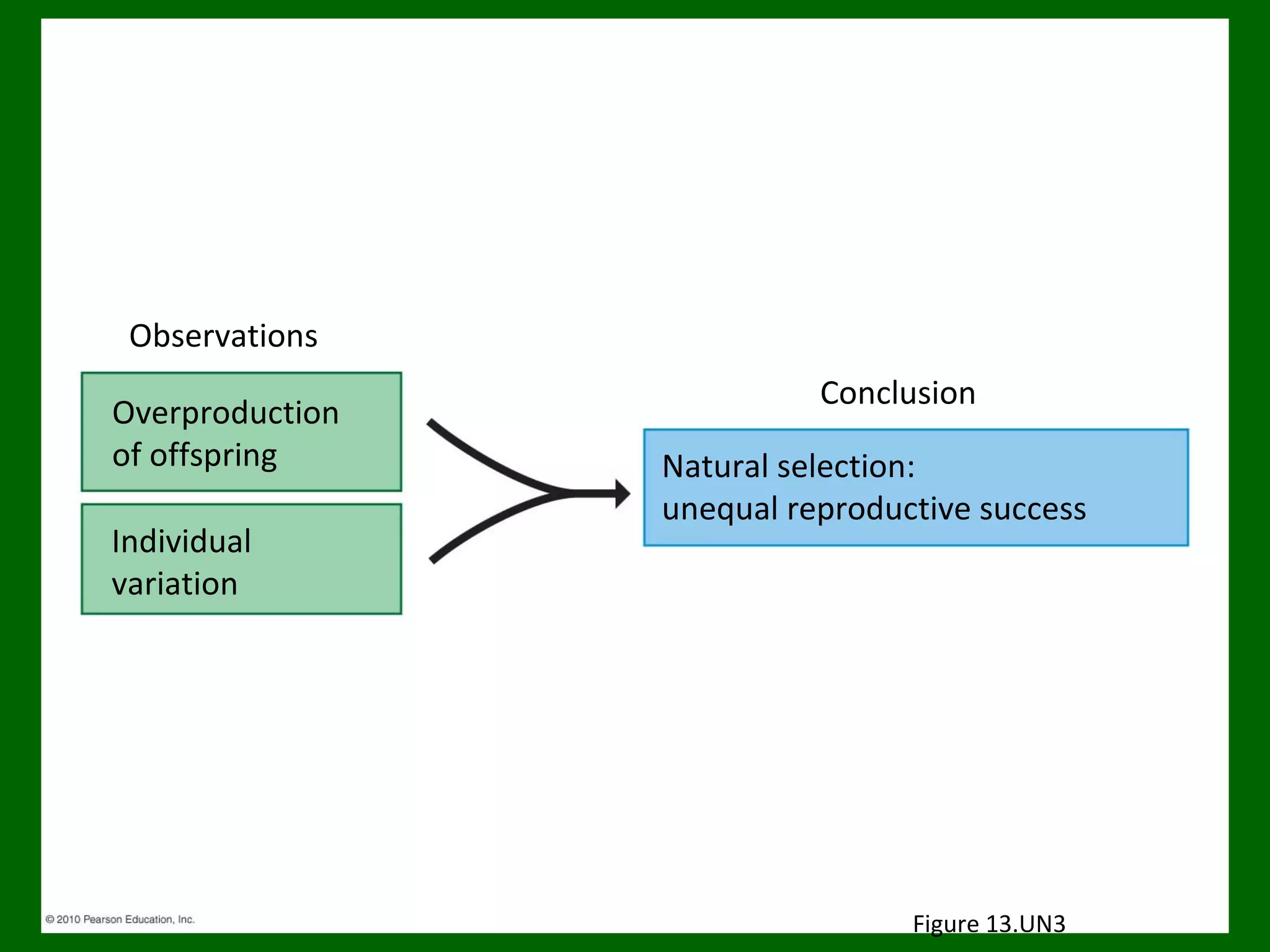
Observations
Overproduction
of offspring
Individual
variation

Conclusion
Natural selection:
unequal reproductive success

Figure 13.UN3
Natural Selection in Action
• Examples of natural selection include:
– Pesticide-resistant insects
– Antibiotic-resistant bacteria
– Drug-resistant strains of HIV

– http://www.pbs.org/wgbh/evolution/educators/teachstuds/svide
5.3 Kinds of Organism Interactions
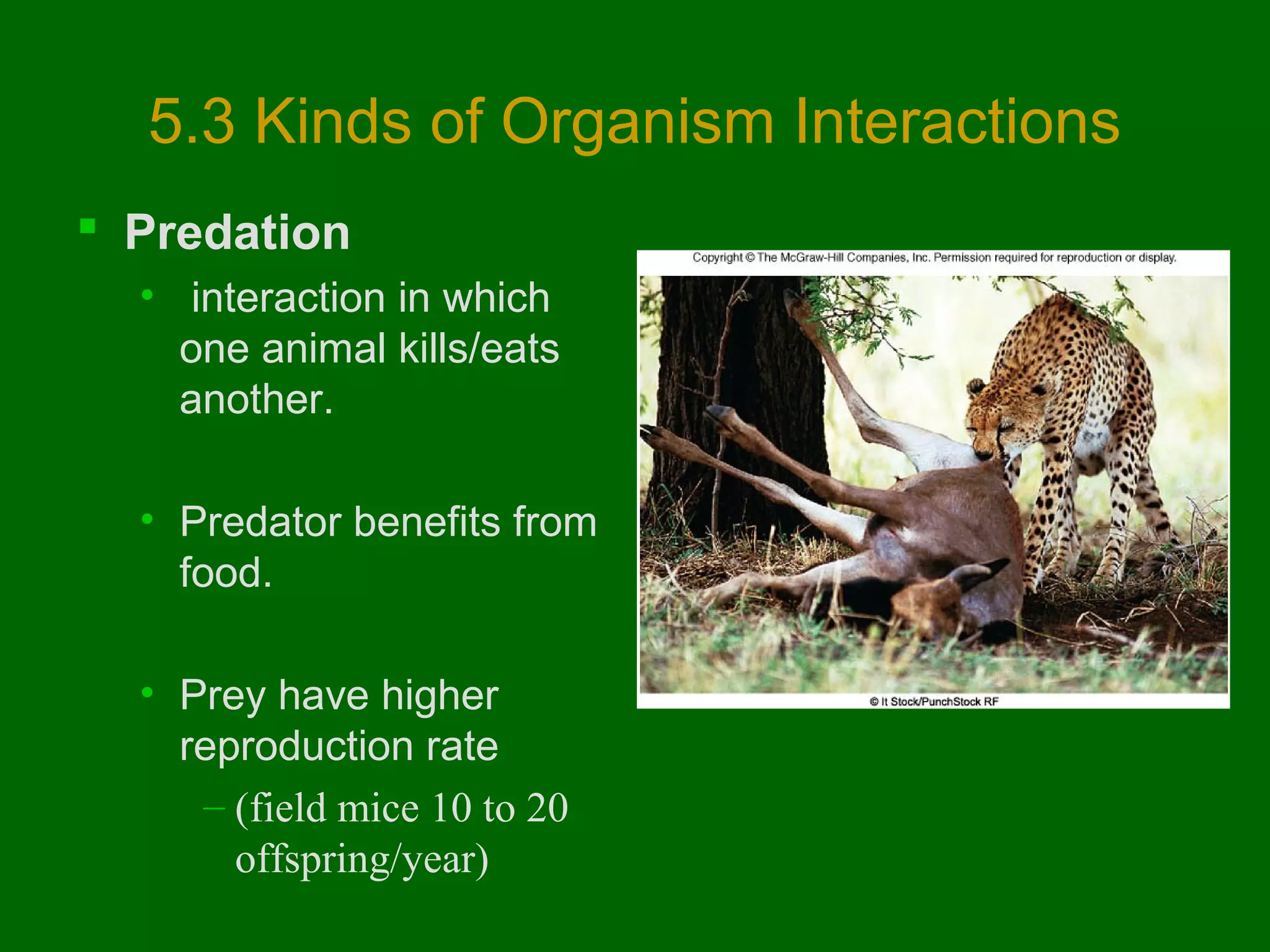
 Predation
• interaction in which
one animal kills/eats
another.
• Predator benefits from
food.
• Prey have higher
reproduction rate
– (field mice 10 to 20
offspring/year)
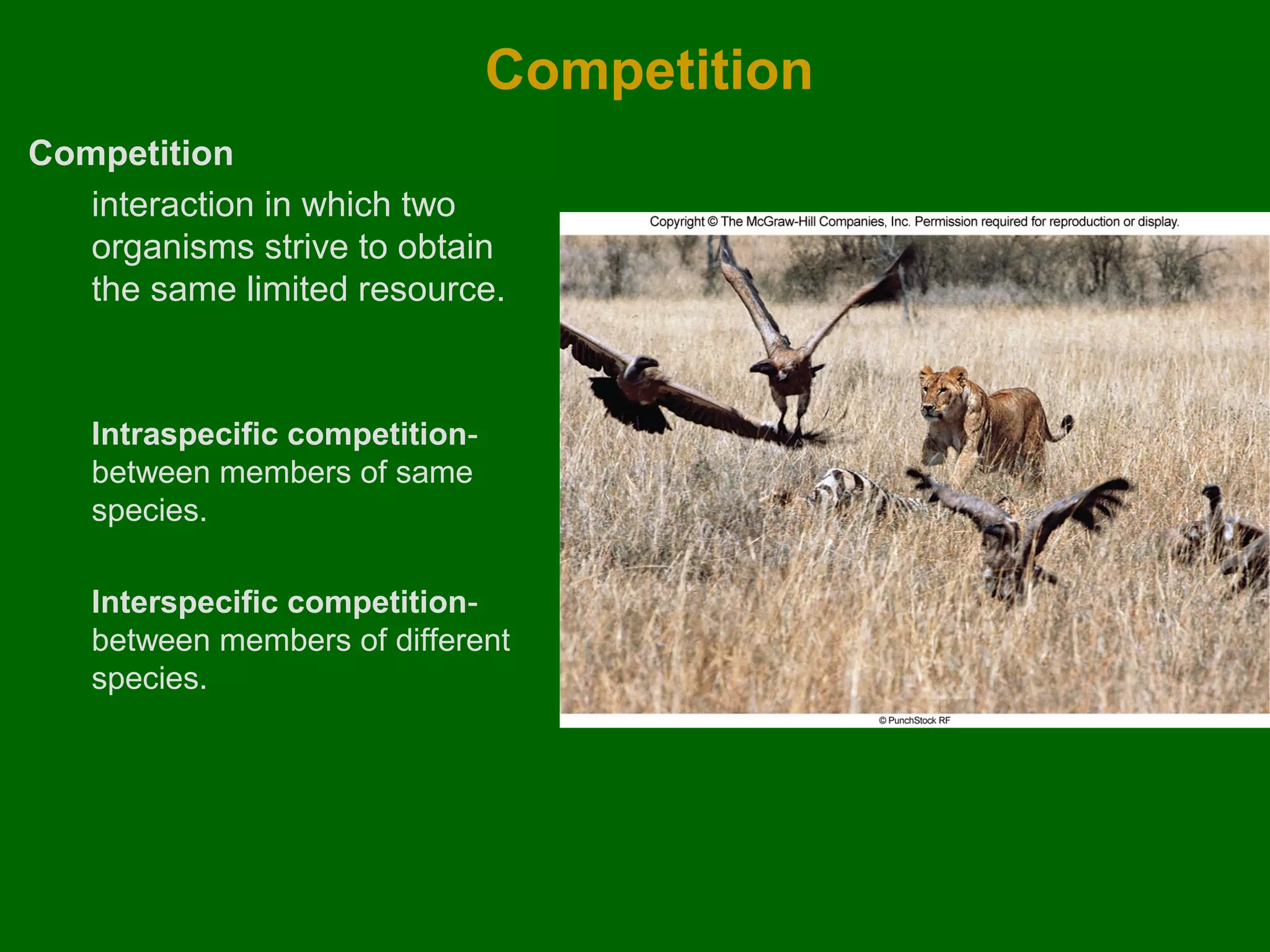
Competition
Competition
interaction in which two
organisms strive to obtain
the same limited resource.

Intraspecific competitionbetween members of same
species.
Interspecific competitionbetween members of different
species.
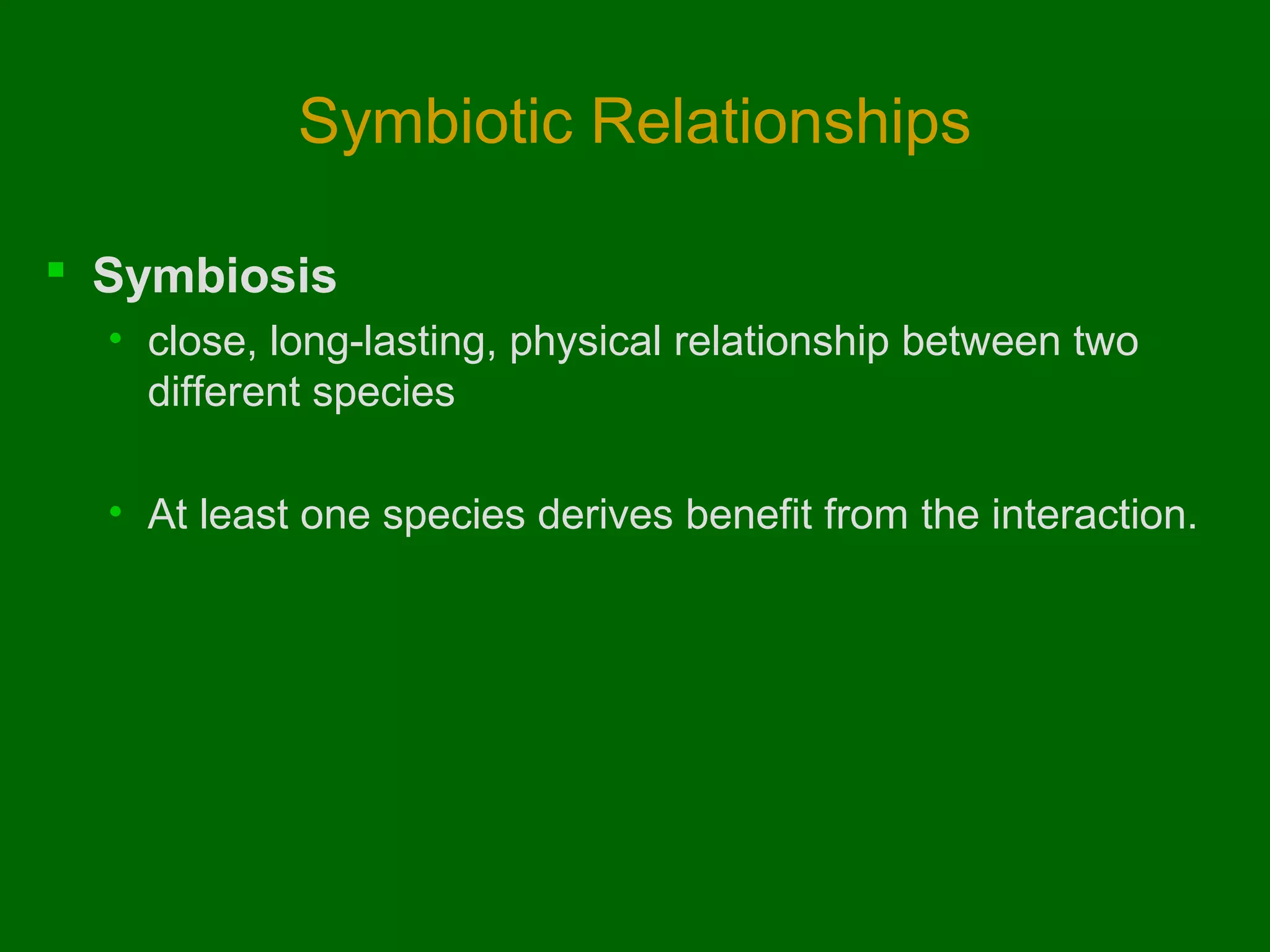
Symbiotic Relationships
 Symbiosis
• close, long-lasting, physical relationship between two
different species
• At least one species derives benefit from the interaction.
Symbiotic Relationships
 There are three categories of symbiotic
relationships:
• Parasitism
• Commensalism
• Mutualism
Symbiotic Relationships
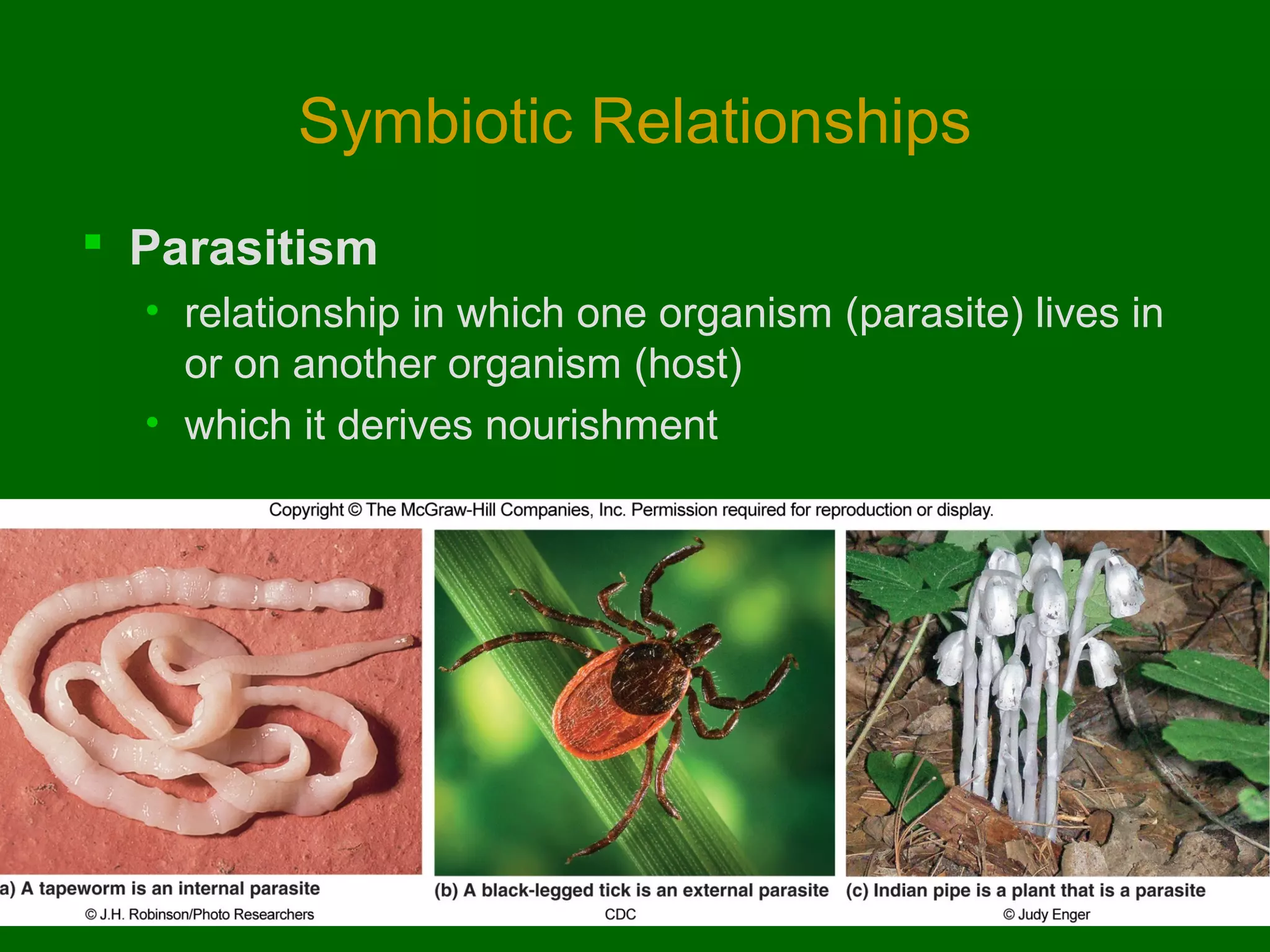
 Parasitism
• relationship in which one organism (parasite) lives in
or on another organism (host)
• which it derives nourishment
Symbiotic Relationships
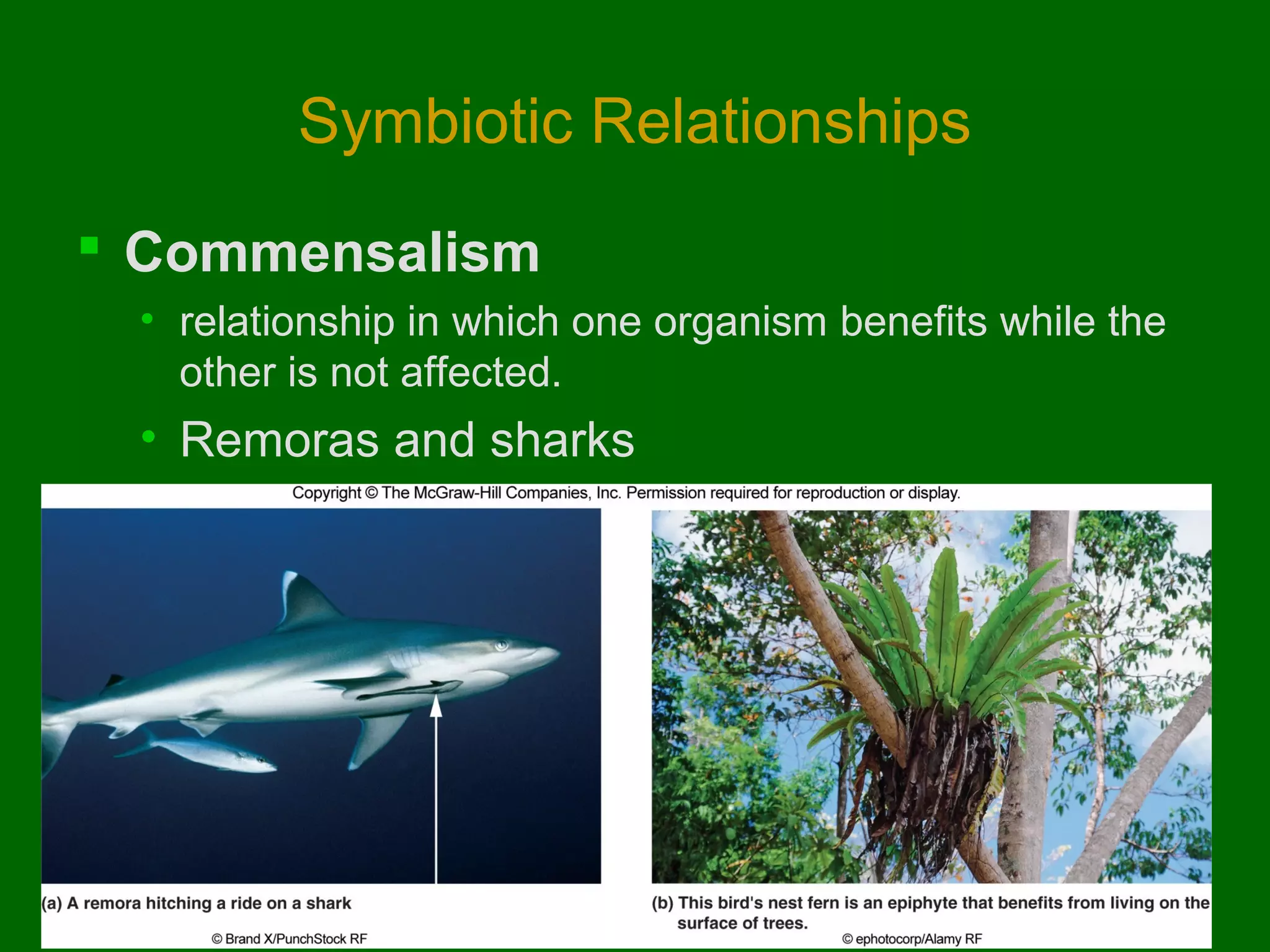
 Commensalism
• relationship in which one organism benefits while the
other is not affected.

• Remoras and sharks
Symbiotic Relationships
 Mutualism
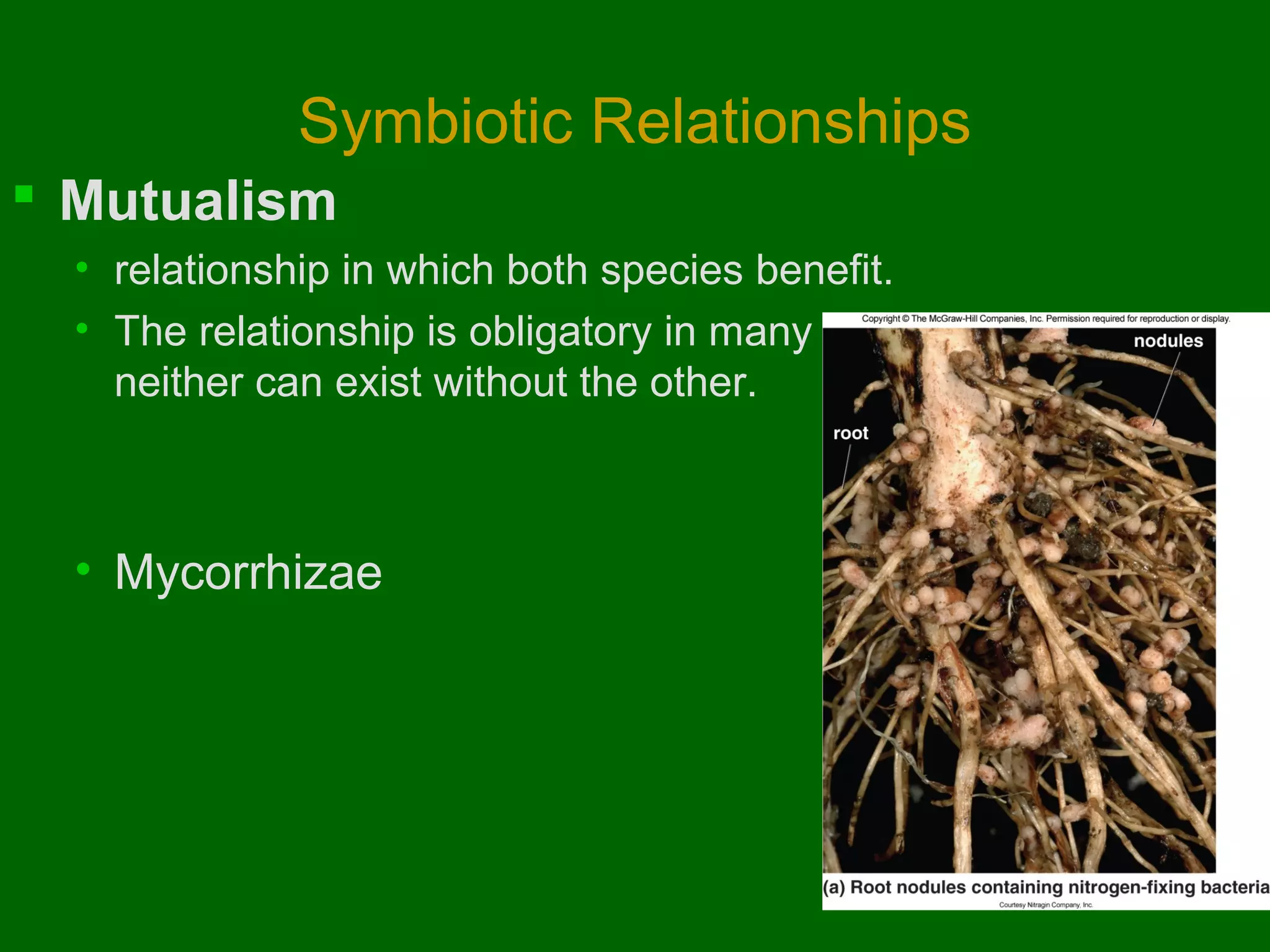
• relationship in which both species benefit.
• The relationship is obligatory in many cases, as
neither can exist without the other.

• Mycorrhizae
5.4 Ecosystem Interactions
 An ecosystem
• defined space in which interactions take place
between a community and the physical environment.

• Ecologists have divided organisms’ roles in
ecosystems into three broad categories:
– 1. Producers
– 2. Consumers
– 3. Decomposers
5.4 Ecosystem Interactions
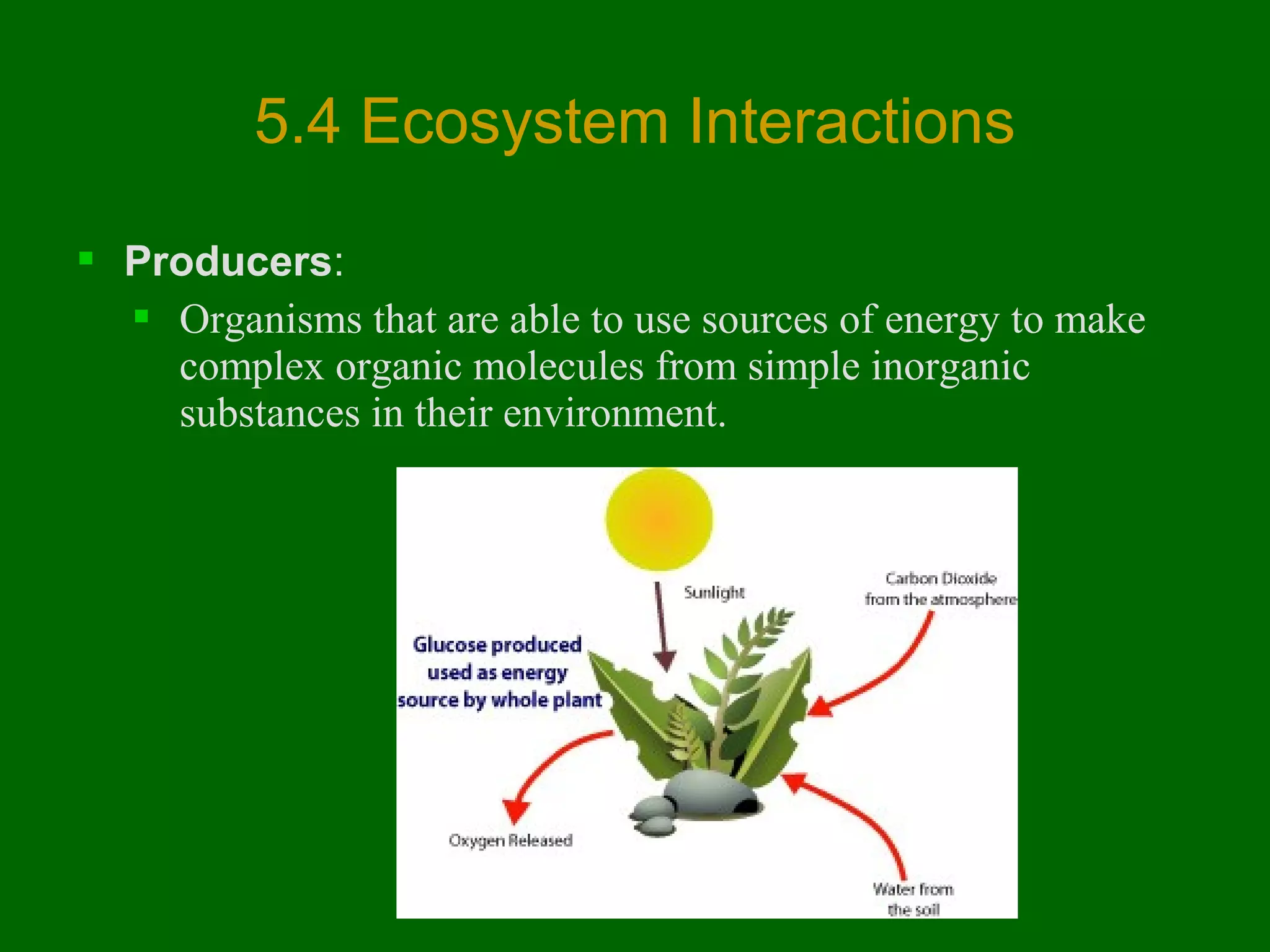
 Producers:
 Organisms that are able to use sources of energy to make
complex organic molecules from simple inorganic
substances in their environment.
Major Roles of Organisms in Ecosystems
1. Consumers:
Organisms that require organic matter as a
source of food.
They consume organic matter to provide
energy, growth and survival.
Major Roles of Organisms in Ecosystems
•

Consumers can be further divided into categories based
on the things they eat and the way they obtain food.
–
–
–

Primary consumers, or herbivores, eat plants as a source
of food.
Secondary consumers, or carnivores, are animals that eat
other animals.
Omnivores consume both plants and animals.
Major Roles of
Organisms in
Ecosystems

 Decomposers
 use nonliving organic matter as a
source of energy and raw
materials to build their bodies.

 Many small animals, bacteria,
and fungi fill this niche.
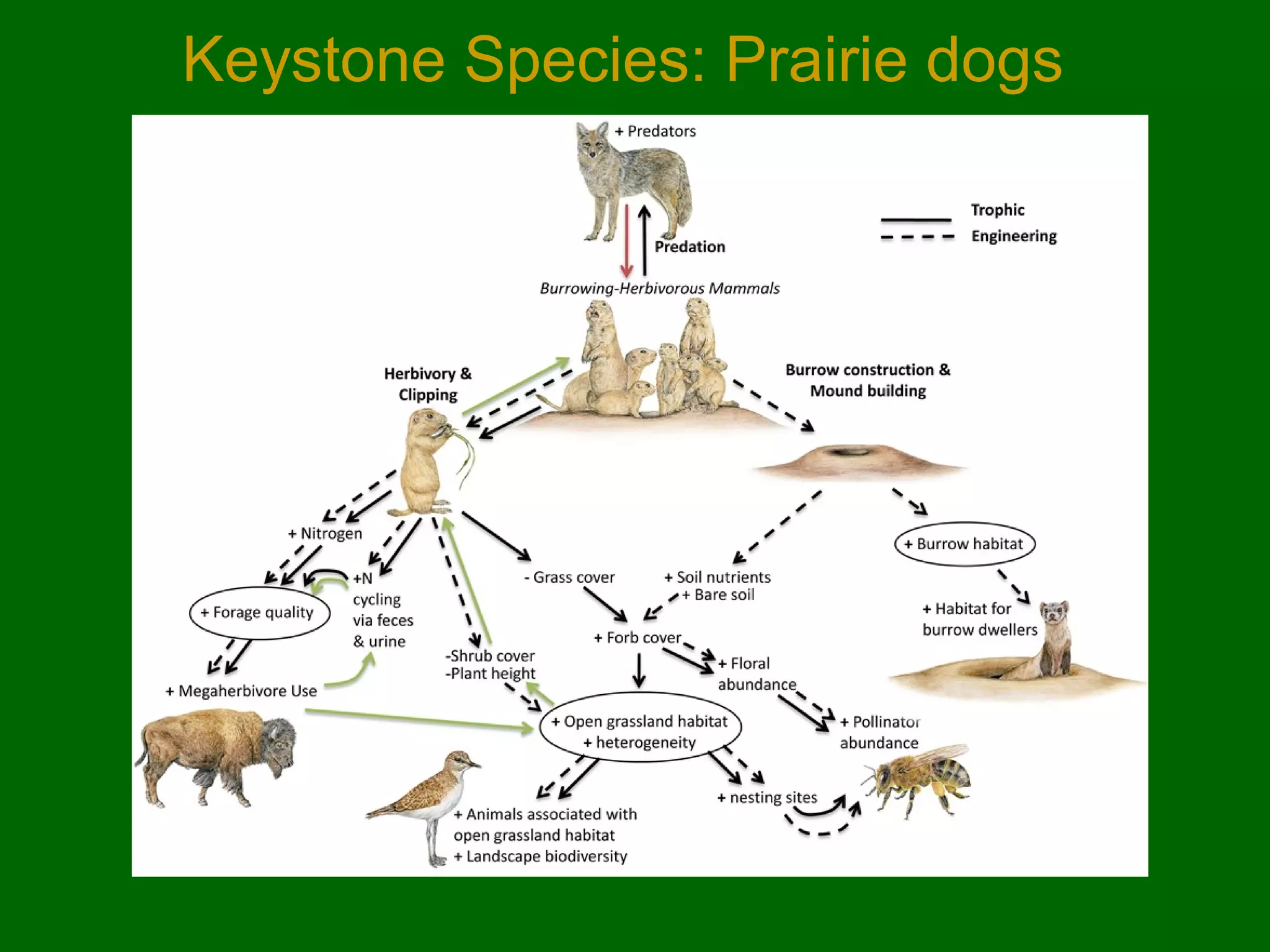
Keystone Species
 A keystone species plays a critical role in the
maintenance of specific ecosystems.
Keystone Species: Prairie dogs
Energy Flow Through Ecosystems
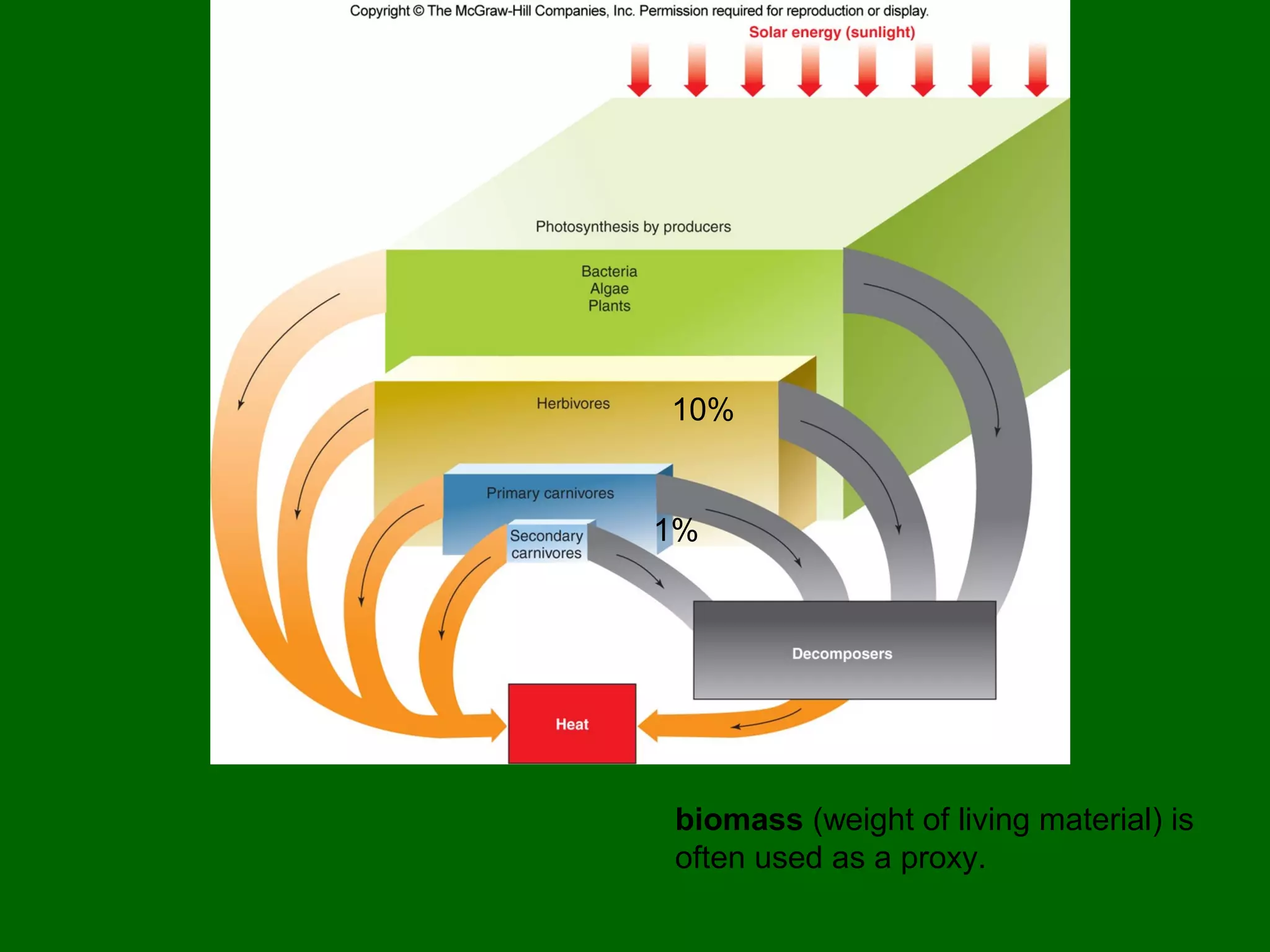
 Each step in the flow of energy through an
ecosystem is known as a trophic level.
 As energy moves from one trophic level to the
next, most of the useful energy (90%) is lost as
heat (second law of thermodynamics).
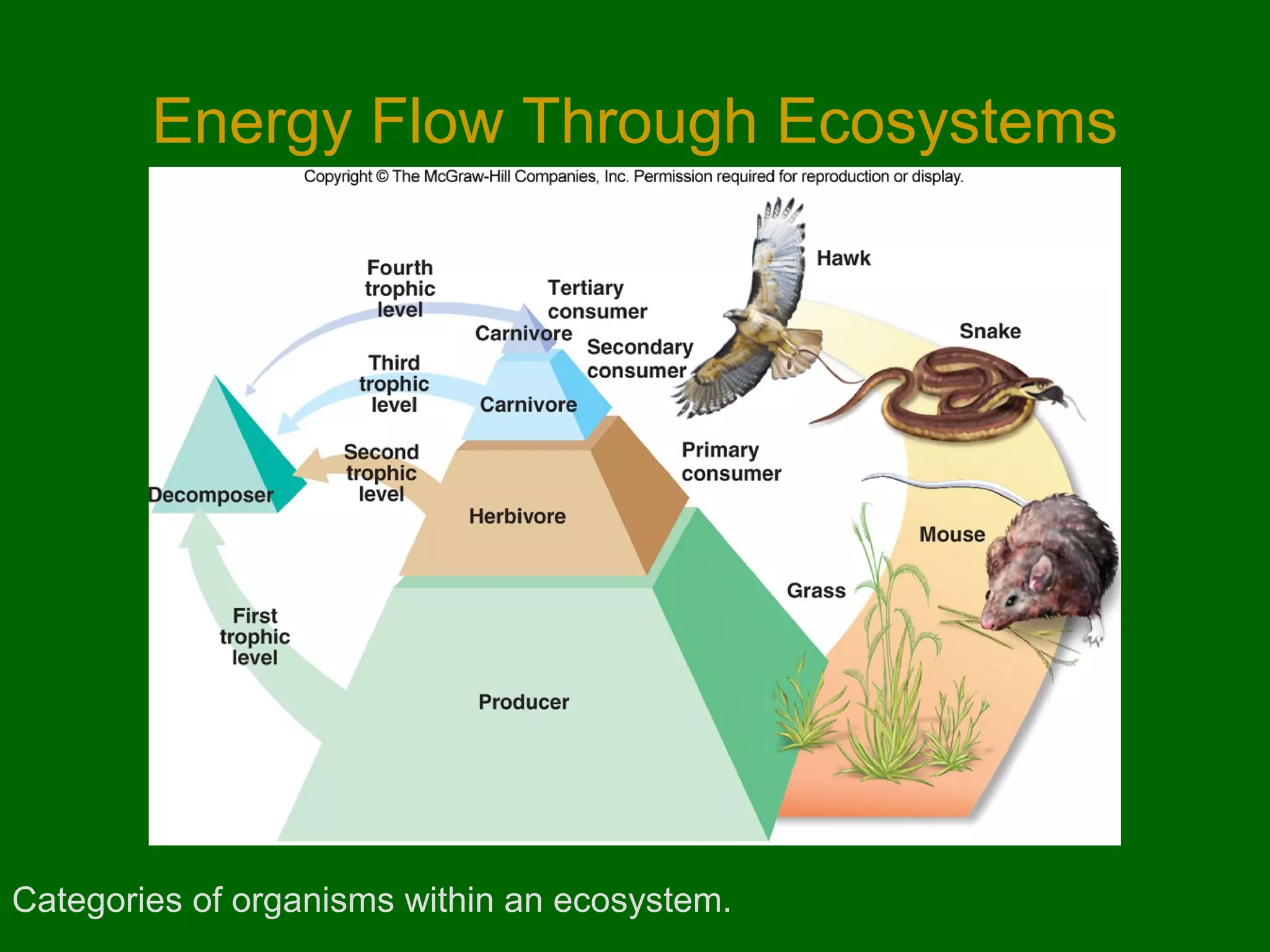
Energy Flow Through Ecosystems

Categories of organisms within an ecosystem.
10%

1%

biomass (weight of living material) is
often used as a proxy.
Discussion
 See handout
Food Chains
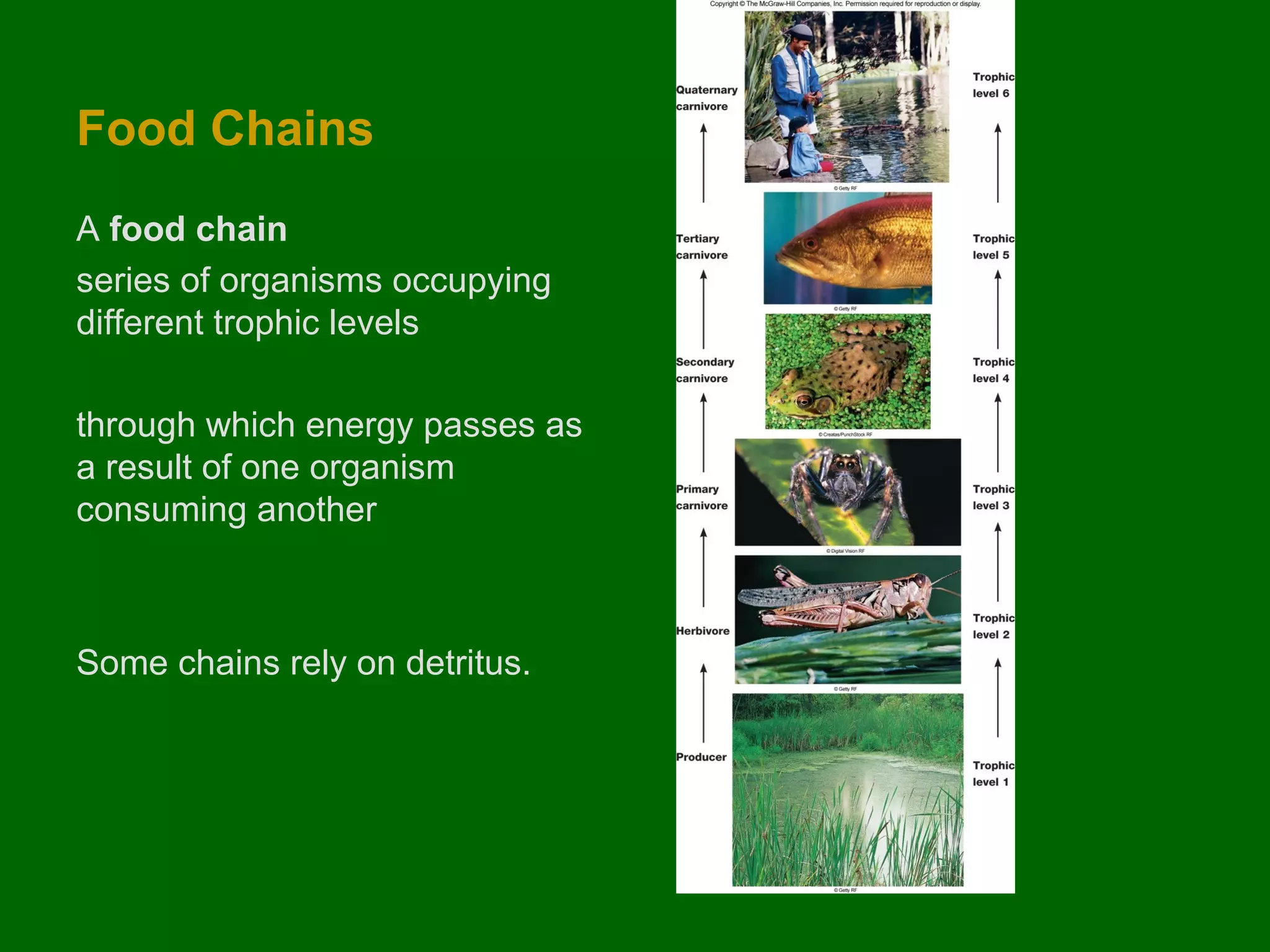
A food chain
series of organisms occupying
different trophic levels
through which energy passes as
a result of one organism
consuming another

Some chains rely on detritus.
Food Web
 A food web
series of multiple,
overlapping food
chains.
• A single predator can
have multiple prey
species at the same
time.
Nutrient Cycles in Ecosystems—
Biogeochemical Cycles
 Organisms are composed of molecules and
atoms that are cycled between living and nonliving portions of an ecosystem.
 These nutrient cycles are called biogeochemical
cycles.
Carbon Cycle
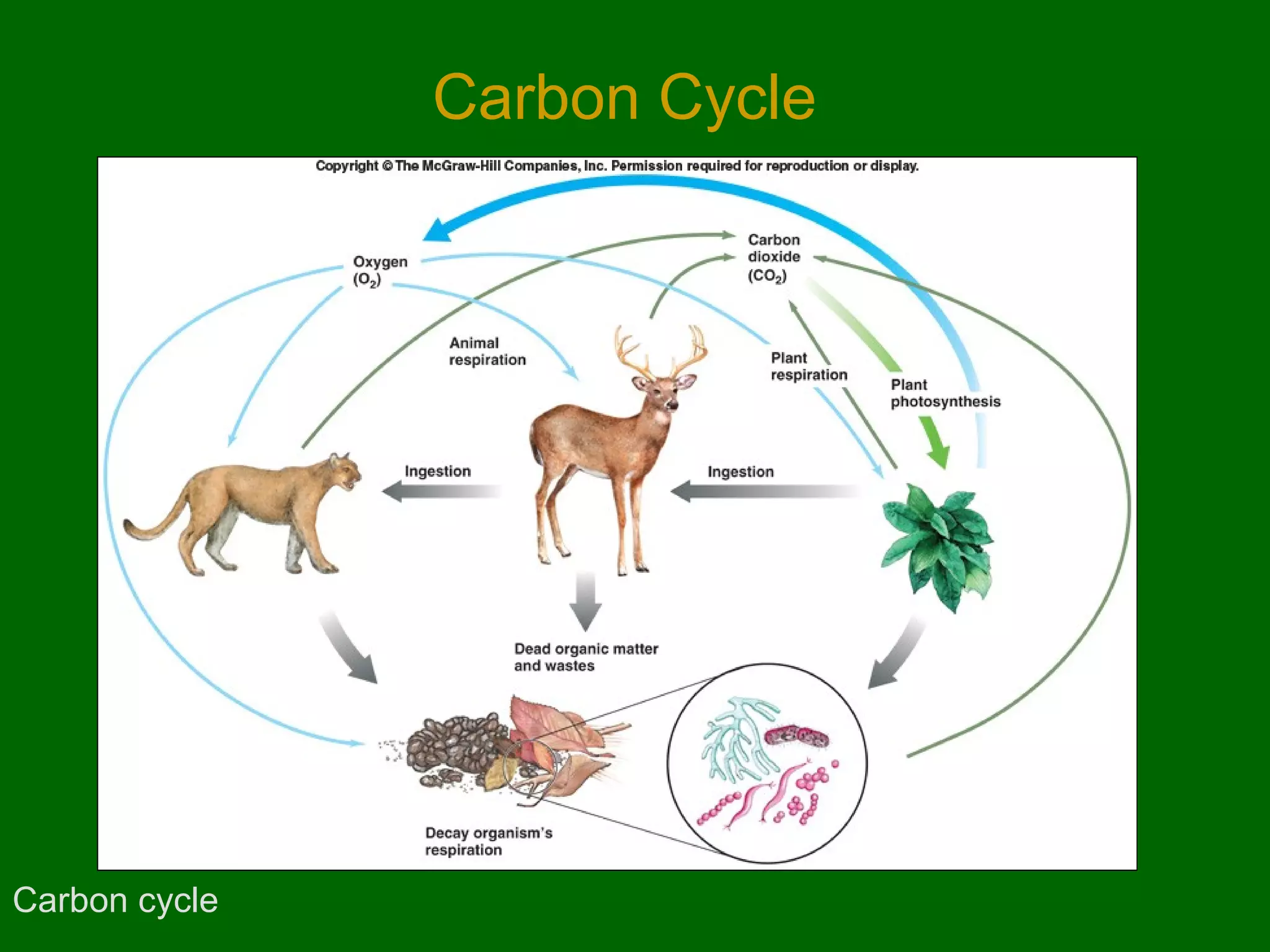
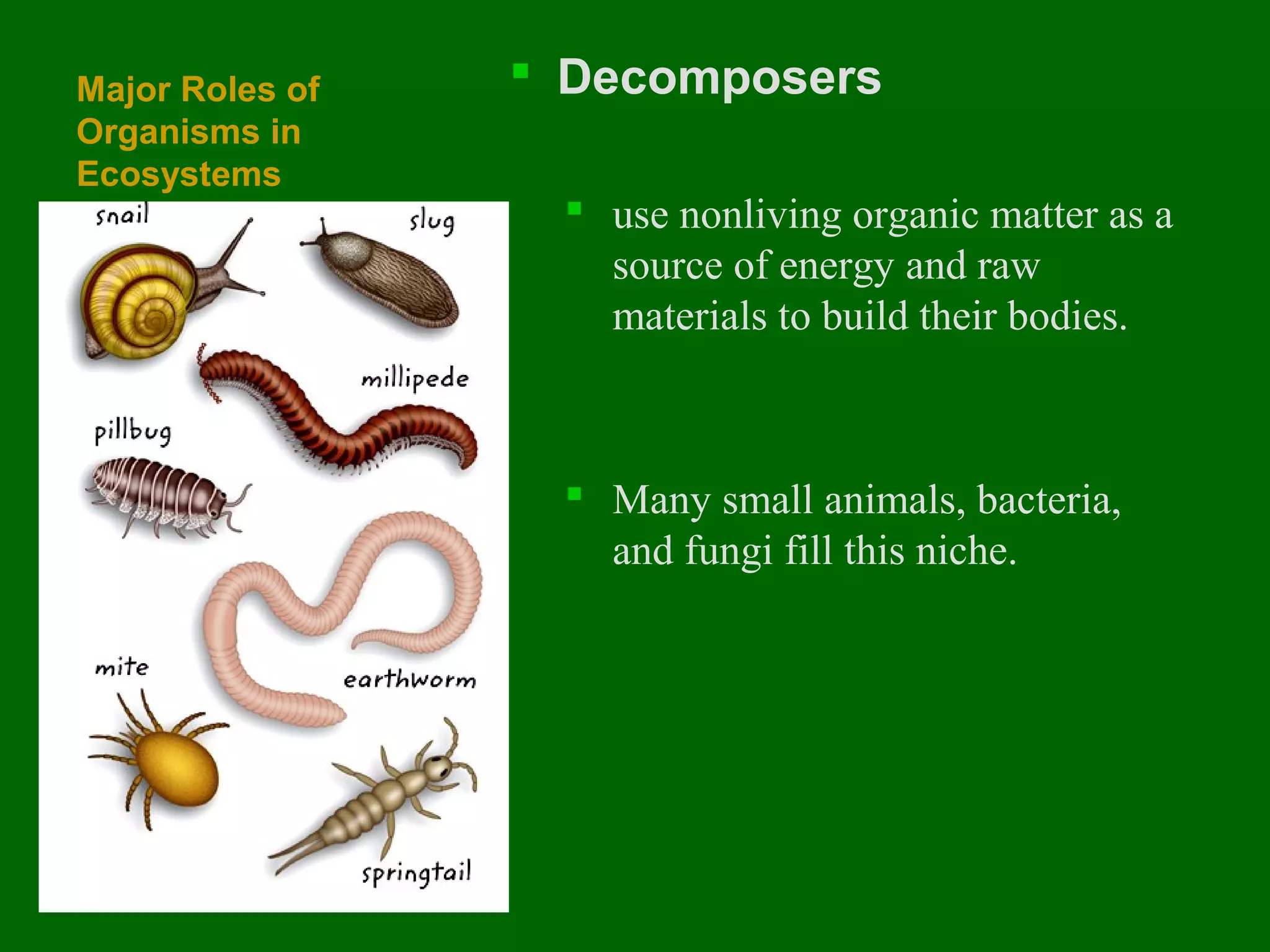
1. Producers: Plants use carbon dioxide during
photosynthesis to produce sugars.
Oxygen is produced as a by-product.

1. Consumers: Herbivores eat plants
break down the complex organic molecules into simpler molecular
building blocks
incorporate those molecules into their structure.

Respiration produces CO2 and water and releases
those compounds back into the atmosphere.
Carbon Cycle
3. Decomposers: The decay process of
decomposers involves respiration
Release of carbon dioxide and water
Dead organisms are recycled

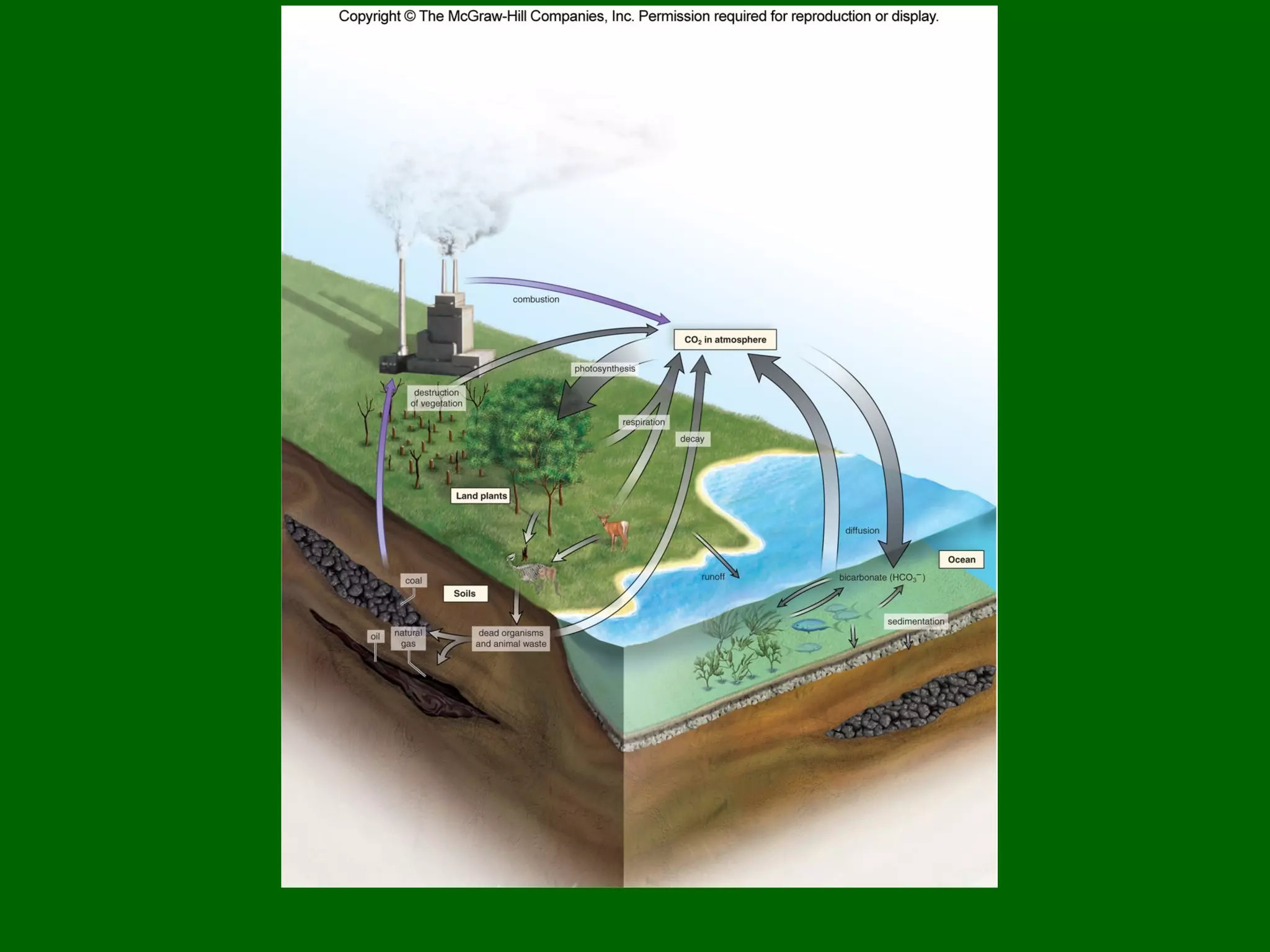
4. Carbon sinks
processes or situations that remove atoms
from active, short-term nutrient cycles
Ex: long-lived trees, fossil fuels
Carbon Cycle

Carbon cycle
Human Impact on the Carbon Cycle
 Burning fossil fuels takes carbon atoms that were
removed temporarily from the active, short-term
carbon cycle and reintroduces them into the active
cycle.
 Converting forests (long-term carbon storage) to
agricultural land (short-term carbon storage) has
increased the amount of carbon dioxide in the
atmosphere.
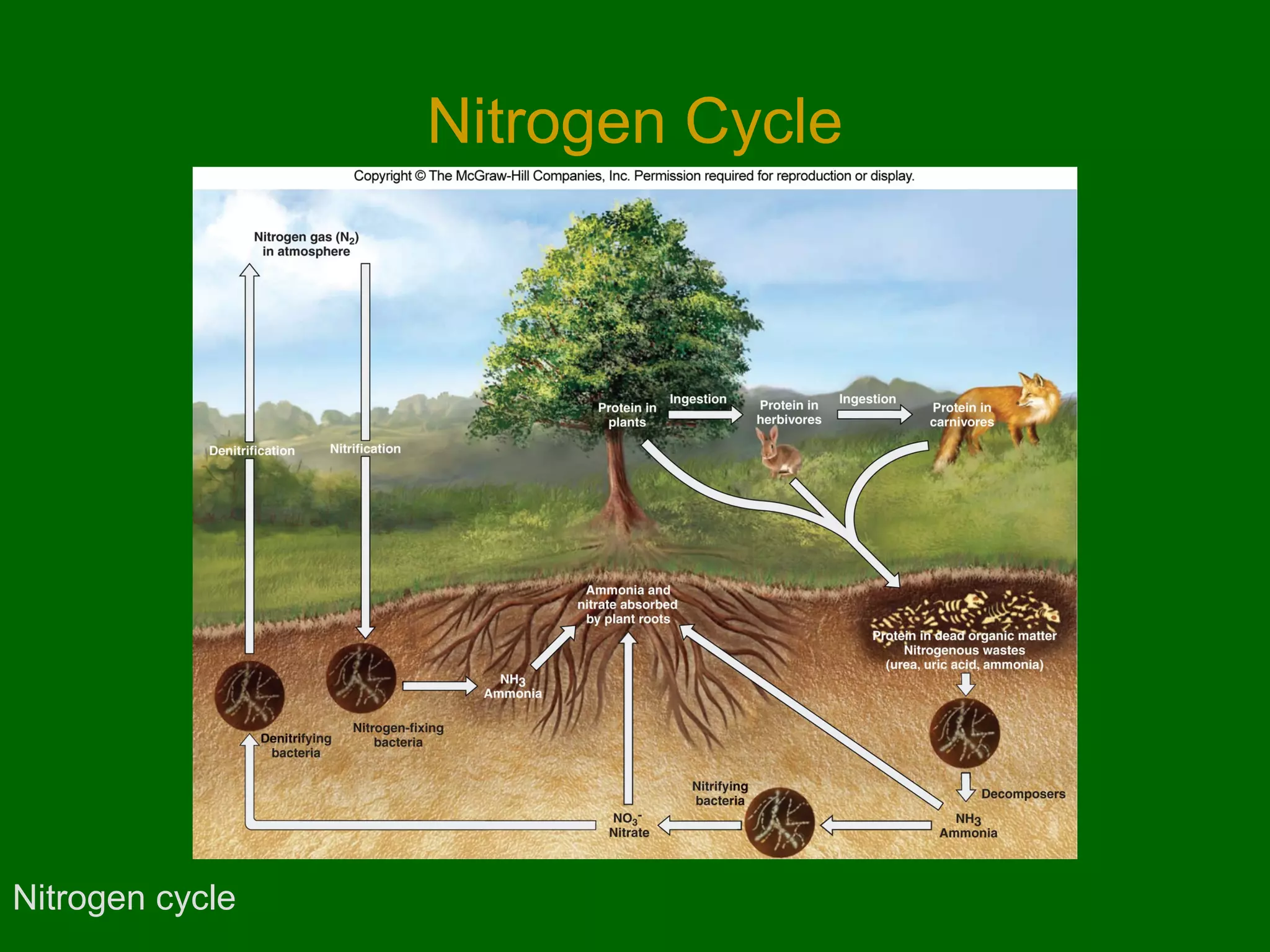
Nitrogen Cycle
 The nitrogen cycle involves the cycling of nitrogen
atoms between abiotic and biotic ecosystem
components.
• Producers are unable to use atmospheric N.
– Must get nitrate (–NO3) or ammonia (NH3.)
• Nitrogen-fixing bacteria convert nitrogen gas N2 into
ammonia.
– Plants construct organic molecules.
– Eaten by animals.
Nitrogen Cycle
 Decomposers also break down nitrogen-containing
molecules, releasing ammonia.
 Primary sink for nitrogen is the atmosphere
Nitrogen Cycle

Nitrogen cycle
Human Impact on the Nitrogen Cycle
 If too much nitrogen or phosphorus is applied as
fertilizer, or if it is applied at the wrong time,
much of the fertilizer is carried into aquatic
ecosystems.
• The presence of these nutrients increases the growth
rate of bacteria, algae, and aquatic plants.
– Toxic algae can kill fish and poison humans.
– An increase in the number of plants and algae results in
lowered oxygen concentrations, creating “dead zones.”
Summary
 An organism’s environment can be divided into
biotic (living) and abiotic (nonliving) components.
 The space an organism occupies is its habitat, and
the role it plays is its niche.
 Organisms interact with one another in a variety of
ways. Symbiotic relationships are those in which two
species live in physical contact and at least one
species derives benefit from the relationship.
 In an ecosystem, energy is trapped by producers
and flows from producers through various trophic
levels of consumers.
Summary
 The sequence of organisms through which
energy flows is called a food chain.
 Multiple interconnecting food chains constitute a
food web.
 The flow of atoms through an ecosystem
involves all the organisms in a community. The
carbon, nitrogen, and phosphorus cycles are
examples of how these materials are cycled in
ecosystems.

A common niche lecture 3

  • 1.
    Environmental Science A Studyof Interrelationships Thirteenth Edition Enger & Smith Chapter 5 Interactions: Environments and Organisms Copyright © The McGraw-Hill Companies, Inc. Permission required for reproduction or display.
  • 2.
  • 3.
    5.1 Ecological Concepts Environment everything that affects an organism during its lifetime. • Abiotic factors: Nonliving things that influence an organism – energy, nonliving matter, living space, and ecological processes • Biotic factors: All forms of life with which the organism interacts.
  • 4.
    5.1 Ecological Concepts Levelsof organization in ecology
  • 5.
    Limiting Factors  Limitingfactors - factors whose shortage or absence restricts species success. • Scarcity of water or specific nutrients (plants). • Climate, availability of a specific food (animals).
  • 6.
    Limiting Factors  Rangeof tolerance - indicates a range of conditions in which an organism can survive. • Some species have a broad range of tolerance, while others have a narrow range of tolerance.
  • 7.
  • 8.
    Habitat—place  The habitat •space in which an organism lives • defined by the biological requirements of each particular organism • Usually highlighted by prominent physical or biological features.
  • 9.
    Habitat and Niche Mosshabitat: cool, moist, and shady
  • 10.
    Niche--role  The niche •functional role (profession) the organism has in its surroundings • Includes: – all the ways it affects other organisms – how it modifies its physical surroundings
  • 11.
  • 12.
    Populations  A population •all organisms of the same kind found within a specific geographic region.
  • 13.
     A species Species •population of all the organisms • potentially capable of reproducing naturally among themselves • and having offspring that also reproduce.
  • 14.
    5.2 The Roleof Natural Selection and Evolution  Natural selection • process that determines which individuals within a species will reproduce and pass their genes to the next generation. • Mechanism that causes Evolution  Evolution • Changes in genes and characteristics within successive generations of a population over time
  • 15.
    Natural Selection  Steps innatural selection: Excess number of individuals Results in a shortage of specific resources Some individuals have a greater chance of obtaining needed resources and have a greater likelihood of surviving and reproducing than others.
  • 16.
    Results of Natural Selection Percentage of individualsshowing favorable variations will increase Percentage showing unfavorable variations will decrease
  • 17.
  • 18.
    Natural Selection inAction • Examples of natural selection include: – Pesticide-resistant insects – Antibiotic-resistant bacteria – Drug-resistant strains of HIV – http://www.pbs.org/wgbh/evolution/educators/teachstuds/svide
  • 19.
    5.3 Kinds ofOrganism Interactions  Predation • interaction in which one animal kills/eats another. • Predator benefits from food. • Prey have higher reproduction rate – (field mice 10 to 20 offspring/year)
  • 20.
    Competition Competition interaction in whichtwo organisms strive to obtain the same limited resource. Intraspecific competitionbetween members of same species. Interspecific competitionbetween members of different species.
  • 21.
    Symbiotic Relationships  Symbiosis •close, long-lasting, physical relationship between two different species • At least one species derives benefit from the interaction.
  • 22.
    Symbiotic Relationships  Thereare three categories of symbiotic relationships: • Parasitism • Commensalism • Mutualism
  • 23.
    Symbiotic Relationships  Parasitism •relationship in which one organism (parasite) lives in or on another organism (host) • which it derives nourishment
  • 24.
    Symbiotic Relationships  Commensalism •relationship in which one organism benefits while the other is not affected. • Remoras and sharks
  • 25.
    Symbiotic Relationships  Mutualism •relationship in which both species benefit. • The relationship is obligatory in many cases, as neither can exist without the other. • Mycorrhizae
  • 26.
    5.4 Ecosystem Interactions An ecosystem • defined space in which interactions take place between a community and the physical environment. • Ecologists have divided organisms’ roles in ecosystems into three broad categories: – 1. Producers – 2. Consumers – 3. Decomposers
  • 27.
    5.4 Ecosystem Interactions Producers:  Organisms that are able to use sources of energy to make complex organic molecules from simple inorganic substances in their environment.
  • 28.
    Major Roles ofOrganisms in Ecosystems 1. Consumers: Organisms that require organic matter as a source of food. They consume organic matter to provide energy, growth and survival.
  • 29.
    Major Roles ofOrganisms in Ecosystems • Consumers can be further divided into categories based on the things they eat and the way they obtain food. – – – Primary consumers, or herbivores, eat plants as a source of food. Secondary consumers, or carnivores, are animals that eat other animals. Omnivores consume both plants and animals.
  • 30.
    Major Roles of Organismsin Ecosystems  Decomposers  use nonliving organic matter as a source of energy and raw materials to build their bodies.  Many small animals, bacteria, and fungi fill this niche.
  • 31.
    Keystone Species  Akeystone species plays a critical role in the maintenance of specific ecosystems.
  • 32.
  • 33.
    Energy Flow ThroughEcosystems  Each step in the flow of energy through an ecosystem is known as a trophic level.  As energy moves from one trophic level to the next, most of the useful energy (90%) is lost as heat (second law of thermodynamics).
  • 34.
    Energy Flow ThroughEcosystems Categories of organisms within an ecosystem.
  • 35.
    10% 1% biomass (weight ofliving material) is often used as a proxy.
  • 36.
  • 37.
    Food Chains A foodchain series of organisms occupying different trophic levels through which energy passes as a result of one organism consuming another Some chains rely on detritus.
  • 38.
    Food Web  Afood web series of multiple, overlapping food chains. • A single predator can have multiple prey species at the same time.
  • 39.
    Nutrient Cycles inEcosystems— Biogeochemical Cycles  Organisms are composed of molecules and atoms that are cycled between living and nonliving portions of an ecosystem.  These nutrient cycles are called biogeochemical cycles.
  • 40.
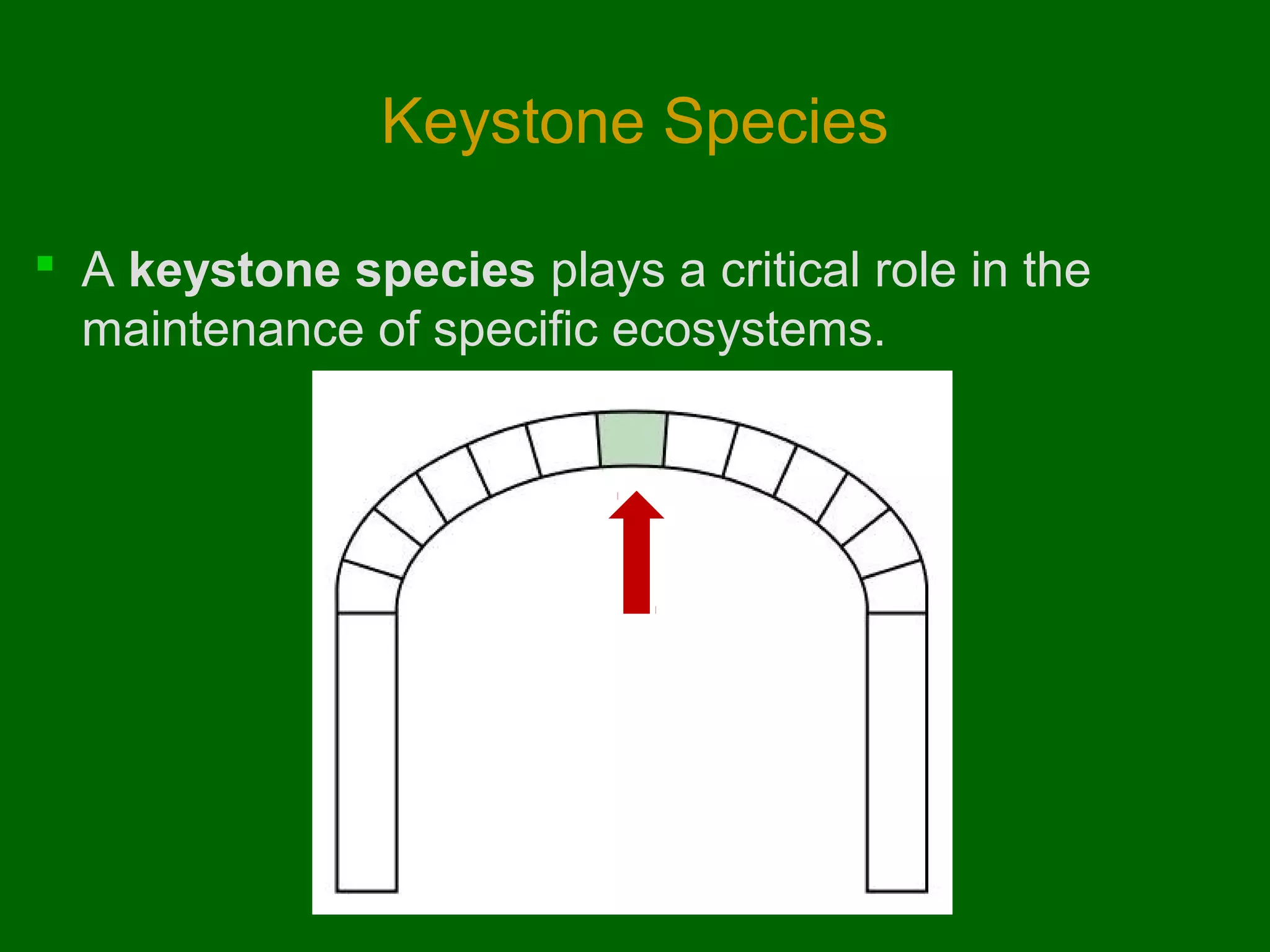
    Carbon Cycle 1. Producers:Plants use carbon dioxide during photosynthesis to produce sugars. Oxygen is produced as a by-product. 1. Consumers: Herbivores eat plants break down the complex organic molecules into simpler molecular building blocks incorporate those molecules into their structure. Respiration produces CO2 and water and releases those compounds back into the atmosphere.
  • 41.
    Carbon Cycle 3. Decomposers:The decay process of decomposers involves respiration Release of carbon dioxide and water Dead organisms are recycled 4. Carbon sinks processes or situations that remove atoms from active, short-term nutrient cycles Ex: long-lived trees, fossil fuels
  • 42.
  • 43.
    Human Impact onthe Carbon Cycle  Burning fossil fuels takes carbon atoms that were removed temporarily from the active, short-term carbon cycle and reintroduces them into the active cycle.  Converting forests (long-term carbon storage) to agricultural land (short-term carbon storage) has increased the amount of carbon dioxide in the atmosphere.
  • 45.
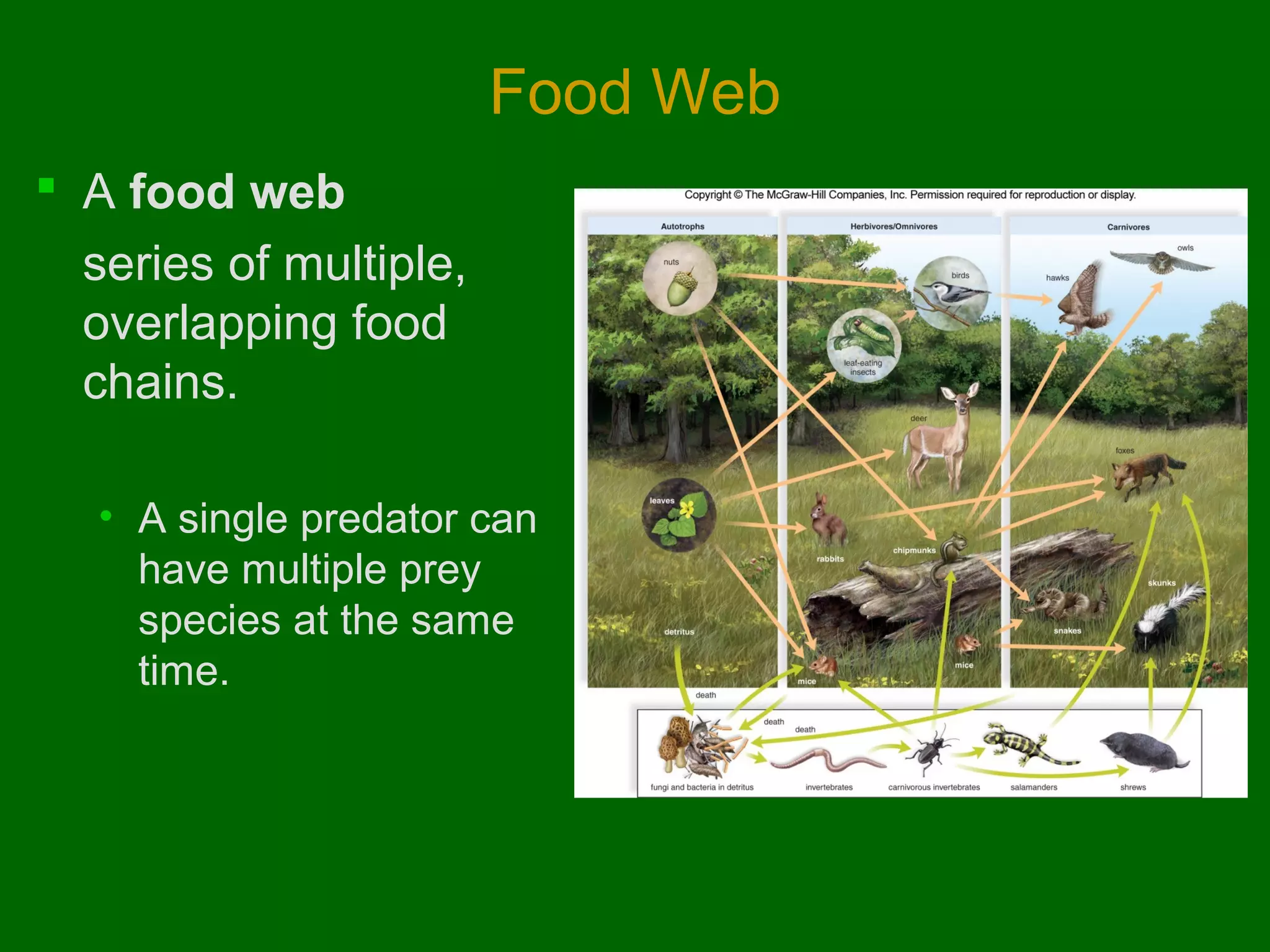
    Nitrogen Cycle  Thenitrogen cycle involves the cycling of nitrogen atoms between abiotic and biotic ecosystem components. • Producers are unable to use atmospheric N. – Must get nitrate (–NO3) or ammonia (NH3.) • Nitrogen-fixing bacteria convert nitrogen gas N2 into ammonia. – Plants construct organic molecules. – Eaten by animals.

  • 46.
    Nitrogen Cycle  Decomposersalso break down nitrogen-containing molecules, releasing ammonia.  Primary sink for nitrogen is the atmosphere
  • 47.
  • 48.
    Human Impact onthe Nitrogen Cycle  If too much nitrogen or phosphorus is applied as fertilizer, or if it is applied at the wrong time, much of the fertilizer is carried into aquatic ecosystems. • The presence of these nutrients increases the growth rate of bacteria, algae, and aquatic plants. – Toxic algae can kill fish and poison humans. – An increase in the number of plants and algae results in lowered oxygen concentrations, creating “dead zones.”
  • 49.
    Summary  An organism’senvironment can be divided into biotic (living) and abiotic (nonliving) components.  The space an organism occupies is its habitat, and the role it plays is its niche.  Organisms interact with one another in a variety of ways. Symbiotic relationships are those in which two species live in physical contact and at least one species derives benefit from the relationship.  In an ecosystem, energy is trapped by producers and flows from producers through various trophic levels of consumers.
  • 50.
    Summary  The sequenceof organisms through which energy flows is called a food chain.  Multiple interconnecting food chains constitute a food web.  The flow of atoms through an ecosystem involves all the organisms in a community. The carbon, nitrogen, and phosphorus cycles are examples of how these materials are cycled in ecosystems.

Editor's Notes

  • #18 Figure 13.UN3 Summary: Darwin's observations and conclusion
  • #19 Student Misconceptions and Concerns 1. Students must understand that the environment does the selecting (editing) in natural selection. Species do not evolve because of want or need. Biological diversity exists and the environment selects. Evolution is not deliberate, it is reactive. 2. A related point is what we learn from extinction. As Darwin noted, species become extinct because they do not get what they want or need! 3. The authors note that evolution is not goal directed and does not lead to perfectly adapted organisms. These excellent points represent two misunderstandings: 1) Instructors need to be clear that evolutionary change is a consequence of an immediate advantage, not a distant goal. Three-chambered hearts in amphibians evolved from two-chambered fish hearts because the three-chambered hearts conveyed an advantage, not because evolution was directed toward producing a four-chambered heart! 2) Evolutionary change only reflects improvement in the context of the immediate environment. What is better today may not be better tomorrow. Thus, species do not steadily get better, they respond to the environment or go extinct. Teaching Tips 1. An analogy might be made between the specialized functions of finch beaks and the many types of screwdrivers that exist today. Each type of screwdriver (Phillips, flathead, long-handled, interchangeable tips) represents a specialization for a particular job. 2. Based upon the human condition, students are likely to think that reproduction is largely a choice, and less a consequence of good health or other adaptations. Yet, in our natural world, there are thousands of examples of the overproduction of offspring and resulting death or failure to reproduce. Thousands of acorns hanging from one tree, spores escaping from a puffball, or a salmon spawning thousands of eggs, are all easy examples of overproduction. Bring a few solid illustrations from your geographic region to bring home this point.