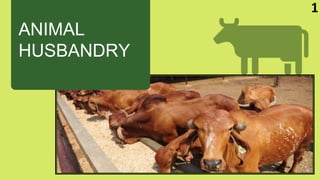
ANIMAL
HUSBANDRY
1
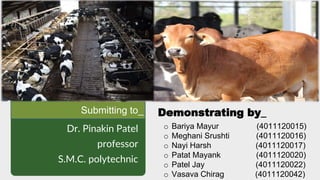
Submitting to_
Dr. Pinakin Patel
professor
S.M.C. polytechnic
Submitting to_ Demonstrating by_
o Bariya Mayur (4011120015)
o Meghani Srushti (4011120016)
o Nayi Harsh (4011120017)
o Patat Mayank (4011120020)
o Patel Jay (4011120022)
o Vasava Chirag (4011120042)
2
1. Introduction
2. Infrastructure
3. Cow breed
4. Maintain cattle
5. Equipment
6. Nutrition and feed management
7. Source of finance
8. Government scheme
9. Capital and working cost
10.Products and its selling cost
11.marketing
12.conclusion
Table Of
Contents
3
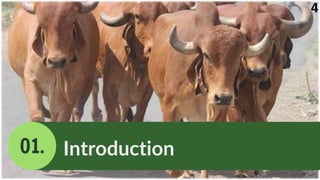
01. Introduction
4
Animal husbandry
5
 The branch of agriculture that deal with the feeding,
caring and breeding of domestic animal.
 Cattle farming
 Poultry farming
 Fish farming
 Bee keeping
 Goat and sheep farming
What is animal
husbandry?
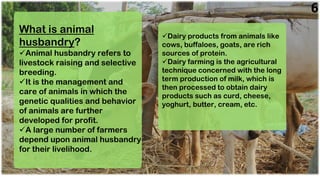
Animal husbandry refers to
livestock raising and selective
breeding.
It is the management and
care of animals in which the
genetic qualities and behavior
of animals are further
developed for profit.
A large number of farmers
depend upon animal husbandry
for their livelihood.
Dairy products from animals like
cows, buffaloes, goats, are rich
sources of protein.
Dairy farming is the agricultural
technique concerned with the long
term production of milk, which is
then processed to obtain dairy
products such as curd, cheese,
yoghurt, butter, cream, etc.
6
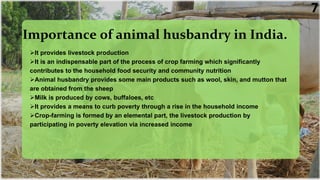
It provides livestock production
It is an indispensable part of the process of crop farming which significantly
contributes to the household food security and community nutrition
Animal husbandry provides some main products such as wool, skin, and mutton that
are obtained from the sheep
Milk is produced by cows, buffaloes, etc
It provides a means to curb poverty through a rise in the household income
Crop-farming is formed by an elemental part, the livestock production by
participating in poverty elevation via increased income
Importance of animal husbandry in India.
7
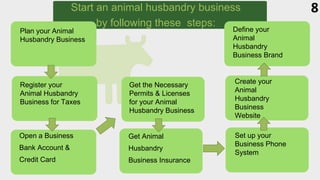
Start an animal husbandry business
by following these steps:
Get Animal
Husbandry
Business Insurance
Open a Business
Bank Account &
Credit Card
Plan your Animal
Husbandry Business
Register your
Animal Husbandry
Business for Taxes
Get the Necessary
Permits & Licenses
for your Animal
Husbandry Business
Define your
Animal
Husbandry
Business Brand
Create your
Animal
Husbandry
Business
Website
Set up your
Business Phone
System
8
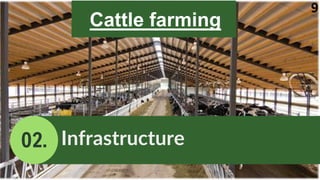
02. Infrastructure
9
Cattle farming
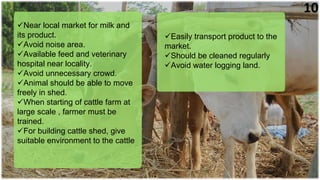
Near local market for milk and
its product.
Avoid noise area.
Available feed and veterinary
hospital near locality.
Avoid unnecessary crowd.
Animal should be able to move
freely in shed.
When starting of cattle farm at
large scale , farmer must be
trained.
For building cattle shed, give
suitable environment to the cattle
Easily transport product to the
market.
Should be cleaned regularly
Avoid water logging land.
10
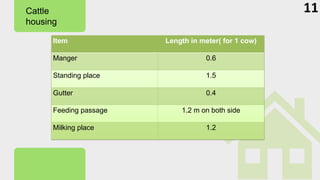
Item Length in meter( for 1 cow)
Manger 0.6
Standing place 1.5
Gutter 0.4
Feeding passage 1.2 m on both side
Milking place 1.2
Cattle
housing
11
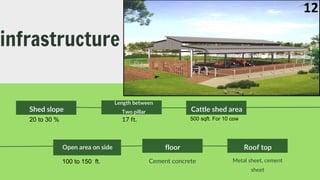
infrastructure
Shed slope
20 to 30 %
Length between
Two pillar
17 ft.
Cattle shed area
500 sqft. For 10 cow
Open area on side floor
Cement concrete
Roof top
Metal sheet, cement
sheet
100 to 150 ft.
12
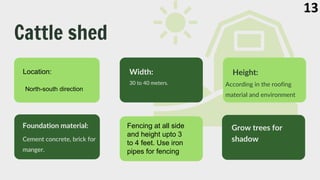
Cattle shed
Location:
30 to 40 meters.
Cement concrete, brick for
manger.
Width:
Foundation material:
According in the roofing
material and environment
Height:
Grow trees for
shadow
North-south direction
Fencing at all side
and height upto 3
to 4 feet. Use iron
pipes for fencing
13
14
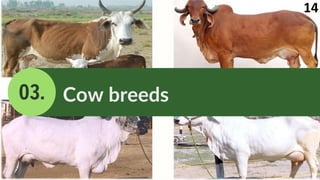
03. Cow breeds
Breed characteristics of high yield dairy cows
 Attractive individuality with femininity, vigour, harmonious blending of
all parts, impressive style and carriage
 Animal should have wedge shaped appearance of the body
 It should have bright eyes with lean neck
 The udder should be well attached to the abdomen
 The skin of the udder should have a good network of blood
vesselsAll four quarters of the udder should be well demarcated with
well placed teats.
15
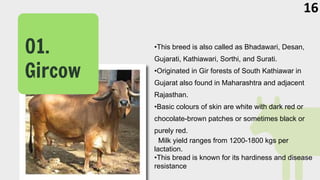
•This breed is also called as Bhadawari, Desan,
Gujarati, Kathiawari, Sorthi, and Surati.
•Originated in Gir forests of South Kathiawar in
Gujarat also found in Maharashtra and adjacent
Rajasthan.
•Basic colours of skin are white with dark red or
chocolate-brown patches or sometimes black or
purely red.
Milk yield ranges from 1200-1800 kgs per
lactation.
•This bread is known for its hardiness and disease
resistance
01.
Gircow
16
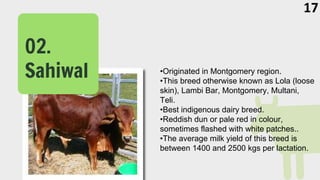
•Originated in Montgomery region.
•This breed otherwise known as Lola (loose
skin), Lambi Bar, Montgomery, Multani,
Teli.
•Best indigenous dairy breed.
•Reddish dun or pale red in colour,
sometimes flashed with white patches..
•The average milk yield of this breed is
between 1400 and 2500 kgs per lactation.
02.
Sahiwal
02.
Sahiwal
17
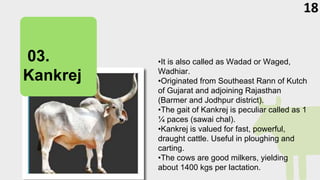
•It is also called as Wadad or Waged,
Wadhiar.
•Originated from Southeast Rann of Kutch
of Gujarat and adjoining Rajasthan
(Barmer and Jodhpur district).
•The gait of Kankrej is peculiar called as 1
¼ paces (sawai chal).
•Kankrej is valued for fast, powerful,
draught cattle. Useful in ploughing and
carting.
•The cows are good milkers, yielding
about 1400 kgs per lactation.
02.
Sahiwal
03.
Kankrej
18
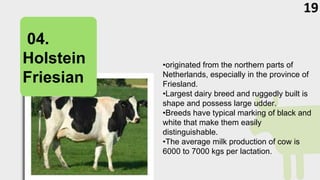
•originated from the northern parts of
Netherlands, especially in the province of
Friesland.
•Largest dairy breed and ruggedly built is
shape and possess large udder.
•Breeds have typical marking of black and
white that make them easily
distinguishable.
•The average milk production of cow is
6000 to 7000 kgs per lactation.
02.
Sahiwal
04.
Holstein
Friesian
19
Insemination
20
 artificial insemination makes possible the mating of
animals with great variations in body size with no injury
to either of the animal.
 It is useful to inseminate the cows denying to stand or
accept the bulls at the time of oestrum. Useful in
maintaining the perfect breeding and calving records.
 There-are different methods :
1. speculum method
2. vaginal method
3. recto vaginal metho
Symptoms of heat in cattle
21
 The animal will be excited condition. The animal will be
in restlessness and nervousness.
 The animal will reduce the intake of feed.
 The animals which are in heat will lick other animals
and smelling other animals.
 The animals will try to mount other animals.
 Clear mucous discharge will be seen from the vulva,
sometimes it will be string like the mucous will be seen
stick to the near the pasts of vulva.
 Milk production will be slightly decreased.
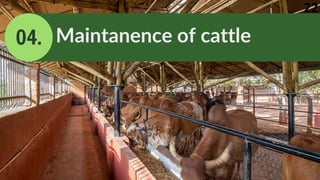
04. Maintanence of cattle
22
•Provision of readily accessible fresh water and nutritionally adequate food
as required.
•Provision of adequate ventilation and suitable environmental temperature
•Adequate freedom of movement and ability to stretch the body.
•Sufficient light for satisfactory inspection
•Rapid diagnosis and treatment of injuries and diseases
•Emergency provision in the event of breakdown of essential mechanical
equipment
•Flooring which neither harms nor causes undue stress
•The avoidance of unnecessary mutilation.
•Good stockmanship is the key factor in the welfare of all livestock.
23
05. Equipments
24
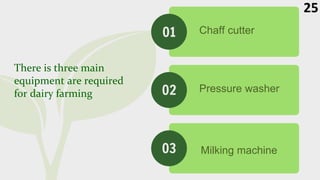
There is three main
equipment are required
for dairy farming
Chaff cutter
Pressure washer
Milking machine
01
02
03
25
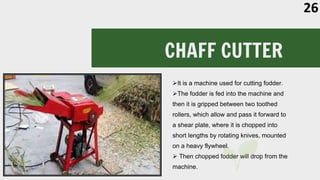
CHAFF CUTTER
It is a machine used for cutting fodder.
The fodder is fed into the machine and
then it is gripped between two toothed
rollers, which allow and pass it forward to
a shear plate, where it is chopped into
short lengths by rotating knives, mounted
on a heavy flywheel.
 Then chopped fodder will drop from the
machine.
26
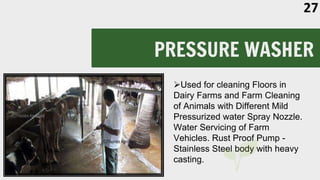
PRESSURE WASHER
Used for cleaning Floors in
Dairy Farms and Farm Cleaning
of Animals with Different Mild
Pressurized water Spray Nozzle.
Water Servicing of Farm
Vehicles. Rust Proof Pump -
Stainless Steel body with heavy
casting.
27
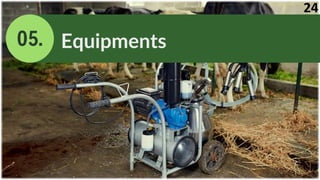
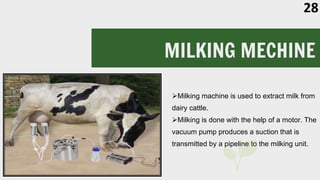
MILKING MECHINE
Milking machine is used to extract milk from
dairy cattle.
Milking is done with the help of a motor. The
vacuum pump produces a suction that is
transmitted by a pipeline to the milking unit.
28
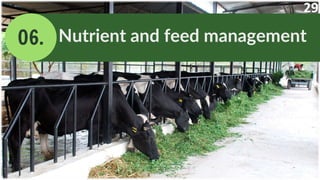
06. Nutrient and feed management
29
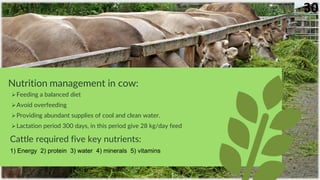
Nutrition management in cow:
Feeding a balanced diet
Avoid overfeeding
Providing abundant supplies of cool and clean water.
Lactation period 300 days, in this period give 28 kg/day feed
Cattle required five key nutrients:
1) Energy 2) protein 3) water 4) minerals 5) vitamins
30
• includes hay, straw, silage, compressed and pelleted
feeds, oils and mixed rations, and sprouted
grains and legumes.
• Roughage: These are rich in fiber; e.g., cowpea,
berseem, etc. They are coarse and fibrous
substances having low nutrient content. ...
• Concentrates: These are nutrient-rich and low on
fibers; e.g., oats, maize, etc. It is low in fibers but
contains relatively high proteins and other nutrients
31
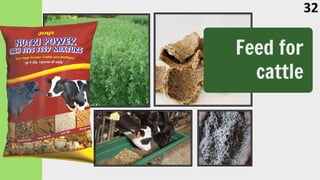
Feed for
cattle
32
07. Source of finance
33
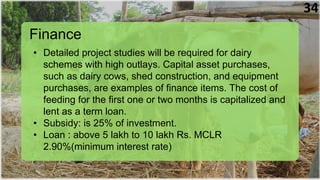
Finance
• Detailed project studies will be required for dairy
schemes with high outlays. Capital asset purchases,
such as dairy cows, shed construction, and equipment
purchases, are examples of finance items. The cost of
feeding for the first one or two months is capitalized and
lent as a term loan.
• Subsidy: is 25% of investment.
• Loan : above 5 lakh to 10 lakh Rs. MCLR
2.90%(minimum interest rate)
34
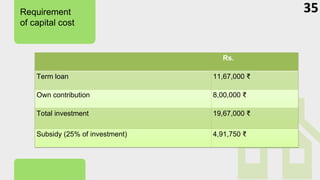
Requirement
of capital cost
35
Rs.
Term loan 11,67,000 ₹
Own contribution 8,00,000 ₹
Total investment 19,67,000 ₹
Subsidy (25% of investment) 4,91,750 ₹
08. Government scheme
36
Support to Dairy Cooperatives and Farmers Production Organisation
engaged in dairy activities (CS)
Dairy Processing & Infrastructure Development Fund (DIDF) (CS)
Animal Husbandry Infrastructure Development Fund (CS)
National Animal Disease Control Programme (NADCP) (CS)
Livestock Health and Disease Control (LH & DC) scheme (CS)
National Livestock Mission(CSS)
Scheme
programme
37
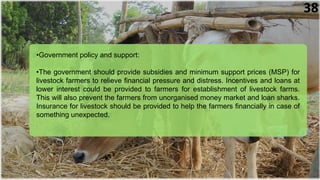
•Government policy and support:
•The government should provide subsidies and minimum support prices (MSP) for
livestock farmers to relieve financial pressure and distress. Incentives and loans at
lower interest could be provided to farmers for establishment of livestock farms.
This will also prevent the farmers from unorganised money market and loan sharks.
Insurance for livestock should be provided to help the farmers financially in case of
something unexpected.
38
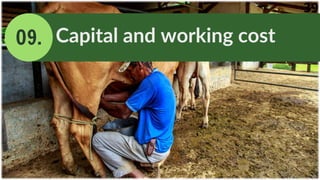
09. Capital and working cost
39
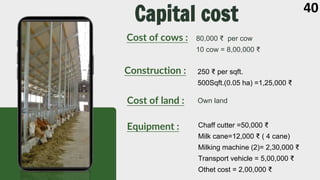
Equipment : Chaff cutter =50,000 ₹
Milk cane=12,000 ₹ ( 4 cane)
Milking machine (2)= 2,30,000 ₹
Transport vehicle = 5,00,000 ₹
Othet cost = 2,00,000 ₹
250 ₹ per sqft.
500Sqft.(0.05 ha) =1,25,000 ₹
Capital cost
Cost of land :
Cost of cows :
Own land
80,000 ₹ per cow
10 cow = 8,00,000 ₹
Construction :
40
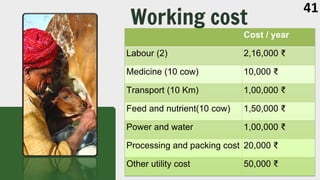
Working cost
41
Cost / year
Labour (2) 2,16,000 ₹
Medicine (10 cow) 10,000 ₹
Transport (10 Km) 1,00,000 ₹
Feed and nutrient(10 cow) 1,50,000 ₹
Power and water 1,00,000 ₹
Processing and packing cost 20,000 ₹
Other utility cost 50,000 ₹
10. Products and its selling cost
42
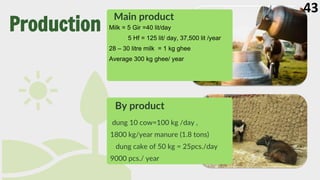
Main product
Milk = 5 Gir =40 lit/day
5 Hf = 125 lit/ day, 37,500 lit /year
28 – 30 litre milk = 1 kg ghee
Average 300 kg ghee/ year
By product
dung 10 cow=100 kg /day ,
1800 kg/year manure (1.8 tons)
dung cake of 50 kg = 25pcs./day
9000 pcs./ year
Production
43
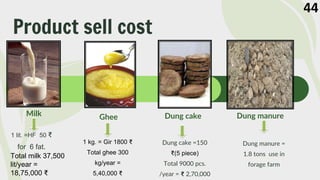
Product sell cost
Milk Ghee Dung cake
1 lit. =HF 50 ₹
for 6 fat.
1 kg. = Gir 1800 ₹
Total ghee 300
kg/year =
5,40,000 ₹
Dung cake =150
₹(5 piece)
Total 9000 pcs.
/year = ₹ 2,70,000
44
Total milk 37,500
lit/year =
18,75,000 ₹
Dung manure
Dung manure =
1.8 tons use in
forage farm
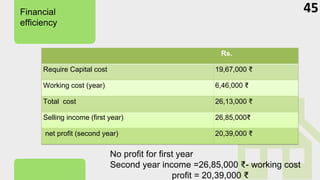
Financial
efficiency
45
Rs.
Require Capital cost 19,67,000 ₹
Working cost (year) 6,46,000 ₹
Total cost 26,13,000 ₹
Selling income (first year) 26,85,000₹
net profit (second year) 20,39,000 ₹
No profit for first year
Second year income =26,85,000 ₹- working cost
profit = 20,39,000 ₹
11. marketing
46
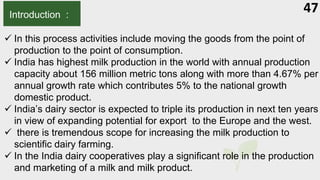
47
Introduction :
 In this process activities include moving the goods from the point of
production to the point of consumption.
 India has highest milk production in the world with annual production
capacity about 156 million metric tons along with more than 4.67% per
annual growth rate which contributes 5% to the national growth
domestic product.
 India’s dairy sector is expected to triple its production in next ten years
in view of expanding potential for export to the Europe and the west.
 there is tremendous scope for increasing the milk production to
scientific dairy farming.
 In the India dairy cooperatives play a significant role in the production
and marketing of a milk and milk product.
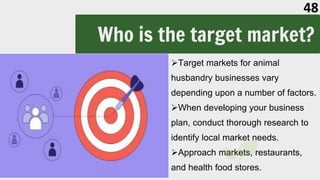
Who is the target market?
Target markets for animal
husbandry businesses vary
depending upon a number of factors.
When developing your business
plan, conduct thorough research to
identify local market needs.
Approach markets, restaurants,
and health food stores.
48
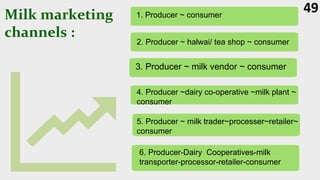
Milk marketing
channels :
49
1. Producer ~ consumer
2. Producer ~ halwai/ tea shop ~ consumer
3. Producer ~ milk vendor ~ consumer
4. Producer ~dairy co-operative ~milk plant ~
consumer
5. Producer ~ milk trader~processer~retailer~
consumer
6. Producer-Dairy Cooperatives-milk
transporter-processor-retailer-consumer
50
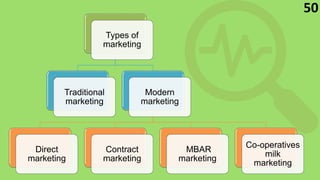
Types of
marketing
Traditional
marketing
Modern
marketing
Direct
marketing
Contract
marketing
MBAR
marketing
Co-operatives
milk
marketing
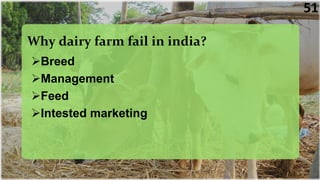
Breed
Management
Feed
Intested marketing
Why dairy farm fail in india?
51
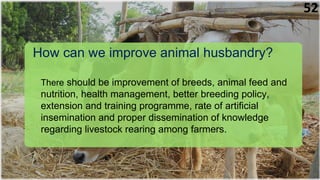
How can we improve animal husbandry?
There should be improvement of breeds, animal feed and
nutrition, health management, better breeding policy,
extension and training programme, rate of artificial
insemination and proper dissemination of knowledge
regarding livestock rearing among farmers.
52
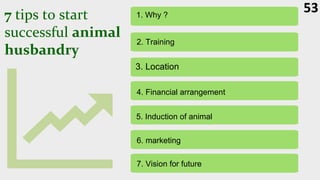
7 tips to start
successful animal
husbandry
53
1. Why ?
2. Training
3. Location
4. Financial arrangement
5. Induction of animal
6. marketing
7. Vision for future
 Animals that help in labor such as draught animals
are used in agricultural work.
 The waste generated from these animals can be
used as natural manure to maintain soil fertility.
 It is the best source of employment.
 Animals that provide milk can be raised and
managed with a good income to support a family.
 Agriculture waste can use as a feed for cattle in
such area where the production is high and there is
no facility to store.
54
HOW ANIMAL HUSBANDRY HELP TO
AGRICULTURE SECTOR
12. Conclusion
55
CONCLUSION as quoted – “If the farmer is rich, then so
is the nation”, upliftment and development
of rural farmers will strengthen the
economy and reduce the margin of
income disparity among various sections
of the country. India boasts a massive
number of livestock population and
manpower, thus, increasing the farmers
income twofold is not impossible but
definitely an uphill struggle. “A farmer is a
magical machine who can convert the soil
into home or crop”. A proper collaboration
and harmony should exist between
ministry, private sector, and farmers to
tackle any grave situation
56
57

animal husbandry.pptx

  • 1.
  • 2.
    Submitting to_ Dr. PinakinPatel professor S.M.C. polytechnic Submitting to_ Demonstrating by_ o Bariya Mayur (4011120015) o Meghani Srushti (4011120016) o Nayi Harsh (4011120017) o Patat Mayank (4011120020) o Patel Jay (4011120022) o Vasava Chirag (4011120042) 2
  • 3.
    1. Introduction 2. Infrastructure 3.Cow breed 4. Maintain cattle 5. Equipment 6. Nutrition and feed management 7. Source of finance 8. Government scheme 9. Capital and working cost 10.Products and its selling cost 11.marketing 12.conclusion Table Of Contents 3
  • 4.
  • 5.
    Animal husbandry 5  Thebranch of agriculture that deal with the feeding, caring and breeding of domestic animal.  Cattle farming  Poultry farming  Fish farming  Bee keeping  Goat and sheep farming
  • 6.
    What is animal husbandry? Animalhusbandry refers to livestock raising and selective breeding. It is the management and care of animals in which the genetic qualities and behavior of animals are further developed for profit. A large number of farmers depend upon animal husbandry for their livelihood. Dairy products from animals like cows, buffaloes, goats, are rich sources of protein. Dairy farming is the agricultural technique concerned with the long term production of milk, which is then processed to obtain dairy products such as curd, cheese, yoghurt, butter, cream, etc. 6
  • 7.
    It provides livestockproduction It is an indispensable part of the process of crop farming which significantly contributes to the household food security and community nutrition Animal husbandry provides some main products such as wool, skin, and mutton that are obtained from the sheep Milk is produced by cows, buffaloes, etc It provides a means to curb poverty through a rise in the household income Crop-farming is formed by an elemental part, the livestock production by participating in poverty elevation via increased income Importance of animal husbandry in India. 7
  • 8.
    Start an animalhusbandry business by following these steps: Get Animal Husbandry Business Insurance Open a Business Bank Account & Credit Card Plan your Animal Husbandry Business Register your Animal Husbandry Business for Taxes Get the Necessary Permits & Licenses for your Animal Husbandry Business Define your Animal Husbandry Business Brand Create your Animal Husbandry Business Website Set up your Business Phone System 8
  • 9.
  • 10.
    Near local marketfor milk and its product. Avoid noise area. Available feed and veterinary hospital near locality. Avoid unnecessary crowd. Animal should be able to move freely in shed. When starting of cattle farm at large scale , farmer must be trained. For building cattle shed, give suitable environment to the cattle Easily transport product to the market. Should be cleaned regularly Avoid water logging land. 10
  • 11.
    Item Length inmeter( for 1 cow) Manger 0.6 Standing place 1.5 Gutter 0.4 Feeding passage 1.2 m on both side Milking place 1.2 Cattle housing 11
  • 12.
    infrastructure Shed slope 20 to30 % Length between Two pillar 17 ft. Cattle shed area 500 sqft. For 10 cow Open area on side floor Cement concrete Roof top Metal sheet, cement sheet 100 to 150 ft. 12
  • 13.
    Cattle shed Location: 30 to40 meters. Cement concrete, brick for manger. Width: Foundation material: According in the roofing material and environment Height: Grow trees for shadow North-south direction Fencing at all side and height upto 3 to 4 feet. Use iron pipes for fencing 13
  • 14.
  • 15.
    Breed characteristics ofhigh yield dairy cows  Attractive individuality with femininity, vigour, harmonious blending of all parts, impressive style and carriage  Animal should have wedge shaped appearance of the body  It should have bright eyes with lean neck  The udder should be well attached to the abdomen  The skin of the udder should have a good network of blood vesselsAll four quarters of the udder should be well demarcated with well placed teats. 15
  • 16.
    •This breed isalso called as Bhadawari, Desan, Gujarati, Kathiawari, Sorthi, and Surati. •Originated in Gir forests of South Kathiawar in Gujarat also found in Maharashtra and adjacent Rajasthan. •Basic colours of skin are white with dark red or chocolate-brown patches or sometimes black or purely red. Milk yield ranges from 1200-1800 kgs per lactation. •This bread is known for its hardiness and disease resistance 01. Gircow 16
  • 17.
    •Originated in Montgomeryregion. •This breed otherwise known as Lola (loose skin), Lambi Bar, Montgomery, Multani, Teli. •Best indigenous dairy breed. •Reddish dun or pale red in colour, sometimes flashed with white patches.. •The average milk yield of this breed is between 1400 and 2500 kgs per lactation. 02. Sahiwal 02. Sahiwal 17
  • 18.
    •It is alsocalled as Wadad or Waged, Wadhiar. •Originated from Southeast Rann of Kutch of Gujarat and adjoining Rajasthan (Barmer and Jodhpur district). •The gait of Kankrej is peculiar called as 1 ¼ paces (sawai chal). •Kankrej is valued for fast, powerful, draught cattle. Useful in ploughing and carting. •The cows are good milkers, yielding about 1400 kgs per lactation. 02. Sahiwal 03. Kankrej 18
  • 19.
    •originated from thenorthern parts of Netherlands, especially in the province of Friesland. •Largest dairy breed and ruggedly built is shape and possess large udder. •Breeds have typical marking of black and white that make them easily distinguishable. •The average milk production of cow is 6000 to 7000 kgs per lactation. 02. Sahiwal 04. Holstein Friesian 19
  • 20.
    Insemination 20  artificial inseminationmakes possible the mating of animals with great variations in body size with no injury to either of the animal.  It is useful to inseminate the cows denying to stand or accept the bulls at the time of oestrum. Useful in maintaining the perfect breeding and calving records.  There-are different methods : 1. speculum method 2. vaginal method 3. recto vaginal metho
  • 21.
    Symptoms of heatin cattle 21  The animal will be excited condition. The animal will be in restlessness and nervousness.  The animal will reduce the intake of feed.  The animals which are in heat will lick other animals and smelling other animals.  The animals will try to mount other animals.  Clear mucous discharge will be seen from the vulva, sometimes it will be string like the mucous will be seen stick to the near the pasts of vulva.  Milk production will be slightly decreased.
  • 22.
  • 23.
    •Provision of readilyaccessible fresh water and nutritionally adequate food as required. •Provision of adequate ventilation and suitable environmental temperature •Adequate freedom of movement and ability to stretch the body. •Sufficient light for satisfactory inspection •Rapid diagnosis and treatment of injuries and diseases •Emergency provision in the event of breakdown of essential mechanical equipment •Flooring which neither harms nor causes undue stress •The avoidance of unnecessary mutilation. •Good stockmanship is the key factor in the welfare of all livestock. 23
  • 24.
  • 25.
    There is threemain equipment are required for dairy farming Chaff cutter Pressure washer Milking machine 01 02 03 25
  • 26.
    CHAFF CUTTER It isa machine used for cutting fodder. The fodder is fed into the machine and then it is gripped between two toothed rollers, which allow and pass it forward to a shear plate, where it is chopped into short lengths by rotating knives, mounted on a heavy flywheel.  Then chopped fodder will drop from the machine. 26
  • 27.
    PRESSURE WASHER Used forcleaning Floors in Dairy Farms and Farm Cleaning of Animals with Different Mild Pressurized water Spray Nozzle. Water Servicing of Farm Vehicles. Rust Proof Pump - Stainless Steel body with heavy casting. 27
  • 28.
    MILKING MECHINE Milking machineis used to extract milk from dairy cattle. Milking is done with the help of a motor. The vacuum pump produces a suction that is transmitted by a pipeline to the milking unit. 28
  • 29.
    06. Nutrient andfeed management 29
  • 30.
    Nutrition management incow: Feeding a balanced diet Avoid overfeeding Providing abundant supplies of cool and clean water. Lactation period 300 days, in this period give 28 kg/day feed Cattle required five key nutrients: 1) Energy 2) protein 3) water 4) minerals 5) vitamins 30
  • 31.
    • includes hay,straw, silage, compressed and pelleted feeds, oils and mixed rations, and sprouted grains and legumes. • Roughage: These are rich in fiber; e.g., cowpea, berseem, etc. They are coarse and fibrous substances having low nutrient content. ... • Concentrates: These are nutrient-rich and low on fibers; e.g., oats, maize, etc. It is low in fibers but contains relatively high proteins and other nutrients 31
  • 32.
  • 33.
    07. Source offinance 33
  • 34.
    Finance • Detailed projectstudies will be required for dairy schemes with high outlays. Capital asset purchases, such as dairy cows, shed construction, and equipment purchases, are examples of finance items. The cost of feeding for the first one or two months is capitalized and lent as a term loan. • Subsidy: is 25% of investment. • Loan : above 5 lakh to 10 lakh Rs. MCLR 2.90%(minimum interest rate) 34
  • 35.
    Requirement of capital cost 35 Rs. Termloan 11,67,000 ₹ Own contribution 8,00,000 ₹ Total investment 19,67,000 ₹ Subsidy (25% of investment) 4,91,750 ₹
  • 36.
  • 37.
    Support to DairyCooperatives and Farmers Production Organisation engaged in dairy activities (CS) Dairy Processing & Infrastructure Development Fund (DIDF) (CS) Animal Husbandry Infrastructure Development Fund (CS) National Animal Disease Control Programme (NADCP) (CS) Livestock Health and Disease Control (LH & DC) scheme (CS) National Livestock Mission(CSS) Scheme programme 37
  • 38.
    •Government policy andsupport: •The government should provide subsidies and minimum support prices (MSP) for livestock farmers to relieve financial pressure and distress. Incentives and loans at lower interest could be provided to farmers for establishment of livestock farms. This will also prevent the farmers from unorganised money market and loan sharks. Insurance for livestock should be provided to help the farmers financially in case of something unexpected. 38
  • 39.
    09. Capital andworking cost 39
  • 40.
    Equipment : Chaffcutter =50,000 ₹ Milk cane=12,000 ₹ ( 4 cane) Milking machine (2)= 2,30,000 ₹ Transport vehicle = 5,00,000 ₹ Othet cost = 2,00,000 ₹ 250 ₹ per sqft. 500Sqft.(0.05 ha) =1,25,000 ₹ Capital cost Cost of land : Cost of cows : Own land 80,000 ₹ per cow 10 cow = 8,00,000 ₹ Construction : 40
  • 41.
    Working cost 41 Cost /year Labour (2) 2,16,000 ₹ Medicine (10 cow) 10,000 ₹ Transport (10 Km) 1,00,000 ₹ Feed and nutrient(10 cow) 1,50,000 ₹ Power and water 1,00,000 ₹ Processing and packing cost 20,000 ₹ Other utility cost 50,000 ₹
  • 42.
    10. Products andits selling cost 42
  • 43.
    Main product Milk =5 Gir =40 lit/day 5 Hf = 125 lit/ day, 37,500 lit /year 28 – 30 litre milk = 1 kg ghee Average 300 kg ghee/ year By product dung 10 cow=100 kg /day , 1800 kg/year manure (1.8 tons) dung cake of 50 kg = 25pcs./day 9000 pcs./ year Production 43
  • 44.
    Product sell cost MilkGhee Dung cake 1 lit. =HF 50 ₹ for 6 fat. 1 kg. = Gir 1800 ₹ Total ghee 300 kg/year = 5,40,000 ₹ Dung cake =150 ₹(5 piece) Total 9000 pcs. /year = ₹ 2,70,000 44 Total milk 37,500 lit/year = 18,75,000 ₹ Dung manure Dung manure = 1.8 tons use in forage farm
  • 45.
    Financial efficiency 45 Rs. Require Capital cost19,67,000 ₹ Working cost (year) 6,46,000 ₹ Total cost 26,13,000 ₹ Selling income (first year) 26,85,000₹ net profit (second year) 20,39,000 ₹ No profit for first year Second year income =26,85,000 ₹- working cost profit = 20,39,000 ₹
  • 46.
  • 47.
    47 Introduction :  Inthis process activities include moving the goods from the point of production to the point of consumption.  India has highest milk production in the world with annual production capacity about 156 million metric tons along with more than 4.67% per annual growth rate which contributes 5% to the national growth domestic product.  India’s dairy sector is expected to triple its production in next ten years in view of expanding potential for export to the Europe and the west.  there is tremendous scope for increasing the milk production to scientific dairy farming.  In the India dairy cooperatives play a significant role in the production and marketing of a milk and milk product.
  • 48.
    Who is thetarget market? Target markets for animal husbandry businesses vary depending upon a number of factors. When developing your business plan, conduct thorough research to identify local market needs. Approach markets, restaurants, and health food stores. 48
  • 49.
    Milk marketing channels : 49 1.Producer ~ consumer 2. Producer ~ halwai/ tea shop ~ consumer 3. Producer ~ milk vendor ~ consumer 4. Producer ~dairy co-operative ~milk plant ~ consumer 5. Producer ~ milk trader~processer~retailer~ consumer 6. Producer-Dairy Cooperatives-milk transporter-processor-retailer-consumer
  • 50.
  • 51.
  • 52.
    How can weimprove animal husbandry? There should be improvement of breeds, animal feed and nutrition, health management, better breeding policy, extension and training programme, rate of artificial insemination and proper dissemination of knowledge regarding livestock rearing among farmers. 52
  • 53.
    7 tips tostart successful animal husbandry 53 1. Why ? 2. Training 3. Location 4. Financial arrangement 5. Induction of animal 6. marketing 7. Vision for future
  • 54.
     Animals thathelp in labor such as draught animals are used in agricultural work.  The waste generated from these animals can be used as natural manure to maintain soil fertility.  It is the best source of employment.  Animals that provide milk can be raised and managed with a good income to support a family.  Agriculture waste can use as a feed for cattle in such area where the production is high and there is no facility to store. 54 HOW ANIMAL HUSBANDRY HELP TO AGRICULTURE SECTOR
  • 55.
  • 56.
    CONCLUSION as quoted– “If the farmer is rich, then so is the nation”, upliftment and development of rural farmers will strengthen the economy and reduce the margin of income disparity among various sections of the country. India boasts a massive number of livestock population and manpower, thus, increasing the farmers income twofold is not impossible but definitely an uphill struggle. “A farmer is a magical machine who can convert the soil into home or crop”. A proper collaboration and harmony should exist between ministry, private sector, and farmers to tackle any grave situation 56
  • 57.