© 2022, Aakash BYJU'S. All rights reserved
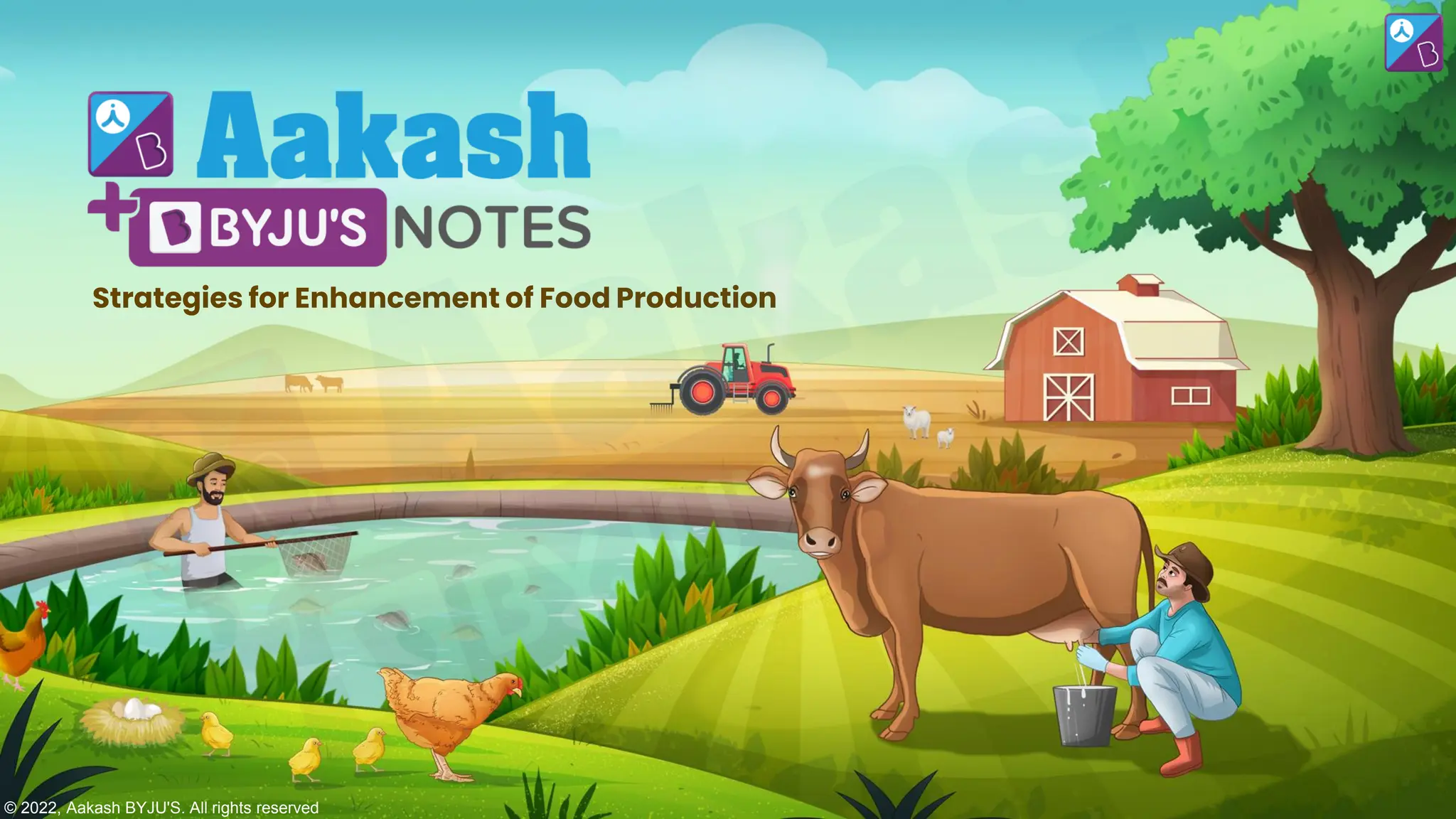
Strategies for Enhancement of Food Production
© 2022, Aakash BYJU'S. All rights reserved
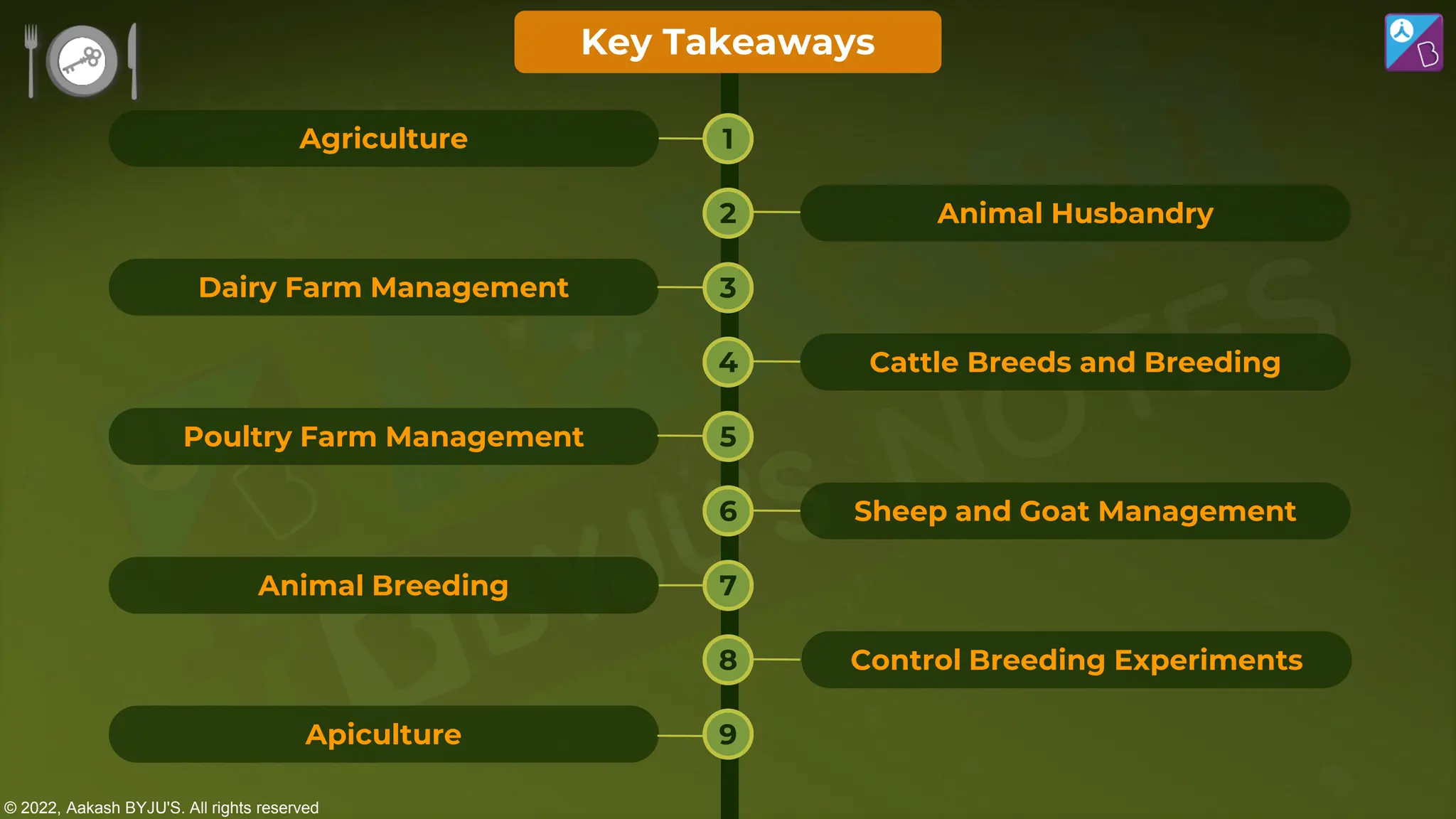
Key Takeaways
Agriculture
Dairy Farm Management
Animal Husbandry
Cattle Breeds and Breeding
Sheep and Goat Management
Poultry Farm Management
Animal Breeding
Control Breeding Experiments
Apiculture
1
2
3
4
5
6
7
8
9
© 2022, Aakash BYJU'S. All rights reserved
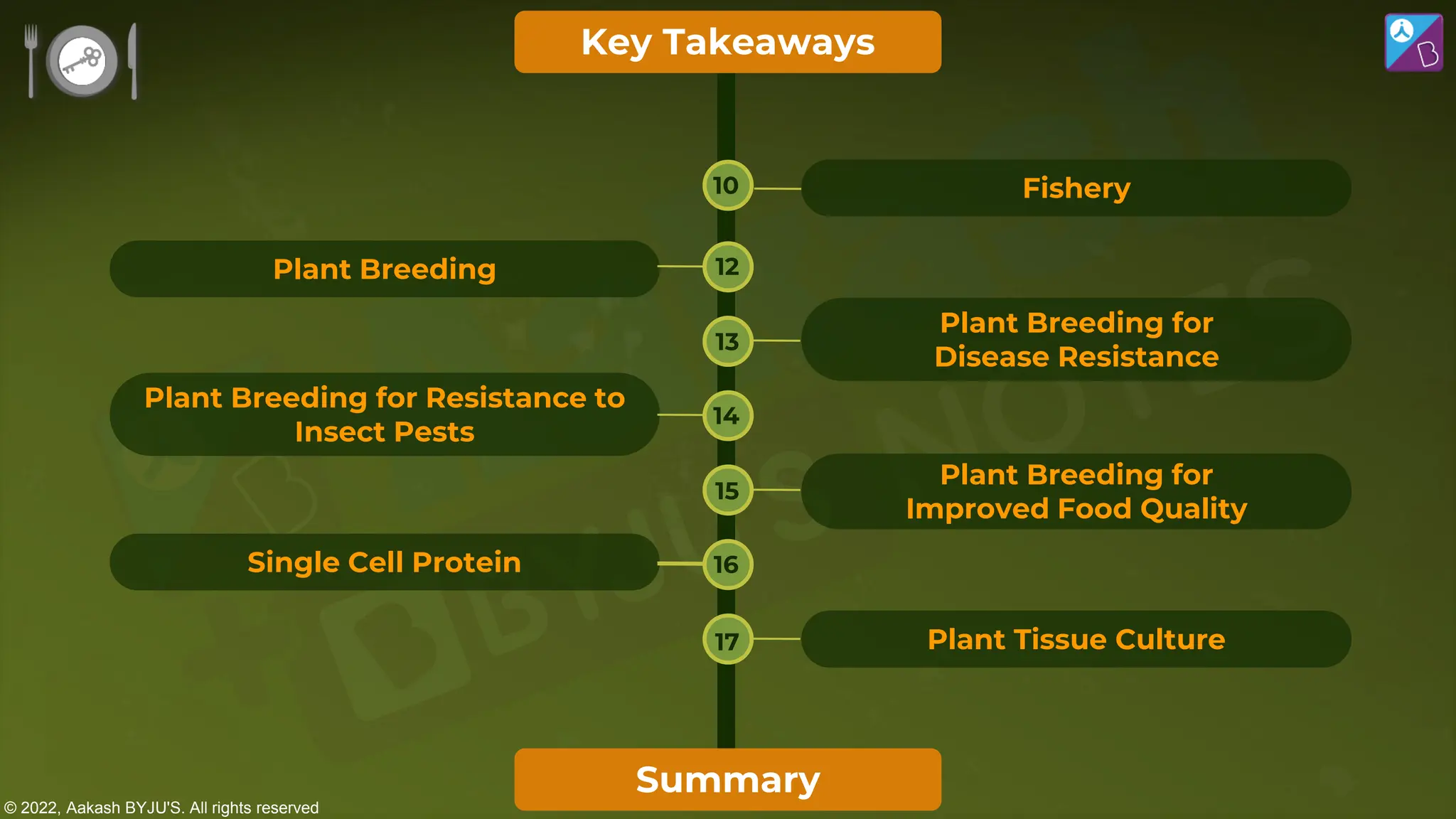
Key Takeaways
Fishery
Plant Breeding
Plant Breeding for
Disease Resistance
Plant Breeding for
Improved Food Quality
Plant Breeding for Resistance to
Insect Pests
Single Cell Protein
Plant Tissue Culture
10
12
13
14
15
16
17
Summary
© 2022, Aakash BYJU'S. All rights reserved
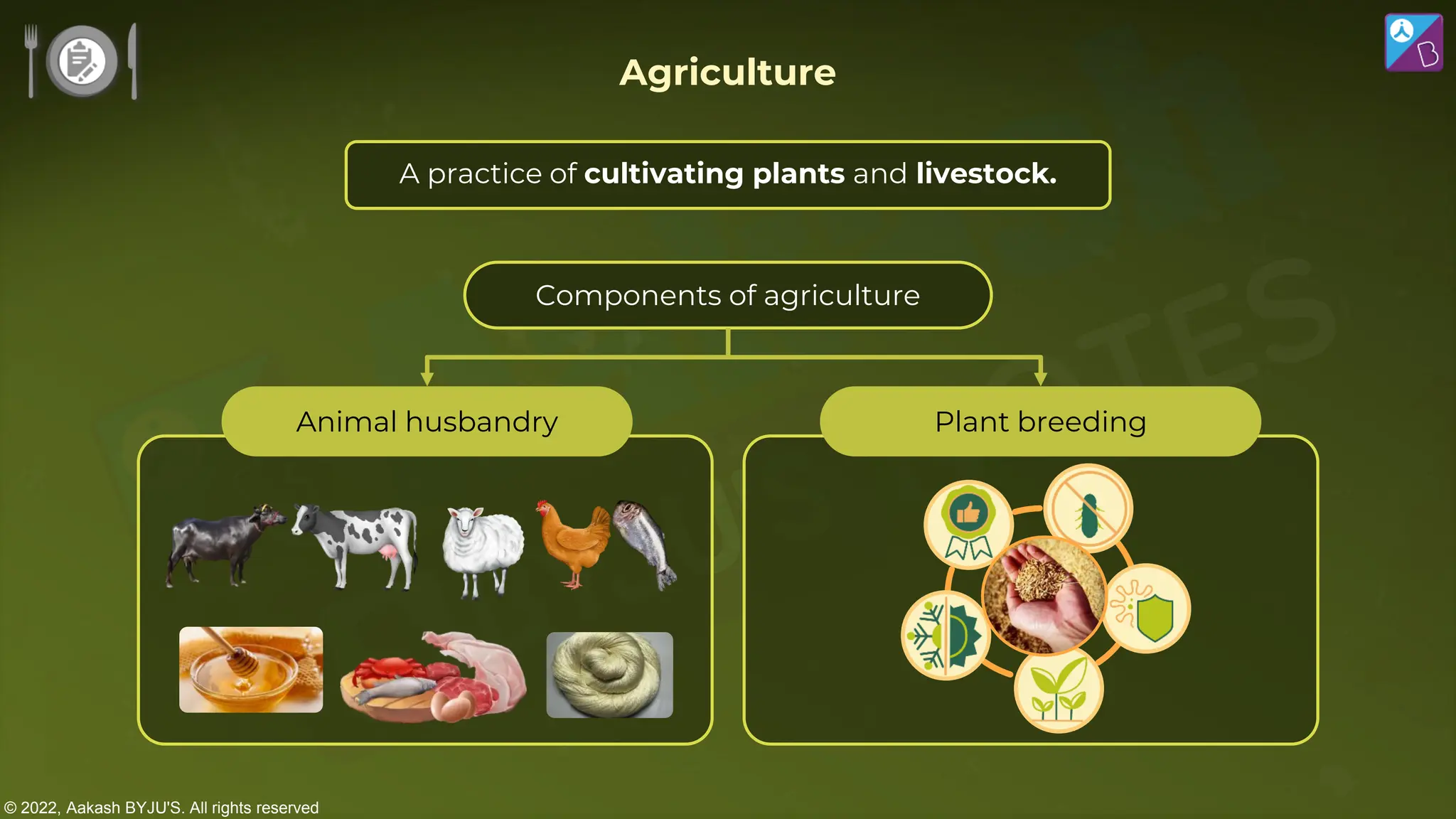
A practice of cultivating plants and livestock.
Components of agriculture
Agriculture
Animal husbandry Plant breeding
Wi
© 2022, Aakash BYJU'S. All rights reserved
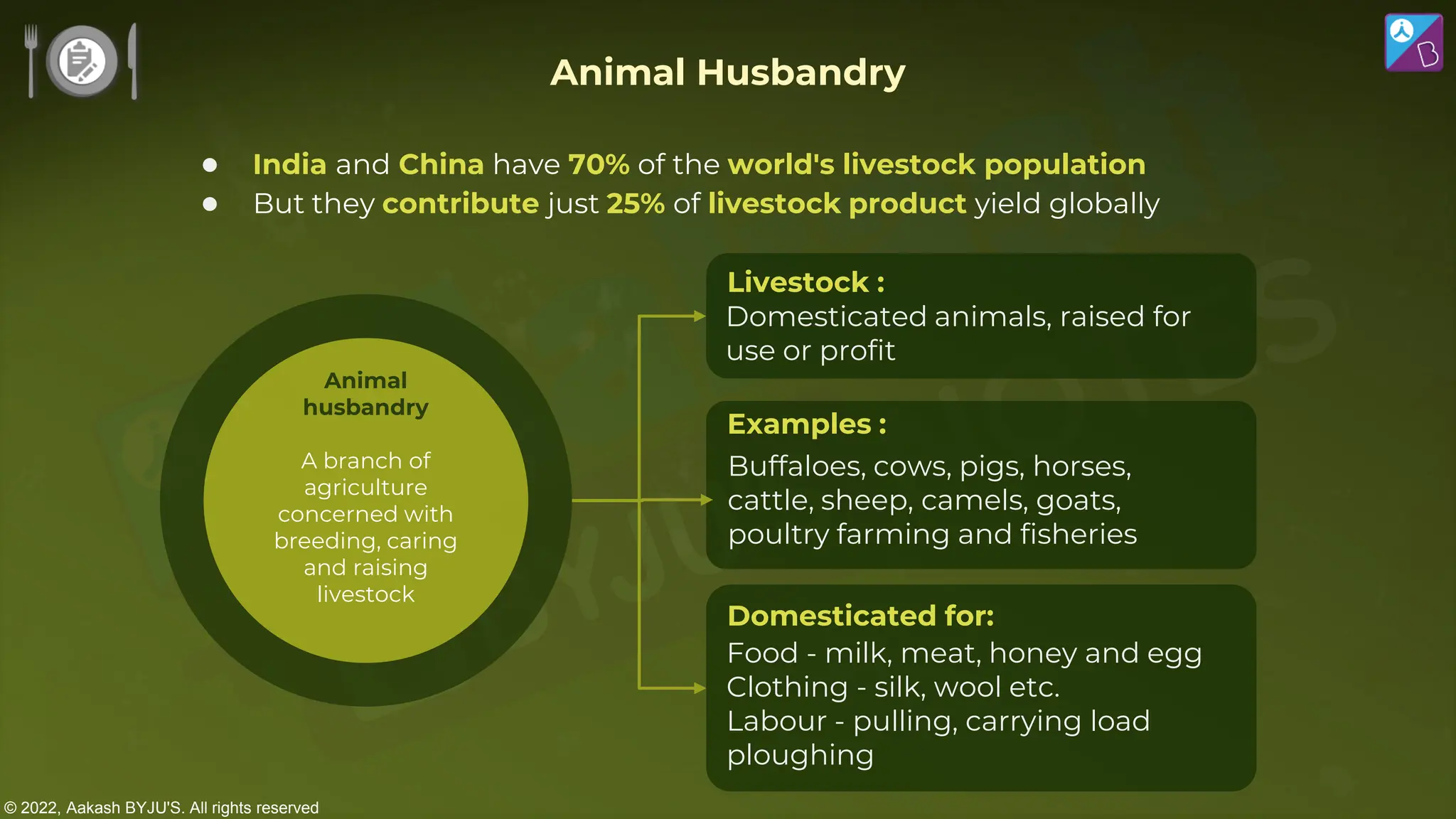
● India and China have 70% of the world's livestock population
● But they contribute just 25% of livestock product yield globally
Animal Husbandry
Livestock :
Examples :
Buffaloes, cows, pigs, horses,
cattle, sheep, camels, goats,
poultry farming and fisheries
Domesticated for:
Food - milk, meat, honey and egg
Clothing - silk, wool etc.
Labour - pulling, carrying load
ploughing
Animal
husbandry
A branch of
agriculture
concerned with
breeding, caring
and raising
livestock
Domesticated animals, raised for
use or profit
© 2022, Aakash BYJU'S. All rights reserved
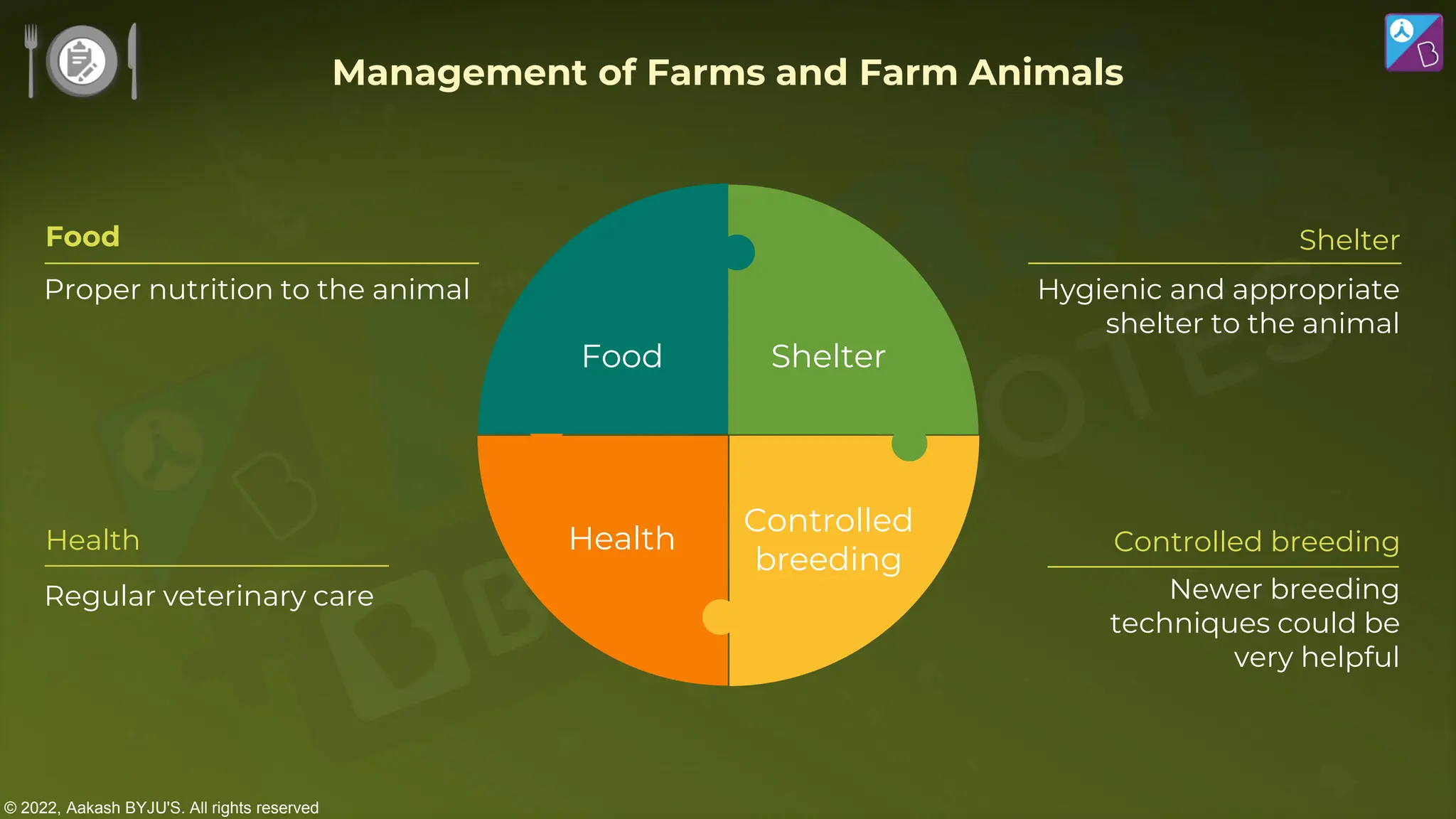
Hygienic and appropriate
shelter to the animal
Shelter
Newer breeding
techniques could be
very helpful
Controlled breeding
Regular veterinary care
Health
Proper nutrition to the animal
Food
Management of Farms and Farm Animals
Food Shelter
Health
Controlled
breeding
© 2022, Aakash BYJU'S. All rights reserved
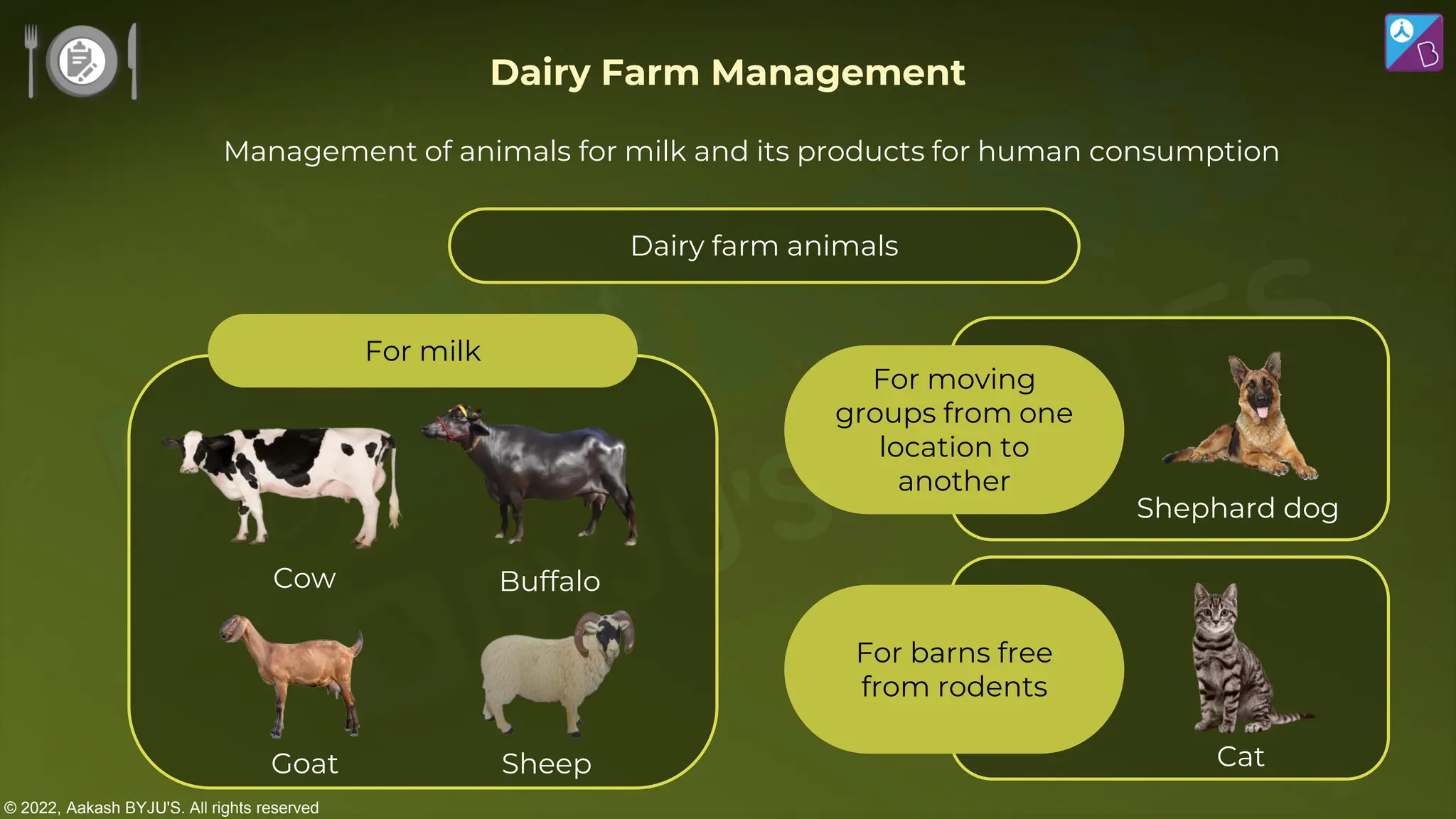
For milk
Dairy farm animals
For moving
groups from one
location to
another
For barns free
from rodents
Cow
Goat
Buffalo
Sheep
Shephard dog
Cat
Dairy Farm Management
Management of animals for milk and its products for human consumption
© 2022, Aakash BYJU'S. All rights reserved
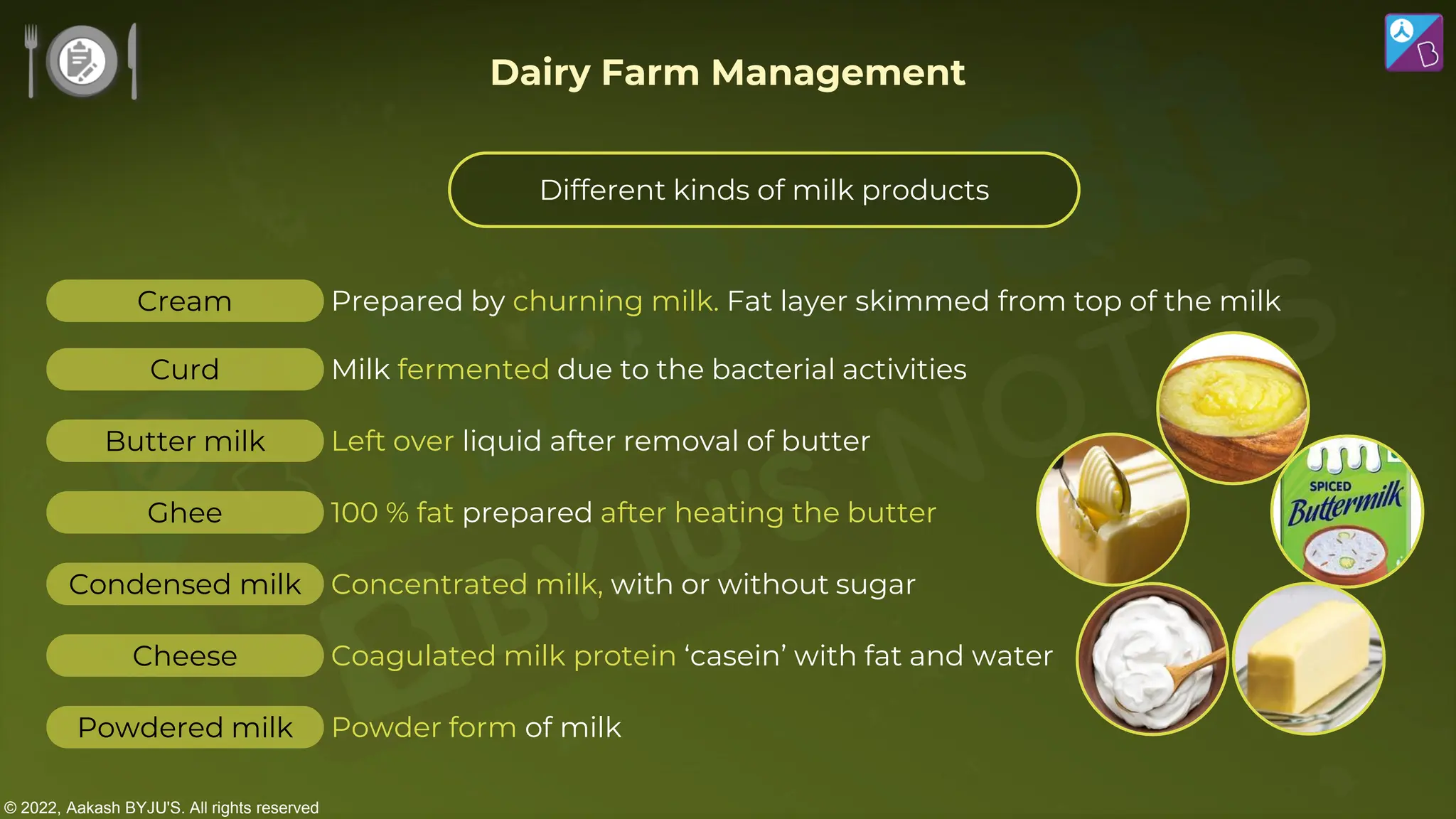
Different kinds of milk products
Cream Prepared by churning milk. Fat layer skimmed from top of the milk
Curd Milk fermented due to the bacterial activities
Butter milk Left over liquid after removal of butter
Ghee 100 % fat prepared after heating the butter
Condensed milk Concentrated milk, with or without sugar
Cheese Coagulated milk protein ‘casein’ with fat and water
Powdered milk Powder form of milk
Dairy Farm Management
© 2022, Aakash BYJU'S. All rights reserved
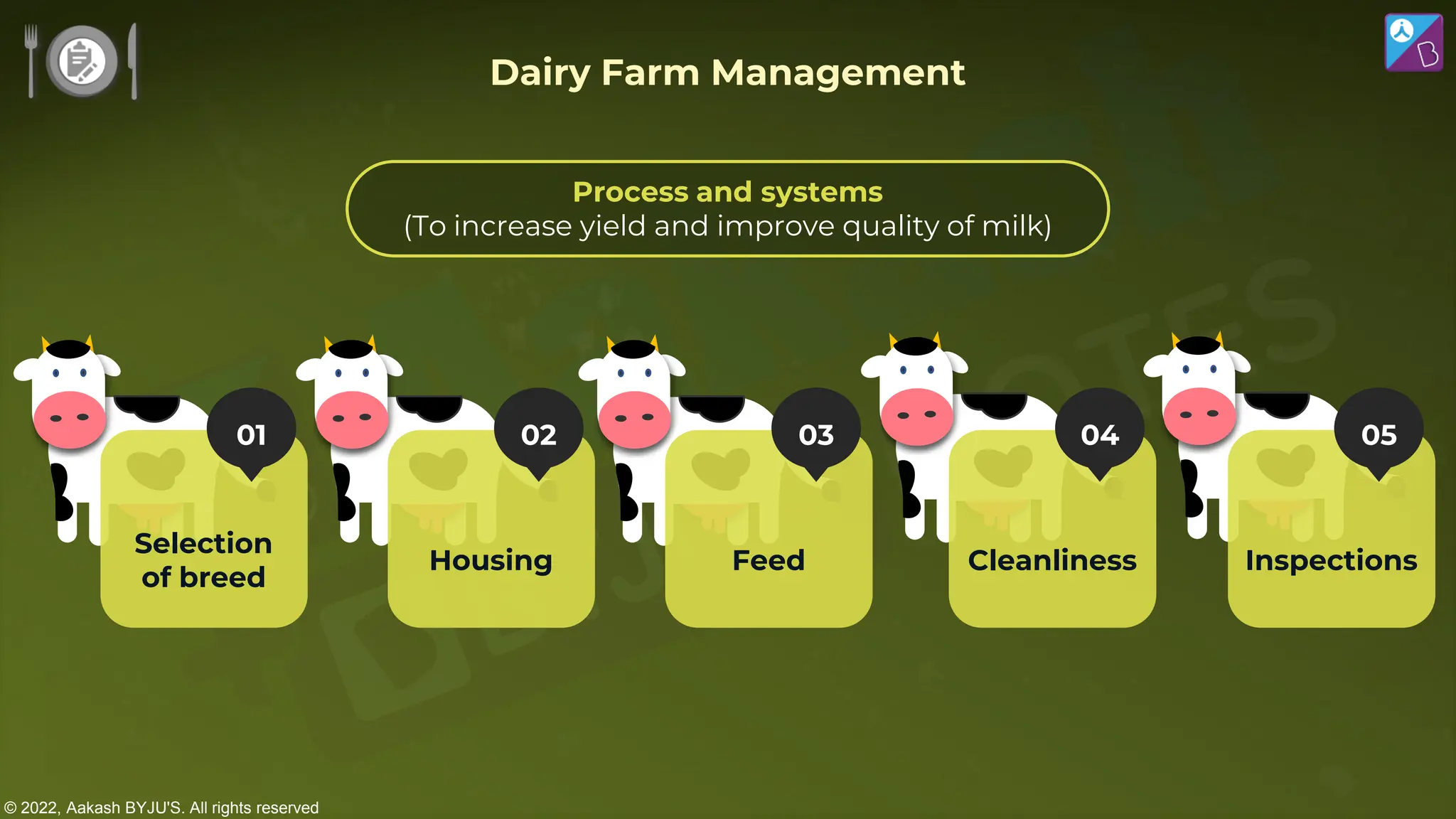
Process and systems
(To increase yield and improve quality of milk)
Dairy Farm Management
01
Selection
of breed
05
Inspections
04
Cleanliness
03
Feed
02
Housing
© 2022, Aakash BYJU'S. All rights reserved
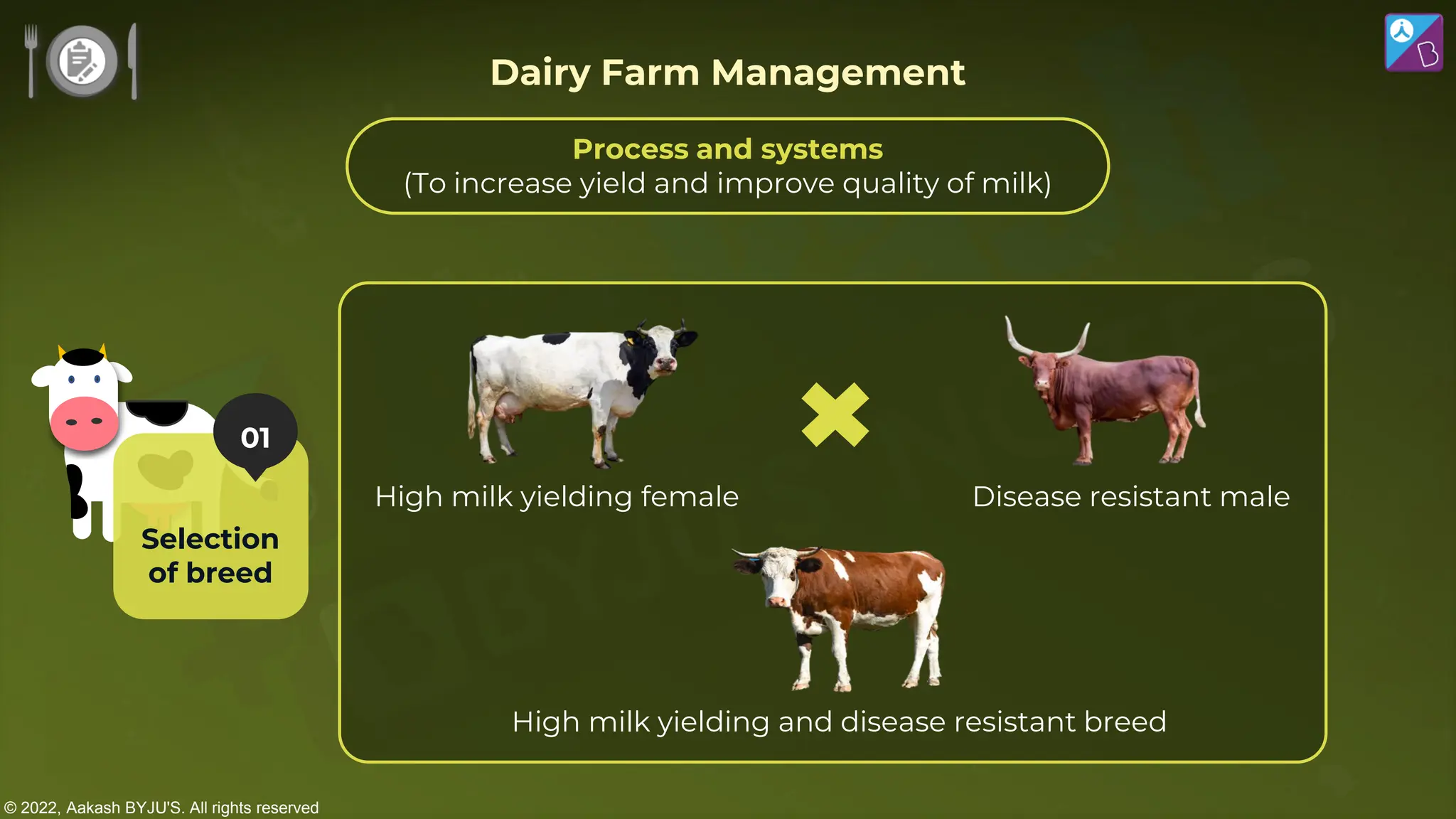
High milk yielding female
High milk yielding and disease resistant breed
Dairy Farm Management
01
Selection
of breed
Disease resistant male
Process and systems
(To increase yield and improve quality of milk)
© 2022, Aakash BYJU'S. All rights reserved
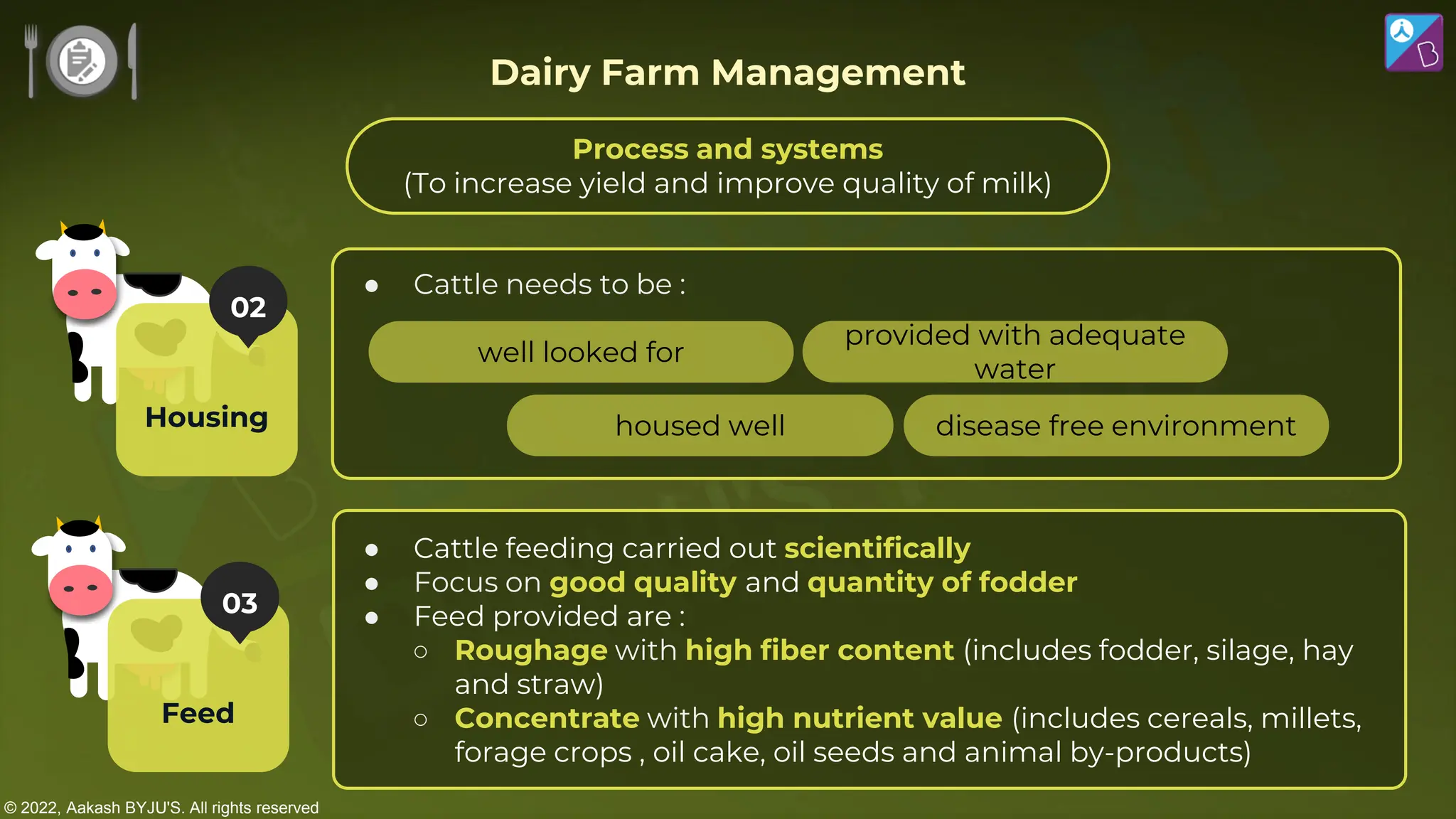
● Cattle needs to be :
● Cattle feeding carried out scientifically
● Focus on good quality and quantity of fodder
● Feed provided are :
○ Roughage with high fiber content (includes fodder, silage, hay
and straw)
○ Concentrate with high nutrient value (includes cereals, millets,
forage crops , oil cake, oil seeds and animal by-products)
well looked for
housed well
provided with adequate
water
disease free environment
Dairy Farm Management
03
Feed
02
Housing
Process and systems
(To increase yield and improve quality of milk)
© 2022, Aakash BYJU'S. All rights reserved
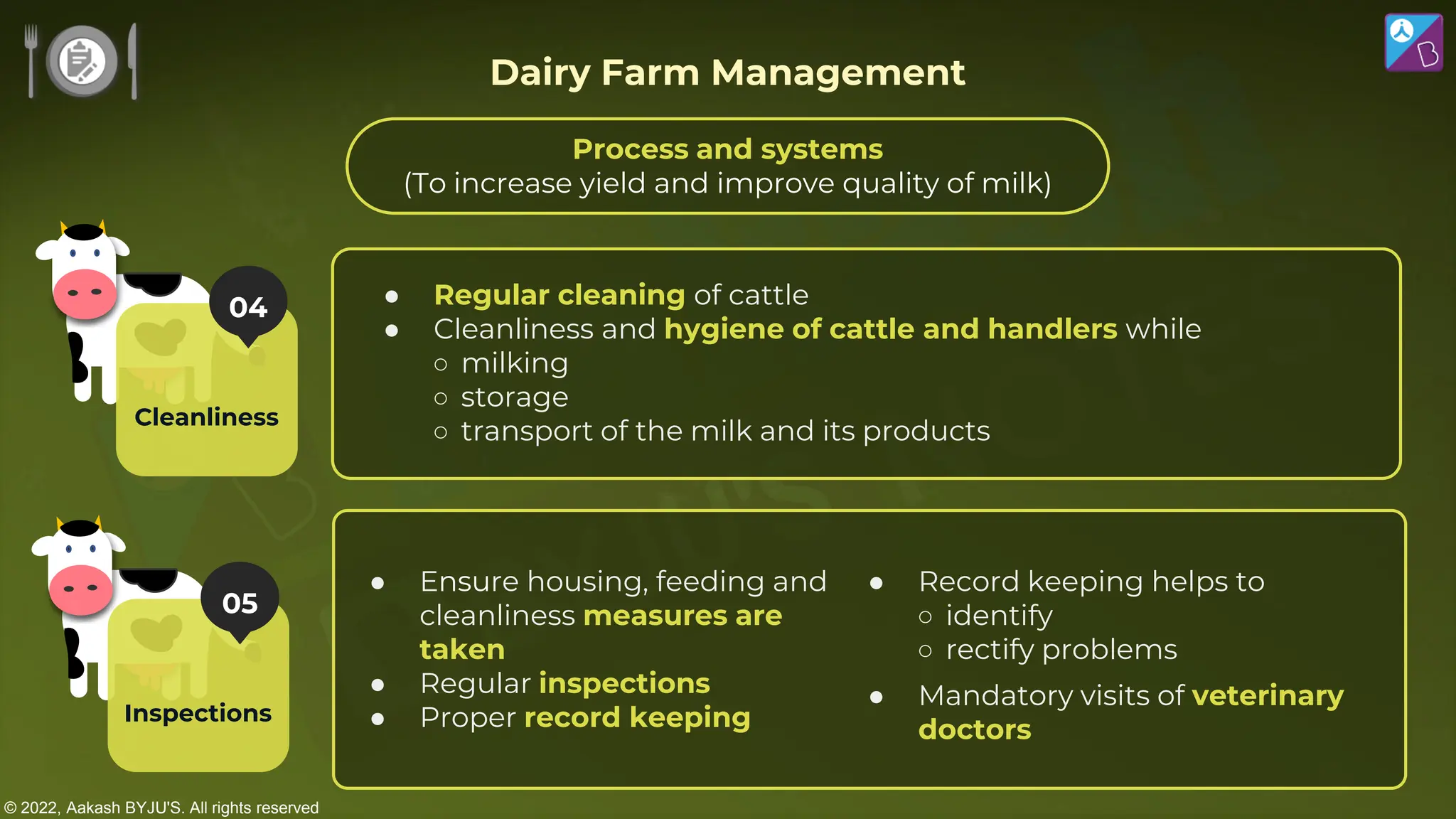
● Regular cleaning of cattle
● Cleanliness and hygiene of cattle and handlers while
○ milking
○ storage
○ transport of the milk and its products
● Ensure housing, feeding and
cleanliness measures are
taken
● Regular inspections
● Proper record keeping
● Record keeping helps to
○ identify
○ rectify problems
● Mandatory visits of veterinary
doctors
Process and systems
(To increase yield and improve quality of milk)
Dairy Farm Management
05
Inspections
04
Cleanliness
© 2022, Aakash BYJU'S. All rights reserved
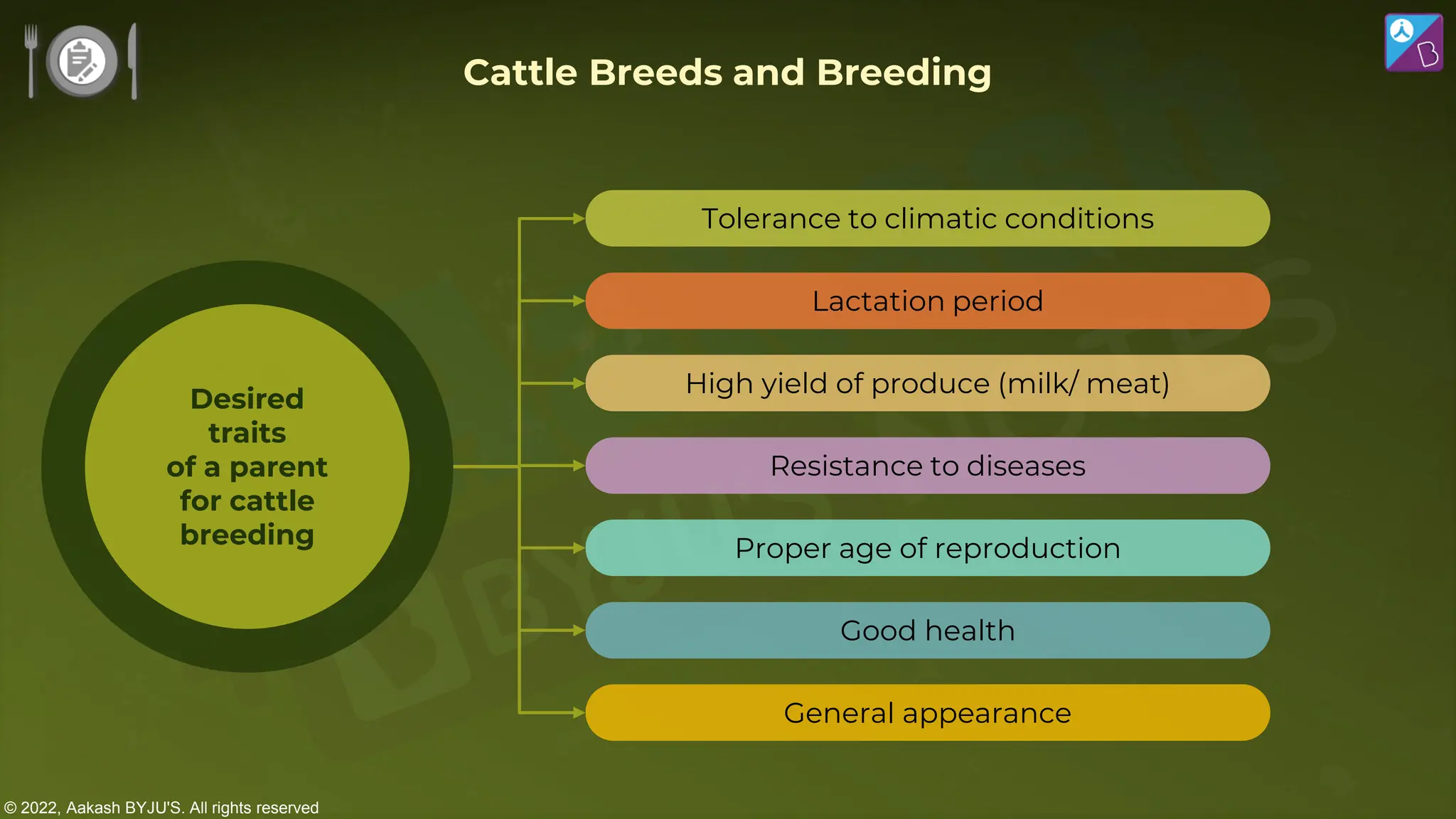
Cattle Breeds and Breeding
Tolerance to climatic conditions
Lactation period
High yield of produce (milk/ meat)
Resistance to diseases
Proper age of reproduction
Good health
General appearance
Desired
traits
of a parent
for cattle
breeding
© 2022, Aakash BYJU'S. All rights reserved
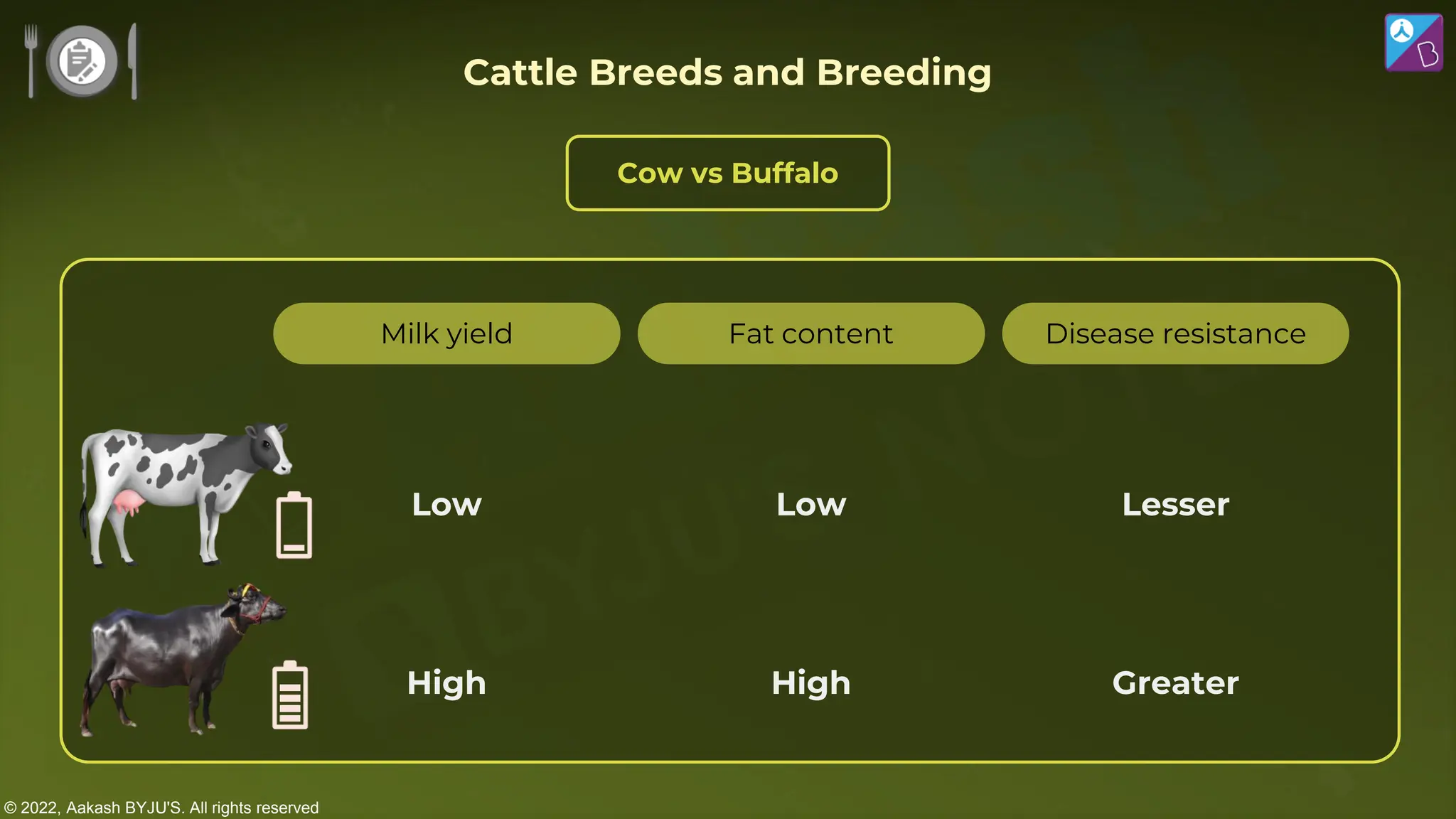
Milk yield
Low
High
Fat content
Low
High
Disease resistance
Lesser
Greater
Cow vs Buffalo
Cattle Breeds and Breeding
© 2022, Aakash BYJU'S. All rights reserved
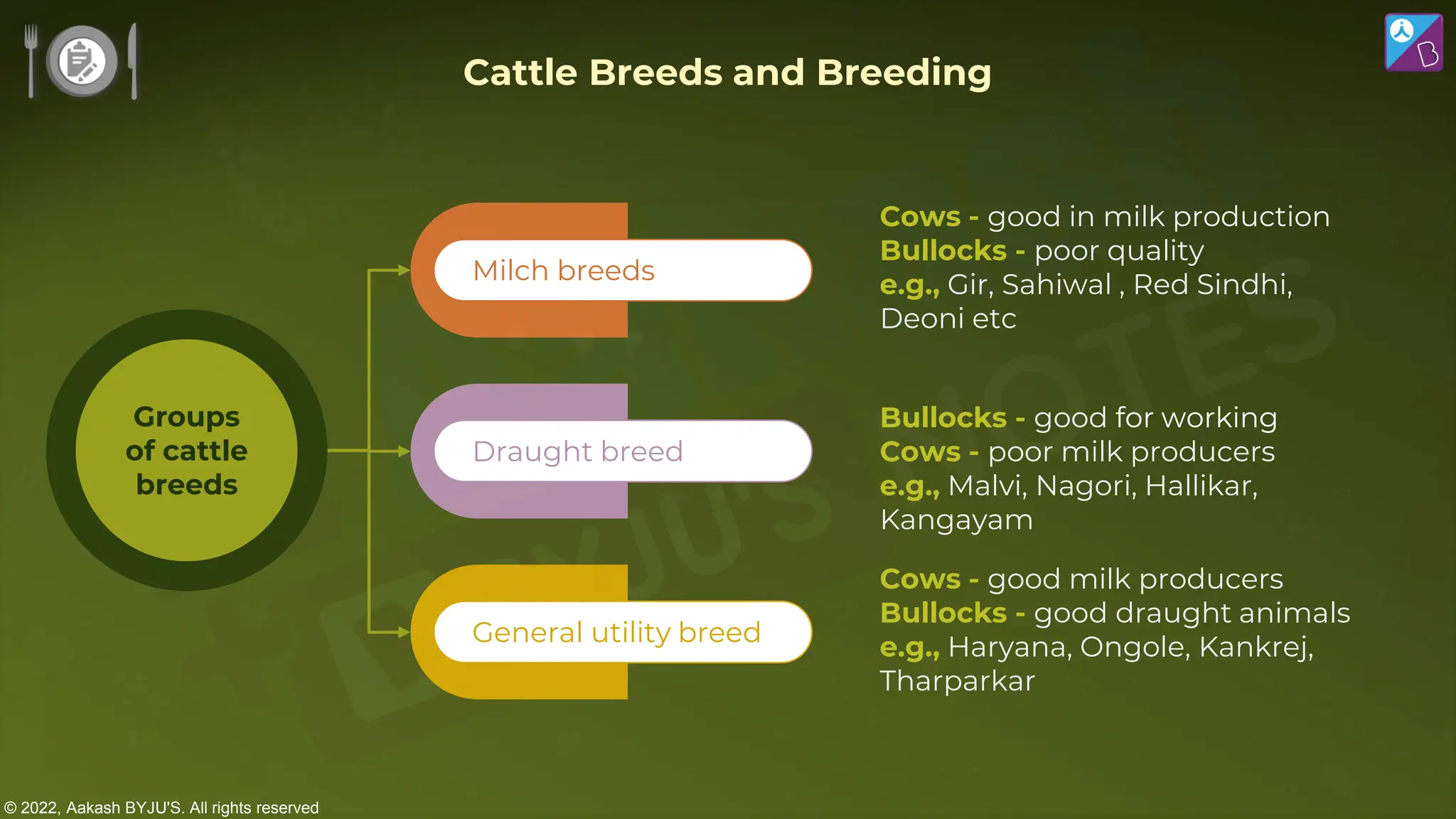
Draught breed
Bullocks - good for working
Cows - poor milk producers
e.g., Malvi, Nagori, Hallikar,
Kangayam
General utility breed
Cows - good milk producers
Bullocks - good draught animals
e.g., Haryana, Ongole, Kankrej,
Tharparkar
Milch breeds
Cows - good in milk production
Bullocks - poor quality
e.g., Gir, Sahiwal , Red Sindhi,
Deoni etc
Cattle Breeds and Breeding
Groups
of cattle
breeds
© 2022, Aakash BYJU'S. All rights reserved
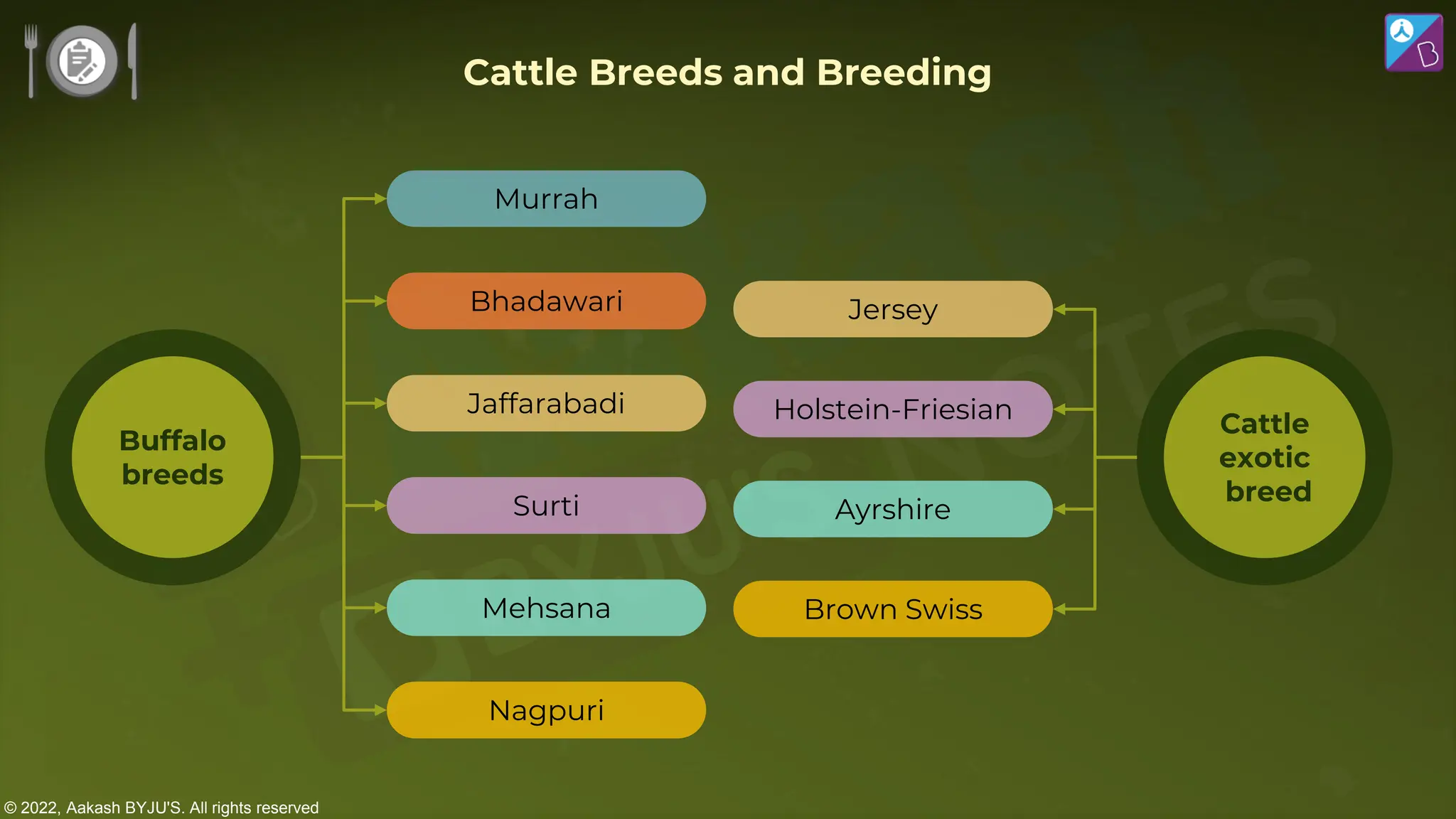
Cattle Breeds and Breeding
Buffalo
breeds
Cattle
exotic
breed
Murrah
Bhadawari
Jaffarabadi
Surti
Mehsana
Nagpuri
Jersey
Holstein-Friesian
Ayrshire
Brown Swiss
© 2022, Aakash BYJU'S. All rights reserved
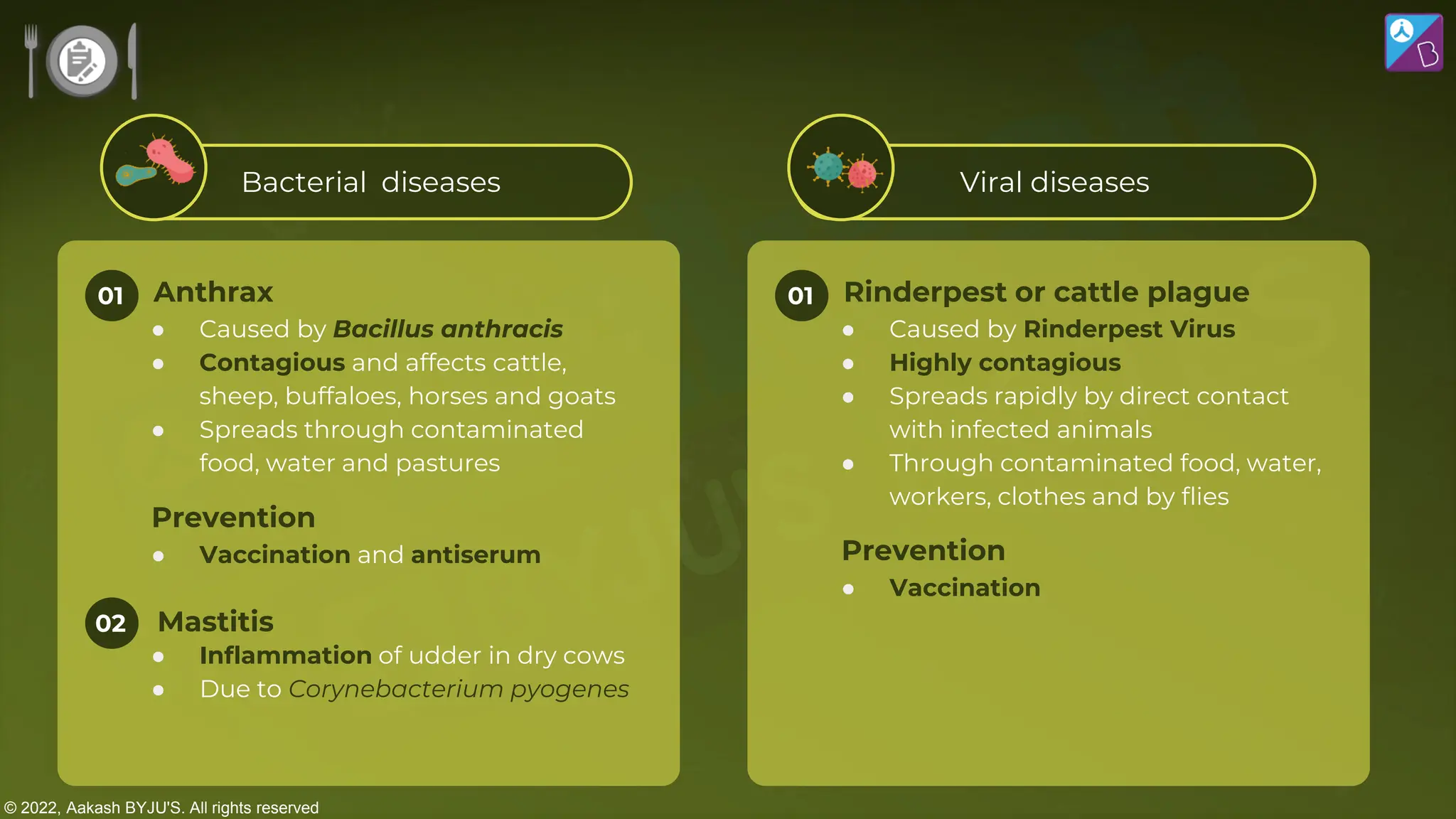
Bacterial diseases Viral diseases
01 Anthrax
● Caused by Bacillus anthracis
● Contagious and affects cattle,
sheep, buffaloes, horses and goats
● Spreads through contaminated
food, water and pastures
Prevention
● Vaccination and antiserum
02 Mastitis
● Inflammation of udder in dry cows
● Due to Corynebacterium pyogenes
01 Rinderpest or cattle plague
● Caused by Rinderpest Virus
● Highly contagious
● Spreads rapidly by direct contact
with infected animals
● Through contaminated food, water,
workers, clothes and by flies
Prevention
● Vaccination
© 2022, Aakash BYJU'S. All rights reserved
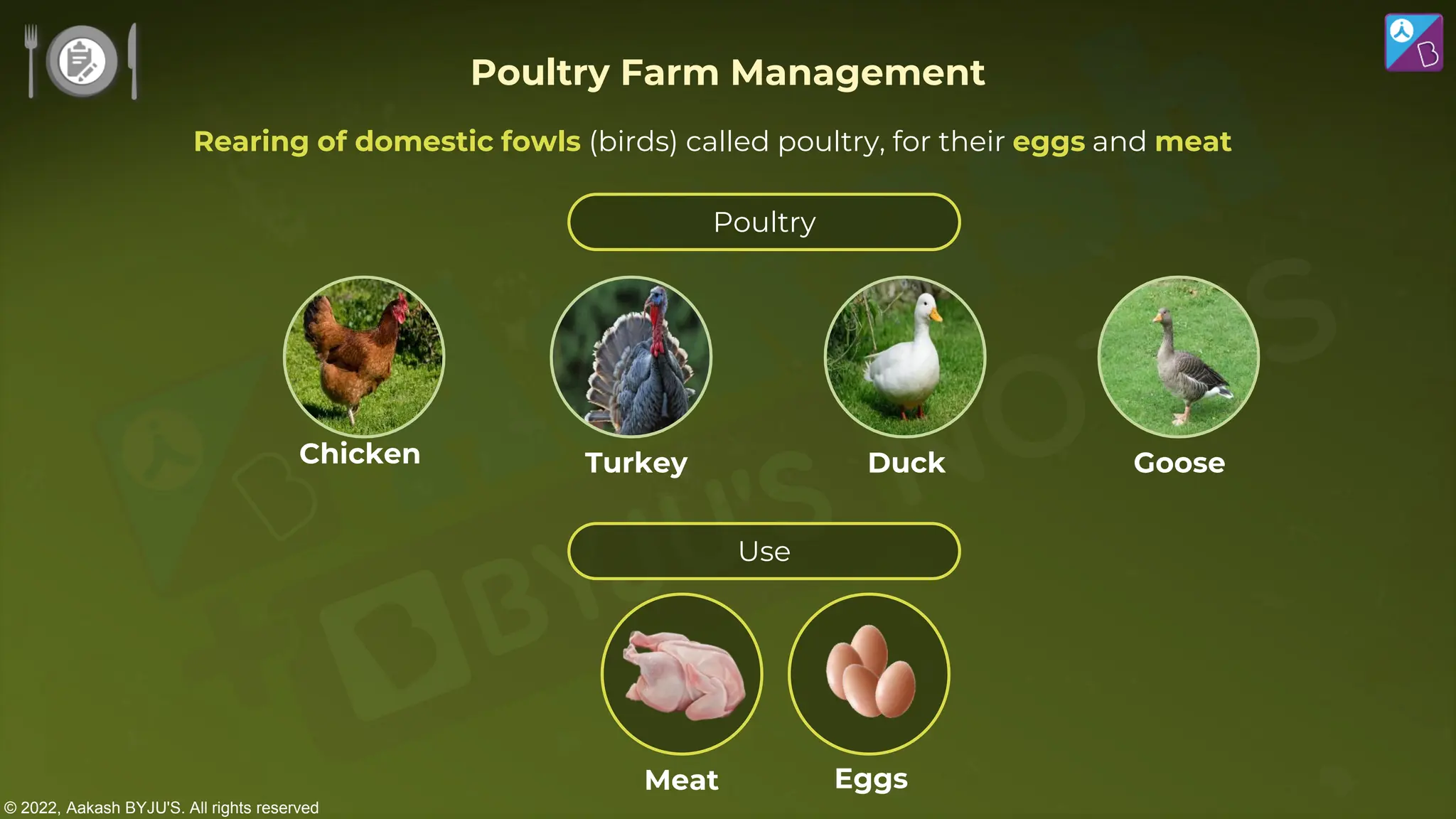
Rearing of domestic fowls (birds) called poultry, for their eggs and meat
Poultry
Chicken Duck
Turkey Goose
Use
Meat Eggs
Poultry Farm Management
© 2022, Aakash BYJU'S. All rights reserved
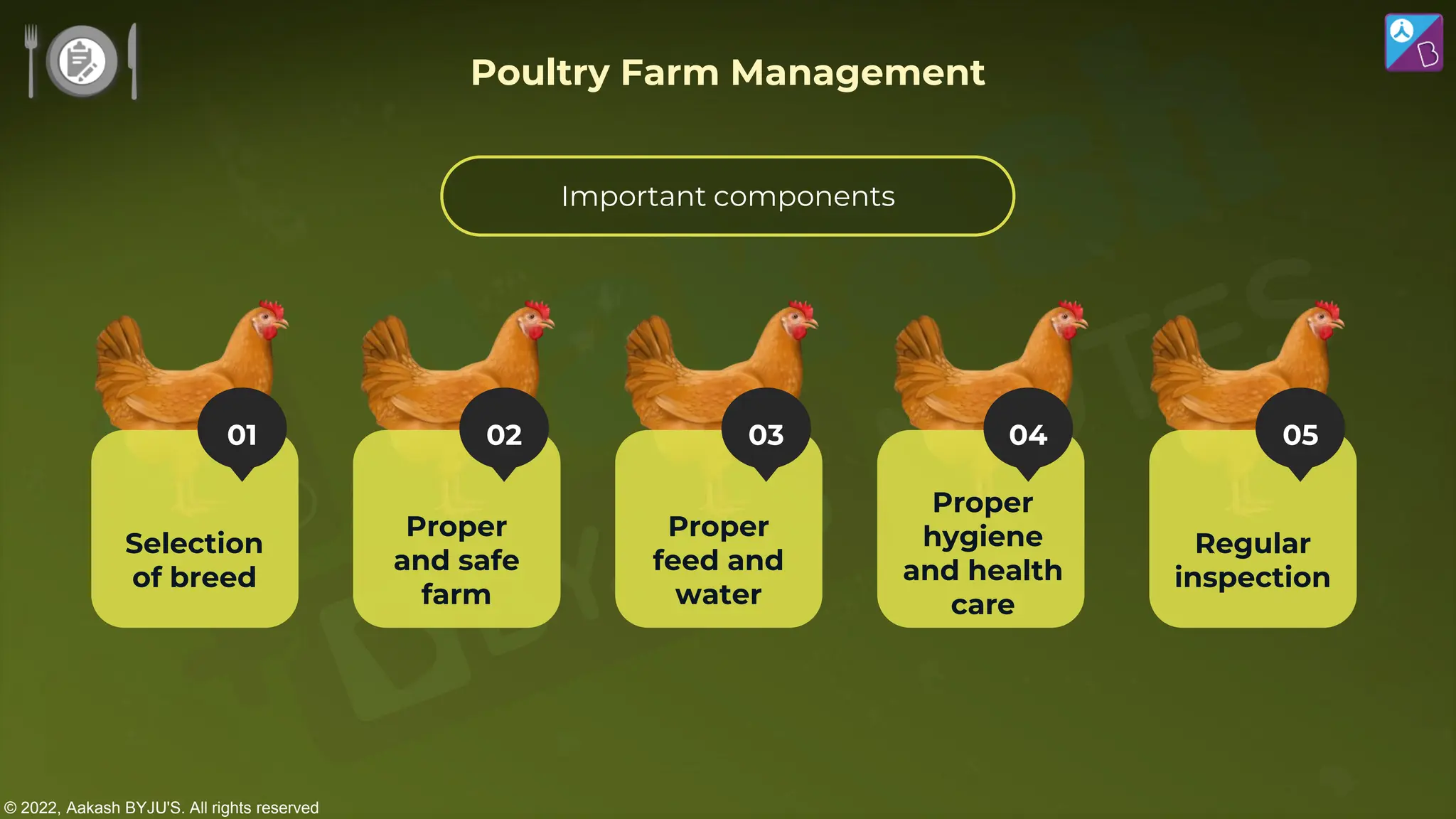
Important components
Poultry Farm Management
01
Selection
of breed
05
Regular
inspection
04
Proper
hygiene
and health
care
03
Proper
feed and
water
02
Proper
and safe
farm
© 2022, Aakash BYJU'S. All rights reserved
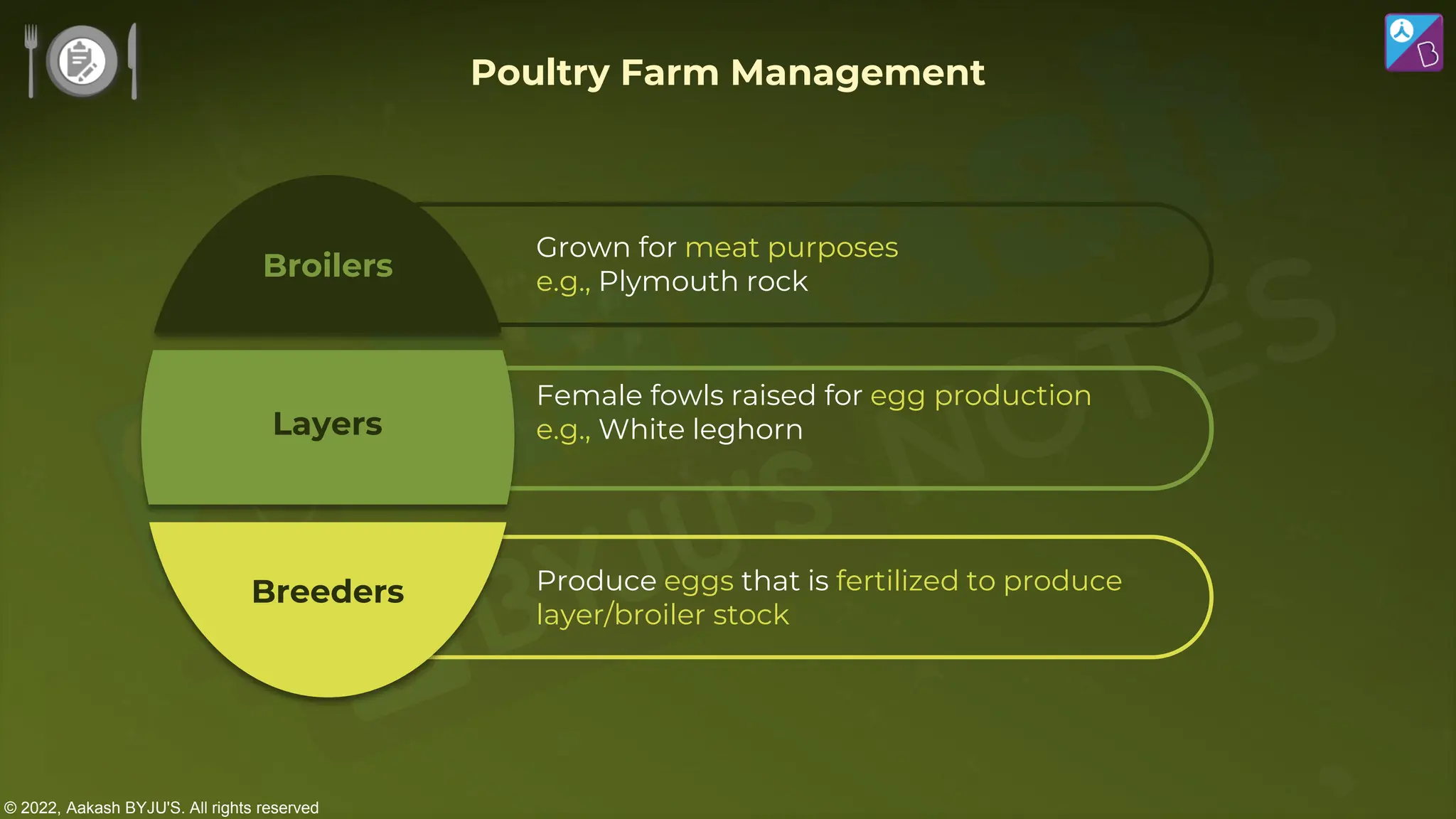
Poultry Farm Management
Grown for meat purposes
e.g., Plymouth rock
Layers
Broilers
Breeders
Female fowls raised for egg production
e.g., White leghorn
Produce eggs that is fertilized to produce
layer/broiler stock
© 2022, Aakash BYJU'S. All rights reserved
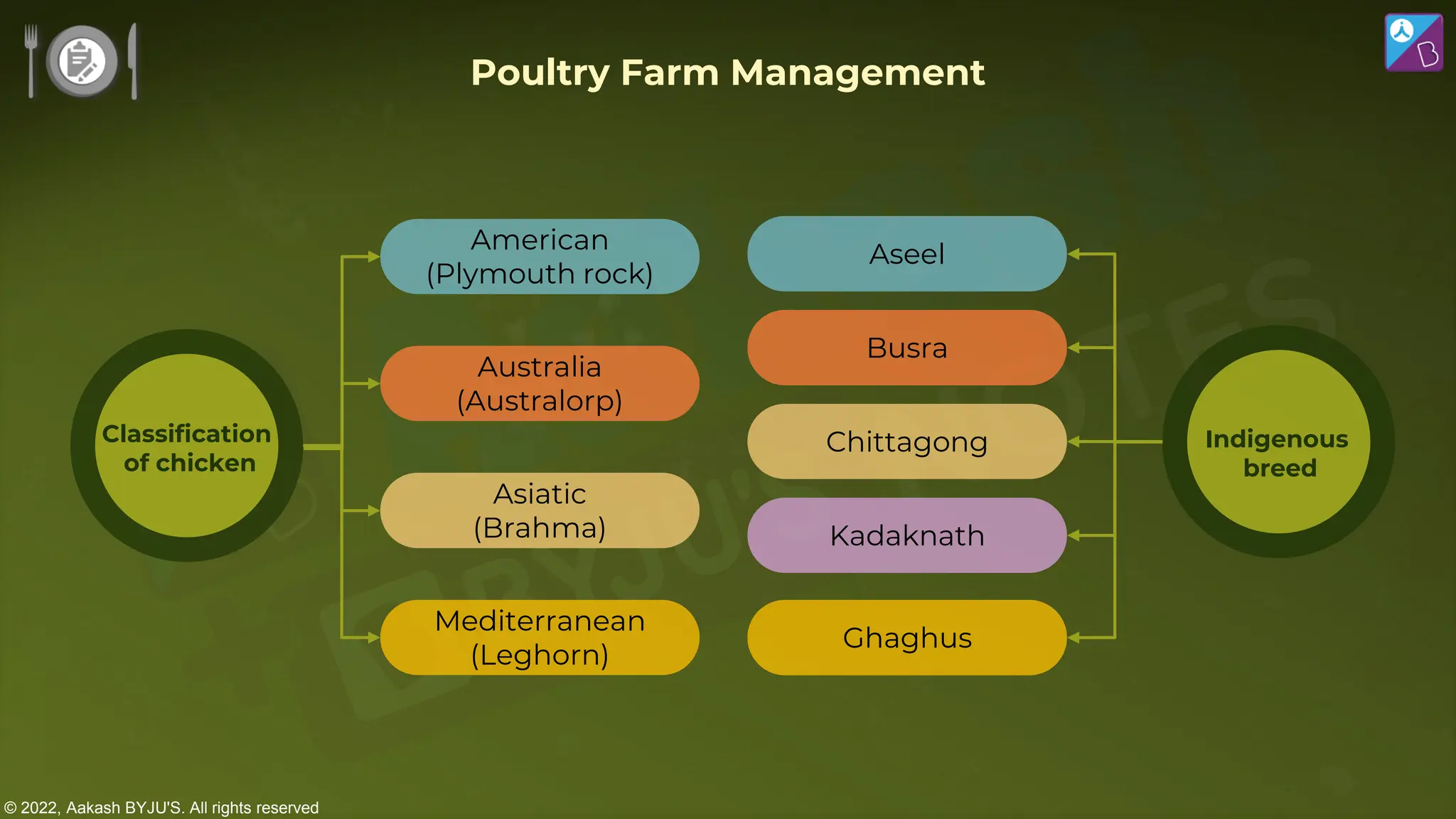
Poultry Farm Management
American
(Plymouth rock)
Australia
(Australorp)
Asiatic
(Brahma)
Mediterranean
(Leghorn)
Aseel
Busra
Chittagong
Kadaknath
Ghaghus
Classification
of chicken
Indigenous
breed
© 2022, Aakash BYJU'S. All rights reserved
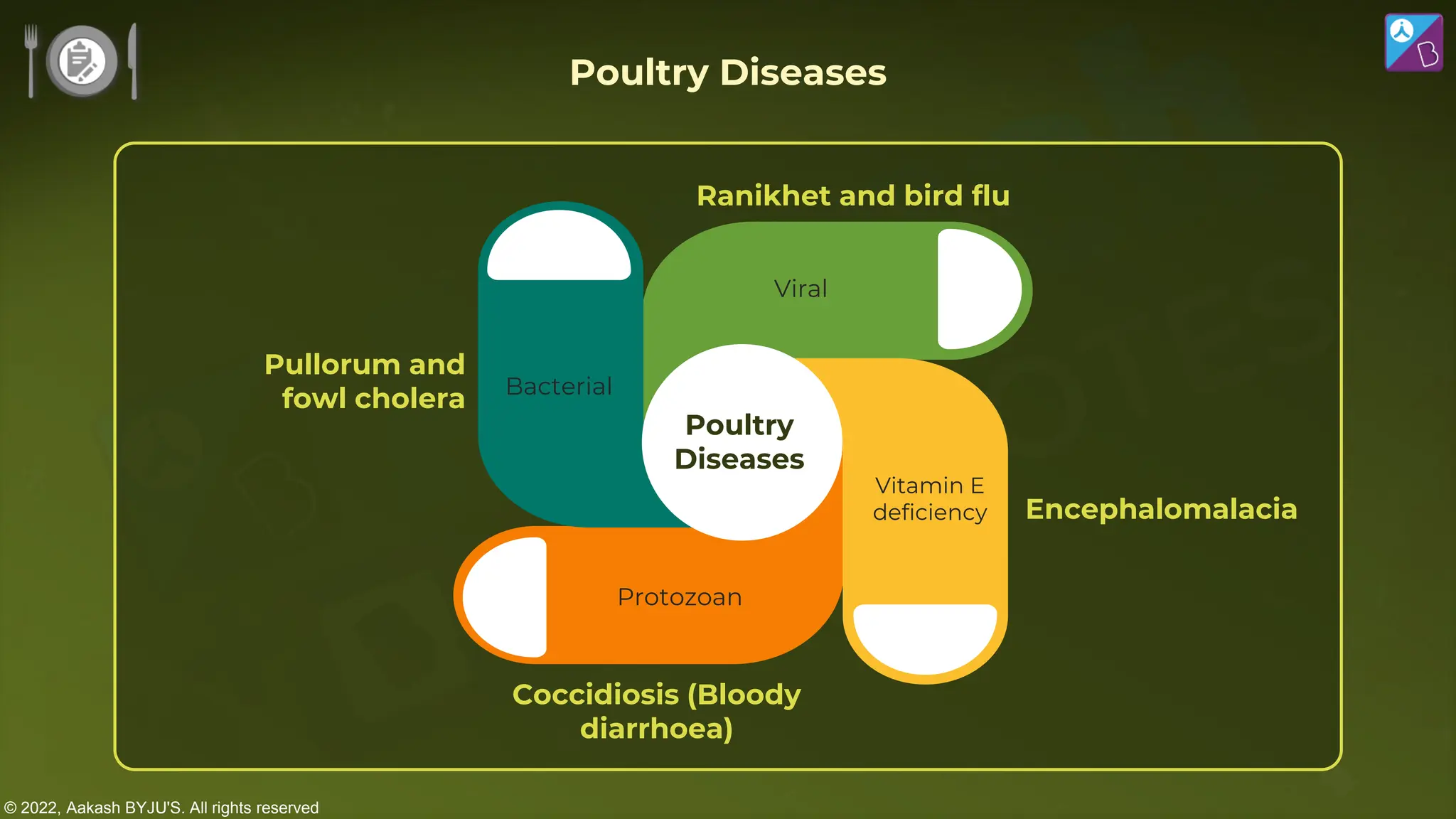
Protozoan
Viral
Bacterial
Vitamin E
deficiency Encephalomalacia
Ranikhet and bird flu
Coccidiosis (Bloody
diarrhoea)
Pullorum and
fowl cholera
Poultry
Diseases
Poultry Diseases
© 2022, Aakash BYJU'S. All rights reserved
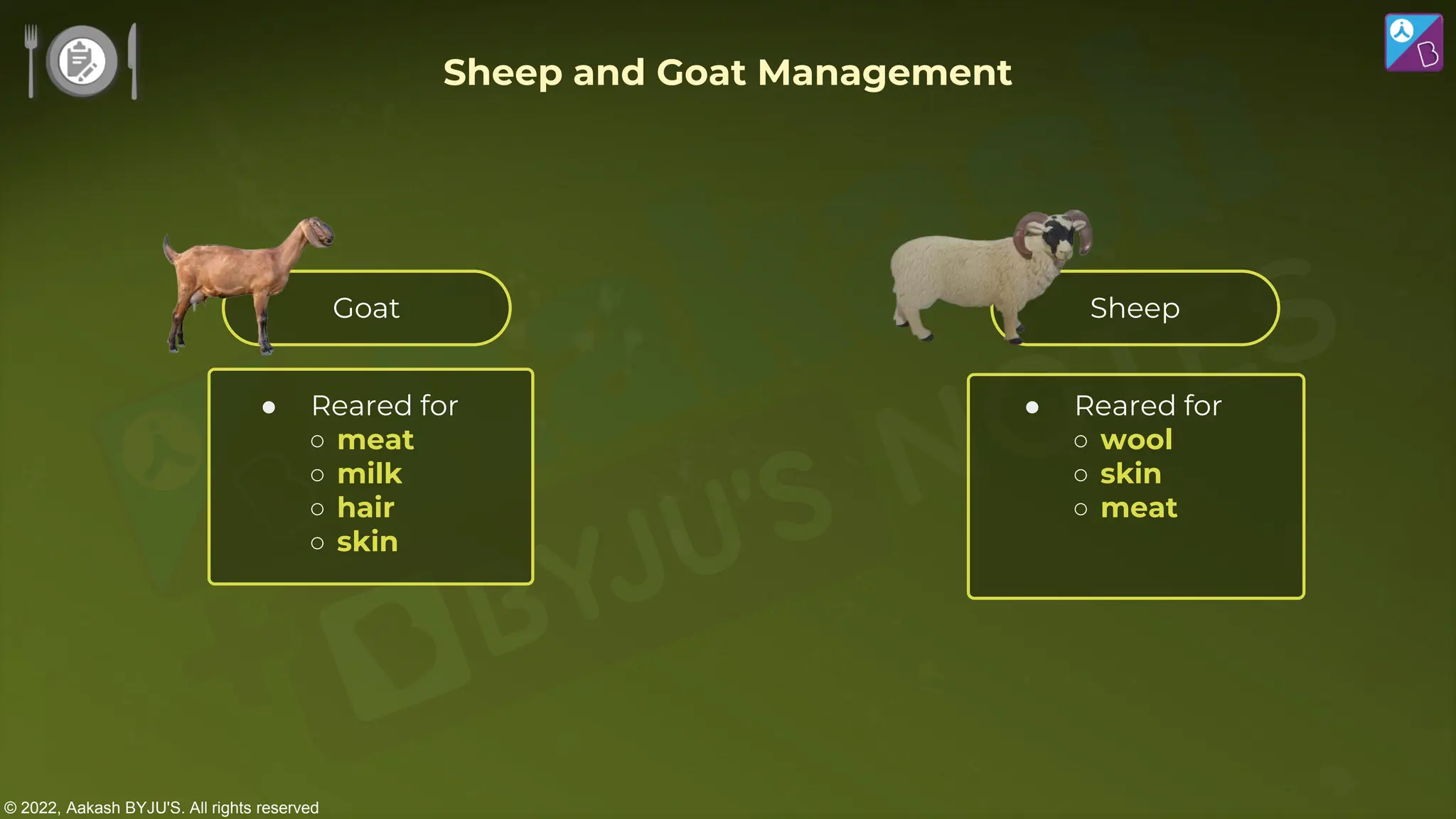
Goat Sheep
● Reared for
○ meat
○ milk
○ hair
○ skin
● Reared for
○ wool
○ skin
○ meat
Sheep and Goat Management
© 2022, Aakash BYJU'S. All rights reserved
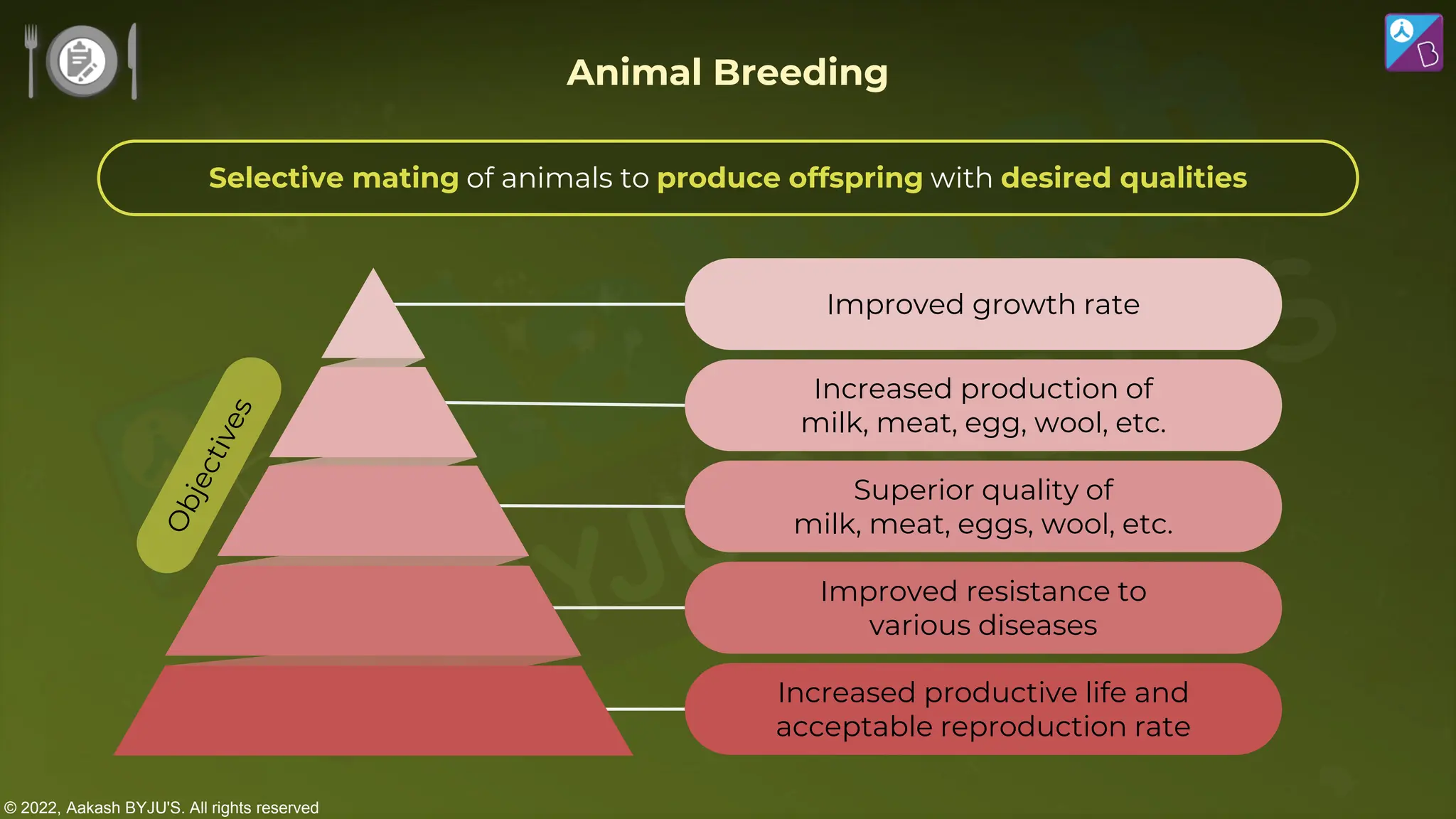
Improved growth rate
Increased production of
milk, meat, egg, wool, etc.
Superior quality of
milk, meat, eggs, wool, etc.
Improved resistance to
various diseases
Increased productive life and
acceptable reproduction rate
Animal Breeding
Selective mating of animals to produce offspring with desired qualities
© 2022, Aakash BYJU'S. All rights reserved
Mating closely related animals
Inbreeding Out-breeding
Mating unrelated animals
Methods of animal breeding
Interspecific hybridisation
Cross-breeding
Out-crossing
Animal Breeding
Breed is a group of animals related by descent and similar in most characters
© 2022, Aakash BYJU'S. All rights reserved
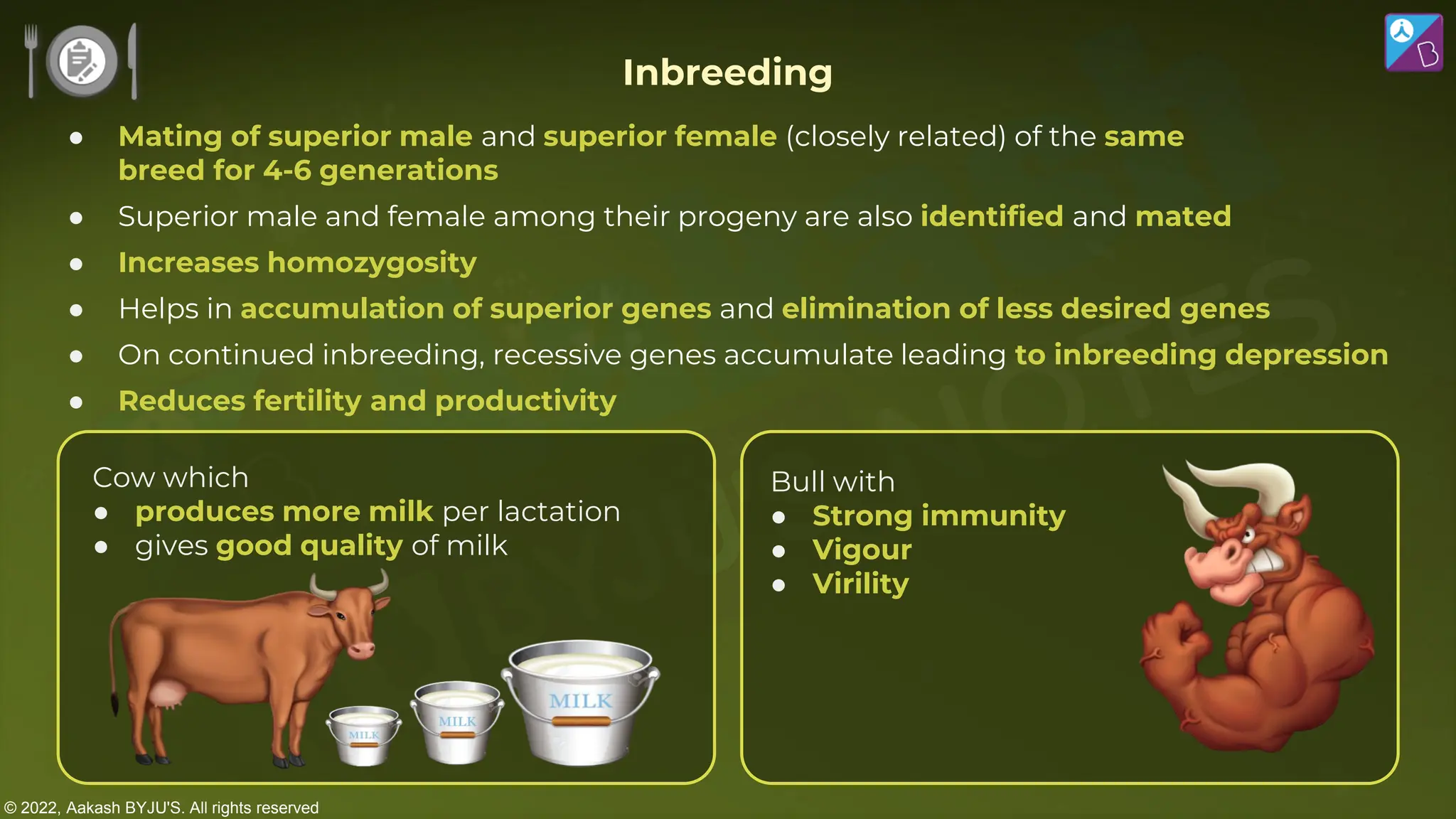
Bull with
● Strong immunity
● Vigour
● Virility
Cow which
● produces more milk per lactation
● gives good quality of milk
● Mating of superior male and superior female (closely related) of the same
breed for 4-6 generations
● Superior male and female among their progeny are also identified and mated
● Increases homozygosity
● Helps in accumulation of superior genes and elimination of less desired genes
● On continued inbreeding, recessive genes accumulate leading to inbreeding depression
● Reduces fertility and productivity
Inbreeding
© 2022, Aakash BYJU'S. All rights reserved
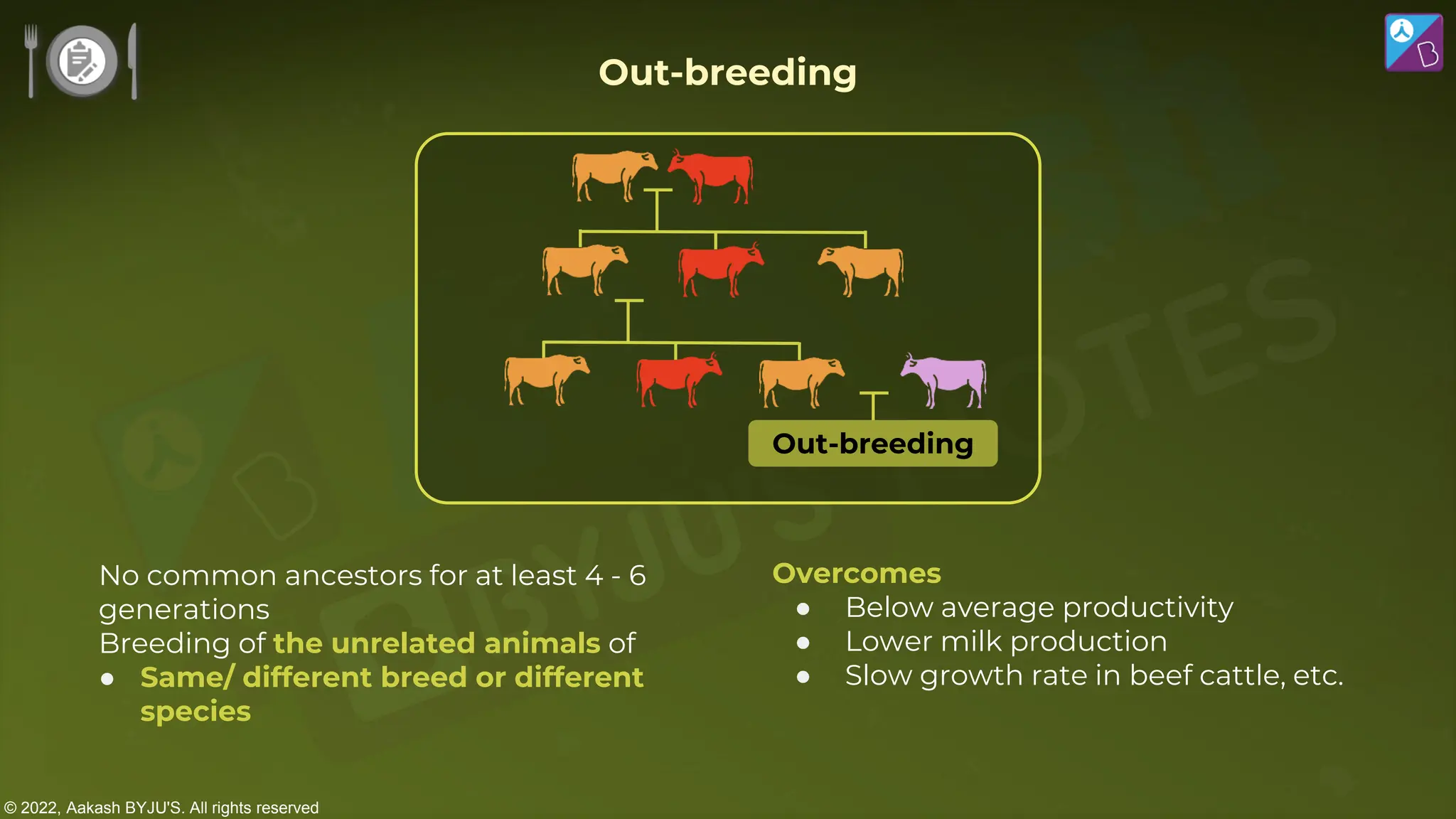
Out-breeding
Overcomes
● Below average productivity
● Lower milk production
● Slow growth rate in beef cattle, etc.
Out-breeding
No common ancestors for at least 4 - 6
generations
Breeding of the unrelated animals of
● Same/ different breed or different
species
© 2022, Aakash BYJU'S. All rights reserved
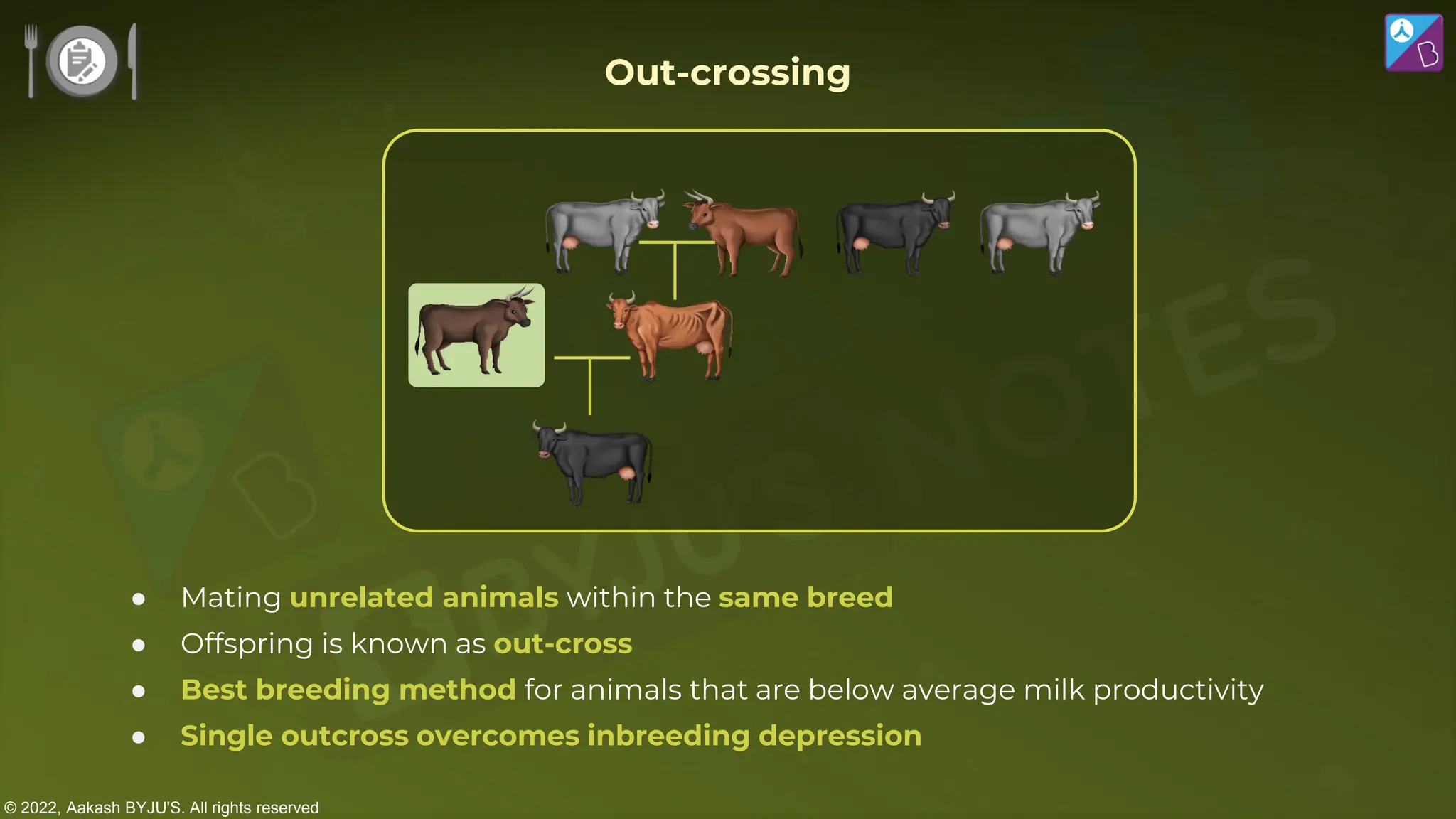
● Mating unrelated animals within the same breed
● Offspring is known as out-cross
● Best breeding method for animals that are below average milk productivity
● Single outcross overcomes inbreeding depression
Out-crossing
© 2022, Aakash BYJU'S. All rights reserved
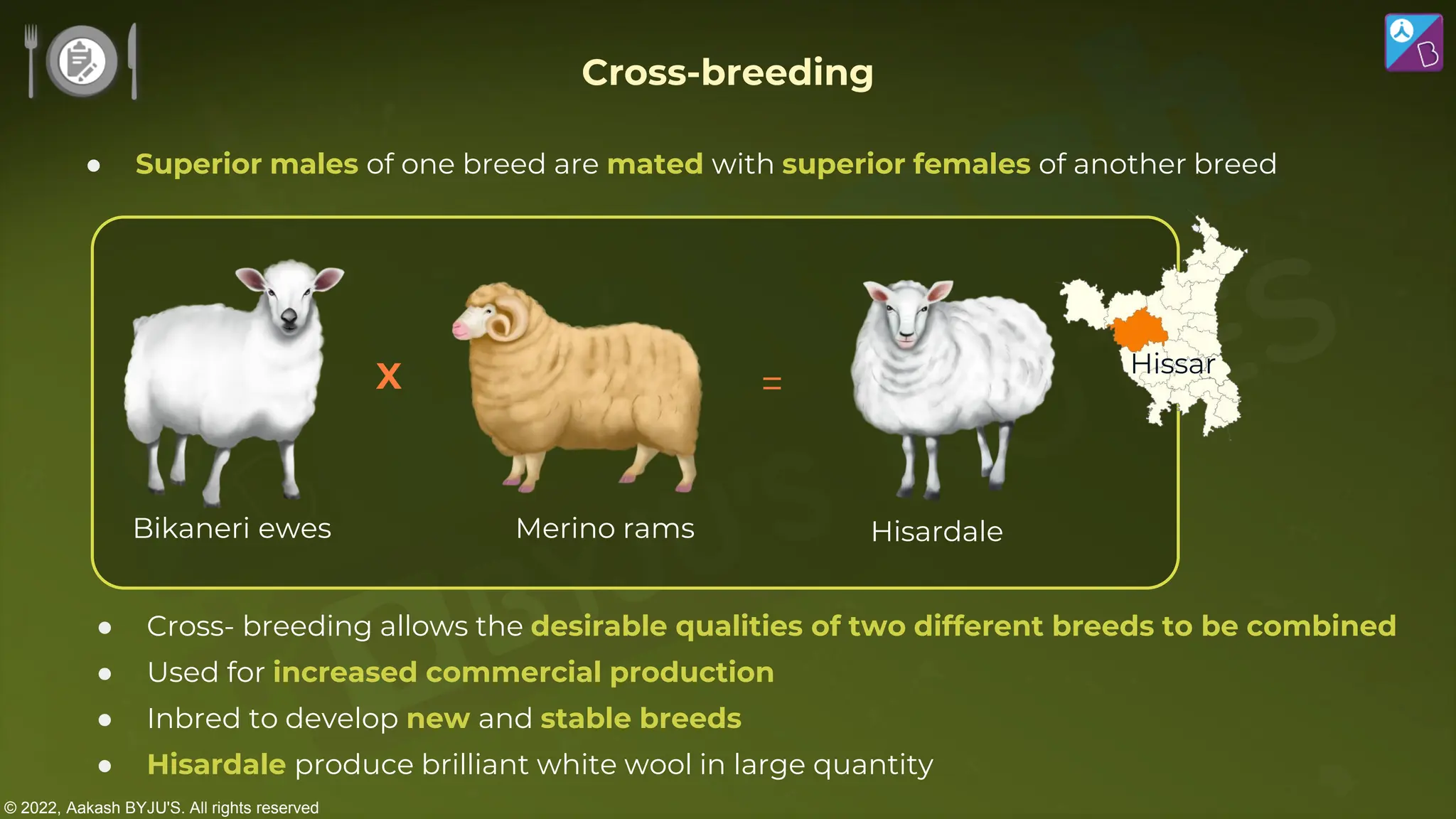
Merino rams
Bikaneri ewes
X =
Hisardale
Hissar
● Cross- breeding allows the desirable qualities of two different breeds to be combined
● Used for increased commercial production
● Inbred to develop new and stable breeds
● Hisardale produce brilliant white wool in large quantity
● Superior males of one breed are mated with superior females of another breed
Cross-breeding
© 2022, Aakash BYJU'S. All rights reserved
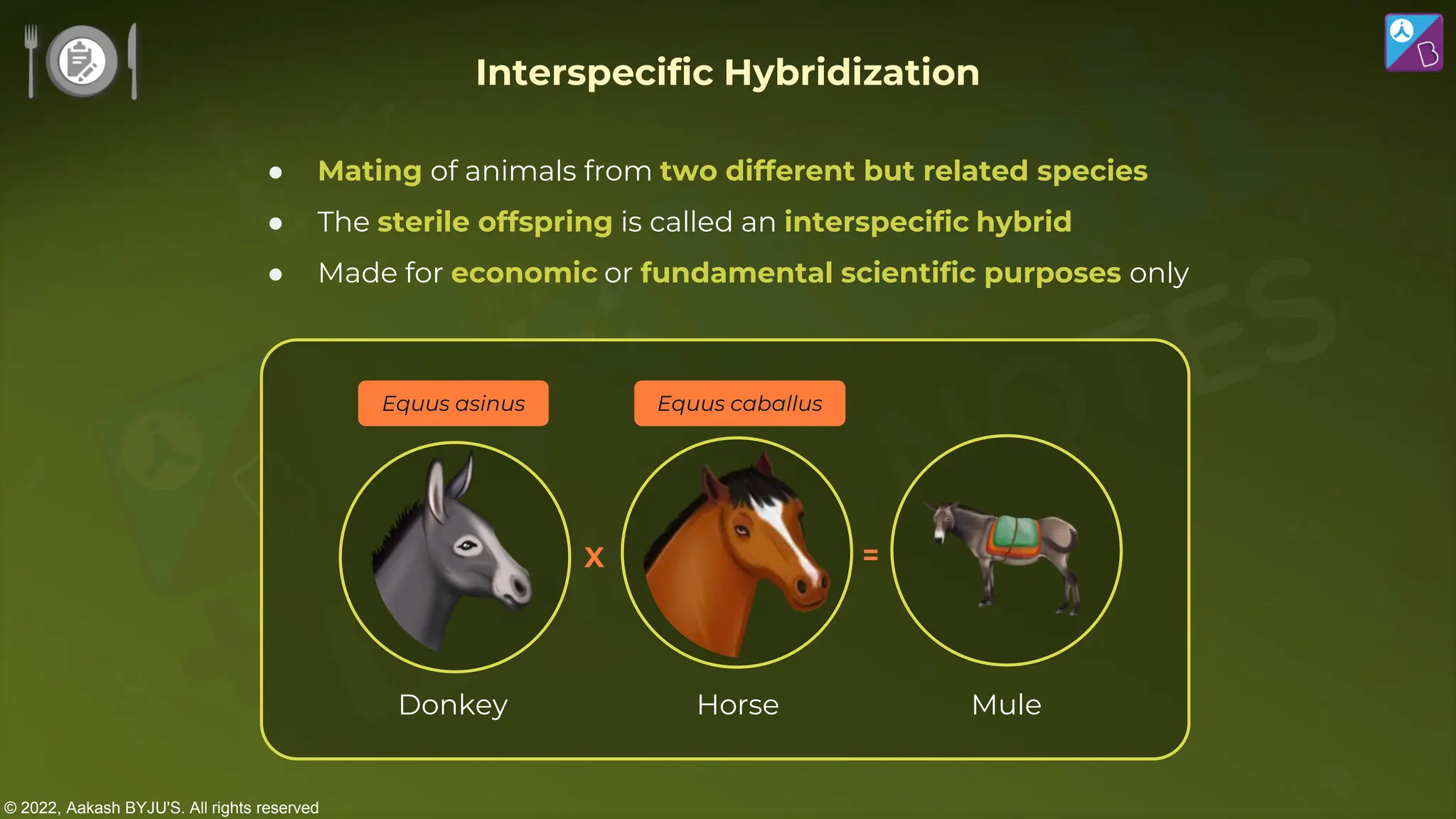
● Mating of animals from two different but related species
● The sterile offspring is called an interspecific hybrid
● Made for economic or fundamental scientific purposes only
Interspecific Hybridization
X =
Donkey Horse Mule
Equus asinus Equus caballus
© 2022, Aakash BYJU'S. All rights reserved
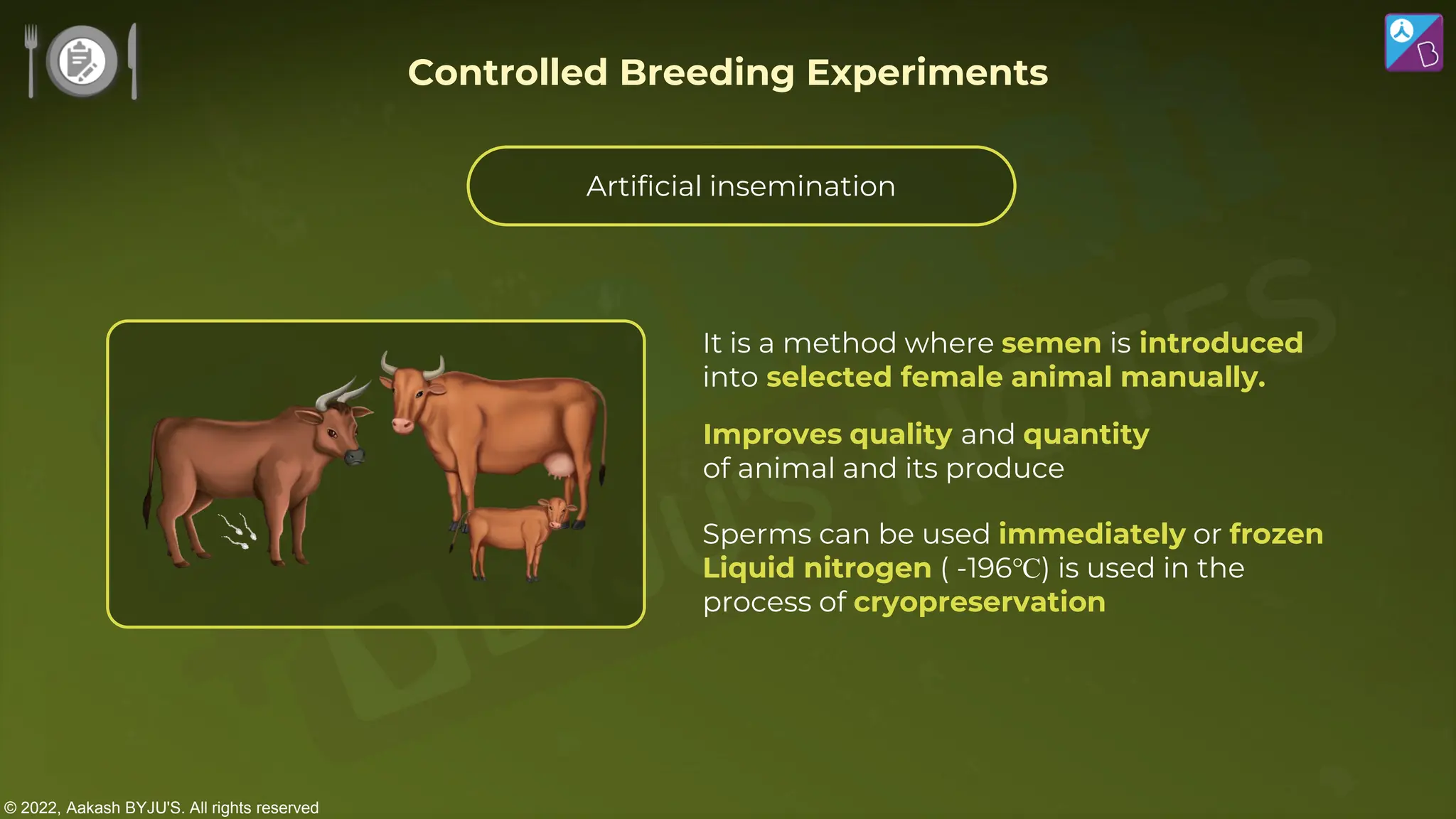
Artificial insemination
It is a method where semen is introduced
into selected female animal manually.
Improves quality and quantity
of animal and its produce
Sperms can be used immediately or frozen
Liquid nitrogen ( -196℃) is used in the
process of cryopreservation
Controlled Breeding Experiments
© 2022, Aakash BYJU'S. All rights reserved
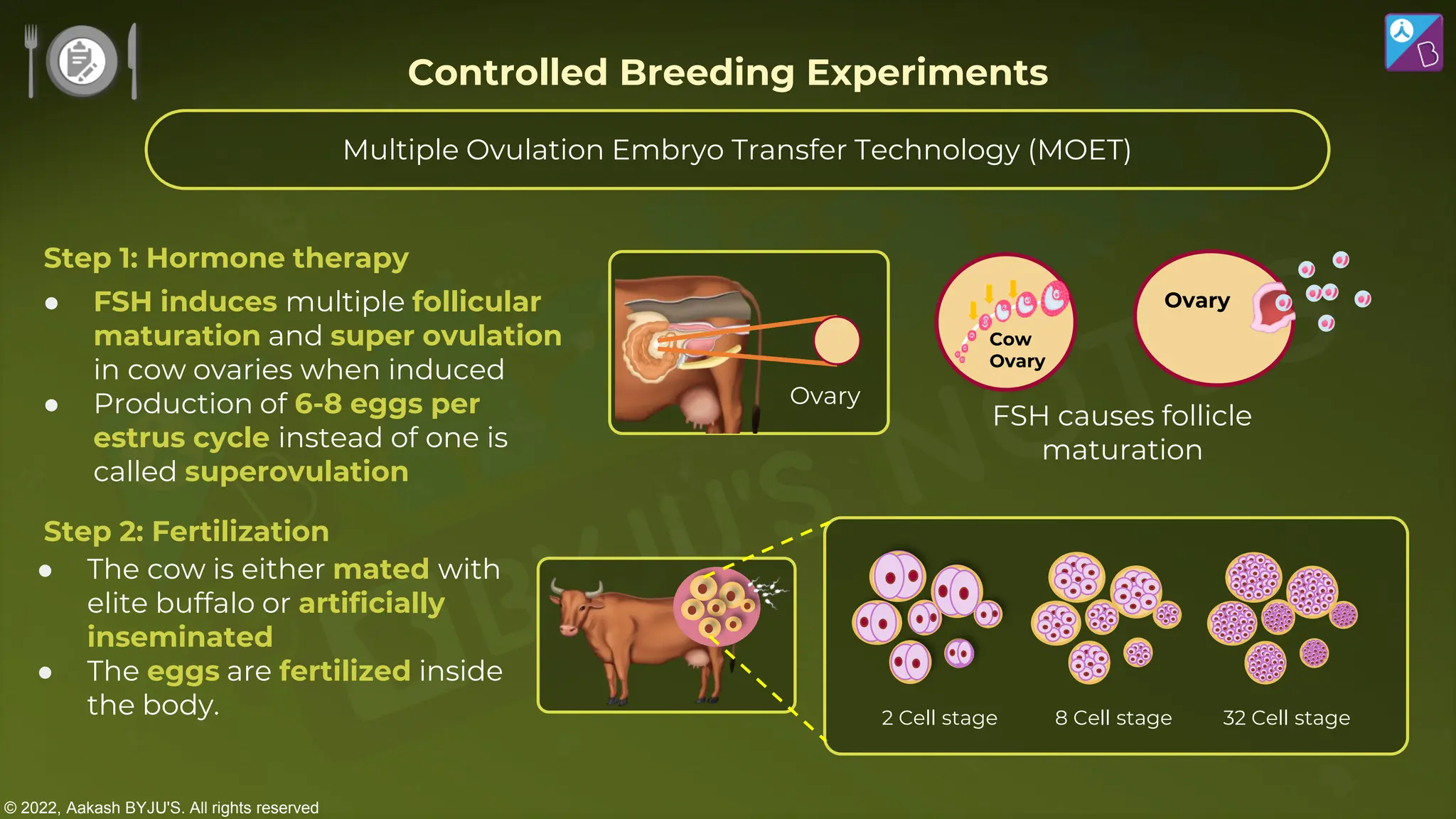
Multiple Ovulation Embryo Transfer Technology (MOET)
Ovary
Step 1: Hormone therapy
Cow
Ovary
● FSH induces multiple follicular
maturation and super ovulation
in cow ovaries when induced
● Production of 6-8 eggs per
estrus cycle instead of one is
called superovulation
FSH causes follicle
maturation
Step 2: Fertilization
● The cow is either mated with
elite buffalo or artificially
inseminated
● The eggs are fertilized inside
the body. 2 Cell stage 8 Cell stage 32 Cell stage
Controlled Breeding Experiments
© 2022, Aakash BYJU'S. All rights reserved
 Embryos (of 8-32 cell
staged) are non-
surgically removed from
the cow.
 These embryos are
○ implanted into uterus
of the surrogate cows
○ grow and develop into
babies in the surrogate
cow
 Embryos develop into
offspring of desired
quality same as genetic
parents
8-32 cell stage embryos
32 cell stage
Surrogate
cows
Repeat Step 1 - 3
 Genetic mother is ready
for next round of
superovulation
 This technique has been
successful in cattle-
sheep, rabbits, buffaloes,
mares, etc.
Multiple eggs
Controlled Breeding Experiments
Step 3: Mating
Multiple Ovulation Embryo Transfer Technology (MOET)
© 2022, Aakash BYJU'S. All rights reserved
Controlled Breeding Experiments
Multiple Ovulation Embryo Transfer Technology (MOET)
Frozen semen can be stored and
transported
Economical, with high rate of
successful fertilisation
Up to 3000 cows can be fertilised by
the semen of one bull
Advantages
© 2022, Aakash BYJU'S. All rights reserved
In India, this is the most common which is found in the wild
Care and management of honeybees for honey and beeswax
Apis indica
(Indian bee)
Apiculture
 Bees are the pollinators
(entomophily) for crops
like sunflower, Brassica,
apple, pear etc.
 Increases pollination
efficiency and improves
the yield of honey.
Artificial beehive is an artificial structure, generally consists
if wooden boxes to house a bee nest
© 2022, Aakash BYJU'S. All rights reserved
Knowledge of
bees and their habits
Suitable location
for keeping beehives
Catching and rearing
of bees
Management of beehives
during different season
Proper handling and collection
of honey and beeswax
Important points for
the success of
beekeeping
Apiculture
© 2022, Aakash BYJU'S. All rights reserved
Queen honeybee
 Larger
 One queen per hive
 Diploid, fertile female
 Lays both fertilised
and unfertilized eggs
 Feeds on royal jelly
 Smallest
 Maximum in numbers
 Diploid, sterile female
 Housekeeping, feeding
the queen, drones and
larvae, collecting the
pollen and nectar, and
making the wax
Worker honeybee
Drone honeybee
 Smaller than queen
 ~200-300 per hive
 Haploid, fertile male
 Fertilises the queen’s eggs
 Developed
parthenogenetically from
unfertilised eggs
Apiculture
Social organisation of honeybee (Polymorphic)
© 2022, Aakash BYJU'S. All rights reserved
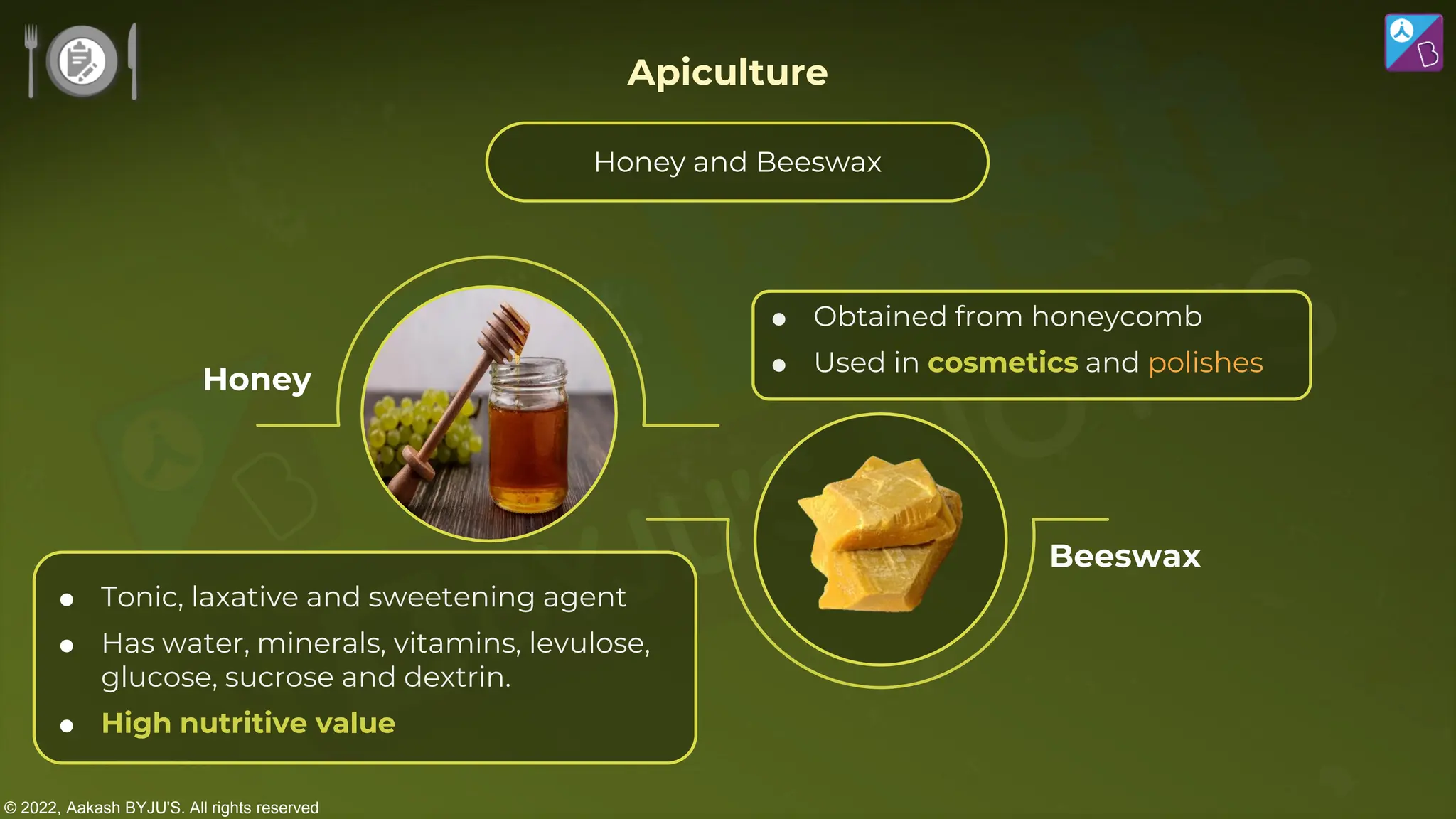
Honey
Beeswax
 Obtained from honeycomb
 Used in cosmetics and polishes
 Tonic, laxative and sweetening agent
 Has water, minerals, vitamins, levulose,
glucose, sucrose and dextrin.
 High nutritive value
Apiculture
Honey and Beeswax
© 2022, Aakash BYJU'S. All rights reserved
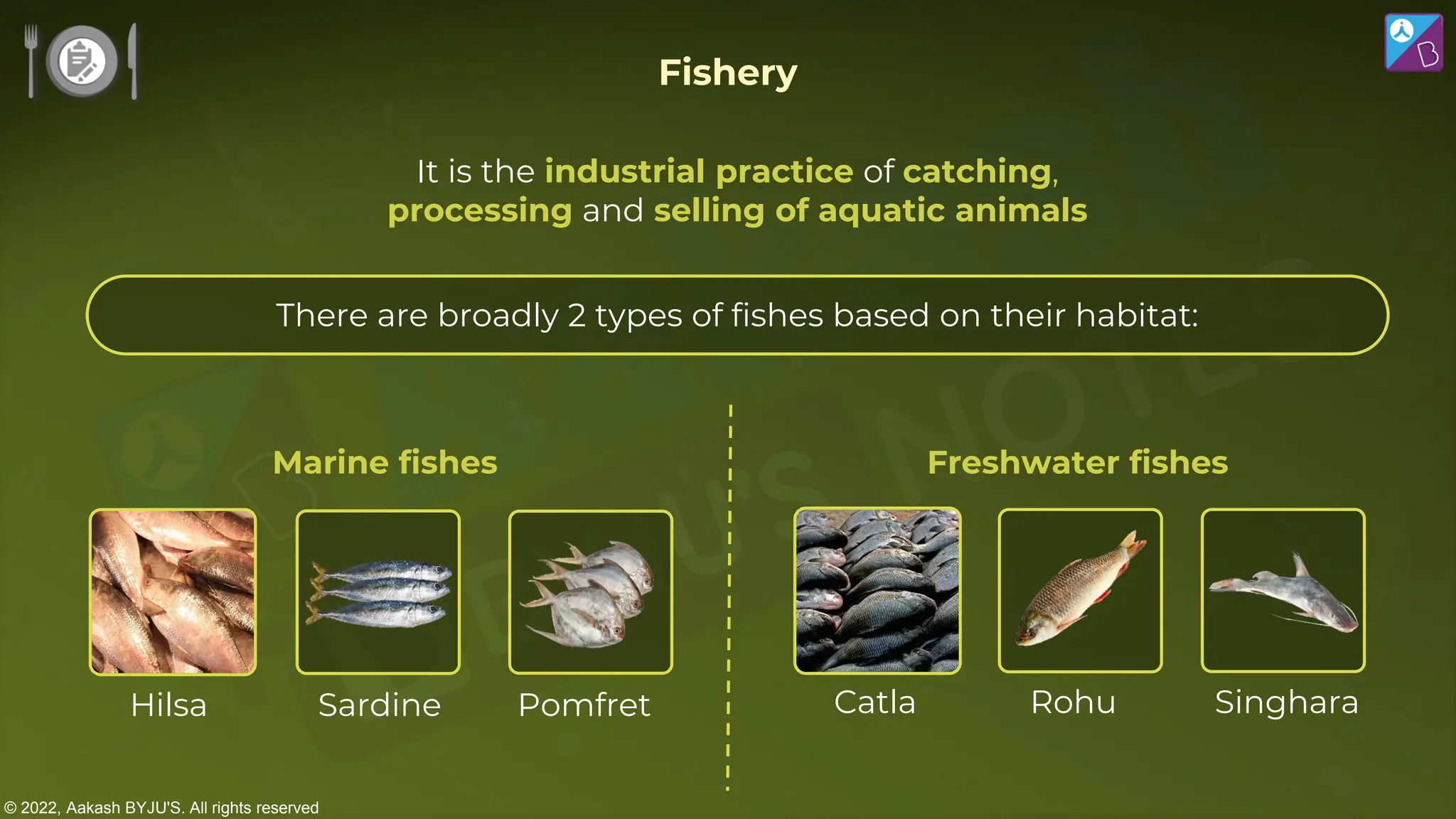
It is the industrial practice of catching,
processing and selling of aquatic animals
Marine fishes
Hilsa Sardine Pomfret
Freshwater fishes
Catla Singhara
Rohu
Fishery
There are broadly 2 types of fishes based on their habitat:
© 2022, Aakash BYJU'S. All rights reserved
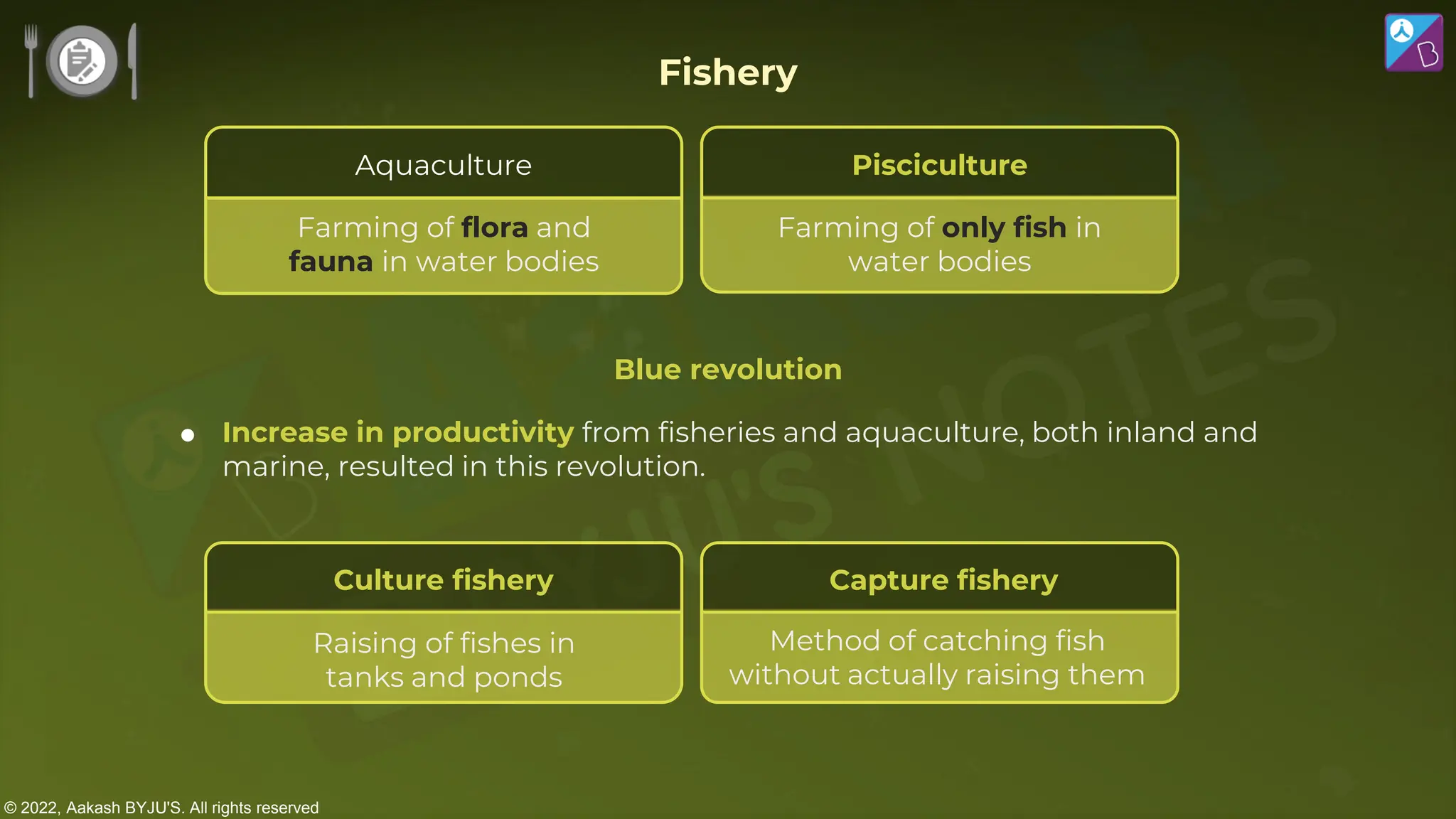
Aquaculture
Farming of flora and
fauna in water bodies
Pisciculture
Farming of only fish in
water bodies
 Increase in productivity from fisheries and aquaculture, both inland and
marine, resulted in this revolution.
Blue revolution
Culture fishery
Raising of fishes in
tanks and ponds
Capture fishery
Method of catching fish
without actually raising them
Fishery
© 2022, Aakash BYJU'S. All rights reserved
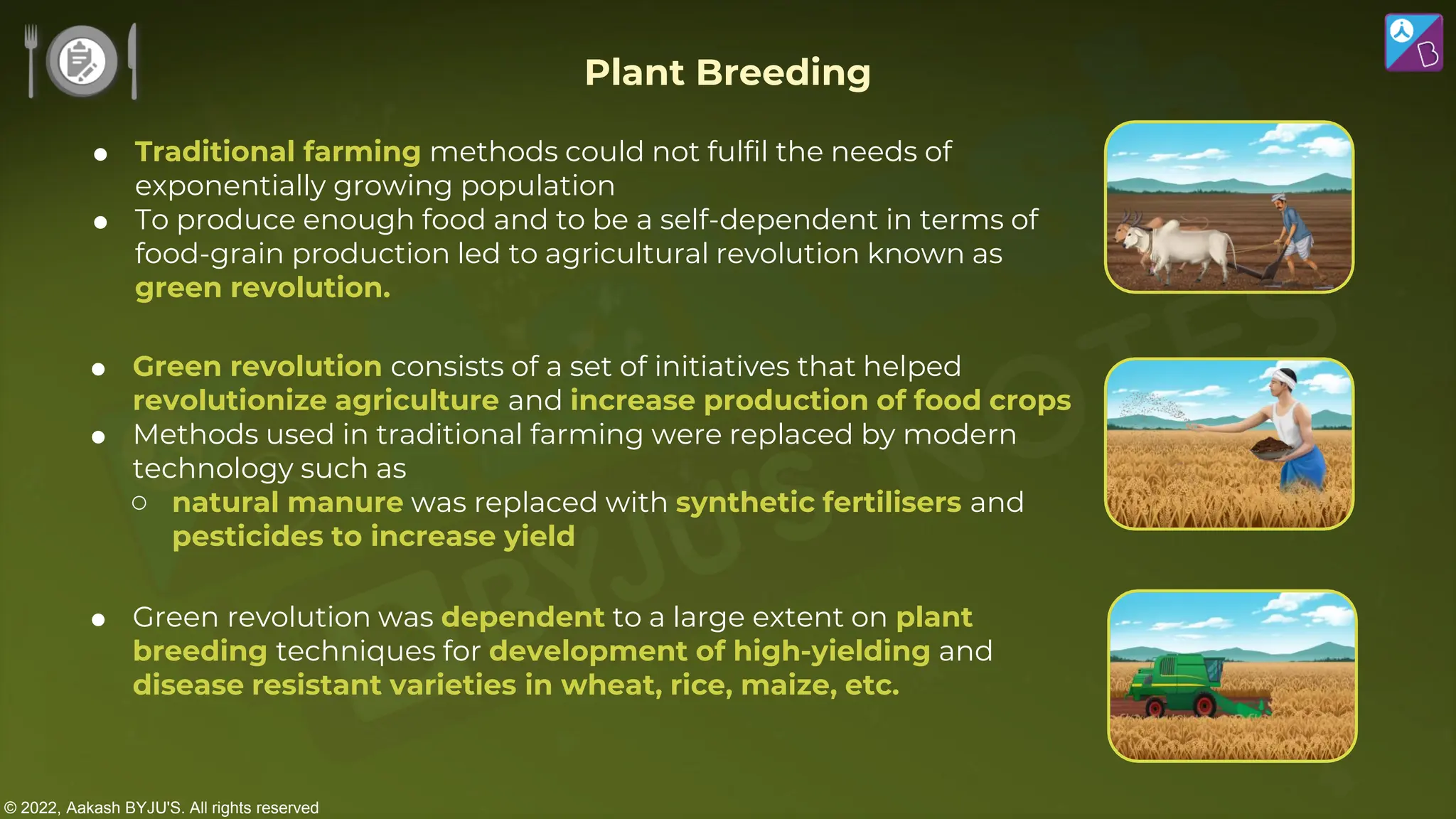
 Traditional farming methods could not fulfil the needs of
exponentially growing population
 To produce enough food and to be a self-dependent in terms of
food-grain production led to agricultural revolution known as
green revolution.
Plant Breeding
 Green revolution consists of a set of initiatives that helped
revolutionize agriculture and increase production of food crops
 Methods used in traditional farming were replaced by modern
technology such as
○ natural manure was replaced with synthetic fertilisers and
pesticides to increase yield
 Green revolution was dependent to a large extent on plant
breeding techniques for development of high-yielding and
disease resistant varieties in wheat, rice, maize, etc.
© 2022, Aakash BYJU'S. All rights reserved
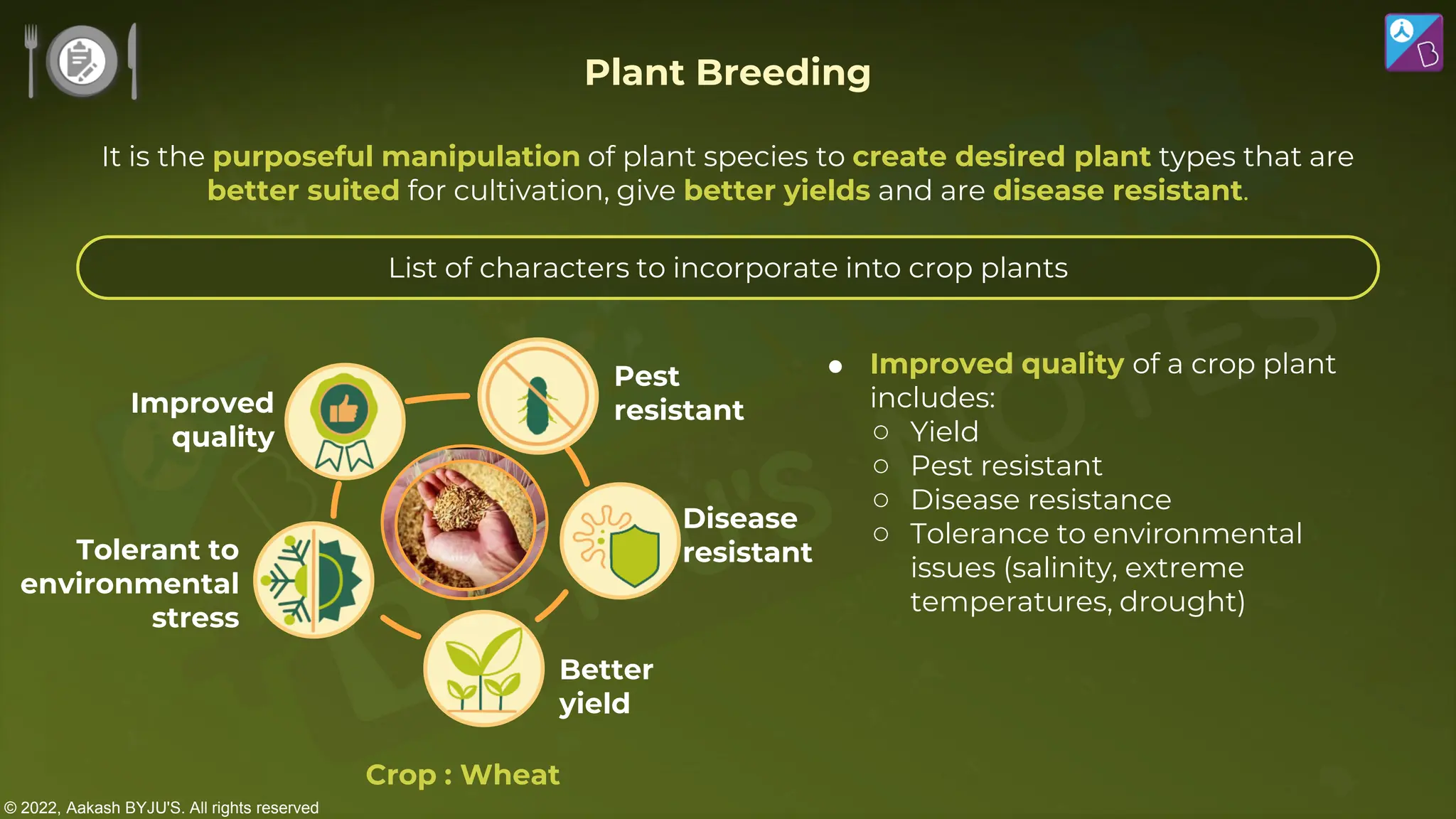
List of characters to incorporate into crop plants
Disease
resistant
Pest
resistant
Better
yield
Tolerant to
environmental
stress
Improved
quality
Crop : Wheat
 Improved quality of a crop plant
includes:
○ Yield
○ Pest resistant
○ Disease resistance
○ Tolerance to environmental
issues (salinity, extreme
temperatures, drought)
It is the purposeful manipulation of plant species to create desired plant types that are
better suited for cultivation, give better yields and are disease resistant.
Plant Breeding
© 2022, Aakash BYJU'S. All rights reserved
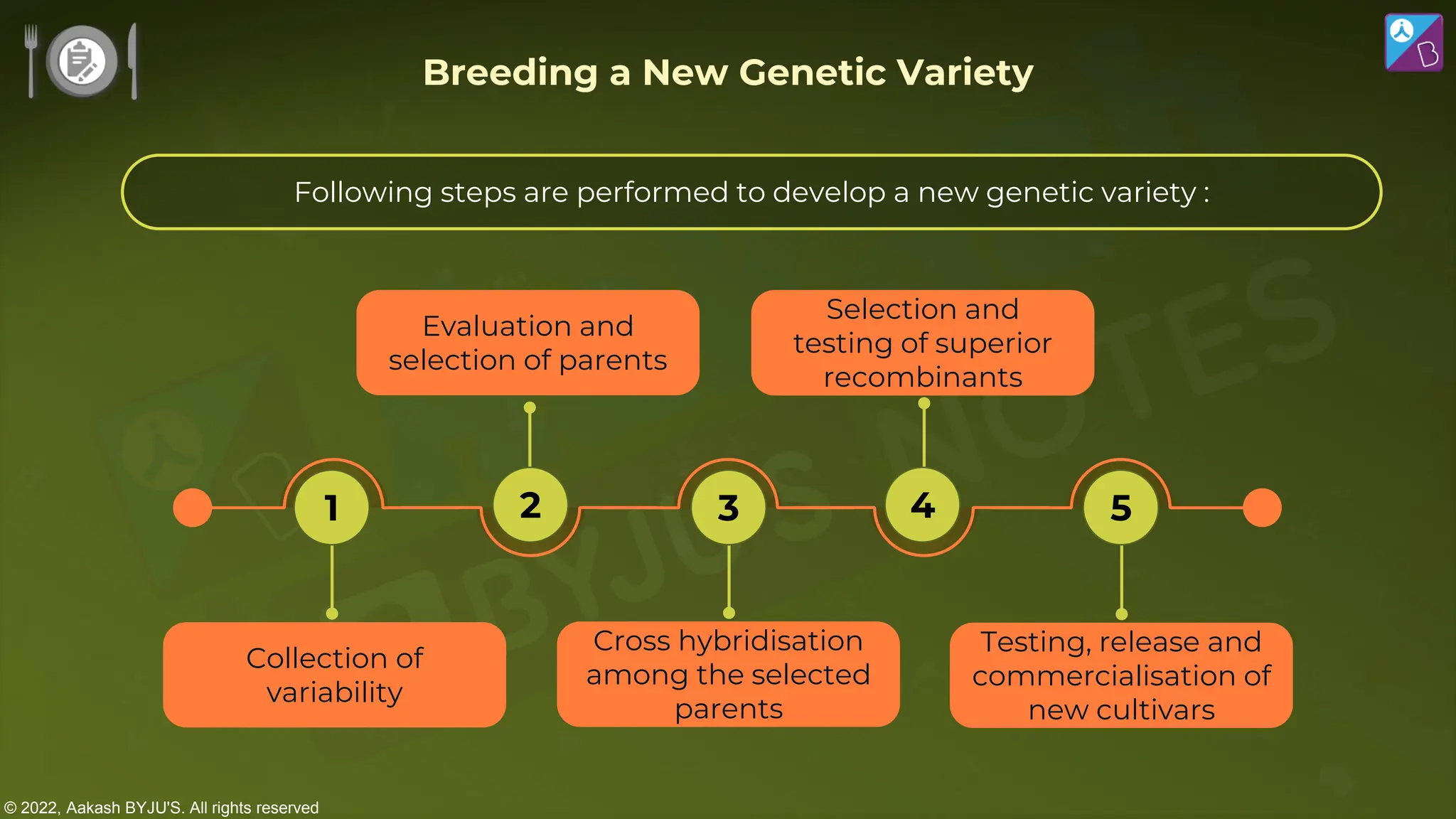
Following steps are performed to develop a new genetic variety :
Collection of
variability
Evaluation and
selection of parents
Selection and
testing of superior
recombinants
Breeding a New Genetic Variety
1 2 3 4 5
Cross hybridisation
among the selected
parents
Testing, release and
commercialisation of
new cultivars
© 2022, Aakash BYJU'S. All rights reserved
 In many crops, pre-existing genetic variability is available in the wild varieties
of the crop.
Figure showing different varieties of a plant
Variety 1 Variety 2 Variety 3 Variety 4 Variety 5
 The entire collection (of plants/seeds)
having all the diverse alleles for all
genes in a given crop is called
germplasm collection.
 It includes all the diverse alleles.
 Example: The wild variety along with
the various types of wheat crops,
together comprise the germplasm
collection.
The first step is to collect, evaluate characteristics and preserve different wild varieties,
species and relatives of all the cultivated species
Breeding a New Genetic Variety
Collection of variability
© 2022, Aakash BYJU'S. All rights reserved
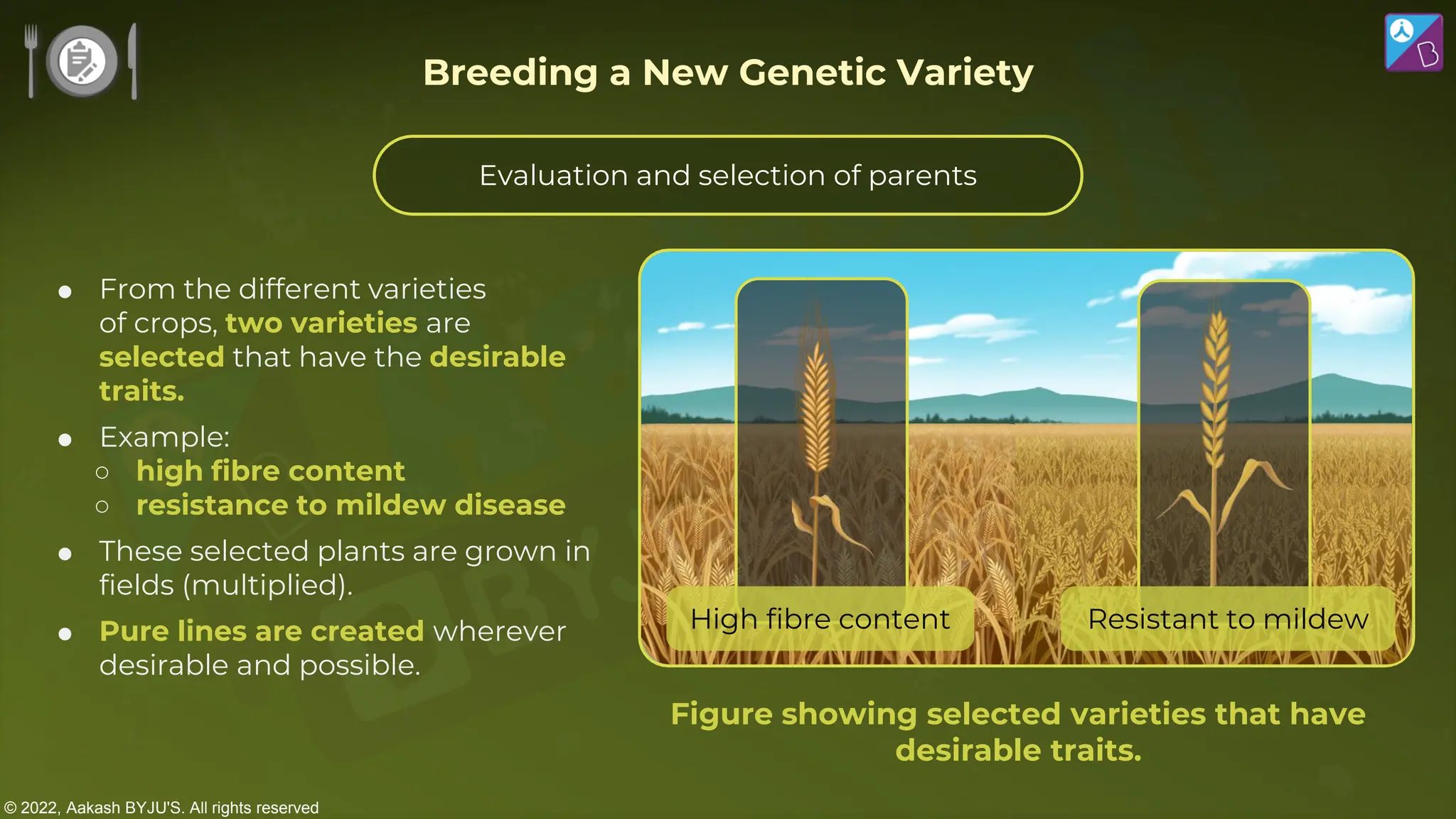
 From the different varieties
of crops, two varieties are
selected that have the desirable
traits.
 Example:
○ high fibre content
○ resistance to mildew disease
 These selected plants are grown in
fields (multiplied).
 Pure lines are created wherever
desirable and possible.
Figure showing selected varieties that have
desirable traits.
Evaluation and selection of parents
Resistant to mildew
High fibre content
Breeding a New Genetic Variety
© 2022, Aakash BYJU'S. All rights reserved
 Parents are cross hybridised to
produce offspring.
 These offspring are genetic
combinations of the desired
characters in one plant.
 Example: The pollen from male plant
with high fibre content is transferred to
the female plant which is resistant to
mildew
High fibre
content
Resistant to
mildew
Figure showing selected varieties
that have desirable traits.
Cross hybridisation among the selected parents
Breeding a New Genetic Variety
© 2022, Aakash BYJU'S. All rights reserved
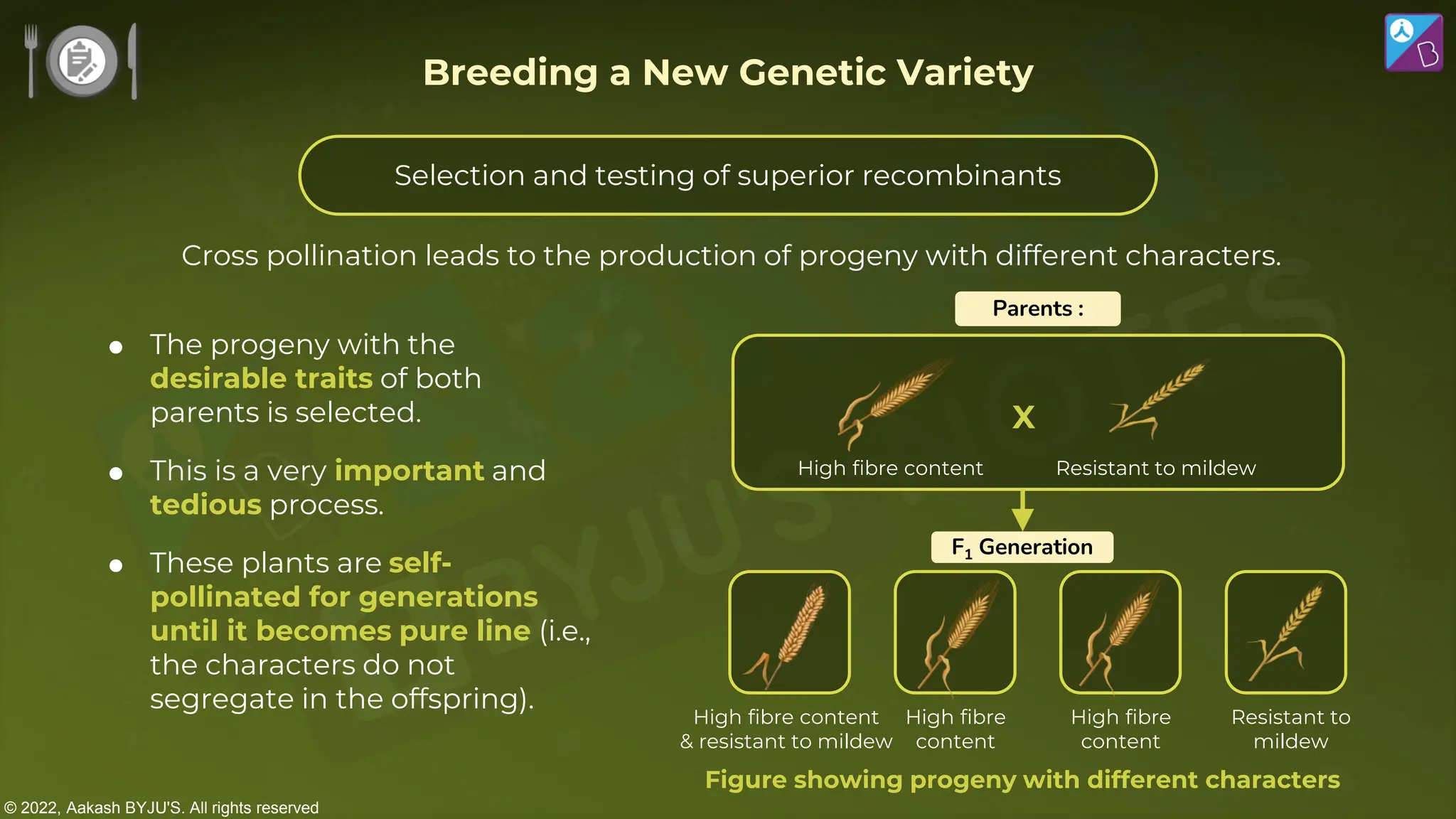
 The progeny with the
desirable traits of both
parents is selected.
 This is a very important and
tedious process.
 These plants are self-
pollinated for generations
until it becomes pure line (i.e.,
the characters do not
segregate in the offspring).
Cross pollination leads to the production of progeny with different characters.
X
High fibre content Resistant to mildew
High fibre content
& resistant to mildew
High fibre
content
High fibre
content
Resistant to
mildew
F1 Generation
Parents :
Figure showing progeny with different characters
Breeding a New Genetic Variety
Selection and testing of superior recombinants
© 2022, Aakash BYJU'S. All rights reserved
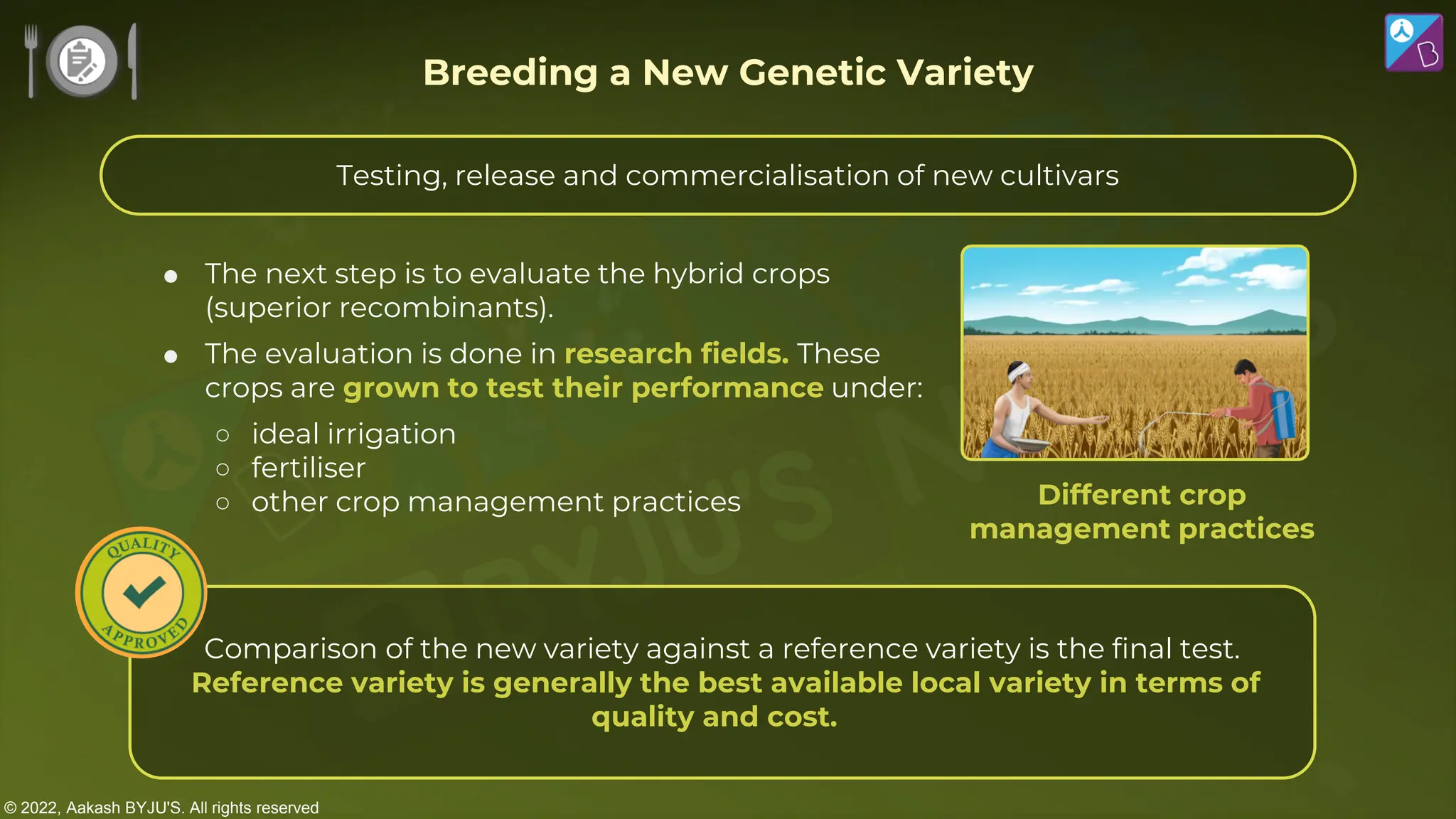
 The next step is to evaluate the hybrid crops
(superior recombinants).
 The evaluation is done in research fields. These
crops are grown to test their performance under:
○ ideal irrigation
○ fertiliser
○ other crop management practices Different crop
management practices
Comparison of the new variety against a reference variety is the final test.
Reference variety is generally the best available local variety in terms of
quality and cost.
Breeding a New Genetic Variety
Testing, release and commercialisation of new cultivars
© 2022, Aakash BYJU'S. All rights reserved
Wheat Rice
Semi- dwarf
wheat
 Kalyan Sona and Sonalika
○ Resistant to wheat rust (fungal
disease)
○ Short stature
○ Short maturity duration
 Cultivated all over wheat belt of India
such as Punjab, Haryana, Uttar Pradesh,
Bihar.
 IR-8, [developed at International Rice
Research Institute (IRRI), Philippines] –
a dwarf and high yielding variety
○ Later, a better yielding variety - Jaya
 Taichung Native-1 (from Taiwan) –
a semi dwarf and disease-resistant
○ Later, a better yielding variety - Ratna
Jaya and
Ratna
 As a result of green
revolution, wheat
production increased from
11 million tonnes to 75
million tonnes.
 As a result, rice production
increased from 35 million
tonnes to 89.5 million
tonnes.
High Yielding Varieties
0
1960 2000
Years
Yield
(tonnes)
20
40
60
80
100
Wheat
Rice
© 2022, Aakash BYJU'S. All rights reserved
Sugarcane Millet
 Saccharum barberi was grown in north
India
○ with poor sugar content and yield
 Saccharum officinarum was grown in
south India
○ thicker stems
○ high sugar content
○ does not grow in north India
 Millets grow in arid regions
 They include maize, jowar, bajra, finger
millet, etc.
 Hybrid maize, jowar and bajra were
successfully developed in India.
 Hybrid breeding have led to the
development of
○ high yielding varieties
○ resistant to water stress
Saccharum
barberi
Saccharum
officinarum
x
Thick Stem
High sugar content
High yield
Ability to grow in North India
Hybrid maize, jowar and bajra
Hybrid
variety
High Yielding Varieties
© 2022, Aakash BYJU'S. All rights reserved
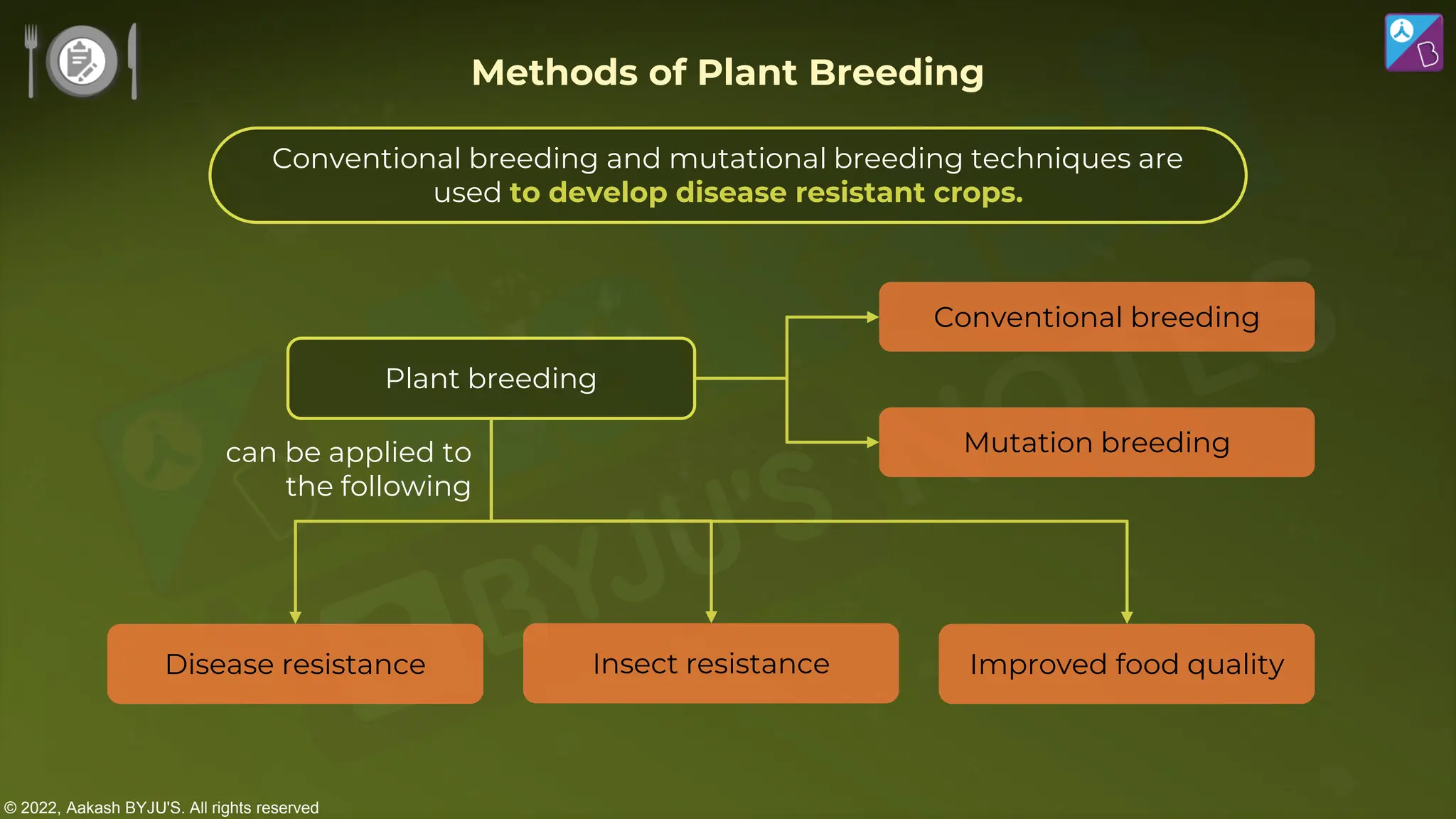
can be applied to
the following
Conventional breeding
Mutation breeding
Disease resistance Improved food quality
Insect resistance
Plant breeding
Methods of Plant Breeding
Conventional breeding and mutational breeding techniques are
used to develop disease resistant crops.
© 2022, Aakash BYJU'S. All rights reserved
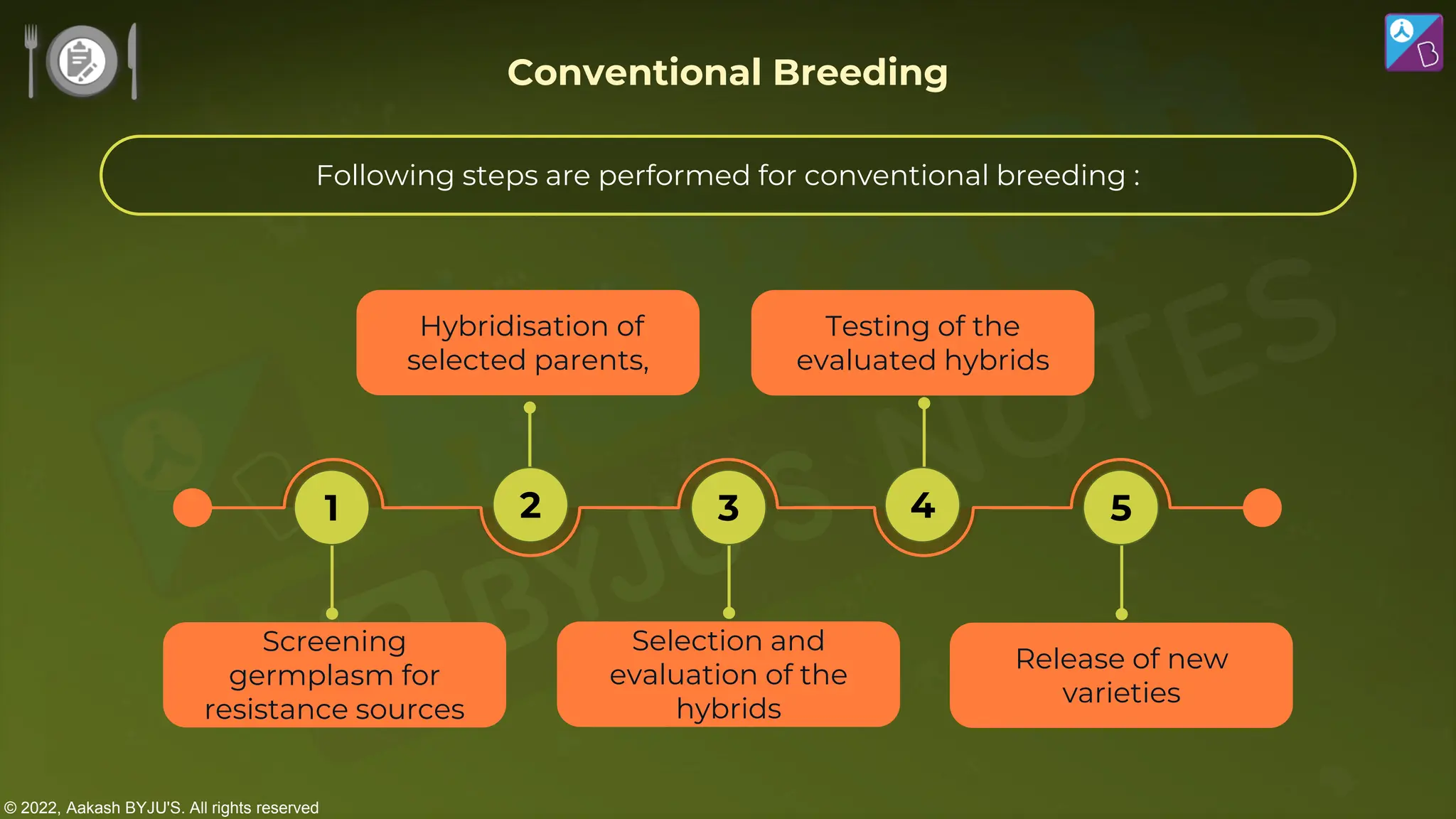
Conventional Breeding
Following steps are performed for conventional breeding :
Screening
germplasm for
resistance sources
Hybridisation of
selected parents,
Testing of the
evaluated hybrids
Selection and
evaluation of the
hybrids
Release of new
varieties
1 2 3 4 5
© 2022, Aakash BYJU'S. All rights reserved
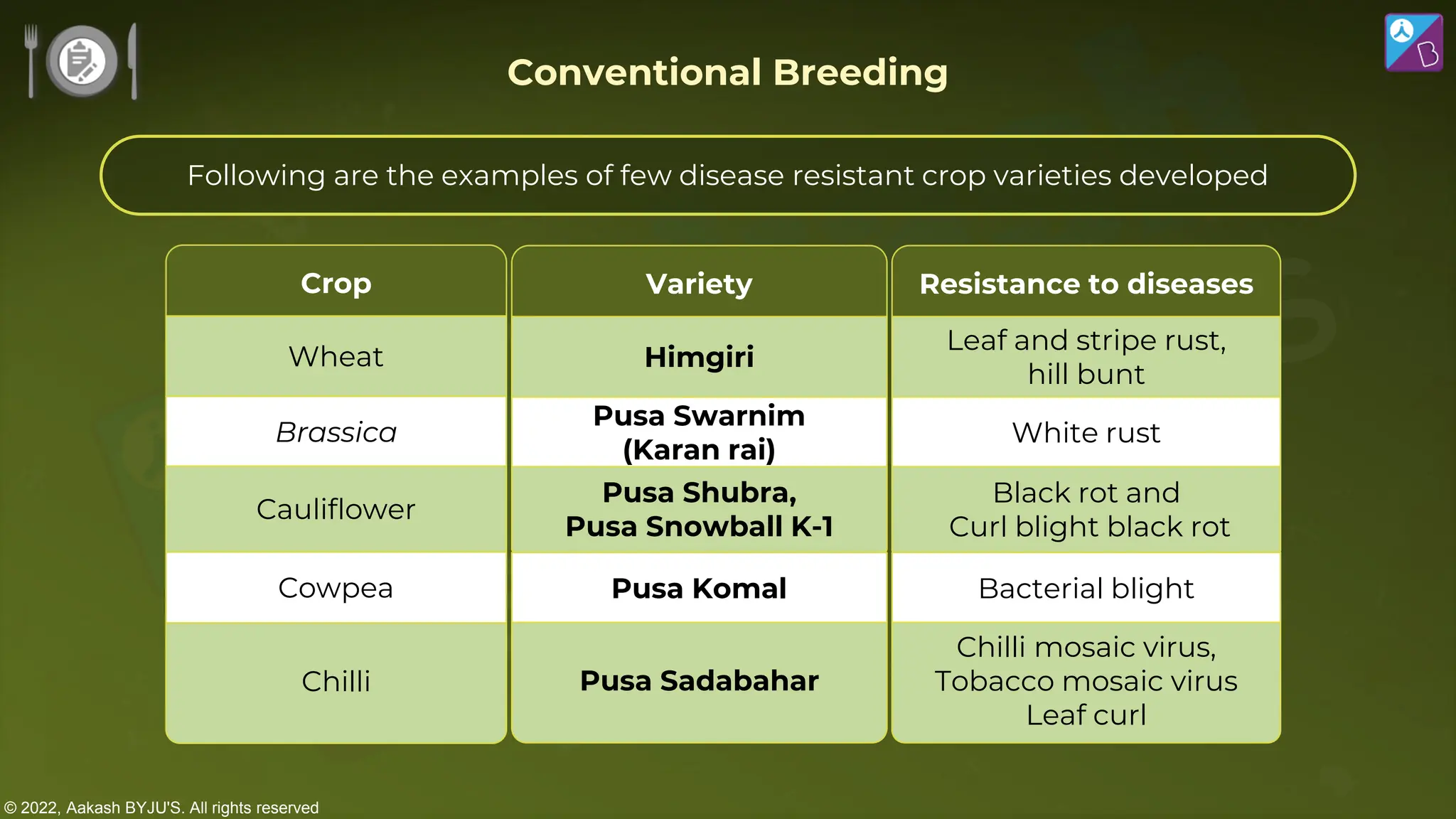
Resistance to diseases
Leaf and stripe rust,
hill bunt
White rust
Black rot and
Curl blight black rot
Bacterial blight
Chilli mosaic virus,
Tobacco mosaic virus
Leaf curl
Variety
Himgiri
Pusa Swarnim
(Karan rai)
Pusa Shubra,
Pusa Snowball K-1
Pusa Komal
Pusa Sadabahar
Crop
Wheat
Brassica
Cauliflower
Cowpea
Chilli
Conventional Breeding
Following are the examples of few disease resistant crop varieties developed
© 2022, Aakash BYJU'S. All rights reserved
● Probability of obtaining desired
combination of genes is low in hybrid crop
● Time consuming
● Tedious process
● Limited number of disease resistance
genes are present and identified in the
various crop varieties and wild relatives
Low probability of
desirable combination
Time consuming and
tedious process
Limited availability of
disease resistance
genes
Conventional Breeding
Limitations
© 2022, Aakash BYJU'S. All rights reserved
 Mutation leads to alteration of DNA sequences.
 It changes the genotype and thus phenotype.
 The characters obtained through mutations are not
found originally in the organism.
Causes
Physical Agents
Example : Radiation like UV
rays and X-rays
Biological Agents
Example : Viruses and
bacteria
Chemical Agents
Example : Cigarette
compounds, Benzoyl
peroxide
Mutation
© 2022, Aakash BYJU'S. All rights reserved
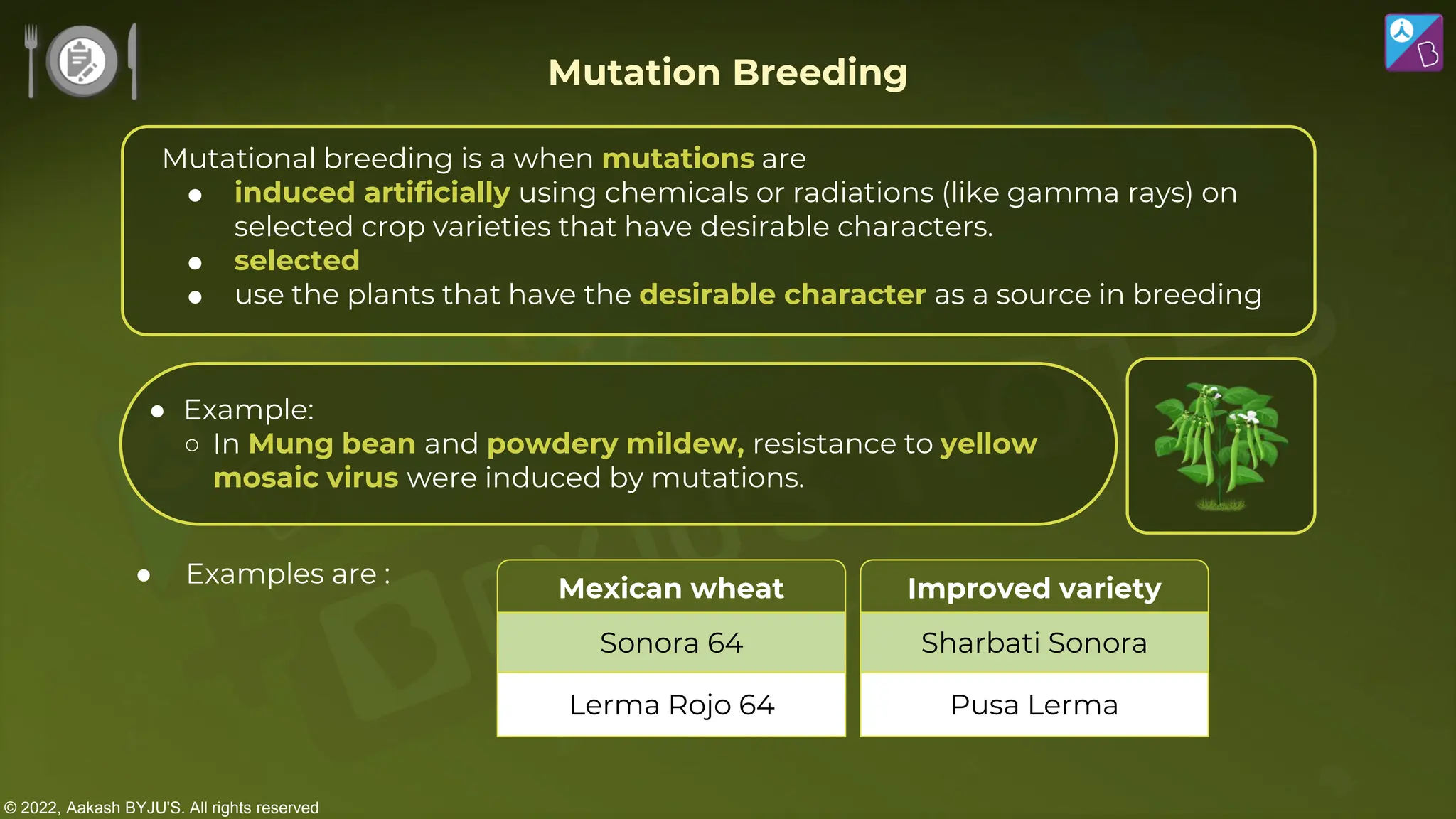
Mutational breeding is a when mutations are
 induced artificially using chemicals or radiations (like gamma rays) on
selected crop varieties that have desirable characters.
 selected
 use the plants that have the desirable character as a source in breeding
● Examples are :
Mutation Breeding
● Example:
○ In Mung bean and powdery mildew, resistance to yellow
mosaic virus were induced by mutations.
Improved variety
Sharbati Sonora
Pusa Lerma
Mexican wheat
Sonora 64
Lerma Rojo 64
© 2022, Aakash BYJU'S. All rights reserved
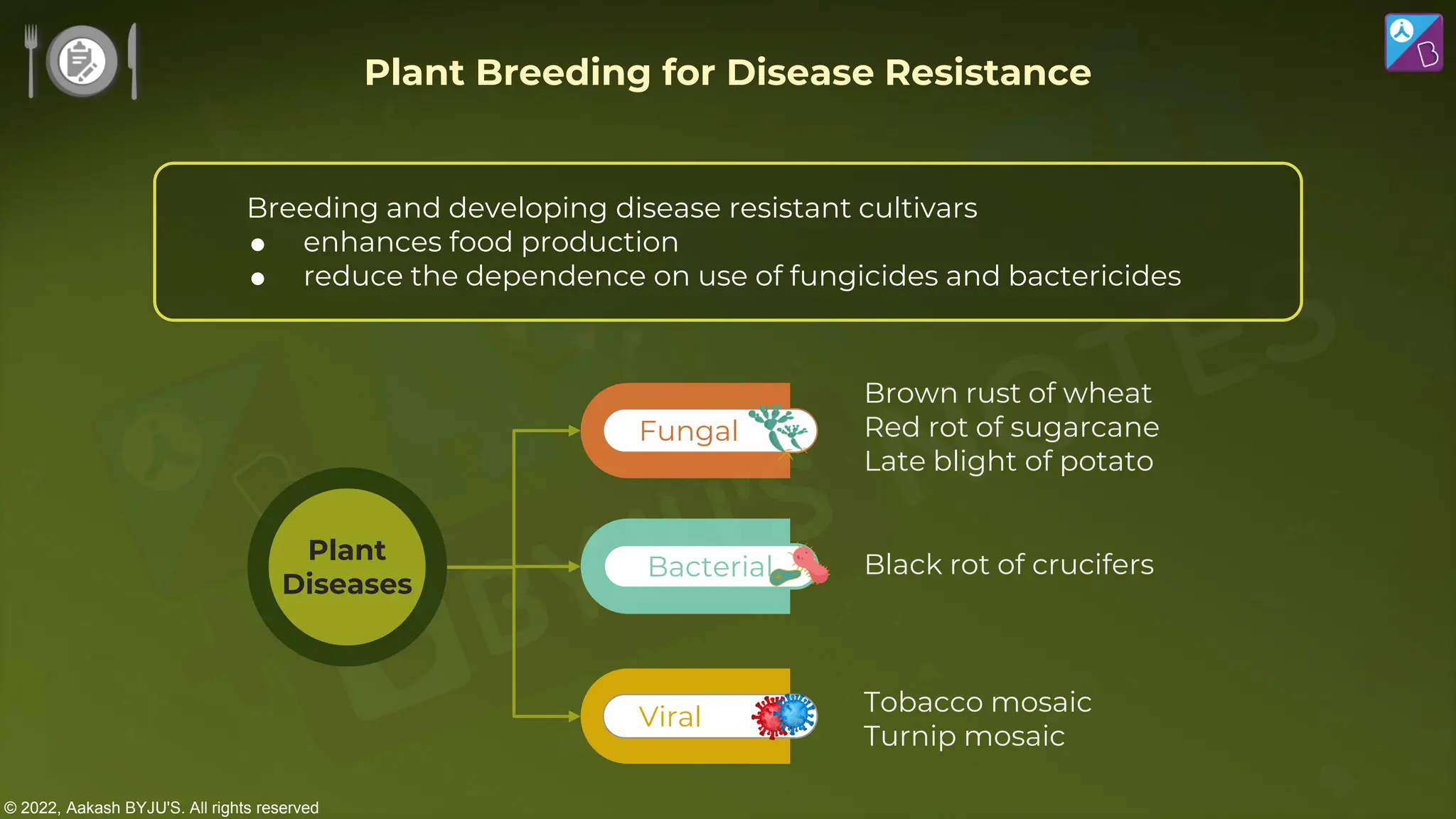
Plant Breeding for Disease Resistance
Breeding and developing disease resistant cultivars
 enhances food production
 reduce the dependence on use of fungicides and bactericides
Black rot of crucifers
Tobacco mosaic
Turnip mosaic
Brown rust of wheat
Red rot of sugarcane
Late blight of potato
Bacterial
Viral
Fungal
Plant
Diseases
© 2022, Aakash BYJU'S. All rights reserved
In cotton plants characteristics like:
● nectar less flowers
● smooth leaves
do not attract bollworms
Hair- like structures on leaves of
● cotton plants help in resisting attacks from
jassids
● wheat crop provide resistance against cereal
leaf beetle
Following characteristics in maize leads to resistance
to maize stem borers :
● high aspartic acid
● low nitrogen
● low sugar content
Plant Breeding for Resistance to Insect Pests
Physiological
Biochemical
Morphological
Insect
resistance
Major cause for large scale destruction of crop plant and crop
produce is insect and pest infestation
© 2022, Aakash BYJU'S. All rights reserved
Plant Breeding for Resistance to Insect Pests
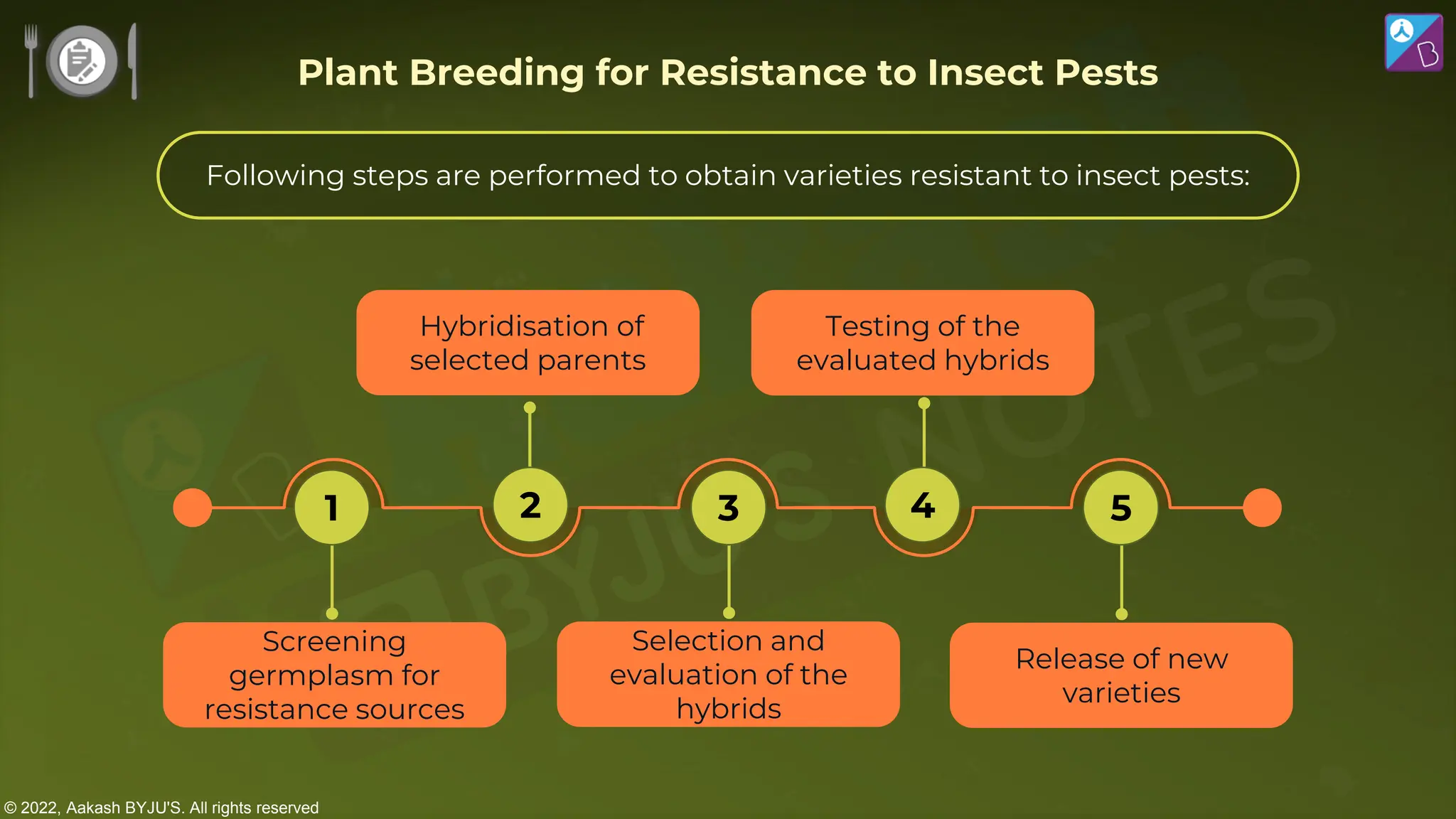
Following steps are performed to obtain varieties resistant to insect pests:
Screening
germplasm for
resistance sources
Hybridisation of
selected parents
Testing of the
evaluated hybrids
1 2 3 4 5
Selection and
evaluation of the
hybrids
Release of new
varieties
© 2022, Aakash BYJU'S. All rights reserved
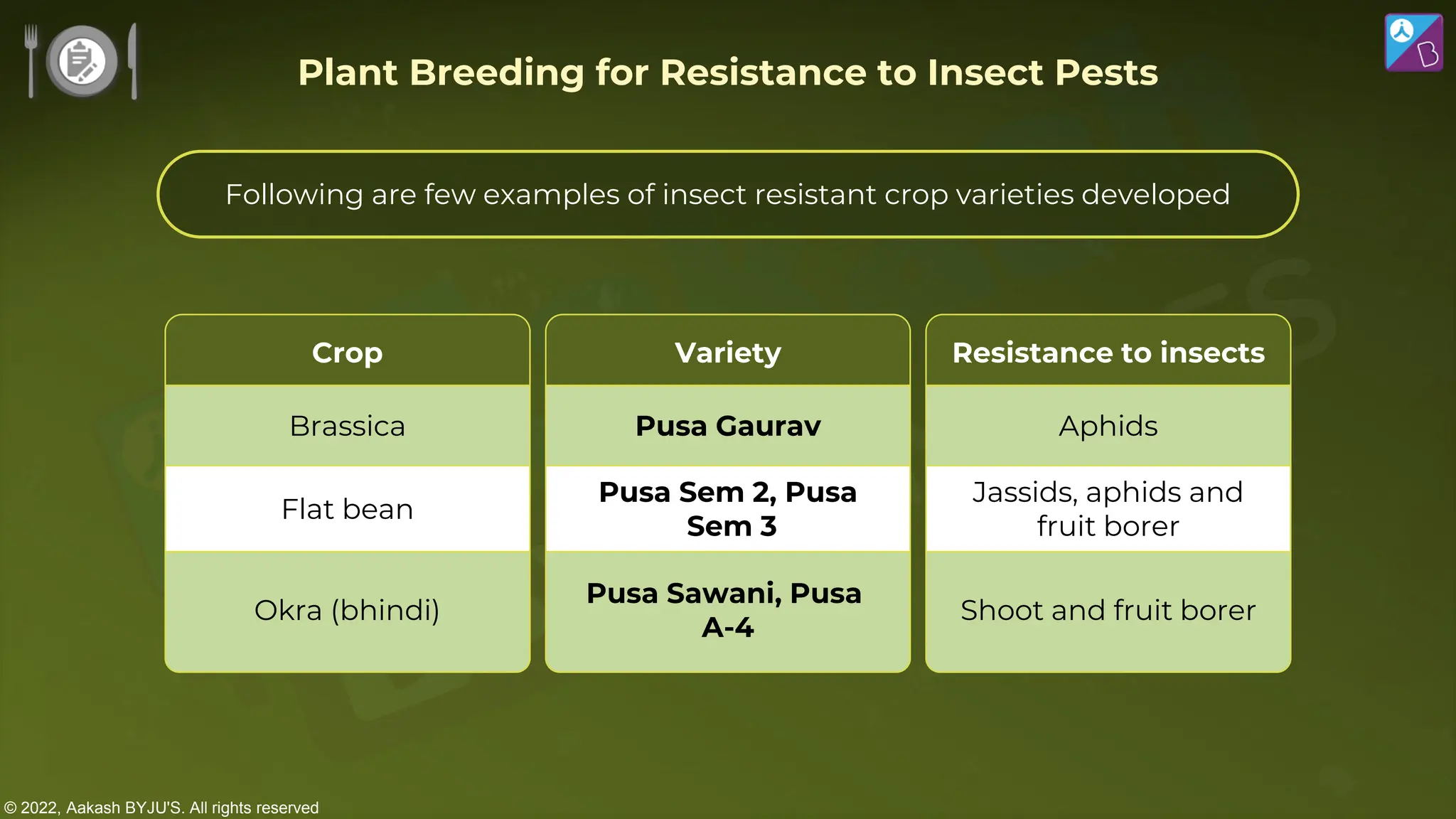
Variety
Pusa Gaurav
Pusa Sem 2, Pusa
Sem 3
Pusa Sawani, Pusa
A-4
Resistance to insects
Aphids
Jassids, aphids and
fruit borer
Shoot and fruit borer
Crop
Brassica
Flat bean
Okra (bhindi)
Plant Breeding for Resistance to Insect Pests
Following are few examples of insect resistant crop varieties developed
© 2022, Aakash BYJU'S. All rights reserved
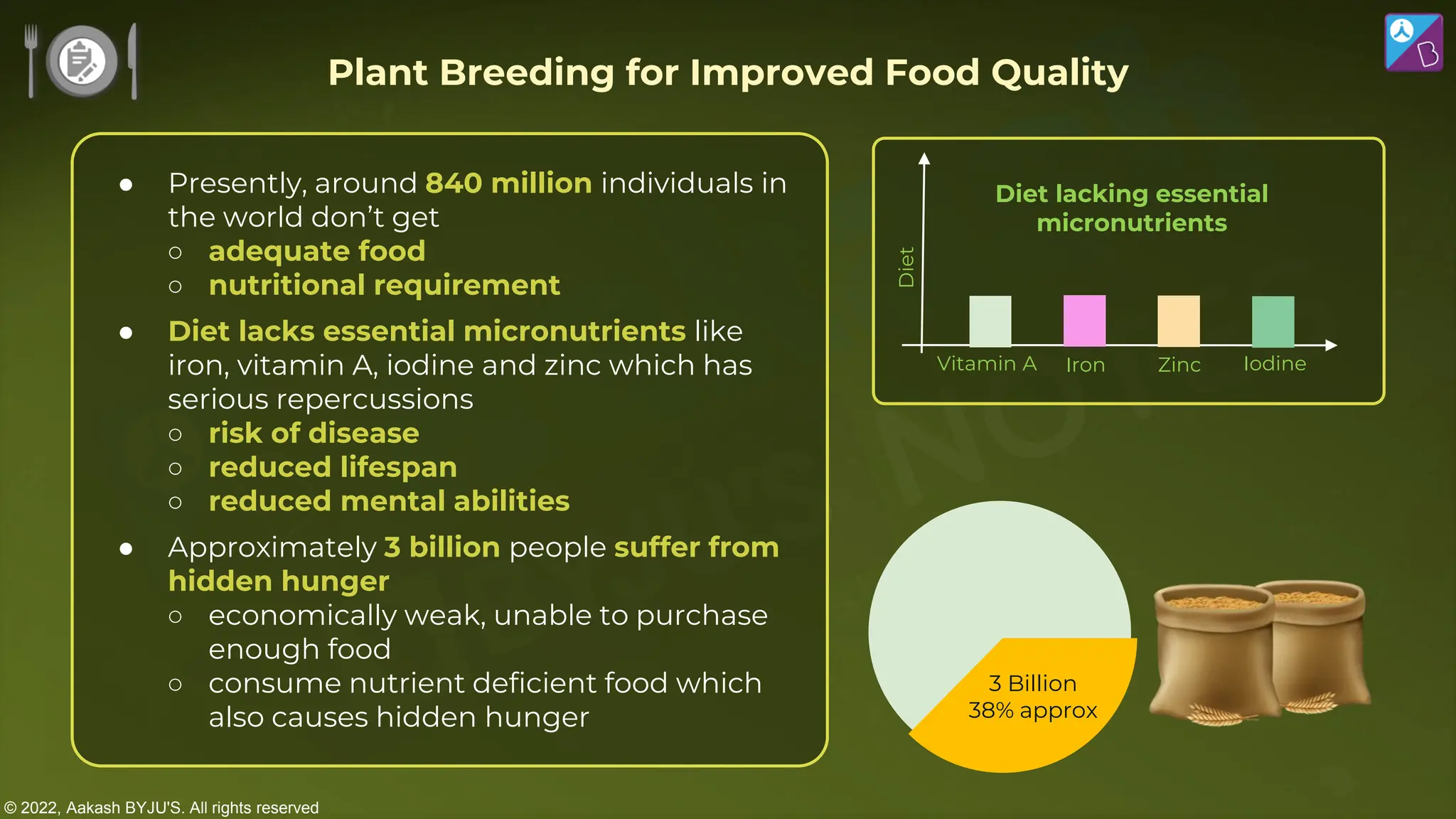
● Presently, around 840 million individuals in
the world don’t get
○ adequate food
○ nutritional requirement
● Diet lacks essential micronutrients like
iron, vitamin A, iodine and zinc which has
serious repercussions
○ risk of disease
○ reduced lifespan
○ reduced mental abilities
● Approximately 3 billion people suffer from
hidden hunger
○ economically weak, unable to purchase
enough food
○ consume nutrient deficient food which
also causes hidden hunger
Iron
Vitamin A
Diet
Iodine
Zinc
Diet lacking essential
micronutrients
3 Billion
38% approx
Plant Breeding for Improved Food Quality
© 2022, Aakash BYJU'S. All rights reserved
● Biofortification is the process of breeding crops with high levels of
vitamins and minerals, or higher protein and healthier fats.
● It is a great way to improve the nutritional aspect of food and
hence public health.
Plant Breeding for Improved Food Quality
Biofortification
4 major
objectives
Protein content and quality
Oil content and quality
Vitamin content
Micronutrient and mineral content
© 2022, Aakash BYJU'S. All rights reserved
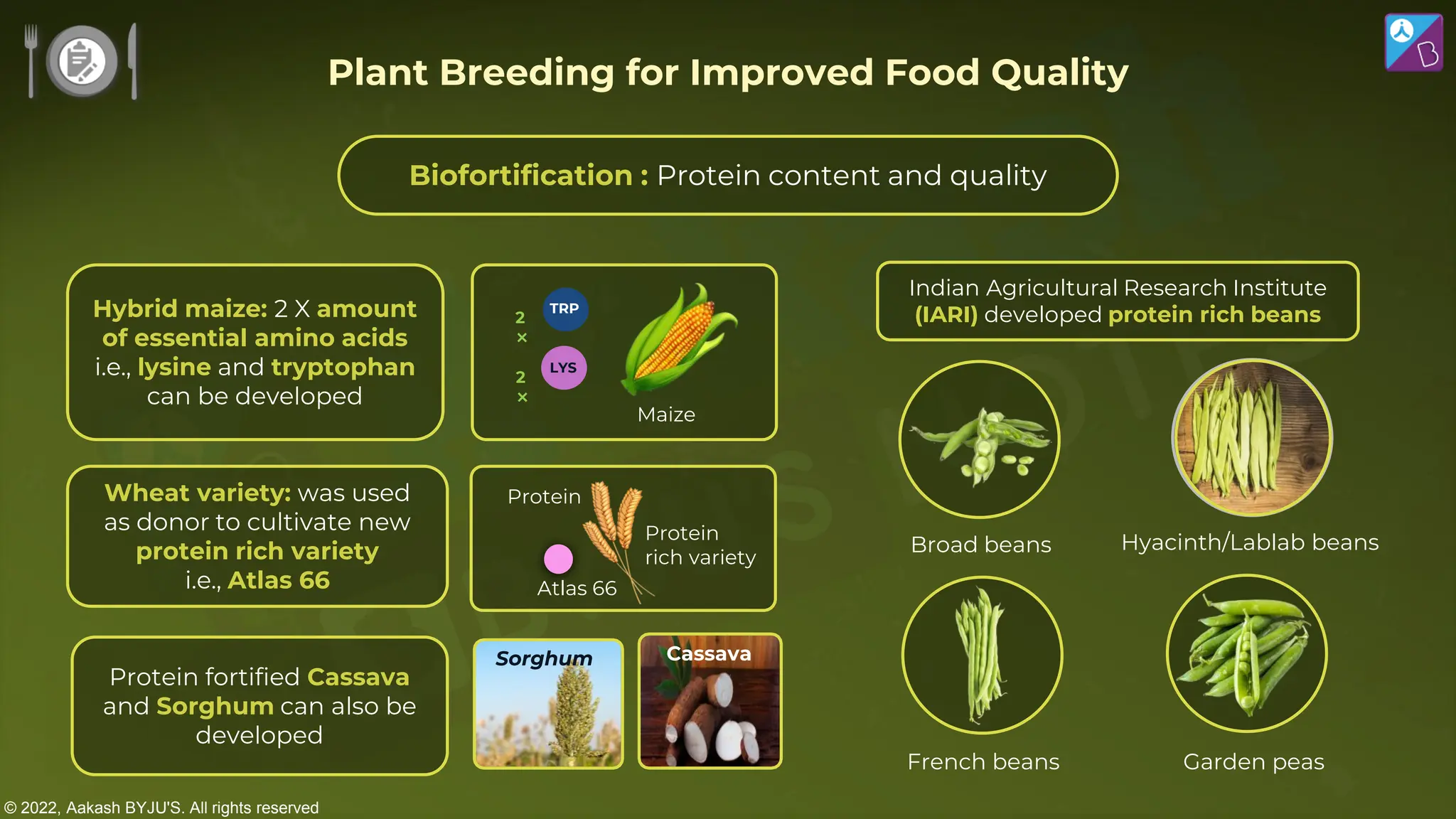
Hybrid maize: 2 X amount
of essential amino acids
i.e., lysine and tryptophan
can be developed
Wheat variety: was used
as donor to cultivate new
protein rich variety
i.e., Atlas 66
Protein fortified Cassava
and Sorghum can also be
developed
TRP
2
×
2
×
LYS
Maize
Protein
Atlas 66
Protein
rich variety
Sorghum Cassava
Indian Agricultural Research Institute
(IARI) developed protein rich beans
Broad beans
French beans Garden peas
Hyacinth/Lablab beans
Biofortification : Protein content and quality
Plant Breeding for Improved Food Quality
© 2022, Aakash BYJU'S. All rights reserved
Carrot
Pumpkin
Spinach
Vitamin A enriched
rice was developed and
named as golden rice.
Vit A
Golden rice
Vitamin A rich Vitamin C rich
Bitter gourd
Mustard Bathua
Tomato
Biofortification : Vitamin content
Indian Agricultural Research Institute (IARI) developed
Plant Breeding for Improved Food Quality
© 2022, Aakash BYJU'S. All rights reserved
Zinc enriched crops
Iron and calcium
enriched
Spinach
Bathua
Wheat
Rice Beans
Maize
Fe
Rice
5 ×
Iron fortified
rice
Plant Breeding for Improved Food Quality
Biofortification : Micronutrient and mineral content
Iron fortified rice was
developed with over 5
times the iron content
© 2022, Aakash BYJU'S. All rights reserved
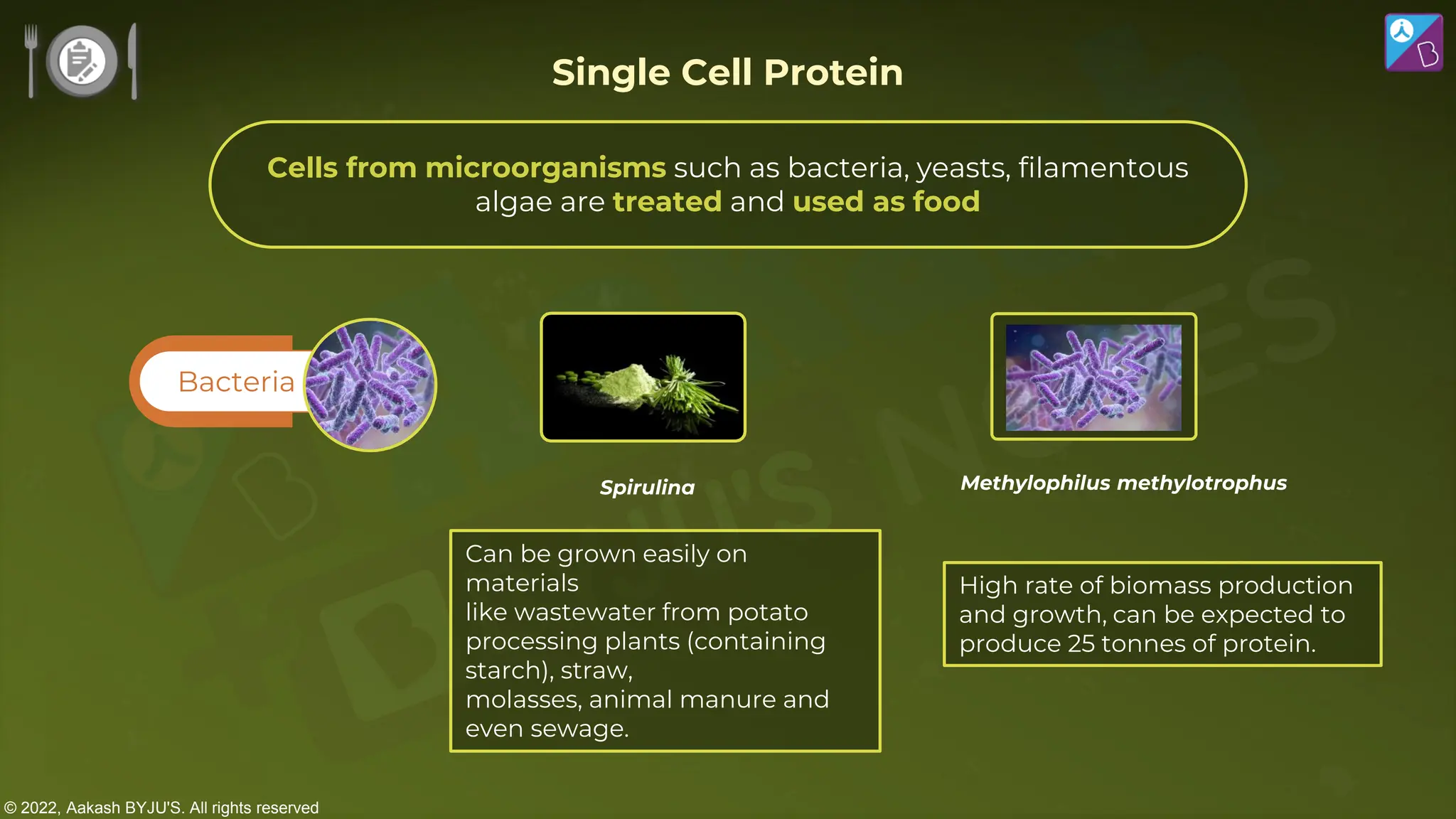
Spirulina Methylophilus methylotrophus
Single Cell Protein
Cells from microorganisms such as bacteria, yeasts, filamentous
algae are treated and used as food
Bacteria
Can be grown easily on
materials
like wastewater from potato
processing plants (containing
starch), straw,
molasses, animal manure and
even sewage.
High rate of biomass production
and growth, can be expected to
produce 25 tonnes of protein.
© 2022, Aakash BYJU'S. All rights reserved
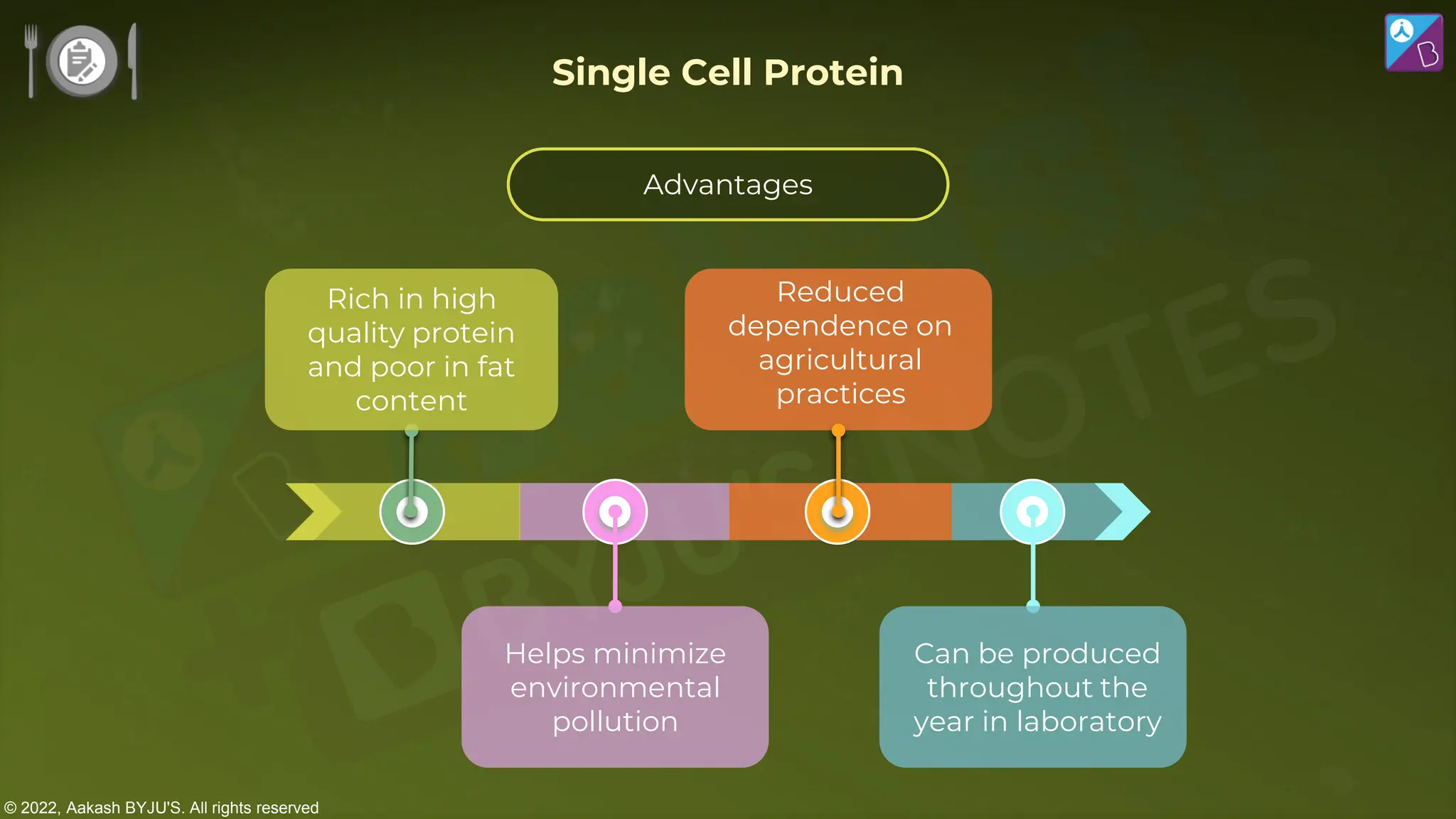
Reduced
dependence on
agricultural
practices
Rich in high
quality protein
and poor in fat
content
Can be produced
throughout the
year in laboratory
Helps minimize
environmental
pollution
Single Cell Protein
Advantages
© 2022, Aakash BYJU'S. All rights reserved
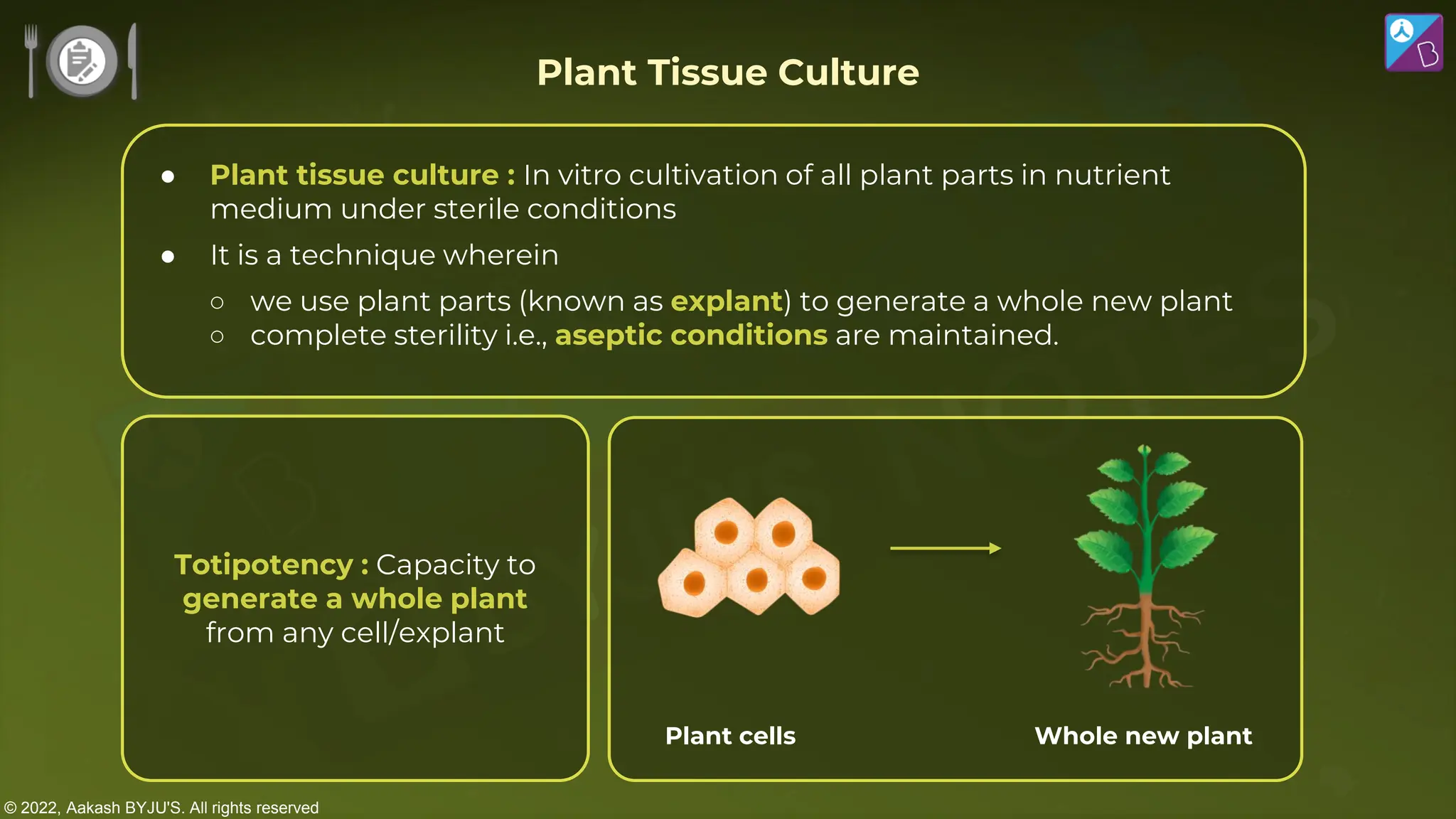
Totipotency : Capacity to
generate a whole plant
from any cell/explant
Plant cells Whole new plant
Plant Tissue Culture
● Plant tissue culture : In vitro cultivation of all plant parts in nutrient
medium under sterile conditions
● It is a technique wherein
○ we use plant parts (known as explant) to generate a whole new plant
○ complete sterility i.e., aseptic conditions are maintained.
© 2022, Aakash BYJU'S. All rights reserved
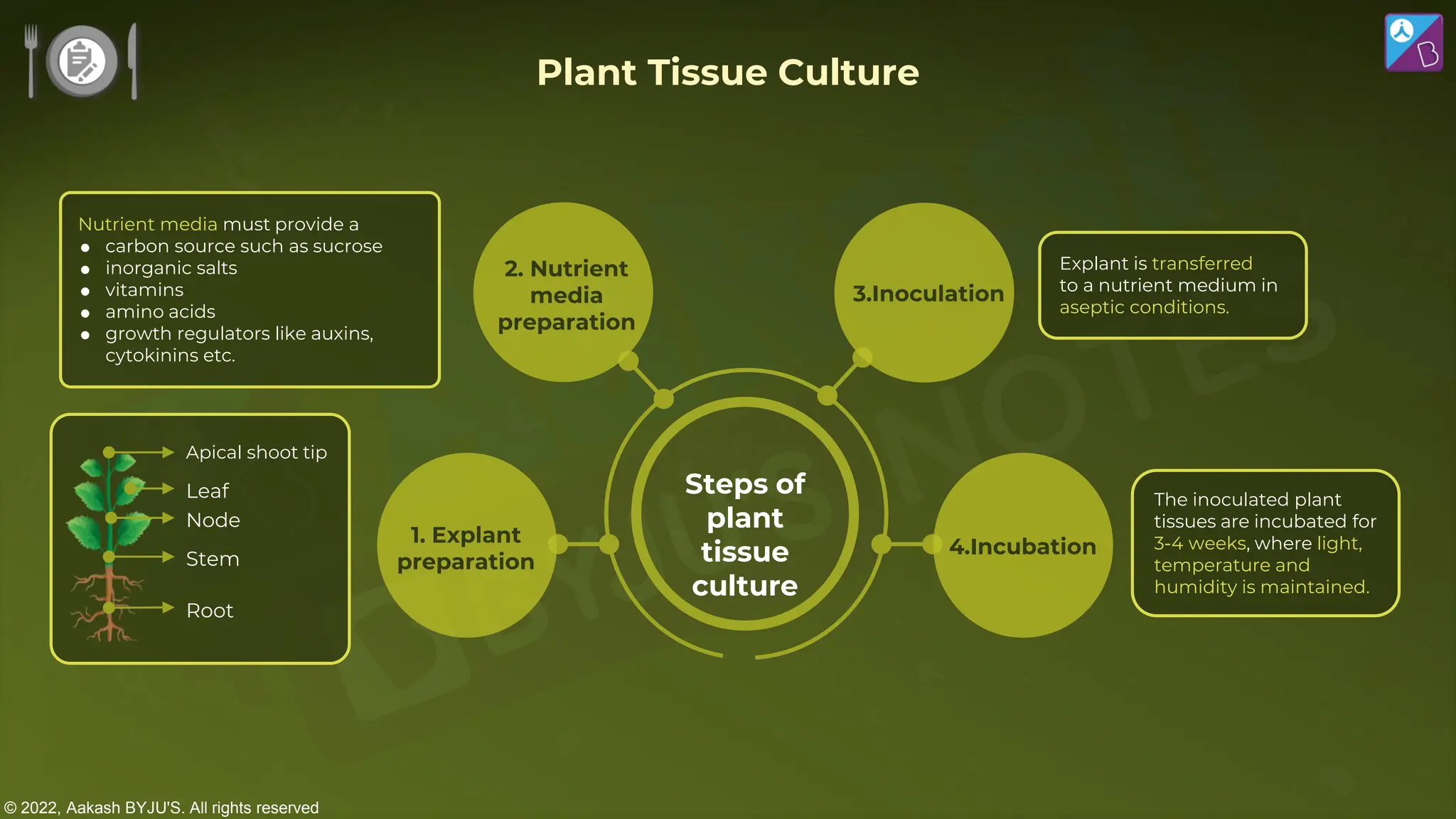
Nutrient media must provide a
 carbon source such as sucrose
 inorganic salts
 vitamins
 amino acids
 growth regulators like auxins,
cytokinins etc.
Apical shoot tip
Leaf
Node
Stem
Root
Explant is transferred
to a nutrient medium in
aseptic conditions.
The inoculated plant
tissues are incubated for
3-4 weeks, where light,
temperature and
humidity is maintained.
Plant Tissue Culture
Steps of
plant
tissue
culture
1. Explant
preparation
2. Nutrient
media
preparation
3.Inoculation
4.Incubation
© 2022, Aakash BYJU'S. All rights reserved
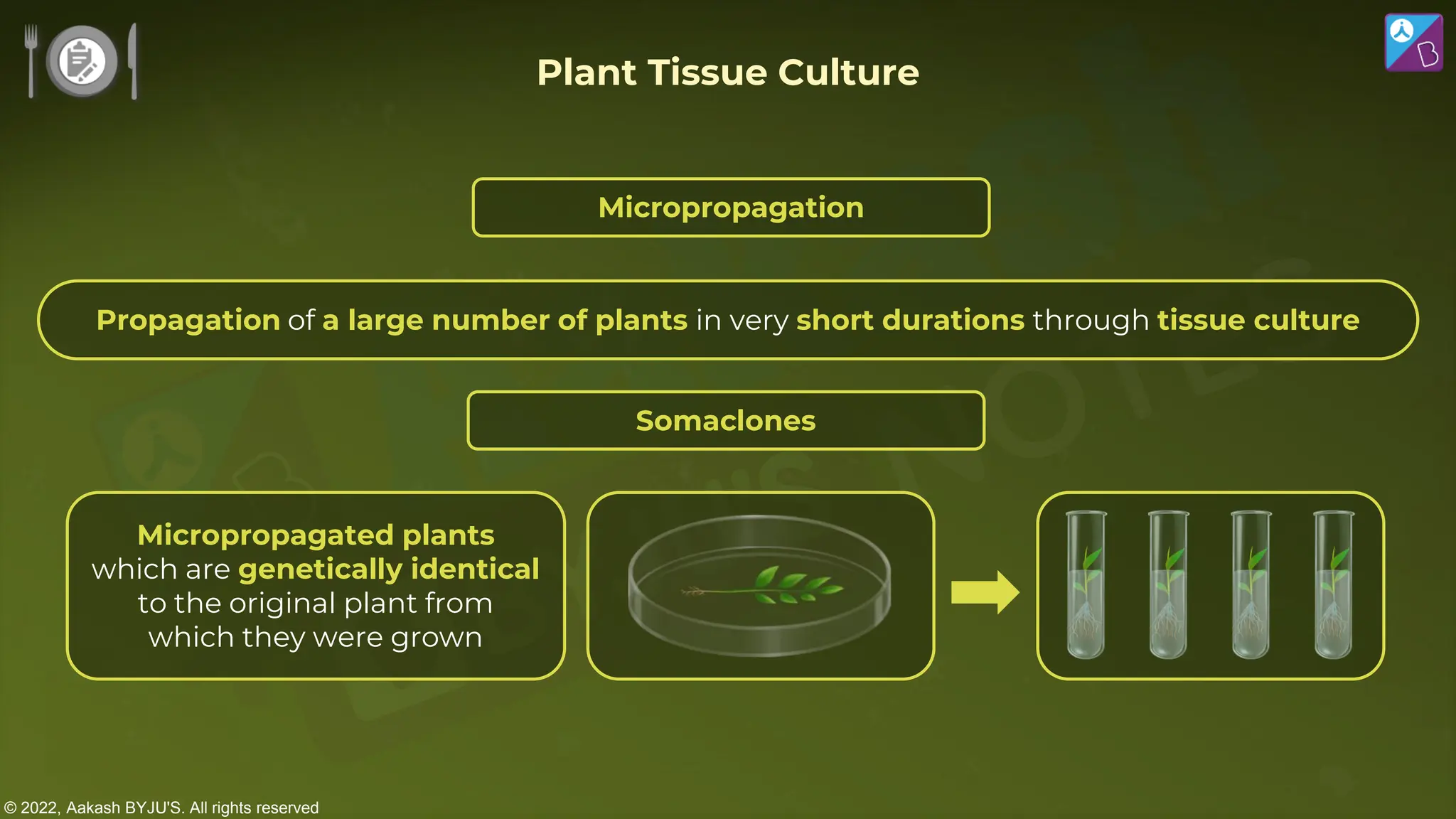
Micropropagation
Somaclones
Micropropagated plants
which are genetically identical
to the original plant from
which they were grown
Plant Tissue Culture
Propagation of a large number of plants in very short durations through tissue culture
© 2022, Aakash BYJU'S. All rights reserved
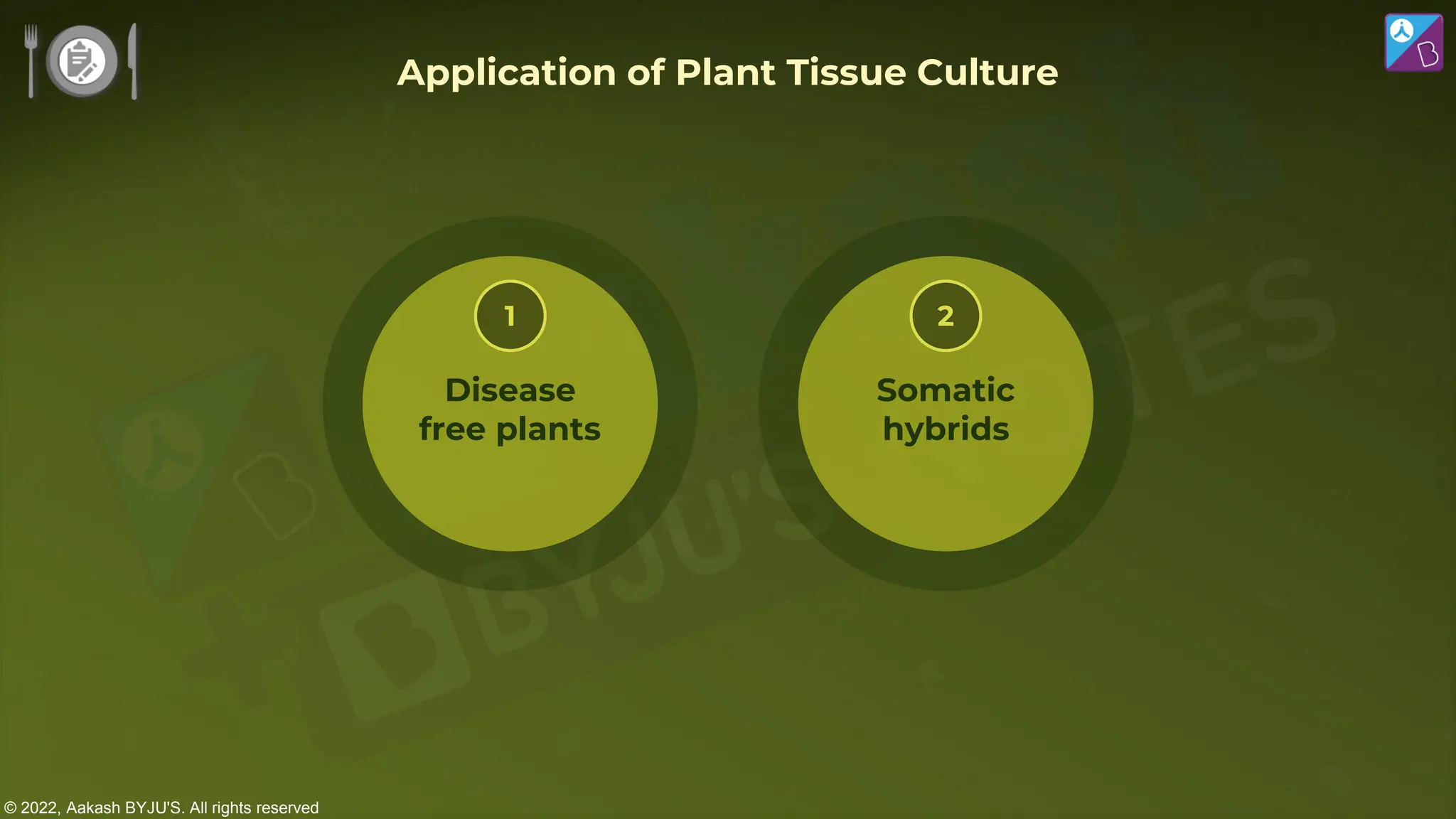
Application of Plant Tissue Culture
Disease
free plants
1
Somatic
hybrids
2
© 2022, Aakash BYJU'S. All rights reserved
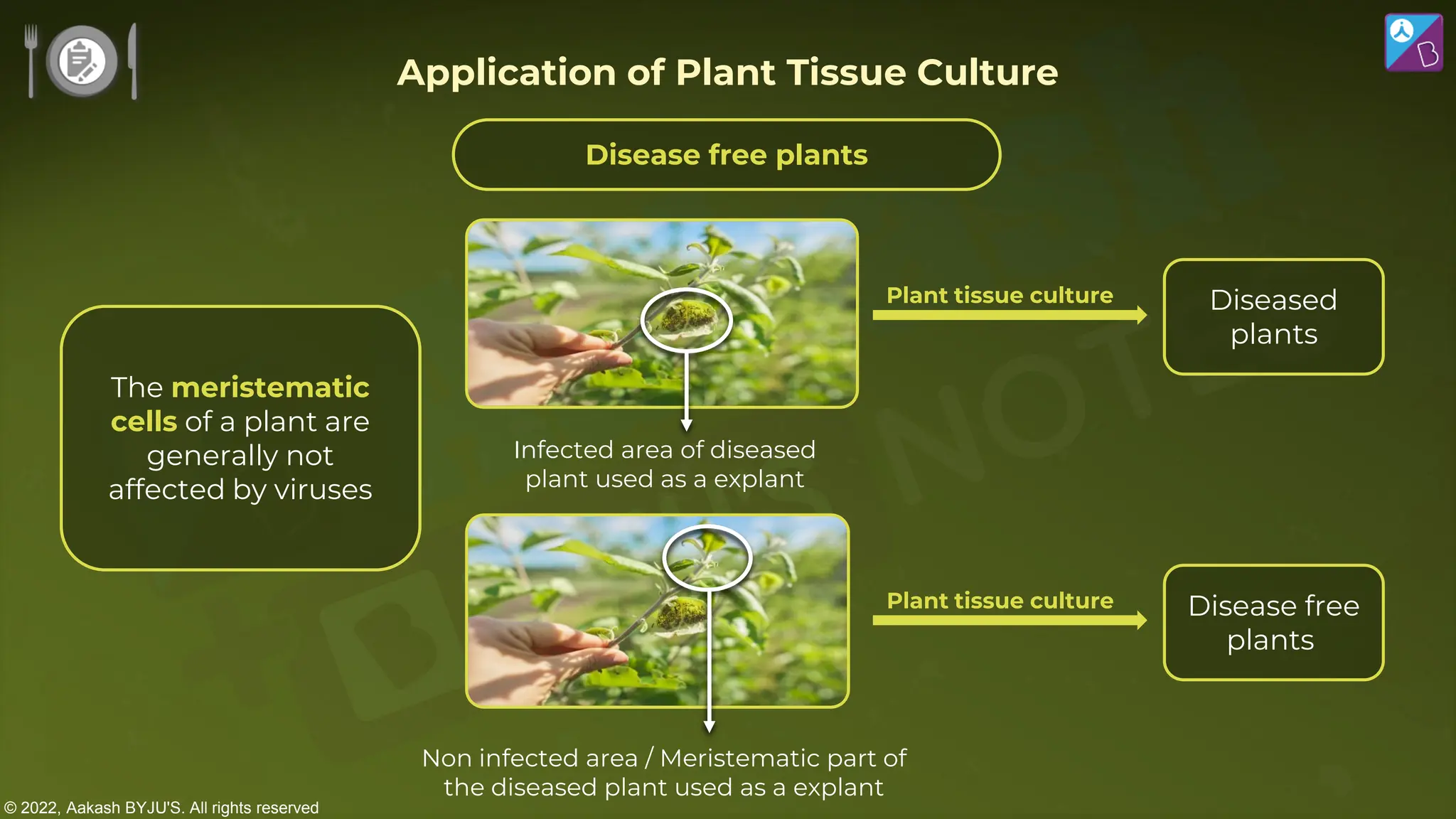
The meristematic
cells of a plant are
generally not
affected by viruses
Disease free plants
Diseased
plants
Infected area of diseased
plant used as a explant
Plant tissue culture
Disease free
plants
Non infected area / Meristematic part of
the diseased plant used as a explant
Plant tissue culture
Application of Plant Tissue Culture
© 2022, Aakash BYJU'S. All rights reserved
Production of hybrids (somatic hybrids) of two distinct plants
via fusion of somatic protoplasts is called somatic hybridisation
Somatic hybrids
Potato + Tomato = POMATO
Isolated potato
protoplast
Isolated tomato
protoplast
Fusion of isolated
protoplasts
Application of Plant Tissue Culture
© 2022, Aakash BYJU'S. All rights reserved
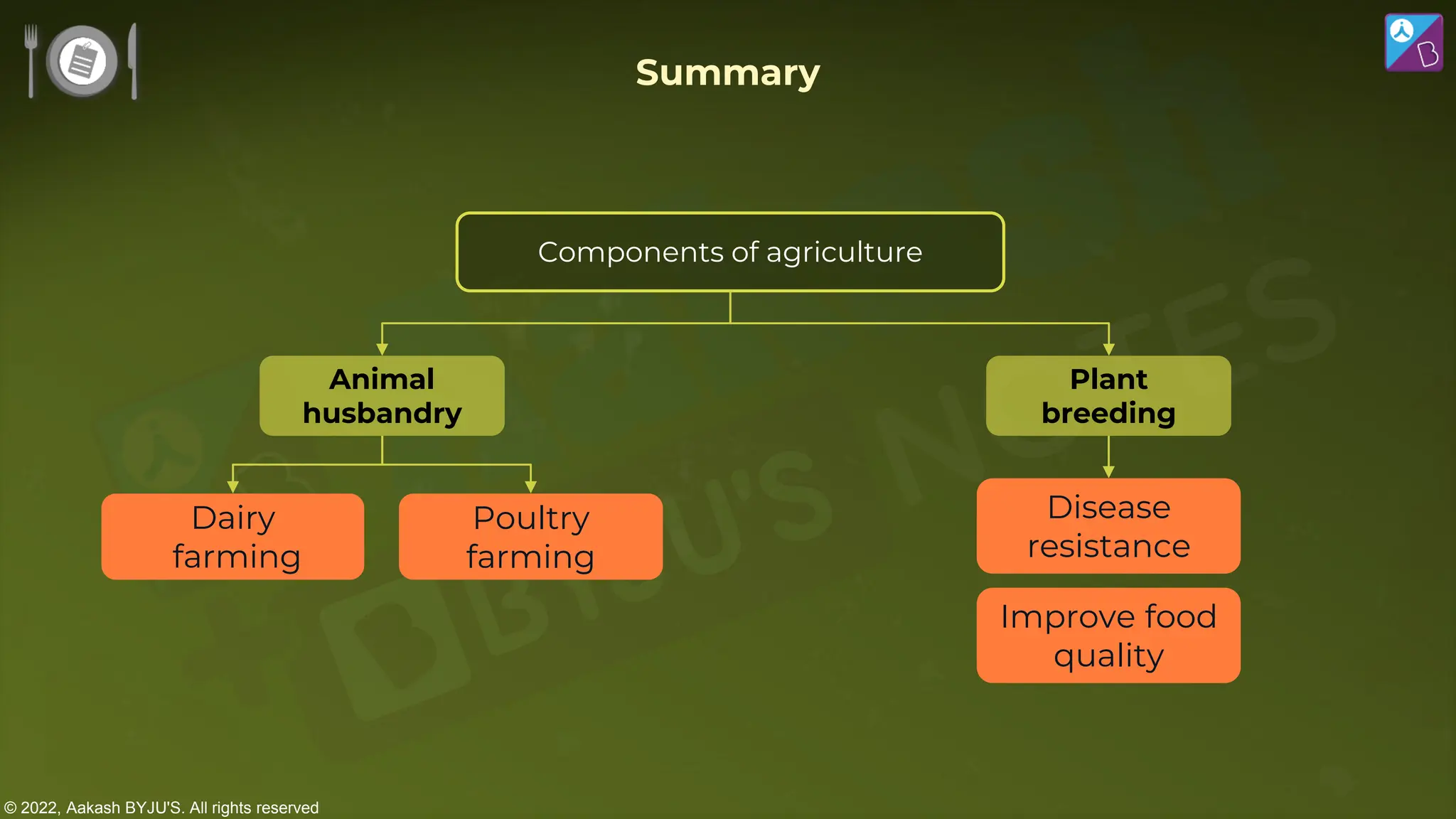
Summary
Animal
husbandry
Plant
breeding
Components of agriculture
Dairy
farming
Poultry
farming
Disease
resistance
Improve food
quality
© 2022, Aakash BYJU'S. All rights reserved
Summary
Process and systems
(to increase yield and improve quality of milk)
Dairy Farm Management
01
Selection
of breed
05
Inspections
04
Cleanliness
03
Feed
02
Housing
© 2022, Aakash BYJU'S. All rights reserved
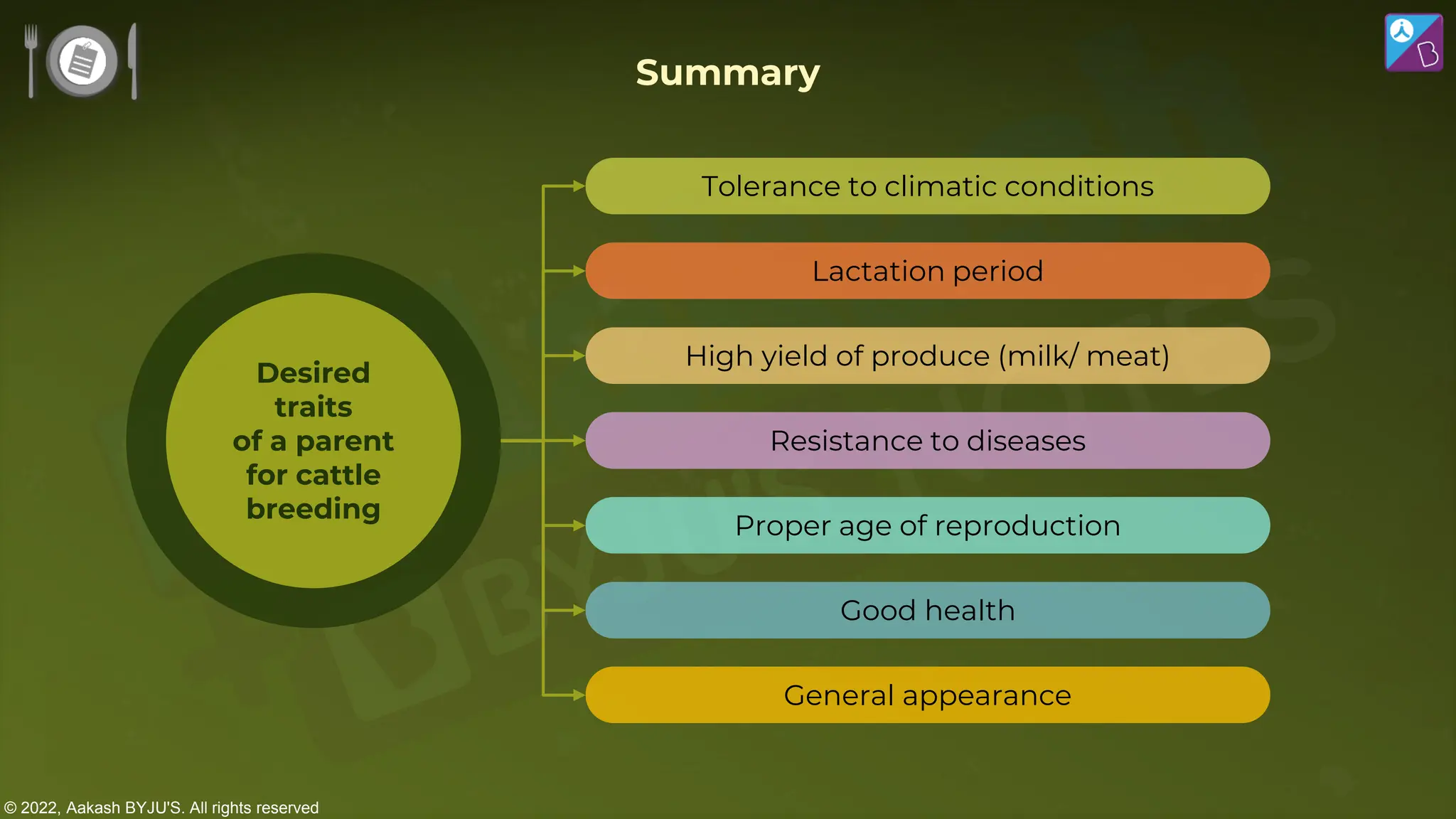
Summary
Tolerance to climatic conditions
Lactation period
High yield of produce (milk/ meat)
Resistance to diseases
Proper age of reproduction
Good health
General appearance
Desired
traits
of a parent
for cattle
breeding
© 2022, Aakash BYJU'S. All rights reserved
Summary
Mating closely related animals
Inbreeding Out-breeding
Mating unrelated animals
Methods of animal breeding
Interspecific hybridisation
Cross-breeding
Out-crossing
© 2022, Aakash BYJU'S. All rights reserved
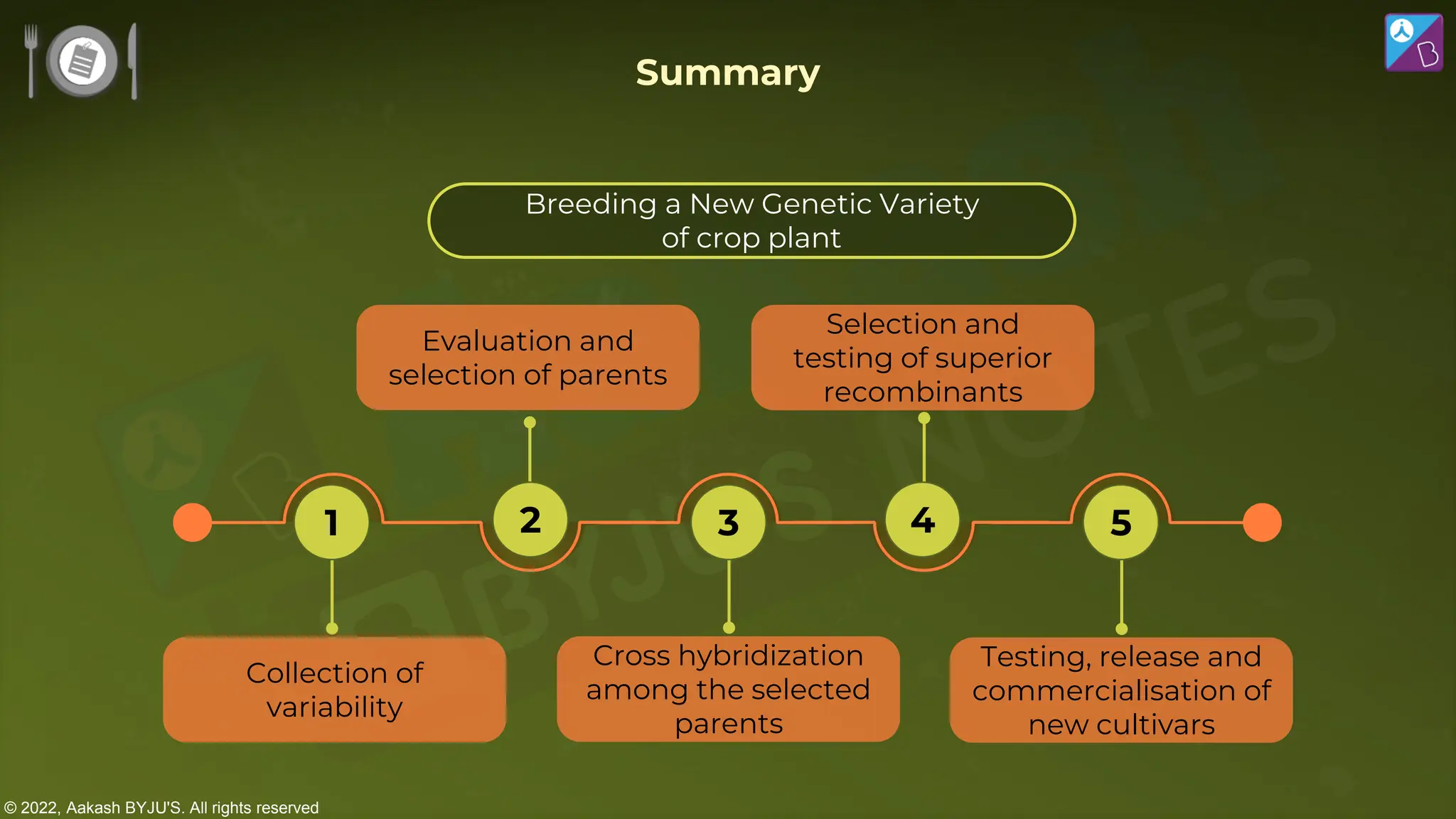
Summary
Breeding a New Genetic Variety
of crop plant
Collection of
variability
Evaluation and
selection of parents
Selection and
testing of superior
recombinants
1 2 3 4 5
Cross hybridization
among the selected
parents
Testing, release and
commercialisation of
new cultivars
© 2022, Aakash BYJU'S. All rights reserved
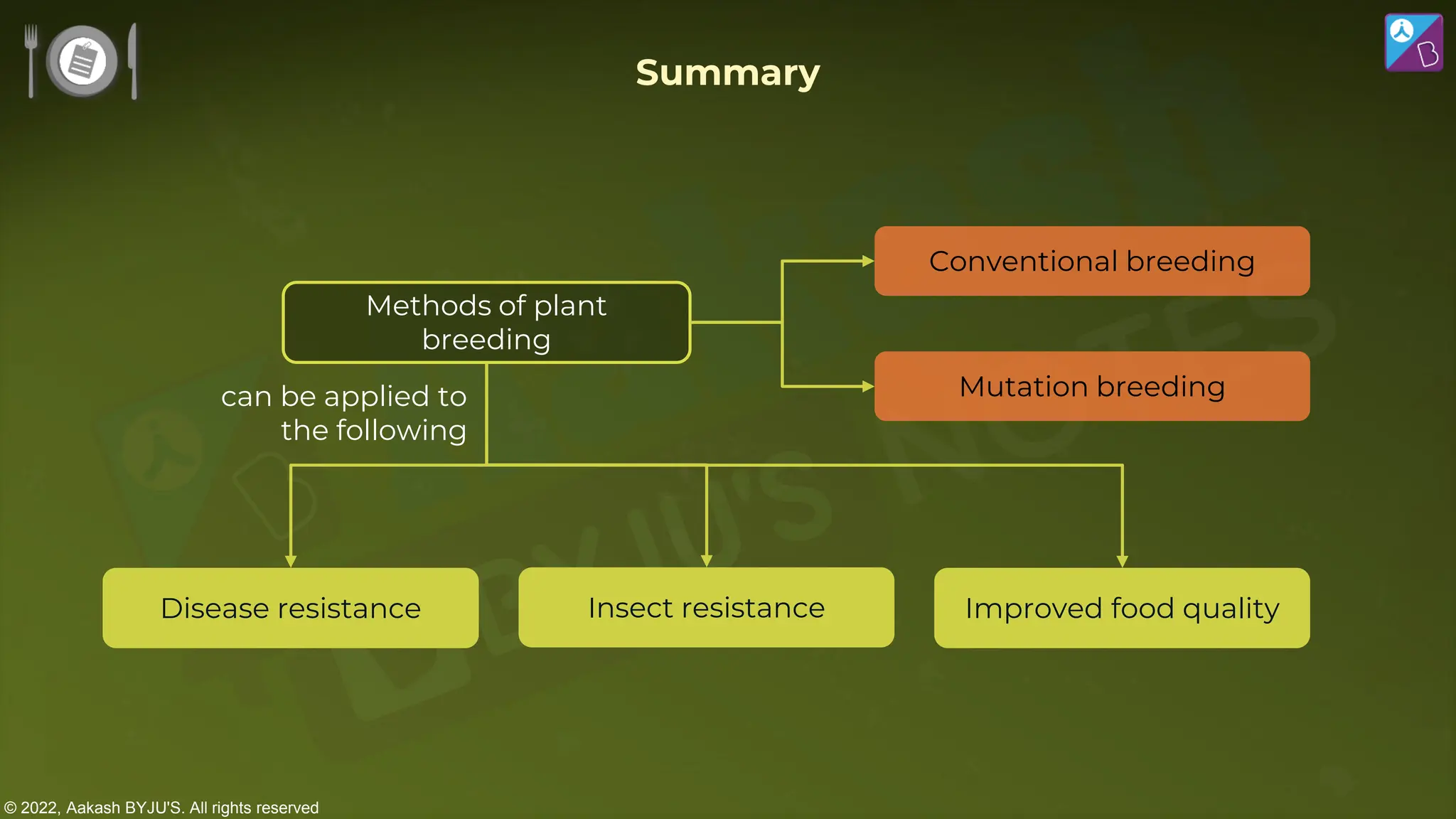
Summary
can be applied to
the following
Conventional breeding
Mutation breeding
Disease resistance Improved food quality
Insect resistance
Methods of plant
breeding
© 2022, Aakash BYJU'S. All rights reserved
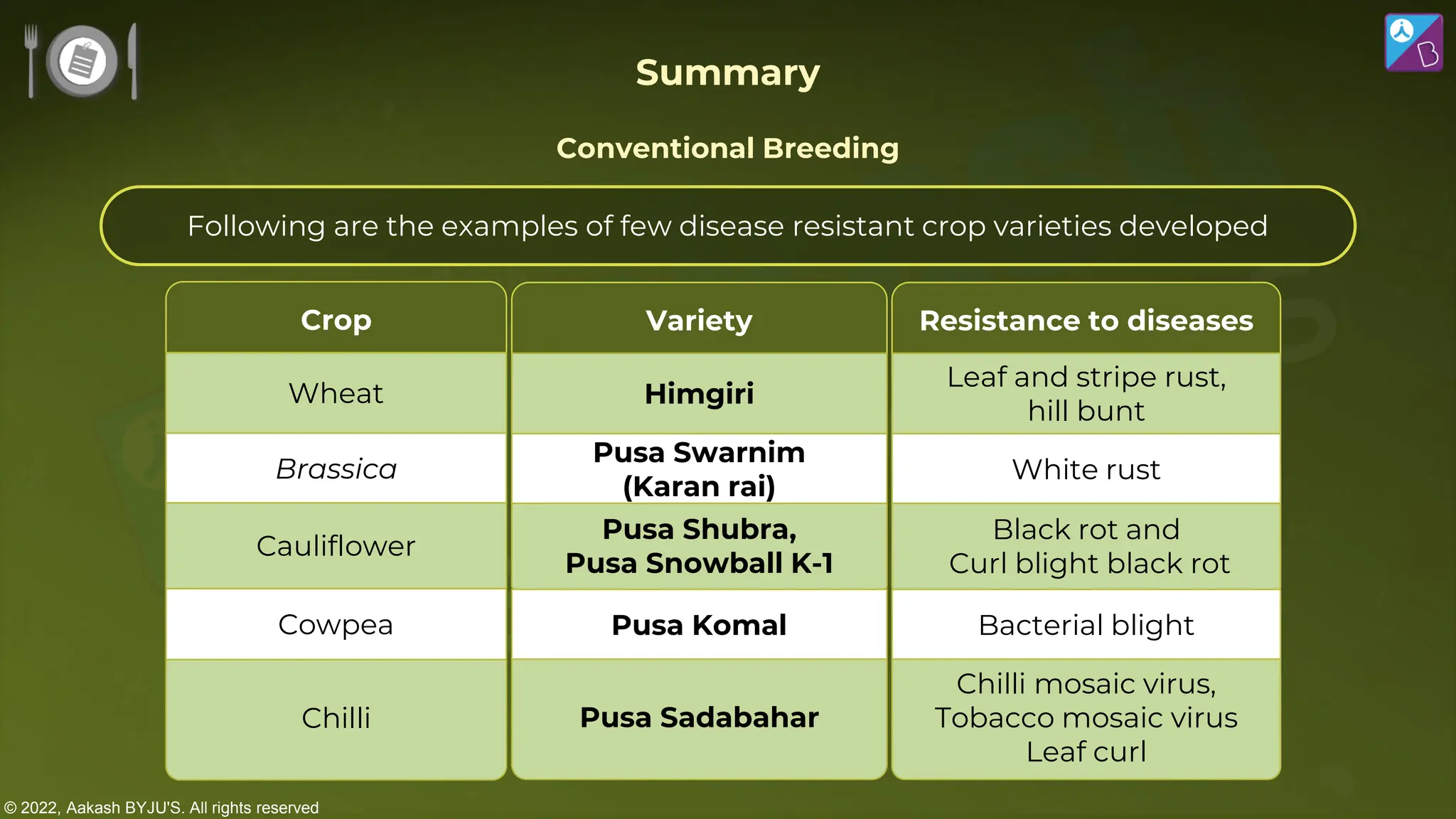
Summary
Resistance to diseases
Leaf and stripe rust,
hill bunt
White rust
Black rot and
Curl blight black rot
Bacterial blight
Chilli mosaic virus,
Tobacco mosaic virus
Leaf curl
Variety
Himgiri
Pusa Swarnim
(Karan rai)
Pusa Shubra,
Pusa Snowball K-1
Pusa Komal
Pusa Sadabahar
Crop
Wheat
Brassica
Cauliflower
Cowpea
Chilli
Conventional Breeding
Following are the examples of few disease resistant crop varieties developed
© 2022, Aakash BYJU'S. All rights reserved
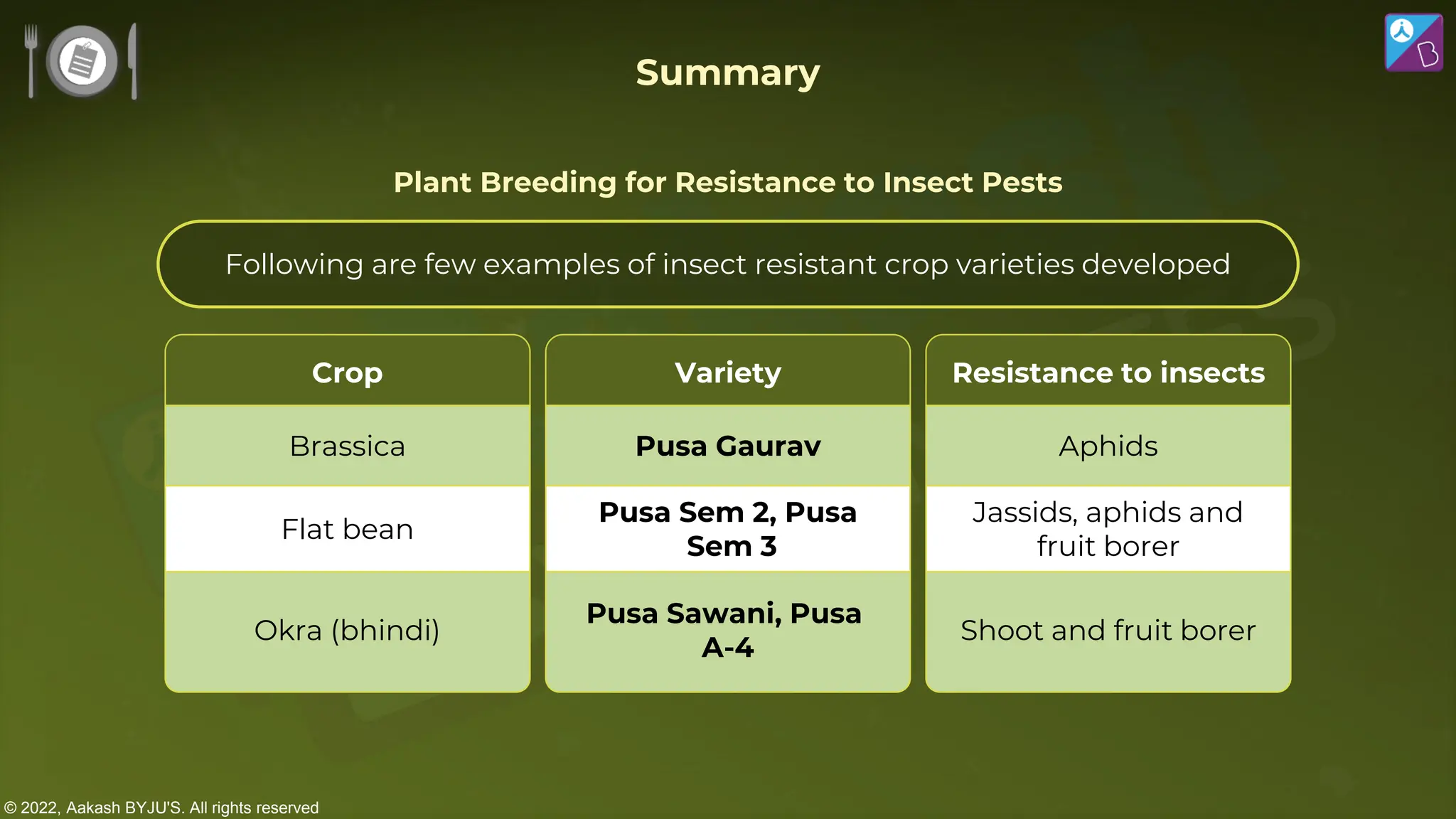
Summary
Variety
Pusa Gaurav
Pusa Sem 2, Pusa
Sem 3
Pusa Sawani, Pusa
A-4
Resistance to insects
Aphids
Jassids, aphids and
fruit borer
Shoot and fruit borer
Crop
Brassica
Flat bean
Okra (bhindi)
Plant Breeding for Resistance to Insect Pests
Following are few examples of insect resistant crop varieties developed
© 2022, Aakash BYJU'S. All rights reserved
Summary
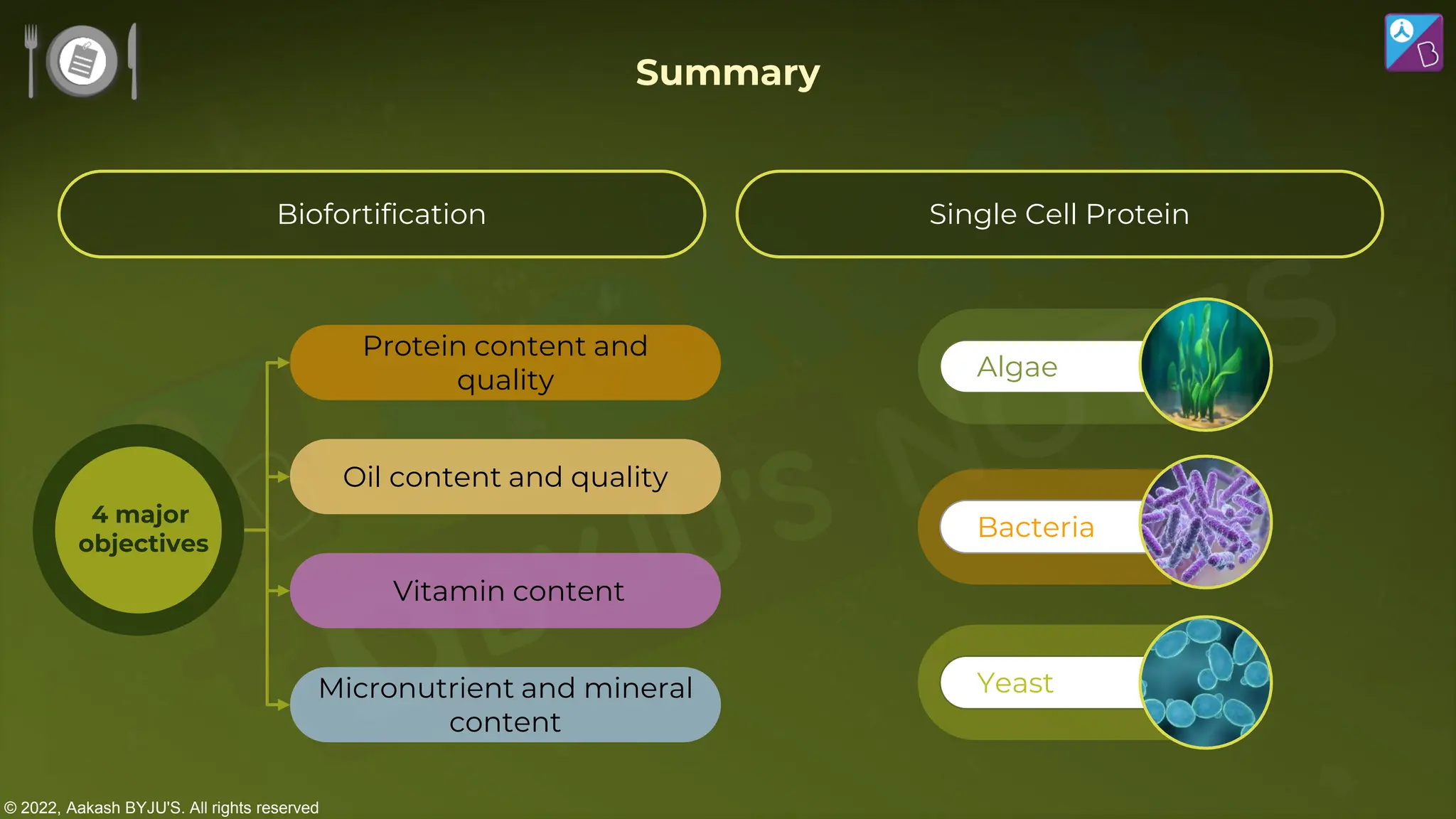
4 major
objectives
Protein content and
quality
Oil content and quality
Vitamin content
Micronutrient and mineral
content
Bacteria
Yeast
Algae
Biofortification Single Cell Protein
© 2022, Aakash BYJU'S. All rights reserved
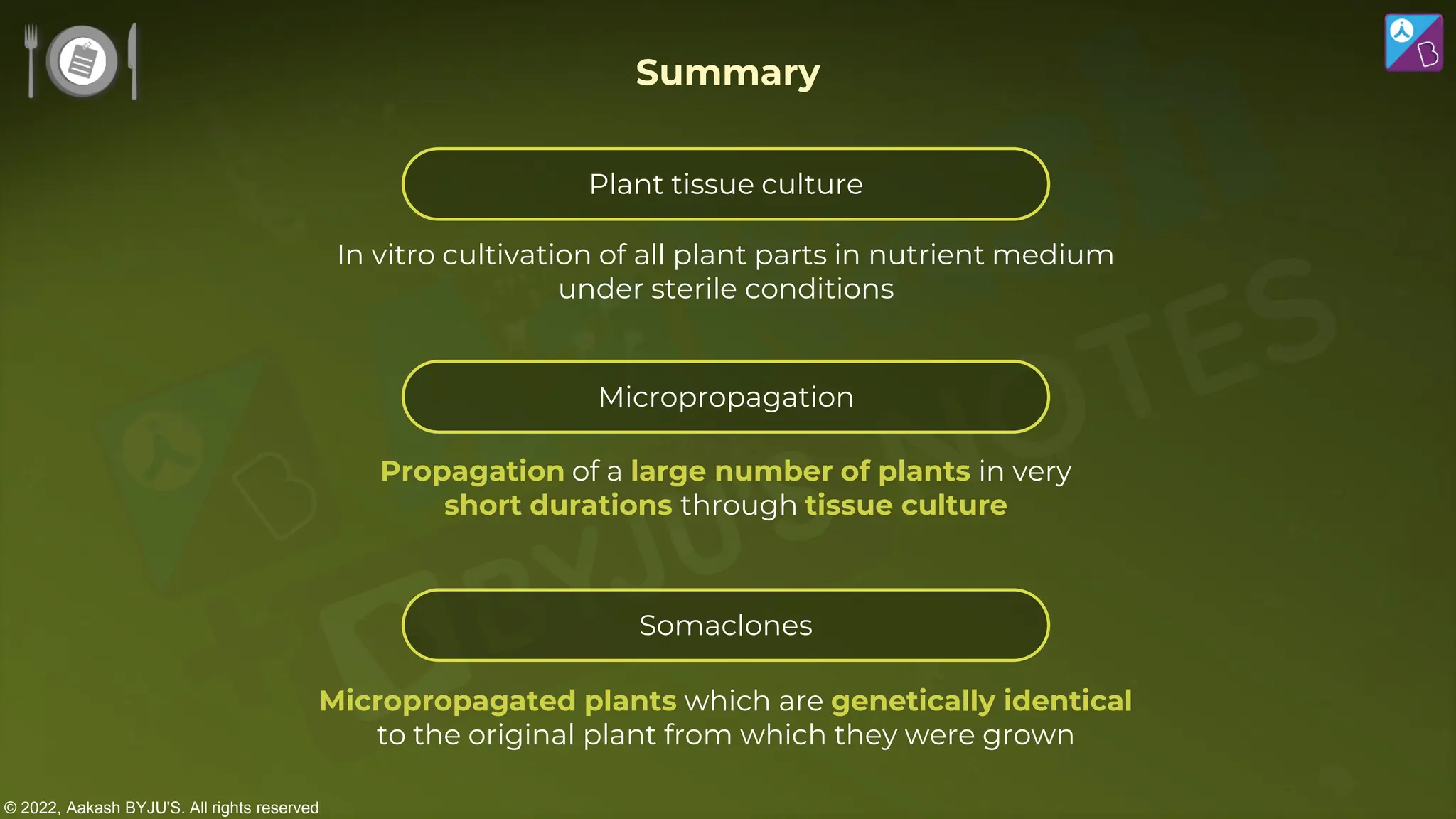
Micropropagated plants which are genetically identical
to the original plant from which they were grown
Propagation of a large number of plants in very
short durations through tissue culture
In vitro cultivation of all plant parts in nutrient medium
under sterile conditions
Summary
Plant tissue culture
Micropropagation
Somaclones

Strategies for Enhancement in Food Production.pdf

  • 1.
    © 2022, AakashBYJU'S. All rights reserved Strategies for Enhancement of Food Production © 2022, Aakash BYJU'S. All rights reserved
  • 2.
    © 2022, AakashBYJU'S. All rights reserved Key Takeaways Agriculture Dairy Farm Management Animal Husbandry Cattle Breeds and Breeding Sheep and Goat Management Poultry Farm Management Animal Breeding Control Breeding Experiments Apiculture 1 2 3 4 5 6 7 8 9
  • 3.
    © 2022, AakashBYJU'S. All rights reserved Key Takeaways Fishery Plant Breeding Plant Breeding for Disease Resistance Plant Breeding for Improved Food Quality Plant Breeding for Resistance to Insect Pests Single Cell Protein Plant Tissue Culture 10 12 13 14 15 16 17 Summary
  • 4.
    © 2022, AakashBYJU'S. All rights reserved A practice of cultivating plants and livestock. Components of agriculture Agriculture Animal husbandry Plant breeding Wi
  • 5.
    © 2022, AakashBYJU'S. All rights reserved ● India and China have 70% of the world's livestock population ● But they contribute just 25% of livestock product yield globally Animal Husbandry Livestock : Examples : Buffaloes, cows, pigs, horses, cattle, sheep, camels, goats, poultry farming and fisheries Domesticated for: Food - milk, meat, honey and egg Clothing - silk, wool etc. Labour - pulling, carrying load ploughing Animal husbandry A branch of agriculture concerned with breeding, caring and raising livestock Domesticated animals, raised for use or profit
  • 6.
    © 2022, AakashBYJU'S. All rights reserved Hygienic and appropriate shelter to the animal Shelter Newer breeding techniques could be very helpful Controlled breeding Regular veterinary care Health Proper nutrition to the animal Food Management of Farms and Farm Animals Food Shelter Health Controlled breeding
  • 7.
    © 2022, AakashBYJU'S. All rights reserved For milk Dairy farm animals For moving groups from one location to another For barns free from rodents Cow Goat Buffalo Sheep Shephard dog Cat Dairy Farm Management Management of animals for milk and its products for human consumption
  • 8.
    © 2022, AakashBYJU'S. All rights reserved Different kinds of milk products Cream Prepared by churning milk. Fat layer skimmed from top of the milk Curd Milk fermented due to the bacterial activities Butter milk Left over liquid after removal of butter Ghee 100 % fat prepared after heating the butter Condensed milk Concentrated milk, with or without sugar Cheese Coagulated milk protein ‘casein’ with fat and water Powdered milk Powder form of milk Dairy Farm Management
  • 9.
    © 2022, AakashBYJU'S. All rights reserved Process and systems (To increase yield and improve quality of milk) Dairy Farm Management 01 Selection of breed 05 Inspections 04 Cleanliness 03 Feed 02 Housing
  • 10.
    © 2022, AakashBYJU'S. All rights reserved High milk yielding female High milk yielding and disease resistant breed Dairy Farm Management 01 Selection of breed Disease resistant male Process and systems (To increase yield and improve quality of milk)
  • 11.
    © 2022, AakashBYJU'S. All rights reserved ● Cattle needs to be : ● Cattle feeding carried out scientifically ● Focus on good quality and quantity of fodder ● Feed provided are : ○ Roughage with high fiber content (includes fodder, silage, hay and straw) ○ Concentrate with high nutrient value (includes cereals, millets, forage crops , oil cake, oil seeds and animal by-products) well looked for housed well provided with adequate water disease free environment Dairy Farm Management 03 Feed 02 Housing Process and systems (To increase yield and improve quality of milk)
  • 12.
    © 2022, AakashBYJU'S. All rights reserved ● Regular cleaning of cattle ● Cleanliness and hygiene of cattle and handlers while ○ milking ○ storage ○ transport of the milk and its products ● Ensure housing, feeding and cleanliness measures are taken ● Regular inspections ● Proper record keeping ● Record keeping helps to ○ identify ○ rectify problems ● Mandatory visits of veterinary doctors Process and systems (To increase yield and improve quality of milk) Dairy Farm Management 05 Inspections 04 Cleanliness
  • 13.
    © 2022, AakashBYJU'S. All rights reserved Cattle Breeds and Breeding Tolerance to climatic conditions Lactation period High yield of produce (milk/ meat) Resistance to diseases Proper age of reproduction Good health General appearance Desired traits of a parent for cattle breeding
  • 14.
    © 2022, AakashBYJU'S. All rights reserved Milk yield Low High Fat content Low High Disease resistance Lesser Greater Cow vs Buffalo Cattle Breeds and Breeding
  • 15.
    © 2022, AakashBYJU'S. All rights reserved Draught breed Bullocks - good for working Cows - poor milk producers e.g., Malvi, Nagori, Hallikar, Kangayam General utility breed Cows - good milk producers Bullocks - good draught animals e.g., Haryana, Ongole, Kankrej, Tharparkar Milch breeds Cows - good in milk production Bullocks - poor quality e.g., Gir, Sahiwal , Red Sindhi, Deoni etc Cattle Breeds and Breeding Groups of cattle breeds
  • 16.
    © 2022, AakashBYJU'S. All rights reserved Cattle Breeds and Breeding Buffalo breeds Cattle exotic breed Murrah Bhadawari Jaffarabadi Surti Mehsana Nagpuri Jersey Holstein-Friesian Ayrshire Brown Swiss
  • 17.
    © 2022, AakashBYJU'S. All rights reserved Bacterial diseases Viral diseases 01 Anthrax ● Caused by Bacillus anthracis ● Contagious and affects cattle, sheep, buffaloes, horses and goats ● Spreads through contaminated food, water and pastures Prevention ● Vaccination and antiserum 02 Mastitis ● Inflammation of udder in dry cows ● Due to Corynebacterium pyogenes 01 Rinderpest or cattle plague ● Caused by Rinderpest Virus ● Highly contagious ● Spreads rapidly by direct contact with infected animals ● Through contaminated food, water, workers, clothes and by flies Prevention ● Vaccination
  • 18.
    © 2022, AakashBYJU'S. All rights reserved Rearing of domestic fowls (birds) called poultry, for their eggs and meat Poultry Chicken Duck Turkey Goose Use Meat Eggs Poultry Farm Management
  • 19.
    © 2022, AakashBYJU'S. All rights reserved Important components Poultry Farm Management 01 Selection of breed 05 Regular inspection 04 Proper hygiene and health care 03 Proper feed and water 02 Proper and safe farm
  • 20.
    © 2022, AakashBYJU'S. All rights reserved Poultry Farm Management Grown for meat purposes e.g., Plymouth rock Layers Broilers Breeders Female fowls raised for egg production e.g., White leghorn Produce eggs that is fertilized to produce layer/broiler stock
  • 21.
    © 2022, AakashBYJU'S. All rights reserved Poultry Farm Management American (Plymouth rock) Australia (Australorp) Asiatic (Brahma) Mediterranean (Leghorn) Aseel Busra Chittagong Kadaknath Ghaghus Classification of chicken Indigenous breed
  • 22.
    © 2022, AakashBYJU'S. All rights reserved Protozoan Viral Bacterial Vitamin E deficiency Encephalomalacia Ranikhet and bird flu Coccidiosis (Bloody diarrhoea) Pullorum and fowl cholera Poultry Diseases Poultry Diseases
  • 23.
    © 2022, AakashBYJU'S. All rights reserved Goat Sheep ● Reared for ○ meat ○ milk ○ hair ○ skin ● Reared for ○ wool ○ skin ○ meat Sheep and Goat Management
  • 24.
    © 2022, AakashBYJU'S. All rights reserved Improved growth rate Increased production of milk, meat, egg, wool, etc. Superior quality of milk, meat, eggs, wool, etc. Improved resistance to various diseases Increased productive life and acceptable reproduction rate Animal Breeding Selective mating of animals to produce offspring with desired qualities
  • 25.
    © 2022, AakashBYJU'S. All rights reserved Mating closely related animals Inbreeding Out-breeding Mating unrelated animals Methods of animal breeding Interspecific hybridisation Cross-breeding Out-crossing Animal Breeding Breed is a group of animals related by descent and similar in most characters
  • 26.
    © 2022, AakashBYJU'S. All rights reserved Bull with ● Strong immunity ● Vigour ● Virility Cow which ● produces more milk per lactation ● gives good quality of milk ● Mating of superior male and superior female (closely related) of the same breed for 4-6 generations ● Superior male and female among their progeny are also identified and mated ● Increases homozygosity ● Helps in accumulation of superior genes and elimination of less desired genes ● On continued inbreeding, recessive genes accumulate leading to inbreeding depression ● Reduces fertility and productivity Inbreeding
  • 27.
    © 2022, AakashBYJU'S. All rights reserved Out-breeding Overcomes ● Below average productivity ● Lower milk production ● Slow growth rate in beef cattle, etc. Out-breeding No common ancestors for at least 4 - 6 generations Breeding of the unrelated animals of ● Same/ different breed or different species
  • 28.
    © 2022, AakashBYJU'S. All rights reserved ● Mating unrelated animals within the same breed ● Offspring is known as out-cross ● Best breeding method for animals that are below average milk productivity ● Single outcross overcomes inbreeding depression Out-crossing
  • 29.
    © 2022, AakashBYJU'S. All rights reserved Merino rams Bikaneri ewes X = Hisardale Hissar ● Cross- breeding allows the desirable qualities of two different breeds to be combined ● Used for increased commercial production ● Inbred to develop new and stable breeds ● Hisardale produce brilliant white wool in large quantity ● Superior males of one breed are mated with superior females of another breed Cross-breeding
  • 30.
    © 2022, AakashBYJU'S. All rights reserved ● Mating of animals from two different but related species ● The sterile offspring is called an interspecific hybrid ● Made for economic or fundamental scientific purposes only Interspecific Hybridization X = Donkey Horse Mule Equus asinus Equus caballus
  • 31.
    © 2022, AakashBYJU'S. All rights reserved Artificial insemination It is a method where semen is introduced into selected female animal manually. Improves quality and quantity of animal and its produce Sperms can be used immediately or frozen Liquid nitrogen ( -196℃) is used in the process of cryopreservation Controlled Breeding Experiments
  • 32.
    © 2022, AakashBYJU'S. All rights reserved Multiple Ovulation Embryo Transfer Technology (MOET) Ovary Step 1: Hormone therapy Cow Ovary ● FSH induces multiple follicular maturation and super ovulation in cow ovaries when induced ● Production of 6-8 eggs per estrus cycle instead of one is called superovulation FSH causes follicle maturation Step 2: Fertilization ● The cow is either mated with elite buffalo or artificially inseminated ● The eggs are fertilized inside the body. 2 Cell stage 8 Cell stage 32 Cell stage Controlled Breeding Experiments
  • 33.
    © 2022, AakashBYJU'S. All rights reserved  Embryos (of 8-32 cell staged) are non- surgically removed from the cow.  These embryos are ○ implanted into uterus of the surrogate cows ○ grow and develop into babies in the surrogate cow  Embryos develop into offspring of desired quality same as genetic parents 8-32 cell stage embryos 32 cell stage Surrogate cows Repeat Step 1 - 3  Genetic mother is ready for next round of superovulation  This technique has been successful in cattle- sheep, rabbits, buffaloes, mares, etc. Multiple eggs Controlled Breeding Experiments Step 3: Mating Multiple Ovulation Embryo Transfer Technology (MOET)
  • 34.
    © 2022, AakashBYJU'S. All rights reserved Controlled Breeding Experiments Multiple Ovulation Embryo Transfer Technology (MOET) Frozen semen can be stored and transported Economical, with high rate of successful fertilisation Up to 3000 cows can be fertilised by the semen of one bull Advantages
  • 35.
    © 2022, AakashBYJU'S. All rights reserved In India, this is the most common which is found in the wild Care and management of honeybees for honey and beeswax Apis indica (Indian bee) Apiculture  Bees are the pollinators (entomophily) for crops like sunflower, Brassica, apple, pear etc.  Increases pollination efficiency and improves the yield of honey. Artificial beehive is an artificial structure, generally consists if wooden boxes to house a bee nest
  • 36.
    © 2022, AakashBYJU'S. All rights reserved Knowledge of bees and their habits Suitable location for keeping beehives Catching and rearing of bees Management of beehives during different season Proper handling and collection of honey and beeswax Important points for the success of beekeeping Apiculture
  • 37.
    © 2022, AakashBYJU'S. All rights reserved Queen honeybee  Larger  One queen per hive  Diploid, fertile female  Lays both fertilised and unfertilized eggs  Feeds on royal jelly  Smallest  Maximum in numbers  Diploid, sterile female  Housekeeping, feeding the queen, drones and larvae, collecting the pollen and nectar, and making the wax Worker honeybee Drone honeybee  Smaller than queen  ~200-300 per hive  Haploid, fertile male  Fertilises the queen’s eggs  Developed parthenogenetically from unfertilised eggs Apiculture Social organisation of honeybee (Polymorphic)
  • 38.
    © 2022, AakashBYJU'S. All rights reserved Honey Beeswax  Obtained from honeycomb  Used in cosmetics and polishes  Tonic, laxative and sweetening agent  Has water, minerals, vitamins, levulose, glucose, sucrose and dextrin.  High nutritive value Apiculture Honey and Beeswax
  • 39.
    © 2022, AakashBYJU'S. All rights reserved It is the industrial practice of catching, processing and selling of aquatic animals Marine fishes Hilsa Sardine Pomfret Freshwater fishes Catla Singhara Rohu Fishery There are broadly 2 types of fishes based on their habitat:
  • 40.
    © 2022, AakashBYJU'S. All rights reserved Aquaculture Farming of flora and fauna in water bodies Pisciculture Farming of only fish in water bodies  Increase in productivity from fisheries and aquaculture, both inland and marine, resulted in this revolution. Blue revolution Culture fishery Raising of fishes in tanks and ponds Capture fishery Method of catching fish without actually raising them Fishery
  • 41.
    © 2022, AakashBYJU'S. All rights reserved  Traditional farming methods could not fulfil the needs of exponentially growing population  To produce enough food and to be a self-dependent in terms of food-grain production led to agricultural revolution known as green revolution. Plant Breeding  Green revolution consists of a set of initiatives that helped revolutionize agriculture and increase production of food crops  Methods used in traditional farming were replaced by modern technology such as ○ natural manure was replaced with synthetic fertilisers and pesticides to increase yield  Green revolution was dependent to a large extent on plant breeding techniques for development of high-yielding and disease resistant varieties in wheat, rice, maize, etc.
  • 42.
    © 2022, AakashBYJU'S. All rights reserved List of characters to incorporate into crop plants Disease resistant Pest resistant Better yield Tolerant to environmental stress Improved quality Crop : Wheat  Improved quality of a crop plant includes: ○ Yield ○ Pest resistant ○ Disease resistance ○ Tolerance to environmental issues (salinity, extreme temperatures, drought) It is the purposeful manipulation of plant species to create desired plant types that are better suited for cultivation, give better yields and are disease resistant. Plant Breeding
  • 43.
    © 2022, AakashBYJU'S. All rights reserved Following steps are performed to develop a new genetic variety : Collection of variability Evaluation and selection of parents Selection and testing of superior recombinants Breeding a New Genetic Variety 1 2 3 4 5 Cross hybridisation among the selected parents Testing, release and commercialisation of new cultivars
  • 44.
    © 2022, AakashBYJU'S. All rights reserved  In many crops, pre-existing genetic variability is available in the wild varieties of the crop. Figure showing different varieties of a plant Variety 1 Variety 2 Variety 3 Variety 4 Variety 5  The entire collection (of plants/seeds) having all the diverse alleles for all genes in a given crop is called germplasm collection.  It includes all the diverse alleles.  Example: The wild variety along with the various types of wheat crops, together comprise the germplasm collection. The first step is to collect, evaluate characteristics and preserve different wild varieties, species and relatives of all the cultivated species Breeding a New Genetic Variety Collection of variability
  • 45.
    © 2022, AakashBYJU'S. All rights reserved  From the different varieties of crops, two varieties are selected that have the desirable traits.  Example: ○ high fibre content ○ resistance to mildew disease  These selected plants are grown in fields (multiplied).  Pure lines are created wherever desirable and possible. Figure showing selected varieties that have desirable traits. Evaluation and selection of parents Resistant to mildew High fibre content Breeding a New Genetic Variety
  • 46.
    © 2022, AakashBYJU'S. All rights reserved  Parents are cross hybridised to produce offspring.  These offspring are genetic combinations of the desired characters in one plant.  Example: The pollen from male plant with high fibre content is transferred to the female plant which is resistant to mildew High fibre content Resistant to mildew Figure showing selected varieties that have desirable traits. Cross hybridisation among the selected parents Breeding a New Genetic Variety
  • 47.
    © 2022, AakashBYJU'S. All rights reserved  The progeny with the desirable traits of both parents is selected.  This is a very important and tedious process.  These plants are self- pollinated for generations until it becomes pure line (i.e., the characters do not segregate in the offspring). Cross pollination leads to the production of progeny with different characters. X High fibre content Resistant to mildew High fibre content & resistant to mildew High fibre content High fibre content Resistant to mildew F1 Generation Parents : Figure showing progeny with different characters Breeding a New Genetic Variety Selection and testing of superior recombinants
  • 48.
    © 2022, AakashBYJU'S. All rights reserved  The next step is to evaluate the hybrid crops (superior recombinants).  The evaluation is done in research fields. These crops are grown to test their performance under: ○ ideal irrigation ○ fertiliser ○ other crop management practices Different crop management practices Comparison of the new variety against a reference variety is the final test. Reference variety is generally the best available local variety in terms of quality and cost. Breeding a New Genetic Variety Testing, release and commercialisation of new cultivars
  • 49.
    © 2022, AakashBYJU'S. All rights reserved Wheat Rice Semi- dwarf wheat  Kalyan Sona and Sonalika ○ Resistant to wheat rust (fungal disease) ○ Short stature ○ Short maturity duration  Cultivated all over wheat belt of India such as Punjab, Haryana, Uttar Pradesh, Bihar.  IR-8, [developed at International Rice Research Institute (IRRI), Philippines] – a dwarf and high yielding variety ○ Later, a better yielding variety - Jaya  Taichung Native-1 (from Taiwan) – a semi dwarf and disease-resistant ○ Later, a better yielding variety - Ratna Jaya and Ratna  As a result of green revolution, wheat production increased from 11 million tonnes to 75 million tonnes.  As a result, rice production increased from 35 million tonnes to 89.5 million tonnes. High Yielding Varieties 0 1960 2000 Years Yield (tonnes) 20 40 60 80 100 Wheat Rice
  • 50.
    © 2022, AakashBYJU'S. All rights reserved Sugarcane Millet  Saccharum barberi was grown in north India ○ with poor sugar content and yield  Saccharum officinarum was grown in south India ○ thicker stems ○ high sugar content ○ does not grow in north India  Millets grow in arid regions  They include maize, jowar, bajra, finger millet, etc.  Hybrid maize, jowar and bajra were successfully developed in India.  Hybrid breeding have led to the development of ○ high yielding varieties ○ resistant to water stress Saccharum barberi Saccharum officinarum x Thick Stem High sugar content High yield Ability to grow in North India Hybrid maize, jowar and bajra Hybrid variety High Yielding Varieties
  • 51.
    © 2022, AakashBYJU'S. All rights reserved can be applied to the following Conventional breeding Mutation breeding Disease resistance Improved food quality Insect resistance Plant breeding Methods of Plant Breeding Conventional breeding and mutational breeding techniques are used to develop disease resistant crops.
  • 52.
    © 2022, AakashBYJU'S. All rights reserved Conventional Breeding Following steps are performed for conventional breeding : Screening germplasm for resistance sources Hybridisation of selected parents, Testing of the evaluated hybrids Selection and evaluation of the hybrids Release of new varieties 1 2 3 4 5
  • 53.
    © 2022, AakashBYJU'S. All rights reserved Resistance to diseases Leaf and stripe rust, hill bunt White rust Black rot and Curl blight black rot Bacterial blight Chilli mosaic virus, Tobacco mosaic virus Leaf curl Variety Himgiri Pusa Swarnim (Karan rai) Pusa Shubra, Pusa Snowball K-1 Pusa Komal Pusa Sadabahar Crop Wheat Brassica Cauliflower Cowpea Chilli Conventional Breeding Following are the examples of few disease resistant crop varieties developed
  • 54.
    © 2022, AakashBYJU'S. All rights reserved ● Probability of obtaining desired combination of genes is low in hybrid crop ● Time consuming ● Tedious process ● Limited number of disease resistance genes are present and identified in the various crop varieties and wild relatives Low probability of desirable combination Time consuming and tedious process Limited availability of disease resistance genes Conventional Breeding Limitations
  • 55.
    © 2022, AakashBYJU'S. All rights reserved  Mutation leads to alteration of DNA sequences.  It changes the genotype and thus phenotype.  The characters obtained through mutations are not found originally in the organism. Causes Physical Agents Example : Radiation like UV rays and X-rays Biological Agents Example : Viruses and bacteria Chemical Agents Example : Cigarette compounds, Benzoyl peroxide Mutation
  • 56.
    © 2022, AakashBYJU'S. All rights reserved Mutational breeding is a when mutations are  induced artificially using chemicals or radiations (like gamma rays) on selected crop varieties that have desirable characters.  selected  use the plants that have the desirable character as a source in breeding ● Examples are : Mutation Breeding ● Example: ○ In Mung bean and powdery mildew, resistance to yellow mosaic virus were induced by mutations. Improved variety Sharbati Sonora Pusa Lerma Mexican wheat Sonora 64 Lerma Rojo 64
  • 57.
    © 2022, AakashBYJU'S. All rights reserved Plant Breeding for Disease Resistance Breeding and developing disease resistant cultivars  enhances food production  reduce the dependence on use of fungicides and bactericides Black rot of crucifers Tobacco mosaic Turnip mosaic Brown rust of wheat Red rot of sugarcane Late blight of potato Bacterial Viral Fungal Plant Diseases
  • 58.
    © 2022, AakashBYJU'S. All rights reserved In cotton plants characteristics like: ● nectar less flowers ● smooth leaves do not attract bollworms Hair- like structures on leaves of ● cotton plants help in resisting attacks from jassids ● wheat crop provide resistance against cereal leaf beetle Following characteristics in maize leads to resistance to maize stem borers : ● high aspartic acid ● low nitrogen ● low sugar content Plant Breeding for Resistance to Insect Pests Physiological Biochemical Morphological Insect resistance Major cause for large scale destruction of crop plant and crop produce is insect and pest infestation
  • 59.
    © 2022, AakashBYJU'S. All rights reserved Plant Breeding for Resistance to Insect Pests Following steps are performed to obtain varieties resistant to insect pests: Screening germplasm for resistance sources Hybridisation of selected parents Testing of the evaluated hybrids 1 2 3 4 5 Selection and evaluation of the hybrids Release of new varieties
  • 60.
    © 2022, AakashBYJU'S. All rights reserved Variety Pusa Gaurav Pusa Sem 2, Pusa Sem 3 Pusa Sawani, Pusa A-4 Resistance to insects Aphids Jassids, aphids and fruit borer Shoot and fruit borer Crop Brassica Flat bean Okra (bhindi) Plant Breeding for Resistance to Insect Pests Following are few examples of insect resistant crop varieties developed
  • 61.
    © 2022, AakashBYJU'S. All rights reserved ● Presently, around 840 million individuals in the world don’t get ○ adequate food ○ nutritional requirement ● Diet lacks essential micronutrients like iron, vitamin A, iodine and zinc which has serious repercussions ○ risk of disease ○ reduced lifespan ○ reduced mental abilities ● Approximately 3 billion people suffer from hidden hunger ○ economically weak, unable to purchase enough food ○ consume nutrient deficient food which also causes hidden hunger Iron Vitamin A Diet Iodine Zinc Diet lacking essential micronutrients 3 Billion 38% approx Plant Breeding for Improved Food Quality
  • 62.
    © 2022, AakashBYJU'S. All rights reserved ● Biofortification is the process of breeding crops with high levels of vitamins and minerals, or higher protein and healthier fats. ● It is a great way to improve the nutritional aspect of food and hence public health. Plant Breeding for Improved Food Quality Biofortification 4 major objectives Protein content and quality Oil content and quality Vitamin content Micronutrient and mineral content
  • 63.
    © 2022, AakashBYJU'S. All rights reserved Hybrid maize: 2 X amount of essential amino acids i.e., lysine and tryptophan can be developed Wheat variety: was used as donor to cultivate new protein rich variety i.e., Atlas 66 Protein fortified Cassava and Sorghum can also be developed TRP 2 × 2 × LYS Maize Protein Atlas 66 Protein rich variety Sorghum Cassava Indian Agricultural Research Institute (IARI) developed protein rich beans Broad beans French beans Garden peas Hyacinth/Lablab beans Biofortification : Protein content and quality Plant Breeding for Improved Food Quality
  • 64.
    © 2022, AakashBYJU'S. All rights reserved Carrot Pumpkin Spinach Vitamin A enriched rice was developed and named as golden rice. Vit A Golden rice Vitamin A rich Vitamin C rich Bitter gourd Mustard Bathua Tomato Biofortification : Vitamin content Indian Agricultural Research Institute (IARI) developed Plant Breeding for Improved Food Quality
  • 65.
    © 2022, AakashBYJU'S. All rights reserved Zinc enriched crops Iron and calcium enriched Spinach Bathua Wheat Rice Beans Maize Fe Rice 5 × Iron fortified rice Plant Breeding for Improved Food Quality Biofortification : Micronutrient and mineral content Iron fortified rice was developed with over 5 times the iron content
  • 66.
    © 2022, AakashBYJU'S. All rights reserved Spirulina Methylophilus methylotrophus Single Cell Protein Cells from microorganisms such as bacteria, yeasts, filamentous algae are treated and used as food Bacteria Can be grown easily on materials like wastewater from potato processing plants (containing starch), straw, molasses, animal manure and even sewage. High rate of biomass production and growth, can be expected to produce 25 tonnes of protein.
  • 67.
    © 2022, AakashBYJU'S. All rights reserved Reduced dependence on agricultural practices Rich in high quality protein and poor in fat content Can be produced throughout the year in laboratory Helps minimize environmental pollution Single Cell Protein Advantages
  • 68.
    © 2022, AakashBYJU'S. All rights reserved Totipotency : Capacity to generate a whole plant from any cell/explant Plant cells Whole new plant Plant Tissue Culture ● Plant tissue culture : In vitro cultivation of all plant parts in nutrient medium under sterile conditions ● It is a technique wherein ○ we use plant parts (known as explant) to generate a whole new plant ○ complete sterility i.e., aseptic conditions are maintained.
  • 69.
    © 2022, AakashBYJU'S. All rights reserved Nutrient media must provide a  carbon source such as sucrose  inorganic salts  vitamins  amino acids  growth regulators like auxins, cytokinins etc. Apical shoot tip Leaf Node Stem Root Explant is transferred to a nutrient medium in aseptic conditions. The inoculated plant tissues are incubated for 3-4 weeks, where light, temperature and humidity is maintained. Plant Tissue Culture Steps of plant tissue culture 1. Explant preparation 2. Nutrient media preparation 3.Inoculation 4.Incubation
  • 70.
    © 2022, AakashBYJU'S. All rights reserved Micropropagation Somaclones Micropropagated plants which are genetically identical to the original plant from which they were grown Plant Tissue Culture Propagation of a large number of plants in very short durations through tissue culture
  • 71.
    © 2022, AakashBYJU'S. All rights reserved Application of Plant Tissue Culture Disease free plants 1 Somatic hybrids 2
  • 72.
    © 2022, AakashBYJU'S. All rights reserved The meristematic cells of a plant are generally not affected by viruses Disease free plants Diseased plants Infected area of diseased plant used as a explant Plant tissue culture Disease free plants Non infected area / Meristematic part of the diseased plant used as a explant Plant tissue culture Application of Plant Tissue Culture
  • 73.
    © 2022, AakashBYJU'S. All rights reserved Production of hybrids (somatic hybrids) of two distinct plants via fusion of somatic protoplasts is called somatic hybridisation Somatic hybrids Potato + Tomato = POMATO Isolated potato protoplast Isolated tomato protoplast Fusion of isolated protoplasts Application of Plant Tissue Culture
  • 74.
    © 2022, AakashBYJU'S. All rights reserved Summary Animal husbandry Plant breeding Components of agriculture Dairy farming Poultry farming Disease resistance Improve food quality
  • 75.
    © 2022, AakashBYJU'S. All rights reserved Summary Process and systems (to increase yield and improve quality of milk) Dairy Farm Management 01 Selection of breed 05 Inspections 04 Cleanliness 03 Feed 02 Housing
  • 76.
    © 2022, AakashBYJU'S. All rights reserved Summary Tolerance to climatic conditions Lactation period High yield of produce (milk/ meat) Resistance to diseases Proper age of reproduction Good health General appearance Desired traits of a parent for cattle breeding
  • 77.
    © 2022, AakashBYJU'S. All rights reserved Summary Mating closely related animals Inbreeding Out-breeding Mating unrelated animals Methods of animal breeding Interspecific hybridisation Cross-breeding Out-crossing
  • 78.
    © 2022, AakashBYJU'S. All rights reserved Summary Breeding a New Genetic Variety of crop plant Collection of variability Evaluation and selection of parents Selection and testing of superior recombinants 1 2 3 4 5 Cross hybridization among the selected parents Testing, release and commercialisation of new cultivars
  • 79.
    © 2022, AakashBYJU'S. All rights reserved Summary can be applied to the following Conventional breeding Mutation breeding Disease resistance Improved food quality Insect resistance Methods of plant breeding
  • 80.
    © 2022, AakashBYJU'S. All rights reserved Summary Resistance to diseases Leaf and stripe rust, hill bunt White rust Black rot and Curl blight black rot Bacterial blight Chilli mosaic virus, Tobacco mosaic virus Leaf curl Variety Himgiri Pusa Swarnim (Karan rai) Pusa Shubra, Pusa Snowball K-1 Pusa Komal Pusa Sadabahar Crop Wheat Brassica Cauliflower Cowpea Chilli Conventional Breeding Following are the examples of few disease resistant crop varieties developed
  • 81.
    © 2022, AakashBYJU'S. All rights reserved Summary Variety Pusa Gaurav Pusa Sem 2, Pusa Sem 3 Pusa Sawani, Pusa A-4 Resistance to insects Aphids Jassids, aphids and fruit borer Shoot and fruit borer Crop Brassica Flat bean Okra (bhindi) Plant Breeding for Resistance to Insect Pests Following are few examples of insect resistant crop varieties developed
  • 82.
    © 2022, AakashBYJU'S. All rights reserved Summary 4 major objectives Protein content and quality Oil content and quality Vitamin content Micronutrient and mineral content Bacteria Yeast Algae Biofortification Single Cell Protein
  • 83.
    © 2022, AakashBYJU'S. All rights reserved Micropropagated plants which are genetically identical to the original plant from which they were grown Propagation of a large number of plants in very short durations through tissue culture In vitro cultivation of all plant parts in nutrient medium under sterile conditions Summary Plant tissue culture Micropropagation Somaclones