FISHERY PROJECT REPORT
1
PRESENTED BY:
1. Aarsh Akhbari 4011120001
2. Nayan Bhatti 4011120002
3. Bhayani Khushi 4011120004
4. Dabhi Meet 4011120006
5. Desai Shreya 4011120007
6. Malaviya Rushant 4011120014
2
Dr. P.C. PATEL
ASSISTANT PROFESSOR
AAU,ANAND
Introduction
Fishery is an activity leading to the harvesting ,with
in the boundaries of a defined area.Fisheries sector
play an important role in the socio-economic
development of farmers in the country
01
02The sector has been recognized as a powerful income
and employment generator as it stimulates growth of
a number of subsidiary industries, and is a source of
cheap and nutritious food besides being a foreign
exchange earner.
Most importantly, it is the source of livelihood for
a large of economically backward population of th
e country.
03
3
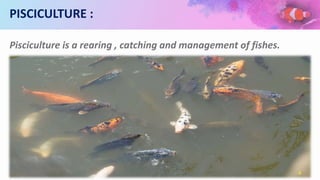
PISCICULTURE :
Pisciculture is a rearing , catching and management of fishes.
4
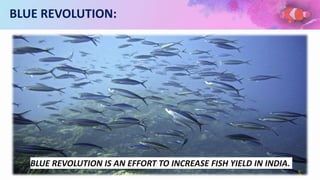
BLUE REVOLUTION:
BLUE REVOLUTION IS AN EFFORT TO INCREASE FISH YIELD IN INDIA.
5
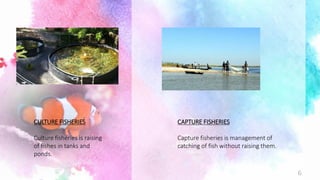
CULTURE FISHERIES
Culture fisheries is raising
of fishes in tanks and
ponds.
CAPTURE FISHERIES
Capture fisheries is management of
catching of fish without raising them.
6
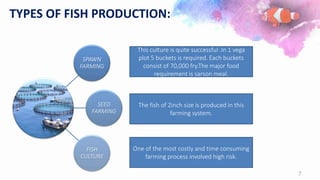
TYPES OF FISH PRODUCTION:
SPAWN
FARMING
SEED
FARMING
FISH
CULTURE
This culture is quite successful .In 1 vega
plot 5 buckets is required. Each buckets
consist of 70,000 fry.The major food
requirement is sarson meal.
The fish of 2inch size is produced in this
farming system.
One of the most costly and time consuming
farming process involved high risk.
7
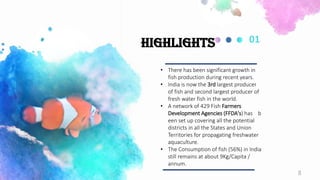
• There has been significant growth in
fish production during recent years.
• India is now the 3rd largest producer
of fish and second largest producer of
fresh water fish in the world.
• A network of 429 Fish Farmers
Development Agencies (FFDA's) has b
een set up covering all the potential
districts in all the States and Union
Territories for propagating freshwater
aquaculture.
• The Consumption of fish (56%) in India
still remains at about 9Kg/Capita /
annum.
01
Highlights
8
9
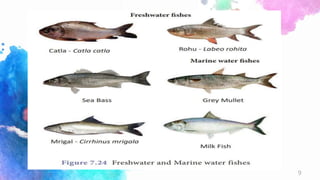
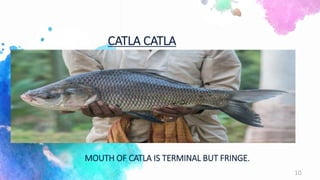
CATLA CATLA
MOUTH OF CATLA IS TERMINAL BUT FRINGE.
10
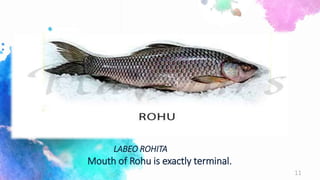
LABEO ROHITA
Mouth of Rohu is exactly terminal.
11
COMPOSITE FISH CULTURE
• The composite fish culture is a technology developed in India by
the Indian Council of Agricultural Research in 1970's. In this
system both local and important fish species, a combination of five
or six fish spp., is used in a single fish pond. These species are
selected so that they do not compete for food among them having
different types of food habitats.
• Fish used in this system include Catla, and Silver Carp, which are
surface feeders, Rohu a column feeder and Mrigal and Common
carp which are bottom feeders.
12
13
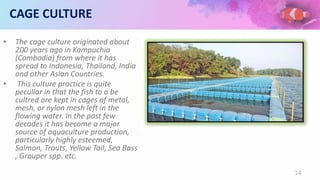
CAGE CULTURE
• The cage culture originated about
200 years ago in Kampuchia
(Combodia) from where it has
spread to Indonesia, Thailand, India
and other Asian Countries.
• This culture practice is quite
peculiar in that the fish to a be
cultred are kept in cages of metal,
mesh, or nylon mesh left in the
flowing water. In the past few
decades it has become a major
source of aquaculture production,
particularly highly esteemed,
Salmon, Trouts, Yellow Tail, Sea Bass
, Grouper spp. etc.
14
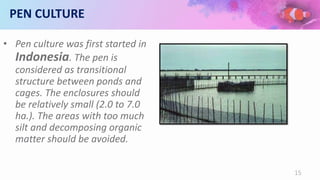
PEN CULTURE
• Pen culture was first started in
Indonesia. The pen is
considered as transitional
structure between ponds and
cages. The enclosures should
be relatively small (2.0 to 7.0
ha.). The areas with too much
silt and decomposing organic
matter should be avoided.
15
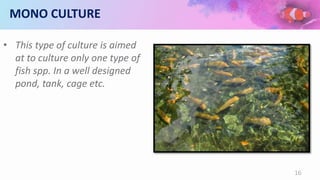
MONO CULTURE
• This type of culture is aimed
at to culture only one type of
fish spp. In a well designed
pond, tank, cage etc.
16
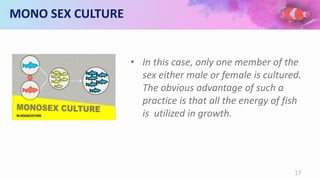
MONO SEX CULTURE
• In this case, only one member of the
sex either male or female is cultured.
The obvious advantage of such a
practice is that all the energy of fish
is utilized in growth.
17
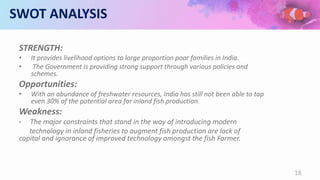
SWOT ANALYSIS
STRENGTH:
• It provides livelihood options to large proportion poor families in India.
• The Government is providing strong support through various policies and
schemes.
Opportunities:
• With an abundance of freshwater resources, India has still not been able to tap
even 30% of the potential area for inland fish production.
Weakness:
• The major constraints that stand in the way of introducing modern
technology in inland fisheries to augment fish production are lack of
capital and ignorance of improved technology amongst the fish Farmer.
18
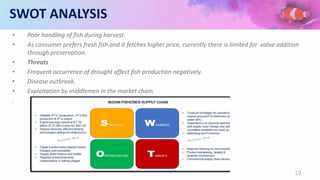
SWOT ANALYSIS
• Poor handling of fish during harvest.
• As consumer prefers fresh fish and it fetches higher price, currently there is limited for value addition
through preservation.
• Threats
• Frequent occurrence of drought affect fish production negatively.
• Disease outbreak.
• Exploitation by middlemen in the market chain.
.
19
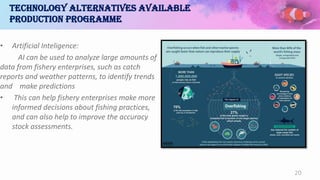
Technology alternatives available
production programme
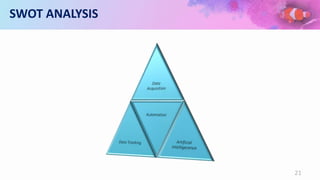
• Artificial Inteligence:
AI can be used to analyze large amounts of
data from fishery enterprises, such as catch
reports and weather patterns, to identify trends
and make predictions
• This can help fishery enterprises make more
informed decisions about fishing practices,
and can also help to improve the accuracy
stock assessments.
20
SWOT ANALYSIS
21
GENERAL INFORMATION
Name Of The Unit : Ajmeri Fish Supplier
Name Of The Owner : Feroz Khan
Product : Fish,fish Meal,fish Manure
Product Details : Live, Fresh Or Chilled Products Is Most preffered
They Provides The World’s Prime Source of High Quality
Protein, provides 14-16% of animal protein
22
PROMOTOR
• His Quailfications : B.F.Sc Bachelor Of Fisheries Science From
College Of Fisheries Science And Research
centre Etawah.
• Working Experience : 2 Years
• Project Related Experience : Fishery Technician In U.P. Fisheries
Cooperative Pvt. Ltd.
23
LOCATION:
• Address : village –jalalpur ,block –baraut , district – baghpat (U.P.) 250621
• Constitution : proprietorship
• Location advantages : least chances of water logging condidtion. Have nearly
neutral ph water suitable for fish rearing . Near to the market for easy
transportation . Ideal pond water temperature is around 20°C -30°C for fish
farm 32q
24
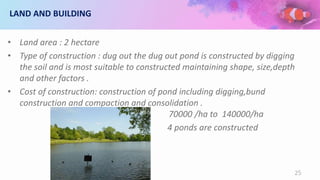
LAND AND BUILDING
• Land area : 2 hectare
• Type of construction : dug out the dug out pond is constructed by digging
the soil and is most suitable to constructed maintaining shape, size,depth
and other factors .
• Cost of construction: construction of pond including digging,bund
construction and compaction and consolidation .
70000 /ha to 140000/ha
4 ponds are constructed
25
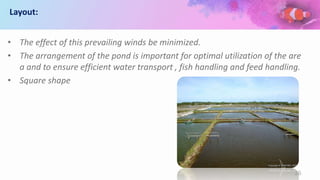
Layout:
• The effect of this prevailing winds be minimized.
• The arrangement of the pond is important for optimal utilization of the are
a and to ensure efficient water transport , fish handling and feed handling.
• Square shape
26
PLAN AND MACHINERY:
Machinery is an important aspects of modern fishery, as it can help to improve
efficiency , reduce labour costs and increase production.
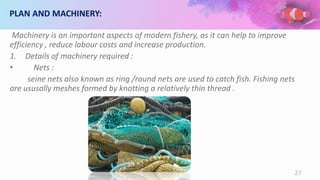
1. Details of machinery required :
• Nets :
seine nets also known as ring /round nets are used to catch fish. Fishing nets
are ususally meshes formed by knotting a relatively thin thread .
27
CONTINUE
• Aquaculture machinery
in aquaculture, machinery is used to create and maintain the ideal environment for fish to g
row. this includes equipments such as water pumps, aerators and water quality monitors
,
• Fish feeders :
in fish farms automatic fish feeders can be used to provide fish with regular and co
ntrolled feeding . This can help improve the growth and health of the fish.
- Suppliers : PURVANCHAL fish farming,U.P.
28
PLAN AND MACHEINERY
3. Cost of net and other implements:10,000rs/-
4. Various alternative available :
aeration system
water filtration systems
29
PLAN AND MACHEINERY
• in aquaculture, machinery is used to create and maintain the ideal
environment for fish to grow. this includes equipments such as water pumps
, aerators and water quality monitors,
• Fish feeders :
in fish farms automatic fish feeders can be used to provide fish with
regular and controlled feeding . This can help improve the growth and
health of the fish.
- Suppliers : PURVANCHAL fish farming,U.P.
30
Technology alternatives available
production programme
• There are several technology alternatives that can
be implemented in a fishery enterprise to improve its
efficiency, sustainability, and profitability. Here are
some
• Remote sensing: Remote sensing technology can be
used to monitor fish stocks, water quality, and
environmental conditions. This can help fishery
enterprises make better decisions about when and w
here to fish, and can also help to prevent overfishing
31
Technology alternatives available
production programme
• Fish tracking: Fish tracking
technology can be used to
monitor the movements of
fish, which can help fisher
y enterpris5es to better
understand fish behavior
and migration patterns
. This can also help to
prevent illegal fishing and
reduce bycatch.Autonomo
us underwater vehicles
32
Production process
The production process of a fishery enterprise typically involves several typically involves se
veral stages including:
1. fish breeding and hatchery:
the process starts with the breeding of fish and the hatching of fish eggs in a controlled
environment such as a hatchery . The goal of this stage is to produce healthy and geneticall
y diverse fish fry.
2. Nursery and grow out the fish fry are the transfer to nursery tank or ponds where they ar
e feed and care for until they reach a size suitable for transfer to grow out tanks or ponds in
the grow out stage the fish are raise to marketable size through feeding water managemen
t and disease prevention
33
Continue
3. Harvesting: when the fish have reach the desired size and maturity they are harvesting t
his can be done through several method such as netting , trapping, or draining the ponds
. the harvested fish are then transported to the processing facility
4. Processing: at the processing facility the fish are cleaned gutted and package . this stage
may include freezing , canning or other processing method depending on the product
5.Distribution and marketing: once processed the fish products are distributed to retailer
wholesalers, or directly to consumers
6. waste management:The production process generates organic wastes, which must be pr
operly treated and disposed of to minimize environmental impacts and comply with regulati
ons. 34
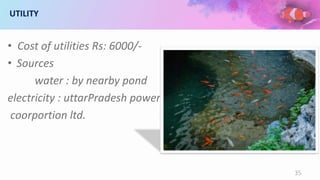
UTILITY
• Cost of utilities Rs: 6000/-
• Sources
water : by nearby pond
electricity : uttarPradesh power
coorportion ltd.
35
RAW MATERIAL
• The raw material for fishery enterprise are primary fish which are obtained,
from various sources such as a oceans , rivers, lakes, and aqua culture farm.
• The feed products that are designed to provide the necessary nutrients for
the growth and health of fish. they are available in various forms including p
ellets, flakes , powder feed are typically made from the combination of plant
and animal ingredient including fish meal , corn , wheat, and other grains
they may also contain added vitamins , minerals and other nutrient.
• Lime ,single super phosphate , urea , raw cow dung
36
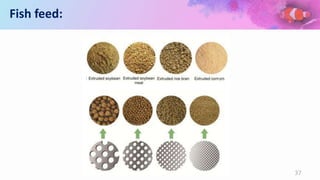
Fish feed:
37
RAW MATERIAL
Sources of procurement : GROWFIN
• Cost of raw material : 2,14,000rs/-
• Alternative raw material :
Algae : source of bio active compounds such as anti oxidant and
pigment
Insect : such as black soldier fly larvae , mealworms, and
crickets, are becoming increasingly popular as a protein source
Plant based protein : soyabean meal , anola, pea , sunflower
seed,
Single cell protein : protein rich biomass produce from micro
organism such as bacteria and yeast 38
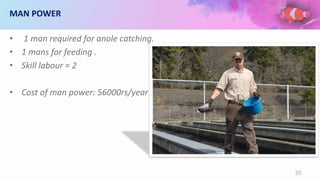
MAN POWER
• 1 man required for anole catching.
• 1 mans for feeding .
• Skill labour = 2
• Cost of man power: 56000rs/year
39
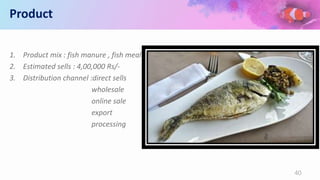
Product
1. Product mix : fish manure , fish meal
2. Estimated sells : 4,00,000 Rs/-
3. Distribution channel :direct sells
wholesale
online sale
export
processing
40
PRODUCT:
4. Product standards: product standards are the set of guide line of
the requirement that define the quality safety
and performance of product
HACCP- Hazard analysis and critical control point is a food safety ma
nagement system that is widely use in a see food industries
Quality standards : include factor such as apprearnce ,texture and fl
avor of fishery products
Labeling requirement : label provide information on the origin of th
e product, species of fish and any additive or preservative has been
used
Sustainability standards : this standard cover factor such as fishing
method used , impact on the eco system and management of fish s
tocks
41
market
End users of product : consumer
 Restaurants and food service company
 Retailers
 Pet food manufacturer
 Industrial user
Distribution of market :
good quality products are sells inter national mark easily perishable products are sells in local mark
et
Sale promotion : coupons and discounts
Free sample
contests and giving
loyalty program
42
Requirement of working capital
• Working capital required : Rs.292500/-
• Sources of working capital : term loan Rs.3,88,688/-
own contribution Rs: 129562/-
43
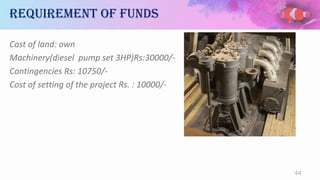
Requirement of funds
Cost of land: own
Machinery(diesel pump set 3HP)Rs:30000/-
Contingencies Rs: 10750/-
Cost of setting of the project Rs. : 10000/-
44
Cost of production and profitability
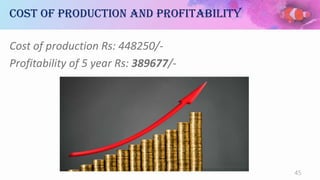
Cost of production Rs: 448250/-
Profitability of 5 year Rs: 389677/-
45
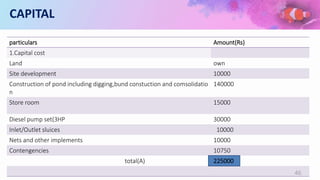
CAPITAL
particulars Amount(Rs)
1.Capital cost
Land own
Site development 10000
Construction of pond including digging,bund constuction and comsolidatio
n
140000
Store room 15000
Diesel pump set(3HP 30000
Inlet/Outlet sluices 10000
Nets and other implements 10000
Contengencies 10750
total(A) 225000
46
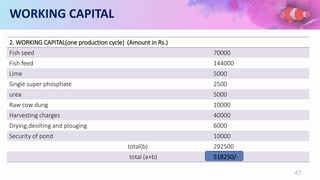
WORKING CAPITAL
2. WORKING CAPITAL(one production cycle) (Amount in Rs.)
Fish seed 70000
Fish feed 144000
Lime 5000
Single super phosphate 2500
urea 5000
Raw cow dung 10000
Harvesting charges 40000
Drying,desilting and plouging 6000
Security of pond 10000
total(b) 292500
total (a+b) 518250/-
47
SOURCES OF FINANCE
C.MEANS OF FINANCE ( Amount in Rs.)
Term loan 388688
Own contribution 129562
total 518250/-
Subsidy entitlement @36% from nabard under AC & ABC scheme 186570
48
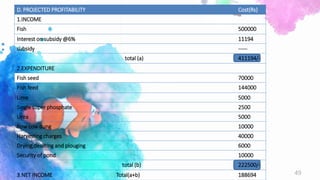
D. PROJECTED PROFITABILITY Cost(Rs)
1.INCOME
Fish 500000
Interest on subsidy @6% 11194
subsidy -----
total (a) 411194/-
2.EXPENDITURE
Fish seed 70000
Fish feed 144000
Lime 5000
Single super phosphate 2500
Urea 5000
Row cow dung 10000
Harvesting charges 40000
Drying,desilting and plouging 6000
Security of pond 10000
total (b) 222500/-
3.NET INCOME Total(a+b) 188694 49
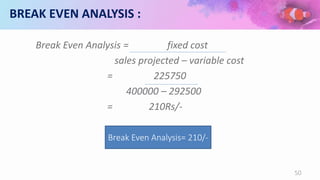
BREAK EVEN ANALYSIS :
Break Even Analysis = fixed cost
sales projected – variable cost
= 225750
400000 – 292500
= 210Rs/-
Break Even Analysis= 210/-
50
THANK YOU
51

fishery project report.PPTX

  • 1.
  • 2.
    PRESENTED BY: 1. AarshAkhbari 4011120001 2. Nayan Bhatti 4011120002 3. Bhayani Khushi 4011120004 4. Dabhi Meet 4011120006 5. Desai Shreya 4011120007 6. Malaviya Rushant 4011120014 2 Dr. P.C. PATEL ASSISTANT PROFESSOR AAU,ANAND
  • 3.
    Introduction Fishery is anactivity leading to the harvesting ,with in the boundaries of a defined area.Fisheries sector play an important role in the socio-economic development of farmers in the country 01 02The sector has been recognized as a powerful income and employment generator as it stimulates growth of a number of subsidiary industries, and is a source of cheap and nutritious food besides being a foreign exchange earner. Most importantly, it is the source of livelihood for a large of economically backward population of th e country. 03 3
  • 4.
    PISCICULTURE : Pisciculture isa rearing , catching and management of fishes. 4
  • 5.
    BLUE REVOLUTION: BLUE REVOLUTIONIS AN EFFORT TO INCREASE FISH YIELD IN INDIA. 5
  • 6.
    CULTURE FISHERIES Culture fisheriesis raising of fishes in tanks and ponds. CAPTURE FISHERIES Capture fisheries is management of catching of fish without raising them. 6
  • 7.
    TYPES OF FISHPRODUCTION: SPAWN FARMING SEED FARMING FISH CULTURE This culture is quite successful .In 1 vega plot 5 buckets is required. Each buckets consist of 70,000 fry.The major food requirement is sarson meal. The fish of 2inch size is produced in this farming system. One of the most costly and time consuming farming process involved high risk. 7
  • 8.
    • There hasbeen significant growth in fish production during recent years. • India is now the 3rd largest producer of fish and second largest producer of fresh water fish in the world. • A network of 429 Fish Farmers Development Agencies (FFDA's) has b een set up covering all the potential districts in all the States and Union Territories for propagating freshwater aquaculture. • The Consumption of fish (56%) in India still remains at about 9Kg/Capita / annum. 01 Highlights 8
  • 9.
  • 10.
    CATLA CATLA MOUTH OFCATLA IS TERMINAL BUT FRINGE. 10
  • 11.
    LABEO ROHITA Mouth ofRohu is exactly terminal. 11
  • 12.
    COMPOSITE FISH CULTURE •The composite fish culture is a technology developed in India by the Indian Council of Agricultural Research in 1970's. In this system both local and important fish species, a combination of five or six fish spp., is used in a single fish pond. These species are selected so that they do not compete for food among them having different types of food habitats. • Fish used in this system include Catla, and Silver Carp, which are surface feeders, Rohu a column feeder and Mrigal and Common carp which are bottom feeders. 12
  • 13.
  • 14.
    CAGE CULTURE • Thecage culture originated about 200 years ago in Kampuchia (Combodia) from where it has spread to Indonesia, Thailand, India and other Asian Countries. • This culture practice is quite peculiar in that the fish to a be cultred are kept in cages of metal, mesh, or nylon mesh left in the flowing water. In the past few decades it has become a major source of aquaculture production, particularly highly esteemed, Salmon, Trouts, Yellow Tail, Sea Bass , Grouper spp. etc. 14
  • 15.
    PEN CULTURE • Penculture was first started in Indonesia. The pen is considered as transitional structure between ponds and cages. The enclosures should be relatively small (2.0 to 7.0 ha.). The areas with too much silt and decomposing organic matter should be avoided. 15
  • 16.
    MONO CULTURE • Thistype of culture is aimed at to culture only one type of fish spp. In a well designed pond, tank, cage etc. 16
  • 17.
    MONO SEX CULTURE •In this case, only one member of the sex either male or female is cultured. The obvious advantage of such a practice is that all the energy of fish is utilized in growth. 17
  • 18.
    SWOT ANALYSIS STRENGTH: • Itprovides livelihood options to large proportion poor families in India. • The Government is providing strong support through various policies and schemes. Opportunities: • With an abundance of freshwater resources, India has still not been able to tap even 30% of the potential area for inland fish production. Weakness: • The major constraints that stand in the way of introducing modern technology in inland fisheries to augment fish production are lack of capital and ignorance of improved technology amongst the fish Farmer. 18
  • 19.
    SWOT ANALYSIS • Poorhandling of fish during harvest. • As consumer prefers fresh fish and it fetches higher price, currently there is limited for value addition through preservation. • Threats • Frequent occurrence of drought affect fish production negatively. • Disease outbreak. • Exploitation by middlemen in the market chain. . 19
  • 20.
    Technology alternatives available productionprogramme • Artificial Inteligence: AI can be used to analyze large amounts of data from fishery enterprises, such as catch reports and weather patterns, to identify trends and make predictions • This can help fishery enterprises make more informed decisions about fishing practices, and can also help to improve the accuracy stock assessments. 20
  • 21.
  • 22.
    GENERAL INFORMATION Name OfThe Unit : Ajmeri Fish Supplier Name Of The Owner : Feroz Khan Product : Fish,fish Meal,fish Manure Product Details : Live, Fresh Or Chilled Products Is Most preffered They Provides The World’s Prime Source of High Quality Protein, provides 14-16% of animal protein 22
  • 23.
    PROMOTOR • His Quailfications: B.F.Sc Bachelor Of Fisheries Science From College Of Fisheries Science And Research centre Etawah. • Working Experience : 2 Years • Project Related Experience : Fishery Technician In U.P. Fisheries Cooperative Pvt. Ltd. 23
  • 24.
    LOCATION: • Address :village –jalalpur ,block –baraut , district – baghpat (U.P.) 250621 • Constitution : proprietorship • Location advantages : least chances of water logging condidtion. Have nearly neutral ph water suitable for fish rearing . Near to the market for easy transportation . Ideal pond water temperature is around 20°C -30°C for fish farm 32q 24
  • 25.
    LAND AND BUILDING •Land area : 2 hectare • Type of construction : dug out the dug out pond is constructed by digging the soil and is most suitable to constructed maintaining shape, size,depth and other factors . • Cost of construction: construction of pond including digging,bund construction and compaction and consolidation . 70000 /ha to 140000/ha 4 ponds are constructed 25
  • 26.
    Layout: • The effectof this prevailing winds be minimized. • The arrangement of the pond is important for optimal utilization of the are a and to ensure efficient water transport , fish handling and feed handling. • Square shape 26
  • 27.
    PLAN AND MACHINERY: Machineryis an important aspects of modern fishery, as it can help to improve efficiency , reduce labour costs and increase production. 1. Details of machinery required : • Nets : seine nets also known as ring /round nets are used to catch fish. Fishing nets are ususally meshes formed by knotting a relatively thin thread . 27
  • 28.
    CONTINUE • Aquaculture machinery inaquaculture, machinery is used to create and maintain the ideal environment for fish to g row. this includes equipments such as water pumps, aerators and water quality monitors , • Fish feeders : in fish farms automatic fish feeders can be used to provide fish with regular and co ntrolled feeding . This can help improve the growth and health of the fish. - Suppliers : PURVANCHAL fish farming,U.P. 28
  • 29.
    PLAN AND MACHEINERY 3.Cost of net and other implements:10,000rs/- 4. Various alternative available : aeration system water filtration systems 29
  • 30.
    PLAN AND MACHEINERY •in aquaculture, machinery is used to create and maintain the ideal environment for fish to grow. this includes equipments such as water pumps , aerators and water quality monitors, • Fish feeders : in fish farms automatic fish feeders can be used to provide fish with regular and controlled feeding . This can help improve the growth and health of the fish. - Suppliers : PURVANCHAL fish farming,U.P. 30
  • 31.
    Technology alternatives available productionprogramme • There are several technology alternatives that can be implemented in a fishery enterprise to improve its efficiency, sustainability, and profitability. Here are some • Remote sensing: Remote sensing technology can be used to monitor fish stocks, water quality, and environmental conditions. This can help fishery enterprises make better decisions about when and w here to fish, and can also help to prevent overfishing 31
  • 32.
    Technology alternatives available productionprogramme • Fish tracking: Fish tracking technology can be used to monitor the movements of fish, which can help fisher y enterpris5es to better understand fish behavior and migration patterns . This can also help to prevent illegal fishing and reduce bycatch.Autonomo us underwater vehicles 32
  • 33.
    Production process The productionprocess of a fishery enterprise typically involves several typically involves se veral stages including: 1. fish breeding and hatchery: the process starts with the breeding of fish and the hatching of fish eggs in a controlled environment such as a hatchery . The goal of this stage is to produce healthy and geneticall y diverse fish fry. 2. Nursery and grow out the fish fry are the transfer to nursery tank or ponds where they ar e feed and care for until they reach a size suitable for transfer to grow out tanks or ponds in the grow out stage the fish are raise to marketable size through feeding water managemen t and disease prevention 33
  • 34.
    Continue 3. Harvesting: whenthe fish have reach the desired size and maturity they are harvesting t his can be done through several method such as netting , trapping, or draining the ponds . the harvested fish are then transported to the processing facility 4. Processing: at the processing facility the fish are cleaned gutted and package . this stage may include freezing , canning or other processing method depending on the product 5.Distribution and marketing: once processed the fish products are distributed to retailer wholesalers, or directly to consumers 6. waste management:The production process generates organic wastes, which must be pr operly treated and disposed of to minimize environmental impacts and comply with regulati ons. 34
  • 35.
    UTILITY • Cost ofutilities Rs: 6000/- • Sources water : by nearby pond electricity : uttarPradesh power coorportion ltd. 35
  • 36.
    RAW MATERIAL • Theraw material for fishery enterprise are primary fish which are obtained, from various sources such as a oceans , rivers, lakes, and aqua culture farm. • The feed products that are designed to provide the necessary nutrients for the growth and health of fish. they are available in various forms including p ellets, flakes , powder feed are typically made from the combination of plant and animal ingredient including fish meal , corn , wheat, and other grains they may also contain added vitamins , minerals and other nutrient. • Lime ,single super phosphate , urea , raw cow dung 36
  • 37.
  • 38.
    RAW MATERIAL Sources ofprocurement : GROWFIN • Cost of raw material : 2,14,000rs/- • Alternative raw material : Algae : source of bio active compounds such as anti oxidant and pigment Insect : such as black soldier fly larvae , mealworms, and crickets, are becoming increasingly popular as a protein source Plant based protein : soyabean meal , anola, pea , sunflower seed, Single cell protein : protein rich biomass produce from micro organism such as bacteria and yeast 38
  • 39.
    MAN POWER • 1man required for anole catching. • 1 mans for feeding . • Skill labour = 2 • Cost of man power: 56000rs/year 39
  • 40.
    Product 1. Product mix: fish manure , fish meal 2. Estimated sells : 4,00,000 Rs/- 3. Distribution channel :direct sells wholesale online sale export processing 40
  • 41.
    PRODUCT: 4. Product standards:product standards are the set of guide line of the requirement that define the quality safety and performance of product HACCP- Hazard analysis and critical control point is a food safety ma nagement system that is widely use in a see food industries Quality standards : include factor such as apprearnce ,texture and fl avor of fishery products Labeling requirement : label provide information on the origin of th e product, species of fish and any additive or preservative has been used Sustainability standards : this standard cover factor such as fishing method used , impact on the eco system and management of fish s tocks 41
  • 42.
    market End users ofproduct : consumer  Restaurants and food service company  Retailers  Pet food manufacturer  Industrial user Distribution of market : good quality products are sells inter national mark easily perishable products are sells in local mark et Sale promotion : coupons and discounts Free sample contests and giving loyalty program 42
  • 43.
    Requirement of workingcapital • Working capital required : Rs.292500/- • Sources of working capital : term loan Rs.3,88,688/- own contribution Rs: 129562/- 43
  • 44.
    Requirement of funds Costof land: own Machinery(diesel pump set 3HP)Rs:30000/- Contingencies Rs: 10750/- Cost of setting of the project Rs. : 10000/- 44
  • 45.
    Cost of productionand profitability Cost of production Rs: 448250/- Profitability of 5 year Rs: 389677/- 45
  • 46.
    CAPITAL particulars Amount(Rs) 1.Capital cost Landown Site development 10000 Construction of pond including digging,bund constuction and comsolidatio n 140000 Store room 15000 Diesel pump set(3HP 30000 Inlet/Outlet sluices 10000 Nets and other implements 10000 Contengencies 10750 total(A) 225000 46
  • 47.
    WORKING CAPITAL 2. WORKINGCAPITAL(one production cycle) (Amount in Rs.) Fish seed 70000 Fish feed 144000 Lime 5000 Single super phosphate 2500 urea 5000 Raw cow dung 10000 Harvesting charges 40000 Drying,desilting and plouging 6000 Security of pond 10000 total(b) 292500 total (a+b) 518250/- 47
  • 48.
    SOURCES OF FINANCE C.MEANSOF FINANCE ( Amount in Rs.) Term loan 388688 Own contribution 129562 total 518250/- Subsidy entitlement @36% from nabard under AC & ABC scheme 186570 48
  • 49.
    D. PROJECTED PROFITABILITYCost(Rs) 1.INCOME Fish 500000 Interest on subsidy @6% 11194 subsidy ----- total (a) 411194/- 2.EXPENDITURE Fish seed 70000 Fish feed 144000 Lime 5000 Single super phosphate 2500 Urea 5000 Row cow dung 10000 Harvesting charges 40000 Drying,desilting and plouging 6000 Security of pond 10000 total (b) 222500/- 3.NET INCOME Total(a+b) 188694 49
  • 50.
    BREAK EVEN ANALYSIS: Break Even Analysis = fixed cost sales projected – variable cost = 225750 400000 – 292500 = 210Rs/- Break Even Analysis= 210/- 50
  • 51.