Presented By
Ramandeep Verma
     Sanjay Singh
  Abhishek Singh
    Harish Kumar
    Ashish Pundir
    Manoj Kumar
   Gives good opportunity for those who are
    looking for long term business.
   While the farming sector is more or less
    stagnant, the dairy sector has seen much
    activity.
   In the past 15 years, milk production in India
    has doubled and is now over 113 million in a
    year.
   Second largest producer of milk.
 India milk production is growing at about 3-4 per
  cent per annum.
 However, due to increasing population, per
  capita availability of milk is expected to increase
  by only about 1.5 per cent per annum.
 For an economy growing at about 8 per cent per
  annum, this increase in availability will be grossly
  inadequate.
 Production growing at only 3-4 per cent and
  consumption growing at more than double the
  rate leads to a mismatch between demand and
  supply.
   Products – Milk, Curds, Ghee,Paneer etc
   Price – According to market demand,
    competition based pricing.
   Place – Varanasi(Uttar Pradesh)
   Promotion – Advertisements, banners, etc
   Strengths, Weaknesses, Opportunities, and
    Threats (SWOT)

   Trends and changes:
     Market analysis

     Segmentation

     Prioritizing target markets
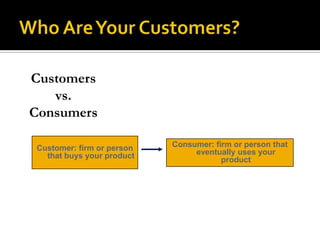
Customers
   vs.
Consumers

Customer: firm or person   Consumer: firm or person that
  that buys your product        eventually uses your
                                       product
Make sure you are distinctively different
 from your competition in areas of
 importance to your customers.

                      Competitive   analysis
                      Positioning
The set of controllable variables that will
 accomplish the marketing objectives:
    Product strategy
    Place (distribution) strategy
    Promotion (communication) strategy
    Pricing strategy
Advertising
   Creating a farm logo.
   Brouchers for retailers.
   advertisement by local channel & news paper.
Personal Selling
   Telling your customers how you create value.
   We distributes to the retailers.
Public Relations
   Being a good neighbor
   Being involved in the community
   Open selling
Price is the cost the customer can bear in order
  to obtain the product. It includes:
 list price
 discounts
 payment period
 credit terms
   Value-Based Pricing
    Competitive strategy pricing
   Cost-Based Pricing
     Add a standard markup to the cost of the product
   Competition-Based Pricing
     Set price based on following competitors’ prices
• Government & customer Oriented
• Based on customer’s perceived value

• Match price to perceived value

• Brand loyalty
   Price decision based on actions of
    competition
   Less attention on cost or product demand
   Large firms all charge the same price
   Smaller firms follow lead of large firms, may
    offer a slightly lower price
   Assess the situation
     Historic patterns (seasonal)
     Basis patterns

   The current situation
     Outlook source
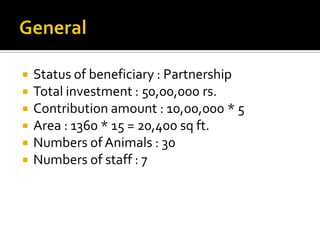
   Status of beneficiary : Partnership
   Total investment : 50,00,000 rs.
   Contribution amount : 10,00,000 * 5
   Area : 1360 * 15 = 20,400 sq ft.
   Numbers of Animals : 30
   Numbers of staff : 7
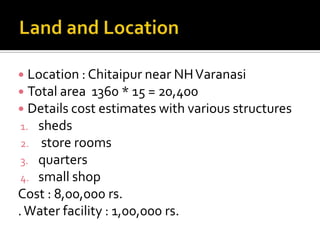
 Location : Chitaipur near NH Varanasi
 Total area  1360 * 15 = 20,400
 Details cost estimates with various structures
 1. sheds
 2. store rooms
 3. quarters
 4. small shop
Cost : 8,00,000 rs.
. Water facility : 1,00,000 rs.
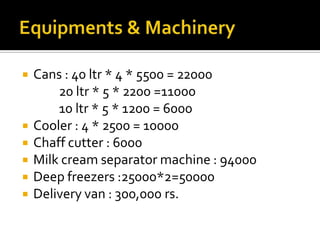
   Cans : 40 ltr * 4 * 5500 = 22000
        20 ltr * 5 * 2200 =11000
        10 ltr * 5 * 1200 = 6000
   Cooler : 4 * 2500 = 10000
   Chaff cutter : 6000
   Milk cream separator machine : 94000
   Deep freezers :25000*2=50000
   Delivery van : 300,000 rs.
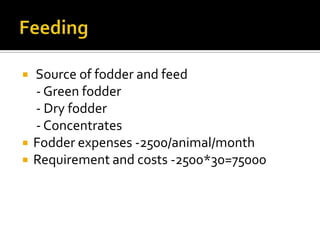
   Source of fodder and feed
    - Green fodder
    - Dry fodder
    - Concentrates
   Fodder expenses -2500/animal/month
   Requirement and costs -2500*30=75000
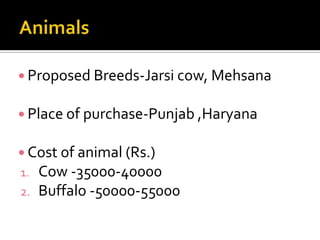
 Proposed Breeds-Jarsi cow, Mehsana

 Place of purchase-Punjab ,Haryana


 Cost of animal (Rs.)
1. Cow -35000-40000
2.   Buffalo -50000-55000
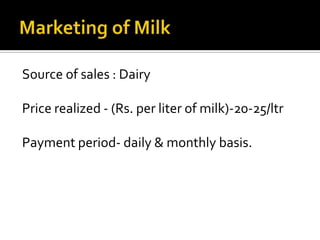
Source of sales : Dairy

Price realized - (Rs. per liter of milk)-20-25/ltr

Payment period- daily & monthly basis.
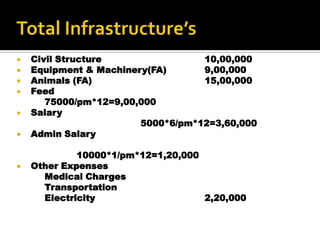
   Civil Structure                10,00,000
   Equipment & Machinery(FA)      9,00,000
   Animals (FA)                   15,00,000
   Feed
       75000/pm*12=9,00,000
   Salary
                        5000*6/pm*12=3,60,000
   Admin Salary

             10000*1/pm*12=1,20,000
   Other Expenses
      Medical Charges
      Transportation
      Electricity                   2,20,000
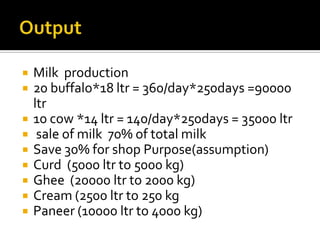
   Milk production
   20 buffalo*18 ltr = 360/day*250days =90000
    ltr
   10 cow *14 ltr = 140/day*250days = 35000 ltr
    sale of milk 70% of total milk
   Save 30% for shop Purpose(assumption)
   Curd (5000 ltr to 5000 kg)
   Ghee (20000 ltr to 2000 kg)
   Cream (2500 ltr to 250 kg
   Paneer (10000 ltr to 4000 kg)
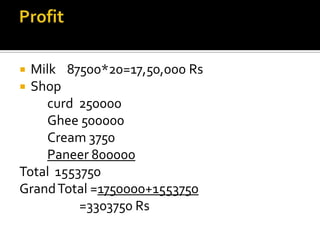
 Milk 87500*20=17,50,000 Rs
 Shop
    curd 250000
    Ghee 500000
    Cream 3750
    Paneer 800000
Total 1553750
Grand Total =1750000+1553750
          =3303750 Rs
   Operation and HR is main task of the
    dairy and milking of cows was
    traditionally a labor-intensive operation
    and still is in less developed countries.
   Small farms need several people to milk
    and care of animals.
 Recruitment of dairy farm employees is a major management
  problem due to the long hours of work, low pay, and poor
  working conditions on dairy farms
 Hired employees create a unique set of management
  challenges for dairy farm operators.
 The demand for labor depends on enterprise and on specific
  growing conditions that determine when and how much labor
  is required.
 Availability of full-time employees is the most common pre-
  expansion human resource management challenge that dairy
  producers face
Total workers : 07

1)   Admin worker : 01
2)   Worker : 04
3)   Helper : 02
4)   If required can be increased

Employees assigned responsibilities according to
 their abilities and preferences for doing different
 tasks
Recruitments through :
 Local areas
 Local advertisements
 References
 Mouth to Mouth advertisements
Interviewing the worker on :
 Communication
 Behavior and nature
 Qualification(according to work)
 Working conditions
 Skills and abilities
 Past experience
   Wages depended on whether an employee was
    provided with any facilities or not.
   Farm occasionally provided bonuses to
    employees based on his perception of their
    commitment and productivity at work.
   Healthcare insurance plans to employees.
   Medical facilities to employees and their
    families(First aid only).
   Others facilities like education(2 child up to 8th
    class), increment in wages etc.
   Poor working condition or not punctual at time.
   Poor working relationship with coworkers.
   Persistently refusing to follow the milking routines.
   Alcoholic nature.
   Fighting with workers.
   Bad verbal communication
 Productivity
 Breeding
 Feed and Fodder
 Storage of milk
 Selling in market
 Caring and health of animals in dairy
 Shop activities
 Purchase of feed and fodders from market.
   A plan that provides directions so a business
    can plan its future and helps it avoid bumps in
    the road.
   The time you spend making your business
    plan thorough and accurate, and keeping it
    up-to-date for future aspects and success.
   Admin work : 01 man (Shop a/c & sales of
    total products)
   Worker : 04 men (Milking and shop)
   Helper : 02 men (other works of dairy)
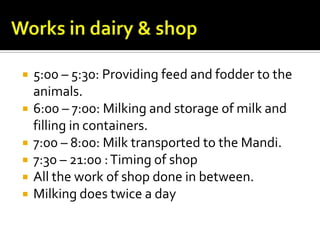
   5:00 – 5:30: Providing feed and fodder to the
    animals.
   6:00 – 7:00: Milking and storage of milk and
    filling in containers.
   7:00 – 8:00: Milk transported to the Mandi.
   7:30 – 21:00 : Timing of shop
   All the work of shop done in between.
   Milking does twice a day
dairy farming

dairy farming

  • 1.
    Presented By Ramandeep Verma Sanjay Singh Abhishek Singh Harish Kumar Ashish Pundir Manoj Kumar
  • 2.
    Gives good opportunity for those who are looking for long term business.  While the farming sector is more or less stagnant, the dairy sector has seen much activity.  In the past 15 years, milk production in India has doubled and is now over 113 million in a year.  Second largest producer of milk.

  • 3.
     India milkproduction is growing at about 3-4 per cent per annum.  However, due to increasing population, per capita availability of milk is expected to increase by only about 1.5 per cent per annum.  For an economy growing at about 8 per cent per annum, this increase in availability will be grossly inadequate.  Production growing at only 3-4 per cent and consumption growing at more than double the rate leads to a mismatch between demand and supply.
  • 4.
    Products – Milk, Curds, Ghee,Paneer etc  Price – According to market demand, competition based pricing.  Place – Varanasi(Uttar Pradesh)  Promotion – Advertisements, banners, etc
  • 5.
    Strengths, Weaknesses, Opportunities, and Threats (SWOT)  Trends and changes:  Market analysis  Segmentation  Prioritizing target markets
  • 6.
    Customers vs. Consumers Customer: firm or person Consumer: firm or person that that buys your product eventually uses your product
  • 7.
    Make sure youare distinctively different from your competition in areas of importance to your customers.  Competitive analysis  Positioning
  • 8.
    The set ofcontrollable variables that will accomplish the marketing objectives: Product strategy Place (distribution) strategy Promotion (communication) strategy Pricing strategy
  • 9.
    Advertising Creating a farm logo.  Brouchers for retailers.  advertisement by local channel & news paper. Personal Selling  Telling your customers how you create value.  We distributes to the retailers. Public Relations  Being a good neighbor  Being involved in the community  Open selling
  • 10.
    Price is thecost the customer can bear in order to obtain the product. It includes:  list price  discounts  payment period  credit terms
  • 11.
    Value-Based Pricing Competitive strategy pricing  Cost-Based Pricing  Add a standard markup to the cost of the product  Competition-Based Pricing  Set price based on following competitors’ prices
  • 12.
    • Government &customer Oriented • Based on customer’s perceived value • Match price to perceived value • Brand loyalty
  • 13.
    Price decision based on actions of competition  Less attention on cost or product demand  Large firms all charge the same price  Smaller firms follow lead of large firms, may offer a slightly lower price
  • 14.
    Assess the situation  Historic patterns (seasonal)  Basis patterns  The current situation  Outlook source
  • 16.
    Status of beneficiary : Partnership  Total investment : 50,00,000 rs.  Contribution amount : 10,00,000 * 5  Area : 1360 * 15 = 20,400 sq ft.  Numbers of Animals : 30  Numbers of staff : 7
  • 17.
     Location :Chitaipur near NH Varanasi  Total area 1360 * 15 = 20,400  Details cost estimates with various structures 1. sheds 2. store rooms 3. quarters 4. small shop Cost : 8,00,000 rs. . Water facility : 1,00,000 rs.
  • 18.
    Cans : 40 ltr * 4 * 5500 = 22000 20 ltr * 5 * 2200 =11000 10 ltr * 5 * 1200 = 6000  Cooler : 4 * 2500 = 10000  Chaff cutter : 6000  Milk cream separator machine : 94000  Deep freezers :25000*2=50000  Delivery van : 300,000 rs.
  • 19.
    Source of fodder and feed - Green fodder - Dry fodder - Concentrates  Fodder expenses -2500/animal/month  Requirement and costs -2500*30=75000
  • 20.
     Proposed Breeds-Jarsicow, Mehsana  Place of purchase-Punjab ,Haryana  Cost of animal (Rs.) 1. Cow -35000-40000 2. Buffalo -50000-55000
  • 21.
    Source of sales: Dairy Price realized - (Rs. per liter of milk)-20-25/ltr Payment period- daily & monthly basis.
  • 22.
    Civil Structure 10,00,000  Equipment & Machinery(FA) 9,00,000  Animals (FA) 15,00,000  Feed 75000/pm*12=9,00,000  Salary 5000*6/pm*12=3,60,000  Admin Salary 10000*1/pm*12=1,20,000  Other Expenses Medical Charges Transportation Electricity 2,20,000
  • 23.
    Milk production  20 buffalo*18 ltr = 360/day*250days =90000 ltr  10 cow *14 ltr = 140/day*250days = 35000 ltr  sale of milk 70% of total milk  Save 30% for shop Purpose(assumption)  Curd (5000 ltr to 5000 kg)  Ghee (20000 ltr to 2000 kg)  Cream (2500 ltr to 250 kg  Paneer (10000 ltr to 4000 kg)
  • 24.
     Milk 87500*20=17,50,000Rs  Shop curd 250000 Ghee 500000 Cream 3750 Paneer 800000 Total 1553750 Grand Total =1750000+1553750 =3303750 Rs
  • 26.
    Operation and HR is main task of the dairy and milking of cows was traditionally a labor-intensive operation and still is in less developed countries.  Small farms need several people to milk and care of animals.
  • 27.
     Recruitment ofdairy farm employees is a major management problem due to the long hours of work, low pay, and poor working conditions on dairy farms  Hired employees create a unique set of management challenges for dairy farm operators.  The demand for labor depends on enterprise and on specific growing conditions that determine when and how much labor is required.  Availability of full-time employees is the most common pre- expansion human resource management challenge that dairy producers face
  • 28.
    Total workers :07 1) Admin worker : 01 2) Worker : 04 3) Helper : 02 4) If required can be increased Employees assigned responsibilities according to their abilities and preferences for doing different tasks
  • 29.
    Recruitments through : Local areas  Local advertisements  References  Mouth to Mouth advertisements
  • 30.
    Interviewing the workeron :  Communication  Behavior and nature  Qualification(according to work)  Working conditions  Skills and abilities  Past experience
  • 31.
    Wages depended on whether an employee was provided with any facilities or not.  Farm occasionally provided bonuses to employees based on his perception of their commitment and productivity at work.  Healthcare insurance plans to employees.  Medical facilities to employees and their families(First aid only).  Others facilities like education(2 child up to 8th class), increment in wages etc.
  • 32.
    Poor working condition or not punctual at time.  Poor working relationship with coworkers.  Persistently refusing to follow the milking routines.  Alcoholic nature.  Fighting with workers.  Bad verbal communication
  • 33.
     Productivity  Breeding Feed and Fodder  Storage of milk  Selling in market  Caring and health of animals in dairy  Shop activities  Purchase of feed and fodders from market.
  • 34.
    A plan that provides directions so a business can plan its future and helps it avoid bumps in the road.  The time you spend making your business plan thorough and accurate, and keeping it up-to-date for future aspects and success.
  • 35.
    Admin work : 01 man (Shop a/c & sales of total products)  Worker : 04 men (Milking and shop)  Helper : 02 men (other works of dairy)
  • 36.
    5:00 – 5:30: Providing feed and fodder to the animals.  6:00 – 7:00: Milking and storage of milk and filling in containers.  7:00 – 8:00: Milk transported to the Mandi.  7:30 – 21:00 : Timing of shop  All the work of shop done in between.  Milking does twice a day

Editor's Notes

  • #3 Dairy farming is a class of agricultural, or an animal husbandry, enterprise, for long-term production of milk, usually from dairy cows but also from goats, sheep and camels, which may be either processed on-site or transported to a dairy factory for processing and eventual retail sale.the Murrah — capable of milk yields as high as 35 kg a dayRs 2.5 lakh
  • #6 Know who you are selling to (market analysis, segmentation, prioritizing targets)Know what is important to targeted customers (customer analysis)Make sure you are distinctively different from your competition in areas of importance to targeted segments (competitive analysis, reallocation of resources if necessary, positioning, market intelligence) Focus attention of everyone on delivering what the customer wants (management of people, monitoring and control).Constant monitoring of changes in the market (market intelligence, market analysis, internal feedback system)The most fundamental marketing concept is treating customers like you are truly interested in them. That means making sure you are meeting needs that customers perceive as important. Meeting needs is the heartland of every marketing program. A useful tool in assessing the marketplace is SWOT. Assessing the opportunities and threats and how the business can capitalize on them or avoid them using the firm’s strengths weaknesses
  • #15 Price expectations can play an important role when setting price and date triggers. A first step is to assess the historical situation: what is the average price at different points during the year? (you may wish to think about futures prices and basis separately). Does it make sense to set a date objective when prices are historically at their lowest point? How variable are prices during the year? Does it make sense to plan on selling all of the crop when prices are the most variable?When examining futures prices, it’s often the case that pricing opportunities occur in the early Spring (in or around USDA’s planting intentions report), just after corn planting begins in the Corn Belt, and just prior to the pollination period. At the same time, low prices are often seen during harvest with recovery occurring throughout the remainder of the Winter. However, every cropping year is different, so its best to assess the current situation and adjust the marketing plan to fit conditions. University extension specialists and the USDA are good sources of current and outlook information which will help one set date targets. The extension specialists and USDA personnel generally assess the situation but seldom make recommendations. Another source of information as well as pricing recommendations are market advisors who often provide a service to help producers “beat the market”. But can someone really beat the market? We’ll discuss that question on the next slide, but notice where you will place the high, average and low prices on the marketing plan worksheet. In addition there is a spot to list either the target price or the loan rate for the crop next to the heading “Farm Bill.”