PRESENTATION ON DAIRY
Presented by:
Sudarshan Kr. Patel
Suhas Zod
PGDMA (2013-15)
FLOW OF PRESENTATION
INTRODUCTION
PRODUCTION
CONSUMPTION
PRODUCT MIX
EXPORT- IMPORT
SUPPLY CHANNEL
MAJOR PLAYERS
POLICIES
INSTITUTIONS
SWOT ANALYSIS
REFERENCES
INTRODUCTION
 India accounts about 2.4% of the worlds geographical area.
 India has 15% of the livestock of total livestock population in the
world, with 50% buffaloes and 20%of world’s cattle.
 Agriculture contributes 14% of the nation’s GDP, about 11% of its
exports.
 India is the largest producer of milk in the world (>15% share) with
127.9 mt production in 2012.
 Nearly 70% of Indian population depends on dairy directly or
indirectly.
 Total GDP share : 3.6% (2011-12)
 Growth rate of milk production : 4%
 Consumer demand rate : 8%.
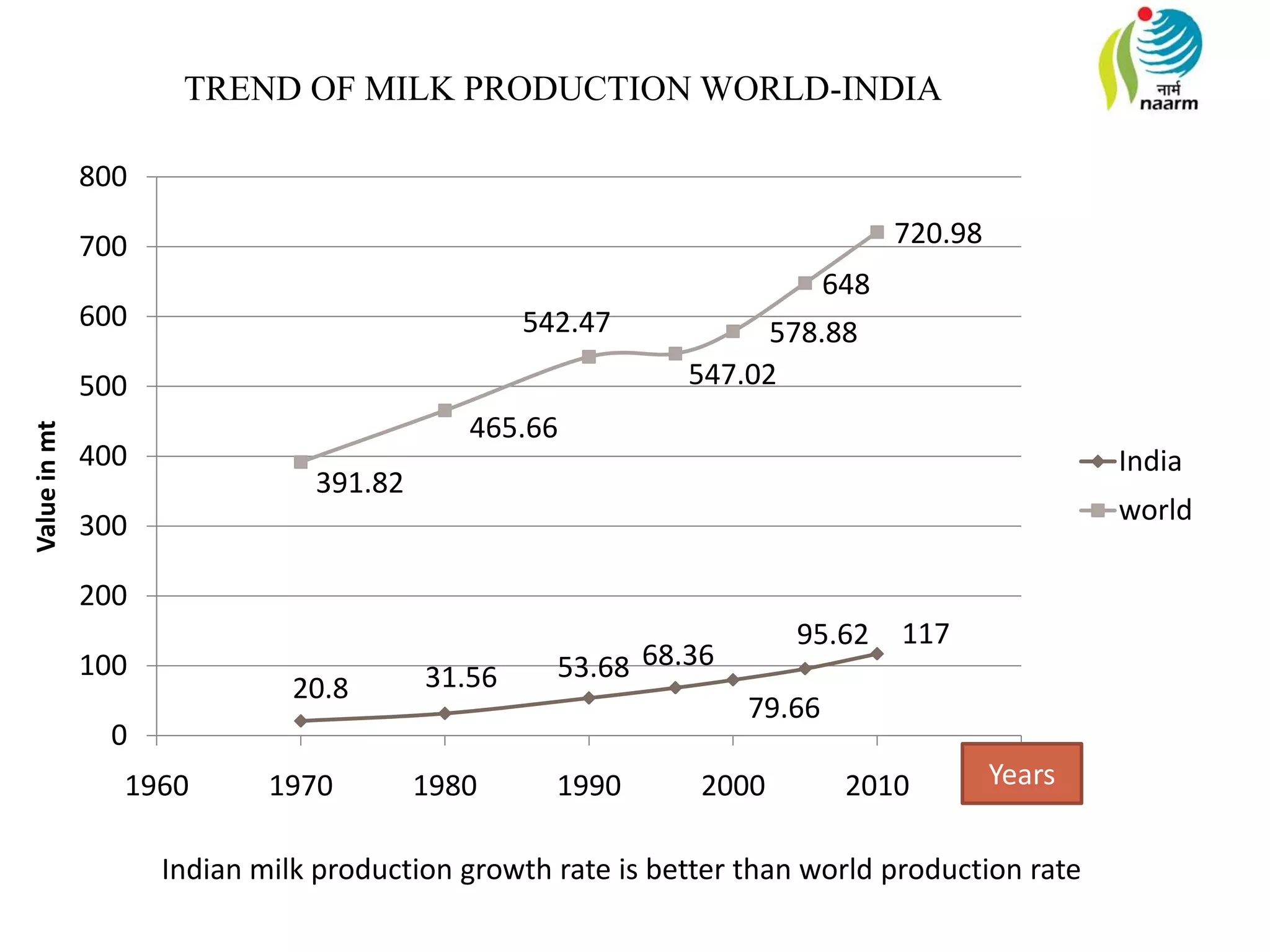
TREND OF MILK PRODUCTION WORLD-INDIA
20.8 31.56 53.68 68.36
79.66
95.62 117
391.82
465.66
542.47
547.02
578.88
648
720.98
0
100
200
300
400
500
600
700
800
1960 1970 1980 1990 2000 2010 2020
India
world
Indian milk production growth rate is better than world production rate
Valueinmt
Years
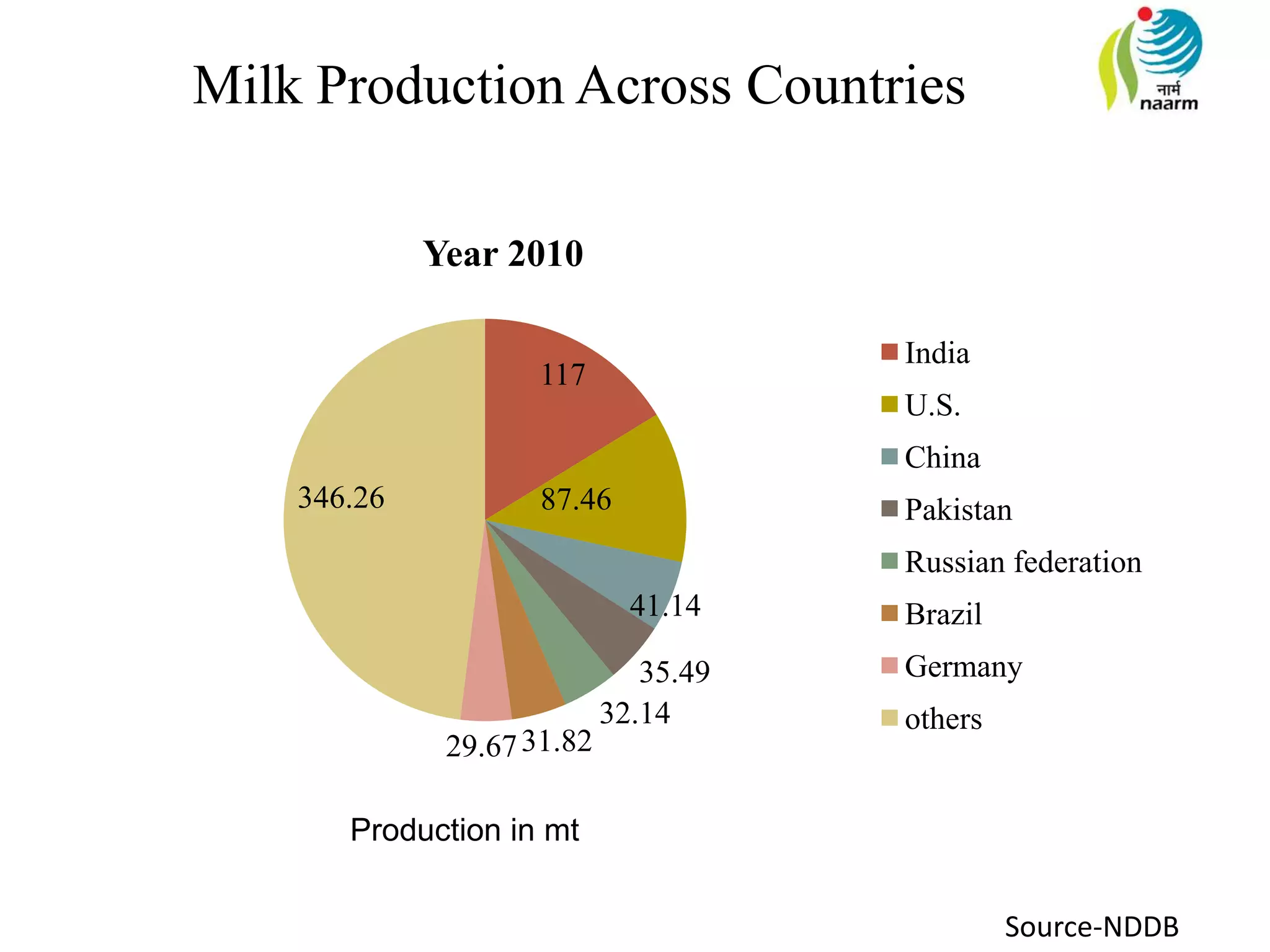
Milk Production Across Countries
117
87.46
41.14
35.49
32.14
31.8229.67
346.26
Year 2010
India
U.S.
China
Pakistan
Russian federation
Brazil
Germany
others
Production in mt
Source-NDDB
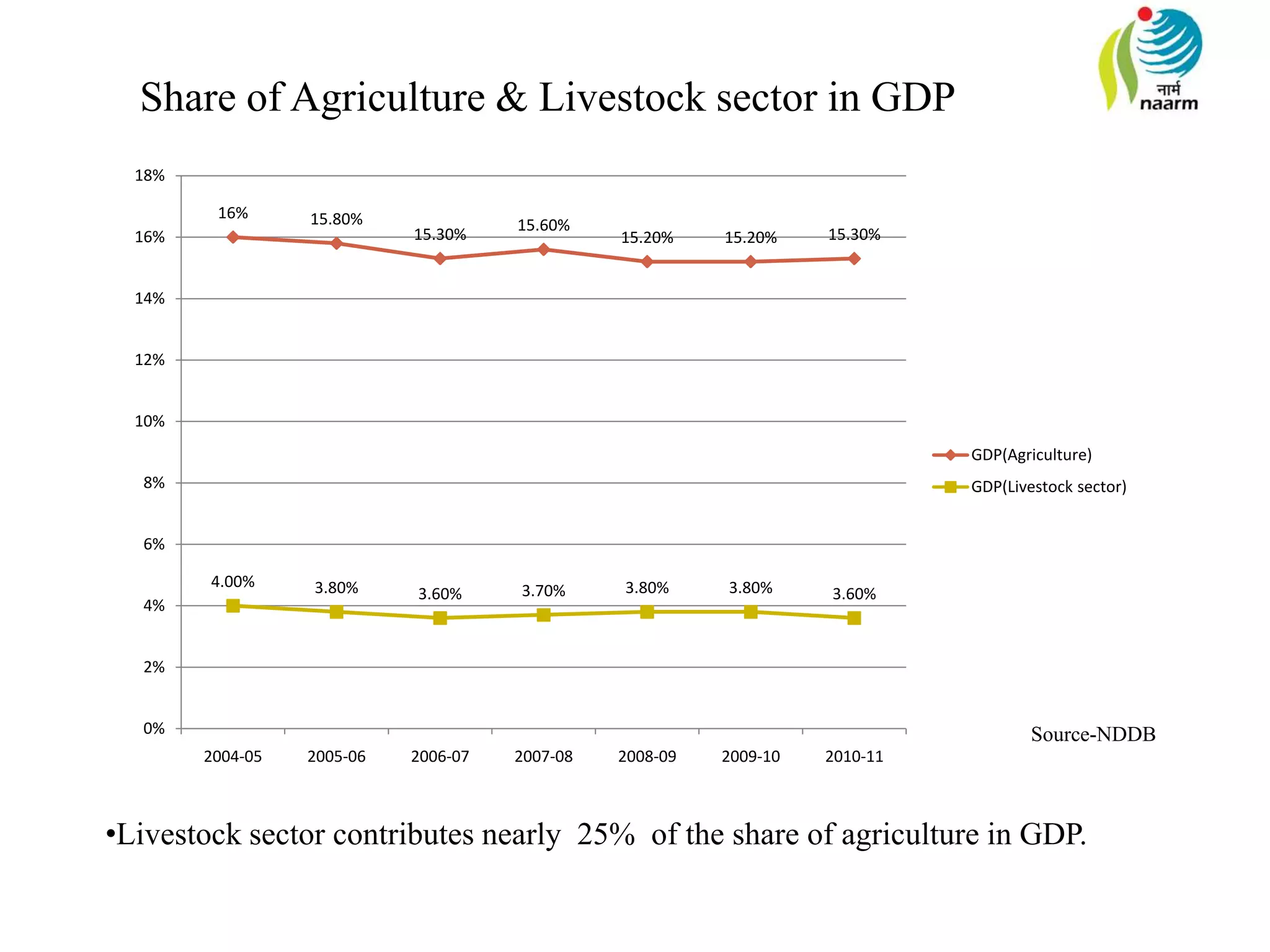
16% 15.80%
15.30%
15.60%
15.20% 15.20% 15.30%
4.00% 3.80% 3.60% 3.70% 3.80% 3.80% 3.60%
0%
2%
4%
6%
8%
10%
12%
14%
16%
18%
2004-05 2005-06 2006-07 2007-08 2008-09 2009-10 2010-11
GDP(Agriculture)
GDP(Livestock sector)
Source-NDDB
Share of Agriculture & Livestock sector in GDP
•Livestock sector contributes nearly 25% of the share of agriculture in GDP.
0
20
40
60
80
100
120
140
0
50
100
150
200
250
300
350
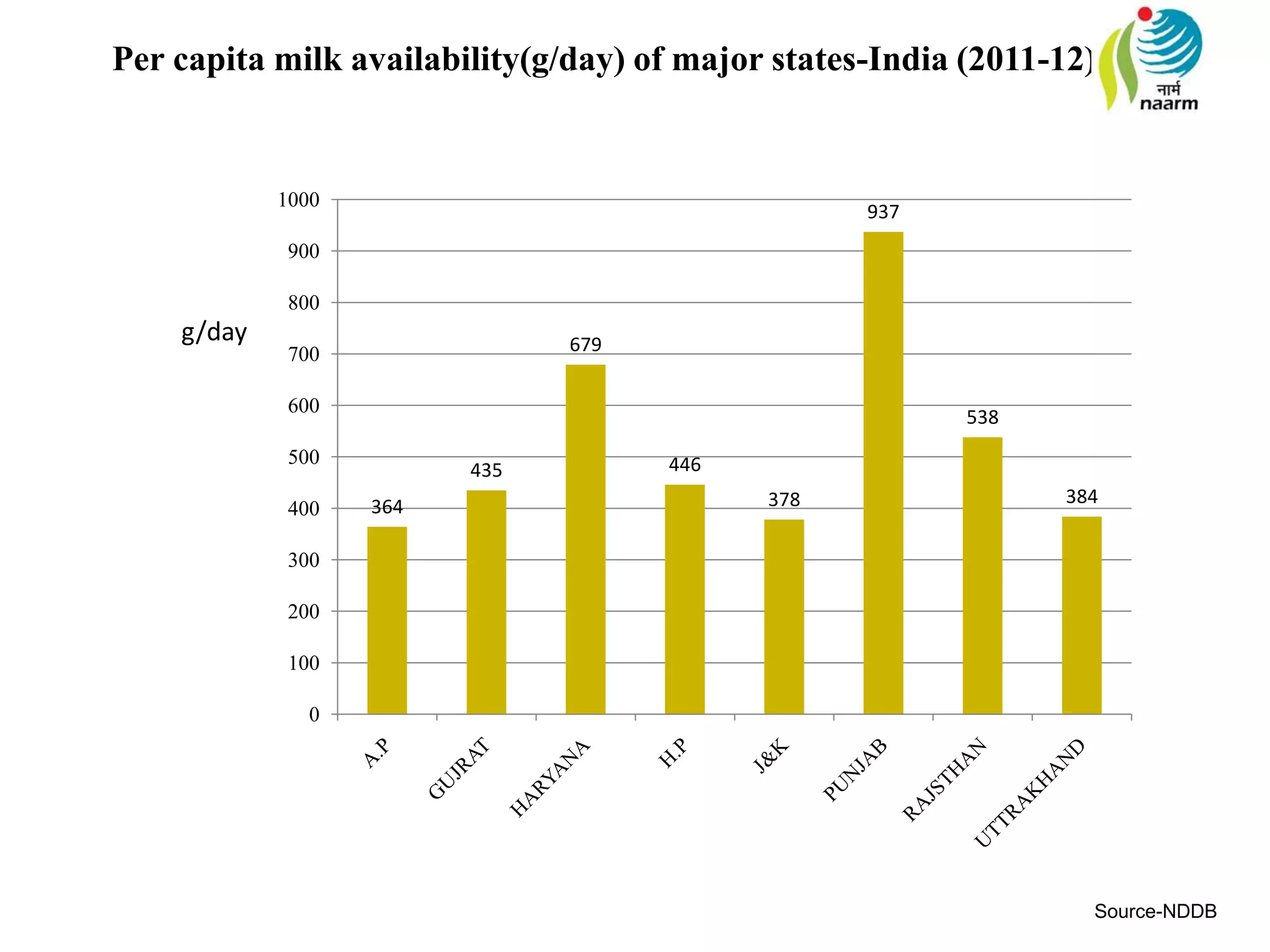
Per capita milk
availability(g/day)
Production (mt)
g/day
mt
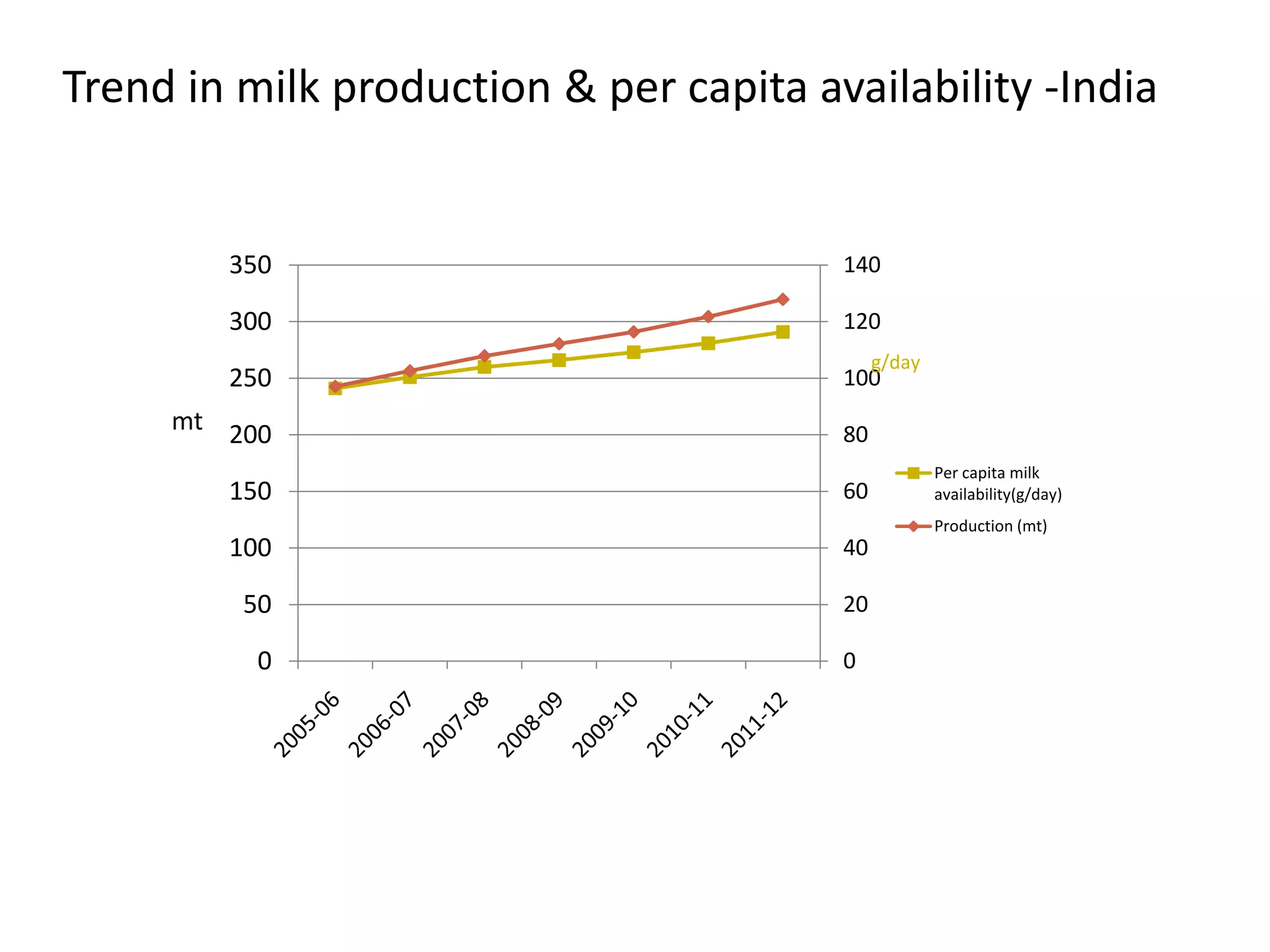
Trend in milk production & per capita availability -India
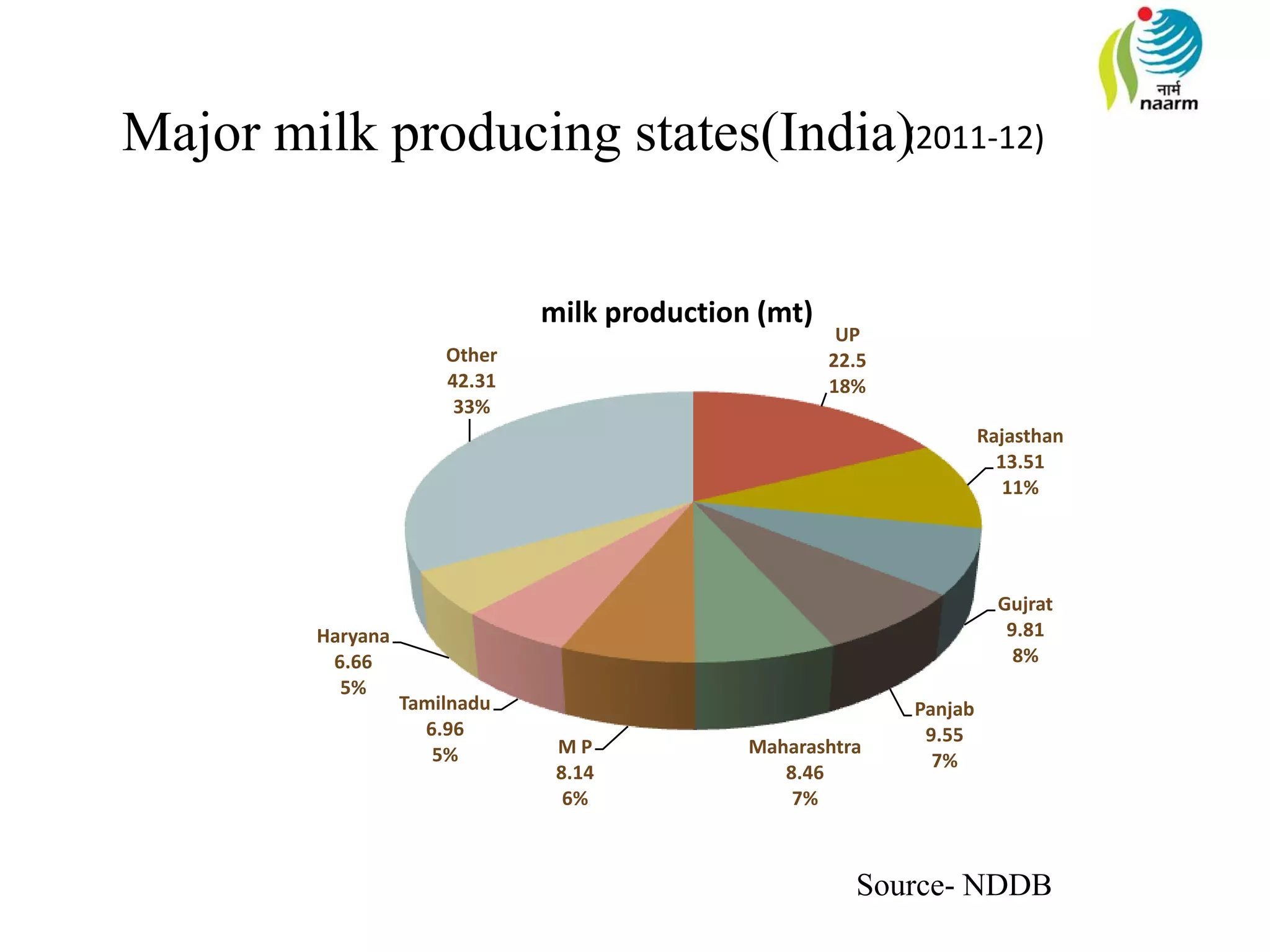
Major milk producing states(India)
Source- NDDB
(2011-12)
UP
22.5
18%
Rajasthan
13.51
11%
Gujrat
9.81
8%
Panjab
9.55
7%
Maharashtra
8.46
7%
M P
8.14
6%
Tamilnadu
6.96
5%
Haryana
6.66
5%
Other
42.31
33%
milk production (mt)
364
435
679
446
378
937
538
384
0
100
200
300
400
500
600
700
800
900
1000
Per capita milk availability(g/day) of major states-India (2011-12)
Source-NDDB
g/day
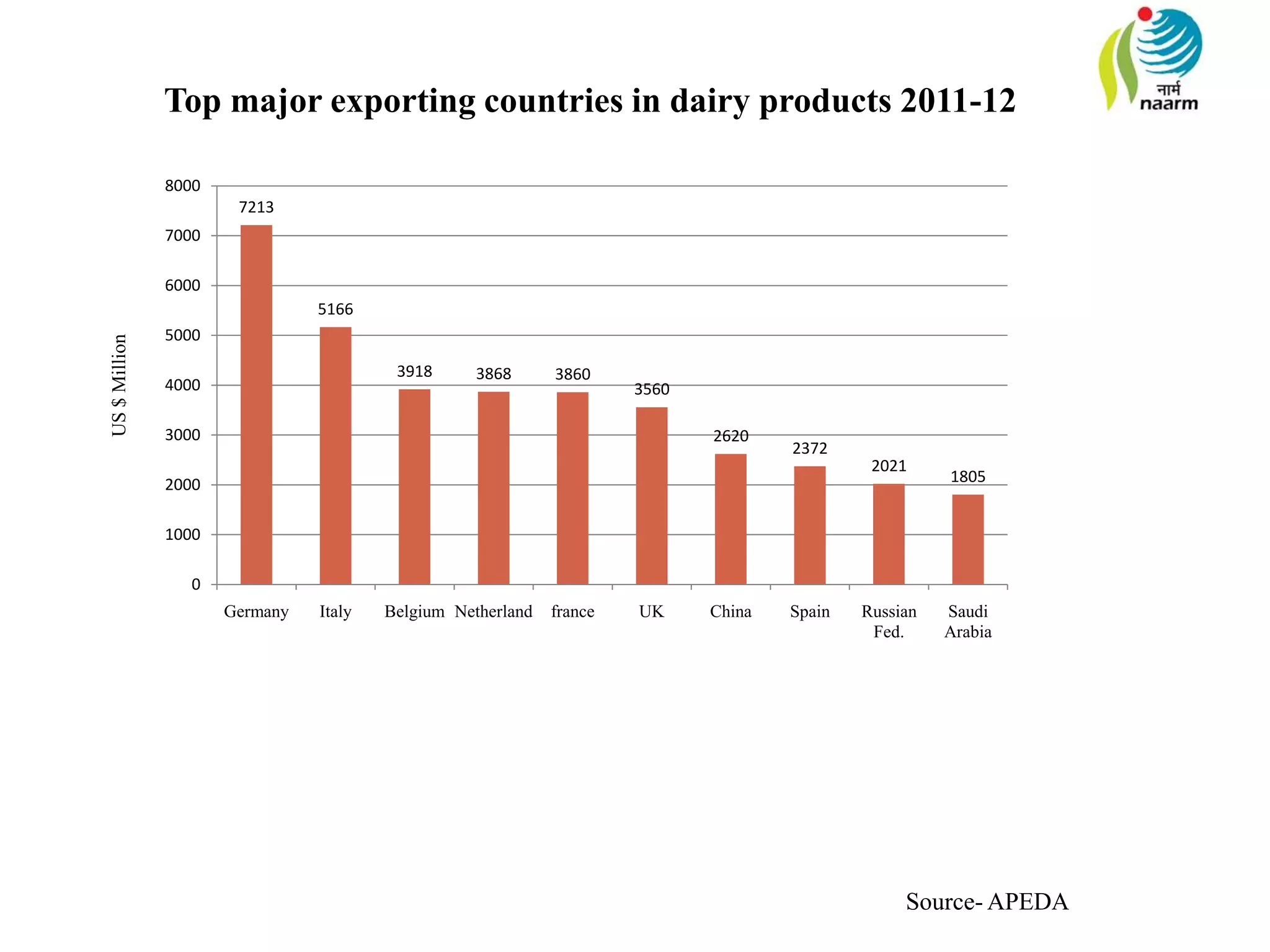
Top major exporting countries in dairy products 2011-12
Source- APEDA
7213
5166
3918 3868 3860
3560
2620
2372
2021
1805
0
1000
2000
3000
4000
5000
6000
7000
8000
Germany Italy Belgium Netherland france UK China Spain Russian
Fed.
Saudi
Arabia
US$Million
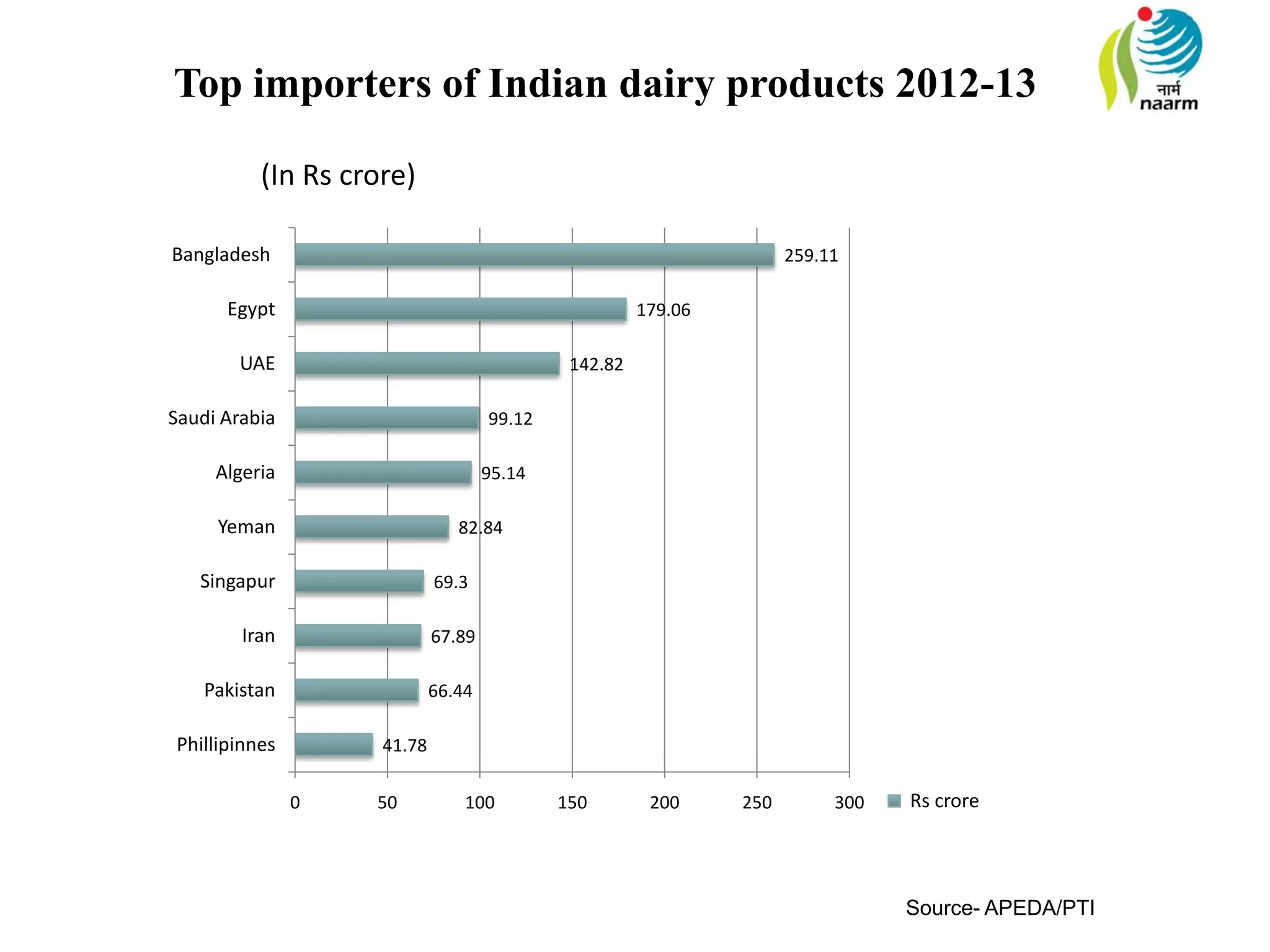
Top importers of Indian dairy products 2012-13
Source- APEDA/PTI
41.78
66.44
67.89
69.3
82.84
95.14
99.12
142.82
179.06
259.11
0 50 100 150 200 250 300
Phillipinnes
Pakistan
Iran
Singapur
Yeman
Algeria
Saudi Arabia
UAE
Egypt
Bangladesh
Rs crore
(In Rs crore)
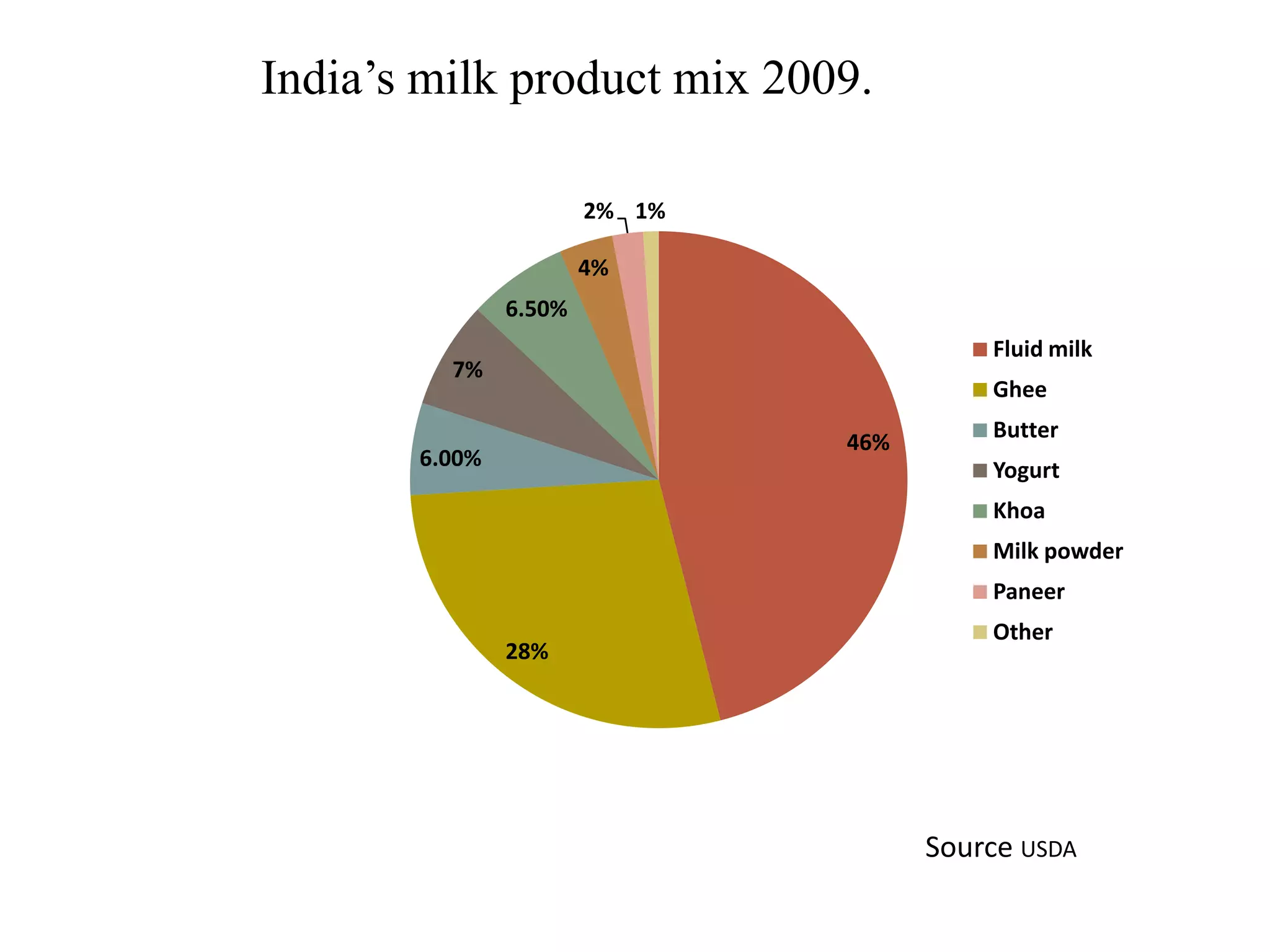
46%
28%
6.00%
7%
6.50%
4%
2% 1%
Fluid milk
Ghee
Butter
Yogurt
Khoa
Milk powder
Paneer
Other
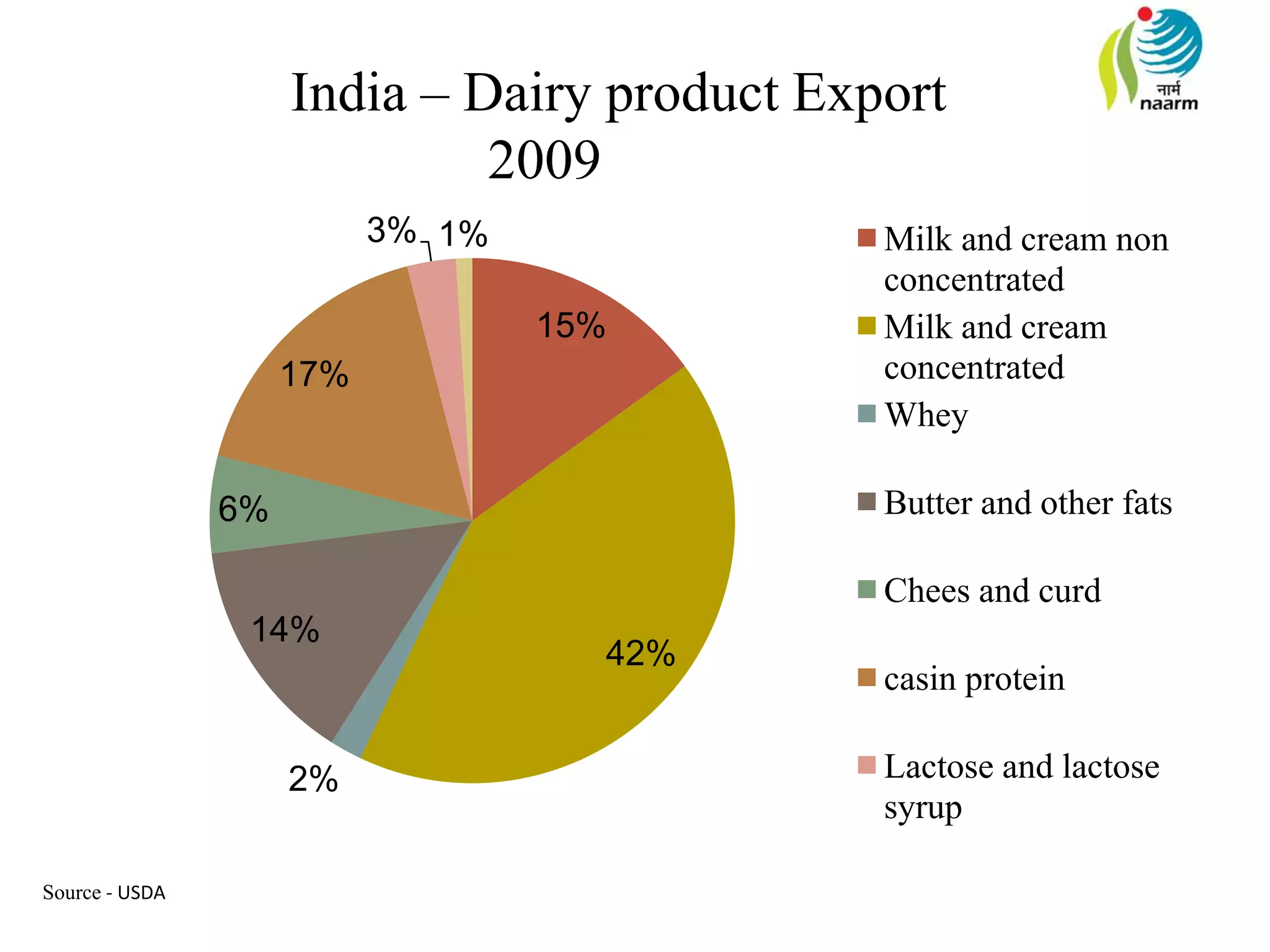
India’s milk product mix 2009.
Source USDA
15%
42%
2%
14%
6%
17%
3% 1% Milk and cream non
concentrated
Milk and cream
concentrated
Whey
Butter and other fats
Chees and curd
casin protein
Lactose and lactose
syrup
India – Dairy product Export
2009
Source - USDA
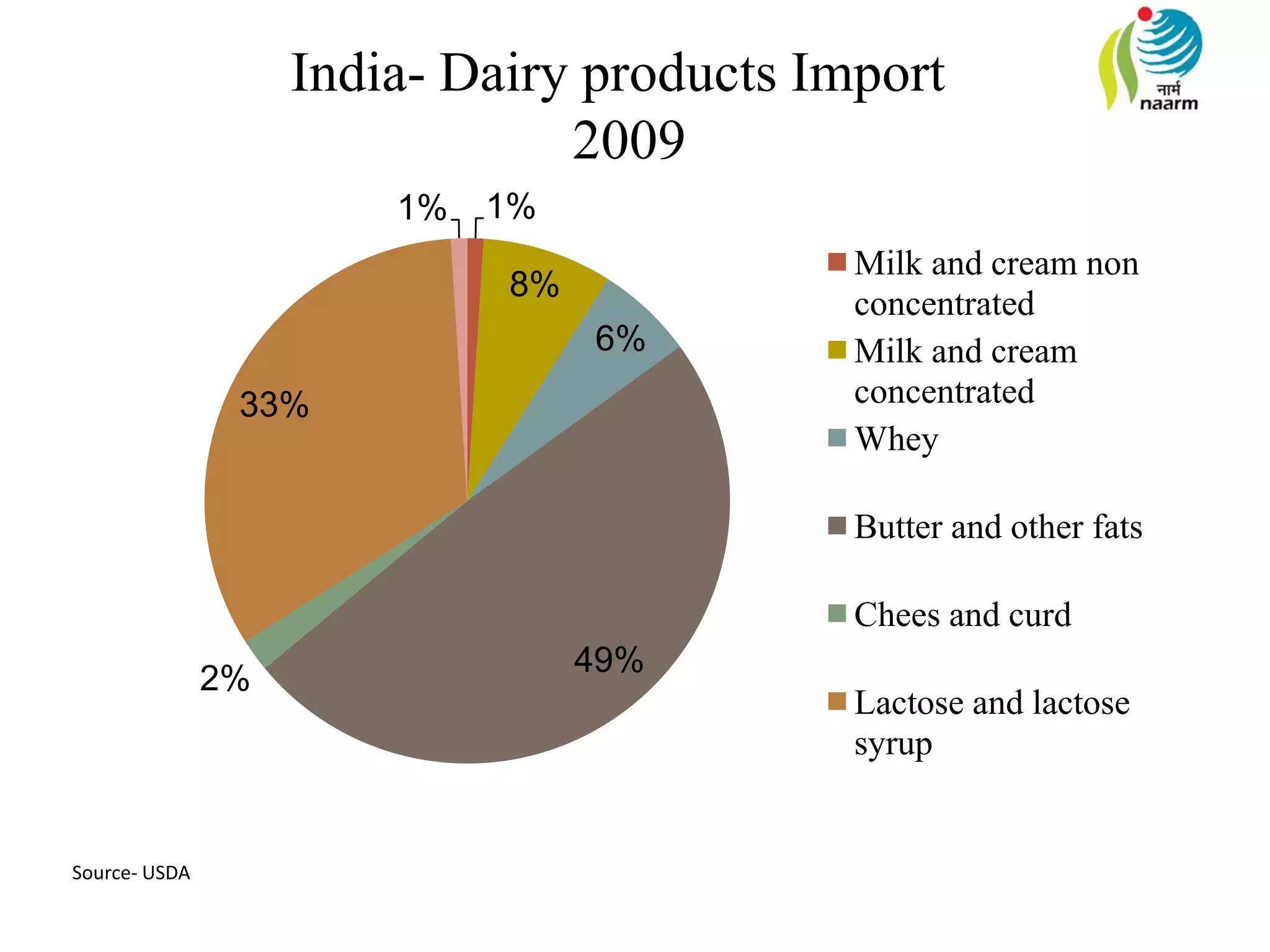
1%
8%
6%
49%
2%
33%
1%
Milk and cream non
concentrated
Milk and cream
concentrated
Whey
Butter and other fats
Chees and curd
Lactose and lactose
syrup
India- Dairy products Import
2009
Source- USDA
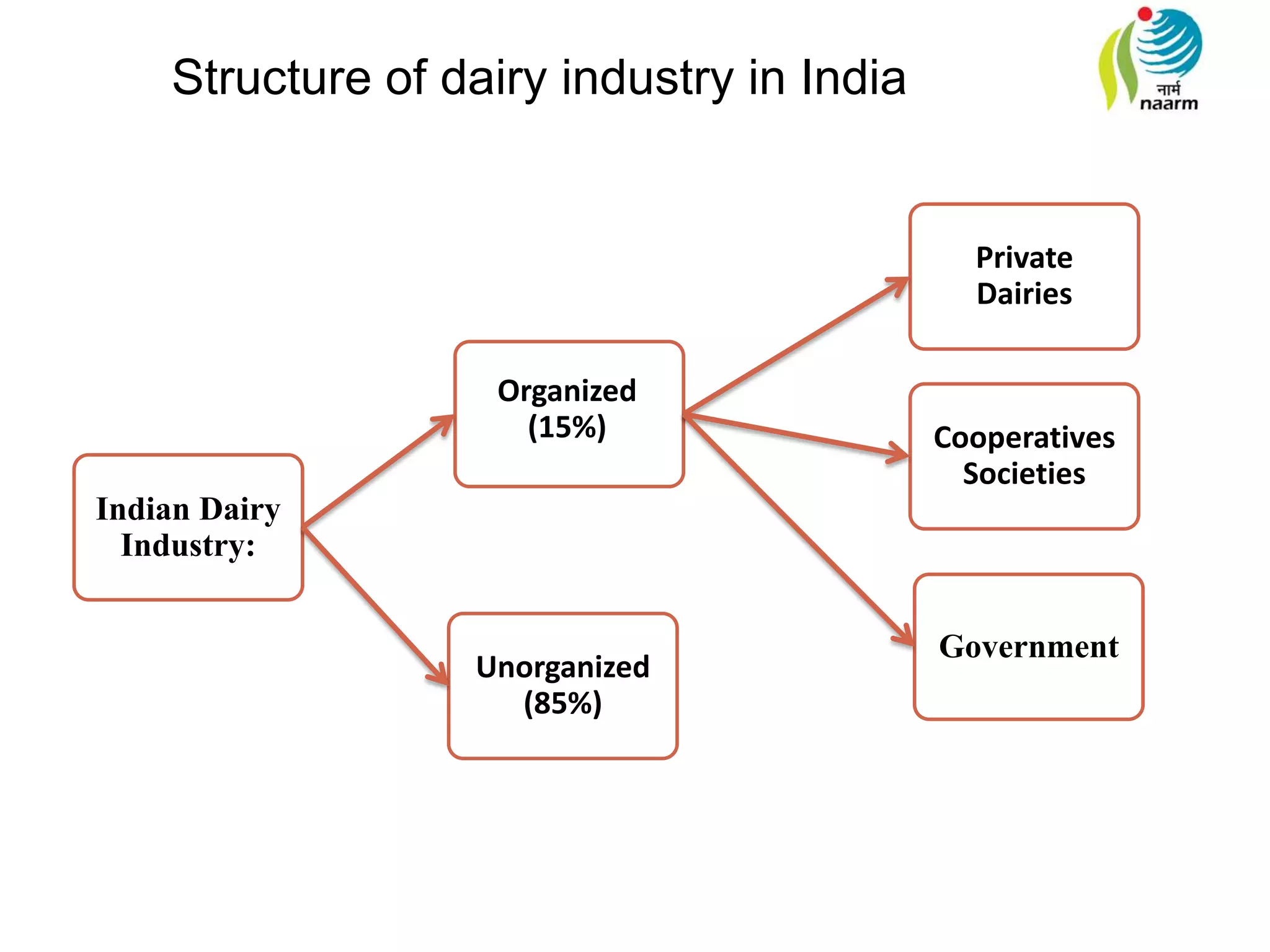
Indian Dairy
Industry:
Organized
(15%)
Unorganized
(85%)
Private
Dairies
Cooperatives
Societies
Government
Structure of dairy industry in India
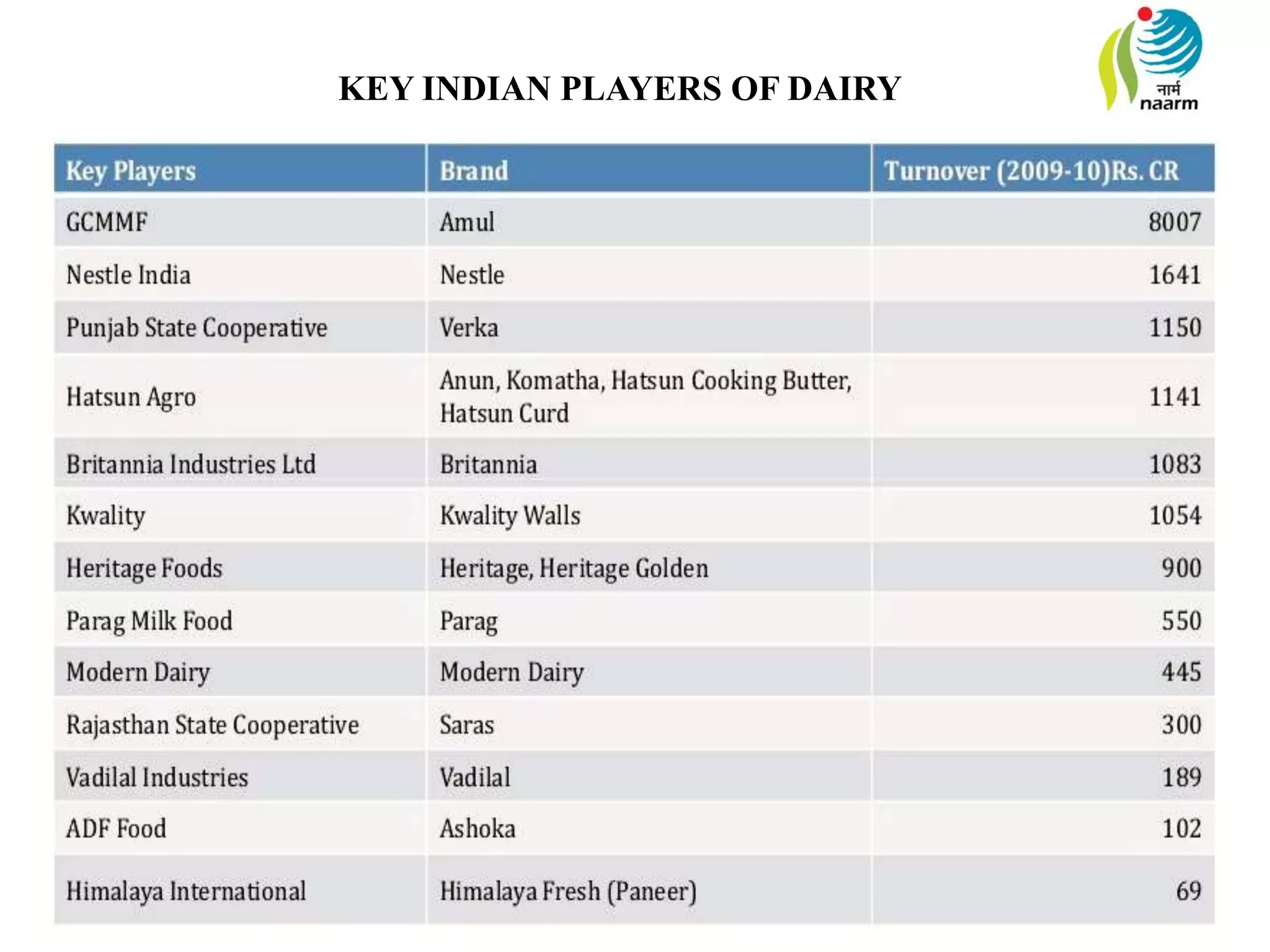
KEY INDIAN PLAYERS OF DAIRY
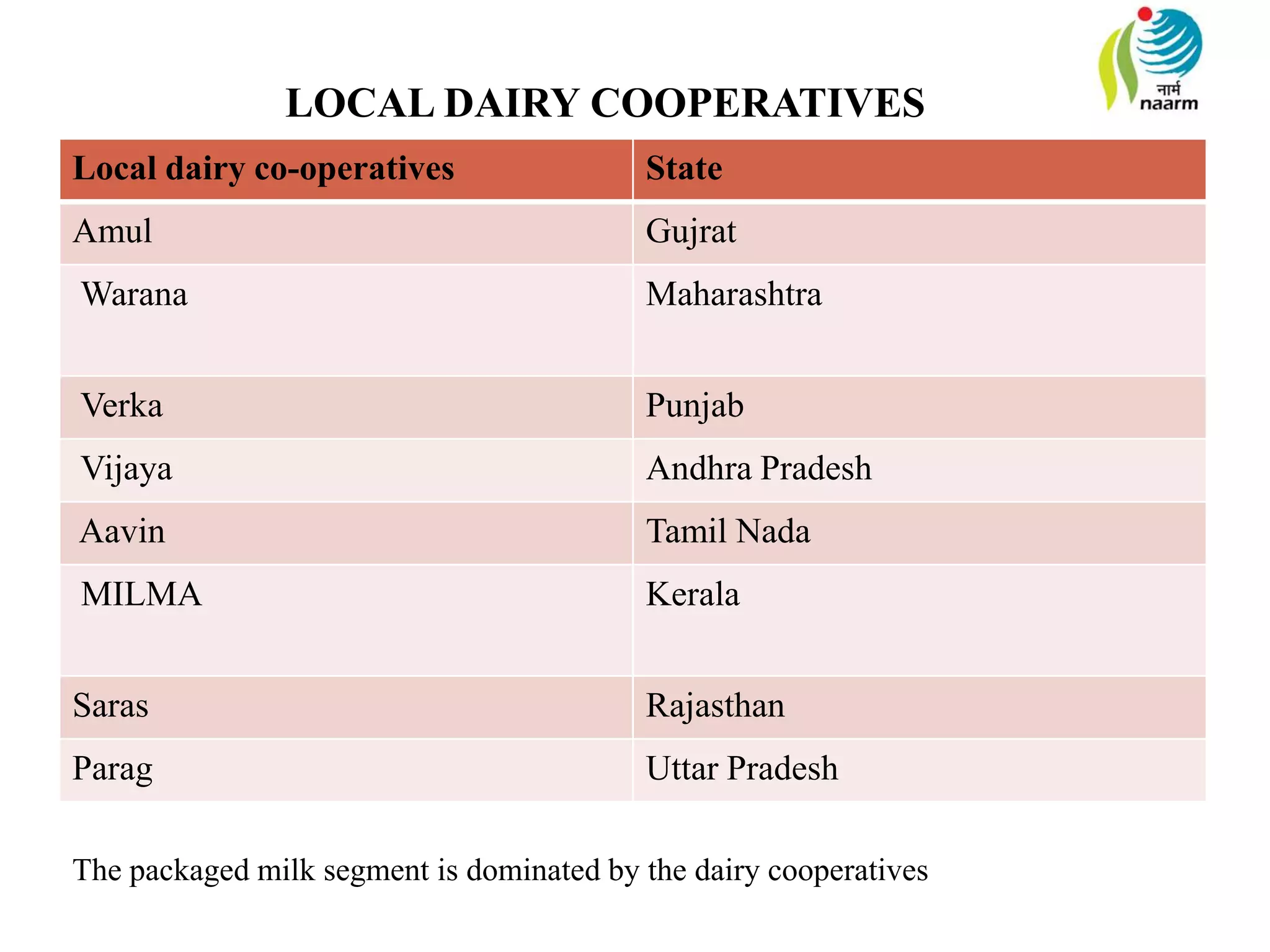
Local dairy co-operatives State
Amul Gujrat
Warana Maharashtra
Verka Punjab
Vijaya Andhra Pradesh
Aavin Tamil Nada
MILMA Kerala
Saras Rajasthan
Parag Uttar Pradesh
LOCAL DAIRY COOPERATIVES
The packaged milk segment is dominated by the dairy cooperatives
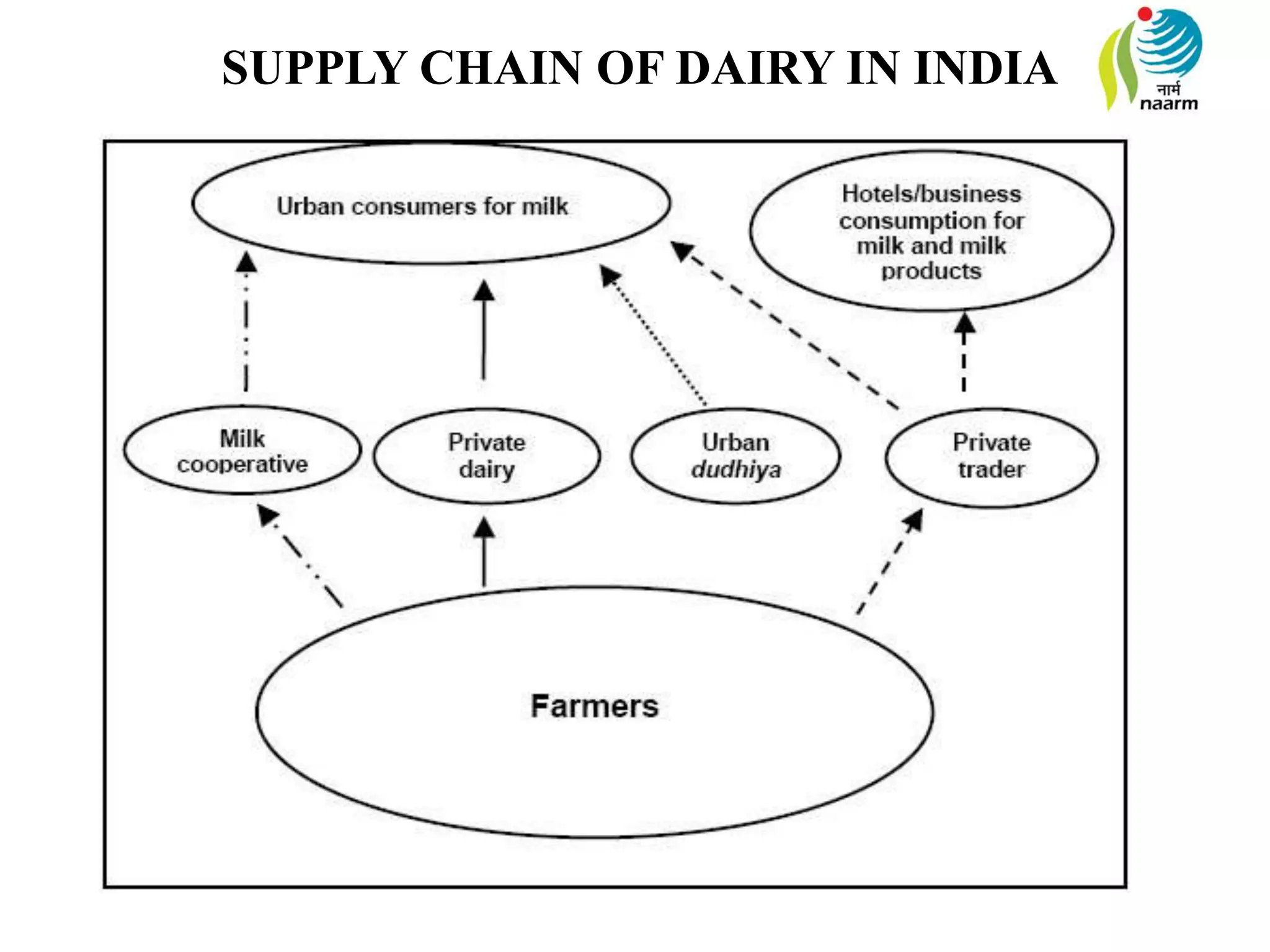
SUPPLY CHAIN OF DAIRY IN INDIA
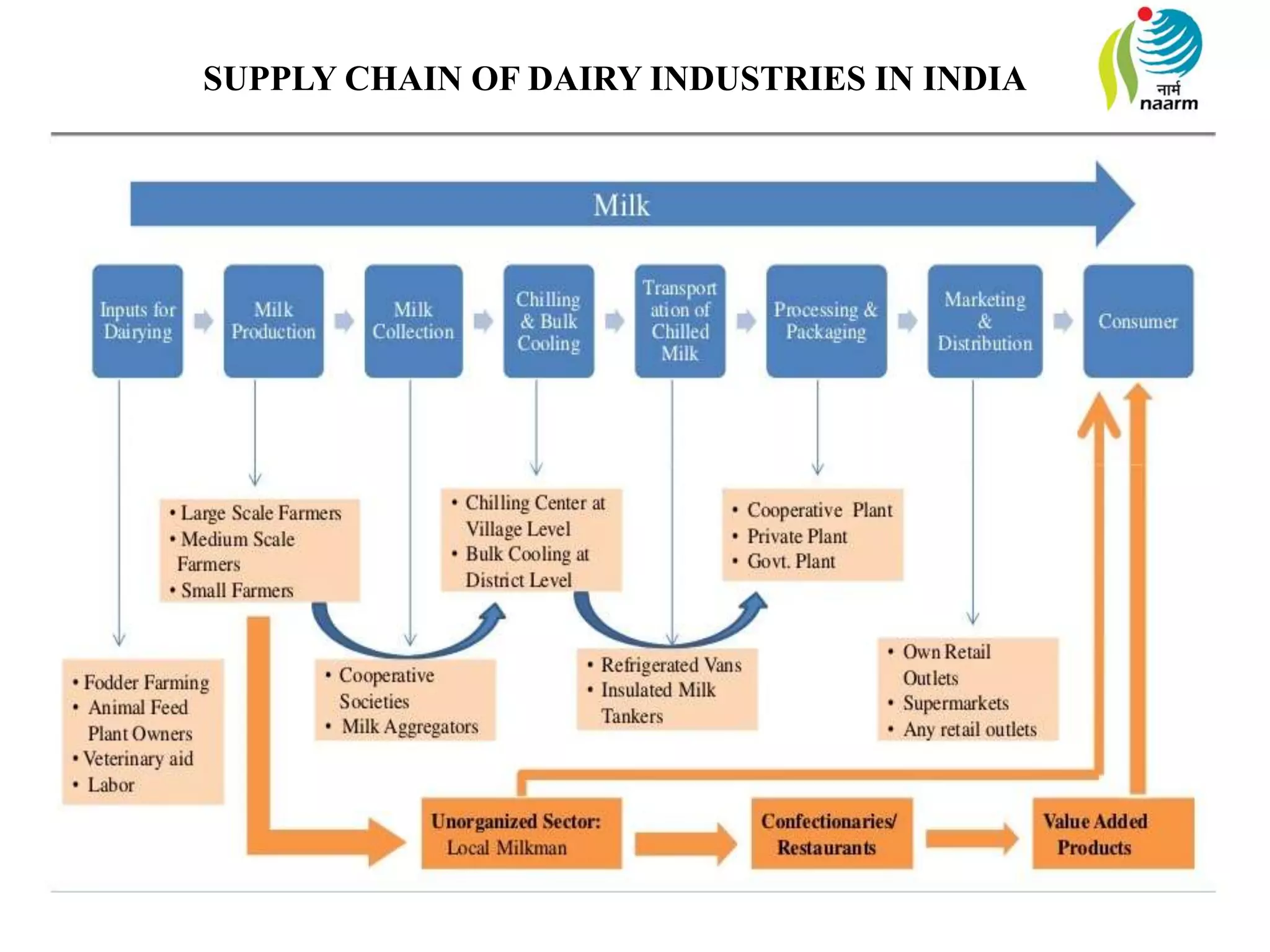
SUPPLY CHAIN OF DAIRY INDUSTRIES IN INDIA
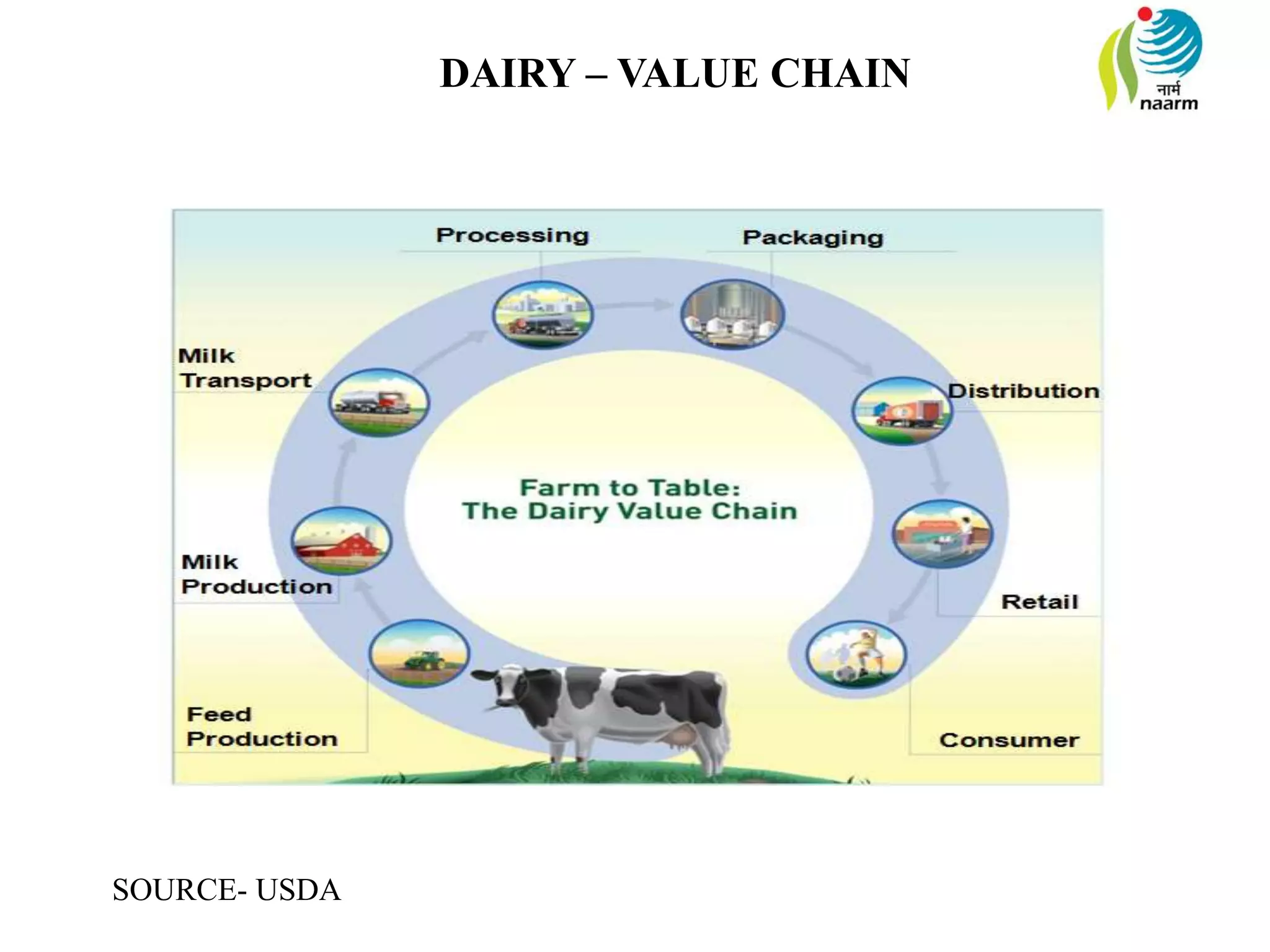
DAIRY – VALUE CHAIN
SOURCE- USDA
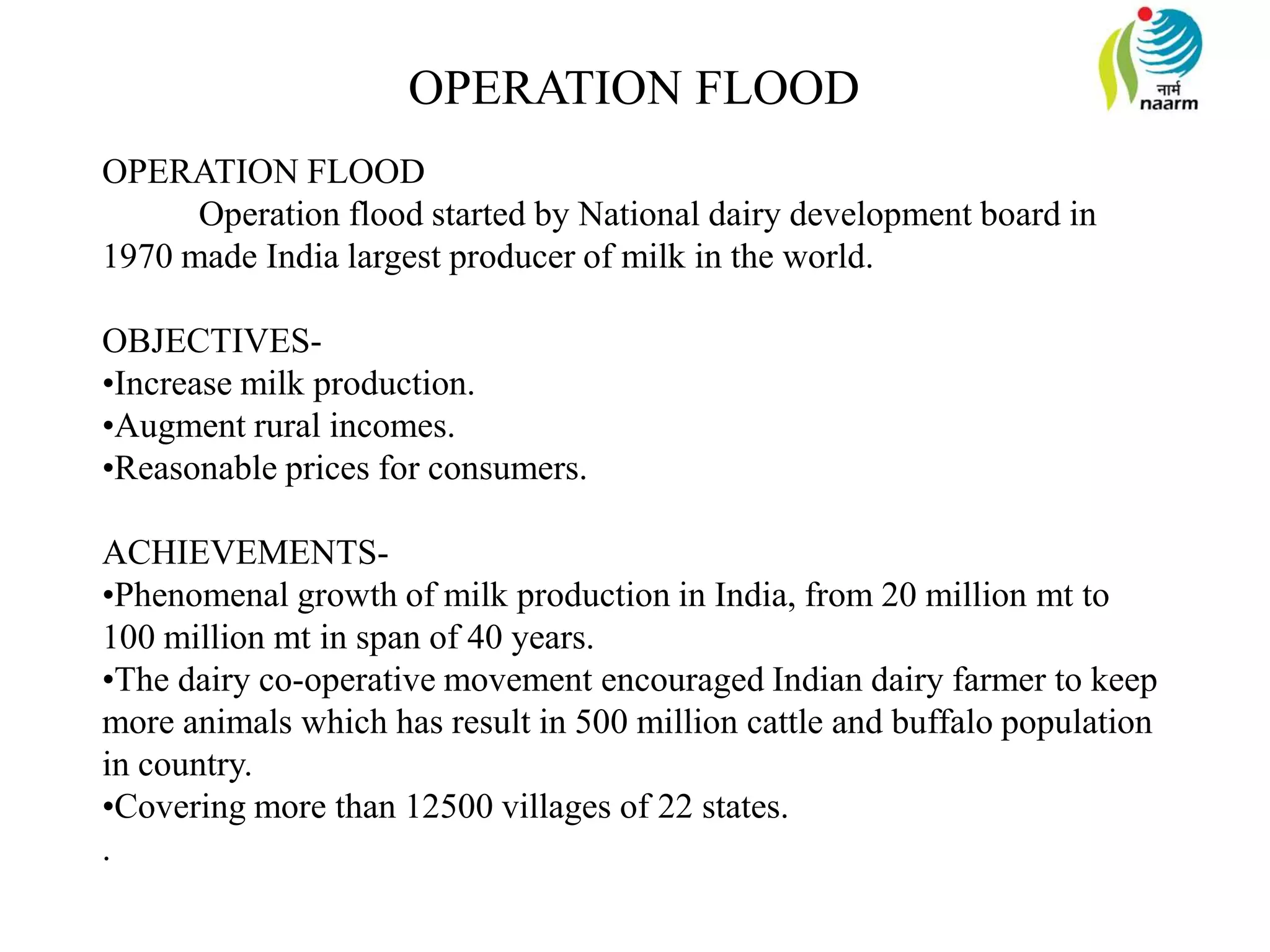
OPERATION FLOOD
Operation flood started by National dairy development board in
1970 made India largest producer of milk in the world.
OBJECTIVES-
•Increase milk production.
•Augment rural incomes.
•Reasonable prices for consumers.
ACHIEVEMENTS-
•Phenomenal growth of milk production in India, from 20 million mt to
100 million mt in span of 40 years.
•The dairy co-operative movement encouraged Indian dairy farmer to keep
more animals which has result in 500 million cattle and buffalo population
in country.
•Covering more than 12500 villages of 22 states.
.
OPERATION FLOOD
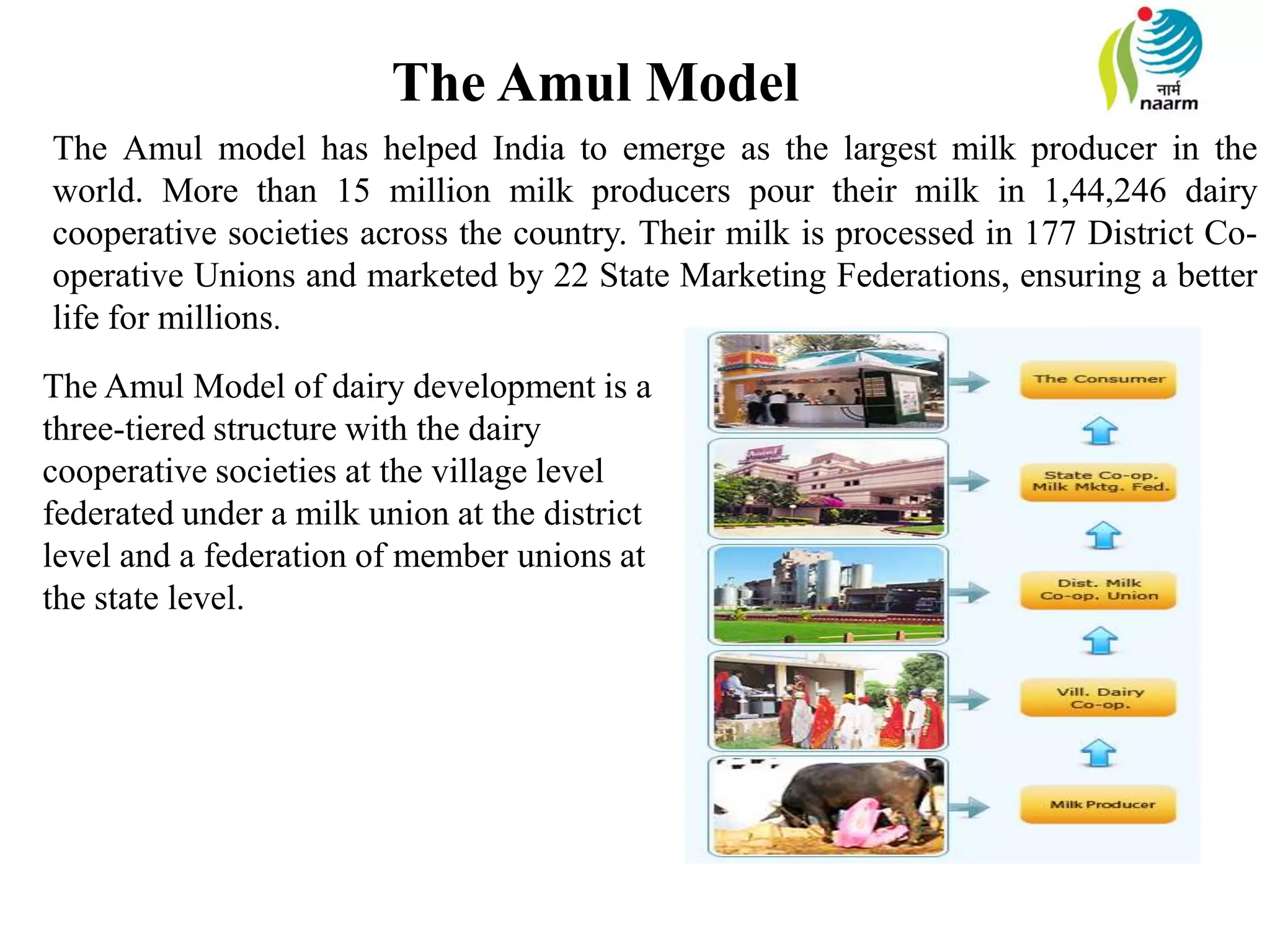
The Amul Model
The Amul Model of dairy development is a
three-tiered structure with the dairy
cooperative societies at the village level
federated under a milk union at the district
level and a federation of member unions at
the state level.
The Amul model has helped India to emerge as the largest milk producer in the
world. More than 15 million milk producers pour their milk in 1,44,246 dairy
cooperative societies across the country. Their milk is processed in 177 District Co-
operative Unions and marketed by 22 State Marketing Federations, ensuring a better
life for millions.
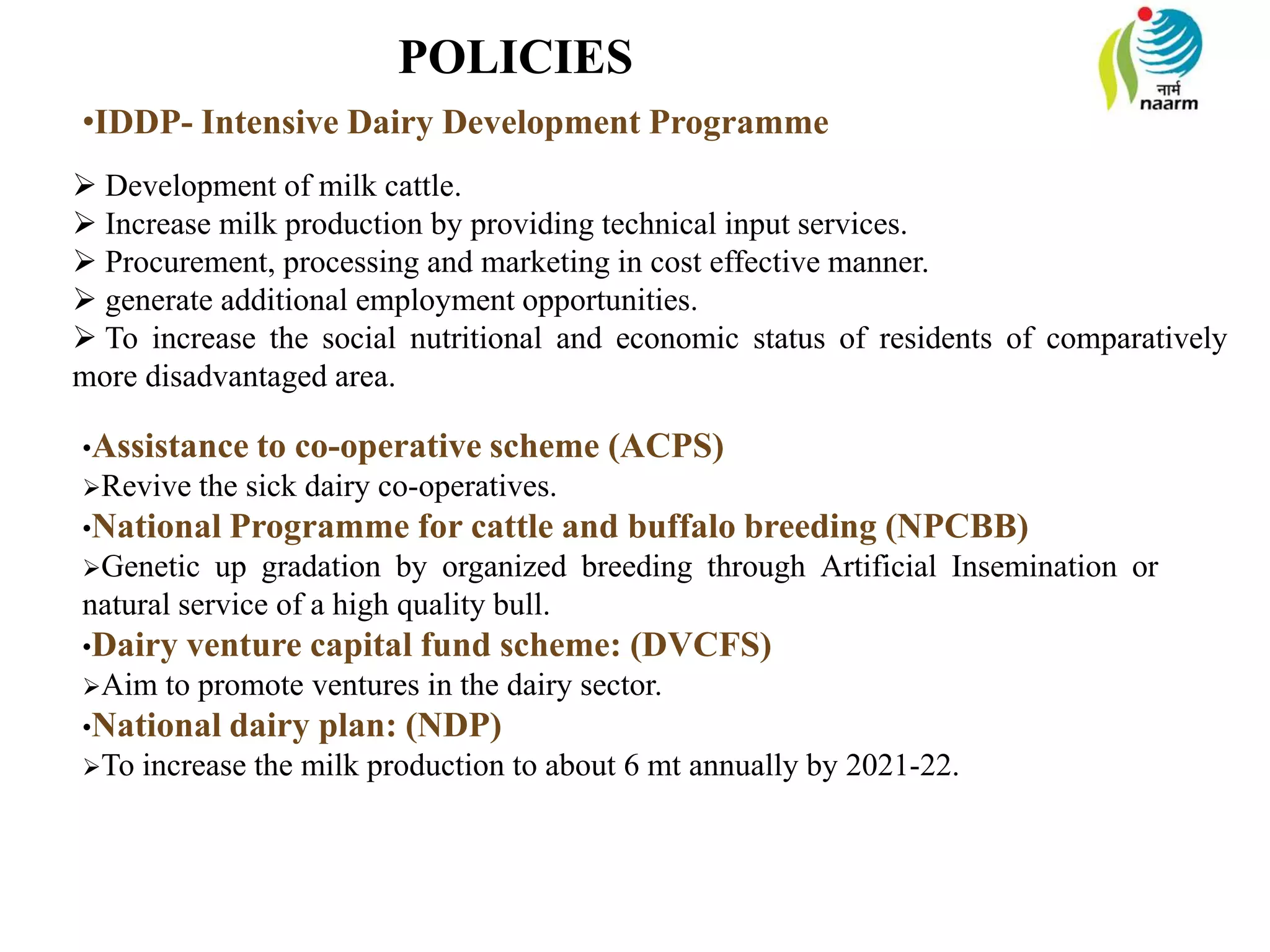
POLICIES
•IDDP- Intensive Dairy Development Programme
 Development of milk cattle.
 Increase milk production by providing technical input services.
 Procurement, processing and marketing in cost effective manner.
 generate additional employment opportunities.
 To increase the social nutritional and economic status of residents of comparatively
more disadvantaged area.
•Assistance to co-operative scheme (ACPS)
Revive the sick dairy co-operatives.
•National Programme for cattle and buffalo breeding (NPCBB)
Genetic up gradation by organized breeding through Artificial Insemination or
natural service of a high quality bull.
•Dairy venture capital fund scheme: (DVCFS)
Aim to promote ventures in the dairy sector.
•National dairy plan: (NDP)
To increase the milk production to about 6 mt annually by 2021-22.
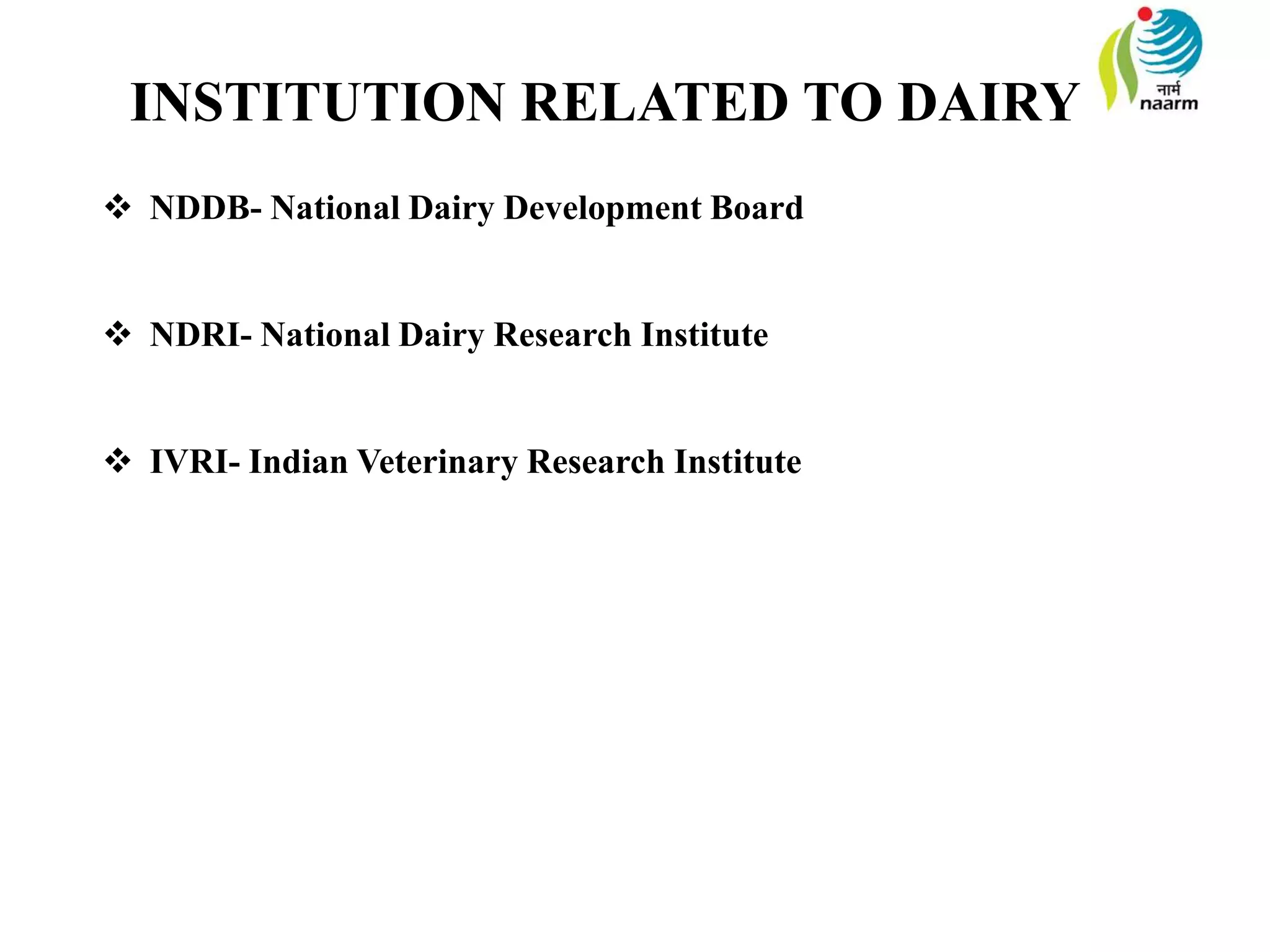
INSTITUTION RELATED TO DAIRY
 NDDB- National Dairy Development Board
 NDRI- National Dairy Research Institute
 IVRI- Indian Veterinary Research Institute
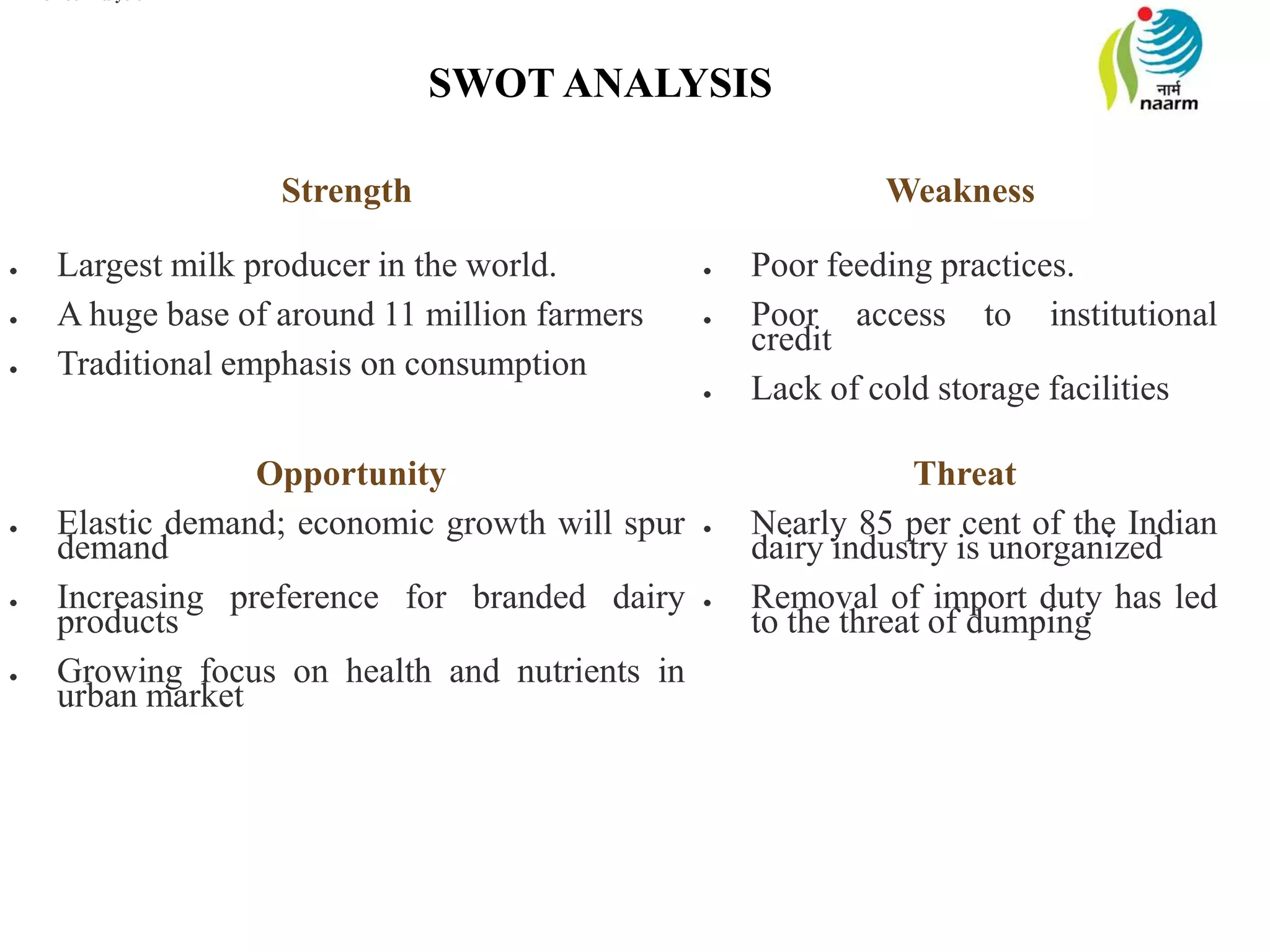
Strength Weakness
Largest milk producer in the world.
A huge base of around 11 million farmers
Traditional emphasis on consumption
Poor feeding practices.
Poor access to institutional
credit
Lack of cold storage facilities
Opportunity Threat
Elastic demand; economic growth will spur
demand
Increasing preference for branded dairy
products
Growing focus on health and nutrients in
urban market
Nearly 85 per cent of the Indian
dairy industry is unorganized
Removal of import duty has led
to the threat of dumping
Swot Analysis
SWOT ANALYSIS
Dairy presentation

Dairy presentation

  • 1.
    PRESENTATION ON DAIRY Presentedby: Sudarshan Kr. Patel Suhas Zod PGDMA (2013-15)
  • 2.
    FLOW OF PRESENTATION INTRODUCTION PRODUCTION CONSUMPTION PRODUCTMIX EXPORT- IMPORT SUPPLY CHANNEL MAJOR PLAYERS POLICIES INSTITUTIONS SWOT ANALYSIS REFERENCES
  • 3.
    INTRODUCTION  India accountsabout 2.4% of the worlds geographical area.  India has 15% of the livestock of total livestock population in the world, with 50% buffaloes and 20%of world’s cattle.  Agriculture contributes 14% of the nation’s GDP, about 11% of its exports.  India is the largest producer of milk in the world (>15% share) with 127.9 mt production in 2012.  Nearly 70% of Indian population depends on dairy directly or indirectly.  Total GDP share : 3.6% (2011-12)  Growth rate of milk production : 4%  Consumer demand rate : 8%.
  • 4.
    TREND OF MILKPRODUCTION WORLD-INDIA 20.8 31.56 53.68 68.36 79.66 95.62 117 391.82 465.66 542.47 547.02 578.88 648 720.98 0 100 200 300 400 500 600 700 800 1960 1970 1980 1990 2000 2010 2020 India world Indian milk production growth rate is better than world production rate Valueinmt Years
  • 5.
    Milk Production AcrossCountries 117 87.46 41.14 35.49 32.14 31.8229.67 346.26 Year 2010 India U.S. China Pakistan Russian federation Brazil Germany others Production in mt Source-NDDB
  • 6.
    16% 15.80% 15.30% 15.60% 15.20% 15.20%15.30% 4.00% 3.80% 3.60% 3.70% 3.80% 3.80% 3.60% 0% 2% 4% 6% 8% 10% 12% 14% 16% 18% 2004-05 2005-06 2006-07 2007-08 2008-09 2009-10 2010-11 GDP(Agriculture) GDP(Livestock sector) Source-NDDB Share of Agriculture & Livestock sector in GDP •Livestock sector contributes nearly 25% of the share of agriculture in GDP.
  • 7.
    0 20 40 60 80 100 120 140 0 50 100 150 200 250 300 350 Per capita milk availability(g/day) Production(mt) g/day mt Trend in milk production & per capita availability -India
  • 8.
    Major milk producingstates(India) Source- NDDB (2011-12) UP 22.5 18% Rajasthan 13.51 11% Gujrat 9.81 8% Panjab 9.55 7% Maharashtra 8.46 7% M P 8.14 6% Tamilnadu 6.96 5% Haryana 6.66 5% Other 42.31 33% milk production (mt)
  • 9.
    364 435 679 446 378 937 538 384 0 100 200 300 400 500 600 700 800 900 1000 Per capita milkavailability(g/day) of major states-India (2011-12) Source-NDDB g/day
  • 10.
    Top major exportingcountries in dairy products 2011-12 Source- APEDA 7213 5166 3918 3868 3860 3560 2620 2372 2021 1805 0 1000 2000 3000 4000 5000 6000 7000 8000 Germany Italy Belgium Netherland france UK China Spain Russian Fed. Saudi Arabia US$Million
  • 11.
    Top importers ofIndian dairy products 2012-13 Source- APEDA/PTI 41.78 66.44 67.89 69.3 82.84 95.14 99.12 142.82 179.06 259.11 0 50 100 150 200 250 300 Phillipinnes Pakistan Iran Singapur Yeman Algeria Saudi Arabia UAE Egypt Bangladesh Rs crore (In Rs crore)
  • 12.
    46% 28% 6.00% 7% 6.50% 4% 2% 1% Fluid milk Ghee Butter Yogurt Khoa Milkpowder Paneer Other India’s milk product mix 2009. Source USDA
  • 13.
    15% 42% 2% 14% 6% 17% 3% 1% Milkand cream non concentrated Milk and cream concentrated Whey Butter and other fats Chees and curd casin protein Lactose and lactose syrup India – Dairy product Export 2009 Source - USDA
  • 14.
    1% 8% 6% 49% 2% 33% 1% Milk and creamnon concentrated Milk and cream concentrated Whey Butter and other fats Chees and curd Lactose and lactose syrup India- Dairy products Import 2009 Source- USDA
  • 15.
  • 16.
  • 17.
    Local dairy co-operativesState Amul Gujrat Warana Maharashtra Verka Punjab Vijaya Andhra Pradesh Aavin Tamil Nada MILMA Kerala Saras Rajasthan Parag Uttar Pradesh LOCAL DAIRY COOPERATIVES The packaged milk segment is dominated by the dairy cooperatives
  • 18.
    SUPPLY CHAIN OFDAIRY IN INDIA
  • 19.
    SUPPLY CHAIN OFDAIRY INDUSTRIES IN INDIA
  • 20.
    DAIRY – VALUECHAIN SOURCE- USDA
  • 21.
    OPERATION FLOOD Operation floodstarted by National dairy development board in 1970 made India largest producer of milk in the world. OBJECTIVES- •Increase milk production. •Augment rural incomes. •Reasonable prices for consumers. ACHIEVEMENTS- •Phenomenal growth of milk production in India, from 20 million mt to 100 million mt in span of 40 years. •The dairy co-operative movement encouraged Indian dairy farmer to keep more animals which has result in 500 million cattle and buffalo population in country. •Covering more than 12500 villages of 22 states. . OPERATION FLOOD
  • 22.
    The Amul Model TheAmul Model of dairy development is a three-tiered structure with the dairy cooperative societies at the village level federated under a milk union at the district level and a federation of member unions at the state level. The Amul model has helped India to emerge as the largest milk producer in the world. More than 15 million milk producers pour their milk in 1,44,246 dairy cooperative societies across the country. Their milk is processed in 177 District Co- operative Unions and marketed by 22 State Marketing Federations, ensuring a better life for millions.
  • 23.
    POLICIES •IDDP- Intensive DairyDevelopment Programme  Development of milk cattle.  Increase milk production by providing technical input services.  Procurement, processing and marketing in cost effective manner.  generate additional employment opportunities.  To increase the social nutritional and economic status of residents of comparatively more disadvantaged area. •Assistance to co-operative scheme (ACPS) Revive the sick dairy co-operatives. •National Programme for cattle and buffalo breeding (NPCBB) Genetic up gradation by organized breeding through Artificial Insemination or natural service of a high quality bull. •Dairy venture capital fund scheme: (DVCFS) Aim to promote ventures in the dairy sector. •National dairy plan: (NDP) To increase the milk production to about 6 mt annually by 2021-22.
  • 24.
    INSTITUTION RELATED TODAIRY  NDDB- National Dairy Development Board  NDRI- National Dairy Research Institute  IVRI- Indian Veterinary Research Institute
  • 25.
    Strength Weakness Largest milkproducer in the world. A huge base of around 11 million farmers Traditional emphasis on consumption Poor feeding practices. Poor access to institutional credit Lack of cold storage facilities Opportunity Threat Elastic demand; economic growth will spur demand Increasing preference for branded dairy products Growing focus on health and nutrients in urban market Nearly 85 per cent of the Indian dairy industry is unorganized Removal of import duty has led to the threat of dumping Swot Analysis SWOT ANALYSIS