Introduction to identifying epithelium
Characteristics of epithelium Covers surfaces with an uninterrupted layer of cells. Cells are attached to one another. Intercellular spaces are small. Epithelial cells are segregated from underlying tissue by the basement membrane.
Epithelium cell shapes Squamous -flattened shape Cuboidal- box-shaped, not flattened Columnar -cells that appear much taller than wide  Transitional-  variation found primarily in urinary tract
Criteria used to identify epithelium: The shape of the component cells. The number of cell layers. The presence of surface specializations, such as cilia, villi, or keratin. The presence of secretory structures or cells.
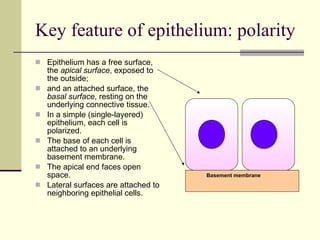
Key feature of epithelium: polarity Epithelium has a free surface, the  apical surface , exposed to the outside;  and an attached surface, the  basal surface , resting on the underlying connective tissue. In a simple (single-layered) epithelium, each cell is polarized.   The base of each cell is attached to an underlying  basement membrane. The apical end faces open space.   Lateral surfaces are attached to neighboring epithelial cells.  Basement membrane
Principle layers of the skin The skin has  two principal layers . The  epidermis   is the epithelial layer of skin. The  dermis  is the connective tissue layer of the skin.
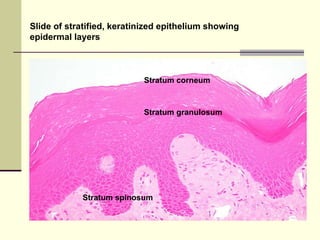
The epidermis The epidermis displays  several layers . These layers are not distinctly different tissues (unlike epidermis and dermis, for example). But rather reflect visible changes or stages along the continuous process of keratinocyte maturation, or  keratinization.   A continuous process that occurs in stratified keratinized epithelium. The stages in keratinocyte maturation appear as layers within the epidermis; a single section the layers may show all the stages of keratinization.
Stratum corneum   Stratum granulosum Stratum spinosum  Slide of stratified, keratinized epithelium showing epidermal layers
The dermis The dermis lies beneath the epidermis, separated from the epithelium by the basement membrane. The dermis consists of dense connective tissue; the primary component being collagen.   The texture of the collagen serves as the basis for recognizing two layers of dermis.
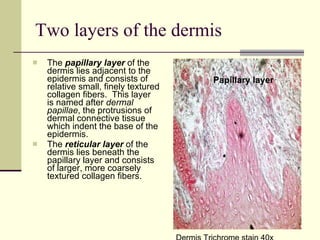
Two layers of the dermis The  papillary layer  of the dermis lies adjacent to the epidermis and consists of relative small, finely textured collagen fibers.  This layer is named after  dermal papillae , the protrusions of dermal connective tissue which indent the base of the epidermis.  The  reticular layer  of the dermis lies beneath the papillary layer and consists of larger, more coarsely textured collagen fibers.  Papillary layer Dermis Trichrome stain 40x
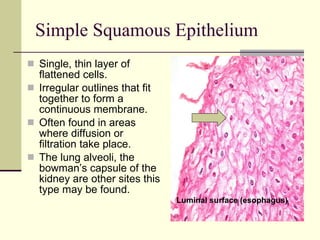
Simple Squamous Epithelium Single, thin layer of flattened cells. Irregular outlines that fit together to form a continuous membrane. Often found in areas where diffusion or filtration take place. The lung alveoli, the bowman’s capsule of the kidney are other sites this type may be found.  Luminal surface (esophagus)
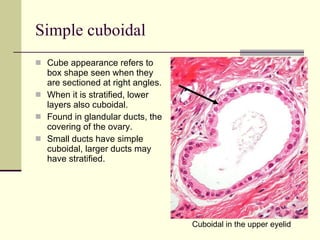
Simple cuboidal Cube appearance refers to box shape seen when they are sectioned at right angles. When it is stratified, lower layers also cuboidal. Found in glandular ducts, the covering of the ovary. Small ducts have simple cuboidal, larger ducts may have stratified. Cuboidal in the upper eyelid
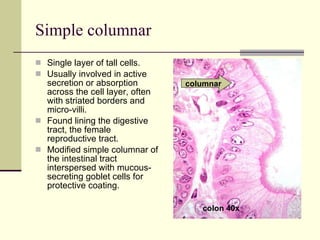
Simple columnar Single layer of tall cells. Usually involved in active secretion or absorption across the cell layer, often with striated borders and micro-villi. Found lining the digestive tract, the female reproductive tract.  Modified simple columnar of the intestinal tract interspersed with mucous-secreting goblet cells for protective coating. colon 40x columnar
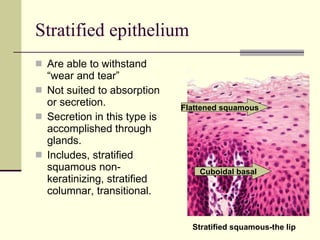
Stratified epithelium Are able to withstand “wear and tear” Not suited to absorption or secretion. Secretion in this type is accomplished through glands. Includes, stratified squamous non-keratinizing, stratified columnar, transitional.  Stratified squamous-the lip Flattened squamous Cuboidal basal
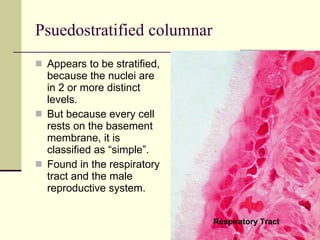
Psuedostratified columnar Appears to be stratified, because the nuclei are in 2 or more distinct levels. But because every cell rests on the basement membrane, it is classified as “simple”. Found in the respiratory tract and the male reproductive system. Respiratory Tract
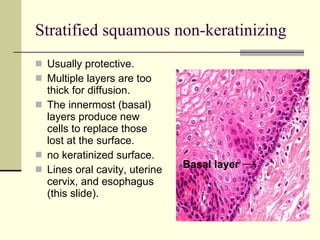
Stratified squamous non-keratinizing Usually protective. Multiple layers are too thick for diffusion. The innermost (basal) layers produce new cells to replace those lost at the surface.  no keratinized surface. Lines oral cavity, uterine cervix, and esophagus (this slide). Basal layer  ->
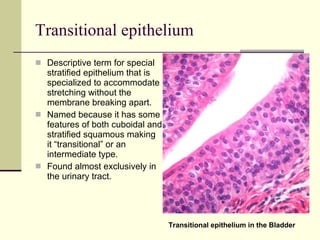
Transitional epithelium Descriptive term for special stratified epithelium that is specialized to accommodate stretching without the membrane breaking apart. Named because it has some features of both cuboidal and stratified squamous making it “transitional” or an intermediate type. Found almost exclusively in the urinary tract. Transitional epithelium in the Bladder
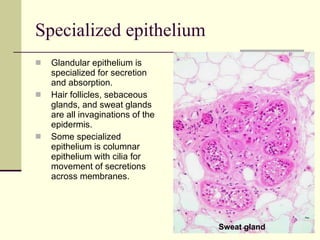
Specialized epithelium Glandular epithelium is specialized for secretion and absorption. Hair follicles, sebaceous glands, and sweat glands are all invaginations of the epidermis.  Some specialized epithelium is columnar epithelium with cilia for movement of secretions across membranes. Sweat gland
Review With practice you will learn to identify epithelial  tissue under the microscope almost immediately.  However, we practiced eliminating obvious possibilities, and learning to identify the nuclei, cytoplasm and structural arrangements typical of epithelial tissue. We identified the basic cell shapes of epithelium. By repeating this process with each section you encounter, you will begin to develop a habitual method of identifying unique characteristics of different tissues under the microscope.

Identifying Epithelium

  • 1.
  • 2.
    Characteristics of epitheliumCovers surfaces with an uninterrupted layer of cells. Cells are attached to one another. Intercellular spaces are small. Epithelial cells are segregated from underlying tissue by the basement membrane.
  • 3.
    Epithelium cell shapesSquamous -flattened shape Cuboidal- box-shaped, not flattened Columnar -cells that appear much taller than wide Transitional- variation found primarily in urinary tract
  • 4.
    Criteria used toidentify epithelium: The shape of the component cells. The number of cell layers. The presence of surface specializations, such as cilia, villi, or keratin. The presence of secretory structures or cells.
  • 5.
    Key feature ofepithelium: polarity Epithelium has a free surface, the apical surface , exposed to the outside; and an attached surface, the basal surface , resting on the underlying connective tissue. In a simple (single-layered) epithelium, each cell is polarized.   The base of each cell is attached to an underlying basement membrane. The apical end faces open space.   Lateral surfaces are attached to neighboring epithelial cells. Basement membrane
  • 6.
    Principle layers ofthe skin The skin has two principal layers . The epidermis is the epithelial layer of skin. The dermis is the connective tissue layer of the skin.
  • 7.
    The epidermis Theepidermis displays several layers . These layers are not distinctly different tissues (unlike epidermis and dermis, for example). But rather reflect visible changes or stages along the continuous process of keratinocyte maturation, or keratinization. A continuous process that occurs in stratified keratinized epithelium. The stages in keratinocyte maturation appear as layers within the epidermis; a single section the layers may show all the stages of keratinization.
  • 8.
    Stratum corneum Stratum granulosum Stratum spinosum Slide of stratified, keratinized epithelium showing epidermal layers
  • 9.
    The dermis Thedermis lies beneath the epidermis, separated from the epithelium by the basement membrane. The dermis consists of dense connective tissue; the primary component being collagen.   The texture of the collagen serves as the basis for recognizing two layers of dermis.
  • 10.
    Two layers ofthe dermis The papillary layer of the dermis lies adjacent to the epidermis and consists of relative small, finely textured collagen fibers.  This layer is named after dermal papillae , the protrusions of dermal connective tissue which indent the base of the epidermis. The reticular layer of the dermis lies beneath the papillary layer and consists of larger, more coarsely textured collagen fibers. Papillary layer Dermis Trichrome stain 40x
  • 11.
    Simple Squamous EpitheliumSingle, thin layer of flattened cells. Irregular outlines that fit together to form a continuous membrane. Often found in areas where diffusion or filtration take place. The lung alveoli, the bowman’s capsule of the kidney are other sites this type may be found. Luminal surface (esophagus)
  • 12.
    Simple cuboidal Cubeappearance refers to box shape seen when they are sectioned at right angles. When it is stratified, lower layers also cuboidal. Found in glandular ducts, the covering of the ovary. Small ducts have simple cuboidal, larger ducts may have stratified. Cuboidal in the upper eyelid
  • 13.
    Simple columnar Singlelayer of tall cells. Usually involved in active secretion or absorption across the cell layer, often with striated borders and micro-villi. Found lining the digestive tract, the female reproductive tract. Modified simple columnar of the intestinal tract interspersed with mucous-secreting goblet cells for protective coating. colon 40x columnar
  • 14.
    Stratified epithelium Areable to withstand “wear and tear” Not suited to absorption or secretion. Secretion in this type is accomplished through glands. Includes, stratified squamous non-keratinizing, stratified columnar, transitional. Stratified squamous-the lip Flattened squamous Cuboidal basal
  • 15.
    Psuedostratified columnar Appearsto be stratified, because the nuclei are in 2 or more distinct levels. But because every cell rests on the basement membrane, it is classified as “simple”. Found in the respiratory tract and the male reproductive system. Respiratory Tract
  • 16.
    Stratified squamous non-keratinizingUsually protective. Multiple layers are too thick for diffusion. The innermost (basal) layers produce new cells to replace those lost at the surface. no keratinized surface. Lines oral cavity, uterine cervix, and esophagus (this slide). Basal layer ->
  • 17.
    Transitional epithelium Descriptiveterm for special stratified epithelium that is specialized to accommodate stretching without the membrane breaking apart. Named because it has some features of both cuboidal and stratified squamous making it “transitional” or an intermediate type. Found almost exclusively in the urinary tract. Transitional epithelium in the Bladder
  • 18.
    Specialized epithelium Glandularepithelium is specialized for secretion and absorption. Hair follicles, sebaceous glands, and sweat glands are all invaginations of the epidermis. Some specialized epithelium is columnar epithelium with cilia for movement of secretions across membranes. Sweat gland
  • 19.
    Review With practiceyou will learn to identify epithelial tissue under the microscope almost immediately. However, we practiced eliminating obvious possibilities, and learning to identify the nuclei, cytoplasm and structural arrangements typical of epithelial tissue. We identified the basic cell shapes of epithelium. By repeating this process with each section you encounter, you will begin to develop a habitual method of identifying unique characteristics of different tissues under the microscope.

Editor's Notes

  • #8 http://www.siumed.edu/%7Edking2/intro/skin.htm#layers Stratum corneum.  Cells of the cornified layer are dead, protective keratinized "squames", eventually sloughed off. - Stratum granulosum.  Cells in the granule-cell layer accumulate keratohyalin , visible as darkly stained granules.  The presence of this layer is diagnostic for keratinized stratified squamous epithelium. - Stratum spinosum.  Cells of the "prickle-cell" layer are attached to one another by desmosomes ("spines") and reinforced by tonofilaments.  These cells gradually move outward as new cells are formed from the basal layer (below). - Stratum basale / stratum germinativum. Cells of the basal layer are attached to the basement membrane (dashed line) by hemidesmosomes.  When a basal cell divides, one of the daughters migrates upward to replenish outer layers of cells.