Animals Exhibit Behavior
• innate behavior - a behavior that is pre-
programmed into an organisms genes, no
learning is required
• learned behavior - a behavior that is not
pre-programmed into an organisms genes,
learning this behavior is required.
However, the ability to learn requires
genes.
• social behavior - a behavior that includes
the interaction between organisms. Can
be learned or innate.
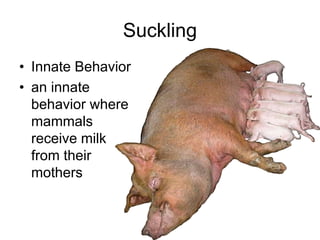
Suckling
• Innate Behavior
• an innate
behavior where
mammals
receive milk
from their
mothers
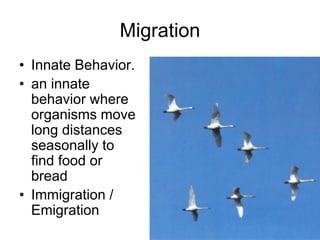
Migration
• Innate Behavior.
• an innate
behavior where
organisms move
long distances
seasonally to
find food or
bread
• Immigration /
Emigration
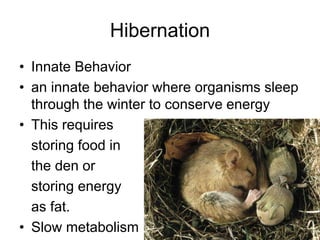
Hibernation
• Innate Behavior
• an innate behavior where organisms sleep
through the winter to conserve energy
• This requires
storing food in
the den or
storing energy
as fat.
• Slow metabolism
Estivation
• Innate Behavior
• an innate behavior
where organisms
sleep through long
hot dry times to
conserve water and
energy
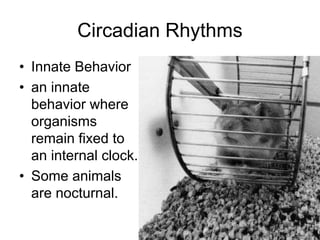
Circadian Rhythms
• Innate Behavior
• an innate
behavior where
organisms
remain fixed to
an internal clock.
• Some animals
are nocturnal.
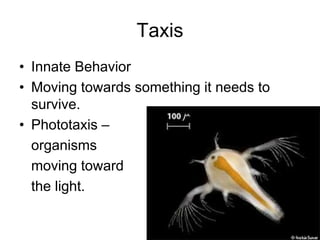
Taxis
• Innate Behavior
• Moving towards something it needs to
survive.
• Phototaxis –
organisms
moving toward
the light.
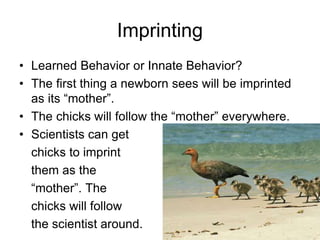
Imprinting
• Learned Behavior or Innate Behavior?
• The first thing a newborn sees will be imprinted
as its “mother”.
• The chicks will follow the “mother” everywhere.
• Scientists can get
chicks to imprint
them as the
“mother”. The
chicks will follow
the scientist around.
Habituation
• Learned Behavior.
• The organism stops responding to a stimuli in
the environment.
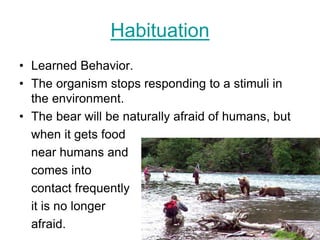
• The bear will be naturally afraid of humans, but
when it gets food
near humans and
comes into
contact frequently
it is no longer
afraid.
Habituation
• Learned Behavior.
• The organism stops responding to a stimuli in
the environment.
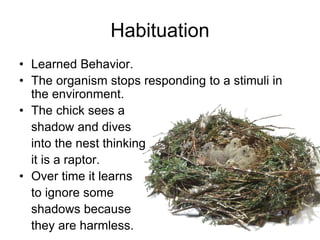
• The chick sees a
shadow and dives
into the nest thinking
it is a raptor.
• Over time it learns
to ignore some
shadows because
they are harmless.
Operant Conditioning
• Learned Behavior.
• Associate an abnormal behavior with a reward
or consequence.
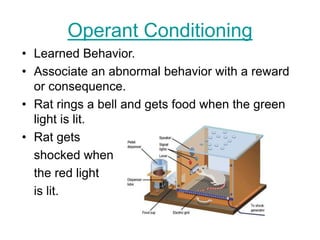
• Rat rings a bell and gets food when the green
light is lit.
• Rat gets
shocked when
the red light
is lit.
Classical Conditioning
• Learned
Behavior
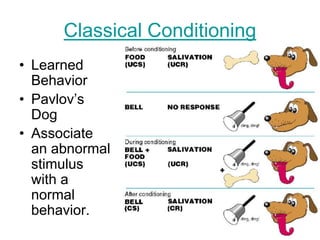
• Pavlov’s
Dog
• Associate
an abnormal
stimulus
with a
normal
behavior.
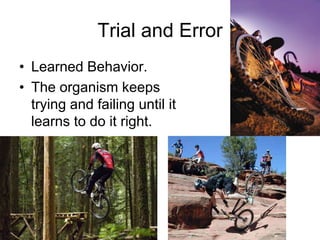
Trial and Error
• Learned Behavior.
• The organism keeps
trying and failing until it
learns to do it right.
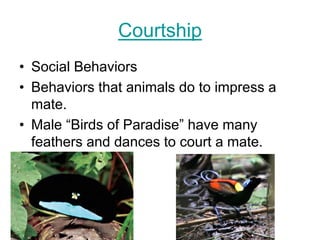
Courtship
• Social Behaviors
• Behaviors that animals do to impress a
mate.
• Male “Birds of Paradise” have many
feathers and dances to court a mate.
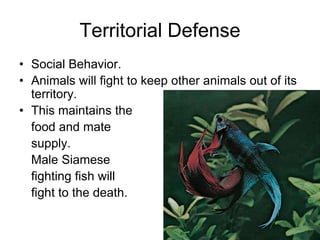
Territorial Defense
• Social Behavior.
• Animals will fight to keep other animals out of its
territory.
• This maintains the
food and mate
supply.
Male Siamese
fighting fish will
fight to the death.
Communication
• Social Behavior.
• Pheromones – chemical signals that can be
detected and used for communication.
• Ants leave a pheromone trail for other ants to
follow.
• Dancing – bees dance to tell other bees where
the good flowers are.
• Sounds – Animals will use sounds to warn of
danger, cry for a mother, or talk to each other.
• How do innate behavior patterns function
as adaptations for animals? Give some
examples in your answers.
• How are learned behaviors of greater
adaptive value than innate behaviors?
What is the value of learning?

Animal Behavior.ppt

  • 1.
    Animals Exhibit Behavior •innate behavior - a behavior that is pre- programmed into an organisms genes, no learning is required • learned behavior - a behavior that is not pre-programmed into an organisms genes, learning this behavior is required. However, the ability to learn requires genes. • social behavior - a behavior that includes the interaction between organisms. Can be learned or innate.
  • 2.
    Suckling • Innate Behavior •an innate behavior where mammals receive milk from their mothers
  • 3.
    Migration • Innate Behavior. •an innate behavior where organisms move long distances seasonally to find food or bread • Immigration / Emigration
  • 4.
    Hibernation • Innate Behavior •an innate behavior where organisms sleep through the winter to conserve energy • This requires storing food in the den or storing energy as fat. • Slow metabolism
  • 5.
    Estivation • Innate Behavior •an innate behavior where organisms sleep through long hot dry times to conserve water and energy
  • 6.
    Circadian Rhythms • InnateBehavior • an innate behavior where organisms remain fixed to an internal clock. • Some animals are nocturnal.
  • 7.
    Taxis • Innate Behavior •Moving towards something it needs to survive. • Phototaxis – organisms moving toward the light.
  • 8.
    Imprinting • Learned Behavioror Innate Behavior? • The first thing a newborn sees will be imprinted as its “mother”. • The chicks will follow the “mother” everywhere. • Scientists can get chicks to imprint them as the “mother”. The chicks will follow the scientist around.
  • 9.
    Habituation • Learned Behavior. •The organism stops responding to a stimuli in the environment. • The bear will be naturally afraid of humans, but when it gets food near humans and comes into contact frequently it is no longer afraid.
  • 10.
    Habituation • Learned Behavior. •The organism stops responding to a stimuli in the environment. • The chick sees a shadow and dives into the nest thinking it is a raptor. • Over time it learns to ignore some shadows because they are harmless.
  • 11.
    Operant Conditioning • LearnedBehavior. • Associate an abnormal behavior with a reward or consequence. • Rat rings a bell and gets food when the green light is lit. • Rat gets shocked when the red light is lit.
  • 12.
    Classical Conditioning • Learned Behavior •Pavlov’s Dog • Associate an abnormal stimulus with a normal behavior.
  • 13.
    Trial and Error •Learned Behavior. • The organism keeps trying and failing until it learns to do it right.
  • 14.
    Courtship • Social Behaviors •Behaviors that animals do to impress a mate. • Male “Birds of Paradise” have many feathers and dances to court a mate.
  • 15.
    Territorial Defense • SocialBehavior. • Animals will fight to keep other animals out of its territory. • This maintains the food and mate supply. Male Siamese fighting fish will fight to the death.
  • 16.
    Communication • Social Behavior. •Pheromones – chemical signals that can be detected and used for communication. • Ants leave a pheromone trail for other ants to follow. • Dancing – bees dance to tell other bees where the good flowers are. • Sounds – Animals will use sounds to warn of danger, cry for a mother, or talk to each other.
  • 17.
    • How doinnate behavior patterns function as adaptations for animals? Give some examples in your answers.
  • 18.
    • How arelearned behaviors of greater adaptive value than innate behaviors? What is the value of learning?