ANIMAL BEHAVIORANIMAL BEHAVIOR
Proximate and ultimate questions
• Two basic types of questions asked in
Animal Behavior
• Proximate (focus on mechanics of
behavior).
• Ultimate (focus on advantages of the
behavior)
Proximate questions
• Questions about physical mechanisms.
Focus on the genetic-developmental aspects
and the sensory-motor aspects of the
behavior.
• Focus on things that cause or enable the
animal to perform the behavior.
Proximate questions
• Examples of proximate questions:
• How mechanically does the behavior take
place?
• What factors in the environment stimulate the
behavior?
• How do the nerves and muscles generate the
behavior?
• How do the animal’s genes affect the behavior?
Ultimate questions
• Ultimate questions are questions about the
evolutionary reasons for a behavior. They
are questions about the selective processes
that shape the behavior.
Ultimate questions
• Examples of ultimate questions:
• What is the purpose of the behavior?
• In what way does the behavior increase an
individual’s reproductive success?
• Does the behavior increase an individual’s
prospects of survival?
How do we answer behavioral
questions?
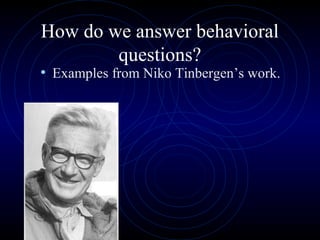
• Examples from Niko Tinbergen’s work.
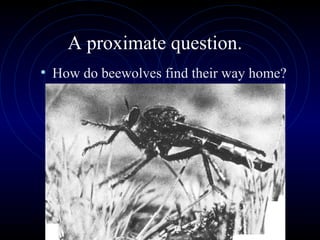
A proximate question.
• How do beewolves find their way home?
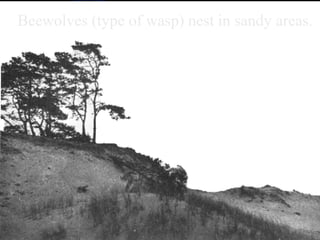
Beewolves (type of wasp) nest in sandy areas.
Beewolf homing
• When leaving nest to hunt bees, female
beewolf covers nest entrance with sand.
• How does she relocate it?
Beewolf homing
• Beewolves circle next before leaving.
• Do they remember landmarks? How would
we test this?
Beewolf homing
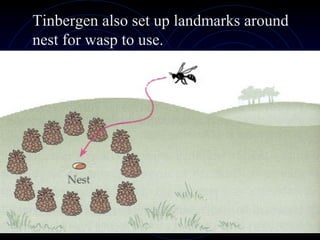
• Tinbergen cleared objects from around nest
after beewolf left and found she struggled to
relocate it.
Tinbergen also set up landmarks around
nest for wasp to use.
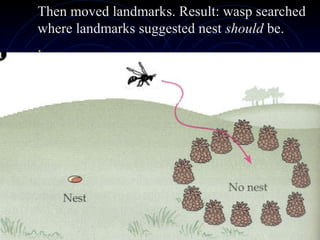
Then moved landmarks. Result: wasp searched
where landmarks suggested nest should be.
.
Beewolf homing
• Tinbergen’s second experiment is more
powerful than his first because it makes a
more specific prediction.
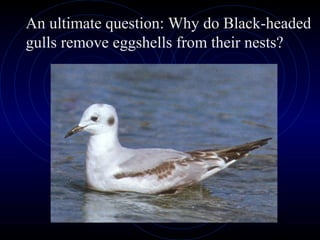
An ultimate question: Why do Black-headed
gulls remove eggshells from their nests?
Gull egg removal
• Tinbergen hypothesized that broken
eggshells draw attention to the nest and
attract predators.
• Removing the eggshells should reduce
predation risk.
Experiment
• Place broken eggshells at different distances
from intact gull eggs.
• Does presence of egg shells affect chance of
intact eggs being found?
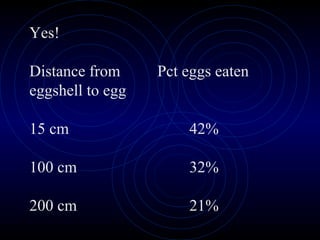
Yes!
Distance from Pct eggs eaten
eggshell to egg
15 cm 42%
100 cm 32%
200 cm 21%
Gull egg removal
• Conclude that Black-headed gulls remove
egg shells because this behavior reduces
egg losses to predators (and ultimately
increase the bird’s reproductive success).
TERMS TO KNOWTERMS TO KNOW
• Instinct – (reflexes and responses) what the
animal has at birth. Ex. Nursing, searching
for food.
• Habituation – learning to respond without
thinking, response to certain stimulus is
established as a result of habituation.
• Conditioning – learning to respond in a
particular way to a stimulus as a result of
reinforcement when the proper response is
made.
TERMS TO KNOWTERMS TO KNOW
• Reinforcement – a reward for making the
proper response.
• Reasoning – the ability to respond correctly
to a stimulus the first time that a new
situation is presented.
• Intelligence – the ability to learn to adjust
successfully to certain situations. Both
short-term and long-term memory are part
of intelligence.
MAJOR TYPES OF ANIMALMAJOR TYPES OF ANIMAL
BEHAVIORBEHAVIOR
• Sexual
• Maternal
• Communicative
• Social
• Feeding
• Eliminative
• Shelter-Seeking
• Investigative
• Allelomimetic
• Maladaptive
SEXUAL BEHAVIORSEXUAL BEHAVIOR
Useful in implementing breeding programs
Examples of Sexual Behavior
o Cows that are in heat, allow themselves to be mounted
by others
o Bulls, rams and stallions smell the vagina and urine to
detect pheromones
o Flehmen – Male animal lifts head and curls its upper lip
o Rams chase ewes that are coming into heat
o Sows seek out boars for mating
o Mares in heat squat and urinate when stallion
approaches and vulva winks
MATERNAL BEHAVIORMATERNAL BEHAVIOR
Females taking care of newborn and young
animals
Examples of Maternal Behavior
o Mothers clean young by licking them
o Mothers fight off intruders
o Become aggressive in protecting they young
after birth
COMMUNICATIVE BEHAVIORCOMMUNICATIVE BEHAVIOR
When some type of information is exchanged
between individual animals
Examples of Communicative Behavior
o Distress Calls – Lambs bleat, calves bawl, pigs
squeal and chicks chirp
o Dams recognize offspring by smell
o Farm animals respond to calls or whistles of the
producer
o Bulls bellow deeply to communicate aggressive
behavior
SOCIAL BEHAVIORSOCIAL BEHAVIOR
Includes “fight or flight” and aggressive and
passive behaviors between animals
Includes interactions with other animals, humans
and behavior during handling and restraint
Examples of Social Behavior
o Males of all farm animals fight when they meet other
unfamiliar males of the same species
o Cows, sows and mares develop a pecking order, but
fight less intensely than males
o Cows withdraw from the herd to a secluded spot just
before calving
o Almost all animals withdraw from the herd if they are
sick
FEEDING BEHAVIORFEEDING BEHAVIOR
Exhibited by animals when eating and
drinking
(Ingestive Behavior)
Examples of Feeding Behavior
o Cattle graze 4-9hrs/day, ruminate 4-9hrs/day,
regurgitate 300-400 boluses of feed per day
o Sheep and goats graze 9-11hrs/day, ruminate 7-
10hrs/day, regurgitate 400-600 boluses of feed per
day
o Cattle usually don’t go more than 3 miles away
from water
o Sheep may travel as much as 8 miles a day
ELIMINATIVE BEHAVIORELIMINATIVE BEHAVIOR
Elimination of feces and urine
Examples of Eliminative Behavior
o Cattle, sheep, horses, goats and chickens eliminate feces
& urine indiscriminately
o Hogs eliminate feces in definite areas of a pasture or pen
o Cattle, sheep, goats and swine defecate while standing or
walking, urinate while standing, but not walking
o Cattle defecate 12-18 times/day, urinate 7-11 times/day
o Horses defecate 5-12 times/day, urinate 7-11 times/day
o Animals defecate & urinate more when stressed or
excited
o Animals loose 3% of their live weight when transported
to & from market points (Shrink)
SHELTER-SEEKINGSHELTER-SEEKING
BEHAVIORBEHAVIOR
Examples of Shelter-Seeking Behavior
o Animals crowd together in snow and cold winds
o Animals seek shelter of trees when it rains
o Cattle and sheep seek shady area for rest and
rumination if weather is hot
o Hogs find a wet area if weather is hot
o In extreme situations, animals pile up to the extent
that some get smothered
INVESTIGATIVE BEHAVIORINVESTIGATIVE BEHAVIOR
Examples of Investigative Behavior
o Pigs, horses and dairy goats are highly curious,
investigate any strange object, approach carefully,
slowly, sniffing and looking as they approach
o Sheep are less curious and more timid
ALLELOMIMETICALLELOMIMETIC
Animals of a species tend to do the same thing at
the same time
Important in that a producer may observe the
herd with little difficulty, also useful in driving
groups of animals from one place to another
Examples of Allelomimetic Behavior
o Cattle and sheep tend to graze at the same time and
rest and ruminate at the same time
o Range cattle gather at the watering place about the
same time each day because one follows the other
MALADAPTIVE BEHAVIORMALADAPTIVE BEHAVIOR
Animals that cannot adapt to their
environment, exhibit inappropriate or
unusual behavior
Examples of Maladaptive Behavior
o Chickens and swine in extensive management
(confinement) systems resort to cannibalism,
removal of tails is a prevention method
o Buller-steer syndrome – steers that have been
castrated before puberty demonstrate masculine
behavior

Animalbehaviorppt

  • 1.
  • 2.
    Proximate and ultimatequestions • Two basic types of questions asked in Animal Behavior • Proximate (focus on mechanics of behavior). • Ultimate (focus on advantages of the behavior)
  • 3.
    Proximate questions • Questionsabout physical mechanisms. Focus on the genetic-developmental aspects and the sensory-motor aspects of the behavior. • Focus on things that cause or enable the animal to perform the behavior.
  • 4.
    Proximate questions • Examplesof proximate questions: • How mechanically does the behavior take place? • What factors in the environment stimulate the behavior? • How do the nerves and muscles generate the behavior? • How do the animal’s genes affect the behavior?
  • 5.
    Ultimate questions • Ultimatequestions are questions about the evolutionary reasons for a behavior. They are questions about the selective processes that shape the behavior.
  • 6.
    Ultimate questions • Examplesof ultimate questions: • What is the purpose of the behavior? • In what way does the behavior increase an individual’s reproductive success? • Does the behavior increase an individual’s prospects of survival?
  • 7.
    How do weanswer behavioral questions? • Examples from Niko Tinbergen’s work.
  • 8.
    A proximate question. •How do beewolves find their way home?
  • 9.
    Beewolves (type ofwasp) nest in sandy areas.
  • 10.
    Beewolf homing • Whenleaving nest to hunt bees, female beewolf covers nest entrance with sand. • How does she relocate it?
  • 11.
    Beewolf homing • Beewolvescircle next before leaving. • Do they remember landmarks? How would we test this?
  • 12.
    Beewolf homing • Tinbergencleared objects from around nest after beewolf left and found she struggled to relocate it.
  • 13.
    Tinbergen also setup landmarks around nest for wasp to use.
  • 14.
    Then moved landmarks.Result: wasp searched where landmarks suggested nest should be. .
  • 15.
    Beewolf homing • Tinbergen’ssecond experiment is more powerful than his first because it makes a more specific prediction.
  • 16.
    An ultimate question:Why do Black-headed gulls remove eggshells from their nests?
  • 17.
    Gull egg removal •Tinbergen hypothesized that broken eggshells draw attention to the nest and attract predators. • Removing the eggshells should reduce predation risk.
  • 18.
    Experiment • Place brokeneggshells at different distances from intact gull eggs. • Does presence of egg shells affect chance of intact eggs being found?
  • 19.
    Yes! Distance from Pcteggs eaten eggshell to egg 15 cm 42% 100 cm 32% 200 cm 21%
  • 20.
    Gull egg removal •Conclude that Black-headed gulls remove egg shells because this behavior reduces egg losses to predators (and ultimately increase the bird’s reproductive success).
  • 21.
    TERMS TO KNOWTERMSTO KNOW • Instinct – (reflexes and responses) what the animal has at birth. Ex. Nursing, searching for food. • Habituation – learning to respond without thinking, response to certain stimulus is established as a result of habituation. • Conditioning – learning to respond in a particular way to a stimulus as a result of reinforcement when the proper response is made.
  • 22.
    TERMS TO KNOWTERMSTO KNOW • Reinforcement – a reward for making the proper response. • Reasoning – the ability to respond correctly to a stimulus the first time that a new situation is presented. • Intelligence – the ability to learn to adjust successfully to certain situations. Both short-term and long-term memory are part of intelligence.
  • 23.
    MAJOR TYPES OFANIMALMAJOR TYPES OF ANIMAL BEHAVIORBEHAVIOR • Sexual • Maternal • Communicative • Social • Feeding • Eliminative • Shelter-Seeking • Investigative • Allelomimetic • Maladaptive
  • 24.
    SEXUAL BEHAVIORSEXUAL BEHAVIOR Usefulin implementing breeding programs Examples of Sexual Behavior o Cows that are in heat, allow themselves to be mounted by others o Bulls, rams and stallions smell the vagina and urine to detect pheromones o Flehmen – Male animal lifts head and curls its upper lip o Rams chase ewes that are coming into heat o Sows seek out boars for mating o Mares in heat squat and urinate when stallion approaches and vulva winks
  • 25.
    MATERNAL BEHAVIORMATERNAL BEHAVIOR Femalestaking care of newborn and young animals Examples of Maternal Behavior o Mothers clean young by licking them o Mothers fight off intruders o Become aggressive in protecting they young after birth
  • 26.
    COMMUNICATIVE BEHAVIORCOMMUNICATIVE BEHAVIOR Whensome type of information is exchanged between individual animals Examples of Communicative Behavior o Distress Calls – Lambs bleat, calves bawl, pigs squeal and chicks chirp o Dams recognize offspring by smell o Farm animals respond to calls or whistles of the producer o Bulls bellow deeply to communicate aggressive behavior
  • 27.
    SOCIAL BEHAVIORSOCIAL BEHAVIOR Includes“fight or flight” and aggressive and passive behaviors between animals Includes interactions with other animals, humans and behavior during handling and restraint Examples of Social Behavior o Males of all farm animals fight when they meet other unfamiliar males of the same species o Cows, sows and mares develop a pecking order, but fight less intensely than males o Cows withdraw from the herd to a secluded spot just before calving o Almost all animals withdraw from the herd if they are sick
  • 28.
    FEEDING BEHAVIORFEEDING BEHAVIOR Exhibitedby animals when eating and drinking (Ingestive Behavior) Examples of Feeding Behavior o Cattle graze 4-9hrs/day, ruminate 4-9hrs/day, regurgitate 300-400 boluses of feed per day o Sheep and goats graze 9-11hrs/day, ruminate 7- 10hrs/day, regurgitate 400-600 boluses of feed per day o Cattle usually don’t go more than 3 miles away from water o Sheep may travel as much as 8 miles a day
  • 29.
    ELIMINATIVE BEHAVIORELIMINATIVE BEHAVIOR Eliminationof feces and urine Examples of Eliminative Behavior o Cattle, sheep, horses, goats and chickens eliminate feces & urine indiscriminately o Hogs eliminate feces in definite areas of a pasture or pen o Cattle, sheep, goats and swine defecate while standing or walking, urinate while standing, but not walking o Cattle defecate 12-18 times/day, urinate 7-11 times/day o Horses defecate 5-12 times/day, urinate 7-11 times/day o Animals defecate & urinate more when stressed or excited o Animals loose 3% of their live weight when transported to & from market points (Shrink)
  • 30.
    SHELTER-SEEKINGSHELTER-SEEKING BEHAVIORBEHAVIOR Examples of Shelter-SeekingBehavior o Animals crowd together in snow and cold winds o Animals seek shelter of trees when it rains o Cattle and sheep seek shady area for rest and rumination if weather is hot o Hogs find a wet area if weather is hot o In extreme situations, animals pile up to the extent that some get smothered
  • 31.
    INVESTIGATIVE BEHAVIORINVESTIGATIVE BEHAVIOR Examplesof Investigative Behavior o Pigs, horses and dairy goats are highly curious, investigate any strange object, approach carefully, slowly, sniffing and looking as they approach o Sheep are less curious and more timid
  • 32.
    ALLELOMIMETICALLELOMIMETIC Animals of aspecies tend to do the same thing at the same time Important in that a producer may observe the herd with little difficulty, also useful in driving groups of animals from one place to another Examples of Allelomimetic Behavior o Cattle and sheep tend to graze at the same time and rest and ruminate at the same time o Range cattle gather at the watering place about the same time each day because one follows the other
  • 33.
    MALADAPTIVE BEHAVIORMALADAPTIVE BEHAVIOR Animalsthat cannot adapt to their environment, exhibit inappropriate or unusual behavior Examples of Maladaptive Behavior o Chickens and swine in extensive management (confinement) systems resort to cannibalism, removal of tails is a prevention method o Buller-steer syndrome – steers that have been castrated before puberty demonstrate masculine behavior