ANGINA PECTORIS – ETIOLOGY AND
TREATMENT
Shreya Bhattacharjee
B.Pharm. Semester VI
Class Roll No. B14014
ACKNOWLEDGEMENT
I would like to express my special thanks of gratitude to Mr. Mrittunjoy
Mojumdar sir, to Mr. Suman Adhikari sir as well as our principal Dr. Arnab
Samanta sir who gave me the golden opportunity to do this wonderful project
on the topic Angina Pectoris – etiology and treatment, which also helped me in
doing a lot of research and I came to know about so many new things. I am
really thankful to them for helping me throughout this project.
I would also like to thank other teachers and my parents who helped me a lot
in finalizing the project within the limited time frame.
OUTLINES
 Definition
 Types of Angina
 Etiology
 Clinical Presentation
 Diagnosis
 Goals of Treatment
 Treating methods
ANGINA PECTORIS
• Spasm/obstruction of coronary arteries
• Myocardial ischemia
• Reduced oxygen supply to myocardium
• Chest pain --- Angina pectoris
4
1
TYPES
STABLE ANGINA /
CLASSIC ANGINA
VARIANT ANGINA /
PRINZMETAL ANGINA
UNSTABLE ANGINA /
CRESCENDO
ANGINA
Atherosclerosis Coronary Spasm Atherosclerosis with
blood clot
Occurs with exertion or
exercise
Severe pain often occurs
at rest or minimal
exertion
Typically at rest during
night or early morning
hours
Relieved by rest or
antianginals
Relieved by anti -
angina drugs
(Nitroglycerin)
Not relieved by rest
or medication
5
2
ETIOLOGY
3
DIAGRAMMATIC REPRESENTATION
CAUSE
7
4
1.Choking, smothering, squeezing, or crushing pressure in the centre of
chest.
2. Patients with atherosclerosis also may experience sweating,
clamminess.
3. Shortness of breath (dyspnea).
1.Angina pain may radiate to the shoulders, arms, back, neck, or
jaw.
2. The pain may be of any intensity from mild to severe.
Angina itself is a symptom (or a set of symptoms) of Ischemic heart disease
(IHD) , not a disease.
CLINICAL PRESENTATION
8
5
Stable angina occurs with a certain amount of stress or physical
activity. Occurs for a shorter time and does not cause more often.
Unstable angina is sudden, more severe and more frequent.
* Pain increases every time.
* Lasts longer than 15-20 minutes.
* Does not respond well even under medication.
* Requires immediate attention.
CLINICAL PRESENTATION (contd.)
9
6
DIAGNOSIS
DIAGNOSIS
Stress (Exercise
Test)
Blood Test (Bio
- Markers)
ECG (Electrocardiogram)
Cardiac Angiography /
Cardiac
Catheterization
Echocardiography
Chest X-Ray 10
7
GOALS OF TREATMENT
All treatments for people with coronary artery disease have the
same goals:
- to decrease the effects of the disease on the quality of life and
alleviate symptoms.
- to reduce mortality due to CAD progression.
Above goals can be achieved by following ways:-
* Lifestyle changes
* Drug Therapy
* Surgical methods
11
8
LIFESTYLE CHANGES
•Stress should be reduced.
•Smoking should be stopped.
•There should be sufficient amount of physical exercise and it’s necessary to keep
body weight under control.
•Eat a healthy diet with limited amounts of saturated fat, Trans fat and salt.
12
9
DRUG THERAPY
NITRATES
Denitrated enzymatically in smooth
cells to release reactive free radical
nitric oxide (NO).
It activates cytostolic guanyl cyclase.
.
Increases cyclic guanosine mono
phosphate (cGMP) .
It causes dephosphorylation of
myosin light chain kinase (MLCK)
through cGMP dependent protein
kinase.
Reduction in phosphorylated MLCK
interferes with myosin and fails contraction.
Relaxation occurs due to reduced calcium
entry.
a) Short acting
- Nitroglycerin
- glyceryltri nitrate
b) Long acting
- Isosorbide
mononitrate
- Isosorbide
dinitrate
13
10
DRUG THERAPY (CONTD.)
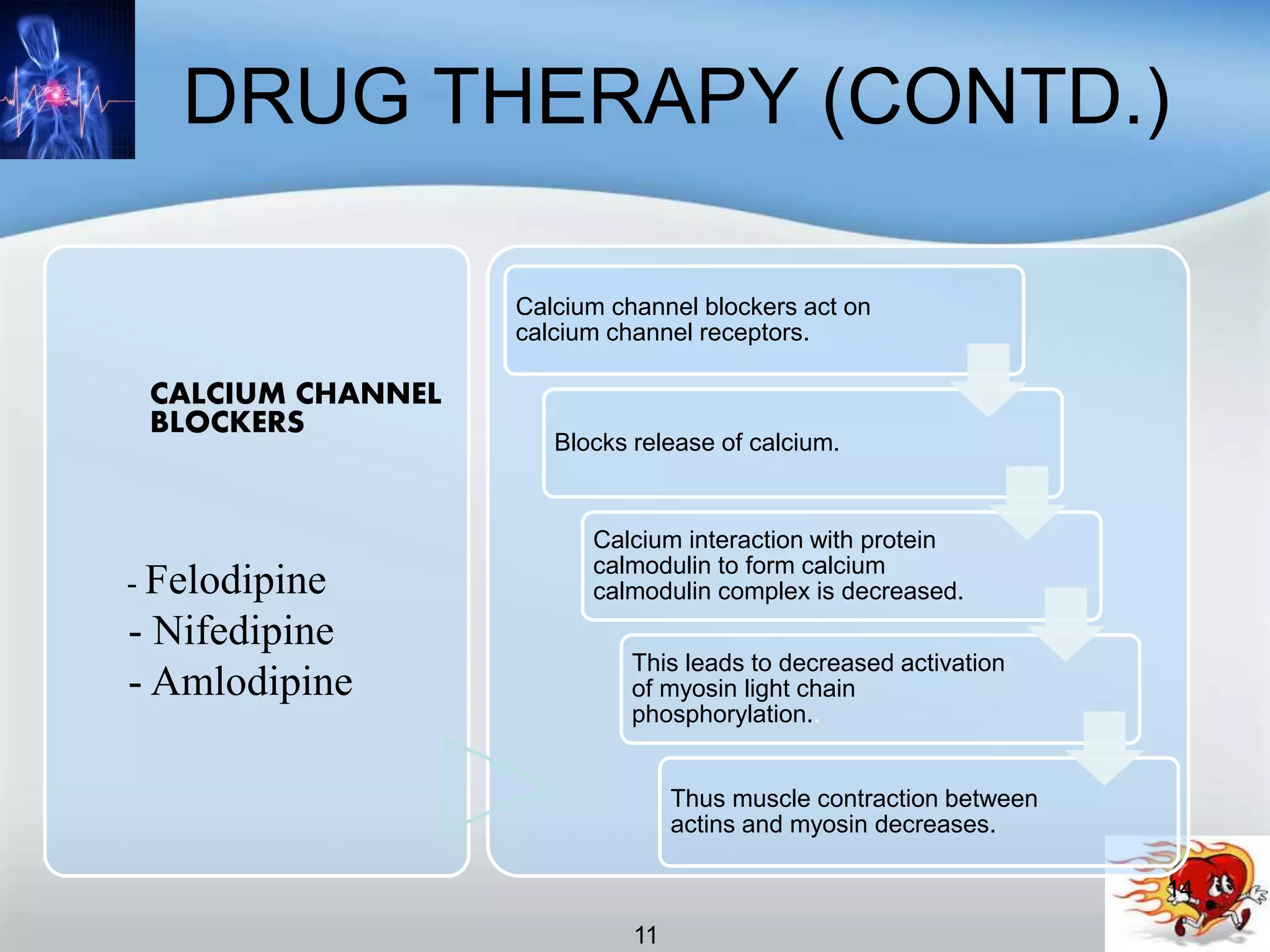
CALCIUM CHANNEL
BLOCKERS
- Felodipine
- Nifedipine
- Amlodipine
Calcium channel blockers act on
calcium channel receptors.
Blocks release of calcium.
Calcium interaction with protein
calmodulin to form calcium
calmodulin complex is decreased.
This leads to decreased activation
of myosin light chain
phosphorylation..
Thus muscle contraction between
actins and myosin decreases.
14
11
DRUG THERAPY (CONTD.)
3. BETA blockers:-
- Propanolol
- Esmolol
- Atenolol
- Metaprolol
4. Potassium channel
opener:-
- Nicorandil
5. Vasodilators:-
- Hydralazine
- Minoxidil
6. Miscellaneous:-
- Aspirin
- Dipyridamole
15
12
SURGICAL METHODS
• Percutaneous Coronary
Intervention (previously called
Angioplasty or Balloon Angioplasty).
• CABG (Coronary Artery Bypass Graft
Surgery)
16
13
Angina seminar

Angina seminar

  • 1.
    ANGINA PECTORIS –ETIOLOGY AND TREATMENT Shreya Bhattacharjee B.Pharm. Semester VI Class Roll No. B14014
  • 2.
    ACKNOWLEDGEMENT I would liketo express my special thanks of gratitude to Mr. Mrittunjoy Mojumdar sir, to Mr. Suman Adhikari sir as well as our principal Dr. Arnab Samanta sir who gave me the golden opportunity to do this wonderful project on the topic Angina Pectoris – etiology and treatment, which also helped me in doing a lot of research and I came to know about so many new things. I am really thankful to them for helping me throughout this project. I would also like to thank other teachers and my parents who helped me a lot in finalizing the project within the limited time frame.
  • 3.
    OUTLINES  Definition  Typesof Angina  Etiology  Clinical Presentation  Diagnosis  Goals of Treatment  Treating methods
  • 4.
    ANGINA PECTORIS • Spasm/obstructionof coronary arteries • Myocardial ischemia • Reduced oxygen supply to myocardium • Chest pain --- Angina pectoris 4 1
  • 5.
    TYPES STABLE ANGINA / CLASSICANGINA VARIANT ANGINA / PRINZMETAL ANGINA UNSTABLE ANGINA / CRESCENDO ANGINA Atherosclerosis Coronary Spasm Atherosclerosis with blood clot Occurs with exertion or exercise Severe pain often occurs at rest or minimal exertion Typically at rest during night or early morning hours Relieved by rest or antianginals Relieved by anti - angina drugs (Nitroglycerin) Not relieved by rest or medication 5 2
  • 6.
  • 7.
  • 8.
    1.Choking, smothering, squeezing,or crushing pressure in the centre of chest. 2. Patients with atherosclerosis also may experience sweating, clamminess. 3. Shortness of breath (dyspnea). 1.Angina pain may radiate to the shoulders, arms, back, neck, or jaw. 2. The pain may be of any intensity from mild to severe. Angina itself is a symptom (or a set of symptoms) of Ischemic heart disease (IHD) , not a disease. CLINICAL PRESENTATION 8 5
  • 9.
    Stable angina occurswith a certain amount of stress or physical activity. Occurs for a shorter time and does not cause more often. Unstable angina is sudden, more severe and more frequent. * Pain increases every time. * Lasts longer than 15-20 minutes. * Does not respond well even under medication. * Requires immediate attention. CLINICAL PRESENTATION (contd.) 9 6
  • 10.
    DIAGNOSIS DIAGNOSIS Stress (Exercise Test) Blood Test(Bio - Markers) ECG (Electrocardiogram) Cardiac Angiography / Cardiac Catheterization Echocardiography Chest X-Ray 10 7
  • 11.
    GOALS OF TREATMENT Alltreatments for people with coronary artery disease have the same goals: - to decrease the effects of the disease on the quality of life and alleviate symptoms. - to reduce mortality due to CAD progression. Above goals can be achieved by following ways:- * Lifestyle changes * Drug Therapy * Surgical methods 11 8
  • 12.
    LIFESTYLE CHANGES •Stress shouldbe reduced. •Smoking should be stopped. •There should be sufficient amount of physical exercise and it’s necessary to keep body weight under control. •Eat a healthy diet with limited amounts of saturated fat, Trans fat and salt. 12 9
  • 13.
    DRUG THERAPY NITRATES Denitrated enzymaticallyin smooth cells to release reactive free radical nitric oxide (NO). It activates cytostolic guanyl cyclase. . Increases cyclic guanosine mono phosphate (cGMP) . It causes dephosphorylation of myosin light chain kinase (MLCK) through cGMP dependent protein kinase. Reduction in phosphorylated MLCK interferes with myosin and fails contraction. Relaxation occurs due to reduced calcium entry. a) Short acting - Nitroglycerin - glyceryltri nitrate b) Long acting - Isosorbide mononitrate - Isosorbide dinitrate 13 10
  • 14.
    DRUG THERAPY (CONTD.) CALCIUMCHANNEL BLOCKERS - Felodipine - Nifedipine - Amlodipine Calcium channel blockers act on calcium channel receptors. Blocks release of calcium. Calcium interaction with protein calmodulin to form calcium calmodulin complex is decreased. This leads to decreased activation of myosin light chain phosphorylation.. Thus muscle contraction between actins and myosin decreases. 14 11
  • 15.
    DRUG THERAPY (CONTD.) 3.BETA blockers:- - Propanolol - Esmolol - Atenolol - Metaprolol 4. Potassium channel opener:- - Nicorandil 5. Vasodilators:- - Hydralazine - Minoxidil 6. Miscellaneous:- - Aspirin - Dipyridamole 15 12
  • 16.
    SURGICAL METHODS • PercutaneousCoronary Intervention (previously called Angioplasty or Balloon Angioplasty). • CABG (Coronary Artery Bypass Graft Surgery) 16 13