By:- Ravikant Sir
ANESTHESIA
• Artificially induced complete/ partial loss of Sensation.
(With or without loss of consciousness)
• Anesthesia is a state of controlled, temporary loss of
sensation or awareness that induced for Therapeutic
purposes.
• It may include :-
– Analgesia -Relief from pain
– Paralysis-Muscle relaxation
– Amnesia -Loss of memory
– Unconsciousness.
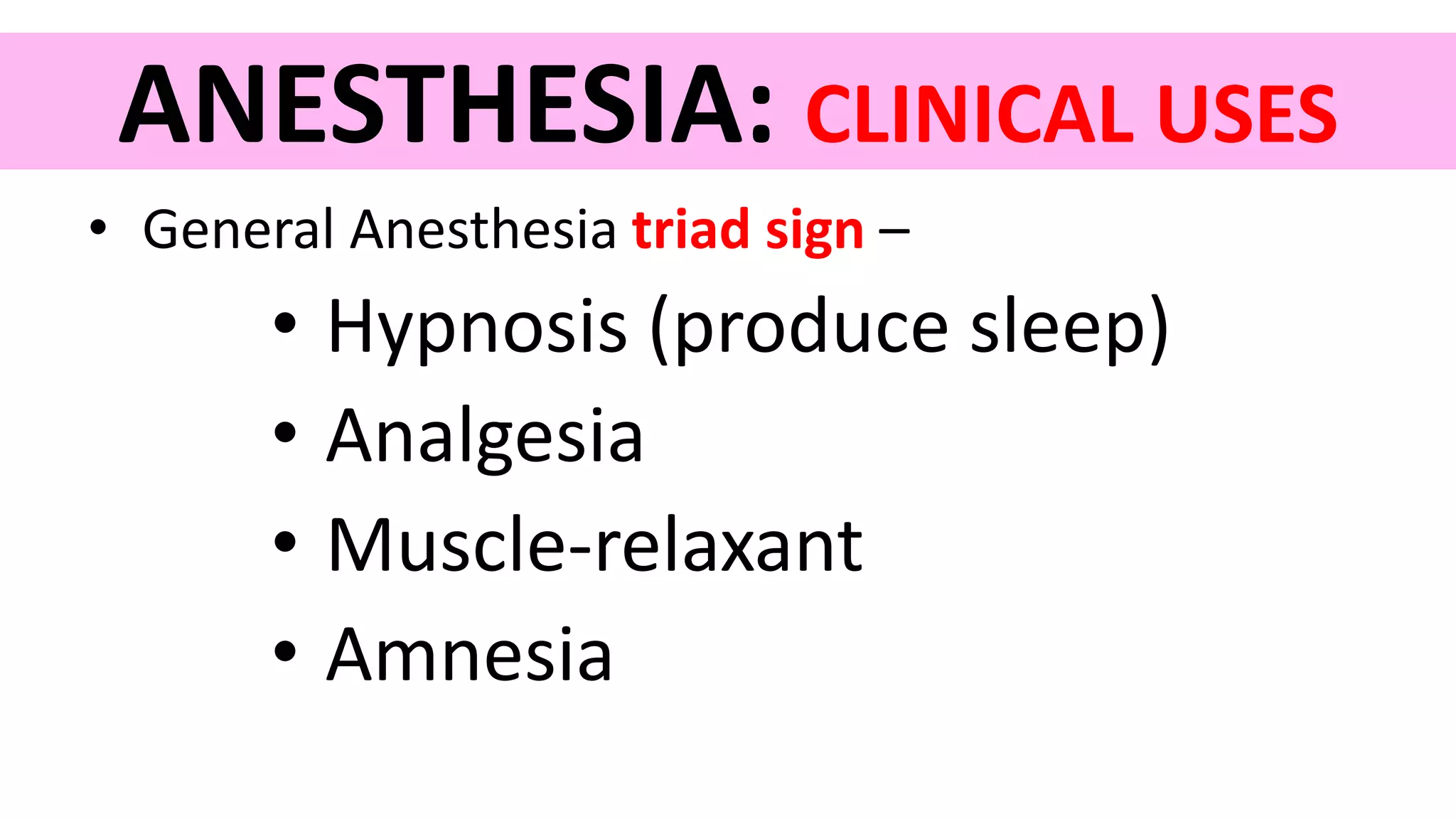
ANESTHESIA: CLINICAL USES
• General Anesthesia triad sign –
• Hypnosis (produce sleep)
• Analgesia
• Muscle-relaxant
• Amnesia
STAGES OF ANESTHESIA
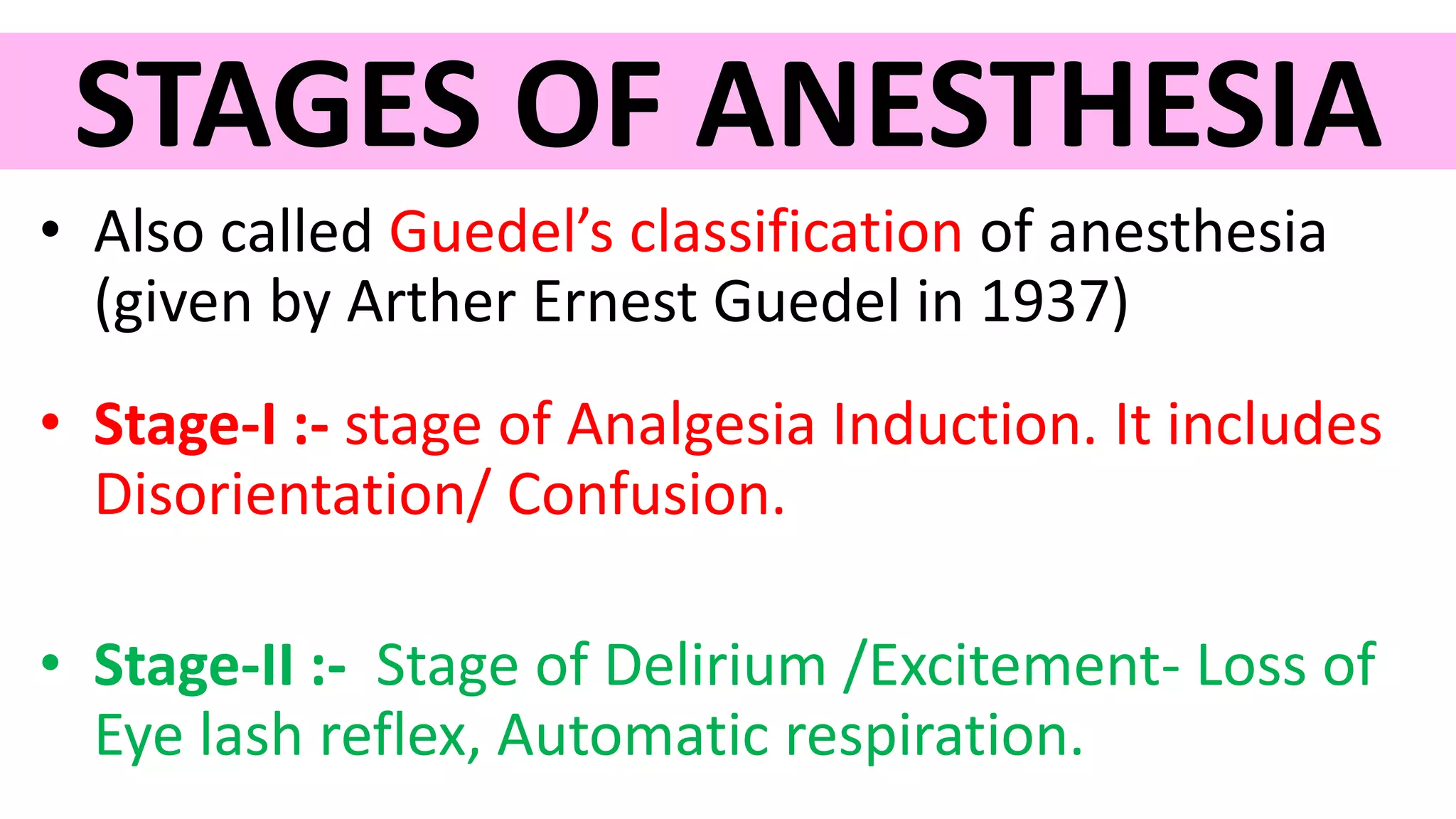
• Also called Guedel’s classification of anesthesia
(given by Arther Ernest Guedel in 1937)
• Stage-I :- stage of Analgesia Induction. It includes
Disorientation/ Confusion.
• Stage-II :- Stage of Delirium /Excitement- Loss of
Eye lash reflex, Automatic respiration.
STAGES OF ANESTHESIA
• Stage- III :- Stage of Surgical anesthesia, Loss of eye
ball movement, swallowing reflex, gag reflex,
laryngeal reflex, loss of all reflex and muscle
relaxation.
• Best marker to assess the onset of surgical anesthesia
s – Gag reflex i.e. assessed in every 3 min.
• Stage –IV (overdose/toxicity) stage of medullary
paralysis, supress of respiration and pupil dilation.
STAGES OF ANESTHESIA
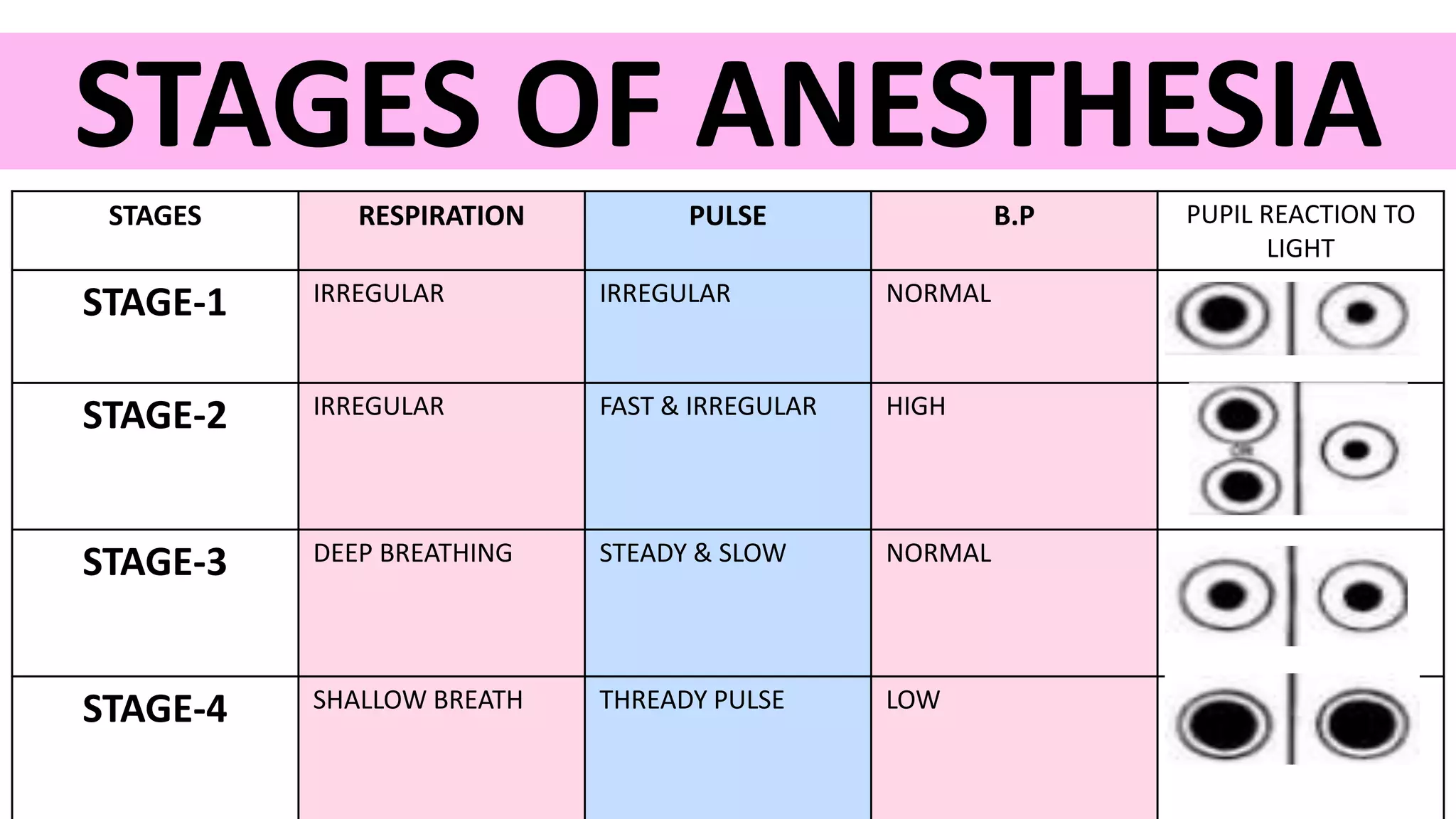
STAGES RESPIRATION PULSE B.P PUPIL REACTION TO
LIGHT
STAGE-1 IRREGULAR IRREGULAR NORMAL
STAGE-2 IRREGULAR FAST & IRREGULAR HIGH
STAGE-3 DEEP BREATHING STEADY & SLOW NORMAL
STAGE-4 SHALLOW BREATH THREADY PULSE LOW
ANESTHESIA RECOVERY
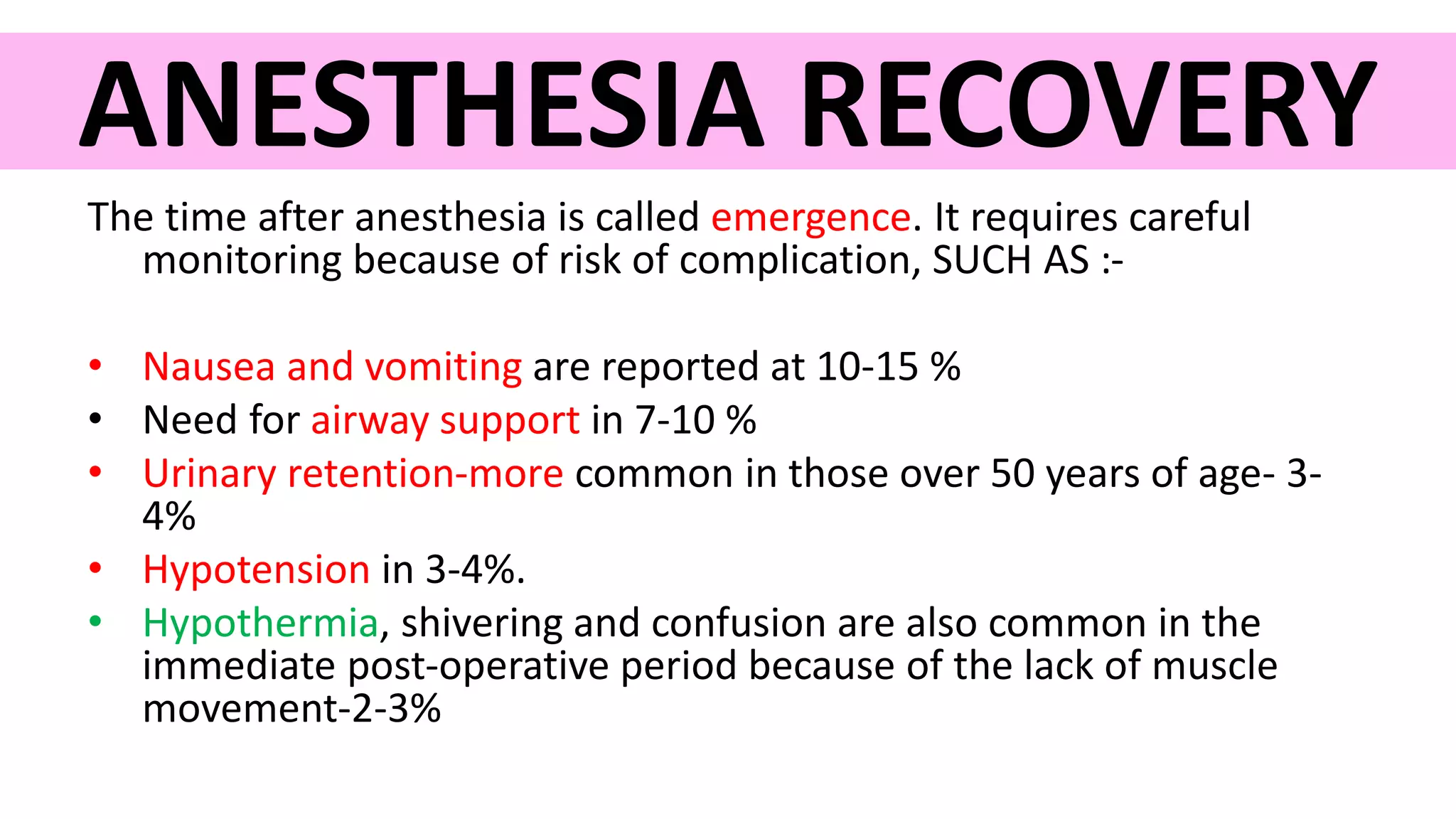
The time after anesthesia is called emergence. It requires careful
monitoring because of risk of complication, SUCH AS :-
• Nausea and vomiting are reported at 10-15 %
• Need for airway support in 7-10 %
• Urinary retention-more common in those over 50 years of age- 3-
4%
• Hypotension in 3-4%.
• Hypothermia, shivering and confusion are also common in the
immediate post-operative period because of the lack of muscle
movement-2-3%
ANESTHESIA RECOVERY
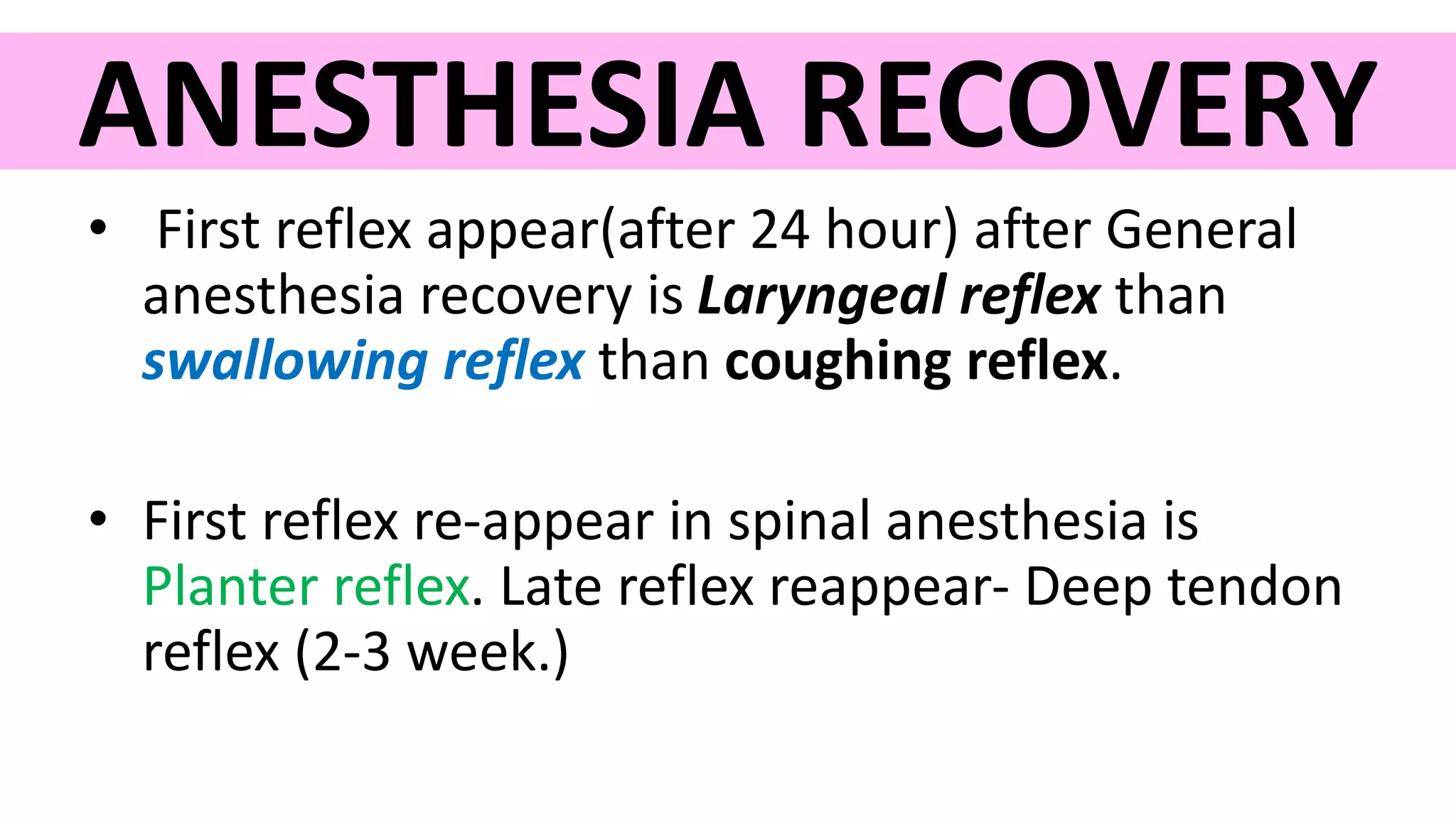
• First reflex appear(after 24 hour) after General
anesthesia recovery is Laryngeal reflex than
swallowing reflex than coughing reflex.
• First reflex re-appear in spinal anesthesia is
Planter reflex. Late reflex reappear- Deep tendon
reflex (2-3 week.)
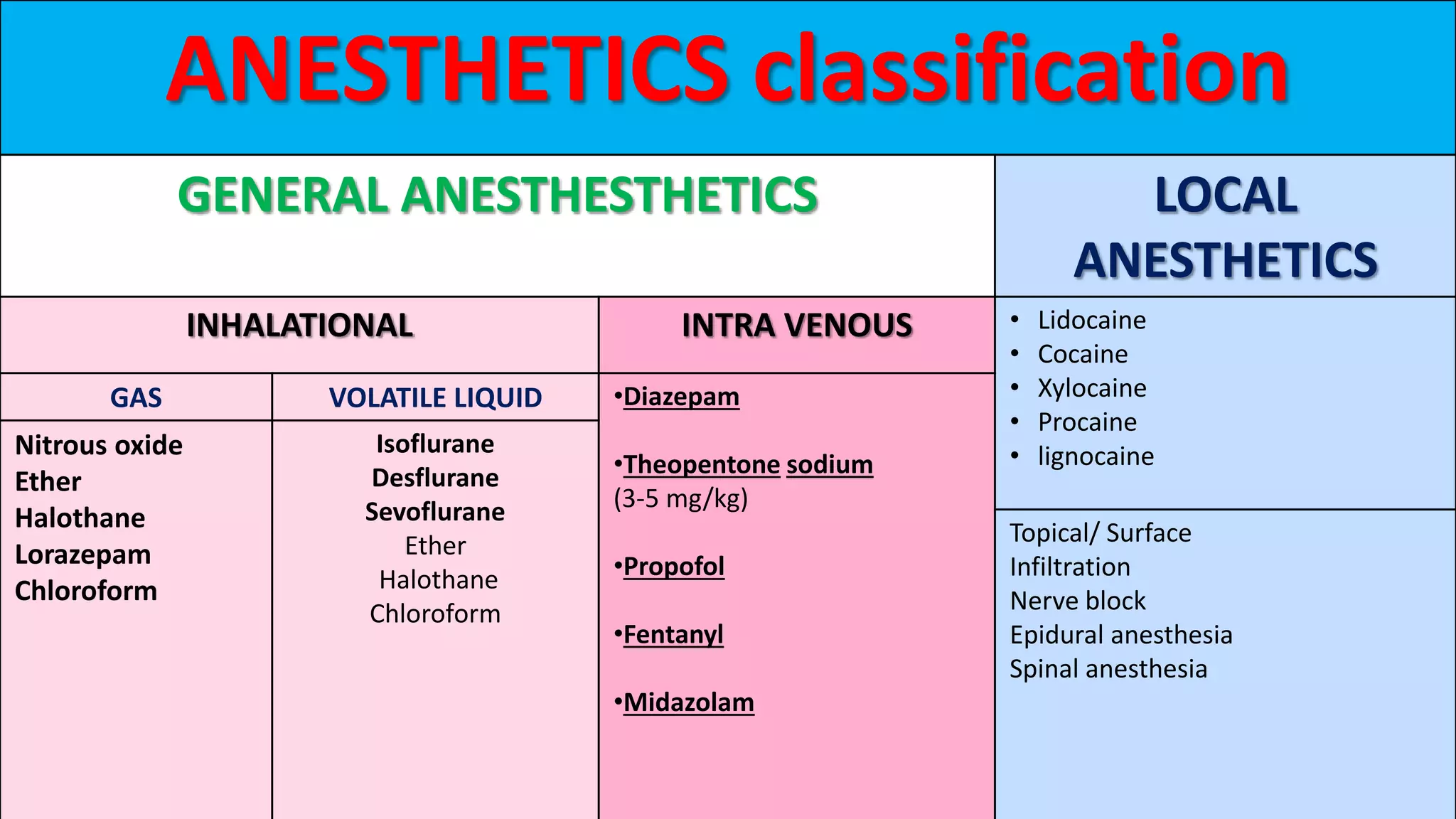
ANESTHETICS classification
GENERAL ANESTHESTHETICS LOCAL
ANESTHETICS
INHALATIONAL INTRA VENOUS • Lidocaine
• Cocaine
• Xylocaine
• Procaine
• lignocaine
GAS VOLATILE LIQUID •Diazepam
•Theopentone sodium
(3-5 mg/kg)
•Propofol
•Fentanyl
•Midazolam
Nitrous oxide
Ether
Halothane
Lorazepam
Chloroform
Isoflurane
Desflurane
Sevoflurane
Ether
Halothane
Chloroform
Topical/ Surface
Infiltration
Nerve block
Epidural anesthesia
Spinal anesthesia
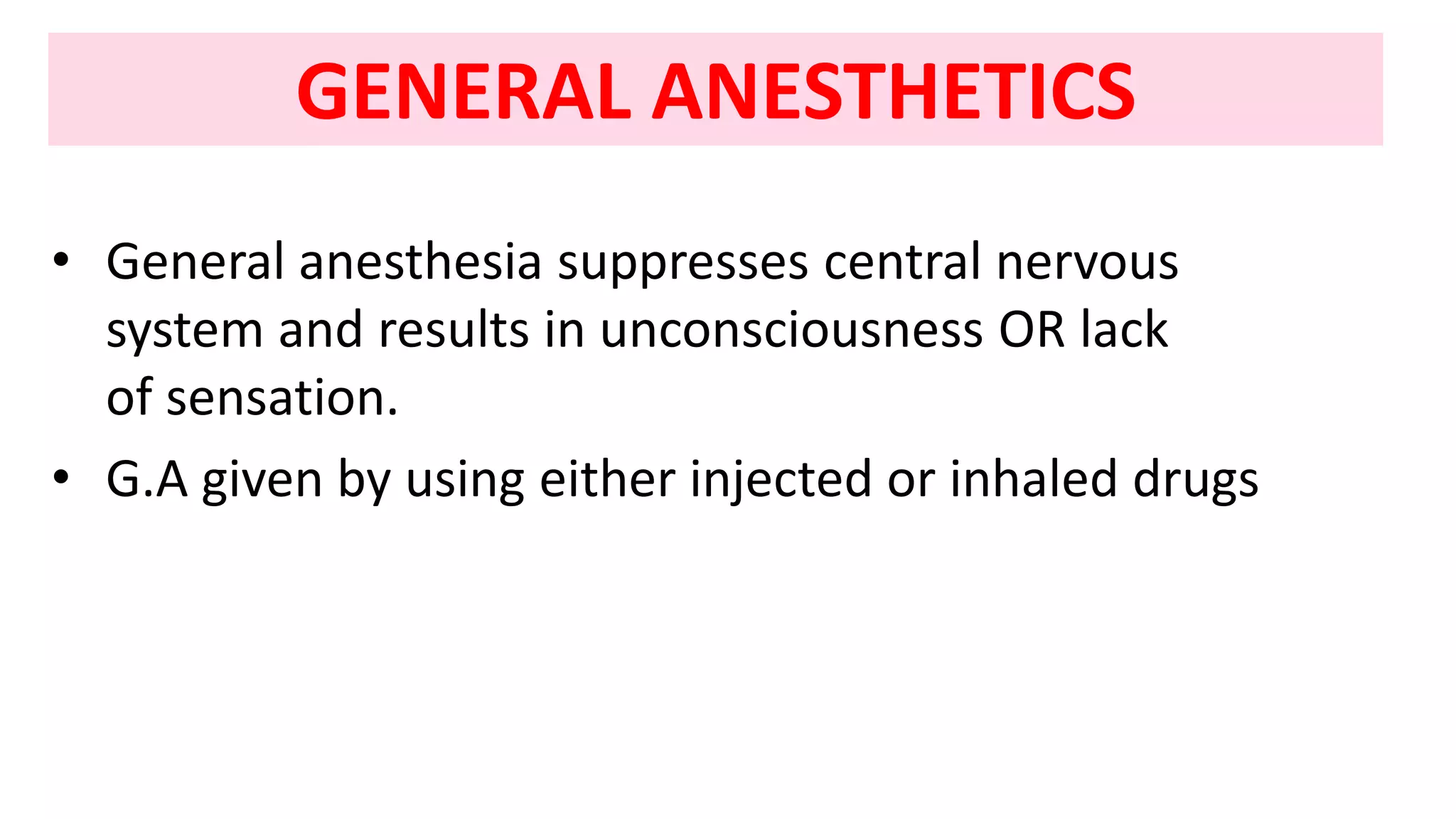
GENERAL ANESTHETICS
• General anesthesia suppresses central nervous
system and results in unconsciousness OR lack
of sensation.
• G.A given by using either injected or inhaled drugs
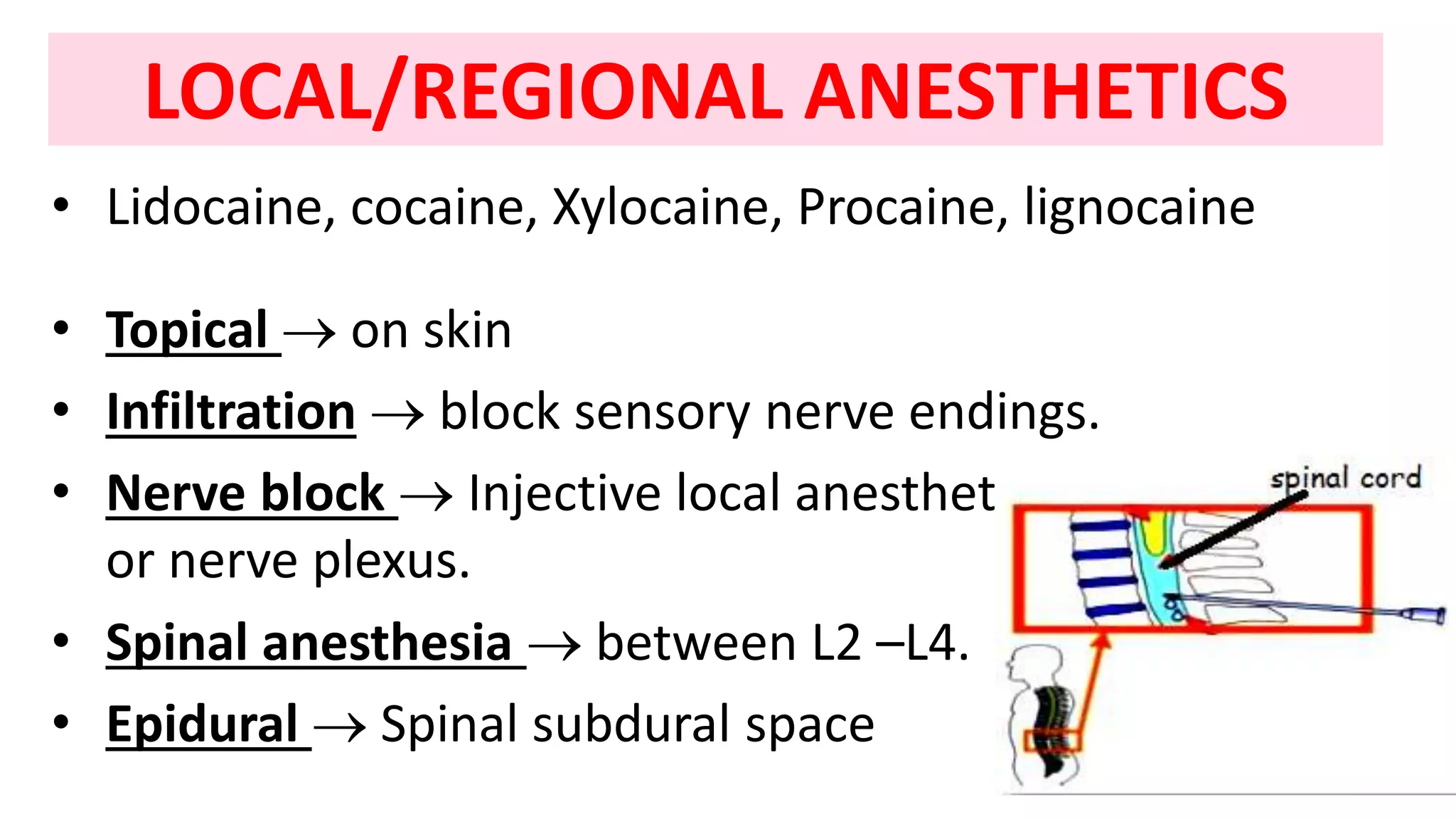
LOCAL/REGIONAL ANESTHETICS
• Lidocaine, cocaine, Xylocaine, Procaine, lignocaine
• Topical  on skin
• Infiltration  block sensory nerve endings.
• Nerve block  Injective local anesthetic around nerve
or nerve plexus.
• Spinal anesthesia  between L2 –L4.
• Epidural  Spinal subdural space
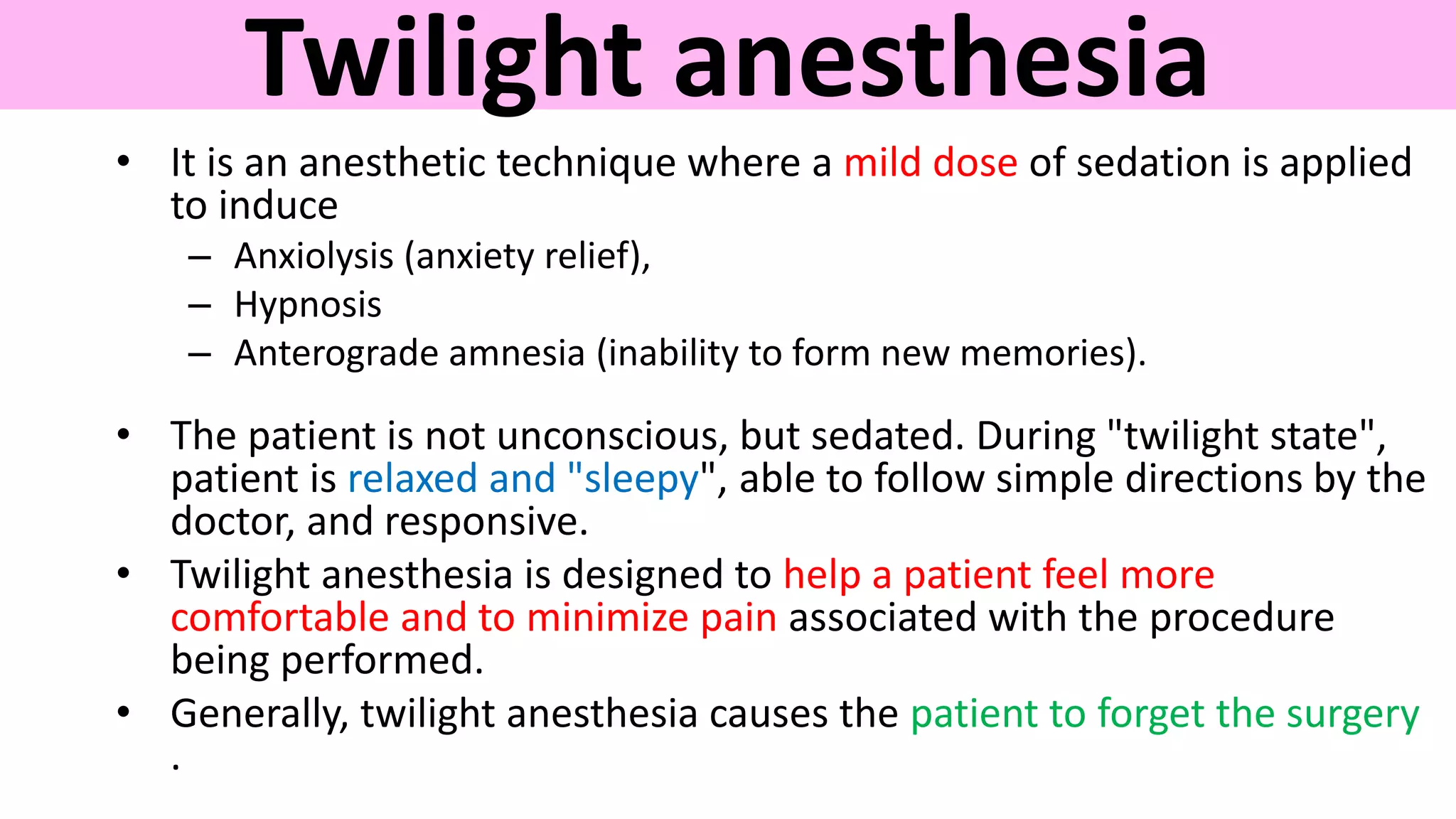
Twilight anesthesia
• It is an anesthetic technique where a mild dose of sedation is applied
to induce
– Anxiolysis (anxiety relief),
– Hypnosis
– Anterograde amnesia (inability to form new memories).
• The patient is not unconscious, but sedated. During "twilight state",
patient is relaxed and "sleepy", able to follow simple directions by the
doctor, and responsive.
• Twilight anesthesia is designed to help a patient feel more
comfortable and to minimize pain associated with the procedure
being performed.
• Generally, twilight anesthesia causes the patient to forget the surgery
.

anesthesia & ansthetics.pptx

  • 1.
  • 2.
    ANESTHESIA • Artificially inducedcomplete/ partial loss of Sensation. (With or without loss of consciousness) • Anesthesia is a state of controlled, temporary loss of sensation or awareness that induced for Therapeutic purposes. • It may include :- – Analgesia -Relief from pain – Paralysis-Muscle relaxation – Amnesia -Loss of memory – Unconsciousness.
  • 3.
    ANESTHESIA: CLINICAL USES •General Anesthesia triad sign – • Hypnosis (produce sleep) • Analgesia • Muscle-relaxant • Amnesia
  • 4.
    STAGES OF ANESTHESIA •Also called Guedel’s classification of anesthesia (given by Arther Ernest Guedel in 1937) • Stage-I :- stage of Analgesia Induction. It includes Disorientation/ Confusion. • Stage-II :- Stage of Delirium /Excitement- Loss of Eye lash reflex, Automatic respiration.
  • 5.
    STAGES OF ANESTHESIA •Stage- III :- Stage of Surgical anesthesia, Loss of eye ball movement, swallowing reflex, gag reflex, laryngeal reflex, loss of all reflex and muscle relaxation. • Best marker to assess the onset of surgical anesthesia s – Gag reflex i.e. assessed in every 3 min. • Stage –IV (overdose/toxicity) stage of medullary paralysis, supress of respiration and pupil dilation.
  • 6.
    STAGES OF ANESTHESIA STAGESRESPIRATION PULSE B.P PUPIL REACTION TO LIGHT STAGE-1 IRREGULAR IRREGULAR NORMAL STAGE-2 IRREGULAR FAST & IRREGULAR HIGH STAGE-3 DEEP BREATHING STEADY & SLOW NORMAL STAGE-4 SHALLOW BREATH THREADY PULSE LOW
  • 7.
    ANESTHESIA RECOVERY The timeafter anesthesia is called emergence. It requires careful monitoring because of risk of complication, SUCH AS :- • Nausea and vomiting are reported at 10-15 % • Need for airway support in 7-10 % • Urinary retention-more common in those over 50 years of age- 3- 4% • Hypotension in 3-4%. • Hypothermia, shivering and confusion are also common in the immediate post-operative period because of the lack of muscle movement-2-3%
  • 8.
    ANESTHESIA RECOVERY • Firstreflex appear(after 24 hour) after General anesthesia recovery is Laryngeal reflex than swallowing reflex than coughing reflex. • First reflex re-appear in spinal anesthesia is Planter reflex. Late reflex reappear- Deep tendon reflex (2-3 week.)
  • 9.
    ANESTHETICS classification GENERAL ANESTHESTHETICSLOCAL ANESTHETICS INHALATIONAL INTRA VENOUS • Lidocaine • Cocaine • Xylocaine • Procaine • lignocaine GAS VOLATILE LIQUID •Diazepam •Theopentone sodium (3-5 mg/kg) •Propofol •Fentanyl •Midazolam Nitrous oxide Ether Halothane Lorazepam Chloroform Isoflurane Desflurane Sevoflurane Ether Halothane Chloroform Topical/ Surface Infiltration Nerve block Epidural anesthesia Spinal anesthesia
  • 10.
    GENERAL ANESTHETICS • Generalanesthesia suppresses central nervous system and results in unconsciousness OR lack of sensation. • G.A given by using either injected or inhaled drugs
  • 11.
    LOCAL/REGIONAL ANESTHETICS • Lidocaine,cocaine, Xylocaine, Procaine, lignocaine • Topical  on skin • Infiltration  block sensory nerve endings. • Nerve block  Injective local anesthetic around nerve or nerve plexus. • Spinal anesthesia  between L2 –L4. • Epidural  Spinal subdural space
  • 12.
    Twilight anesthesia • Itis an anesthetic technique where a mild dose of sedation is applied to induce – Anxiolysis (anxiety relief), – Hypnosis – Anterograde amnesia (inability to form new memories). • The patient is not unconscious, but sedated. During "twilight state", patient is relaxed and "sleepy", able to follow simple directions by the doctor, and responsive. • Twilight anesthesia is designed to help a patient feel more comfortable and to minimize pain associated with the procedure being performed. • Generally, twilight anesthesia causes the patient to forget the surgery .