R. Bwanali
 Define anaesthesia
 Historical background of anaesthesia
 Discuss levels of anaesthesia
 Stages of general anaesthesia
 Balanced anaesthesia
 Pre-medication
 Pre-operative anaesthetic review
 Explain complications of anaesthesia
 Insensitivity to pain, especially as artificially
induced by the administration of gases or the
injection of drugs before surgical operations.
 Anaesthesia is a state of temporary induced
loss of sensation or awareness. It may
include analgesia, paralysis, amnesia,
or unconsciousness. A patient under the
effects of anesthetic drugs is referred to as
being anesthetized.
 Comes from a Greek word anaisthetos,
meaning “without sensation”.
 William T.G. Morton was the first to make history
by publicly demonstrating the use of ether
anaesthesia in 1846. He had single-handedly
proven to the world that ether is a gas that when
inhaled in the proper dose, provided safe and
effective anaesthesia.
 Through his tenacity driven by enthusiasm to
discovery, Dr. Morton and a renowned surgeon at
Massachusetts General Hospital, John Collins
Warren (1778-1856) made history on October
16, 1846 with the first successful surgical
procedure performed with anaesthesia.
 General anaesthetic: Used for major
operations and when a patient needs to be
unconscious, also known as being
anaesthetised.
 Local anaesthetic: Used for minor procedures
such as skin surgery and tooth extractions. ...
 Regional anaesthesia AKA Nerve block: The
use of local anaesthetics to block sensations
of pain from a large area of the body, such as
an arm or leg or the abdomen.
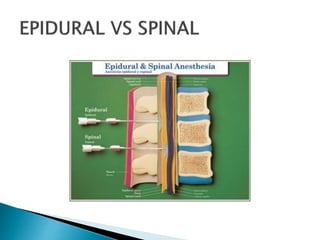
 Epidural anaesthesia: is a regional
anaesthesia that blocks pain in a particular
region of the body. The goal of an epidural is
to provide analgesia, or pain relief, rather
than anaesthesia, which leads to total lack of
feeling. Epidurals block the nerve impulses
from the lower spinal segments. This results
in decreased sensation in the lower half
of the body.
 Spinal anaesthesia AKA spinal block,
subarachnoid block, intradural block and
intrathecal block: Is a form of
regional anaesthesia involving the injection of
a local anaesthetic into the subarachnoid
space, generally through a fine needle,
usually 9 cm (3.5 in) long.
 Combinations: Refers to a technique of
anaesthesia that uses a combination of 2 or
more types of anaesthesia to yield benefits of
each anaesthesia type.

Sedation: In general, sedation is considered a
“lighter sleep.” When under sedation, a
patients are unaware of their surroundings,
but might respond to stimulation.

Sedation is typically used in minor surgical
procedures such as endoscopy, vasectomy,
or dentistry and for reconstructive surgery,
some cosmetic surgeries, removal of wisdom
teeth, or for high-anxiety patients.
 Sedation is also extensively used in
the intensive care unit so that patients who
are being ventilated tolerate having
an endotracheal tube in their trachea.
 There are different levels of sedation: mild,
moderate and deep.
 Typically, levels are (i) agitation, (ii) calm, (iii)
responsive to voice alone, (iv) responsive to
tactile stimulation, (v) responsive to painful
stimulation only, and (vi) unresponsive to painful
stimulation.
 Sedation scales are used in medical situations in
conjunction with a medical history in assessing
the applicable degree of sedation in patients in
order to avoid under-sedation (the patient risks
experiencing pain or distress) and over-sedation
(the patient risks side effects such as
suppression of breathing, which might lead to
death).
 A variety of drugs that are administered with
to achieve unconsciousness, amnesia,
analgesia, loss of reflexes of the autonomic
nervous system and even paralysis of the
skeletal muscles.
 Balanced anesthesia allows us to minimize
patient risk and maximize patient comfort
and safety. The objectives of balanced
anesthesia are to calm the patient, minimize
pain, and reduce the potential for adverse
effects associated with analgesic and
anesthetic agents.
 Premedication refers to the administration of
medication before anaesthesia. Premedication
is used to prepare the patient for anaesthesia
and to help provide optimal conditions for
surgery.
 Premedication helps in:
 Reduction of anxiety and pain.
 Promotion of amnesia.
 Reduction of secretions.
 Reduction of volume and pH of gastric
contents (to avoid Mendelson's syndrome).
 Reduction of postoperative nausea and
vomiting.
 Reduction of vagal reflexes to intubation.
 Stage I (stage of analgesia or disorientation):
from beginning of induction of general
anaesthesia to loss of consciousness. This
stage has further been divided into 3 planes:
 1st plane The patient does not
experience amnesia or analgesia
 2nd plane The patient is completely amnesic
but experiences only partial analgesia
 3rd plane The patient has complete analgesia
and amnesia
 Stage II (stage of excitement or delirium):
from loss of consciousness to onset of
automatic breathing. Eyelash reflex disappear
but other reflexes remain intact and
coughing, vomiting and struggling may
occur; respiration can be irregular with
breath-holding.
 Stage III (stage of surgical anaesthesia): from
onset of automatic respiration to respiratory
paralysis. It is divided into four planes:
 Plane I - from onset of automatic respiration
to cessation of eyeball movements. Eyelid
reflex is lost, swallowing reflex disappears,
marked eyeball movement may occur but
conjunctival reflex is lost at the bottom of the
plane
 Plane II - from cessation of eyeball
movements to beginning of paralysis of
intercostal muscles. Laryngeal reflex is lost
although inflammation of the upper
respiratory tract increases reflex irritability,
corneal reflex disappears, secretion of
tears increases (a useful sign of light
anesthesia), respiration is automatic and
regular, movement and deep breathing as a
response to skin stimulation disappears.
 Plane III - from beginning to completion of
intercostal muscle paralysis. Diaphragmatic
respiration persists but there is progressive
intercostal paralysis, pupils dilated and light
reflex is abolished. The laryngeal reflex lost
in plane II can still be initiated by painful
stimuli arising from the dilatation of anus or
cervix. This was the desired plane for surgery
when muscle relaxants were not used.
 Plane IV - from complete intercostal paralysis
to diaphragmatic paralysis (apnea).
 Stage IV: from stoppage of respiration till
death. Anesthetic overdose-caused medullary
paralysis with respiratory arrest and
vasomotor collapse. Pupils are widely dilated
and muscles are relaxed.
 Pre-operative assessment is required prior to
the majority of elective surgical procedures,
primarily to ensure that the patient is fit to
undergo surgery, as well as identifying issues
that may need to be managed by the surgical
or anaesthetic teams.
 Pre-anaesthetic evaluation is a basic
component of safe anaesthetic practice and
ends with the establishment of an anaesthetic
plan of action for individual patients.
 Local/Regional( Spinal, epidural, nerve
blocks):
◦ Lignocaine
◦ Bupivucaine
◦ Marcaine
◦ Mepivacaine
 It is medium acting; works for 25-60
minutes.
 It has smaller particles which makes it
relatively quicker when compared to
Bupivucaine.
 It have mild effects to the cardiovascular
system compared to Bupivucaine.
 Still, continued cardio-vascular monitoring is
required.
 Used as local anaesthesia, spinal anaesthesia,
epidural as well as other nerve blocks.
 It is heavier, because the add some sugar
which makes the molecules larger and gives it
relatively long acting properties (45-90
minutes)
 It reduces activity of the sympathetic nervous
system.
 It may have depressing effects on the
cardiovascular and respiratory systems
 Its effects on the cardiovascular and respiratory
systems may still come long after 90 minutes,
hence need for continued monitoring
 Spinal anaesthesia headache is a common side
effect of spinal anaesthesia which may appear
with 48 hours of administration of anaesthesia
 Management of these headaches, begin with
conservative. If no improvement, pain killers
maybe prescribed.
 Need to ensure muscle strength has returned,
before discharge from PACU
 Also need to assess visual acuity
 Has three levels: The triad of anaesthesia
◦ Induction
◦ Neuro-muscular blocking agents/muscle relaxant
◦ Anago-sedation, maintanance
 Can be achieved with intravenous agents as well
as inhalation agents
 Halothane-An inhalation induction agent in
children.
 Thiopental sodium- A barbiturate. Slows down
activities of the brain and the entire nervous
system. It is a short ultra-acting.
 It controls seizures
 Side effects: causes cardiovascular and
respiratory depression- leading to hypotension,
apnea and airway obstruction.
 Causes venous necrosis when not given in the
veins
 Short acting drug anaesthetic agent with amnesic
effects.
 Causes cardiovascular and respiratory
depression.
 Require mechanical ventilation
 Can also be used as maintainance anaesthesia.
 No reported teratogenic effects reported, there
its safe to use in pregnant women.
 Side effects: causes slow the heart rate, high or
low blood pressure, apnea, rash and itching.
 Induces a trance like effect.
 Has good pain relief, sedation and amnesia
properties.
 Is also used in chronic pain management,
sedation in ICU as well as in depression.
 It causes hallucinations as such it is administered
with daizepam
 It is contra-indicated in psychiatric and epileptic
patient.
 Also contra-indicated in hypertensive patients.
 Cuases excessive secretions, it may be
administered with atropine
 Well known for its cardiovascular and
respiratory stable properties
 As such, it preferred in haemodynamically
unstable patient. (septic shock, hypovolemic
shock etc)

Introduction to Anaesthesia.pptx

  • 1.
  • 3.
     Define anaesthesia Historical background of anaesthesia  Discuss levels of anaesthesia  Stages of general anaesthesia  Balanced anaesthesia  Pre-medication  Pre-operative anaesthetic review  Explain complications of anaesthesia
  • 4.
     Insensitivity topain, especially as artificially induced by the administration of gases or the injection of drugs before surgical operations.  Anaesthesia is a state of temporary induced loss of sensation or awareness. It may include analgesia, paralysis, amnesia, or unconsciousness. A patient under the effects of anesthetic drugs is referred to as being anesthetized.  Comes from a Greek word anaisthetos, meaning “without sensation”.
  • 5.
     William T.G.Morton was the first to make history by publicly demonstrating the use of ether anaesthesia in 1846. He had single-handedly proven to the world that ether is a gas that when inhaled in the proper dose, provided safe and effective anaesthesia.  Through his tenacity driven by enthusiasm to discovery, Dr. Morton and a renowned surgeon at Massachusetts General Hospital, John Collins Warren (1778-1856) made history on October 16, 1846 with the first successful surgical procedure performed with anaesthesia.
  • 7.
     General anaesthetic:Used for major operations and when a patient needs to be unconscious, also known as being anaesthetised.  Local anaesthetic: Used for minor procedures such as skin surgery and tooth extractions. ...  Regional anaesthesia AKA Nerve block: The use of local anaesthetics to block sensations of pain from a large area of the body, such as an arm or leg or the abdomen.
  • 8.
     Epidural anaesthesia:is a regional anaesthesia that blocks pain in a particular region of the body. The goal of an epidural is to provide analgesia, or pain relief, rather than anaesthesia, which leads to total lack of feeling. Epidurals block the nerve impulses from the lower spinal segments. This results in decreased sensation in the lower half of the body.
  • 9.
     Spinal anaesthesiaAKA spinal block, subarachnoid block, intradural block and intrathecal block: Is a form of regional anaesthesia involving the injection of a local anaesthetic into the subarachnoid space, generally through a fine needle, usually 9 cm (3.5 in) long.
  • 11.
     Combinations: Refersto a technique of anaesthesia that uses a combination of 2 or more types of anaesthesia to yield benefits of each anaesthesia type.
  • 12.
     Sedation: In general,sedation is considered a “lighter sleep.” When under sedation, a patients are unaware of their surroundings, but might respond to stimulation.  Sedation is typically used in minor surgical procedures such as endoscopy, vasectomy, or dentistry and for reconstructive surgery, some cosmetic surgeries, removal of wisdom teeth, or for high-anxiety patients.
  • 13.
     Sedation isalso extensively used in the intensive care unit so that patients who are being ventilated tolerate having an endotracheal tube in their trachea.  There are different levels of sedation: mild, moderate and deep.
  • 14.
     Typically, levelsare (i) agitation, (ii) calm, (iii) responsive to voice alone, (iv) responsive to tactile stimulation, (v) responsive to painful stimulation only, and (vi) unresponsive to painful stimulation.  Sedation scales are used in medical situations in conjunction with a medical history in assessing the applicable degree of sedation in patients in order to avoid under-sedation (the patient risks experiencing pain or distress) and over-sedation (the patient risks side effects such as suppression of breathing, which might lead to death).
  • 15.
     A varietyof drugs that are administered with to achieve unconsciousness, amnesia, analgesia, loss of reflexes of the autonomic nervous system and even paralysis of the skeletal muscles.
  • 16.
     Balanced anesthesiaallows us to minimize patient risk and maximize patient comfort and safety. The objectives of balanced anesthesia are to calm the patient, minimize pain, and reduce the potential for adverse effects associated with analgesic and anesthetic agents.
  • 17.
     Premedication refersto the administration of medication before anaesthesia. Premedication is used to prepare the patient for anaesthesia and to help provide optimal conditions for surgery.  Premedication helps in:  Reduction of anxiety and pain.  Promotion of amnesia.  Reduction of secretions.
  • 18.
     Reduction ofvolume and pH of gastric contents (to avoid Mendelson's syndrome).  Reduction of postoperative nausea and vomiting.  Reduction of vagal reflexes to intubation.
  • 19.
     Stage I(stage of analgesia or disorientation): from beginning of induction of general anaesthesia to loss of consciousness. This stage has further been divided into 3 planes:  1st plane The patient does not experience amnesia or analgesia  2nd plane The patient is completely amnesic but experiences only partial analgesia  3rd plane The patient has complete analgesia and amnesia
  • 20.
     Stage II(stage of excitement or delirium): from loss of consciousness to onset of automatic breathing. Eyelash reflex disappear but other reflexes remain intact and coughing, vomiting and struggling may occur; respiration can be irregular with breath-holding.
  • 21.
     Stage III(stage of surgical anaesthesia): from onset of automatic respiration to respiratory paralysis. It is divided into four planes:  Plane I - from onset of automatic respiration to cessation of eyeball movements. Eyelid reflex is lost, swallowing reflex disappears, marked eyeball movement may occur but conjunctival reflex is lost at the bottom of the plane
  • 22.
     Plane II- from cessation of eyeball movements to beginning of paralysis of intercostal muscles. Laryngeal reflex is lost although inflammation of the upper respiratory tract increases reflex irritability, corneal reflex disappears, secretion of tears increases (a useful sign of light anesthesia), respiration is automatic and regular, movement and deep breathing as a response to skin stimulation disappears.
  • 23.
     Plane III- from beginning to completion of intercostal muscle paralysis. Diaphragmatic respiration persists but there is progressive intercostal paralysis, pupils dilated and light reflex is abolished. The laryngeal reflex lost in plane II can still be initiated by painful stimuli arising from the dilatation of anus or cervix. This was the desired plane for surgery when muscle relaxants were not used.  Plane IV - from complete intercostal paralysis to diaphragmatic paralysis (apnea).
  • 24.
     Stage IV:from stoppage of respiration till death. Anesthetic overdose-caused medullary paralysis with respiratory arrest and vasomotor collapse. Pupils are widely dilated and muscles are relaxed.
  • 25.
     Pre-operative assessmentis required prior to the majority of elective surgical procedures, primarily to ensure that the patient is fit to undergo surgery, as well as identifying issues that may need to be managed by the surgical or anaesthetic teams.  Pre-anaesthetic evaluation is a basic component of safe anaesthetic practice and ends with the establishment of an anaesthetic plan of action for individual patients.
  • 26.
     Local/Regional( Spinal,epidural, nerve blocks): ◦ Lignocaine ◦ Bupivucaine ◦ Marcaine ◦ Mepivacaine
  • 27.
     It ismedium acting; works for 25-60 minutes.  It has smaller particles which makes it relatively quicker when compared to Bupivucaine.  It have mild effects to the cardiovascular system compared to Bupivucaine.  Still, continued cardio-vascular monitoring is required.
  • 28.
     Used aslocal anaesthesia, spinal anaesthesia, epidural as well as other nerve blocks.  It is heavier, because the add some sugar which makes the molecules larger and gives it relatively long acting properties (45-90 minutes)  It reduces activity of the sympathetic nervous system.  It may have depressing effects on the cardiovascular and respiratory systems
  • 29.
     Its effectson the cardiovascular and respiratory systems may still come long after 90 minutes, hence need for continued monitoring  Spinal anaesthesia headache is a common side effect of spinal anaesthesia which may appear with 48 hours of administration of anaesthesia  Management of these headaches, begin with conservative. If no improvement, pain killers maybe prescribed.  Need to ensure muscle strength has returned, before discharge from PACU  Also need to assess visual acuity
  • 30.
     Has threelevels: The triad of anaesthesia ◦ Induction ◦ Neuro-muscular blocking agents/muscle relaxant ◦ Anago-sedation, maintanance
  • 31.
     Can beachieved with intravenous agents as well as inhalation agents  Halothane-An inhalation induction agent in children.  Thiopental sodium- A barbiturate. Slows down activities of the brain and the entire nervous system. It is a short ultra-acting.  It controls seizures  Side effects: causes cardiovascular and respiratory depression- leading to hypotension, apnea and airway obstruction.  Causes venous necrosis when not given in the veins
  • 32.
     Short actingdrug anaesthetic agent with amnesic effects.  Causes cardiovascular and respiratory depression.  Require mechanical ventilation  Can also be used as maintainance anaesthesia.  No reported teratogenic effects reported, there its safe to use in pregnant women.  Side effects: causes slow the heart rate, high or low blood pressure, apnea, rash and itching.
  • 33.
     Induces atrance like effect.  Has good pain relief, sedation and amnesia properties.  Is also used in chronic pain management, sedation in ICU as well as in depression.  It causes hallucinations as such it is administered with daizepam  It is contra-indicated in psychiatric and epileptic patient.  Also contra-indicated in hypertensive patients.  Cuases excessive secretions, it may be administered with atropine
  • 34.
     Well knownfor its cardiovascular and respiratory stable properties  As such, it preferred in haemodynamically unstable patient. (septic shock, hypovolemic shock etc)

Editor's Notes

  • #30 Spinal headaches may also present in epidural anaesthesia.