NSAIDS
(Non-steroidal Anti Inflammatory Drugs)
• Also called Non narcotics or non Opioids or COX inhibitors.
• They have following effects (3A’s)
• Anti-inflammatory, (high dose)
• Antipyretic,
• Analgesics.
• Primary action peripheral pain mechanism
• Secondary action on CNS
By:- Ravikant Sir
NSAIDS
• They inhibit synthesis of Prostaglandin by blocking
cyclo-oxygenase (COX) enzyme. COX is found in
Endoplasmic reticulum of cells.
• COX - I :- It is constitutive enzyme found in stomach,
GI, kidney and platlets. (Normal constituent).
• COX – II :- It is Inducible enzyme that induce pain
inflammation by forming prostaglandins.
• COX- III :- It is found in brain, heart aorta.
MECHANISM OF ACTION
Cell -Injury/Phospholipids releases
Arachidonic acid
Cyclo oxygenase enzyme (COX-II) NSAIDS BLOCK COX RECEPTORS
pathway
Prostaglandin
Inflammation/pain/swelling Thromboxane
formed by platlets
• Along with this mechanism mast cell release Histamin that increases capillary
permeability, and due to clotting mechanism RBC Rouleaux formation started
ANTI- INFLAMMATORY EFFECT
They inhibit cyclo-oxygenase enzyme, that produce
Arachidonic acid into prostaglandins at injury site.
ANALGESIC EFFECT
• They inhibit peripheral production of prostaglandin.
• They also inhibit pain stimuli at sub cortical region.
• They prevent action of prostaglandin on peripheral
nerve stimulation.
ANTI- PYRETIC EFFECT
• They inhibit production of prostaglandin induced by
interleukins at hypothalamus.
• Hypothalamus have centers for thermal regulation.
• It results in Vasodilation and increased heat loss.
NSAID’S EXAMPLES
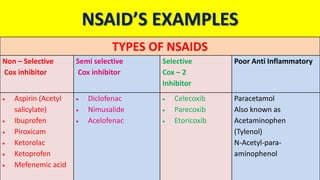
TYPES OF NSAIDS
Non – Selective
Cox inhibitor
Semi selective
Cox inhibitor
Selective
Cox – 2
Inhibitor
Poor Anti Inflammatory
 Aspirin (Acetyl
salicylate)
 Ibuprofen
 Piroxicam
 Ketorolac
 Ketoprofen
 Mefenemic acid
 Diclofenac
 Nimusalide
 Acelofenac
 Celecoxib
 Parecoxib
 Etoricoxib
Paracetamol
Also known as
Acetaminophen
(Tylenol)
N-Acetyl-para-
aminophenol
NSAIDS – SIDE EFFECTS
• Irritates gastric mucosa
• Gastric ulcer
• Epigastric distress
• Nausea
• Vomiting
• Dyspepsia
• Dizziness
• Confusion.
ASPIRIN
• Aspirin is also called as Acetyl Salicylate
• It has Analgesic, Antipyretic & Anti-Inflammatory
effects.
• It also act as Anti-Platelet medicine. It interferes the
aggregation of platlets, so it can increase Bleeding
time Twice of normal values.
USES OF ASPIRIN
• ANALGESIC :- 300-600 mg for headache, neuralgias.
• ANTI INFLAMMATORY :- Rheumatic fever & Rheumatic
Arthritis :- 75 to 100 mg/kg/day
• ANTI PYRETIC :- 300-600 mg for low grade fever.
• ANTI PLATLET :- 75 to 100 mg daily aspirin. Used in case of
heart attack or heart failure to prevent blood clotting.
ASPIRIN : contraindication
• Aspirin is strictly contraindicated for children under
15 year of age.
• It may cause a rare hepatic encephalopathy in
childrens (Known as Reye’s Syndrome)

NSAID's.pptx

  • 1.
    NSAIDS (Non-steroidal Anti InflammatoryDrugs) • Also called Non narcotics or non Opioids or COX inhibitors. • They have following effects (3A’s) • Anti-inflammatory, (high dose) • Antipyretic, • Analgesics. • Primary action peripheral pain mechanism • Secondary action on CNS By:- Ravikant Sir
  • 2.
    NSAIDS • They inhibitsynthesis of Prostaglandin by blocking cyclo-oxygenase (COX) enzyme. COX is found in Endoplasmic reticulum of cells. • COX - I :- It is constitutive enzyme found in stomach, GI, kidney and platlets. (Normal constituent). • COX – II :- It is Inducible enzyme that induce pain inflammation by forming prostaglandins. • COX- III :- It is found in brain, heart aorta.
  • 3.
    MECHANISM OF ACTION Cell-Injury/Phospholipids releases Arachidonic acid Cyclo oxygenase enzyme (COX-II) NSAIDS BLOCK COX RECEPTORS pathway Prostaglandin Inflammation/pain/swelling Thromboxane formed by platlets • Along with this mechanism mast cell release Histamin that increases capillary permeability, and due to clotting mechanism RBC Rouleaux formation started
  • 4.
    ANTI- INFLAMMATORY EFFECT Theyinhibit cyclo-oxygenase enzyme, that produce Arachidonic acid into prostaglandins at injury site.
  • 5.
    ANALGESIC EFFECT • Theyinhibit peripheral production of prostaglandin. • They also inhibit pain stimuli at sub cortical region. • They prevent action of prostaglandin on peripheral nerve stimulation.
  • 6.
    ANTI- PYRETIC EFFECT •They inhibit production of prostaglandin induced by interleukins at hypothalamus. • Hypothalamus have centers for thermal regulation. • It results in Vasodilation and increased heat loss.
  • 7.
    NSAID’S EXAMPLES TYPES OFNSAIDS Non – Selective Cox inhibitor Semi selective Cox inhibitor Selective Cox – 2 Inhibitor Poor Anti Inflammatory  Aspirin (Acetyl salicylate)  Ibuprofen  Piroxicam  Ketorolac  Ketoprofen  Mefenemic acid  Diclofenac  Nimusalide  Acelofenac  Celecoxib  Parecoxib  Etoricoxib Paracetamol Also known as Acetaminophen (Tylenol) N-Acetyl-para- aminophenol
  • 8.
    NSAIDS – SIDEEFFECTS • Irritates gastric mucosa • Gastric ulcer • Epigastric distress • Nausea • Vomiting • Dyspepsia • Dizziness • Confusion.
  • 9.
    ASPIRIN • Aspirin isalso called as Acetyl Salicylate • It has Analgesic, Antipyretic & Anti-Inflammatory effects. • It also act as Anti-Platelet medicine. It interferes the aggregation of platlets, so it can increase Bleeding time Twice of normal values.
  • 10.
    USES OF ASPIRIN •ANALGESIC :- 300-600 mg for headache, neuralgias. • ANTI INFLAMMATORY :- Rheumatic fever & Rheumatic Arthritis :- 75 to 100 mg/kg/day • ANTI PYRETIC :- 300-600 mg for low grade fever. • ANTI PLATLET :- 75 to 100 mg daily aspirin. Used in case of heart attack or heart failure to prevent blood clotting.
  • 11.
    ASPIRIN : contraindication •Aspirin is strictly contraindicated for children under 15 year of age. • It may cause a rare hepatic encephalopathy in childrens (Known as Reye’s Syndrome)