PRACTICE TEACHING 
ANESTHESIA 
SUMITTED TO: SUMITTED BY: 
MRS. HIMANTA S. MAGANJI MR. KAPIL SHARMA 
HOD MEDICAL SURGICAL NURSING M.Sc. NSG 1st YEAR 
SAIMS COLLEGE OF NURSING SAIMS COLLEGE OF NSG
INTRODUCTION 
 From greek anaisthesis means “Not sensation”. 
 When the effect of ether was discovered 
“anesthesia” used as name for the new 
phenomena. 
 It is defined as a depressed level of 
consciousness that dose not impair the patient 
airway & to respond appropriately to physical 
stimulation & verbal command.
DEFINITION 
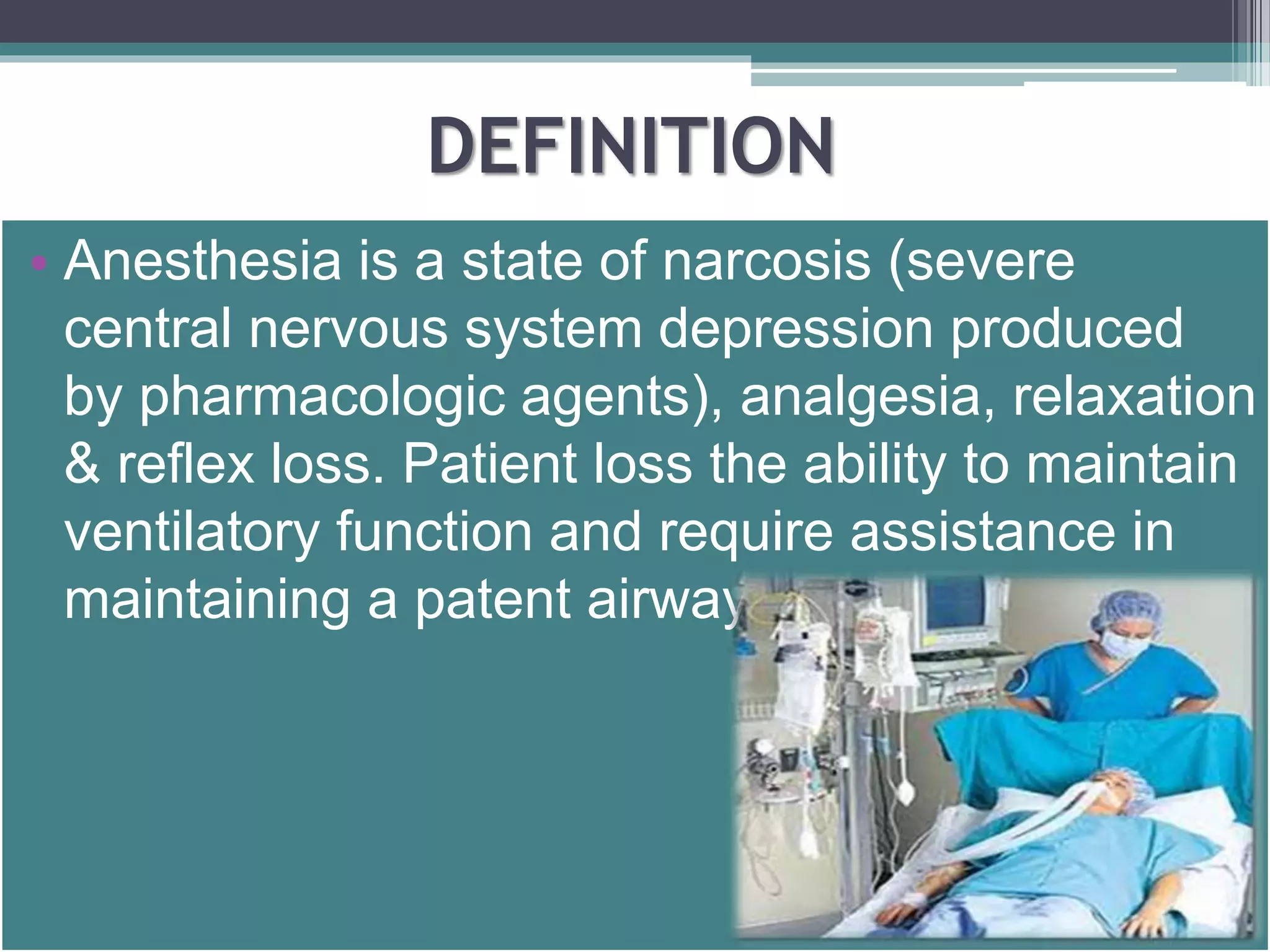
• Anesthesia is a state of narcosis (severe 
central nervous system depression produced 
by pharmacologic agents), analgesia, relaxation 
& reflex loss. Patient loss the ability to maintain 
ventilatory function and require assistance in 
maintaining a patent airway.
HISTORY OF ANESTHESIA 
Ether synthesized in 1540 by Cordus 
Ether used as anesthetic in 1842 by Dr. 
Crawford W. Long 
Ether publicized as anesthetic in 1846 by Dr. 
William Morton 
Chloroform used as anesthetic in 1853 by Dr. 
John Snow
ANATOMY & PHYSIOLOGY OF 
NERVOUS SYSTEM 
• Nervous system controls all the activities of the 
body. 
• It is divided into two parts. 
- Central nervous system. 
- Peripheral nervous system.
ANATOMY & PHYSIOLOGY OF 
NERVOUS SYSTEM 
i. CENTRAL NERVOUS SYSTEM:- 
• It includes brain and spinal cord. 
• It is formed by neuron and the supporting cells 
called neuroglia. 
• Brain is situated in the skull. 
• It continued as spinal cord in the vertebral canal 
through foramen magnum of the skull bone.
ANATOMY & PHYSIOLOGY OF 
NERVOUS SYSTEM 
• Brain and spinal cord are surrounding by three 
layers of meninges called the outer Dura mater, 
middle Arachnoid mater and inner Pia mater. 
• The space between the arachnoid mater and 
Pia mater is known as subarachnoid space. 
• This space is filled with a fluid called 
cerebrospinal fluid.
ANATOMY & PHYSIOLOGY OF 
NERVOUS SYSTEM 
ii. PERIPHERAL NERVOUS SYSTEM:- 
• It consists of all the nerves outside the brain 
and spinal cord. 
• It is divided into two subdivisions; 
• Somatic nervous system (it includes the nerves 
supplying the skeletal muscles, it control the 
movements of the body e.g. Skeletal muscles).
ANATOMY & PHYSIOLOGY OF 
NERVOUS SYSTEM 
• Autonomic nervous system (it concerned with 
regulation of visceral or vegetative functions 
e.g. cardiac muscles, smooth muscles, glands). 
• It is also divided into two types 1. Sympathetic 
2. Parasympathetic division.
TYPES OF ANESTHESIA 
Anesthetic produce anesthesia because they are 
delivered to the brain at a high partial pressure 
that 
enable them to cross the blood-brain-barrier.
CONTI.. 
1. GENERAL ANESTHESIA:- 
It is a state of nacrosis, analgesia, relaxation, 
and reflex loss. Patient under general 
anesthesia are not arousable, not even to 
painful stimuli. They loss the ability to maintain 
ventilatory function and require assistance in 
maintaining a patent airway. Cardiovascular 
function may be impaired.
CONTI.. 
 Stages of general anesthesia-a. 
STAGE I:- BEGINNING ANESTHESIA 
The patient may have a ringing, roaring, or 
buzzing in 
the ears and though still conscious, may sense 
an 
inability to move the extremities easily. 
b. STAGE II:- EXCITEMENT 
The pupils dilate, but contract if exposed to 
light,
CONTI.. 
c. STAGE III:- SURGICAL ANESTHESIA 
Surgical anesthesia is reached by continued 
administration of the anesthetic vapor or gas. 
The 
patient is unconscious and lies quietly on table. 
The pupils are small but contract when exposed 
to 
light. Respirations are regular, the pulse rate and 
volume are normal and the skin is pink or slightly 
flushed.
CONTI.. 
d. STAGE IV:- MEDULLARY DEPRESSION 
This stage reached when too much anesthesia 
has been administered. Respirations become 
shallow, the pulse is weak and thready, and the 
pupils become widely dilated and no longer 
contract when exposed to light. Cyanosis 
develops and without prompt intervention death 
rapidly follows.
ANESTHESTIC TECHNIQUES OF 
GENERAL ANESTHESIA 
 INHALATION: 
Liquid anesthetics may be administered by 
mixing the vapors with oxygen or nitrous 
oxide-oxygen and then having the patient 
inhale the mixture. The inhalation anesthetic 
may also be administered through a laryngeal 
mask and endotracheal tube.
CONTI.. 
o INHALATION ANESTHETIC AGENTS:- 
A. LIQUID ANESTHETIC AGENTS: 
a. Halothane- 
• Advantages- it is useful in every type of 
surgery and low incidence of post operative 
nausea and vomiting. The induction is rapid 
and smooth. 
• Disadvantage- it require skillful administration 
to prevent over dosage and require special 
vaporizer for administration. It may cause liver 
damage and produce hypotension.
CONTI.. 
b. Methoxyflurane- 
• Advantage- it is a excellent muscles relaxation 
and have a analgesic action continues several 
hours after surgery. 
• Disadvantage- it has unpleasant odour and 
renal damage may occur. 
•
CONTI.. 
B. GASES ANESTHTIC AGENTS-a. 
Nitrous oxide (N2O):- 
• Advantage- it’s induction and recovery rapid. it 
is noninflammable and useful with oxygen for 
short procedures and useful with other agents 
for all type of surgery. 
• Disadvantage- it is a poor relaxant & weak 
anesthetic. May produce hypoxia.
CONTI.. 
 INTRAVENOUS: 
o General anesthesia can also be produced by 
the intravenous injection of various 
substances such as barbiturates, 
benzodiazepines, non-barbiturate hypnotics, 
dissociative agents and opioid agents. 
o An advantage 
a. Onset of anesthesia is pleasant 
b. No buzzing, roaring, or dizziness 
c. Duration of action is brief and 
d. Patient awaken with little nausea and
CONTI.. 
A. INTRAVENOUS ANESTHETIC AGENTS: 
a. Tranquilizers and Sedative hypnotics- 
 Benzodiazepines midazolam:- 
- Advantage- it is a short acting and has 
antianxiety, sedative, amnesic, and muscle 
relaxant effect. 
- Disadvantage- increased sensitivity to its 
effects in chronic obstructive pulmonary 
disease patient.
CONTI.. 
b. Opioids- 
Morphine:- 
- Advantage- it is not a myocardial depressant. 
- Disadvantage-i. 
Depress arterial blood pressure 
ii. Dose not provide good amnesia
CONTI.. 
c. Barbiturates- 
 Thiopental sodium- 
- Advantage-i. 
Low incidence of post operative nausea and 
vomiting & rapid induction 
ii. Requires little equipment. 
- Disadvantage-i. 
powerful depressant of breathing 
ii. not useful for children
CONTI.. 
d. Nonbarbiturate hypnotic- 
 Propofol- 
- Advantage-i. 
Rapid induction 
ii. Antiemetic effect. 
- Disadvantage-i. 
Myocardial depression 
ii. Hypotension 
iii. Pain on injection
CONTI.. 
2. REGIONAL ANESTHESIA:- 
oRegional anesthesia is a form of local 
anesthesia in which an anesthetic agent is 
injected around nerves so that the area 
supplied by these nerves is anesthetized. 
oIt is defined as “a reversible loss of 
sensation in a specific area of the body” 
i. Spinal anesthesia 
ii. Epidural anesthesia 
iii. IV Regional Blocks 
iv. Peripheral Nerve Blocks
CONTI.. 
i. Spinal Anesthesia:- 
A local anesthetic agent is injected into the 
subarachnoid space. Spinal anesthesia is also 
known as a subarachnoid block. Blocks 
sensory and motor nerves, producing loss of 
sensation. 
Spinal anesthetic agents-a. 
Procaine (Novocaine)- 
- Advantage- easily administered by a physician. 
- Disadvantage- Blood pressure may fall rapidly.
CONTI.. 
i. Epidural Anesthesia- 
Local anesthetic agent is injected through an 
inter vertebral space into the epidural space 
may be administered as a one-time dose, or as 
a continuous epidural, with a catheter inserted 
into the epidural space to administer anesthetic 
drug. 
Complications of Epidural Anesthesia- 
Hypotension 
Inadvertent dural puncture 
Inadvertent injection of anesthetic into the 
subarachnoid space
CONTI.. 
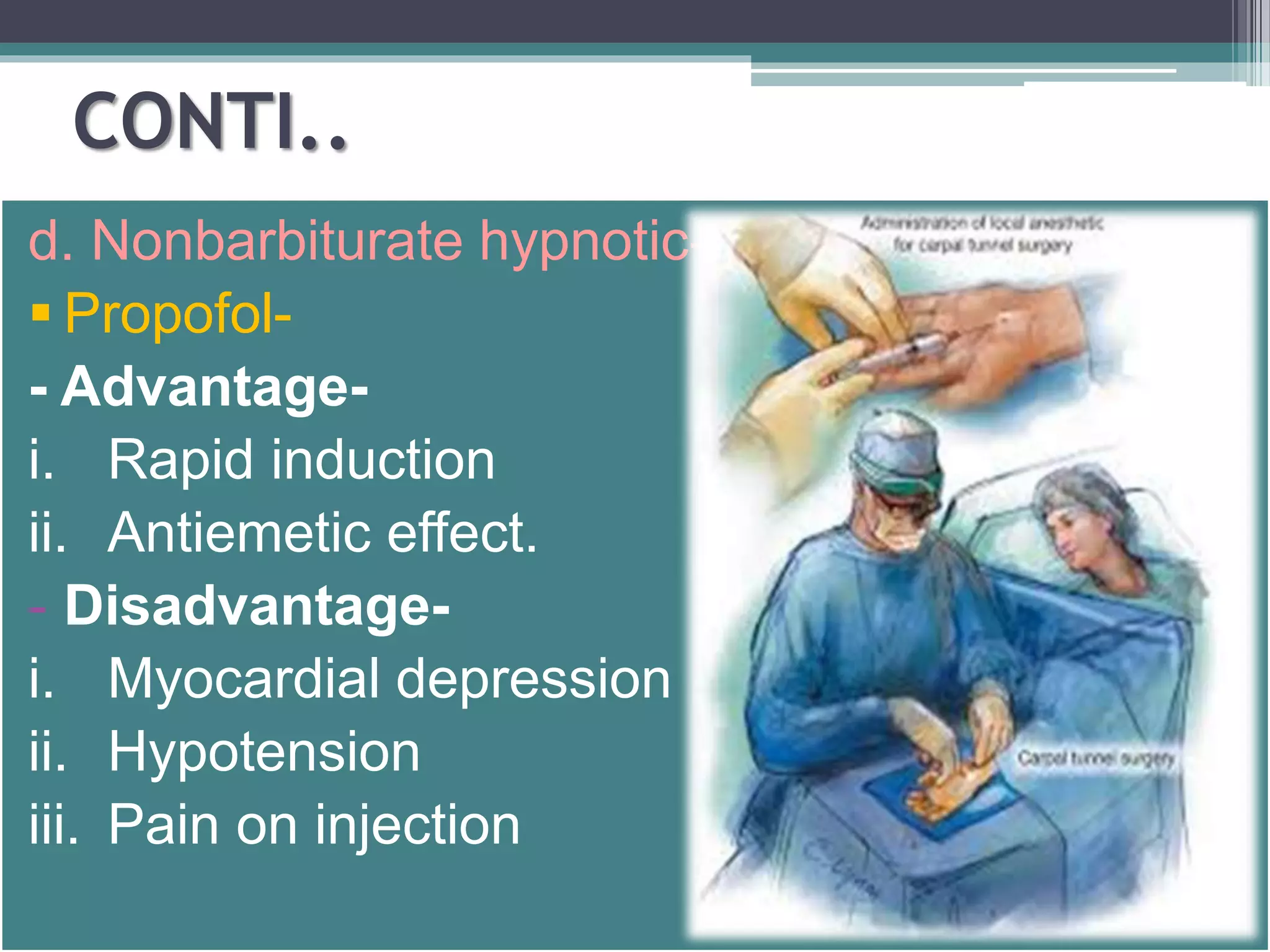
iii. Peripheral nerve block- 
It is achieved by injecting a local anesthetic into a 
bundle of nerves (eg. Axillary plexus) or into a 
single nerve to achieve anesthesia to a specific 
part of body (eg. Hand or single finger). 
 Brachial plexus block- Anesthesia for arms 
 Para-vertebral anesthesia- which produces 
anesthesia of the nerves supplying the chest, 
abdominal wall, and extremities. 
 Transsacral (caudal) blocks- which produces 
anesthesia of the perinieum and occasionally, 
the lower abdomen.
CONTI.. 
iv. Moderate sedation-o 
Moderate sedation is a form of anesthesia that 
involves the IV administration of sedatives or 
analgesics medications to reduce patient 
anxiety and control pain during diagnostic and 
surgical procedure. 
oThe goal is to depress a patient’s 
consciousness to a moderate level to enable 
surgical, diagnostic, or therapeutic procedures 
to be performed while ensuring the patient’s 
comfort during and cooperation with the 
procedures.
CONTI.. 
oThe patient is able to maintain a patient airway, 
retain protective airway reflexes, and respond 
to verbal and physical stimuli.
CONTI.. 
V. Local anesthesia- 
 It is the injection of a solution containing the 
anesthetic agents into the tissue at the planned 
incision site. 
 Advantages of local anesthesia are as follows: 
a. It is simple, economical, and non explosive. 
b. Equipment needed is minimal. 
c. Postoperative recovery is brief. 
d. Undesirable effects of general anesthesia are 
avoided. 
e. It is ideal for short and minor surgical 
procedures
CONTI.. 
 Local anesthesia is often administered in 
combination with epinephrine. Epinephrine 
constricts blood vessels, which prevents rapid 
absorption of the anesthetic agent and thus 
prolongs its local action. 
 The action of the agent is almost immediate, so 
surgery may begin as soon as the injections 
complete. Anesthesia lasts 45 min to 3 hr. 
depending on the anesthetic agent and the 
simultaneous use of epinephrine.
CONTI.. 
LOCAL ANESTHETIC AGENTS:- 
a. Lidocain- 
- Administration- 
Epidural 
Spinal 
Peripheral intravenous 
Local infiltration. 
- Advantage- It has rapid effect and longer 
duration of action. Duration is 2-3 times 
longer than lidocaine & free from local 
irritative effect. 
- Disadvantage- occasional idiosyncrasy.
CONTI.. 
b. Tetracaine- 
- Administration- It is topical, infiltration, and 
nerve block local infiltration. 
- Advantage- long acting, produces good 
relaxation. 
- Disadvantage- occasionally allergic reaction.
Anesthesia

Anesthesia

  • 1.
    PRACTICE TEACHING ANESTHESIA SUMITTED TO: SUMITTED BY: MRS. HIMANTA S. MAGANJI MR. KAPIL SHARMA HOD MEDICAL SURGICAL NURSING M.Sc. NSG 1st YEAR SAIMS COLLEGE OF NURSING SAIMS COLLEGE OF NSG
  • 2.
    INTRODUCTION  Fromgreek anaisthesis means “Not sensation”.  When the effect of ether was discovered “anesthesia” used as name for the new phenomena.  It is defined as a depressed level of consciousness that dose not impair the patient airway & to respond appropriately to physical stimulation & verbal command.
  • 4.
    DEFINITION • Anesthesiais a state of narcosis (severe central nervous system depression produced by pharmacologic agents), analgesia, relaxation & reflex loss. Patient loss the ability to maintain ventilatory function and require assistance in maintaining a patent airway.
  • 5.
    HISTORY OF ANESTHESIA Ether synthesized in 1540 by Cordus Ether used as anesthetic in 1842 by Dr. Crawford W. Long Ether publicized as anesthetic in 1846 by Dr. William Morton Chloroform used as anesthetic in 1853 by Dr. John Snow
  • 6.
    ANATOMY & PHYSIOLOGYOF NERVOUS SYSTEM • Nervous system controls all the activities of the body. • It is divided into two parts. - Central nervous system. - Peripheral nervous system.
  • 7.
    ANATOMY & PHYSIOLOGYOF NERVOUS SYSTEM i. CENTRAL NERVOUS SYSTEM:- • It includes brain and spinal cord. • It is formed by neuron and the supporting cells called neuroglia. • Brain is situated in the skull. • It continued as spinal cord in the vertebral canal through foramen magnum of the skull bone.
  • 8.
    ANATOMY & PHYSIOLOGYOF NERVOUS SYSTEM • Brain and spinal cord are surrounding by three layers of meninges called the outer Dura mater, middle Arachnoid mater and inner Pia mater. • The space between the arachnoid mater and Pia mater is known as subarachnoid space. • This space is filled with a fluid called cerebrospinal fluid.
  • 9.
    ANATOMY & PHYSIOLOGYOF NERVOUS SYSTEM ii. PERIPHERAL NERVOUS SYSTEM:- • It consists of all the nerves outside the brain and spinal cord. • It is divided into two subdivisions; • Somatic nervous system (it includes the nerves supplying the skeletal muscles, it control the movements of the body e.g. Skeletal muscles).
  • 10.
    ANATOMY & PHYSIOLOGYOF NERVOUS SYSTEM • Autonomic nervous system (it concerned with regulation of visceral or vegetative functions e.g. cardiac muscles, smooth muscles, glands). • It is also divided into two types 1. Sympathetic 2. Parasympathetic division.
  • 11.
    TYPES OF ANESTHESIA Anesthetic produce anesthesia because they are delivered to the brain at a high partial pressure that enable them to cross the blood-brain-barrier.
  • 12.
    CONTI.. 1. GENERALANESTHESIA:- It is a state of nacrosis, analgesia, relaxation, and reflex loss. Patient under general anesthesia are not arousable, not even to painful stimuli. They loss the ability to maintain ventilatory function and require assistance in maintaining a patent airway. Cardiovascular function may be impaired.
  • 13.
    CONTI..  Stagesof general anesthesia-a. STAGE I:- BEGINNING ANESTHESIA The patient may have a ringing, roaring, or buzzing in the ears and though still conscious, may sense an inability to move the extremities easily. b. STAGE II:- EXCITEMENT The pupils dilate, but contract if exposed to light,
  • 14.
    CONTI.. c. STAGEIII:- SURGICAL ANESTHESIA Surgical anesthesia is reached by continued administration of the anesthetic vapor or gas. The patient is unconscious and lies quietly on table. The pupils are small but contract when exposed to light. Respirations are regular, the pulse rate and volume are normal and the skin is pink or slightly flushed.
  • 15.
    CONTI.. d. STAGEIV:- MEDULLARY DEPRESSION This stage reached when too much anesthesia has been administered. Respirations become shallow, the pulse is weak and thready, and the pupils become widely dilated and no longer contract when exposed to light. Cyanosis develops and without prompt intervention death rapidly follows.
  • 18.
    ANESTHESTIC TECHNIQUES OF GENERAL ANESTHESIA  INHALATION: Liquid anesthetics may be administered by mixing the vapors with oxygen or nitrous oxide-oxygen and then having the patient inhale the mixture. The inhalation anesthetic may also be administered through a laryngeal mask and endotracheal tube.
  • 19.
    CONTI.. o INHALATIONANESTHETIC AGENTS:- A. LIQUID ANESTHETIC AGENTS: a. Halothane- • Advantages- it is useful in every type of surgery and low incidence of post operative nausea and vomiting. The induction is rapid and smooth. • Disadvantage- it require skillful administration to prevent over dosage and require special vaporizer for administration. It may cause liver damage and produce hypotension.
  • 20.
    CONTI.. b. Methoxyflurane- • Advantage- it is a excellent muscles relaxation and have a analgesic action continues several hours after surgery. • Disadvantage- it has unpleasant odour and renal damage may occur. •
  • 22.
    CONTI.. B. GASESANESTHTIC AGENTS-a. Nitrous oxide (N2O):- • Advantage- it’s induction and recovery rapid. it is noninflammable and useful with oxygen for short procedures and useful with other agents for all type of surgery. • Disadvantage- it is a poor relaxant & weak anesthetic. May produce hypoxia.
  • 23.
    CONTI..  INTRAVENOUS: o General anesthesia can also be produced by the intravenous injection of various substances such as barbiturates, benzodiazepines, non-barbiturate hypnotics, dissociative agents and opioid agents. o An advantage a. Onset of anesthesia is pleasant b. No buzzing, roaring, or dizziness c. Duration of action is brief and d. Patient awaken with little nausea and
  • 24.
    CONTI.. A. INTRAVENOUSANESTHETIC AGENTS: a. Tranquilizers and Sedative hypnotics-  Benzodiazepines midazolam:- - Advantage- it is a short acting and has antianxiety, sedative, amnesic, and muscle relaxant effect. - Disadvantage- increased sensitivity to its effects in chronic obstructive pulmonary disease patient.
  • 25.
    CONTI.. b. Opioids- Morphine:- - Advantage- it is not a myocardial depressant. - Disadvantage-i. Depress arterial blood pressure ii. Dose not provide good amnesia
  • 26.
    CONTI.. c. Barbiturates-  Thiopental sodium- - Advantage-i. Low incidence of post operative nausea and vomiting & rapid induction ii. Requires little equipment. - Disadvantage-i. powerful depressant of breathing ii. not useful for children
  • 27.
    CONTI.. d. Nonbarbituratehypnotic-  Propofol- - Advantage-i. Rapid induction ii. Antiemetic effect. - Disadvantage-i. Myocardial depression ii. Hypotension iii. Pain on injection
  • 28.
    CONTI.. 2. REGIONALANESTHESIA:- oRegional anesthesia is a form of local anesthesia in which an anesthetic agent is injected around nerves so that the area supplied by these nerves is anesthetized. oIt is defined as “a reversible loss of sensation in a specific area of the body” i. Spinal anesthesia ii. Epidural anesthesia iii. IV Regional Blocks iv. Peripheral Nerve Blocks
  • 29.
    CONTI.. i. SpinalAnesthesia:- A local anesthetic agent is injected into the subarachnoid space. Spinal anesthesia is also known as a subarachnoid block. Blocks sensory and motor nerves, producing loss of sensation. Spinal anesthetic agents-a. Procaine (Novocaine)- - Advantage- easily administered by a physician. - Disadvantage- Blood pressure may fall rapidly.
  • 31.
    CONTI.. i. EpiduralAnesthesia- Local anesthetic agent is injected through an inter vertebral space into the epidural space may be administered as a one-time dose, or as a continuous epidural, with a catheter inserted into the epidural space to administer anesthetic drug. Complications of Epidural Anesthesia- Hypotension Inadvertent dural puncture Inadvertent injection of anesthetic into the subarachnoid space
  • 32.
    CONTI.. iii. Peripheralnerve block- It is achieved by injecting a local anesthetic into a bundle of nerves (eg. Axillary plexus) or into a single nerve to achieve anesthesia to a specific part of body (eg. Hand or single finger).  Brachial plexus block- Anesthesia for arms  Para-vertebral anesthesia- which produces anesthesia of the nerves supplying the chest, abdominal wall, and extremities.  Transsacral (caudal) blocks- which produces anesthesia of the perinieum and occasionally, the lower abdomen.
  • 33.
    CONTI.. iv. Moderatesedation-o Moderate sedation is a form of anesthesia that involves the IV administration of sedatives or analgesics medications to reduce patient anxiety and control pain during diagnostic and surgical procedure. oThe goal is to depress a patient’s consciousness to a moderate level to enable surgical, diagnostic, or therapeutic procedures to be performed while ensuring the patient’s comfort during and cooperation with the procedures.
  • 35.
    CONTI.. oThe patientis able to maintain a patient airway, retain protective airway reflexes, and respond to verbal and physical stimuli.
  • 36.
    CONTI.. V. Localanesthesia-  It is the injection of a solution containing the anesthetic agents into the tissue at the planned incision site.  Advantages of local anesthesia are as follows: a. It is simple, economical, and non explosive. b. Equipment needed is minimal. c. Postoperative recovery is brief. d. Undesirable effects of general anesthesia are avoided. e. It is ideal for short and minor surgical procedures
  • 37.
    CONTI..  Localanesthesia is often administered in combination with epinephrine. Epinephrine constricts blood vessels, which prevents rapid absorption of the anesthetic agent and thus prolongs its local action.  The action of the agent is almost immediate, so surgery may begin as soon as the injections complete. Anesthesia lasts 45 min to 3 hr. depending on the anesthetic agent and the simultaneous use of epinephrine.
  • 39.
    CONTI.. LOCAL ANESTHETICAGENTS:- a. Lidocain- - Administration- Epidural Spinal Peripheral intravenous Local infiltration. - Advantage- It has rapid effect and longer duration of action. Duration is 2-3 times longer than lidocaine & free from local irritative effect. - Disadvantage- occasional idiosyncrasy.
  • 40.
    CONTI.. b. Tetracaine- - Administration- It is topical, infiltration, and nerve block local infiltration. - Advantage- long acting, produces good relaxation. - Disadvantage- occasionally allergic reaction.