Anemia in CKD
Dr. Dipendra Bhusal
Anemia
• Anemia is a condition in which the number of
red blood cells or their oxygen-carrying
capacity is insufficient to meet physiologic
needs, which vary by age, sex, altitude,
smoking, and pregnancy status. (WHO)
• anemia refers to a state in which the level of
hemoglobin in the blood is below the
reference range appropriate for age and sex.
(Davidson’s p n p of medicine 23rd ed.)
Role of Kidney in RBC formation
• Low blood oxygen causes kidney and liver to
release erythropoietin which stimulate RBC
production
• Negative feedback mechanism
• Induces RBCs production, new RBCs appear in
blood within few days
Anemia in CKD-Introduction
• frequent complication
• associated with a decrease in the quality of
life
• main cause -inadequate production of
endogenous erythropoietin
• anemia associated with CKD is usually
normocytic and normochromic and without
iron deficiency (ferritin >100ng/ml and
transferrin saturation index [TSAT], >20%).
Anemia in CKD-Causes
• Relative deficiency of erythropoietin
• Toxic effects of uremia on marrow precursor
cells
• Reduced red cell survival
• Blood loss due to capillary fragility and poor
platelet function
• Reduced intake, absorption and utilization of
dietary iron
(Davidson’s p n p of medicine 23rd ed.)
Patient Hx and Complains
• General symptoms of anemia
-fatigue
-exercise intolerance
-dyspnoea
-weakness
-dizziness
-loss of libido ( blood rev 2010 jan)
-headache
Diagnosis of Anemia in CKD
• For diagnosis and further evaluation Hb
values according to NKFguidelines:
• <13.5 g/dL in adult males. ( WHO-13g/dL)
• <12.0g/dL in adult females.
Anemia in CKD- Diagnosis
• Adults and children >15 years with CKD when
the Hb concentration is <13.0 g/dl (<130 g/l)
in males and <12.0 g/dl (<120 g/l) in females
• children with CKD if Hb concentration is <11.0
g/dl (<110 g/l) in children 0.5–5 years, <11.5
g/dl (115 g/l) in children 5–12 years, and
<12.0 g/dl (120 g/l) in children 12–15 years
(KDIGO-2012-Anemia-Guideline)
Source:www.researchgate.net
and ncbi.nlm.nih.gov
Source: Saudi Journal of Kidney Disease and Transplantation
Study topic: Prevalence of anemia in predialysis chronic kidney disease pt.
Anemia In CKD-Monitoring Hb
WITHOUT known anemia- when clinically
indicated and
• At least once a year in patients with CKD3
• At least 2 times a year in patients with CKD 4–
5 ND
• At least every 3 months in patients with CKD-
5D
WITH anemia and not treated with ESA when clinically
indicated and
At least every 3 months in CKD3–5(CKD-ND) or stage 5D
on PD.
Monthly in patients with CKD 5D in HD.
WITH anemia receiving ESA, Hb levels should be
measured when clinically indicated and:
Monthly in the correction phase.
In the maintenance phase: in patients with at least every
3 months and in patients with CKD-5D (in
Hemodialysis) monthly and every 2 months in patients
with CKD-5D (in Peritoneal Dialysis).
Initial evaluation and Anaemia
Workup
• Initial evaluation when GFR <60 ml/min (ckd3)
and Hb<11g/dl
• Hb/Hematocrit
• MCV
• Reticulocyte count
• Iron profiling
-Transferin saturation
-ferritin
We have to look for
• Fe deficiency anemia when
-s. ferritin <=500ng/ml
-s. transferrin saturation:<=30%
• We have to look for blood loss or hemolysis if
-Reticulocytes count>130000 per microliter
• ESR- to exclude infection
• Stool R/E for Occult blood
Anemia in CKD-Peripheral Smear Pic
• Normochromic
• Normocytic
• Hypopproliferative
Target Hb- Between 100-120 g/L
(Davidson’s P n P of medicine 23rd ED.)
• By maintaining Serum ferritin: >100ng/ml
Optimal : 200-500ng/ml
• Transferrin saturation :>20%
Optimal :30-40
Treatment option
• Iron Therapy
• Erythropoietin stimulating agents
• Blood transfusion
• Folic acid and vit. B12
Iron therapy- Indication
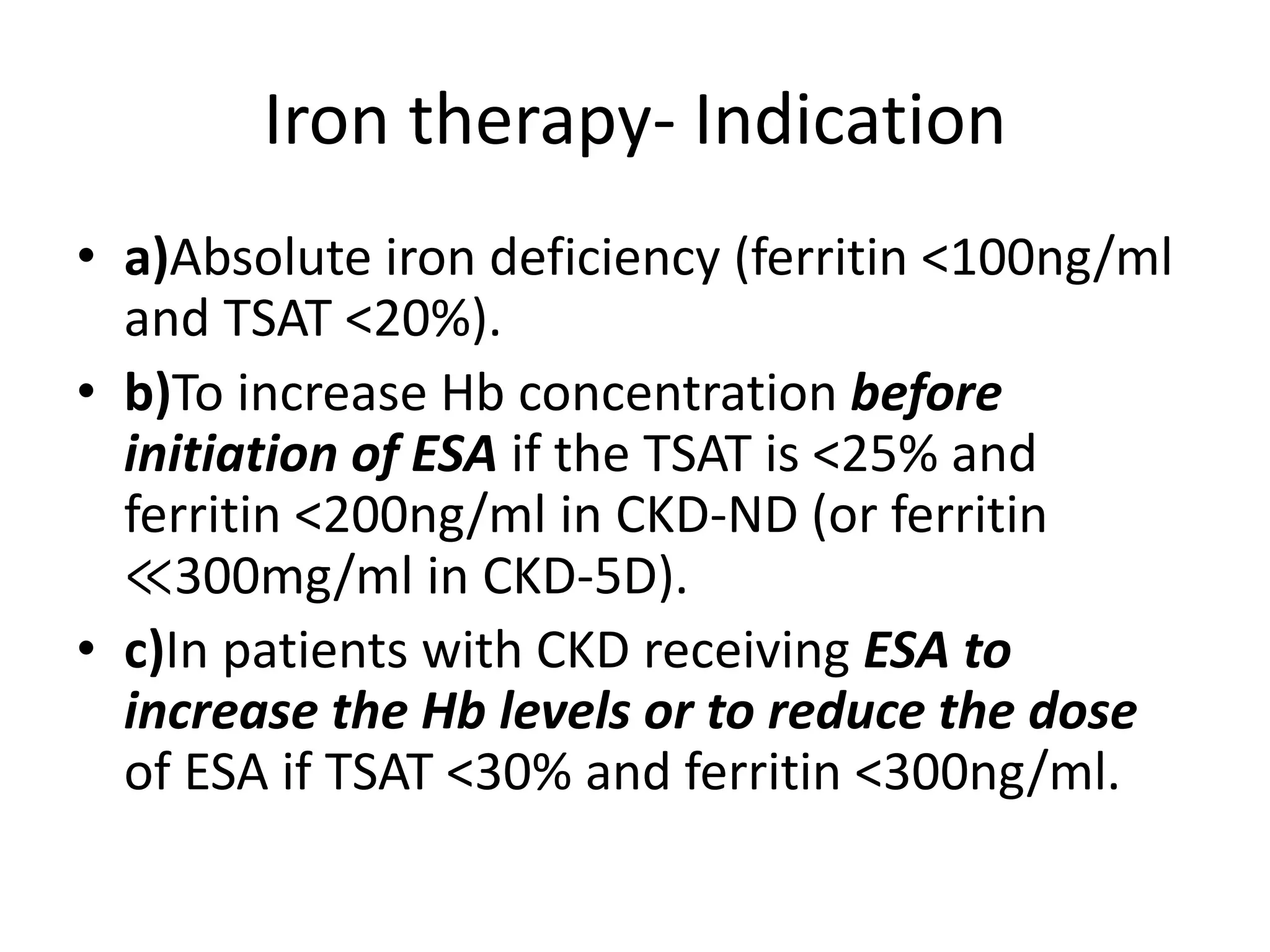
• a)Absolute iron deficiency (ferritin <100ng/ml
and TSAT <20%).
• b)To increase Hb concentration before
initiation of ESA if the TSAT is <25% and
ferritin <200ng/ml in CKD-ND (or ferritin
≪300mg/ml in CKD-5D).
• c)In patients with CKD receiving ESA to
increase the Hb levels or to reduce the dose
of ESA if TSAT <30% and ferritin <300ng/ml.
1. Iron Therapy
Important to replete iron store
Parenteral vs Oral
• Parenteral is recommanded for all CKD patient
• Oral is liited with poor absorption and poor pt.
adherence
• Oral in ND or PD Pt. without IV access or
maintenance therapy for ND or pd pt.
• Oral route not recommended for HD pt.
Drugs and Dose
Parental:
• Iron Dextron
• Ferric gluconate
• Iron sucrose
• ferumoxytol
Oral:
-200mg elemental iron per day/
-600mg ferrous femorate/
-1.8g ferrous gluconate
2. Erythropoietin stimulating agents
• Epoetin-alpha
-same molicular st as human erythropoetin
• Darbepoetin alpha
-More duration of action
-Advantage: less frequent dosing
• Address all treatable causes of anaemia
Why correction of Nutritional
deficiency is important before ESA?
When to start…..
• In Non Dialysis pt.
-Consider only when Hb<10g/dl than
reduce or stop once Hb>10g/dL
• In Dialysis pt.
-Initiate when Hb<10g/dL and reduce or
interrupt the ESA dose if Hb level
approach/exceeds 11g/dL
GOAL: 10.0-11.5g/dL
Avoid>13g/dL
ESA Monitoring
• Hb initially every 1-2 weeks than every 2-4
weeks then after.
• Montoring BP and Treatment as required.
• Iron store
-Ferritin: HD Target: 200 to 500
-Transferin saturation:>20
3.RBC transfusion
When:
-ESA therapy is ineffective
-Risk vs Benefit (eg: in pt with malignancy or corrected previous malignancy or previous stroke)
-rapid correction is required to stabilize the pt’s
condn.
-rapid pre op Hb correction required
Articles and studies in this arena
• One of the cause of anaemia in CKD is iron
deficiency anemia.
• Which is found to be due to Impaired absorption
of iron in the background of hepcidine excess.
• Hepcidine is main hormone responsible for
maintaining systemic iron homeostasis.
• Hepcidine binds and induce inhibitors of
erythropoiesis, shortened erythrocyte survival,
and disordered iron homeostasis.
Articles and studies in this arena (contd.)
• Recognition of a key role for hepcidin excess in causing
the functional iron deficiency and anemia of CKD has
ignited interest in targeting the hepcidin-ferroportin
axis as a new treatment strategy for this disease. By
blocking hepcidin and/or increasing ferroportin activity,
these agents could improve dietary iron absorption and
iron mobilization from the patients’ own body stores,
thereby minimizing the need for supraphysiologic
doses of intravenous iron and ESAs with their potential
adverse effects.
• Mechanisms of Anemia in CKD
• Jodie L. Babitt and Herbert Y. Lin
• JASN October 2012, 23 (10) 1631-1634; DOI: https://doi.org/10.1681/ASN.2011111078
Thank you

Anaemia in CKD

  • 1.
    Anemia in CKD Dr.Dipendra Bhusal
  • 2.
    Anemia • Anemia isa condition in which the number of red blood cells or their oxygen-carrying capacity is insufficient to meet physiologic needs, which vary by age, sex, altitude, smoking, and pregnancy status. (WHO) • anemia refers to a state in which the level of hemoglobin in the blood is below the reference range appropriate for age and sex. (Davidson’s p n p of medicine 23rd ed.)
  • 3.
    Role of Kidneyin RBC formation • Low blood oxygen causes kidney and liver to release erythropoietin which stimulate RBC production • Negative feedback mechanism • Induces RBCs production, new RBCs appear in blood within few days
  • 4.
    Anemia in CKD-Introduction •frequent complication • associated with a decrease in the quality of life • main cause -inadequate production of endogenous erythropoietin • anemia associated with CKD is usually normocytic and normochromic and without iron deficiency (ferritin >100ng/ml and transferrin saturation index [TSAT], >20%).
  • 5.
    Anemia in CKD-Causes •Relative deficiency of erythropoietin • Toxic effects of uremia on marrow precursor cells • Reduced red cell survival • Blood loss due to capillary fragility and poor platelet function • Reduced intake, absorption and utilization of dietary iron (Davidson’s p n p of medicine 23rd ed.)
  • 6.
    Patient Hx andComplains • General symptoms of anemia -fatigue -exercise intolerance -dyspnoea -weakness -dizziness -loss of libido ( blood rev 2010 jan) -headache
  • 7.
    Diagnosis of Anemiain CKD • For diagnosis and further evaluation Hb values according to NKFguidelines: • <13.5 g/dL in adult males. ( WHO-13g/dL) • <12.0g/dL in adult females.
  • 8.
    Anemia in CKD-Diagnosis • Adults and children >15 years with CKD when the Hb concentration is <13.0 g/dl (<130 g/l) in males and <12.0 g/dl (<120 g/l) in females • children with CKD if Hb concentration is <11.0 g/dl (<110 g/l) in children 0.5–5 years, <11.5 g/dl (115 g/l) in children 5–12 years, and <12.0 g/dl (120 g/l) in children 12–15 years (KDIGO-2012-Anemia-Guideline)
  • 9.
  • 11.
    Source: Saudi Journalof Kidney Disease and Transplantation Study topic: Prevalence of anemia in predialysis chronic kidney disease pt.
  • 12.
    Anemia In CKD-MonitoringHb WITHOUT known anemia- when clinically indicated and • At least once a year in patients with CKD3 • At least 2 times a year in patients with CKD 4– 5 ND • At least every 3 months in patients with CKD- 5D
  • 13.
    WITH anemia andnot treated with ESA when clinically indicated and At least every 3 months in CKD3–5(CKD-ND) or stage 5D on PD. Monthly in patients with CKD 5D in HD. WITH anemia receiving ESA, Hb levels should be measured when clinically indicated and: Monthly in the correction phase. In the maintenance phase: in patients with at least every 3 months and in patients with CKD-5D (in Hemodialysis) monthly and every 2 months in patients with CKD-5D (in Peritoneal Dialysis).
  • 14.
    Initial evaluation andAnaemia Workup • Initial evaluation when GFR <60 ml/min (ckd3) and Hb<11g/dl • Hb/Hematocrit • MCV • Reticulocyte count • Iron profiling -Transferin saturation -ferritin
  • 15.
    We have tolook for • Fe deficiency anemia when -s. ferritin <=500ng/ml -s. transferrin saturation:<=30% • We have to look for blood loss or hemolysis if -Reticulocytes count>130000 per microliter • ESR- to exclude infection • Stool R/E for Occult blood
  • 16.
    Anemia in CKD-PeripheralSmear Pic • Normochromic • Normocytic • Hypopproliferative
  • 17.
    Target Hb- Between100-120 g/L (Davidson’s P n P of medicine 23rd ED.) • By maintaining Serum ferritin: >100ng/ml Optimal : 200-500ng/ml • Transferrin saturation :>20% Optimal :30-40
  • 18.
    Treatment option • IronTherapy • Erythropoietin stimulating agents • Blood transfusion • Folic acid and vit. B12
  • 19.
    Iron therapy- Indication •a)Absolute iron deficiency (ferritin <100ng/ml and TSAT <20%). • b)To increase Hb concentration before initiation of ESA if the TSAT is <25% and ferritin <200ng/ml in CKD-ND (or ferritin ≪300mg/ml in CKD-5D). • c)In patients with CKD receiving ESA to increase the Hb levels or to reduce the dose of ESA if TSAT <30% and ferritin <300ng/ml.
  • 20.
    1. Iron Therapy Importantto replete iron store Parenteral vs Oral • Parenteral is recommanded for all CKD patient • Oral is liited with poor absorption and poor pt. adherence • Oral in ND or PD Pt. without IV access or maintenance therapy for ND or pd pt. • Oral route not recommended for HD pt.
  • 21.
    Drugs and Dose Parental: •Iron Dextron • Ferric gluconate • Iron sucrose • ferumoxytol Oral: -200mg elemental iron per day/ -600mg ferrous femorate/ -1.8g ferrous gluconate
  • 22.
    2. Erythropoietin stimulatingagents • Epoetin-alpha -same molicular st as human erythropoetin • Darbepoetin alpha -More duration of action -Advantage: less frequent dosing • Address all treatable causes of anaemia
  • 23.
    Why correction ofNutritional deficiency is important before ESA?
  • 24.
    When to start….. •In Non Dialysis pt. -Consider only when Hb<10g/dl than reduce or stop once Hb>10g/dL • In Dialysis pt. -Initiate when Hb<10g/dL and reduce or interrupt the ESA dose if Hb level approach/exceeds 11g/dL GOAL: 10.0-11.5g/dL Avoid>13g/dL
  • 25.
    ESA Monitoring • Hbinitially every 1-2 weeks than every 2-4 weeks then after. • Montoring BP and Treatment as required. • Iron store -Ferritin: HD Target: 200 to 500 -Transferin saturation:>20
  • 26.
    3.RBC transfusion When: -ESA therapyis ineffective -Risk vs Benefit (eg: in pt with malignancy or corrected previous malignancy or previous stroke) -rapid correction is required to stabilize the pt’s condn. -rapid pre op Hb correction required
  • 27.
    Articles and studiesin this arena • One of the cause of anaemia in CKD is iron deficiency anemia. • Which is found to be due to Impaired absorption of iron in the background of hepcidine excess. • Hepcidine is main hormone responsible for maintaining systemic iron homeostasis. • Hepcidine binds and induce inhibitors of erythropoiesis, shortened erythrocyte survival, and disordered iron homeostasis.
  • 28.
    Articles and studiesin this arena (contd.) • Recognition of a key role for hepcidin excess in causing the functional iron deficiency and anemia of CKD has ignited interest in targeting the hepcidin-ferroportin axis as a new treatment strategy for this disease. By blocking hepcidin and/or increasing ferroportin activity, these agents could improve dietary iron absorption and iron mobilization from the patients’ own body stores, thereby minimizing the need for supraphysiologic doses of intravenous iron and ESAs with their potential adverse effects. • Mechanisms of Anemia in CKD • Jodie L. Babitt and Herbert Y. Lin • JASN October 2012, 23 (10) 1631-1634; DOI: https://doi.org/10.1681/ASN.2011111078
  • 29.