29 April 2017Nabieh Alhilali 1
Dr. Nabieh Alhilali
Consultant Nephrologist and Physcian
Therapeutic landscape
for anemia in CKD
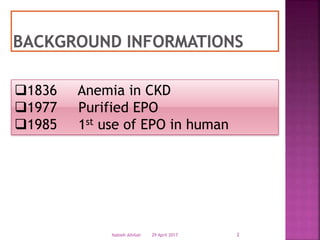
1836 Anemia in CKD
1977 Purified EPO
1985 1st use of EPO in human
29 April 2017 2Nabieh Alhilali
29 April 2017 3Nabieh Alhilali
Definition and prevalence in
CKD
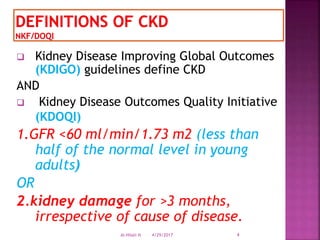
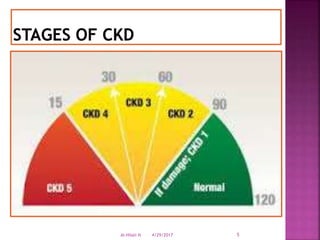
 Kidney Disease Improving Global Outcomes
(KDIGO) guidelines define CKD
AND
 Kidney Disease Outcomes Quality Initiative
(KDOQI)
1.GFR <60 ml/min/1.73 m2 (less than
half of the normal level in young
adults)
OR
2.kidney damage for >3 months,
irrespective of cause of disease.
4/29/2017 4Al-Hilali N
4/29/2017Al-Hilali N 5
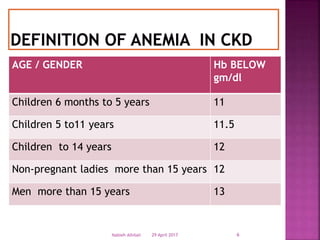
AGE / GENDER Hb BELOW
gm/dl
Children 6 months to 5 years 11
Children 5 to11 years 11.5
Children to 14 years 12
Non-pregnant ladies more than 15 years 12
Men more than 15 years 13
29 April 2017Nabieh Alhilali 6
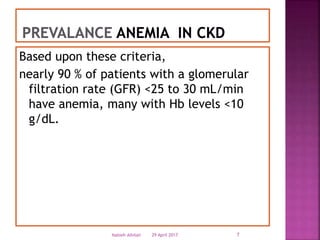
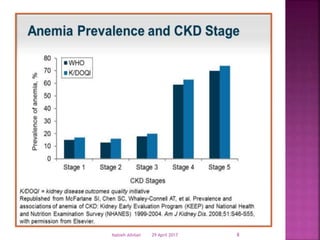
Based upon these criteria,
nearly 90 % of patients with a glomerular
filtration rate (GFR) <25 to 30 mL/min
have anemia, many with Hb levels <10
g/dL.
29 April 2017 7Nabieh Alhilali
29 April 2017 8Nabieh Alhilali
29 April 2017Nabieh Alhilali 9
CAUSES OF anemia in CKD
29 April 2017 10Nabieh Alhilali
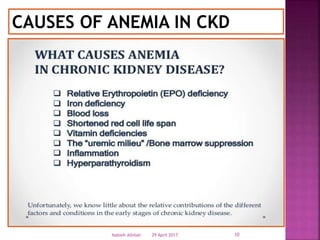
CAUSES OF ANEMIA IN CKD
29 April 2017
Nabieh Alhilali 11
29 April 2017 12Nabieh Alhilali
29 April 2017 13Nabieh Alhilali
29 April 2017 14Nabieh Alhilali
29 April 2017 15Nabieh Alhilali
29 April 2017Nabieh Alhilali 16
Effects of anemia in CKD
 Anemia results in poorer quality of life in
patients with renal failure.
 This correlation can be proven by the poor
quality of life scores in patients with lower Hb
values.
 Many observational studies have positively
demonstrated that the QOL scores improved in
patients who were given ESA and iron to
increase their Hb
29 April 2017 17Nabieh Alhilali
 Generation of hypoxia due to anemia is poorly
tolerated in patients with preexisting cardiac
and vascular diseases. Compensatory
mechanisms leads to development of LVH.
 Observational studies do show an increase in
mortality in patients with CKD with anemia.
 Also, other data show that CKD with anemia
increases the mortality rate by 2.7 times than
without.
 Interventional studies show that for an increase
of 1g/dL of Hb results in 4% decline in
mortality.
29 April 2017 18Nabieh Alhilali
 CV disease related mortality is 15 times more
in patients with CKD.
 50% of deaths in patients with CKD are due to
CV disease.
 LVH is the most common abnormality seen in
patients with CKD and there is a strong
correlation between anemia and LVH.
 Tissue hypoxia due to anemia is the principal
stimuli triggering the compensatory changes
that stresses the CV system
29 April 2017 19Nabieh Alhilali
 Acceleration of progression of kidney
disease by oxygen deprivation.
 Increased risk of bacteremia (11% increased
risk for every 1g/dl fall in Hb)
 Detrimental effects on brain and cognitive
functions.
29 April 2017 20Nabieh Alhilali
29 April 2017Nabieh Alhilali 21
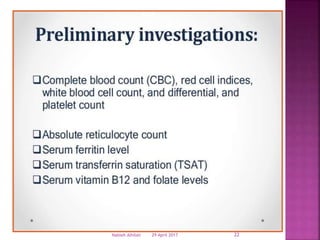
PRELMENARY INVESTIGATIONS
29 April 2017 22Nabieh Alhilali
29 April 2017Nabieh Alhilali 23
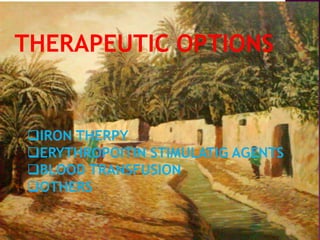
THERAPEUTIC OPTIONS
IRON THERPY
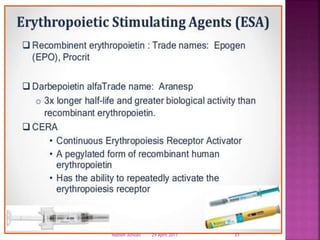
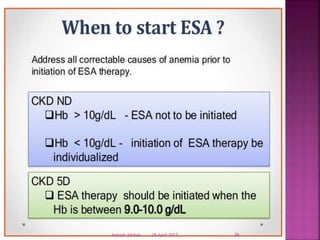
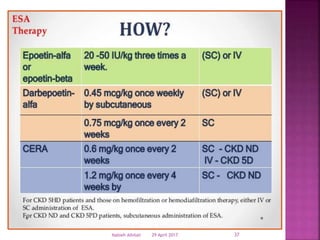
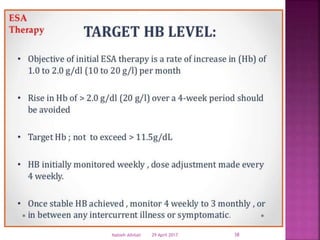
ERYTHROPOITIN STIMULATIG AGENTS
BLOOD TRANSFUSION
OTHERS
1. IRON THERPY
29 April 2017 24Nabieh Alhilali
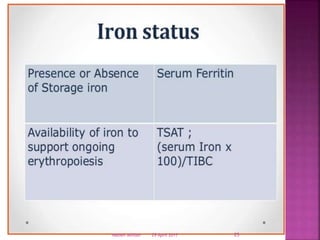
29 April 2017 25Nabieh Alhilali
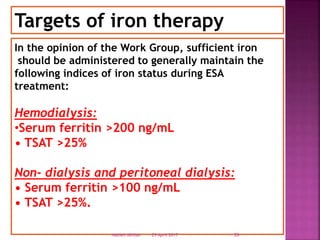
In the opinion of the Work Group, sufficient iron
should be administered to generally maintain the
following indices of iron status during ESA
treatment:
Hemodialysis:
•Serum ferritin >200 ng/mL
• TSAT >25%
Non- dialysis and peritoneal dialysis:
• Serum ferritin >100 ng/mL
• TSAT >25%.
Targets of iron therapy
29 April 2017 26Nabieh Alhilali
29 April 2017 27Nabieh Alhilali
29 April 2017 28Nabieh Alhilali
29 April 2017 29Nabieh Alhilali
 Allergic reaction.
 Hypotension. Dizziness.
 Dyspnea.
 Headache.
 Low back pain.
 Arthralgia.
 Syncope.
 Arthritis.
 Some side effects can be reduced by decreasing the
dose or rate of infusion.
 Sodium ferric gluconate or iron sucrose has better
safety profile than iron dextran.
29 April 2017 30Nabieh Alhilali
2. ERTHROPOIESIS STIMULATING
AGENT
(ERTHROPOITEN)
29 April 2017 31Nabieh Alhilali
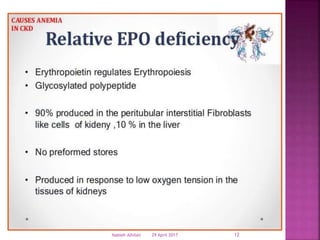
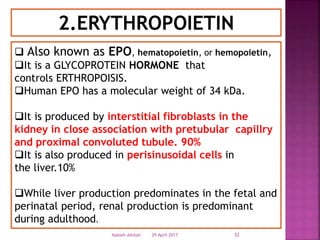
 Also known as EPO, hematopoietin, or hemopoietin,
It is a GLYCOPROTEIN HORMONE that
controls ERTHROPOISIS.
Human EPO has a molecular weight of 34 kDa.
It is produced by interstitial fibroblasts in the
kidney in close association with pretubular capillry
and proximal convoluted tubule. 90%
It is also produced in perisinusoidal cells in
the liver.10%
While liver production predominates in the fetal and
perinatal period, renal production is predominant
during adulthood.
2.ERYTHROPOIETIN
29 April 2017 32Nabieh Alhilali
 They are used in treating anemia resulting
from chronic kidney disease,
 chemotherapy induced anemia in patients
with cancer,
 inflammatory bowel disease (Crohnes
disease and ulcerative colitis)[20] and
 myelodysplasia from the treatment
of cancer (chemotherapy and radiation).
29 April 2017 33Nabieh Alhilali
29 April 2017 34Nabieh Alhilali
29 April 2017 35Nabieh Alhilali
29 April 2017 36Nabieh Alhilali
29 April 2017 37Nabieh Alhilali
29 April 2017 38Nabieh Alhilali
29 April 2017 39Nabieh Alhilali
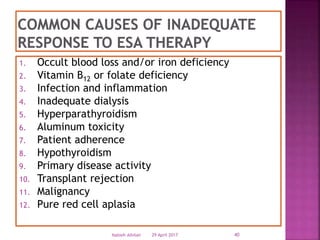
1. Occult blood loss and/or iron deficiency
2. Vitamin B12 or folate deficiency
3. Infection and inflammation
4. Inadequate dialysis
5. Hyperparathyroidism
6. Aluminum toxicity
7. Patient adherence
8. Hypothyroidism
9. Primary disease activity
10. Transplant rejection
11. Malignancy
12. Pure red cell aplasia
29 April 2017 40Nabieh Alhilali
29 April 2017 41Nabieh Alhilali
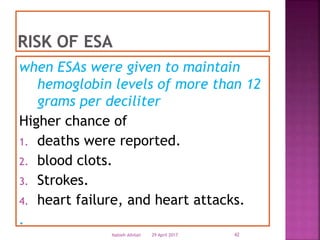
when ESAs were given to maintain
hemoglobin levels of more than 12
grams per deciliter
Higher chance of
1. deaths were reported.
2. blood clots.
3. Strokes.
4. heart failure, and heart attacks.
.
29 April 2017 42Nabieh Alhilali
29 April 2017Nabieh Alhilali 43
5. increased rate of tumor growth were
reported in
a) patients with advanced head and neck
cancer receiving radiation therapy
and in
b) patients with metastatic breast
cancer receiving chemotherapy.
c) Patients with cancer and anemia not
receiving chemotherapy.
6. Higher chance of death was reported
and no fewer blood transfusions were
received when ESAs were given
7.Higher chance of blood clots was
reported in patients who were scheduled
for major surgery and given ESAs.
29 April 2017 44Nabieh Alhilali
 ESA therapy is ineffective
 The risks of ESA therapy may outweigh its
benefits (e.g., previous or current malignancy,
previous stroke).
 When rapid correction of anemia is required to
stabilize the patient’s condition (e.g., acute
hemorrhage, unstable coronary artery disease).
 When rapid pre-operative Hb correction is
required.
 Transfusion should be directed toward
reduction of anemia sign and symptoms rather
than achieving specific target.
29 April 2017 45Nabieh Alhilali
 Longer half life
 Absent immunogenicity
 Oral
 Simple manufacturing
 Not costly
29 April 2017Nabieh Alhilali 46
1. Hematide
2. HIF stablizer
3. CATA Inhibitors
29 April 2017Nabieh Alhilali 47
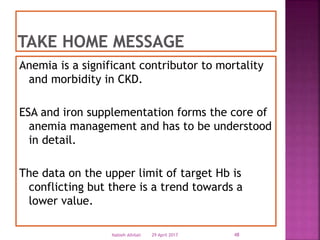
Take home message
Anemia is a significant contributor to mortality
and morbidity in CKD.
ESA and iron supplementation forms the core of
anemia management and has to be understood
in detail.
The data on the upper limit of target Hb is
conflicting but there is a trend towards a
lower value.
29 April 2017 48Nabieh Alhilali
29 April 2017 49Nabieh Alhilali
29 April 2017 50Nabieh Alhilali

Esa 2

  • 1.
    29 April 2017NabiehAlhilali 1 Dr. Nabieh Alhilali Consultant Nephrologist and Physcian Therapeutic landscape for anemia in CKD
  • 2.
    1836 Anemia inCKD 1977 Purified EPO 1985 1st use of EPO in human 29 April 2017 2Nabieh Alhilali
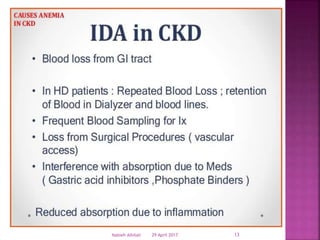
  • 3.
    29 April 20173Nabieh Alhilali Definition and prevalence in CKD
  • 4.
     Kidney DiseaseImproving Global Outcomes (KDIGO) guidelines define CKD AND  Kidney Disease Outcomes Quality Initiative (KDOQI) 1.GFR <60 ml/min/1.73 m2 (less than half of the normal level in young adults) OR 2.kidney damage for >3 months, irrespective of cause of disease. 4/29/2017 4Al-Hilali N
  • 5.
  • 6.
    AGE / GENDERHb BELOW gm/dl Children 6 months to 5 years 11 Children 5 to11 years 11.5 Children to 14 years 12 Non-pregnant ladies more than 15 years 12 Men more than 15 years 13 29 April 2017Nabieh Alhilali 6
  • 7.
    Based upon thesecriteria, nearly 90 % of patients with a glomerular filtration rate (GFR) <25 to 30 mL/min have anemia, many with Hb levels <10 g/dL. 29 April 2017 7Nabieh Alhilali
  • 8.
    29 April 20178Nabieh Alhilali
  • 9.
    29 April 2017NabiehAlhilali 9 CAUSES OF anemia in CKD
  • 10.
    29 April 201710Nabieh Alhilali CAUSES OF ANEMIA IN CKD
  • 11.
  • 12.
    29 April 201712Nabieh Alhilali
  • 13.
    29 April 201713Nabieh Alhilali
  • 14.
    29 April 201714Nabieh Alhilali
  • 15.
    29 April 201715Nabieh Alhilali
  • 16.
    29 April 2017NabiehAlhilali 16 Effects of anemia in CKD
  • 17.
     Anemia resultsin poorer quality of life in patients with renal failure.  This correlation can be proven by the poor quality of life scores in patients with lower Hb values.  Many observational studies have positively demonstrated that the QOL scores improved in patients who were given ESA and iron to increase their Hb 29 April 2017 17Nabieh Alhilali
  • 18.
     Generation ofhypoxia due to anemia is poorly tolerated in patients with preexisting cardiac and vascular diseases. Compensatory mechanisms leads to development of LVH.  Observational studies do show an increase in mortality in patients with CKD with anemia.  Also, other data show that CKD with anemia increases the mortality rate by 2.7 times than without.  Interventional studies show that for an increase of 1g/dL of Hb results in 4% decline in mortality. 29 April 2017 18Nabieh Alhilali
  • 19.
     CV diseaserelated mortality is 15 times more in patients with CKD.  50% of deaths in patients with CKD are due to CV disease.  LVH is the most common abnormality seen in patients with CKD and there is a strong correlation between anemia and LVH.  Tissue hypoxia due to anemia is the principal stimuli triggering the compensatory changes that stresses the CV system 29 April 2017 19Nabieh Alhilali
  • 20.
     Acceleration ofprogression of kidney disease by oxygen deprivation.  Increased risk of bacteremia (11% increased risk for every 1g/dl fall in Hb)  Detrimental effects on brain and cognitive functions. 29 April 2017 20Nabieh Alhilali
  • 21.
    29 April 2017NabiehAlhilali 21 PRELMENARY INVESTIGATIONS
  • 22.
    29 April 201722Nabieh Alhilali
  • 23.
    29 April 2017NabiehAlhilali 23 THERAPEUTIC OPTIONS IRON THERPY ERYTHROPOITIN STIMULATIG AGENTS BLOOD TRANSFUSION OTHERS
  • 24.
    1. IRON THERPY 29April 2017 24Nabieh Alhilali
  • 25.
    29 April 201725Nabieh Alhilali
  • 26.
    In the opinionof the Work Group, sufficient iron should be administered to generally maintain the following indices of iron status during ESA treatment: Hemodialysis: •Serum ferritin >200 ng/mL • TSAT >25% Non- dialysis and peritoneal dialysis: • Serum ferritin >100 ng/mL • TSAT >25%. Targets of iron therapy 29 April 2017 26Nabieh Alhilali
  • 27.
    29 April 201727Nabieh Alhilali
  • 28.
    29 April 201728Nabieh Alhilali
  • 29.
    29 April 201729Nabieh Alhilali
  • 30.
     Allergic reaction. Hypotension. Dizziness.  Dyspnea.  Headache.  Low back pain.  Arthralgia.  Syncope.  Arthritis.  Some side effects can be reduced by decreasing the dose or rate of infusion.  Sodium ferric gluconate or iron sucrose has better safety profile than iron dextran. 29 April 2017 30Nabieh Alhilali
  • 31.
  • 32.
     Also knownas EPO, hematopoietin, or hemopoietin, It is a GLYCOPROTEIN HORMONE that controls ERTHROPOISIS. Human EPO has a molecular weight of 34 kDa. It is produced by interstitial fibroblasts in the kidney in close association with pretubular capillry and proximal convoluted tubule. 90% It is also produced in perisinusoidal cells in the liver.10% While liver production predominates in the fetal and perinatal period, renal production is predominant during adulthood. 2.ERYTHROPOIETIN 29 April 2017 32Nabieh Alhilali
  • 33.
     They areused in treating anemia resulting from chronic kidney disease,  chemotherapy induced anemia in patients with cancer,  inflammatory bowel disease (Crohnes disease and ulcerative colitis)[20] and  myelodysplasia from the treatment of cancer (chemotherapy and radiation). 29 April 2017 33Nabieh Alhilali
  • 34.
    29 April 201734Nabieh Alhilali
  • 35.
    29 April 201735Nabieh Alhilali
  • 36.
    29 April 201736Nabieh Alhilali
  • 37.
    29 April 201737Nabieh Alhilali
  • 38.
    29 April 201738Nabieh Alhilali
  • 39.
    29 April 201739Nabieh Alhilali
  • 40.
    1. Occult bloodloss and/or iron deficiency 2. Vitamin B12 or folate deficiency 3. Infection and inflammation 4. Inadequate dialysis 5. Hyperparathyroidism 6. Aluminum toxicity 7. Patient adherence 8. Hypothyroidism 9. Primary disease activity 10. Transplant rejection 11. Malignancy 12. Pure red cell aplasia 29 April 2017 40Nabieh Alhilali
  • 41.
    29 April 201741Nabieh Alhilali
  • 42.
    when ESAs weregiven to maintain hemoglobin levels of more than 12 grams per deciliter Higher chance of 1. deaths were reported. 2. blood clots. 3. Strokes. 4. heart failure, and heart attacks. . 29 April 2017 42Nabieh Alhilali
  • 43.
    29 April 2017NabiehAlhilali 43 5. increased rate of tumor growth were reported in a) patients with advanced head and neck cancer receiving radiation therapy and in b) patients with metastatic breast cancer receiving chemotherapy. c) Patients with cancer and anemia not receiving chemotherapy.
  • 44.
    6. Higher chanceof death was reported and no fewer blood transfusions were received when ESAs were given 7.Higher chance of blood clots was reported in patients who were scheduled for major surgery and given ESAs. 29 April 2017 44Nabieh Alhilali
  • 45.
     ESA therapyis ineffective  The risks of ESA therapy may outweigh its benefits (e.g., previous or current malignancy, previous stroke).  When rapid correction of anemia is required to stabilize the patient’s condition (e.g., acute hemorrhage, unstable coronary artery disease).  When rapid pre-operative Hb correction is required.  Transfusion should be directed toward reduction of anemia sign and symptoms rather than achieving specific target. 29 April 2017 45Nabieh Alhilali
  • 46.
     Longer halflife  Absent immunogenicity  Oral  Simple manufacturing  Not costly 29 April 2017Nabieh Alhilali 46 1. Hematide 2. HIF stablizer 3. CATA Inhibitors
  • 47.
    29 April 2017NabiehAlhilali 47 Take home message
  • 48.
    Anemia is asignificant contributor to mortality and morbidity in CKD. ESA and iron supplementation forms the core of anemia management and has to be understood in detail. The data on the upper limit of target Hb is conflicting but there is a trend towards a lower value. 29 April 2017 48Nabieh Alhilali
  • 49.
    29 April 201749Nabieh Alhilali
  • 50.
    29 April 201750Nabieh Alhilali