ANEMIA IN CKD- HOW TO
MANAGE IT
7/7/2015 1
TOPICS BEING DISCUSSED
Anemia in CKD
Causes for Anemia in CKD
Reasons for Anemia correction
Therapeutic options for correction in anemia of
CKD
7/7/2015 2
ANEMIA IN CKD
• Anemia - WHO recommendations- Hb concentration
<13.0 g/dL for adult males and postmenopausal
women and an Hb <12.0 g/dL for premenopausal
women
• The anemia of chronic kidney disease
(CKD)normocytic and normochromic
7/7/2015 3
Causes for Anemia in CKD
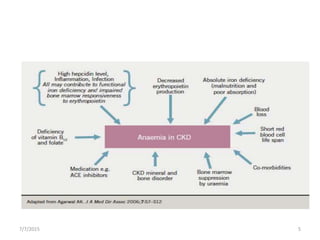
• Failure of Erythropoietin (EPO) production by
diseased kidney
• Reduction in red cell survival
7/7/2015 4
7/7/2015 5
Reasons for Anemia Correction
• Deterioration in cardiac function
• Decreased cognition and mental acuity
• Fatigue
• Increased risk of morbidity and mortality
7/7/2015 6
THERAPEUTIC OPTIONS FOR CORRECTION IN ANEMIA
OF CKD
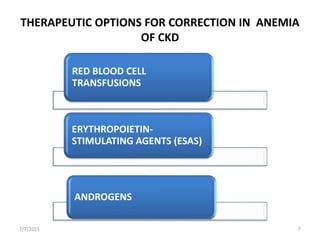
RED BLOOD CELL
TRANSFUSIONS
ERYTHROPOIETIN-
STIMULATING AGENTS (ESAS)
ANDROGENS
7/7/2015 7
RBC TRANSFUSIONS
• Universally successful in increasing Hb levels.
• Decreases symptoms & improve health-related
quality of life.
• COMPLICATIONS
Transfusion-transmitted infection
Immunologic sensitization
Iron overload syndromes
Volume overload
Transfusion reactions
7/7/2015 8
Androgens
• Androgens (se endogenous EPO production,
sensitivity of erythroid progenitors to the effects of
EPO, and red blood cell survival) were used regularly
in the treatment of anemia in dialysis patients.
• Limited role side effects – IM injection, acne,
priapism, hepatitis, LFT abnormalities, and risk of
HCC.
7/7/2015 9
ERYTHROPOIETIN-STIMULATING AGENTS (ESAS)
• Initial phase III clinical trial showing that recombinant human EPO
was effective and eliminated the need for continued transfusions.
• In this study, 333 dialysis patients with Hb levels <10 g/dL received
recombinant human EPO to maintain the hematocrit at 35 % .
• Within 2 months of initiation of therapy, the need for transfusions
(1030 within the six months prior to beginning treatment) was
eliminated.
• In addition, there was a 40 % reduction in ferritin levels after 6
months among the 68 patients with iron overload.
7/7/2015 10
• They substantially reduced the need for red cell
transfusions
• Decrease in risk for transfusion-related complications
• They also help mobilize iron stores, which is
particularly beneficial in patients with CKD and iron
overload due to previous transfusions
7/7/2015 11
PEGINESATIDE
• Peginesatide is a synthetic peptide that activates the
EPO receptor
• Stimulates erythroid colony growth, reticulocyte
count, and hematocrit
• Does not crossreact with EPO antibodies (amino acid
sequence is unrelated to EPO)
7/7/2015 12
7/7/2015 13
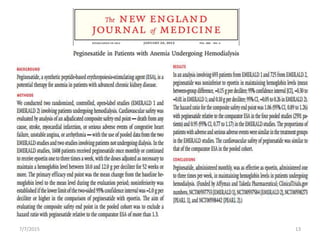
• In 2 phase-III studies (PEARL-I and PEARL-II) that compared
peginesatide with darbepoetin among non-dialysis CKD
patients, there was an increase in cardiovascular events
associated with peginesatide.
• FDA approved peginesatide for IV or SC administration to
treat anemia in adult dialysis patients only, but not in patients
with CKD who are not on dialysis or in patients with cancer-
related anemia.
• Serious hypersensitivity reactions reported in approximately
0.2 % of patients following the first dose of IV administration,
with death occurring in 0.02 % of patients
7/7/2015 14
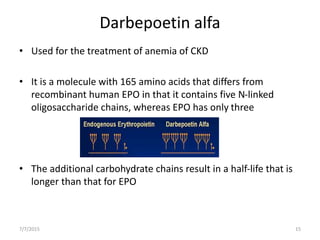
Darbepoetin alfa
• Used for the treatment of anemia of CKD
• It is a molecule with 165 amino acids that differs from
recombinant human EPO in that it contains five N-linked
oligosaccharide chains, whereas EPO has only three
• The additional carbohydrate chains result in a half-life that is
longer than that for EPO
7/7/2015 15
PRINCIPLES GOVERNING THE ADMINISTRATION OF
RECOMBINANT HUMAN ESAS
• The response to EPO is dose-dependent
• The response is dependent on the route of administration (IV
Vs. SC ) and the frequency of administration.
• The response may be limited by low iron stores, bone marrow
fibrosis, infection, inflammation, inadequate dialysis, and
other conditions.
• Stroke, mortality, and hypertension may complicate therapy.
This is primarily limited to patients undergoing dialysis.
7/7/2015 16
INDICATIONS OF ESA
• Use in HD patients – Hb level of <10g/dL with consideration
specific patient characteristics, such as functional and
cognitive status, life-expectancy
• Nondialysis patients with CKD- initiate ESAs when Hb levels
are <10 g/dL and try to maintain goal Hb levels between 10.0
and 11.5 g/dL.
• Exceptions- Dialysis patients who have a H/o stroke or
malignancy, or an active malignancy.
• ESAs should not be started until iron status has been
evaluated
7/7/2015 17
• Reliance upon the hematocrit alone is not the optimal
method for assessing the response to ESAs
• Laboratory variability in the measurement of hematocrit is
greater than for Hb
• Current Guidelines- Recommend the use of Hb rather than
hematocrit, for evaluating & treating anemia in CKD patients
• Route of administration
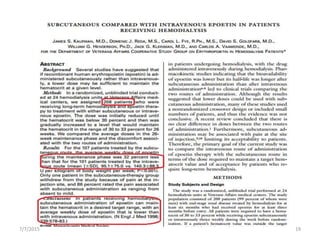
• Large studies – SC dose of EPO required to achieve a target
Hb is approximately 30 % less than that required with IV
administration.
7/7/2015 18
7/7/2015 19
• The 2012 KDIGO guidelines suggest either IV or SC
administration for patients on hemodialysis,
hemofiltration, or hemodiafiltration, and SC
administration for nondialysis CKD patients or
patients on peritoneal dialysis
7/7/2015 20
Dose
• Initial dose of EPO baseline Hb level, overall clinical setting,
mode of administration & target hemoglobin level
• Numerous studies  IV therapy requires 30% more EPO than
with the subcutaneous route
• The FDA-recommended starting dose is 50 to
100 units/kg three times per week for both IV and
subcutaneous administration
7/7/2015 21
Side effects
• Hypertension
• Headache
• Pure red cell aplasia
• Hyporesponsiveness to ESAs
 No increase in Hb concentration after 1st month of
appropriate weight-based dosing & acquired
hyporesponsiveness as requiring two increases in ESA doses
up to 50% beyond the dose at which the patient had
originally been stable- KDIGO
7/7/2015 22
Causes for resistance to ESA
• Absolute iron deficiency  external blood
losses or exhaustion of iron stores due to an increase in
erythropoiesis caused by ESA treatment
• Bone disease due to secondary hyperparathyroidism
• Occult malignancy and unsuspected hematologic disorders
• Multiple myeloma/myelofibrosis/myelodysplastic syndrome
• HIV infection
• Chronic inflammation (with inhibition possibly due to
enhanced cytokine production)
7/7/2015 23
THANK YOU
7/7/2015 24

Anemia in ckd

  • 1.
    ANEMIA IN CKD-HOW TO MANAGE IT 7/7/2015 1
  • 2.
    TOPICS BEING DISCUSSED Anemiain CKD Causes for Anemia in CKD Reasons for Anemia correction Therapeutic options for correction in anemia of CKD 7/7/2015 2
  • 3.
    ANEMIA IN CKD •Anemia - WHO recommendations- Hb concentration <13.0 g/dL for adult males and postmenopausal women and an Hb <12.0 g/dL for premenopausal women • The anemia of chronic kidney disease (CKD)normocytic and normochromic 7/7/2015 3
  • 4.
    Causes for Anemiain CKD • Failure of Erythropoietin (EPO) production by diseased kidney • Reduction in red cell survival 7/7/2015 4
  • 5.
  • 6.
    Reasons for AnemiaCorrection • Deterioration in cardiac function • Decreased cognition and mental acuity • Fatigue • Increased risk of morbidity and mortality 7/7/2015 6
  • 7.
    THERAPEUTIC OPTIONS FORCORRECTION IN ANEMIA OF CKD RED BLOOD CELL TRANSFUSIONS ERYTHROPOIETIN- STIMULATING AGENTS (ESAS) ANDROGENS 7/7/2015 7
  • 8.
    RBC TRANSFUSIONS • Universallysuccessful in increasing Hb levels. • Decreases symptoms & improve health-related quality of life. • COMPLICATIONS Transfusion-transmitted infection Immunologic sensitization Iron overload syndromes Volume overload Transfusion reactions 7/7/2015 8
  • 9.
    Androgens • Androgens (seendogenous EPO production, sensitivity of erythroid progenitors to the effects of EPO, and red blood cell survival) were used regularly in the treatment of anemia in dialysis patients. • Limited role side effects – IM injection, acne, priapism, hepatitis, LFT abnormalities, and risk of HCC. 7/7/2015 9
  • 10.
    ERYTHROPOIETIN-STIMULATING AGENTS (ESAS) •Initial phase III clinical trial showing that recombinant human EPO was effective and eliminated the need for continued transfusions. • In this study, 333 dialysis patients with Hb levels <10 g/dL received recombinant human EPO to maintain the hematocrit at 35 % . • Within 2 months of initiation of therapy, the need for transfusions (1030 within the six months prior to beginning treatment) was eliminated. • In addition, there was a 40 % reduction in ferritin levels after 6 months among the 68 patients with iron overload. 7/7/2015 10
  • 11.
    • They substantiallyreduced the need for red cell transfusions • Decrease in risk for transfusion-related complications • They also help mobilize iron stores, which is particularly beneficial in patients with CKD and iron overload due to previous transfusions 7/7/2015 11
  • 12.
    PEGINESATIDE • Peginesatide isa synthetic peptide that activates the EPO receptor • Stimulates erythroid colony growth, reticulocyte count, and hematocrit • Does not crossreact with EPO antibodies (amino acid sequence is unrelated to EPO) 7/7/2015 12
  • 13.
  • 14.
    • In 2phase-III studies (PEARL-I and PEARL-II) that compared peginesatide with darbepoetin among non-dialysis CKD patients, there was an increase in cardiovascular events associated with peginesatide. • FDA approved peginesatide for IV or SC administration to treat anemia in adult dialysis patients only, but not in patients with CKD who are not on dialysis or in patients with cancer- related anemia. • Serious hypersensitivity reactions reported in approximately 0.2 % of patients following the first dose of IV administration, with death occurring in 0.02 % of patients 7/7/2015 14
  • 15.
    Darbepoetin alfa • Usedfor the treatment of anemia of CKD • It is a molecule with 165 amino acids that differs from recombinant human EPO in that it contains five N-linked oligosaccharide chains, whereas EPO has only three • The additional carbohydrate chains result in a half-life that is longer than that for EPO 7/7/2015 15
  • 16.
    PRINCIPLES GOVERNING THEADMINISTRATION OF RECOMBINANT HUMAN ESAS • The response to EPO is dose-dependent • The response is dependent on the route of administration (IV Vs. SC ) and the frequency of administration. • The response may be limited by low iron stores, bone marrow fibrosis, infection, inflammation, inadequate dialysis, and other conditions. • Stroke, mortality, and hypertension may complicate therapy. This is primarily limited to patients undergoing dialysis. 7/7/2015 16
  • 17.
    INDICATIONS OF ESA •Use in HD patients – Hb level of <10g/dL with consideration specific patient characteristics, such as functional and cognitive status, life-expectancy • Nondialysis patients with CKD- initiate ESAs when Hb levels are <10 g/dL and try to maintain goal Hb levels between 10.0 and 11.5 g/dL. • Exceptions- Dialysis patients who have a H/o stroke or malignancy, or an active malignancy. • ESAs should not be started until iron status has been evaluated 7/7/2015 17
  • 18.
    • Reliance uponthe hematocrit alone is not the optimal method for assessing the response to ESAs • Laboratory variability in the measurement of hematocrit is greater than for Hb • Current Guidelines- Recommend the use of Hb rather than hematocrit, for evaluating & treating anemia in CKD patients • Route of administration • Large studies – SC dose of EPO required to achieve a target Hb is approximately 30 % less than that required with IV administration. 7/7/2015 18
  • 19.
  • 20.
    • The 2012KDIGO guidelines suggest either IV or SC administration for patients on hemodialysis, hemofiltration, or hemodiafiltration, and SC administration for nondialysis CKD patients or patients on peritoneal dialysis 7/7/2015 20
  • 21.
    Dose • Initial doseof EPO baseline Hb level, overall clinical setting, mode of administration & target hemoglobin level • Numerous studies  IV therapy requires 30% more EPO than with the subcutaneous route • The FDA-recommended starting dose is 50 to 100 units/kg three times per week for both IV and subcutaneous administration 7/7/2015 21
  • 22.
    Side effects • Hypertension •Headache • Pure red cell aplasia • Hyporesponsiveness to ESAs  No increase in Hb concentration after 1st month of appropriate weight-based dosing & acquired hyporesponsiveness as requiring two increases in ESA doses up to 50% beyond the dose at which the patient had originally been stable- KDIGO 7/7/2015 22
  • 23.
    Causes for resistanceto ESA • Absolute iron deficiency  external blood losses or exhaustion of iron stores due to an increase in erythropoiesis caused by ESA treatment • Bone disease due to secondary hyperparathyroidism • Occult malignancy and unsuspected hematologic disorders • Multiple myeloma/myelofibrosis/myelodysplastic syndrome • HIV infection • Chronic inflammation (with inhibition possibly due to enhanced cytokine production) 7/7/2015 23
  • 24.