ANDA REGULATORY APPROVAL
PROCESS
Mr. Suresh Gautam
M.Pharm 1st year
(P.Ceutics Dept.)
DRUG
Abbreviated new drug application
(ANDA)
• These are submitted to the FDA’s CDER(center for
drug evaluation and research)
• The Office of the Generic drugs (OGD) is located
within the CDER under the office of pharmaceutical
science, to obtain approval to market a generic drug
product.
• The OGD ensures the safety and efficacy of generic
drugs by employing a review process that is similar
to the NDA process.
• Once approved the applicant may manufacture &
market the generic product to provide a safe, effective
& low cost alternative.
• These are termed “Abbreviated” because they
generally need not include preclinical & clinical data
to establish safety & effectiveness.
• They must scientifically demonstrate that their
product is bioequivalent to the innovator drug.
• The primary difference between the generic drug
review process and NDA process is the study
requirements.
• For ex , an ANDA generally requires a BE study
between the generic drug product and Reference list
of drugs(RLD )product.
• The safety and efficacy of the RLD product were
established previously through animal ,clinical ,BA
studies.SO, no need to repeat for ANDA.
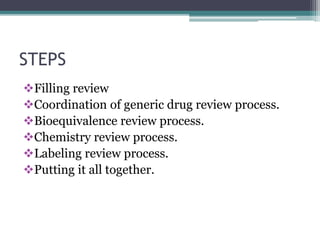
STEPS
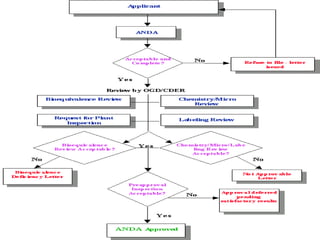
Filling review
Coordination of generic drug review process.
Bioequivalence review process.
Chemistry review process.
Labeling review process.
Putting it all together.
Filling review
The process begins when an applicant submits an ANDA
to the OGD.
The document room staff assigns it an ANDA number
and stamps a received date on the cover letter of ANDA.
It is sent to a consumer safety technician who reviews
the preliminary sections of ANDA checklist
With in first 60 days –submission , filling review is
completed. Regulatory support branch(RSB) is
responsible for this process.
• Once the RSB(REGULATORY SUPPORT BRANCH)completes the filling
review of the ANDA and verifies that the application
contains all the necessary regulatory requirements an
“Acknowledgement “ letter is issued to the applicant
indicating its acceptance for filling and the official filling
date
 The application is then assigned to technical reviewers.
 If the ANDA does not met the criteria for filling ,
a “ refuse –to-receive “ letter is issued with a list of
deficiencies.
Upon filling an ANDA ,the RPM(REGULATORY PROGRAM MANEGER)
forwards an establishment evaluation request (EER) to
the office of compliance.
Office of Compliance are operating in compliance with
current Good Manufacturing Practice( cGMP)
regulations.
Currently , ANDA can be submitted entirely
electronically.
All applicants who plan to submit ANDA electronically
should consult CDER’S website for electronic
submissions at www.fda.gov/cder/regulatory
/rsr/default.htm.
COORDINATION OF THE GENERIC DRUG
REVIEW PROCESS
Now application enters the review queue,this means
that the application is assigned to a bioequivalence
reviewer , a chemist and a labelling reviewer.
Each chemistry team consists of a team leader , a
project manager and several reviewers .The
chemistry project manager serves as the “Applicant “
project manager(APM),they plan ,organize and
coordinate all of the review activities for the
applications that they manage.
BIOEQUIVALENCE REVIEW PROCESS
• Bioequivalence project manager( BPM) access list of
pending ANDA assign to individual reviewers
according to “first-in ,first-reviewed “policy.
• The DBE’s responsibilities include BE section of
ANDA, Bio-investigational new drug
applications(Bio-INDs),protocols and controlled
correspondence.
• This process establishes BE between a proposed
generic drug and the RLD.
• It resolve the regulatory and scientific issues
regarding the BE of drug products submitted for
marketing approval.
CHEMISTRY REVIEW PROCESS
The chemistry ,manufacturing and controls(CMC)
section of the application is assigned to the app
chemistry division and team based on therapeutic
category of the drug product.
The team leader assigns the application to a reviewer
on his/her team according to the “ first-in,first
reviewed policy”.
The Chemistry division reviews CMC section Of
ANDA, drug master files , annual reports and
controlled correspondence.
LABELLING REVIEW PROCESS
Labeling section of the application is assigned to the
app labeling reviewer based on the therapeutic
category of the drug product.
The labeling review branch is part of DLPS.
A team leader oversees the work of 4-6 reviewers.
The basis for the labeling review is to ensure that the
generic drug labeling is the “same as” the RLD
labeling.
The labeling reviewer identifies and resolves
concerns about medication errors. Ex: sound alike or
legibility of drug names on a container label.
To ensure that the proposed labeling in an ANDA is
the “same as” the RLD,
a. The reviewer must first identify the RLD
b. Next step is to find the most recently approved
labeling for the RLD.
c. If it is not the recently approves ,it is considered as
discontinued labeling ( so not acceptable for
labeling review).
• The applicant may submit four copies of draft
labeling or 12 copies of final printed labeling as
proposed labeling. They are submitted for tentative
approval.
• The labeling branch supports the submission of
electronic labeling which is preferred and strongly
encouraged.
• As the container label is reviewed , the labeling
reviewer decides of the labeling is easy to read and
positioned in accordance with the regulations.
PUTTING IT ALL TOGETHER
• After the final office level administrative review and
individual disciplines have resolved their deficiencies
,the application will either receive a full approval or a
tentative letter.
• When the review of an ANDA is completed, the
APMs draft the app approval letter and circulate it
with the reviews and application for concurrence.
• The APMs communicate with the OGD management
on a weekly basis to update them on the progress of
reviews.
• A full approval letter details the conditions of
approval and allows the applicant to market the
generic drug product.
• A tentative approval letter is issued if there are
unexpired patents or exclusivities accorded to the
RLD, and delays the marketing of the product .
• Once the office director has signed the final approval
letter, APM(APPLICANT PROJECT MANEGER) calls and faxes a
copy of the approval letter to the applicant.
• The document room staff then mails the final
approval letter to the applicant.
THANK YOU

Anda

  • 1.
    ANDA REGULATORY APPROVAL PROCESS Mr.Suresh Gautam M.Pharm 1st year (P.Ceutics Dept.)
  • 2.
  • 4.
    Abbreviated new drugapplication (ANDA) • These are submitted to the FDA’s CDER(center for drug evaluation and research) • The Office of the Generic drugs (OGD) is located within the CDER under the office of pharmaceutical science, to obtain approval to market a generic drug product. • The OGD ensures the safety and efficacy of generic drugs by employing a review process that is similar to the NDA process.
  • 5.
    • Once approvedthe applicant may manufacture & market the generic product to provide a safe, effective & low cost alternative. • These are termed “Abbreviated” because they generally need not include preclinical & clinical data to establish safety & effectiveness. • They must scientifically demonstrate that their product is bioequivalent to the innovator drug.
  • 6.
    • The primarydifference between the generic drug review process and NDA process is the study requirements. • For ex , an ANDA generally requires a BE study between the generic drug product and Reference list of drugs(RLD )product. • The safety and efficacy of the RLD product were established previously through animal ,clinical ,BA studies.SO, no need to repeat for ANDA.
  • 7.
    STEPS Filling review Coordination ofgeneric drug review process. Bioequivalence review process. Chemistry review process. Labeling review process. Putting it all together.
  • 8.
    Filling review The processbegins when an applicant submits an ANDA to the OGD. The document room staff assigns it an ANDA number and stamps a received date on the cover letter of ANDA. It is sent to a consumer safety technician who reviews the preliminary sections of ANDA checklist With in first 60 days –submission , filling review is completed. Regulatory support branch(RSB) is responsible for this process.
  • 9.
    • Once theRSB(REGULATORY SUPPORT BRANCH)completes the filling review of the ANDA and verifies that the application contains all the necessary regulatory requirements an “Acknowledgement “ letter is issued to the applicant indicating its acceptance for filling and the official filling date  The application is then assigned to technical reviewers.  If the ANDA does not met the criteria for filling , a “ refuse –to-receive “ letter is issued with a list of deficiencies.
  • 10.
    Upon filling anANDA ,the RPM(REGULATORY PROGRAM MANEGER) forwards an establishment evaluation request (EER) to the office of compliance. Office of Compliance are operating in compliance with current Good Manufacturing Practice( cGMP) regulations. Currently , ANDA can be submitted entirely electronically. All applicants who plan to submit ANDA electronically should consult CDER’S website for electronic submissions at www.fda.gov/cder/regulatory /rsr/default.htm.
  • 11.
    COORDINATION OF THEGENERIC DRUG REVIEW PROCESS Now application enters the review queue,this means that the application is assigned to a bioequivalence reviewer , a chemist and a labelling reviewer. Each chemistry team consists of a team leader , a project manager and several reviewers .The chemistry project manager serves as the “Applicant “ project manager(APM),they plan ,organize and coordinate all of the review activities for the applications that they manage.
  • 12.
    BIOEQUIVALENCE REVIEW PROCESS •Bioequivalence project manager( BPM) access list of pending ANDA assign to individual reviewers according to “first-in ,first-reviewed “policy. • The DBE’s responsibilities include BE section of ANDA, Bio-investigational new drug applications(Bio-INDs),protocols and controlled correspondence.
  • 13.
    • This processestablishes BE between a proposed generic drug and the RLD. • It resolve the regulatory and scientific issues regarding the BE of drug products submitted for marketing approval.
  • 14.
    CHEMISTRY REVIEW PROCESS Thechemistry ,manufacturing and controls(CMC) section of the application is assigned to the app chemistry division and team based on therapeutic category of the drug product. The team leader assigns the application to a reviewer on his/her team according to the “ first-in,first reviewed policy”. The Chemistry division reviews CMC section Of ANDA, drug master files , annual reports and controlled correspondence.
  • 15.
    LABELLING REVIEW PROCESS Labelingsection of the application is assigned to the app labeling reviewer based on the therapeutic category of the drug product. The labeling review branch is part of DLPS. A team leader oversees the work of 4-6 reviewers. The basis for the labeling review is to ensure that the generic drug labeling is the “same as” the RLD labeling.
  • 16.
    The labeling revieweridentifies and resolves concerns about medication errors. Ex: sound alike or legibility of drug names on a container label. To ensure that the proposed labeling in an ANDA is the “same as” the RLD, a. The reviewer must first identify the RLD b. Next step is to find the most recently approved labeling for the RLD. c. If it is not the recently approves ,it is considered as discontinued labeling ( so not acceptable for labeling review).
  • 17.
    • The applicantmay submit four copies of draft labeling or 12 copies of final printed labeling as proposed labeling. They are submitted for tentative approval. • The labeling branch supports the submission of electronic labeling which is preferred and strongly encouraged. • As the container label is reviewed , the labeling reviewer decides of the labeling is easy to read and positioned in accordance with the regulations.
  • 18.
    PUTTING IT ALLTOGETHER • After the final office level administrative review and individual disciplines have resolved their deficiencies ,the application will either receive a full approval or a tentative letter. • When the review of an ANDA is completed, the APMs draft the app approval letter and circulate it with the reviews and application for concurrence. • The APMs communicate with the OGD management on a weekly basis to update them on the progress of reviews.
  • 19.
    • A fullapproval letter details the conditions of approval and allows the applicant to market the generic drug product. • A tentative approval letter is issued if there are unexpired patents or exclusivities accorded to the RLD, and delays the marketing of the product . • Once the office director has signed the final approval letter, APM(APPLICANT PROJECT MANEGER) calls and faxes a copy of the approval letter to the applicant. • The document room staff then mails the final approval letter to the applicant.
  • 20.

Editor's Notes

  • #5 CDER= CENTER FOR DRUG EVALUATION AND RESEARCH FDA=FOOD AND DRUG ADMINISTRATION
  • #10 RSB=REGULATORY SUPPORT BRANCH
  • #13 BE=BIOEQUIVALENCE DBEs= DIVISION OF BIOEQUIVALENCE EQUIVALENCES
  • #14 BPM= BIOEQUIVALENCE PROJECT MANAGER RLD= REFERENCE LIST OF DRUGS T= TEST PRODUCT R=REFERENCE PRODUCT
  • #16 DLPS= DIVISION OF LABELING AND PROGRAM SUPPORT RLD= REFERENCE LISTED DRUG