Anatomy of Respiratory
System
14-Arid-2022
PMAS
FAISAL
SHAHZAD SOMROO
Organization and Functions of
the Respiratory System
 Consists of an upper respiratory tract (nose to
larynx) and a lower respiratory tract ( trachea
onwards) .
 Conducting portion transports air.
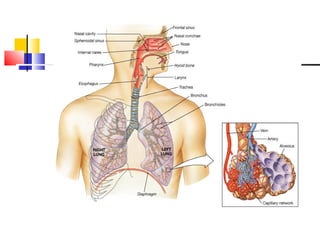
- includes the nose, nasal cavity, pharynx, larynx,
trachea, and progressively smaller airways, from the
primary bronchi to the terminal bronchioles
 Respiratory portion carries out gas exchange.
- composed of small airways called respiratory
bronchioles and alveolar ducts as well as air sacs
called alveoli
Respiratory System Functions
1. supplies the body with oxygen and
disposes of carbon dioxide
2. filters inspired air
3. produces sound
4. contains receptors for smell
5. rids the body of some excess water and
heat
6. helps regulate blood pH
Breathing
 Breathing (pulmonary ventilation).
consists of two cyclic phases:
 inhalation, also called inspiration - draws
gases into the lungs.
 exhalation, also called expiration - forces
gases out of the lungs.
Upper Respiratory Tract
 Composed of the nose and nasal
cavity, paranasal sinuses, pharynx
(throat), larynx.
 All part of the conducting portion of the
respiratory system.
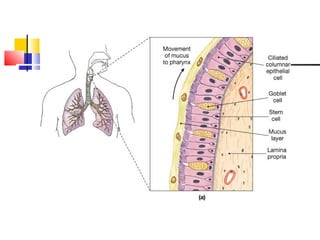
Respiratory mucosa
 A layer of pseudostratified ciliated
columnar epithelial cells that
secrete mucus
 Found in nose, sinuses, pharynx, larynx
and trachea
 Mucus can trap contaminants
 Cilia move mucus up towards mouth
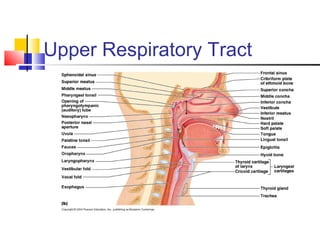
Upper Respiratory Tract
Nose
 Internal nares - opening to exterior
 External nares opening to pharynx
 Nasal conchae - folds in the mucous
membrane that increase air turbulence
and ensures that most air contacts the
mucous membranes
Nose
 rich supply of capillaries warm the inspired air
 olfactory mucosa – mucous membranes that
contain smell receptors
 respiratory mucosa – pseudostratified ciliated
columnar epithelium containing goblet cells that
secrete mucus which traps inhaled particles,
 lysozyme kills bacteria and lymphocytes and
 IgA antibodies that protect against bacteria
Nose
provides and airway for respiration
• moistens and warms entering air
• filters and cleans inspired air
• resonating chamber for speech
detects odors in the air stream
rhinoplasty: surgery to change shape of
external nose
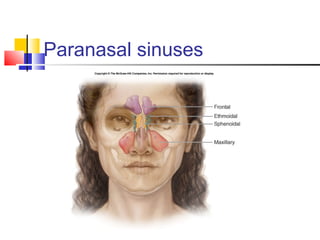
Paranasal Sinuses
 Four bones of the skull contain paired air
spaces called the paranasal sinuses -
frontal, ethmoidal, sphenoidal,
maxillary
 Decrease skull bone weight
 Warm, moisten and filter incoming air
 Add resonance to voice.
 Communicate with the nasal cavity by ducts.
 Lined by pseudostratified ciliated
columnar epithelium.
Paranasal sinuses
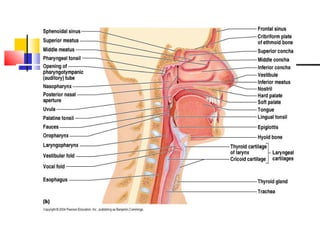
Pharynx
 Common space used by both the
respiratory and digestive systems.
 Commonly called the throat.
 Originates posterior to the nasal and
oral cavities and extends inferiorly near
the level of the bifurcation of the larynx
and esophagus.
 Common pathway for both air and food.
Pharynx
 Walls are lined by a mucosa and contain
skeletal muscles that are primarily used for
swallowing.
 Flexible lateral walls are distensible in order
to force swallowed food into the esophagus.
 Partitioned into three adjoining regions:
nasopharynx
oropharynx
laryngopharynx
Nasopharynx
 Superior-most region of the pharynx. Covered with
pseudostratified ciliated columnar epithelium.
 Located directly posterior to the nasal cavity and superior
to the soft palate, which separates the oral cavity.
 Normally, only air passes through.
 Material from the oral cavity and oropharynx is typically
blocked from entering the nasopharynx by the uvula of
soft palate, which elevates when we swallow.
 In the lateral walls of the nasopharynx, paired
auditory/eustachian tubes connect the nasopharynx
to the middle ear.
 Posterior nasopharynx wall also houses a single
pharyngeal tonsil (commonly called the adenoids).
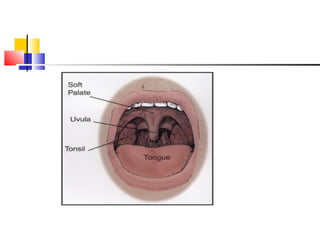
Oropharynx
 The middle pharyngeal region.
 Immediately posterior to the oral cavity.
 Bounded by the edge of the soft palate superiorly and the
hyoid bone inferiorly.
 Common respiratory and digestive pathway through which
both air and swallowed food and drink pass.
 Contains nonkeratinized stratified squamous
epithelim.
 Lymphatic organs here provide the first line of defense
against ingested or inhaled foreign materials. Palatine
tonsils are on the lateral wall between the arches, and the
lingual tonsils are at the base of the tongue.
Laryngopharynx
 Inferior, narrowed region of the pharynx.
 Extends inferiorly from the hyoid bone to the
larynx and esophagus.
 Terminates at the superior border of the
esophagus and the epiglottis of the larynx.
 Lined with a nonkeratinized stratified
squamous epithelium.
 Permits passage of both food and air.
Lower Respiratory Tract
 Conducting airways (trachea, bronchi,
up to terminal bronchioles).
 Respiratory portion of the respiratory
system (respiratory bronchioles,
alveolar ducts, and alveoli).
Larynx
 Voice box is a short, somewhat cylindrical
airway ends in the trachea.
 Prevents swallowed materials from entering
the lower respiratory tract.
 Conducts air into the lower respiratory tract.
 Produces sounds.
 Supported by a framework of nine pieces of
cartilage (three individual pieces and three
cartilage pairs) that are held in place by
ligaments and muscles.
Larynx
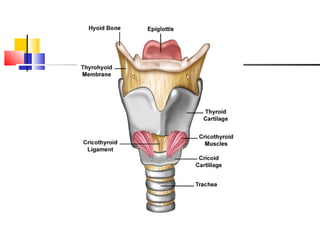
 Nine c-rings of cartilage form the framework of
the larynx
 thyroid cartilage – (1) Adam’s apple, hyaline,
anterior attachment of vocal folds, testosterone
increases size after puberty
 cricoid cartilage – (1) ring-shaped, hyaline
 arytenoid cartilages – (2) hyaline, posterior
attachment of vocal folds, hyaline
 cuneiform cartilages - (2) hyaline
 corniculate cartlages - (2) hyaline
epiglottis – (1) elastic cartilage
Larynx
 Muscular walls aid in voice production and
the swallowing reflex
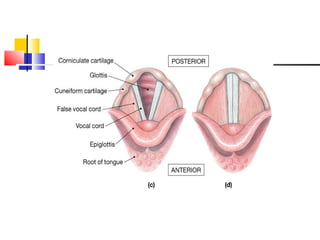
 Glottis – the superior opening of the larynx
 Epiglottis – prevents food and drink from
entering airway when swallowing
 pseudostratified ciliated columnar
epithelium
Sound Production
 Inferior ligaments are called the vocal folds.
- are true vocal cords モ because they produce
sound when air passes between them
 Superior ligaments are called the vestibular
folds.
- are false vocal cords モ because they have no
function in sound production, but protect the vocal
folds.
 The tension, length, and position of the vocal folds
determine the quality of the sound.
Sound production
 Intermittent release of exhaled air through the
vocal folds
 Loudness – depends on the force with which air is
exhaled through the cords
 Pharynx, oral cavity, nasal cavity, paranasal
sinuses act as resonating chambers that add
quality to the sound
 Muscles of the face, tongue, and lips help with
enunciation of words
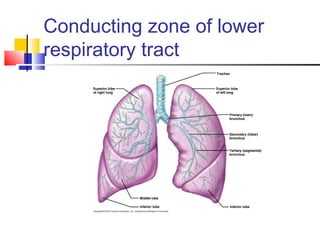
Conducting zone of lower
respiratory tract
Trachea
 A flexible tube also called windpipe.
 Extends through the mediastinum and lies anterior to
the esophagus and inferior to the larynx.
 Anterior and lateral walls of the trachea supported by
15 to 20 C-shaped tracheal cartilages.
 Cartilage rings reinforce and provide rigidity to the
tracheal wall to ensure that the trachea remains open
at all times
 Posterior part of tube lined by trachealis muscle
 Lined by ciliated pseudostratified columnar
epithelium.
Trachea
 At the level of the sternal angle, the trachea
bifurcates into two smaller tubes, called the
right and left primary bronchi.
 Each primary bronchus projects laterally
toward each lung.
 The most inferior tracheal cartilage separates
the primary bronchi at their origin and forms
an internal ridge called the carina.
Bronchial tree
 A highly branched system of air-conducting passages
that originate from the left and right primary bronchi.
 Progressively branch into narrower tubes as they
diverge throughout the lungs before terminating in
terminal bronchioles.
 Incomplete rings of hyaline cartilage support
the walls of the primary bronchi to ensure that they
remain open.
 Right primary bronchus is shorter, wider, and more
vertically oriented than the left primary bronchus.
 Foreign particles are more likely to lodge in the right
primary bronchus.
Bronchial tree
 The primary bronchi enter the hilus of each lung
together with the pulmonary vessels, lymphatic
vessels, and nerves.
 Each primary bronchus branches into several
secondary bronchi (or lobar bronchi).
 The left lung has two secondary bronchi.The right
lung has three secondary bronchi.
 They further divide into tertiary bronchi.
 Each tertiary bronchus is called a segmental
bronchus because it supplies a part of the lung called
a bronchopulmonary segment.
Bronchial Tree
 Secondary bronchi tertiary bronchi bronchioles
terminal bronchioles
 with successive branching amount of cartilage decreases
and amount of smooth muscle increases, this allows for
variation in airway diameter
 during exertion and when sympathetic division active 
bronchodilation
 mediators of allergic reactions like histamine 
bronchoconstriction
 epithelium gradually changes from ciliated
pseudostratified columnar epithelium to simple
cuboidal epithelium in terminal bronchioles
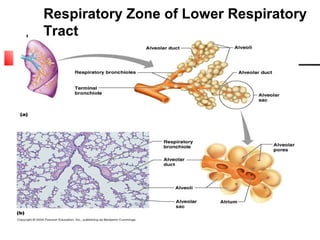
Respiratory Zone of Lower Respiratory
Tract
Conduction vs. Respiratory
zones
 Most of the tubing in the lungs makes up
conduction zone
 Consists of nasal cavity to terminal
bronchioles
 The respiratory zone is where gas is
exchanged
 Consists of alveoli, alveolar sacs, alveolar
ducts and respiratory bronchioles
Respiratory Bronchioles,
Alveolar Ducts, and Alveoli
 Lungs contain small saccular outpocketings called
alveoli.
 They have a thin wall specialized to promote
diffusion of gases between the alveolus and the
blood in the pulmonary capillaries.
 Gas exchange can take place in the respiratory
bronchioles and alveolar ducts as well as in
the alveoli, each lung contains approximately 300
to 400 million alveoli.
 The spongy nature of the lung is due to the packing
of millions of alveoli together.
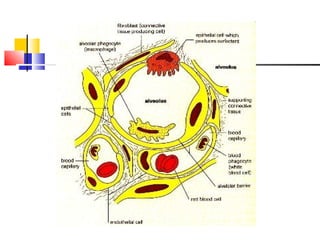
Respiratory Membrane
 squamous cells of alveoli .
 basement membrane of alveoli.
 basement membrane of capillaries
 simple squamous cells of capillaries
 about .5 μ in thickness
Cells in Alveolus
Type I cells : simple squamous cells forming
lining
Type II cells : or septal cells secrete
surfactant
Alveolar macrophages
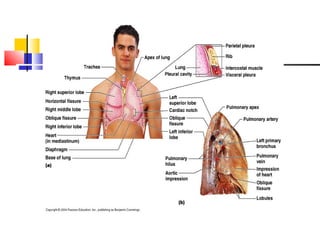
Gross Anatomy of the Lungs
 Each lung has a conical shape. Its wide, concave
base rests upon the muscular diaphragm.
 Its superior region called the apex projects superiorly
to a point that is slightly superior and posterior to the
clavicle.
 Both lungs are bordered by the thoracic wall
anteriorly, laterally, and posteriorly, and supported by
the rib cage.
 Toward the midline, the lungs are separated from
each other by the mediastinum.
 The relatively broad, rounded surface in contact with
the thoracic wall is called the costal surface of the
lung.
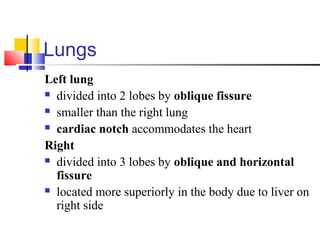
Lungs
Left lung
 divided into 2 lobes by oblique fissure
 smaller than the right lung
 cardiac notch accommodates the heart
Right
 divided into 3 lobes by oblique and horizontal
fissure
 located more superiorly in the body due to liver on
right side
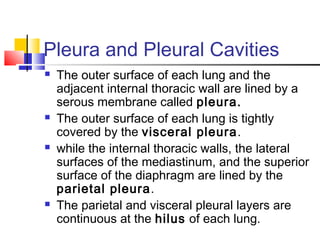
Pleura and Pleural Cavities
 The outer surface of each lung and the
adjacent internal thoracic wall are lined by a
serous membrane called pleura.
 The outer surface of each lung is tightly
covered by the visceral pleura.
 while the internal thoracic walls, the lateral
surfaces of the mediastinum, and the superior
surface of the diaphragm are lined by the
parietal pleura.
 The parietal and visceral pleural layers are
continuous at the hilus of each lung.
Pleural Cavities
The potential space between the serous
membrane layers is a pleural cavity.
 The pleural membranes produce a thin,
serous pleural fluid that circulates in the
pleural cavity and acts as a lubricant,
ensuring minimal friction during breathing.
 Pleural effusion – pleuritis with too much
fluid
Blood supply of Lungs
 pulmonary circulation -
 bronchial circulation – bronchial arteries supply
oxygenated blood to lungs, bronchial veins carry
away deoxygenated blood from lung tissue 
superior vena cava
 Response of two systems to hypoxia –
pulmonary vessels undergo vasoconstriction
bronchial vessels like all other systemic vessels
undergo vasodilation
Respiratory events
 Pulmonary ventilation = exchange of
gases between lungs and atmosphere
 External respiration = exchange of gases
between alveoli and pulmonary capillaries
 Internal respiration = exchange of gases
between systemic capillaries and tissue cells
Two phases of pulmonary
ventilation
 Inspiration, or inhalation - a very active
process that requires input of energy.The
diaphragm, contracts, moving downward and
flattening, when stimulated by phrenic
nerves.
 Expiration, or exhalation - a passive
process that takes advantage of the recoil
properties of elastic fiber. ・ The diaphragm
relaxes.The elasticity of the lungs and the
thoracic cage allows them to return to their
normal size and shape.
Muscles that ASSIST with
respiration
 The scalenes help increase thoracic cavity
dimensions by elevating the first and second ribs
during forced inhalation.
 The ribs elevate upon contraction of the external
intercostals, thereby increasing the transverse
dimensions of the thoracic cavity during inhalation.
 Contraction of the internal intercostals depresses
the ribs, but this only occurs during forced exhalation.
 Normal exhalation requires no active muscular effort.
Muscles that ASSIST with
respiration
 Other accessory muscles assist with
respiratory activities.
 The pectoralis minor, serratus anterior,
and sternocleidomastoid help with forced
inhalation,
 while the abdominal muscles(external
and internal obliques, transversus
abdominis, and rectus abdominis)
assist in active exhalation.
Boyle’s Law
 The pressure of a gas decreases if the
volume of the container increases, and vice
versa.
 When the volume of the thoracic cavity increases
even slightly during inhalation, the intrapulmonary
pressure decreases slightly, and air flows into the
lungs through the conducting airways. Air flows into
the lungs from a region of higher pressure (the
atmosphere)into a region of lower pressure (the
intrapulmonary region).
 When the volume of the thoracic cavity decreases
during exhalation, the intrapulmonary pressure
increases and forces air out of the lungs into the
atmosphere.
Ventilation Control by
Respiratory Centers of the Brain
 The trachea, bronchial tree, and lungs are
innervated by the autonomic nervous
system.
 The autonomic nerve fibers that innervate the
heart also send branches to the respiratory
structures.
 The involuntary, rhythmic activities that
deliver and remove respiratory gases are
regulated in the brainstem within the
reticular formation through both the
medulla oblongata and pons.
Respiratory Values
 A normal adult averages 12 breathes per
minute = respiratory rate(RR)
 Respiratory volumes – determined by
using a spirometer
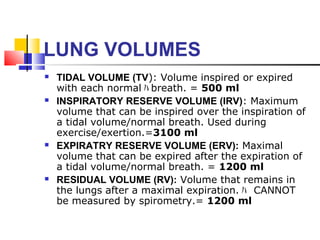
LUNG VOLUMES
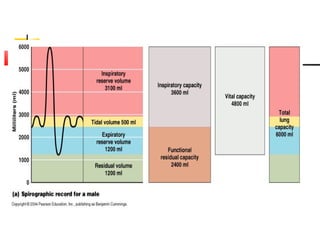
 TIDAL VOLUME (TV): Volume inspired or expired
with each normal ハ breath. = 500 ml
 INSPIRATORY RESERVE VOLUME (IRV): Maximum
volume that can be inspired over the inspiration of
a tidal volume/normal breath. Used during
exercise/exertion.=3100 ml
 EXPIRATRY RESERVE VOLUME (ERV): Maximal
volume that can be expired after the expiration of
a tidal volume/normal breath. = 1200 ml
 RESIDUAL VOLUME (RV): Volume that remains in
the lungs after a maximal expiration. ハ CANNOT
be measured by spirometry.= 1200 ml
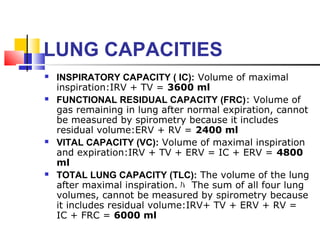
LUNG CAPACITIES
 INSPIRATORY CAPACITY ( IC): Volume of maximal
inspiration:IRV + TV = 3600 ml
 FUNCTIONAL RESIDUAL CAPACITY (FRC): Volume of
gas remaining in lung after normal expiration, cannot
be measured by spirometry because it includes
residual volume:ERV + RV = 2400 ml
 VITAL CAPACITY (VC): Volume of maximal inspiration
and expiration:IRV + TV + ERV = IC + ERV = 4800
ml
 TOTAL LUNG CAPACITY (TLC): The volume of the lung
after maximal inspiration. ハ The sum of all four lung
volumes, cannot be measured by spirometry because
it includes residual volume:IRV+ TV + ERV + RV =
IC + FRC = 6000 ml
anatomy of Respsystem

anatomy of Respsystem

  • 1.
  • 2.
    Organization and Functionsof the Respiratory System  Consists of an upper respiratory tract (nose to larynx) and a lower respiratory tract ( trachea onwards) .  Conducting portion transports air. - includes the nose, nasal cavity, pharynx, larynx, trachea, and progressively smaller airways, from the primary bronchi to the terminal bronchioles  Respiratory portion carries out gas exchange. - composed of small airways called respiratory bronchioles and alveolar ducts as well as air sacs called alveoli
  • 4.
    Respiratory System Functions 1.supplies the body with oxygen and disposes of carbon dioxide 2. filters inspired air 3. produces sound 4. contains receptors for smell 5. rids the body of some excess water and heat 6. helps regulate blood pH
  • 5.
    Breathing  Breathing (pulmonaryventilation). consists of two cyclic phases:  inhalation, also called inspiration - draws gases into the lungs.  exhalation, also called expiration - forces gases out of the lungs.
  • 6.
    Upper Respiratory Tract Composed of the nose and nasal cavity, paranasal sinuses, pharynx (throat), larynx.  All part of the conducting portion of the respiratory system.
  • 8.
    Respiratory mucosa  Alayer of pseudostratified ciliated columnar epithelial cells that secrete mucus  Found in nose, sinuses, pharynx, larynx and trachea  Mucus can trap contaminants  Cilia move mucus up towards mouth
  • 9.
  • 10.
    Nose  Internal nares- opening to exterior  External nares opening to pharynx  Nasal conchae - folds in the mucous membrane that increase air turbulence and ensures that most air contacts the mucous membranes
  • 11.
    Nose  rich supplyof capillaries warm the inspired air  olfactory mucosa – mucous membranes that contain smell receptors  respiratory mucosa – pseudostratified ciliated columnar epithelium containing goblet cells that secrete mucus which traps inhaled particles,  lysozyme kills bacteria and lymphocytes and  IgA antibodies that protect against bacteria
  • 12.
    Nose provides and airwayfor respiration • moistens and warms entering air • filters and cleans inspired air • resonating chamber for speech detects odors in the air stream rhinoplasty: surgery to change shape of external nose
  • 13.
    Paranasal Sinuses  Fourbones of the skull contain paired air spaces called the paranasal sinuses - frontal, ethmoidal, sphenoidal, maxillary  Decrease skull bone weight  Warm, moisten and filter incoming air  Add resonance to voice.  Communicate with the nasal cavity by ducts.  Lined by pseudostratified ciliated columnar epithelium.
  • 14.
  • 15.
    Pharynx  Common spaceused by both the respiratory and digestive systems.  Commonly called the throat.  Originates posterior to the nasal and oral cavities and extends inferiorly near the level of the bifurcation of the larynx and esophagus.  Common pathway for both air and food.
  • 16.
    Pharynx  Walls arelined by a mucosa and contain skeletal muscles that are primarily used for swallowing.  Flexible lateral walls are distensible in order to force swallowed food into the esophagus.  Partitioned into three adjoining regions: nasopharynx oropharynx laryngopharynx
  • 17.
    Nasopharynx  Superior-most regionof the pharynx. Covered with pseudostratified ciliated columnar epithelium.  Located directly posterior to the nasal cavity and superior to the soft palate, which separates the oral cavity.  Normally, only air passes through.  Material from the oral cavity and oropharynx is typically blocked from entering the nasopharynx by the uvula of soft palate, which elevates when we swallow.  In the lateral walls of the nasopharynx, paired auditory/eustachian tubes connect the nasopharynx to the middle ear.  Posterior nasopharynx wall also houses a single pharyngeal tonsil (commonly called the adenoids).
  • 19.
    Oropharynx  The middlepharyngeal region.  Immediately posterior to the oral cavity.  Bounded by the edge of the soft palate superiorly and the hyoid bone inferiorly.  Common respiratory and digestive pathway through which both air and swallowed food and drink pass.  Contains nonkeratinized stratified squamous epithelim.  Lymphatic organs here provide the first line of defense against ingested or inhaled foreign materials. Palatine tonsils are on the lateral wall between the arches, and the lingual tonsils are at the base of the tongue.
  • 21.
    Laryngopharynx  Inferior, narrowedregion of the pharynx.  Extends inferiorly from the hyoid bone to the larynx and esophagus.  Terminates at the superior border of the esophagus and the epiglottis of the larynx.  Lined with a nonkeratinized stratified squamous epithelium.  Permits passage of both food and air.
  • 22.
    Lower Respiratory Tract Conducting airways (trachea, bronchi, up to terminal bronchioles).  Respiratory portion of the respiratory system (respiratory bronchioles, alveolar ducts, and alveoli).
  • 23.
    Larynx  Voice boxis a short, somewhat cylindrical airway ends in the trachea.  Prevents swallowed materials from entering the lower respiratory tract.  Conducts air into the lower respiratory tract.  Produces sounds.  Supported by a framework of nine pieces of cartilage (three individual pieces and three cartilage pairs) that are held in place by ligaments and muscles.
  • 25.
    Larynx  Nine c-ringsof cartilage form the framework of the larynx  thyroid cartilage – (1) Adam’s apple, hyaline, anterior attachment of vocal folds, testosterone increases size after puberty  cricoid cartilage – (1) ring-shaped, hyaline  arytenoid cartilages – (2) hyaline, posterior attachment of vocal folds, hyaline  cuneiform cartilages - (2) hyaline  corniculate cartlages - (2) hyaline epiglottis – (1) elastic cartilage
  • 26.
    Larynx  Muscular wallsaid in voice production and the swallowing reflex  Glottis – the superior opening of the larynx  Epiglottis – prevents food and drink from entering airway when swallowing  pseudostratified ciliated columnar epithelium
  • 27.
    Sound Production  Inferiorligaments are called the vocal folds. - are true vocal cords モ because they produce sound when air passes between them  Superior ligaments are called the vestibular folds. - are false vocal cords モ because they have no function in sound production, but protect the vocal folds.  The tension, length, and position of the vocal folds determine the quality of the sound.
  • 28.
    Sound production  Intermittentrelease of exhaled air through the vocal folds  Loudness – depends on the force with which air is exhaled through the cords  Pharynx, oral cavity, nasal cavity, paranasal sinuses act as resonating chambers that add quality to the sound  Muscles of the face, tongue, and lips help with enunciation of words
  • 30.
    Conducting zone oflower respiratory tract
  • 31.
    Trachea  A flexibletube also called windpipe.  Extends through the mediastinum and lies anterior to the esophagus and inferior to the larynx.  Anterior and lateral walls of the trachea supported by 15 to 20 C-shaped tracheal cartilages.  Cartilage rings reinforce and provide rigidity to the tracheal wall to ensure that the trachea remains open at all times  Posterior part of tube lined by trachealis muscle  Lined by ciliated pseudostratified columnar epithelium.
  • 32.
    Trachea  At thelevel of the sternal angle, the trachea bifurcates into two smaller tubes, called the right and left primary bronchi.  Each primary bronchus projects laterally toward each lung.  The most inferior tracheal cartilage separates the primary bronchi at their origin and forms an internal ridge called the carina.
  • 33.
    Bronchial tree  Ahighly branched system of air-conducting passages that originate from the left and right primary bronchi.  Progressively branch into narrower tubes as they diverge throughout the lungs before terminating in terminal bronchioles.  Incomplete rings of hyaline cartilage support the walls of the primary bronchi to ensure that they remain open.  Right primary bronchus is shorter, wider, and more vertically oriented than the left primary bronchus.  Foreign particles are more likely to lodge in the right primary bronchus.
  • 34.
    Bronchial tree  Theprimary bronchi enter the hilus of each lung together with the pulmonary vessels, lymphatic vessels, and nerves.  Each primary bronchus branches into several secondary bronchi (or lobar bronchi).  The left lung has two secondary bronchi.The right lung has three secondary bronchi.  They further divide into tertiary bronchi.  Each tertiary bronchus is called a segmental bronchus because it supplies a part of the lung called a bronchopulmonary segment.
  • 35.
    Bronchial Tree  Secondarybronchi tertiary bronchi bronchioles terminal bronchioles  with successive branching amount of cartilage decreases and amount of smooth muscle increases, this allows for variation in airway diameter  during exertion and when sympathetic division active  bronchodilation  mediators of allergic reactions like histamine  bronchoconstriction  epithelium gradually changes from ciliated pseudostratified columnar epithelium to simple cuboidal epithelium in terminal bronchioles
  • 36.
    Respiratory Zone ofLower Respiratory Tract
  • 37.
    Conduction vs. Respiratory zones Most of the tubing in the lungs makes up conduction zone  Consists of nasal cavity to terminal bronchioles  The respiratory zone is where gas is exchanged  Consists of alveoli, alveolar sacs, alveolar ducts and respiratory bronchioles
  • 38.
    Respiratory Bronchioles, Alveolar Ducts,and Alveoli  Lungs contain small saccular outpocketings called alveoli.  They have a thin wall specialized to promote diffusion of gases between the alveolus and the blood in the pulmonary capillaries.  Gas exchange can take place in the respiratory bronchioles and alveolar ducts as well as in the alveoli, each lung contains approximately 300 to 400 million alveoli.  The spongy nature of the lung is due to the packing of millions of alveoli together.
  • 39.
    Respiratory Membrane  squamouscells of alveoli .  basement membrane of alveoli.  basement membrane of capillaries  simple squamous cells of capillaries  about .5 μ in thickness
  • 40.
    Cells in Alveolus TypeI cells : simple squamous cells forming lining Type II cells : or septal cells secrete surfactant Alveolar macrophages
  • 42.
    Gross Anatomy ofthe Lungs  Each lung has a conical shape. Its wide, concave base rests upon the muscular diaphragm.  Its superior region called the apex projects superiorly to a point that is slightly superior and posterior to the clavicle.  Both lungs are bordered by the thoracic wall anteriorly, laterally, and posteriorly, and supported by the rib cage.  Toward the midline, the lungs are separated from each other by the mediastinum.  The relatively broad, rounded surface in contact with the thoracic wall is called the costal surface of the lung.
  • 44.
    Lungs Left lung  dividedinto 2 lobes by oblique fissure  smaller than the right lung  cardiac notch accommodates the heart Right  divided into 3 lobes by oblique and horizontal fissure  located more superiorly in the body due to liver on right side
  • 45.
    Pleura and PleuralCavities  The outer surface of each lung and the adjacent internal thoracic wall are lined by a serous membrane called pleura.  The outer surface of each lung is tightly covered by the visceral pleura.  while the internal thoracic walls, the lateral surfaces of the mediastinum, and the superior surface of the diaphragm are lined by the parietal pleura.  The parietal and visceral pleural layers are continuous at the hilus of each lung.
  • 46.
    Pleural Cavities The potentialspace between the serous membrane layers is a pleural cavity.  The pleural membranes produce a thin, serous pleural fluid that circulates in the pleural cavity and acts as a lubricant, ensuring minimal friction during breathing.  Pleural effusion – pleuritis with too much fluid
  • 47.
    Blood supply ofLungs  pulmonary circulation -  bronchial circulation – bronchial arteries supply oxygenated blood to lungs, bronchial veins carry away deoxygenated blood from lung tissue  superior vena cava  Response of two systems to hypoxia – pulmonary vessels undergo vasoconstriction bronchial vessels like all other systemic vessels undergo vasodilation
  • 48.
    Respiratory events  Pulmonaryventilation = exchange of gases between lungs and atmosphere  External respiration = exchange of gases between alveoli and pulmonary capillaries  Internal respiration = exchange of gases between systemic capillaries and tissue cells
  • 49.
    Two phases ofpulmonary ventilation  Inspiration, or inhalation - a very active process that requires input of energy.The diaphragm, contracts, moving downward and flattening, when stimulated by phrenic nerves.  Expiration, or exhalation - a passive process that takes advantage of the recoil properties of elastic fiber. ・ The diaphragm relaxes.The elasticity of the lungs and the thoracic cage allows them to return to their normal size and shape.
  • 50.
    Muscles that ASSISTwith respiration  The scalenes help increase thoracic cavity dimensions by elevating the first and second ribs during forced inhalation.  The ribs elevate upon contraction of the external intercostals, thereby increasing the transverse dimensions of the thoracic cavity during inhalation.  Contraction of the internal intercostals depresses the ribs, but this only occurs during forced exhalation.  Normal exhalation requires no active muscular effort.
  • 51.
    Muscles that ASSISTwith respiration  Other accessory muscles assist with respiratory activities.  The pectoralis minor, serratus anterior, and sternocleidomastoid help with forced inhalation,  while the abdominal muscles(external and internal obliques, transversus abdominis, and rectus abdominis) assist in active exhalation.
  • 52.
    Boyle’s Law  Thepressure of a gas decreases if the volume of the container increases, and vice versa.  When the volume of the thoracic cavity increases even slightly during inhalation, the intrapulmonary pressure decreases slightly, and air flows into the lungs through the conducting airways. Air flows into the lungs from a region of higher pressure (the atmosphere)into a region of lower pressure (the intrapulmonary region).  When the volume of the thoracic cavity decreases during exhalation, the intrapulmonary pressure increases and forces air out of the lungs into the atmosphere.
  • 53.
    Ventilation Control by RespiratoryCenters of the Brain  The trachea, bronchial tree, and lungs are innervated by the autonomic nervous system.  The autonomic nerve fibers that innervate the heart also send branches to the respiratory structures.  The involuntary, rhythmic activities that deliver and remove respiratory gases are regulated in the brainstem within the reticular formation through both the medulla oblongata and pons.
  • 54.
    Respiratory Values  Anormal adult averages 12 breathes per minute = respiratory rate(RR)  Respiratory volumes – determined by using a spirometer
  • 55.
    LUNG VOLUMES  TIDALVOLUME (TV): Volume inspired or expired with each normal ハ breath. = 500 ml  INSPIRATORY RESERVE VOLUME (IRV): Maximum volume that can be inspired over the inspiration of a tidal volume/normal breath. Used during exercise/exertion.=3100 ml  EXPIRATRY RESERVE VOLUME (ERV): Maximal volume that can be expired after the expiration of a tidal volume/normal breath. = 1200 ml  RESIDUAL VOLUME (RV): Volume that remains in the lungs after a maximal expiration. ハ CANNOT be measured by spirometry.= 1200 ml
  • 56.
    LUNG CAPACITIES  INSPIRATORYCAPACITY ( IC): Volume of maximal inspiration:IRV + TV = 3600 ml  FUNCTIONAL RESIDUAL CAPACITY (FRC): Volume of gas remaining in lung after normal expiration, cannot be measured by spirometry because it includes residual volume:ERV + RV = 2400 ml  VITAL CAPACITY (VC): Volume of maximal inspiration and expiration:IRV + TV + ERV = IC + ERV = 4800 ml  TOTAL LUNG CAPACITY (TLC): The volume of the lung after maximal inspiration. ハ The sum of all four lung volumes, cannot be measured by spirometry because it includes residual volume:IRV+ TV + ERV + RV = IC + FRC = 6000 ml