“Pregnancy Problems Of Ewe” 1
Presented to: Dr. Kashif Ishaq
Presented By: 14-Arid-2022
14-Arid-2025
Evening B Group
Contents…! 2
• Introduction of Ewe
• Puberty
• Pregnancy
• Pragnancy problems
• Source from taken data
Ewe 3
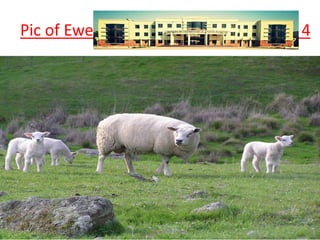
“ The female of the sheep especially when it
fully mature”.
• A member of a people of Togo and Ghana, in
western Africa, the Kwa language spoken by
the Ewe people.
Pic of Ewe 4
Puberty 5
• Ewes generally reach Puberty at six to
eight months of age .
• Puberty is when a ewe reaches sexual
maturity and exhibits estrus (heat) for the first
time.
• The age of puberty is influenced by
breed, genetic selection, body size,
nutrition, and season of birth.
Pregnancy 6
The average gestation length in sheep varies
from 142 to 152 days.
• The average is 147 days.
• There are breed differences in gestation
length.
Pragnancy problems 7
01. Pregnancy toxaemia
02. Hypocalcaemia
03. Hypomagnesaemia
01.Pregnancy toxaemia 8
• ketosis, pregnancy toxemia
• Pregnancy toxaemia occurs when low levels of
glucose in the blood, damage the brain and
result in dehydration, kidney failure and
potentially death.
• It usually occurs in the last weeks of
pregnancy.
Causes 9
not receive enough nutrition.
• In Western Australia, autumn is a precarious time
for ewes dry feed is minimal and the
pregnant ewe’s nutritional needs are increasing,
making her susceptible to pregnancy toxaemia.
Symptoms 10
• standing apart from the flock
• not grazing
• not coming to the trough at feeding time.
Treatment 11
• Propylene glycol can be given orally that acts
as a precursor to glucose
• administering IV dextrose
02. Hypocalcaemia 12
(Also known as Milk Fever)
• It can occur in late pregnancy.
• The condition can be induced by some form of
stress with her normal metabolism
low blood calcium.
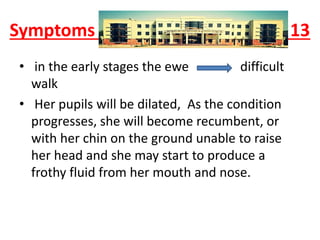
Symptoms 13
• in the early stages the ewe difficult
walk
• Her pupils will be dilated, As the condition
progresses, she will become recumbent, or
with her chin on the ground unable to raise
her head and she may start to produce a
frothy fluid from her mouth and nose.
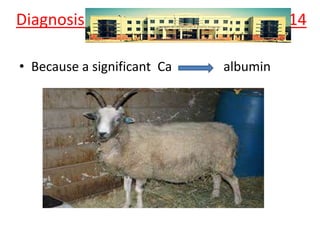
Diagnosis 14
• Because a significant Ca albumin
Treatment 15
• administered as calcium borogluconate IV
(50–150 mL of a 23% solution)
03. Hypomagnesaemia 16
(Also known as Grass Staggers)
• Fast-growing spring grass is often very low in
magnesium, especially if it has been heavily
fertilised with nitrogen and potash fertiliser,
resulting in low blood magnesium in the ewe
Symptoms 17
• animals will appear over-alert
• if left untreated the condition progresses
quickly,
• causing excitability and spasms, or
convulsions, leading to collapse and death in a
few hours
Treatment 18
.
• 1. Slow intravenous injection of calcium
borogluconate and magnesium sulphate
• 2. Further subcutaneous injection of a
solution containing a higher concentration of
magnesium.
Picture 19
Source 20
• Helen A. Swartz, State Sheep, Goat and Small
Livestock Specialist
• Merck & Co (2008) The Merck Veterinary
Manual (Eighth Edition) Merial (Pregnancy
Toxaemia)
• Durlach, J; Bac, P; Durlach, V; Bara, M; Guiet-
Bara, A (June 1997). "Neurotic, neuromuscular
and autonomic nervous form of magnesium
imbalance". Magnesium research (International
Society for the Development of Research on
Magnesium) (Hypocalcaemia)
Source 21
• Foster, A. (2007) Farm Animal Practice:
Magnesium disorders in ruminants In
Practice 29:534-539 (Hypomagnesaemia)
Pregnancy problems of ewe

Pregnancy problems of ewe

  • 1.
    “Pregnancy Problems OfEwe” 1 Presented to: Dr. Kashif Ishaq Presented By: 14-Arid-2022 14-Arid-2025 Evening B Group
  • 2.
    Contents…! 2 • Introductionof Ewe • Puberty • Pregnancy • Pragnancy problems • Source from taken data
  • 3.
    Ewe 3 “ Thefemale of the sheep especially when it fully mature”. • A member of a people of Togo and Ghana, in western Africa, the Kwa language spoken by the Ewe people.
  • 4.
  • 5.
    Puberty 5 • Ewesgenerally reach Puberty at six to eight months of age . • Puberty is when a ewe reaches sexual maturity and exhibits estrus (heat) for the first time. • The age of puberty is influenced by breed, genetic selection, body size, nutrition, and season of birth.
  • 6.
    Pregnancy 6 The averagegestation length in sheep varies from 142 to 152 days. • The average is 147 days. • There are breed differences in gestation length.
  • 7.
    Pragnancy problems 7 01.Pregnancy toxaemia 02. Hypocalcaemia 03. Hypomagnesaemia
  • 8.
    01.Pregnancy toxaemia 8 •ketosis, pregnancy toxemia • Pregnancy toxaemia occurs when low levels of glucose in the blood, damage the brain and result in dehydration, kidney failure and potentially death. • It usually occurs in the last weeks of pregnancy.
  • 9.
    Causes 9 not receiveenough nutrition. • In Western Australia, autumn is a precarious time for ewes dry feed is minimal and the pregnant ewe’s nutritional needs are increasing, making her susceptible to pregnancy toxaemia.
  • 10.
    Symptoms 10 • standingapart from the flock • not grazing • not coming to the trough at feeding time.
  • 11.
    Treatment 11 • Propyleneglycol can be given orally that acts as a precursor to glucose • administering IV dextrose
  • 12.
    02. Hypocalcaemia 12 (Alsoknown as Milk Fever) • It can occur in late pregnancy. • The condition can be induced by some form of stress with her normal metabolism low blood calcium.
  • 13.
    Symptoms 13 • inthe early stages the ewe difficult walk • Her pupils will be dilated, As the condition progresses, she will become recumbent, or with her chin on the ground unable to raise her head and she may start to produce a frothy fluid from her mouth and nose.
  • 14.
    Diagnosis 14 • Becausea significant Ca albumin
  • 15.
    Treatment 15 • administeredas calcium borogluconate IV (50–150 mL of a 23% solution)
  • 16.
    03. Hypomagnesaemia 16 (Alsoknown as Grass Staggers) • Fast-growing spring grass is often very low in magnesium, especially if it has been heavily fertilised with nitrogen and potash fertiliser, resulting in low blood magnesium in the ewe
  • 17.
    Symptoms 17 • animalswill appear over-alert • if left untreated the condition progresses quickly, • causing excitability and spasms, or convulsions, leading to collapse and death in a few hours
  • 18.
    Treatment 18 . • 1.Slow intravenous injection of calcium borogluconate and magnesium sulphate • 2. Further subcutaneous injection of a solution containing a higher concentration of magnesium.
  • 19.
  • 20.
    Source 20 • HelenA. Swartz, State Sheep, Goat and Small Livestock Specialist • Merck & Co (2008) The Merck Veterinary Manual (Eighth Edition) Merial (Pregnancy Toxaemia) • Durlach, J; Bac, P; Durlach, V; Bara, M; Guiet- Bara, A (June 1997). "Neurotic, neuromuscular and autonomic nervous form of magnesium imbalance". Magnesium research (International Society for the Development of Research on Magnesium) (Hypocalcaemia)
  • 21.
    Source 21 • Foster,A. (2007) Farm Animal Practice: Magnesium disorders in ruminants In Practice 29:534-539 (Hypomagnesaemia)