Module 4
Analyzing Primary Sources:
Dasalan at Tocsohan
Learning Outcomes
At the end of the course, the students should be able to:
● develop critical and analytical skills by reading primary sources
● analyze the context and content of a selected primary source.
● determine the historical importance of the text
● examine the author’s point of view and main argument
ENGAGEMENT
When was the last time when you did not like what others did to you because they made
everything worse for you? And when was the time you wanted to speak back to them? Didn’t
you speak back to them—or at least about them? Didn’t you express your disgust? How hid
you do it—what exactly did you do? How did you express your disappointment or disgust of
their undesirable deeds? Did you just attack them to get back at them—or did you do
something more?
Such was the feeling of the members of the Propaganda Movement—including
Marcelo H. Del Pilar, who wrote and published on their periodical La Solidaridad. Most
ilustrados (Enlightened) during the 1880s did just that—take to writing to express their
opinions but most importantly their dislike of the oppressive Spanish rule.
The Ilustrados were a group of wealthy sons of the middle class who went abroad to
study and be enlightened of the real happenings in their country. There they published articles
and newspapers which attacked the oppressive rule in their home country, Las Islas Filipinas.
Among the literary forms they used are satire and parodies, which attack people in position
and power.
EXPLORATION
PARODY
What is a parody? A parody is an
imitation of something, particularly
literature or a film that is meant to make
fun of it. Also called a spoof, a send-up, a
takeoff, a lampoon, a play on something,
or a caricature, a parody is a creative work
that imitates, comments on, and/or makes
fun of its subject.
Often its subject is an original
work or some aspect of it—theme or
content, author, style, etc. It can also be
about a real-life person (e.g. a politician),
event, or movement (e.g. the French
Revolution, people in government, or
despotic rulers).
Parodies can be found in art or
culture, including literature, music, theater,
television and film, animation and gaming.
Some parody is practiced in theater.
For example, in movies, Austin
Powers is a character parody of James
Bond while Fifty Shades of Black is a
parody of Fifty Shade of Grey. Vampires
Suck parodies Twilight while Meet the
Spartans makes fun of the popular movie
300.
See the collages below.
PRESENTATION
Read the following work by Marcelo H. Del Pilar, one of the noted propagandists at the time
who used parody to attack the oppressive Spanish rule in his time.
Dasalan at Tocsohan
See separate material on Google Classroom.
Context
In reading his work, Dasalan at Tocsohan (1888), it is important to know the author’s background.
M
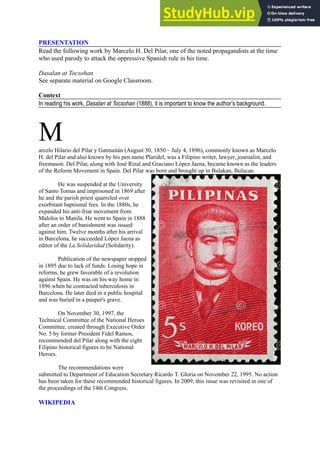
arcelo Hilario del Pilar y Gatmaitán (August 30, 1850 – July 4, 1896), commonly known as Marcelo
H. del Pilar and also known by his pen name Plaridel, was a Filipino writer, lawyer, journalist, and
freemason. Del Pilar, along with José Rizal and Graciano López Jaena, became known as the leaders
of the Reform Movement in Spain. Del Pilar was born and brought up in Bulakan, Bulacan.
He was suspended at the University
of Santo Tomas and imprisoned in 1869 after
he and the parish priest quarreled over
exorbitant baptismal fees. In the 1880s, he
expanded his anti-friar movement from
Malolos to Manila. He went to Spain in 1888
after an order of banishment was issued
against him. Twelve months after his arrival
in Barcelona, he succeeded López Jaena as
editor of the La Solidaridad (Solidarity).
Publication of the newspaper stopped
in 1895 due to lack of funds. Losing hope in
reforms, he grew favorable of a revolution
against Spain. He was on his way home in
1896 when he contracted tuberculosis in
Barcelona. He later died in a public hospital
and was buried in a pauper's grave.
On November 30, 1997, the
Technical Committee of the National Heroes
Committee, created through Executive Order
No. 5 by former President Fidel Ramos,
recommended del Pilar along with the eight
Filipino historical figures to be National
Heroes.
The recommendations were
submitted to Department of Education Secretary Ricardo T. Gloria on November 22, 1995. No action
has been taken for these recommended historical figures. In 2009, this issue was revisited in one of
the proceedings of the 14th Congress.
WIKIPEDIA
SEATWORK
LOGO PARODY. Make a parody of a popular brand. Design the logo using the same font or
stylization as the original. Make sure your parody is clear and makes fun of—if not
criticizes—the brand itself. See examples below.
SONG PARODY
Write a parody of a popular song you like. Write the title of the song and its lyrics—stanza by
stanza. You can choose Tagalog song or English song. Substitute the original lyrics with your
funny lyrics. Make sure you are criticizing or attacking an issue.

Analyzing Primary Sources Dasalan At Tocsohan

  • 1.
    Module 4 Analyzing PrimarySources: Dasalan at Tocsohan Learning Outcomes At the end of the course, the students should be able to: ● develop critical and analytical skills by reading primary sources ● analyze the context and content of a selected primary source. ● determine the historical importance of the text ● examine the author’s point of view and main argument ENGAGEMENT When was the last time when you did not like what others did to you because they made everything worse for you? And when was the time you wanted to speak back to them? Didn’t you speak back to them—or at least about them? Didn’t you express your disgust? How hid you do it—what exactly did you do? How did you express your disappointment or disgust of their undesirable deeds? Did you just attack them to get back at them—or did you do something more? Such was the feeling of the members of the Propaganda Movement—including Marcelo H. Del Pilar, who wrote and published on their periodical La Solidaridad. Most ilustrados (Enlightened) during the 1880s did just that—take to writing to express their opinions but most importantly their dislike of the oppressive Spanish rule. The Ilustrados were a group of wealthy sons of the middle class who went abroad to study and be enlightened of the real happenings in their country. There they published articles and newspapers which attacked the oppressive rule in their home country, Las Islas Filipinas. Among the literary forms they used are satire and parodies, which attack people in position and power. EXPLORATION PARODY What is a parody? A parody is an imitation of something, particularly literature or a film that is meant to make fun of it. Also called a spoof, a send-up, a takeoff, a lampoon, a play on something, or a caricature, a parody is a creative work that imitates, comments on, and/or makes fun of its subject. Often its subject is an original work or some aspect of it—theme or content, author, style, etc. It can also be about a real-life person (e.g. a politician), event, or movement (e.g. the French Revolution, people in government, or despotic rulers). Parodies can be found in art or culture, including literature, music, theater, television and film, animation and gaming. Some parody is practiced in theater. For example, in movies, Austin Powers is a character parody of James Bond while Fifty Shades of Black is a parody of Fifty Shade of Grey. Vampires Suck parodies Twilight while Meet the Spartans makes fun of the popular movie 300. See the collages below.
  • 4.
    PRESENTATION Read the followingwork by Marcelo H. Del Pilar, one of the noted propagandists at the time who used parody to attack the oppressive Spanish rule in his time. Dasalan at Tocsohan See separate material on Google Classroom. Context In reading his work, Dasalan at Tocsohan (1888), it is important to know the author’s background. M arcelo Hilario del Pilar y Gatmaitán (August 30, 1850 – July 4, 1896), commonly known as Marcelo H. del Pilar and also known by his pen name Plaridel, was a Filipino writer, lawyer, journalist, and freemason. Del Pilar, along with José Rizal and Graciano López Jaena, became known as the leaders of the Reform Movement in Spain. Del Pilar was born and brought up in Bulakan, Bulacan. He was suspended at the University of Santo Tomas and imprisoned in 1869 after he and the parish priest quarreled over exorbitant baptismal fees. In the 1880s, he expanded his anti-friar movement from Malolos to Manila. He went to Spain in 1888 after an order of banishment was issued against him. Twelve months after his arrival in Barcelona, he succeeded López Jaena as editor of the La Solidaridad (Solidarity). Publication of the newspaper stopped in 1895 due to lack of funds. Losing hope in reforms, he grew favorable of a revolution against Spain. He was on his way home in 1896 when he contracted tuberculosis in Barcelona. He later died in a public hospital and was buried in a pauper's grave. On November 30, 1997, the Technical Committee of the National Heroes Committee, created through Executive Order No. 5 by former President Fidel Ramos, recommended del Pilar along with the eight Filipino historical figures to be National Heroes. The recommendations were submitted to Department of Education Secretary Ricardo T. Gloria on November 22, 1995. No action has been taken for these recommended historical figures. In 2009, this issue was revisited in one of the proceedings of the 14th Congress. WIKIPEDIA
  • 5.
    SEATWORK LOGO PARODY. Makea parody of a popular brand. Design the logo using the same font or stylization as the original. Make sure your parody is clear and makes fun of—if not criticizes—the brand itself. See examples below.
  • 6.
    SONG PARODY Write aparody of a popular song you like. Write the title of the song and its lyrics—stanza by stanza. You can choose Tagalog song or English song. Substitute the original lyrics with your funny lyrics. Make sure you are criticizing or attacking an issue.