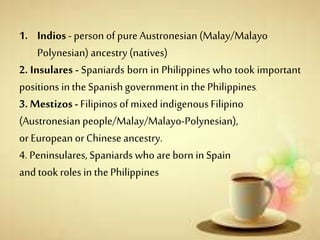
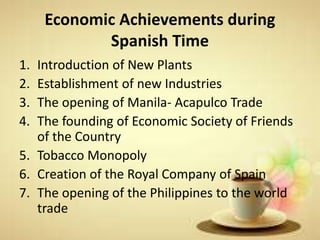
During the Spanish colonial period in the Philippines, Spanish rule established a complex social hierarchy. The principalia class, composed of local leaders, were exempt from forced labor and granted certain political rights. The ilustrados constituted the educated Filipino middle class exposed to liberal Spanish ideals in the late 19th century. Indigenous Filipinos were at the bottom of the social pyramid as indios, while Spaniards held the most power either born in the Philippines or Spain. The Spanish also introduced economic reforms and industries that developed the Philippines' economy and trade, while social changes like education and architecture reflected Spanish colonial influence over three centuries.