Topic 10:
Analyzing and managing Project Risk
Topic 10 : Analyzing and managing project risk
• Project risk management is the process of identifying, analyzing and then
responding to any risk that arises over the life cycle of a project to help the project
remain on track and meet its goal.
• Proactively identifying and controlling risk greatly increases the accuracy of the
project’s scope, schedule, and budget.
• A risk is anything that could potentially impact your project’s timeline, performance
or budget.
• What is risk analysis?
o Risk analysis is to find out how likely that a risk will arise in a project and to
study on the uncertainty and the impact to the project schedule, quality and
costs.
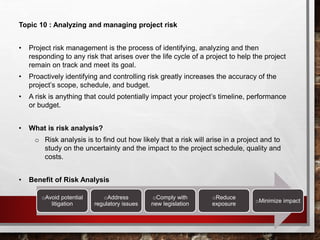
• Benefit of Risk Analysis
oAvoid potential
litigation
oAddress
regulatory issues
oComply with
new legislation
oReduce
exposure
oMinimize impact
• The process of evaluating project risk begins in the planning stages, but it must
continue through every stage of the project.
2 fundamental process of analyzing risks:
• Qualitative Risk Analysis
o Qualitative risk analysis is the process of prioritizing risks for further analysis or
action.
o Determining each risk’s likelihood or probability of occurring, as well as rating its
impact on the project.
o Qualitative risk analysis to reduce uncertainty in the project and focus mostly on
high-impact risks, which then the appropriate mitigation responses will be
planned.
• Quantitative Risk Analysis
o Quantitative risk analysis is a statistical analysis of the effect of those identified
risks on the overall project.
o Quantitative risk counts the possible outcomes for the project and figures out the
probability of still meeting project objectives which helps in decision-making,
creates cost, schedule or scope targets that are realistic.
Determining Impact
• Through qualitative and quantitative risk analysis, potential risks can be defined by
determining impacts to the following aspects of the project:
o Activity resource estimates
o Activity duration estimates
o Schedule
o Cost estimates
o Budget
o Quality
o Procurements
Tools and Techniques to Identify Risks
 Documentation reviews
o Involve reviewing project plans, assumptions, procurement documents and
historical information from previous projects
 Information Gathering
o Information gathering includes several techniques including Brainstorming, Delph
technique, Interviewing and root cause analysis.
• Brainstorming – Most often used technique to identify risk. It involves getting
the subject matter experts, team members, risk management team members
and anyone else that might benefit from the process.
Continue
• Delphi Technique – It is a technique like brainstorming, except the people
participating in the meeting don’t know each other. The email is used to
facilitate. Experts are assembled inside and outside company and provide
them with the questionnaire to identify the potential risks.
• Interviewing – Question and answer sessions held with others including other
project managers, subject matter expert, stakeholders, customers, the
management team, project team members and users.
• Root Cause Analysis – Investigating the cause of the risk that helps to
develop the risk response plan.
Developing Risk Response Plan
 Is a process deciding what actions to take to reduce threats and take advantage of
the opportunities discovered during the risk analysis process.
Strategies for Negative Risks and Threats
 Avoid – Eliminating the cause of the risk event or by changing the project
management plan to protect the project objectives from the risk event.
 Transfer – Transferring the risk and the consequences of that risk to third party.
As an example, car insurance. Purchasing car insurance so that if anything
happen on the road the cost to repair the damage of the car will be paid by the
insurance company.
 Mitigate – When mitigating the risks, the probability of the risk event occurring,
and the impacts are reduced.
 Accept – The acceptance strategy is used when aren’t able to eliminate the
threats on the project.
Strategies for Positive Risks or Opportunities
 Exploit – When exploit the risk event, you are looking for opportunities for positive
impacts. Example reducing the amount of time to complete the project by bringing
more qualified resources or by providing better quality.
 Share – Similar to transferring because the risk will be assigned to a third party
owner who is best able to bring the opportunity the risk event presents. Example
forming a joint venture with a marketing firm to capitalize on positive risk will make
the most of the opportunities.
 Enhance – Closely watches the probability or impact of the risk event to assure
that the organization realizes the benefits. This method is to increase the
probability and impact a positive risks.
Contingency response strategy
 Contingency planning involves planning alternatives to deal with certain risks
should they occur.
 This may include setting aside funding, resources, or adding contingency time to
the project schedule.
 Fallback plan is not contingency plan. It should be developed for risks with high
impact or for risks with identified strategies that might not be the most effective at
dealing with the risk.
Quiz 8
1. What is the benefit of Risk Analysis?

Analyzing And Managing Project Risk

  • 1.
    Topic 10: Analyzing andmanaging Project Risk
  • 2.
    Topic 10 :Analyzing and managing project risk • Project risk management is the process of identifying, analyzing and then responding to any risk that arises over the life cycle of a project to help the project remain on track and meet its goal. • Proactively identifying and controlling risk greatly increases the accuracy of the project’s scope, schedule, and budget. • A risk is anything that could potentially impact your project’s timeline, performance or budget. • What is risk analysis? o Risk analysis is to find out how likely that a risk will arise in a project and to study on the uncertainty and the impact to the project schedule, quality and costs. • Benefit of Risk Analysis oAvoid potential litigation oAddress regulatory issues oComply with new legislation oReduce exposure oMinimize impact
  • 3.
    • The processof evaluating project risk begins in the planning stages, but it must continue through every stage of the project. 2 fundamental process of analyzing risks: • Qualitative Risk Analysis o Qualitative risk analysis is the process of prioritizing risks for further analysis or action. o Determining each risk’s likelihood or probability of occurring, as well as rating its impact on the project. o Qualitative risk analysis to reduce uncertainty in the project and focus mostly on high-impact risks, which then the appropriate mitigation responses will be planned. • Quantitative Risk Analysis o Quantitative risk analysis is a statistical analysis of the effect of those identified risks on the overall project. o Quantitative risk counts the possible outcomes for the project and figures out the probability of still meeting project objectives which helps in decision-making, creates cost, schedule or scope targets that are realistic.
  • 4.
    Determining Impact • Throughqualitative and quantitative risk analysis, potential risks can be defined by determining impacts to the following aspects of the project: o Activity resource estimates o Activity duration estimates o Schedule o Cost estimates o Budget o Quality o Procurements
  • 5.
    Tools and Techniquesto Identify Risks  Documentation reviews o Involve reviewing project plans, assumptions, procurement documents and historical information from previous projects  Information Gathering o Information gathering includes several techniques including Brainstorming, Delph technique, Interviewing and root cause analysis. • Brainstorming – Most often used technique to identify risk. It involves getting the subject matter experts, team members, risk management team members and anyone else that might benefit from the process. Continue
  • 6.
    • Delphi Technique– It is a technique like brainstorming, except the people participating in the meeting don’t know each other. The email is used to facilitate. Experts are assembled inside and outside company and provide them with the questionnaire to identify the potential risks. • Interviewing – Question and answer sessions held with others including other project managers, subject matter expert, stakeholders, customers, the management team, project team members and users. • Root Cause Analysis – Investigating the cause of the risk that helps to develop the risk response plan.
  • 7.
    Developing Risk ResponsePlan  Is a process deciding what actions to take to reduce threats and take advantage of the opportunities discovered during the risk analysis process. Strategies for Negative Risks and Threats  Avoid – Eliminating the cause of the risk event or by changing the project management plan to protect the project objectives from the risk event.  Transfer – Transferring the risk and the consequences of that risk to third party. As an example, car insurance. Purchasing car insurance so that if anything happen on the road the cost to repair the damage of the car will be paid by the insurance company.  Mitigate – When mitigating the risks, the probability of the risk event occurring, and the impacts are reduced.  Accept – The acceptance strategy is used when aren’t able to eliminate the threats on the project.
  • 8.
    Strategies for PositiveRisks or Opportunities  Exploit – When exploit the risk event, you are looking for opportunities for positive impacts. Example reducing the amount of time to complete the project by bringing more qualified resources or by providing better quality.  Share – Similar to transferring because the risk will be assigned to a third party owner who is best able to bring the opportunity the risk event presents. Example forming a joint venture with a marketing firm to capitalize on positive risk will make the most of the opportunities.  Enhance – Closely watches the probability or impact of the risk event to assure that the organization realizes the benefits. This method is to increase the probability and impact a positive risks.
  • 9.
    Contingency response strategy Contingency planning involves planning alternatives to deal with certain risks should they occur.  This may include setting aside funding, resources, or adding contingency time to the project schedule.  Fallback plan is not contingency plan. It should be developed for risks with high impact or for risks with identified strategies that might not be the most effective at dealing with the risk.
  • 10.
    Quiz 8 1. Whatis the benefit of Risk Analysis?