LOGO
Chapter 13
Risk
Analysis
Your Site Here
Presented By:
Singhzee and Group
Economics
To study a variety of tools to help
managers improve decision making
To understand the concept of expected
value
To examine techniques to reduce
uncertainty
To understand the concept of expected
utility
Objectives
 Risk and Probability
 Probability Distributions and Expected Value
 Comparisons of Expected Profit
 Road Map to Decision
 The Expected Value of Perfect Information
 Measuring Attitudes towards risk
 The Standard Deviation and Coefficient of Variation Measures
of Risk
 Certainty Equivalence
Contents
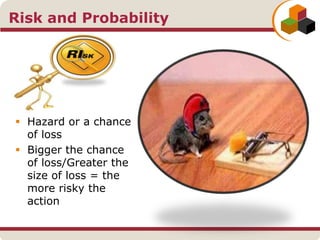
 Hazard or a chance
of loss
 Bigger the chance
of loss/Greater the
size of loss = the
more risky the
action
Risk and Probability
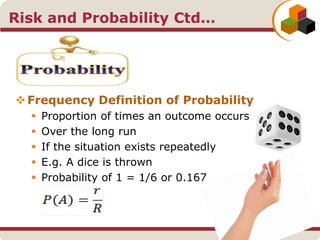
Frequency Definition of Probability
 Proportion of times an outcome occurs
 Over the long run
 If the situation exists repeatedly
 E.g. A dice is thrown
 Probability of 1 = 1/6 or 0.167
Risk and Probability Ctd…
Subjective Definition of Probability
 Managers ‘ Degree of confidence or belief
 That event will occur
 Used when experiments cannot be repeated
 Use of Managers’ judgment
 High probability for higher degree of
confidence and vice versa
Risk and Probability Ctd…
Subjective Definition of Probability
Risk and Probability Ctd…
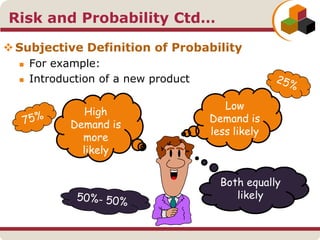
Subjective Definition of Probability
 For example:
 Introduction of a new product
Risk and Probability Ctd…
High
Demand is
more
likely
Low
Demand is
less likely
Both equally
likely
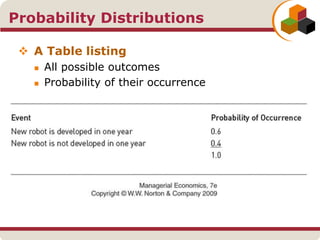
Probability Distributions
 A Table listing
 All possible outcomes
 Probability of their occurrence
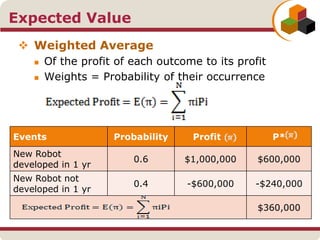
Expected Value
 Weighted Average
 Of the profit of each outcome to its profit
 Weights = Probability of their occurrence
Events Probability Profit P*
New Robot
developed in 1 yr
0.6 $1,000,000 $600,000
New Robot not
developed in 1 yr
0.4 -$600,000 -$240,000
$360,000
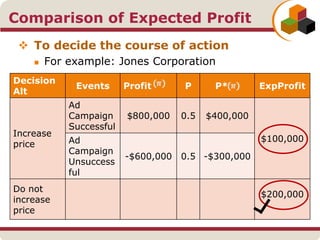
Comparison of Expected Profit
 To decide the course of action
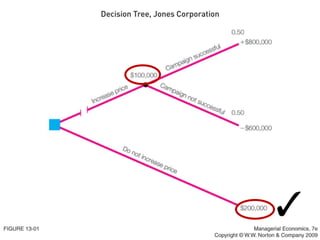
 For example: Jones Corporation
Decision
Alt
Events Profit P P* ExpProfit
Increase
price
Ad
Campaign
Successful
$800,000 0.5 $400,000
$100,000Ad
Campaign
Unsuccess
ful
-$600,000 0.5 -$300,000
Do not
increase
price
$200,000
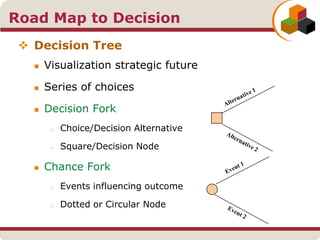
Road Map to Decision
 Decision Tree
 Visualization strategic future
 Series of choices
 Decision Fork
o Choice/Decision Alternative
o Square/Decision Node
 Chance Fork
o Events influencing outcome
o Dotted or Circular Node
EVPI
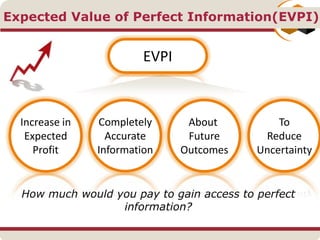
Expected Value of Perfect Information(EVPI)
How much would you pay to gain access to perfect
information?
Completely
Accurate
Information
About
Future
Outcomes
Increase in
Expected
Profit
To
Reduce
Uncertainty
EVPI Continued…
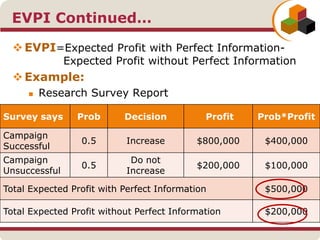
EVPI=Expected Profit with Perfect Information-
Expected Profit without Perfect Information
Example:
 Research Survey Report
Survey says Prob Decision Profit Prob*Profit
Campaign
Successful
0.5 Increase $800,000 $400,000
Campaign
Unsuccessful
0.5
Do not
Increase
$200,000 $100,000
Total Expected Profit with Perfect Information $500,000
Total Expected Profit without Perfect Information $200,000
EVPI Continued…
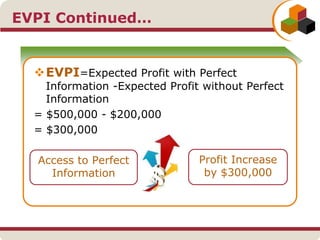
EVPI=Expected Profit with Perfect
Information -Expected Profit without Perfect
Information
= $500,000 - $200,000
= $300,000
Access to Perfect
Information
Profit Increase
by $300,000
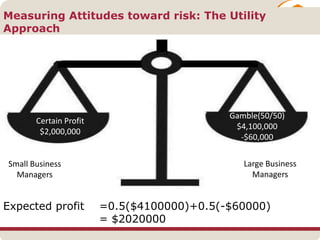
Measuring Attitudes toward risk: The Utility
Approach
Certain Profit
$2,000,000
Gamble(50/50)
$4,100,000
-$60,000
Expected profit =0.5($4100000)+0.5(-$60000)
= $2020000
Small Business
Managers
Large Business
Managers
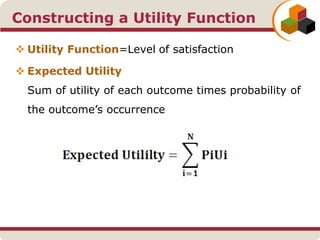
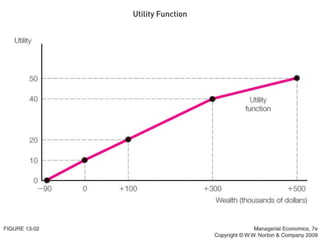
Constructing a Utility Function
 Utility Function=Level of satisfaction
 Expected Utility
Sum of utility of each outcome times probability of
the outcome’s occurrence
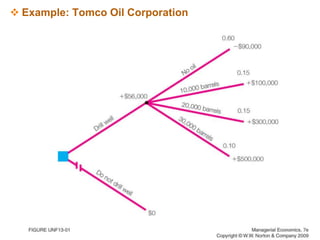
Constructing a Utility Function Example: Tomco Oil Corporation
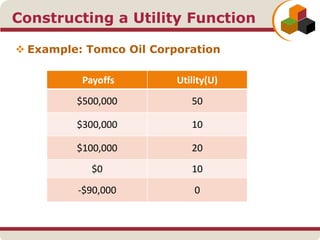
Constructing a Utility Function
Payoffs Utility(U)
$500,000 50
$300,000 10
$100,000 20
$0 10
-$90,000 0
 Example: Tomco Oil Corporation
Attitudes towards Risk
 Three Types
Risk Averter
Risk Lover
Risk-Neutral
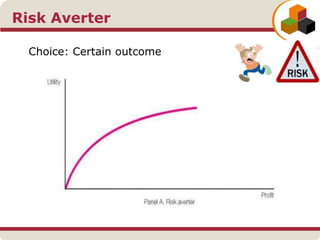
Risk Averter
Choice: Certain outcome
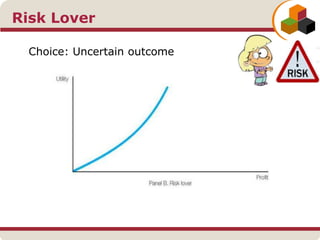
Risk Lover
Choice: Uncertain outcome
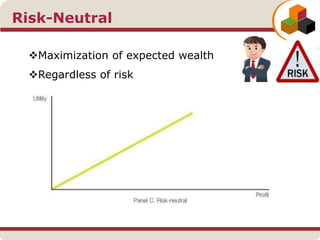
Risk-Neutral
Maximization of expected wealth
Regardless of risk
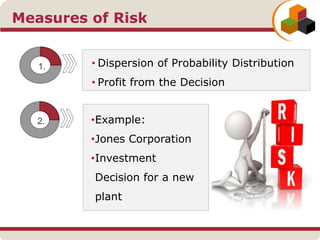
Measures of Risk
2. •Example:
•Jones Corporation
•Investment
Decision for a new
plant
1. • Dispersion of Probability Distribution
• Profit from the Decision
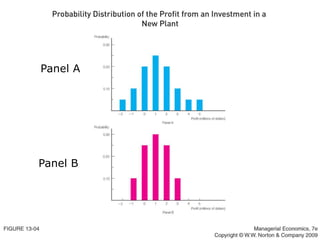
 Magnitude of negative outcomes
 Dispersion of Probability distribution
Measures of Risk
 For Example:
 Jones Corporation
 Decision to invest in a
new plant
Panel A
Panel B
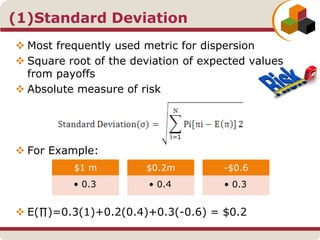
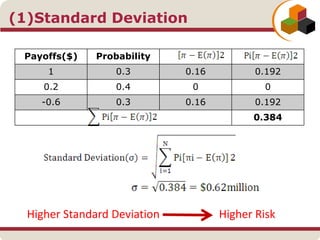
(1)Standard Deviation
 Most frequently used metric for dispersion
 Square root of the deviation of expected values
from payoffs
 Absolute measure of risk
 For Example:
 E(∏)=0.3(1)+0.2(0.4)+0.3(-0.6) = $0.2
$1 m
• 0.3
$0.2m
• 0.4
-$0.6
• 0.3
(1)Standard Deviation
Payoffs($) Probability
1 0.3 0.16 0.192
0.2 0.4 0 0
-0.6 0.3 0.16 0.192
0.384
Higher Standard Deviation Higher Risk
(2)Coefficient of Variation(V)
 Relative measure of risk
 Ratio of S.D(σ) to Expected Profit [E(∏)]
 Lower the V better the risk-return trade off
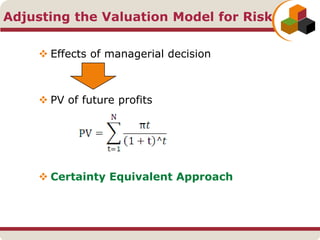
Adjusting the Valuation Model for Risk
 Effects of managerial decision
 PV of future profits
 Certainty Equivalent Approach
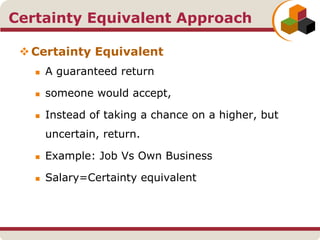
Certainty Equivalent
 A guaranteed return
 someone would accept,
 Instead of taking a chance on a higher, but
uncertain, return.
 Example: Job Vs Own Business
 Salary=Certainty equivalent
Certainty Equivalent Approach
Click to Edit Title
Sub Title Sub Title
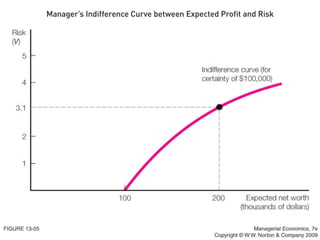
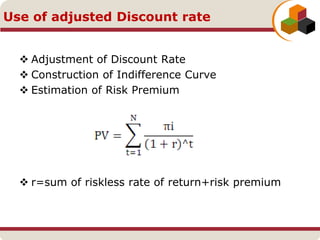
 Adjustment of Discount Rate
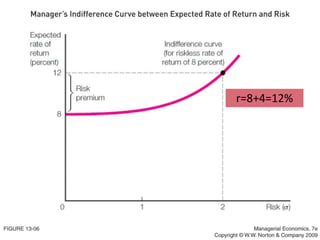
 Construction of Indifference Curve
 Estimation of Risk Premium
 r=sum of riskless rate of return+risk premium
Use of adjusted Discount rate
A
B
C
D
1 2 3 4
Click to Edit Title
r=8+4=12%
LOGO
Thank
You!

Risk analysis Chapter

  • 1.
    LOGO Chapter 13 Risk Analysis Your SiteHere Presented By: Singhzee and Group Economics
  • 2.
    To study avariety of tools to help managers improve decision making To understand the concept of expected value To examine techniques to reduce uncertainty To understand the concept of expected utility Objectives
  • 3.
     Risk andProbability  Probability Distributions and Expected Value  Comparisons of Expected Profit  Road Map to Decision  The Expected Value of Perfect Information  Measuring Attitudes towards risk  The Standard Deviation and Coefficient of Variation Measures of Risk  Certainty Equivalence Contents
  • 4.
     Hazard ora chance of loss  Bigger the chance of loss/Greater the size of loss = the more risky the action Risk and Probability
  • 5.
    Frequency Definition ofProbability  Proportion of times an outcome occurs  Over the long run  If the situation exists repeatedly  E.g. A dice is thrown  Probability of 1 = 1/6 or 0.167 Risk and Probability Ctd…
  • 6.
    Subjective Definition ofProbability  Managers ‘ Degree of confidence or belief  That event will occur  Used when experiments cannot be repeated  Use of Managers’ judgment  High probability for higher degree of confidence and vice versa Risk and Probability Ctd…
  • 7.
    Subjective Definition ofProbability Risk and Probability Ctd…
  • 8.
    Subjective Definition ofProbability  For example:  Introduction of a new product Risk and Probability Ctd… High Demand is more likely Low Demand is less likely Both equally likely
  • 9.
    Probability Distributions  ATable listing  All possible outcomes  Probability of their occurrence
  • 10.
    Expected Value  WeightedAverage  Of the profit of each outcome to its profit  Weights = Probability of their occurrence Events Probability Profit P* New Robot developed in 1 yr 0.6 $1,000,000 $600,000 New Robot not developed in 1 yr 0.4 -$600,000 -$240,000 $360,000
  • 11.
    Comparison of ExpectedProfit  To decide the course of action  For example: Jones Corporation Decision Alt Events Profit P P* ExpProfit Increase price Ad Campaign Successful $800,000 0.5 $400,000 $100,000Ad Campaign Unsuccess ful -$600,000 0.5 -$300,000 Do not increase price $200,000
  • 12.
    Road Map toDecision  Decision Tree  Visualization strategic future  Series of choices  Decision Fork o Choice/Decision Alternative o Square/Decision Node  Chance Fork o Events influencing outcome o Dotted or Circular Node
  • 14.
    EVPI Expected Value ofPerfect Information(EVPI) How much would you pay to gain access to perfect information? Completely Accurate Information About Future Outcomes Increase in Expected Profit To Reduce Uncertainty
  • 15.
    EVPI Continued… EVPI=Expected Profitwith Perfect Information- Expected Profit without Perfect Information Example:  Research Survey Report Survey says Prob Decision Profit Prob*Profit Campaign Successful 0.5 Increase $800,000 $400,000 Campaign Unsuccessful 0.5 Do not Increase $200,000 $100,000 Total Expected Profit with Perfect Information $500,000 Total Expected Profit without Perfect Information $200,000
  • 16.
    EVPI Continued… EVPI=Expected Profitwith Perfect Information -Expected Profit without Perfect Information = $500,000 - $200,000 = $300,000 Access to Perfect Information Profit Increase by $300,000
  • 17.
    Measuring Attitudes towardrisk: The Utility Approach Certain Profit $2,000,000 Gamble(50/50) $4,100,000 -$60,000 Expected profit =0.5($4100000)+0.5(-$60000) = $2020000 Small Business Managers Large Business Managers
  • 18.
    Constructing a UtilityFunction  Utility Function=Level of satisfaction  Expected Utility Sum of utility of each outcome times probability of the outcome’s occurrence
  • 19.
    Constructing a UtilityFunction Example: Tomco Oil Corporation
  • 20.
    Constructing a UtilityFunction Payoffs Utility(U) $500,000 50 $300,000 10 $100,000 20 $0 10 -$90,000 0  Example: Tomco Oil Corporation
  • 22.
    Attitudes towards Risk Three Types Risk Averter Risk Lover Risk-Neutral
  • 23.
  • 24.
  • 25.
    Risk-Neutral Maximization of expectedwealth Regardless of risk
  • 26.
    Measures of Risk 2.•Example: •Jones Corporation •Investment Decision for a new plant 1. • Dispersion of Probability Distribution • Profit from the Decision
  • 27.
     Magnitude ofnegative outcomes  Dispersion of Probability distribution Measures of Risk  For Example:  Jones Corporation  Decision to invest in a new plant Panel A Panel B
  • 28.
    (1)Standard Deviation  Mostfrequently used metric for dispersion  Square root of the deviation of expected values from payoffs  Absolute measure of risk  For Example:  E(∏)=0.3(1)+0.2(0.4)+0.3(-0.6) = $0.2 $1 m • 0.3 $0.2m • 0.4 -$0.6 • 0.3
  • 29.
    (1)Standard Deviation Payoffs($) Probability 10.3 0.16 0.192 0.2 0.4 0 0 -0.6 0.3 0.16 0.192 0.384 Higher Standard Deviation Higher Risk
  • 30.
    (2)Coefficient of Variation(V) Relative measure of risk  Ratio of S.D(σ) to Expected Profit [E(∏)]  Lower the V better the risk-return trade off
  • 31.
    Adjusting the ValuationModel for Risk  Effects of managerial decision  PV of future profits  Certainty Equivalent Approach
  • 32.
    Certainty Equivalent  Aguaranteed return  someone would accept,  Instead of taking a chance on a higher, but uncertain, return.  Example: Job Vs Own Business  Salary=Certainty equivalent Certainty Equivalent Approach
  • 33.
    Click to EditTitle Sub Title Sub Title
  • 34.
     Adjustment ofDiscount Rate  Construction of Indifference Curve  Estimation of Risk Premium  r=sum of riskless rate of return+risk premium Use of adjusted Discount rate
  • 35.
    A B C D 1 2 34 Click to Edit Title r=8+4=12%
  • 36.