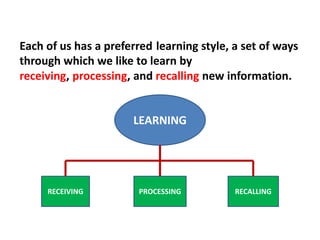

Each of us has a preferred learning style, a set of ways
through which we like to learn by
receiving, processing, and recalling new information.
LEARNING
RECEIVING PROCESSING RECALLING
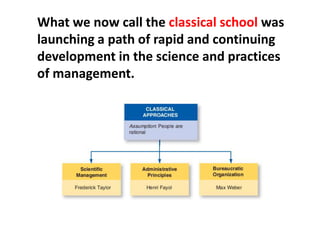
What we now call the classical school was
launching a path of rapid and continuing
development in the science and practices
of management.
Taylor:
The principal object of management should be to secure maximum
prosperity for the employer, coupled with the maximum prosperity
for the employee.
Scientific management included these four core principles:
1.Develop a science for each job-rules of motion, standard work tools, and
proper work conditions.
2.Hire workers with the right abilities for the job.
3.Train and motivate workers to do their jobs according to the science.
4.Support workers by planning and assisting their work according to the science.
Max Weber was especially concerned that
people were in positions of authority not
because of their job-related capabilities
but because of their social standing or
privileged status.
A bureaucracy is a rational and efficient
form of organization founded on
logic, order, and legitimate authority.
Clear Division of Labor Jobs are well defined, and workers
become highly skilled at performing them.
Clear Hierarchy of Authority Authority and responsibility are
well defined, and each position reports to a higher-level one.
Formal Rules and Procedures Written guidelines describe
expected behavior and decisions in jobs; written files are kept
for the historical record.
Impersonality Rules and procedures are impartially and
uniformly applied; no one gets preferential treatment.
Careers Based on Merit Workers are selected and promoted on
ability and performance; managers are career employees of
the organization.
Characteristics of an Ideal Bureaucracy
Fayol’s Five Rules Of Management:
•Foresight—complete a plan of action for the future.
•Organization—provide and mobilize resources to implement plan.
•Command—lead, select, and evaluate workers.
•Coordination—fit diverse efforts together, ensure information is shared and
problems are solved.
•Control—make sure things happen according to plan, take necessary
corrective action.
The scalar chain principle
states that organizations should
operate with clear and unbroken
lines of communication top to
bottom.
The unity of command
Principle states that a worker
should receive orders from only
one boss.
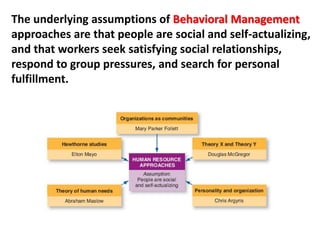
The underlying assumptions of Behavioral Management
approaches are that people are social and self-actualizing,
and that workers seek satisfying social relationships,
respond to group pressures, and search for personal
fulfillment.
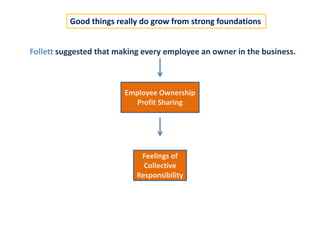
Good things really do grow from strong foundations
Follett suggested that making every employee an owner in the business.
Feelings of
Collective
Responsibility
Employee Ownership
Profit Sharing
The Hawthorne effect is the tendency of persons
singled out for special attention to perform as
expected.
The Hawthorne studies helped shift the attention of
managers and researchers away from the technical
and structural concerns of the classical approaches
and toward social and human concerns as important
keys to workplace productivity.
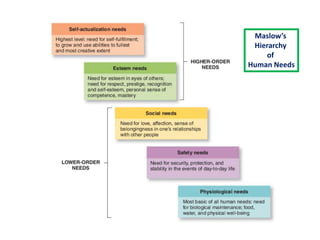
Maslow :
Needs create tensions that can influence a person’s
work attitudes and behaviors.
A NEED is a physiological or
psychological deficiency that a
person wants to satisfy.
Maslow’s
Hierarchy
of
Human Needs
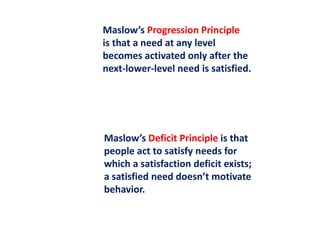
Maslow’s Progression Principle
is that a need at any level
becomes activated only after the
next-lower-level need is satisfied.
Maslow’s Deficit Principle is that
people act to satisfy needs for
which a satisfaction deficit exists;
a satisfied need doesn’t motivate
behavior.
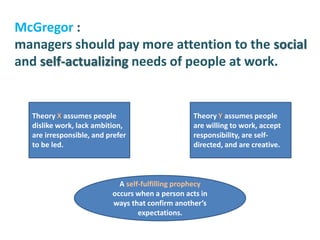
McGregor :
managers should pay more attention to the social
and self-actualizing needs of people at work.
Theory X assumes people
dislike work, lack ambition,
are irresponsible, and prefer
to be led.
Theory Y assumes people
are willing to work, accept
responsibility, are self-
directed, and are creative.
A self-fulfilling prophecy
occurs when a person acts in
ways that confirm another’s
expectations.
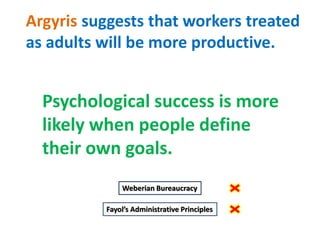
Argyris suggests that workers treated
as adults will be more productive.
Psychological success is more
likely when people define
their own goals.
Weberian Bureaucracy
Fayol’s Administrative Principles
Analytics is the systematic use and analysis
of data to solve problems and make
informed decisions.
Management science and operations research
apply mathematical techniques to solve
management problems.
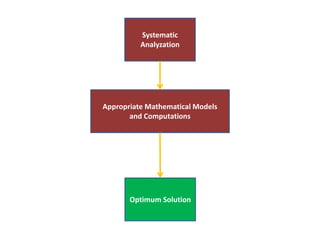
Systematic
Analyzation
Appropriate Mathematical Models
and Computations
Optimum Solution
Operations Management is the study of
how organizations produce goods and
services efficiently and effectively.
Business Process Analysis
Workflow Designs
Facilities Layouts and Locations
Work Scheduling and Project Management
Production Planning
Inventory Management
Quality Control
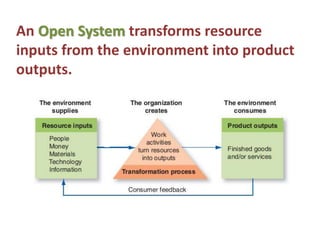
An Open System transforms resource
inputs from the environment into product
outputs.
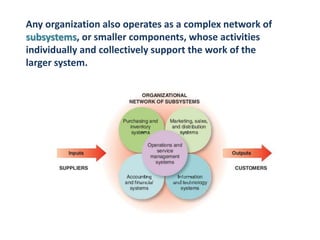
Any organization also operates as a complex network of
subsystems, or smaller components, whose activities
individually and collectively support the work of the
larger system.
Contingency Thinking recognizes organizational complexities
and attempts to identify practices that best fit with the unique
demands of different situations.
Contingency Thinking recognizes that the structure that works
well for one organization may not work well for another in
different circumstances.
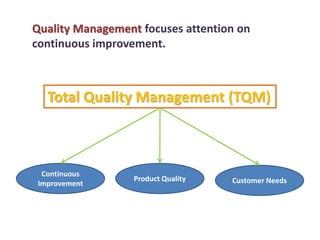
Quality Management focuses attention on
continuous improvement.
Total Quality Management (TQM)
Continuous
Improvement
Product Quality Customer Needs
Continuous Improvement involves always searching
for new ways to improve work quality and
performance.
The goal is that one can never be satisfied;
something always can and should be
improved upon.
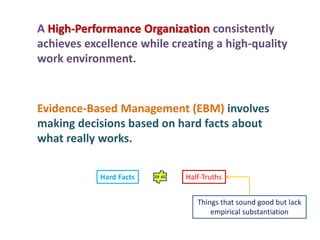
A High-Performance Organization consistently
achieves excellence while creating a high-quality
work environment.
Evidence-Based Management (EBM) involves
making decisions based on hard facts about
what really works.
Hard Facts Half-Truths
Things that sound good but lack
empirical substantiation
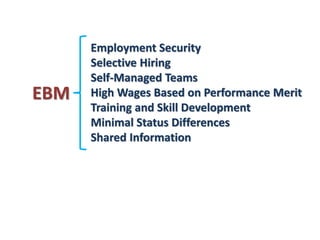
Employment Security
Selective Hiring
Self-Managed Teams
High Wages Based on Performance Merit
Training and Skill Development
Minimal Status Differences
Shared Information
EBM
Management Learning
Management Learning

Management Learning

  • 2.
    Each of ushas a preferred learning style, a set of ways through which we like to learn by receiving, processing, and recalling new information. LEARNING RECEIVING PROCESSING RECALLING
  • 3.
    What we nowcall the classical school was launching a path of rapid and continuing development in the science and practices of management.
  • 4.
    Taylor: The principal objectof management should be to secure maximum prosperity for the employer, coupled with the maximum prosperity for the employee. Scientific management included these four core principles: 1.Develop a science for each job-rules of motion, standard work tools, and proper work conditions. 2.Hire workers with the right abilities for the job. 3.Train and motivate workers to do their jobs according to the science. 4.Support workers by planning and assisting their work according to the science.
  • 5.
    Max Weber wasespecially concerned that people were in positions of authority not because of their job-related capabilities but because of their social standing or privileged status. A bureaucracy is a rational and efficient form of organization founded on logic, order, and legitimate authority.
  • 6.
    Clear Division ofLabor Jobs are well defined, and workers become highly skilled at performing them. Clear Hierarchy of Authority Authority and responsibility are well defined, and each position reports to a higher-level one. Formal Rules and Procedures Written guidelines describe expected behavior and decisions in jobs; written files are kept for the historical record. Impersonality Rules and procedures are impartially and uniformly applied; no one gets preferential treatment. Careers Based on Merit Workers are selected and promoted on ability and performance; managers are career employees of the organization. Characteristics of an Ideal Bureaucracy
  • 7.
    Fayol’s Five RulesOf Management: •Foresight—complete a plan of action for the future. •Organization—provide and mobilize resources to implement plan. •Command—lead, select, and evaluate workers. •Coordination—fit diverse efforts together, ensure information is shared and problems are solved. •Control—make sure things happen according to plan, take necessary corrective action. The scalar chain principle states that organizations should operate with clear and unbroken lines of communication top to bottom. The unity of command Principle states that a worker should receive orders from only one boss.
  • 8.
    The underlying assumptionsof Behavioral Management approaches are that people are social and self-actualizing, and that workers seek satisfying social relationships, respond to group pressures, and search for personal fulfillment.
  • 9.
    Good things reallydo grow from strong foundations Follett suggested that making every employee an owner in the business. Feelings of Collective Responsibility Employee Ownership Profit Sharing
  • 10.
    The Hawthorne effectis the tendency of persons singled out for special attention to perform as expected. The Hawthorne studies helped shift the attention of managers and researchers away from the technical and structural concerns of the classical approaches and toward social and human concerns as important keys to workplace productivity.
  • 11.
    Maslow : Needs createtensions that can influence a person’s work attitudes and behaviors. A NEED is a physiological or psychological deficiency that a person wants to satisfy.
  • 12.
  • 13.
    Maslow’s Progression Principle isthat a need at any level becomes activated only after the next-lower-level need is satisfied. Maslow’s Deficit Principle is that people act to satisfy needs for which a satisfaction deficit exists; a satisfied need doesn’t motivate behavior.
  • 14.
    McGregor : managers shouldpay more attention to the social and self-actualizing needs of people at work. Theory X assumes people dislike work, lack ambition, are irresponsible, and prefer to be led. Theory Y assumes people are willing to work, accept responsibility, are self- directed, and are creative. A self-fulfilling prophecy occurs when a person acts in ways that confirm another’s expectations.
  • 15.
    Argyris suggests thatworkers treated as adults will be more productive. Psychological success is more likely when people define their own goals. Weberian Bureaucracy Fayol’s Administrative Principles
  • 16.
    Analytics is thesystematic use and analysis of data to solve problems and make informed decisions. Management science and operations research apply mathematical techniques to solve management problems.
  • 17.
  • 18.
    Operations Management isthe study of how organizations produce goods and services efficiently and effectively. Business Process Analysis Workflow Designs Facilities Layouts and Locations Work Scheduling and Project Management Production Planning Inventory Management Quality Control
  • 19.
    An Open Systemtransforms resource inputs from the environment into product outputs.
  • 20.
    Any organization alsooperates as a complex network of subsystems, or smaller components, whose activities individually and collectively support the work of the larger system.
  • 21.
    Contingency Thinking recognizesorganizational complexities and attempts to identify practices that best fit with the unique demands of different situations. Contingency Thinking recognizes that the structure that works well for one organization may not work well for another in different circumstances.
  • 22.
    Quality Management focusesattention on continuous improvement. Total Quality Management (TQM) Continuous Improvement Product Quality Customer Needs
  • 23.
    Continuous Improvement involvesalways searching for new ways to improve work quality and performance. The goal is that one can never be satisfied; something always can and should be improved upon.
  • 24.
    A High-Performance Organizationconsistently achieves excellence while creating a high-quality work environment. Evidence-Based Management (EBM) involves making decisions based on hard facts about what really works. Hard Facts Half-Truths Things that sound good but lack empirical substantiation
  • 25.
    Employment Security Selective Hiring Self-ManagedTeams High Wages Based on Performance Merit Training and Skill Development Minimal Status Differences Shared Information EBM