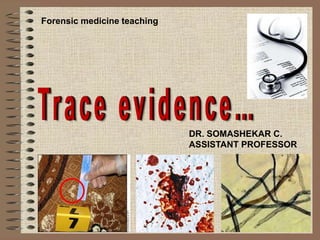
DR. SOMASHEKAR C.
ASSISTANT PROFESSOR
Forensic medicine teaching
2
What is trace evidence?
• Trace evidence is material found at a crime
scene or accident scene in small but measurable
amounts.
• This is important as it can definitively LINK an
individual or object to the scene.
3
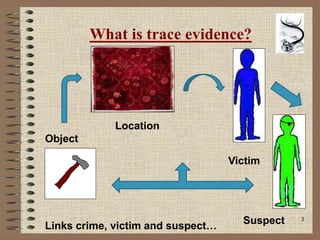
What is trace evidence?
Object
Links crime, victim and suspect…
Location
Victim
Suspect
4
Importance
“No crime is committed without leaving a clue!!
“Central dogma of any criminalistic investigation
involves recognition, identification, comparison,
individualisation and interpretation of evidence”
“Court / judgement relies on evidence / proof /
witness!”
5
Physical evidence
Transient (eg. PM changes, colour of blood stains)
Conditional
TRANSFER/TRACE EVIDENCE
(most diverse and most useful!)
Pattern
associative
6
Trace/transfer evidences
Biological (grass, leaves, wood, seeds, pollen etc)
Physiological (blood and other body fluids, hair etc)
Chemical (drugs, poisons, ink, GSR etc)
Mineralogical (soil, minerals, glass, metal etc)
Construction materials (cement, nails, paints etc)
Polymeric (paints, plastics, fibres etc)
7
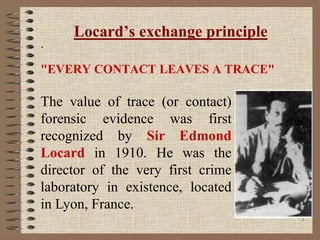
Locard’s exchange principle
.
"EVERY CONTACT LEAVES A TRACE"
The value of trace (or contact)
forensic evidence was first
recognized by Sir Edmond
Locard in 1910. He was the
director of the very first crime
laboratory in existence, located
in Lyon, France.
8
Locard’s exchange principle
The Locard’s Exchange Principle states that
"with contact between two items, there will be
an exchange."
For example, burglars will leave traces of their
presence behind and will also take traces with
them. They may leave hairs from their body or
fibers from their clothing behind and they may
take carpet fibers away with them.
9
BLOOD/BLOOD STAINS
Blood components
Haemoglobin and derivatives
Blood groups
Haemostasis
10
Forensic analysis of suspected
blood stain
Blood stain or not (dry/wet)
Human or animal (species origin)
Haemoptysis/hematemesis/menstrual
Arterial/venous
Tests for blood:
11
Presumptive/screening tests
• Negative result means the questioned
stain is not blood
• Positive result means the questioned stain
is likely blood
• exclusary value!
12
Presumptive/screening tests
Presumptive tests produce a color reaction or
release of light
Tests rely on catalytic properties of blood
(hemoglobin presence)
13
Presumptive /screening tests
RAPID color change is a positive result.
This means the stain is blood.
Color Tests
Apply chromogen (color changing chemical)
Apply oxidizing agent (hydrogen peroxide)
The catalyst of the reaction is hemoglobin
14
Color Test Method
• Sample stain with clean cotton swab
• Add drop of chromogen
• Add drop of hydrogen peroxide
Alternatively, collect stain on thread; add
chromogen and hydrogen peroxide in spot plate
15
Remember, other non-blood substances
might catalyze the reaction also.
False Positive – A positive result given by
a substance that is not blood
Chemical Oxidants
 Plant materials
16
5 Types of Color Tests
• Benzidine
• Phenolphthalein
• O-Tolidine
• Tetramethylbenzidine (TMB)
• Leucomalachite Green (LMG)
17
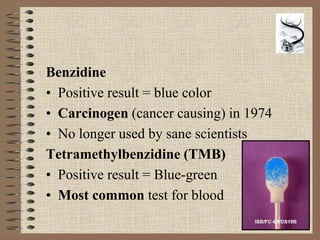
Benzidine
• Positive result = blue color
• Carcinogen (cancer causing) in 1974
• No longer used by sane scientists
Tetramethylbenzidine (TMB)
• Positive result = Blue-green
• Most common test for blood
18
Color tests
Phenolphthalein
• Positive result = pink
O-Tolidine
• Positive result = blue
• Similar to benzidine; still carcinogenic as
it can be metabolized to benzidine
Leucomalachite Green (LMG)
• Positive result = Green
• Not as sensitive as TMB or specific as
phenolphthalein
19
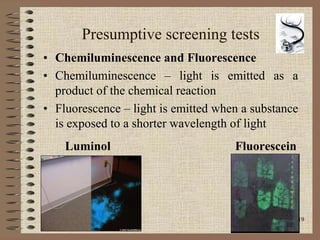
Presumptive screening tests
• Chemiluminescence and Fluorescence
• Chemiluminescence – light is emitted as a
product of the chemical reaction
• Fluorescence – light is emitted when a substance
is exposed to a shorter wavelength of light
Luminol Fluorescein
20
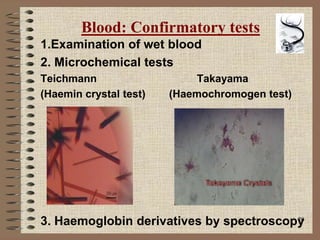
Blood: Confirmatory tests
1.Examination of wet blood
2. Microchemical tests
Teichmann Takayama
(Haemin crystal test) (Haemochromogen test)
3. Haemoglobin derivatives by spectroscopy
21
Confirmatory tests
4. Electrophoresis
5. Immuno-electrophoresis
6. Chromatography
22
Human blood or not
Species origin:
Most methods test for serum proteins
Serum proteins are found in all animals, but are
slightly different
Species Id methods based on antigen/antibody
interactions
23
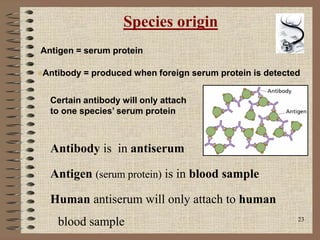
Species origin
Antibody is in antiserum
Antigen (serum protein) is in blood sample
Human antiserum will only attach to human
blood sample
Antigen = serum protein
Antibody = produced when foreign serum protein is detected
Certain antibody will only attach
to one species’ serum protein
24
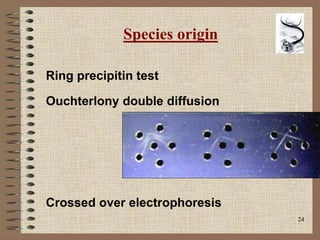
Species origin
Ring precipitin test
Ouchterlony double diffusion
Crossed over electrophoresis
25
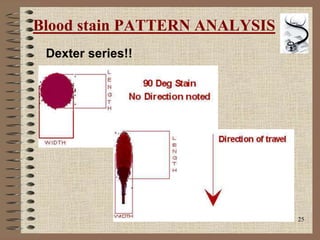
Blood stain PATTERN ANALYSIS
Dexter series!!
26
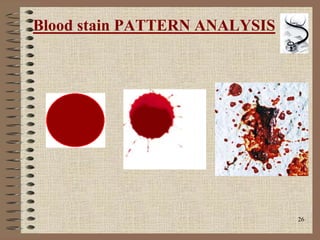
Blood stain PATTERN ANALYSIS
27
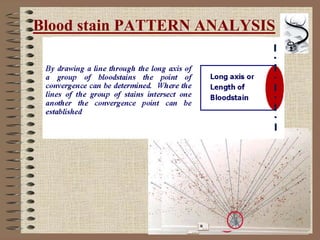
Blood stain PATTERN ANALYSIS
28
Determination of blood groups
For Individualising blood/blood stains
1. Blood groups – ABO, Rh, MNS, Kell,
Duffy, Luthern, Kidd etc
Dry blood stain – how to do blood grouping?
A. Latte’s crust method
B. Absorption – elusion technique
C. Absorption – inhibition technique
D. Latex method
Disputed maternity/paternity cases
Crime settings
29
For Individualising blood/blood
stains
1. Blood groups – ABO, Rh, MNS, Kell,
Duffy, Luthern, Kidd etc
2. Polymorphisms exhibited by serum proteins
(Hp, Gc, Ag, KM, Gm1, Gm2, etc)
3. Red cell enzymes (PGM, GPT, ADA)
4. HLA typing
5. DNA typing
Application in:
Disputed maternity/paternity cases
30
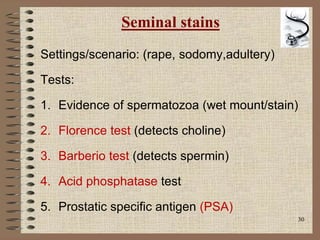
Seminal stains
Settings/scenario: (rape, sodomy,adultery)
Tests:
1. Evidence of spermatozoa (wet mount/stain)
2. Florence test (detects choline)
3. Barberio test (detects spermin)
4. Acid phosphatase test
5. Prostatic specific antigen (PSA)
SALIVA
VAGINAL FLUID
32
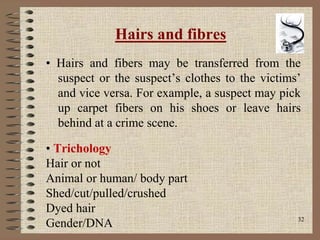
Hairs and fibres
• Hairs and fibers may be transferred from the
suspect or the suspect’s clothes to the victims’
and vice versa. For example, a suspect may pick
up carpet fibers on his shoes or leave hairs
behind at a crime scene.
• Trichology
Hair or not
Animal or human/ body part
Shed/cut/pulled/crushed
Dyed hair
Gender/DNA
33
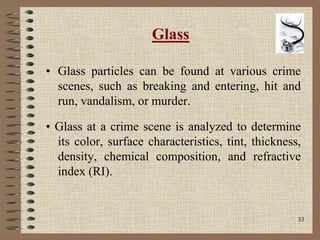
Glass
• Glass particles can be found at various crime
scenes, such as breaking and entering, hit and
run, vandalism, or murder.
• Glass at a crime scene is analyzed to determine
its color, surface characteristics, tint, thickness,
density, chemical composition, and refractive
index (RI).
34
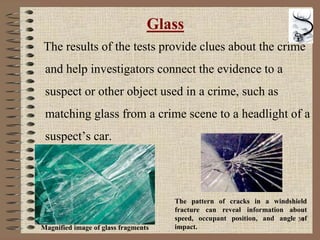
Glass
The results of the tests provide clues about the crime
and help investigators connect the evidence to a
suspect or other object used in a crime, such as
matching glass from a crime scene to a headlight of a
suspect’s car.
The pattern of cracks in a windshield
fracture can reveal information about
speed, occupant position, and angle of
impact.
Magnified image of glass fragments
35
Paint
• Physical and chemical analysis of paint evidence (chips or
residue) can indicate it’s class, such as automobile paint,
house paint, nail polish, etc.
• The evidence can be compared to 40,000 different types of
paint classified in a database, which can be used to
identify a particular make or model of car or brand of tool
36
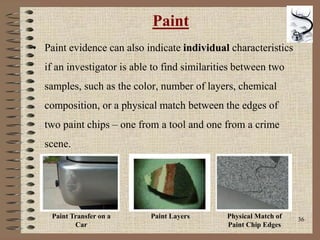
Paint
• Paint evidence can also indicate individual characteristics
if an investigator is able to find similarities between two
samples, such as the color, number of layers, chemical
composition, or a physical match between the edges of
two paint chips – one from a tool and one from a crime
scene.
Paint Transfer on a
Car
Paint Layers Physical Match of
Paint Chip Edges
37
Ballistics
• Characteristics of ammunition, firearms, and
residue are examined to find matches between
suspects and the evidence found at a crime
scene.
• Chemical tests can reveal gunshot residue
(GSR) on the hands, face, or clothing of a
victim or suspect to indicate how close a person
was to a fired gun.
•
38
Ballistics
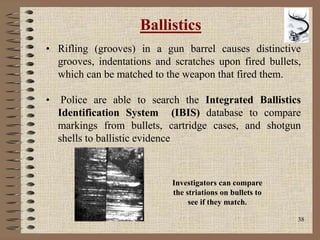
• Rifling (grooves) in a gun barrel causes distinctive
grooves, indentations and scratches upon fired bullets,
which can be matched to the weapon that fired them.
• Police are able to search the Integrated Ballistics
Identification System (IBIS) database to compare
markings from bullets, cartridge cases, and shotgun
shells to ballistic evidence
Investigators can compare
the striations on bullets to
see if they match.
39
We learnt…
Trace evidence
Locard’s exchange principle
Blood stain- tests and pattern analysis
Seminal stains
Trichology
Glass/paint/GSR
40
Thank You

trace evidence in forensic medicine practice

  • 1.
    DR. SOMASHEKAR C. ASSISTANTPROFESSOR Forensic medicine teaching
  • 2.
    2 What is traceevidence? • Trace evidence is material found at a crime scene or accident scene in small but measurable amounts. • This is important as it can definitively LINK an individual or object to the scene.
  • 3.
    3 What is traceevidence? Object Links crime, victim and suspect… Location Victim Suspect
  • 4.
    4 Importance “No crime iscommitted without leaving a clue!! “Central dogma of any criminalistic investigation involves recognition, identification, comparison, individualisation and interpretation of evidence” “Court / judgement relies on evidence / proof / witness!”
  • 5.
    5 Physical evidence Transient (eg.PM changes, colour of blood stains) Conditional TRANSFER/TRACE EVIDENCE (most diverse and most useful!) Pattern associative
  • 6.
    6 Trace/transfer evidences Biological (grass,leaves, wood, seeds, pollen etc) Physiological (blood and other body fluids, hair etc) Chemical (drugs, poisons, ink, GSR etc) Mineralogical (soil, minerals, glass, metal etc) Construction materials (cement, nails, paints etc) Polymeric (paints, plastics, fibres etc)
  • 7.
    7 Locard’s exchange principle . "EVERYCONTACT LEAVES A TRACE" The value of trace (or contact) forensic evidence was first recognized by Sir Edmond Locard in 1910. He was the director of the very first crime laboratory in existence, located in Lyon, France.
  • 8.
    8 Locard’s exchange principle TheLocard’s Exchange Principle states that "with contact between two items, there will be an exchange." For example, burglars will leave traces of their presence behind and will also take traces with them. They may leave hairs from their body or fibers from their clothing behind and they may take carpet fibers away with them.
  • 9.
    9 BLOOD/BLOOD STAINS Blood components Haemoglobinand derivatives Blood groups Haemostasis
  • 10.
    10 Forensic analysis ofsuspected blood stain Blood stain or not (dry/wet) Human or animal (species origin) Haemoptysis/hematemesis/menstrual Arterial/venous Tests for blood:
  • 11.
    11 Presumptive/screening tests • Negativeresult means the questioned stain is not blood • Positive result means the questioned stain is likely blood • exclusary value!
  • 12.
    12 Presumptive/screening tests Presumptive testsproduce a color reaction or release of light Tests rely on catalytic properties of blood (hemoglobin presence)
  • 13.
    13 Presumptive /screening tests RAPIDcolor change is a positive result. This means the stain is blood. Color Tests Apply chromogen (color changing chemical) Apply oxidizing agent (hydrogen peroxide) The catalyst of the reaction is hemoglobin
  • 14.
    14 Color Test Method •Sample stain with clean cotton swab • Add drop of chromogen • Add drop of hydrogen peroxide Alternatively, collect stain on thread; add chromogen and hydrogen peroxide in spot plate
  • 15.
    15 Remember, other non-bloodsubstances might catalyze the reaction also. False Positive – A positive result given by a substance that is not blood Chemical Oxidants  Plant materials
  • 16.
    16 5 Types ofColor Tests • Benzidine • Phenolphthalein • O-Tolidine • Tetramethylbenzidine (TMB) • Leucomalachite Green (LMG)
  • 17.
    17 Benzidine • Positive result= blue color • Carcinogen (cancer causing) in 1974 • No longer used by sane scientists Tetramethylbenzidine (TMB) • Positive result = Blue-green • Most common test for blood
  • 18.
    18 Color tests Phenolphthalein • Positiveresult = pink O-Tolidine • Positive result = blue • Similar to benzidine; still carcinogenic as it can be metabolized to benzidine Leucomalachite Green (LMG) • Positive result = Green • Not as sensitive as TMB or specific as phenolphthalein
  • 19.
    19 Presumptive screening tests •Chemiluminescence and Fluorescence • Chemiluminescence – light is emitted as a product of the chemical reaction • Fluorescence – light is emitted when a substance is exposed to a shorter wavelength of light Luminol Fluorescein
  • 20.
    20 Blood: Confirmatory tests 1.Examinationof wet blood 2. Microchemical tests Teichmann Takayama (Haemin crystal test) (Haemochromogen test) 3. Haemoglobin derivatives by spectroscopy
  • 21.
    21 Confirmatory tests 4. Electrophoresis 5.Immuno-electrophoresis 6. Chromatography
  • 22.
    22 Human blood ornot Species origin: Most methods test for serum proteins Serum proteins are found in all animals, but are slightly different Species Id methods based on antigen/antibody interactions
  • 23.
    23 Species origin Antibody isin antiserum Antigen (serum protein) is in blood sample Human antiserum will only attach to human blood sample Antigen = serum protein Antibody = produced when foreign serum protein is detected Certain antibody will only attach to one species’ serum protein
  • 24.
    24 Species origin Ring precipitintest Ouchterlony double diffusion Crossed over electrophoresis
  • 25.
    25 Blood stain PATTERNANALYSIS Dexter series!!
  • 26.
  • 27.
  • 28.
    28 Determination of bloodgroups For Individualising blood/blood stains 1. Blood groups – ABO, Rh, MNS, Kell, Duffy, Luthern, Kidd etc Dry blood stain – how to do blood grouping? A. Latte’s crust method B. Absorption – elusion technique C. Absorption – inhibition technique D. Latex method Disputed maternity/paternity cases Crime settings
  • 29.
    29 For Individualising blood/blood stains 1.Blood groups – ABO, Rh, MNS, Kell, Duffy, Luthern, Kidd etc 2. Polymorphisms exhibited by serum proteins (Hp, Gc, Ag, KM, Gm1, Gm2, etc) 3. Red cell enzymes (PGM, GPT, ADA) 4. HLA typing 5. DNA typing Application in: Disputed maternity/paternity cases
  • 30.
    30 Seminal stains Settings/scenario: (rape,sodomy,adultery) Tests: 1. Evidence of spermatozoa (wet mount/stain) 2. Florence test (detects choline) 3. Barberio test (detects spermin) 4. Acid phosphatase test 5. Prostatic specific antigen (PSA)
  • 31.
  • 32.
    32 Hairs and fibres •Hairs and fibers may be transferred from the suspect or the suspect’s clothes to the victims’ and vice versa. For example, a suspect may pick up carpet fibers on his shoes or leave hairs behind at a crime scene. • Trichology Hair or not Animal or human/ body part Shed/cut/pulled/crushed Dyed hair Gender/DNA
  • 33.
    33 Glass • Glass particlescan be found at various crime scenes, such as breaking and entering, hit and run, vandalism, or murder. • Glass at a crime scene is analyzed to determine its color, surface characteristics, tint, thickness, density, chemical composition, and refractive index (RI).
  • 34.
    34 Glass The results ofthe tests provide clues about the crime and help investigators connect the evidence to a suspect or other object used in a crime, such as matching glass from a crime scene to a headlight of a suspect’s car. The pattern of cracks in a windshield fracture can reveal information about speed, occupant position, and angle of impact. Magnified image of glass fragments
  • 35.
    35 Paint • Physical andchemical analysis of paint evidence (chips or residue) can indicate it’s class, such as automobile paint, house paint, nail polish, etc. • The evidence can be compared to 40,000 different types of paint classified in a database, which can be used to identify a particular make or model of car or brand of tool
  • 36.
    36 Paint • Paint evidencecan also indicate individual characteristics if an investigator is able to find similarities between two samples, such as the color, number of layers, chemical composition, or a physical match between the edges of two paint chips – one from a tool and one from a crime scene. Paint Transfer on a Car Paint Layers Physical Match of Paint Chip Edges
  • 37.
    37 Ballistics • Characteristics ofammunition, firearms, and residue are examined to find matches between suspects and the evidence found at a crime scene. • Chemical tests can reveal gunshot residue (GSR) on the hands, face, or clothing of a victim or suspect to indicate how close a person was to a fired gun. •
  • 38.
    38 Ballistics • Rifling (grooves)in a gun barrel causes distinctive grooves, indentations and scratches upon fired bullets, which can be matched to the weapon that fired them. • Police are able to search the Integrated Ballistics Identification System (IBIS) database to compare markings from bullets, cartridge cases, and shotgun shells to ballistic evidence Investigators can compare the striations on bullets to see if they match.
  • 39.
    39 We learnt… Trace evidence Locard’sexchange principle Blood stain- tests and pattern analysis Seminal stains Trichology Glass/paint/GSR
  • 40.