Forensic science >Forensic science laboratory :
Forensic science > Forensic science laboratory :
Forensic science is the study & application of different
scientific knowledge to the process of law involving the
scientific examination & evaluation of evidences.
Trace evidence
Trace evidence:
Any trace substance which could be found in the scene of
crime with assailant or victim of the crime that has
evidential value to link or investigate crime is trace
evidence.
Ex: Semen, hair, bloodstain
5.
Locard’s Principle ofExchange
Locard’s Principle of Exchange (Lawyer & doctor
Edmond Locard, 1877-1966): It states that when any two
objects come into contact, there is always a transference
of material from each other. In other words, when an act
of crime is committed there must be sign of crime both
in the accused & the victim.
6.
Some important traceevidences
Some important trace evidences -Blood stain, seminal
stain, hair, Saliva stains, vaginal fluid, fecal stains, vomits
stains, urine, skin, tooth pulp, nails & dandruff, nail mark,
bite mark etc.
7.
Seminal stain astrace evidence
Semen : It is grayish yellow, thick, jelly like alkaline fluid
with characteristic order, consists of spermatozoa,
epithelial & other cells suspended in a fluid known as
seminal plasma.
Quantity: 2-5 ml/ejaculation
Sperm count: 200-500million/ejaculation.
100million/ml,
200-500 reach to the ampulla, 90% motile
at
ejaculation.
8.
Circumstances in relationto semen examination
1.Rape or attempted rape
2.Lust murder
3.Unnatural sexual offences
4.Disputed paternity
5.Legitimacy
6.Sterility
7.Divorce case
8.Artificial insemination
9.
Materials may mestained with semen-
1.Clothes
2.On person
3.Bedclothes
4.Seats of a
motorcar
4.The floor
of grass at
the scene of
crime.
10.
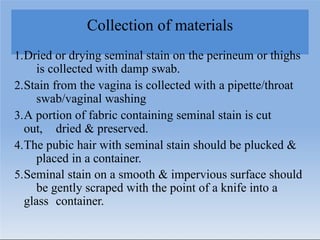
Collection of materials
1.Driedor drying seminal stain on the perineum or thighs
is collected with damp swab.
2.Stain from the vagina is collected with a pipette/throat
swab/vaginal washing
3.A portion of fabric containing seminal stain is cut
out, dried & preserved.
4.The pubic hair with seminal stain should be plucked &
placed in a container.
5.Seminal stain on a smooth & impervious surface should
be gently scraped with the point of a knife into a
glass container.
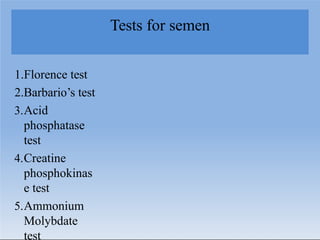
Tests for semen
1.Florencetest
2.Barbario’s test
3.Acid
phosphatase
test
4.Creatine
phosphokinas
e test
5.Ammonium
Molybdate
test
13.
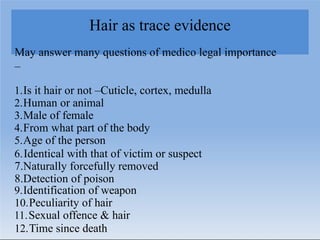
Hair as traceevidence
May answer many questions of medico legal importance
–
1.Is it hair or not –Cuticle, cortex, medulla
2.Human or animal
3.Male of female
4.From what part of the body
5.Age of the person
6.Identical with that of victim or suspect
7.Naturally forcefully removed
8.Detection of poison
9.Identification of weapon
10.Peculiarity of hair
11.Sexual offence & hair
12.Time since death
14.
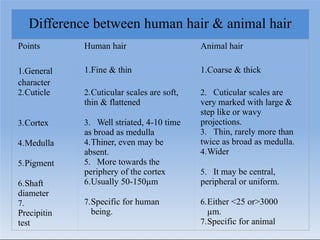
Difference between humanhair & animal hair
Points Human hair
1.Fine & thin
Animal hair
1.Coarse & thick
1.General
character
2.Cuticle
3.Cortex
4.Medulla
5.Pigment
6.Shaft
diameter
7.
Precipitin
test
2.Cuticular scales are soft,
thin & flattened
3. Well striated, 4-10 time
as broad as medulla
4.Thiner, even may be
absent.
5. More towards the
periphery of the cortex
6.Usually 50-150µm
7.Specific for human
being.
2. Cuticular scales are
very marked with large &
step like or wavy
projections.
3. Thin, rarely more than
twice as broad as medulla.
4.Wider
5. It may be central,
peripheral or uniform.
6.Either <25 or>3000
µm.
7.Specific for animal
15.
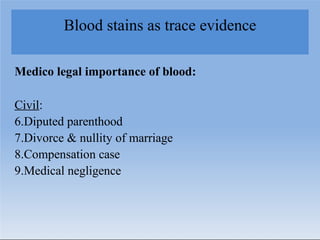
Blood stains astrace evidence
Medico legal importance of blood:
Civil:
6.Diputed parenthood
7.Divorce & nullity of marriage
8.Compensation case
9.Medical negligence
16.
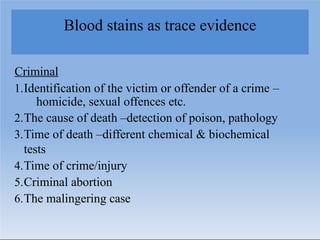
Blood stains astrace evidence
Criminal
1.Identification of the victim or offender of a crime –
homicide, sexual offences etc.
2.The cause of death –detection of poison, pathology
3.Time of death –different chemical & biochemical
tests
4.Time of crime/injury
5.Criminal abortion
6.The malingering case
17.
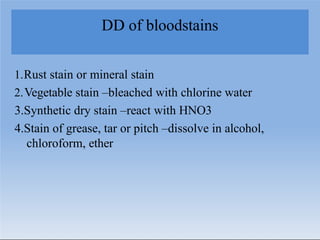
DD of bloodstains
1.Ruststain or mineral stain
2.Vegetable stain –bleached with chlorine water
3.Synthetic dry stain –react with HNO3
4.Stain of grease, tar or pitch –dissolve in alcohol,
chloroform, ether
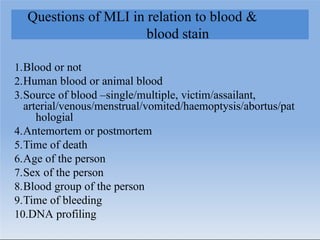
Questions of MLIin relation to blood &
blood stain
1.Blood or not
2.Human blood or animal blood
3.Source of blood –single/multiple, victim/assailant,
arterial/venous/menstrual/vomited/haemoptysis/abortus/pat
hologial
4.Antemortem or postmortem
5.Time of death
6.Age of the person
7.Sex of the person
8.Blood group of the person
9.Time of bleeding
10.DNA profiling
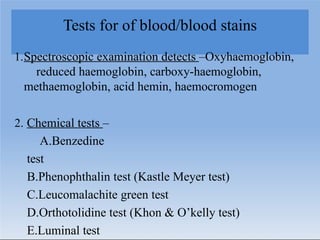
Tests for ofblood/blood stains
1.Spectroscopic examination detects –Oxyhaemoglobin,
reduced haemoglobin, carboxy-haemoglobin,
methaemoglobin, acid hemin, haemocromogen
2. Chemical tests –
A.Benzedine
test
B.Phenophthalin test (Kastle Meyer test)
C.Leucomalachite green test
D.Orthotolidine test (Khon & O’kelly test)
E.Luminal test
22.
Tests for ofblood/blood stains
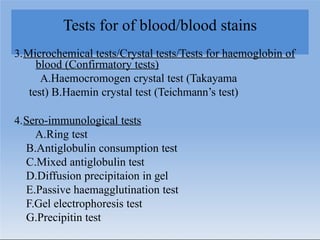
3.Microchemical tests/Crystal tests/Tests for haemoglobin of
blood (Confirmatory tests)
A.Haemocromogen crystal test (Takayama
test) B.Haemin crystal test (Teichmann’s test)
4.Sero-immunological tests
A.Ring test
B.Antiglobulin consumption test
C.Mixed antiglobulin test
D.Diffusion precipitaion in gel
E.Passive haemagglutination test
F.Gel electrophoresis test
G.Precipitin test
23.
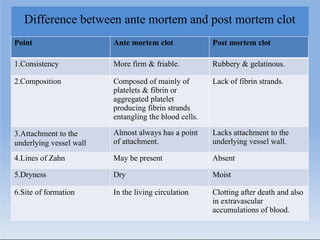
Difference between antemortem and post mortem clot
Point Ante mortem clot Post mortem clot
1.Consistency More firm & friable. Rubbery & gelatinous.
2.Composition Composed of mainly of
platelets & fibrin or
aggregated platelet
producing fibrin strands
entangling the blood cells.
Lack of fibrin strands.
3.Attachment to the
underlying vessel wall
Almost always has a point
of attachment.
Lacks attachment to the
underlying vessel wall.
4.Lines of Zahn May be present Absent
5.Dryness Dry Moist
6.Site of formation In the living circulation Clotting after death and also
in extravascular
accumulations of blood.
24.
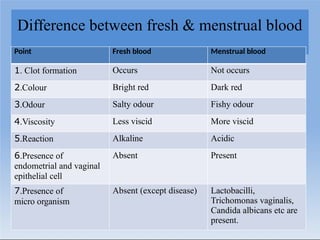
Difference between fresh& menstrual blood
Point Fresh blood Menstrual blood
1. Clot formation Occurs Not occurs
2.Colour Bright red Dark red
3.Odour Salty odour Fishy odour
4.Viscosity Less viscid More viscid
5.Reaction Alkaline Acidic
6.Presence of
endometrial and vaginal
epithelial cell
Absent Present
7.Presence of
micro organism
Absent (except disease) Lactobacilli,
Trichomonas vaginalis,
Candida albicans etc are
present.
25.
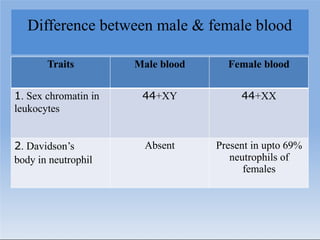
Difference between male& female blood
Traits Male blood Female blood
1. Sex chromatin in
leukocytes
44+XY 44+XX
2. Davidson’s
body in neutrophil
Absent Present in upto 69%
neutrophils of
females
26.
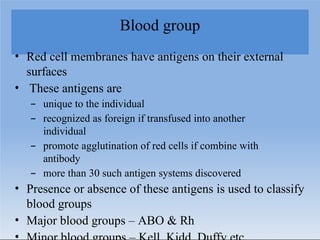
Blood group
• Redcell membranes have antigens on their external
surfaces
• These antigens are
– unique to the individual
– recognized as foreign if transfused into another
individual
– promote agglutination of red cells if combine with
antibody
– more than 30 such antigen systems discovered
• Presence or absence of these antigens is used to classify
blood groups
• Major blood groups – ABO & Rh
27.
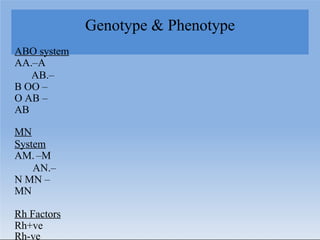
Genotype & Phenotype
ABOsystem
AA.–A
AB.–
B OO –
O AB –
AB
MN
System
AM. –M
AN.–
N MN –
MN
Rh Factors
Rh+ve
Rh-ve
28.
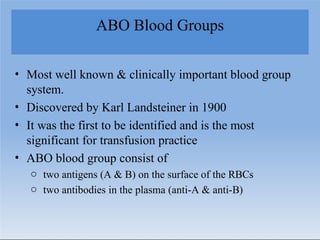
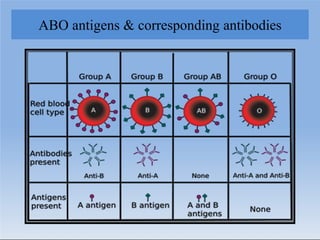
ABO Blood Groups
•Most well known & clinically important blood group
system.
• Discovered by Karl Landsteiner in 1900
• It was the first to be identified and is the most
significant for transfusion practice
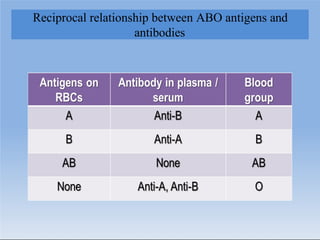
• ABO blood group consist of
o two antigens (A & B) on the surface of the RBCs
o two antibodies in the plasma (anti-A & anti-B)
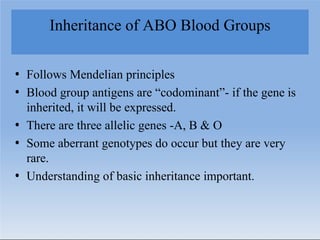
Inheritance of ABOBlood Groups
• Follows Mendelian principles
• Blood group antigens are “codominant”- if the gene is
inherited, it will be expressed.
• There are three allelic genes -A, B & O
• Some aberrant genotypes do occur but they are very
rare.
• Understanding of basic inheritance important.
32.
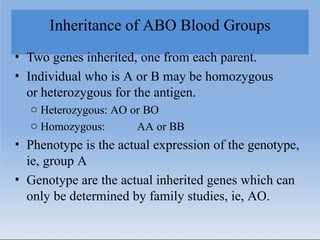
Inheritance of ABOBlood Groups
• Two genes inherited, one from each parent.
• Individual who is A or B may be homozygous
or heterozygous for the antigen.
o Heterozygous: AO or BO
o Homozygous: AA or BB
• Phenotype is the actual expression of the genotype,
ie, group A
• Genotype are the actual inherited genes which can
only be determined by family studies, ie, AO.
33.
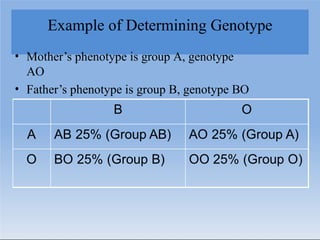
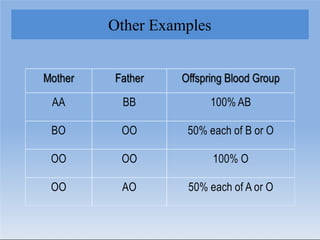
Example of DeterminingGenotype
• Mother’s phenotype is group A, genotype
AO
• Father’s phenotype is group B, genotype BO
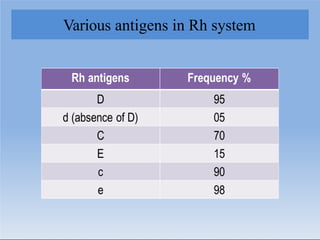
Rh typing
• Normaltyping for Rh antigens only includes
typing for Rh (D).
• The result of this typing determines the Rh status
of the cells (Rh - positive or Rh - negative).
• Some Rh typing sera is diluted in high protein
solutions and may require a negative control.
• It is recommended to use two monoclonal anti-D
sera from two different manufacturers labeled as
D1 and D2, especially to confirm all Rh negatives
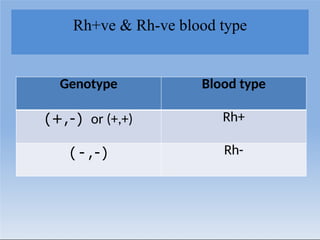
Rh+ve & Rh-veblood type
Genotype Blood type
(+,-) or (+,+) Rh+
( - ,-) Rh-
38.
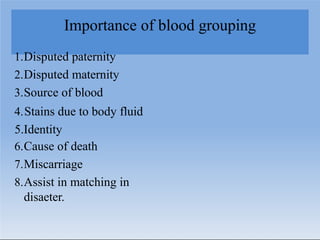
Importance of bloodgrouping
1.Disputed paternity
2.Disputed maternity
3.Source of blood
4.Stains due to body fluid
5.Identity
6.Cause of death
7.Miscarriage
8.Assist in matching in
disaeter.