1
Analog design (1): Introduction,
Classical and Non-classical bioisosters,
Bio-isosteric replacement strategies,
Rigid analogs
Subject:- Advanced Medicinal Chemistry - 1
Subject Code:- MPC 103T
Presented to -
Ms. Lima Patowary
Assistant Professor
Department of Pharmaceutical Chemistry
Presented by-
Seemanta Nayan Das
M.Pharm 1st
semester
Roll No.- 2412023009
Department of Pharmaceutical Chemistry
2
Contents
1. Analog design : Introduction.
2. Classification of Bioisosterism.
3. Bioisosteric replacement strategies.
4. Rigid analog.
5. Bibliography.
3
Analog design: Introduction
1. Analog design is usually defined as the modification of a drug molecule or of
any bioactive compound in order to prepare a new molecule showing chemical
and biological similarity with the original compound.
2. Analog design is employed in pharmaceutical research from the beginning,
particularly from the second half of twentieth century the production of very
sophisticated molecules such as steroids, anticancer drugs, antibiotics became
available.
3. Analog design possess three categories which are:-
a. Analogs possessing chemical and pharmacological similarities.
b. Analogs possessing only chemical similarities.
c. Compounds chemically different, but displaying similar pharmacological
properties.
4. Strategies for analog design:
a. Bio-isosteric replacement.
b. Design of rigid analogs.
c. Homologation of alkyl chains.
4
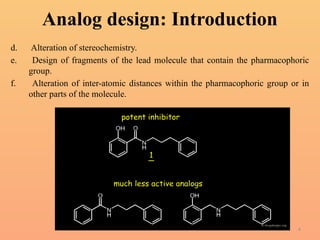
Analog design: Introduction
d. Alteration of stereochemistry.
e. Design of fragments of the lead molecule that contain the pharmacophoric
group.
f. Alteration of inter-atomic distances within the pharmacophoric group or in
other parts of the molecule.
5
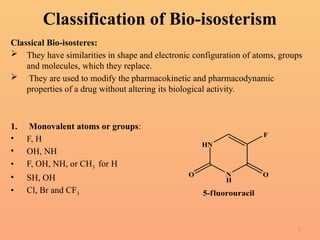
Classification of Bio-isosterism
Classical Bio-isosteres:
 They have similarities in shape and electronic configuration of atoms, groups
and molecules, which they replace.
 They are used to modify the pharmacokinetic and pharmacodynamic
properties of a drug without altering its biological activity.
1. Monovalent atoms or groups:
• F, H
• OH, NH
• F, OH, NH, or CH3 for H
• SH, OH
• Cl, Br and CF3
HN
O N
H
O
F
5-fluorouracil
6
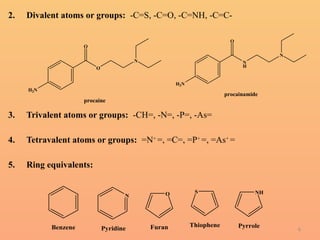
2. Divalent atoms or groups: -C=S, -C=O, -C=NH, -C=C-
3. Trivalent atoms or groups: -CH=, -N=, -P=, -As=
4. Tetravalent atoms or groups: =N+
=, =C=, =P+
=, =As+
=
5. Ring equivalents:
H2N
O
N
O
procaine
H2N
N
H
N
O
procainamide
Benzene
N
Pyridine
O
Furan
S
Thiophene
NH
Pyrrole
7
Classification of Bio-isosterism
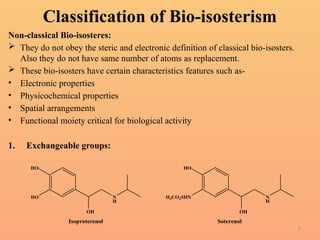
Non-classical Bio-isosteres:
 They do not obey the steric and electronic definition of classical bio-isosters.
Also they do not have same number of atoms as replacement.
 These bio-isosters have certain characteristics features such as-
• Electronic properties
• Physicochemical properties
• Spatial arrangements
• Functional moiety critical for biological activity
1. Exchangeable groups:
N
H
HO
HO
OH
Isoproterenol
N
H
H3CO2SHN
HO
OH
Soterenol
8
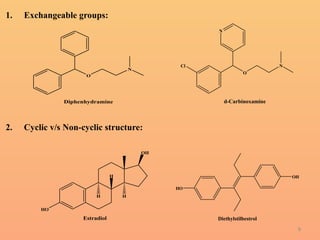
1. Exchangeable groups:
2. Cyclic v/s Non-cyclic structure:
N
O
Diphenhydramine
N
O
N
d-Carbinoxamine
Cl
HO
OH
H
H
H
Estradiol
OH
HO
Diethylstilbestrol
9
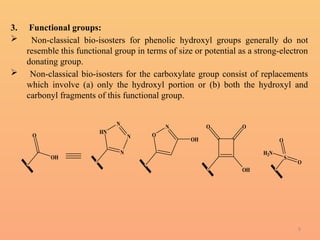
3. Functional groups:
 Non-classical bio-isosters for phenolic hydroxyl groups generally do not
resemble this functional group in terms of size or potential as a strong-electron
donating group.
 Non-classical bio-isosters for the carboxylate group consist of replacements
which involve (a) only the hydroxyl portion or (b) both the hydroxyl and
carbonyl fragments of this functional group.
O
OH
N
N
N
HN
N
O
OH
O O
OH
S
O
O
H2N
10
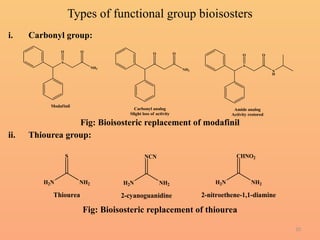
Types of functional group bioisosters
i. Carbonyl group:
Fig: Bioisosteric replacement of modafinil
ii. Thiourea group:
Fig: Bioisosteric replacement of thiourea
S
NH2
O
O
Modafinil
NH2
O
O
Carbonyl analog
Slight loss of activity
S
N
H
O
O
Amide analog
Activity restored
H2N
S
NH2
Thiourea
H2N
NCN
NH2 H2N
CHNO2
NH2
2-cyanoguanidine 2-nitroethene-1,1-diamine
11
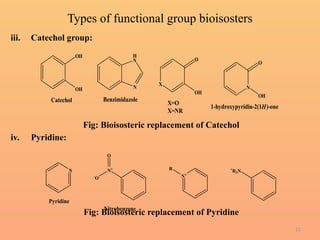
Types of functional group bioisosters
iii. Catechol group:
Fig: Bioisosteric replacement of Catechol
iv. Pyridine:
Fig: Bioisosteric replacement of Pyridine
OH
OH
Catechol
N
H
N
Benzimidazole
O
OH
X
X=O
X=NR
O
N
OH
1-hydroxypyridin-2(1H)-one
N
Pyridine
N+
O
-
O
Nitrobenzene
N+
R +
R3N
12
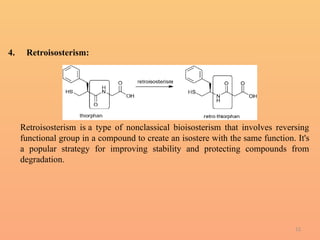
4. Retroisosterism:
Retroisosterism is a type of nonclassical bioisosterism that involves reversing
functional group in a compound to create an isostere with the same function. It's
a popular strategy for improving stability and protecting compounds from
degradation.
13
Bioisosteric replacement strategies
Bioisosteric replacement should be rigorously preceded by careful analysis of the
following parameters:-
a) size, volume and electronic distribution of the atoms or the considerations on the
degree of hybridization, polarizability, bonding angles and inductive and
mesomeric effects when fitting.
b) degree of lipidic and aqueous solubility, so as to allow prediction of alteration of
the physicochemical properties such as logP and pKa.
c) chemical reactivity of the functional groups or bioisosteric structural subunits,
mainly to predict significant alterations in the processes of biotransformation,
including for the eventual alteration of the toxicity profile relative to the main
metabolites.
d) conformational factors, including the differential capacity formation of inter- or
intramolecular hydrogen bonds.
14
Rigid analogs
1. Imposition of some degree of molecular rigidity on a certain organic molecule
results in potent, biologically active agents that shows a higher degree of
specificity of pharmacologic effect.
2. Advantages:
 The key functional groups are held in one steric disposition.
 Through the rigid analog strategy, if any pharmacological effect results then it
may assist in defining and understanding structure activity parameters
including 3D geometry of pharmacophore.
15
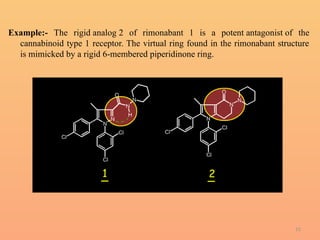
Example:- The rigid analog 2 of rimonabant 1 is a potent antagonist of the
cannabinoid type 1 receptor. The virtual ring found in the rimonabant structure
is mimicked by a rigid 6-membered piperidinone ring.
16
Bibliography
1. Donald J. Abraham , David P. Rotella, “Burger’s Medicinal Chemistry,
Drug Discovery, and Development, Seventh Edition, John Wiley & Sons,
Inc., 2010.
2. Ahmad S., Haque Z., Usman M.D.M., Iqbal A.S., “A text book of advanced
organic chemistry-I” P.V publication, Page No.- 60-64.
3. Lidia Moreira Lima, Eliezer J. Barreiro, “Bioisosterism: A Useful Strategy
for Molecular Modification and Drug Design”, Current Medicinal
Chemistry, 2005 Bentham Science Publishers Ltd., 12, 23-49
4. https://www.slideshare.net/slideshow/analog-design-medicinal-chemistry-
174199070/174199070
17
THANK YOU

Analog design-Bioisosteric replacement strategies

  • 1.
    1 Analog design (1):Introduction, Classical and Non-classical bioisosters, Bio-isosteric replacement strategies, Rigid analogs Subject:- Advanced Medicinal Chemistry - 1 Subject Code:- MPC 103T Presented to - Ms. Lima Patowary Assistant Professor Department of Pharmaceutical Chemistry Presented by- Seemanta Nayan Das M.Pharm 1st semester Roll No.- 2412023009 Department of Pharmaceutical Chemistry
  • 2.
    2 Contents 1. Analog design: Introduction. 2. Classification of Bioisosterism. 3. Bioisosteric replacement strategies. 4. Rigid analog. 5. Bibliography.
  • 3.
    3 Analog design: Introduction 1.Analog design is usually defined as the modification of a drug molecule or of any bioactive compound in order to prepare a new molecule showing chemical and biological similarity with the original compound. 2. Analog design is employed in pharmaceutical research from the beginning, particularly from the second half of twentieth century the production of very sophisticated molecules such as steroids, anticancer drugs, antibiotics became available. 3. Analog design possess three categories which are:- a. Analogs possessing chemical and pharmacological similarities. b. Analogs possessing only chemical similarities. c. Compounds chemically different, but displaying similar pharmacological properties. 4. Strategies for analog design: a. Bio-isosteric replacement. b. Design of rigid analogs. c. Homologation of alkyl chains.
  • 4.
    4 Analog design: Introduction d.Alteration of stereochemistry. e. Design of fragments of the lead molecule that contain the pharmacophoric group. f. Alteration of inter-atomic distances within the pharmacophoric group or in other parts of the molecule.
  • 5.
    5 Classification of Bio-isosterism ClassicalBio-isosteres:  They have similarities in shape and electronic configuration of atoms, groups and molecules, which they replace.  They are used to modify the pharmacokinetic and pharmacodynamic properties of a drug without altering its biological activity. 1. Monovalent atoms or groups: • F, H • OH, NH • F, OH, NH, or CH3 for H • SH, OH • Cl, Br and CF3 HN O N H O F 5-fluorouracil
  • 6.
    6 2. Divalent atomsor groups: -C=S, -C=O, -C=NH, -C=C- 3. Trivalent atoms or groups: -CH=, -N=, -P=, -As= 4. Tetravalent atoms or groups: =N+ =, =C=, =P+ =, =As+ = 5. Ring equivalents: H2N O N O procaine H2N N H N O procainamide Benzene N Pyridine O Furan S Thiophene NH Pyrrole
  • 7.
    7 Classification of Bio-isosterism Non-classicalBio-isosteres:  They do not obey the steric and electronic definition of classical bio-isosters. Also they do not have same number of atoms as replacement.  These bio-isosters have certain characteristics features such as- • Electronic properties • Physicochemical properties • Spatial arrangements • Functional moiety critical for biological activity 1. Exchangeable groups: N H HO HO OH Isoproterenol N H H3CO2SHN HO OH Soterenol
  • 8.
    8 1. Exchangeable groups: 2.Cyclic v/s Non-cyclic structure: N O Diphenhydramine N O N d-Carbinoxamine Cl HO OH H H H Estradiol OH HO Diethylstilbestrol
  • 9.
    9 3. Functional groups: Non-classical bio-isosters for phenolic hydroxyl groups generally do not resemble this functional group in terms of size or potential as a strong-electron donating group.  Non-classical bio-isosters for the carboxylate group consist of replacements which involve (a) only the hydroxyl portion or (b) both the hydroxyl and carbonyl fragments of this functional group. O OH N N N HN N O OH O O OH S O O H2N
  • 10.
    10 Types of functionalgroup bioisosters i. Carbonyl group: Fig: Bioisosteric replacement of modafinil ii. Thiourea group: Fig: Bioisosteric replacement of thiourea S NH2 O O Modafinil NH2 O O Carbonyl analog Slight loss of activity S N H O O Amide analog Activity restored H2N S NH2 Thiourea H2N NCN NH2 H2N CHNO2 NH2 2-cyanoguanidine 2-nitroethene-1,1-diamine
  • 11.
    11 Types of functionalgroup bioisosters iii. Catechol group: Fig: Bioisosteric replacement of Catechol iv. Pyridine: Fig: Bioisosteric replacement of Pyridine OH OH Catechol N H N Benzimidazole O OH X X=O X=NR O N OH 1-hydroxypyridin-2(1H)-one N Pyridine N+ O - O Nitrobenzene N+ R + R3N
  • 12.
    12 4. Retroisosterism: Retroisosterism isa type of nonclassical bioisosterism that involves reversing functional group in a compound to create an isostere with the same function. It's a popular strategy for improving stability and protecting compounds from degradation.
  • 13.
    13 Bioisosteric replacement strategies Bioisostericreplacement should be rigorously preceded by careful analysis of the following parameters:- a) size, volume and electronic distribution of the atoms or the considerations on the degree of hybridization, polarizability, bonding angles and inductive and mesomeric effects when fitting. b) degree of lipidic and aqueous solubility, so as to allow prediction of alteration of the physicochemical properties such as logP and pKa. c) chemical reactivity of the functional groups or bioisosteric structural subunits, mainly to predict significant alterations in the processes of biotransformation, including for the eventual alteration of the toxicity profile relative to the main metabolites. d) conformational factors, including the differential capacity formation of inter- or intramolecular hydrogen bonds.
  • 14.
    14 Rigid analogs 1. Impositionof some degree of molecular rigidity on a certain organic molecule results in potent, biologically active agents that shows a higher degree of specificity of pharmacologic effect. 2. Advantages:  The key functional groups are held in one steric disposition.  Through the rigid analog strategy, if any pharmacological effect results then it may assist in defining and understanding structure activity parameters including 3D geometry of pharmacophore.
  • 15.
    15 Example:- The rigidanalog 2 of rimonabant 1 is a potent antagonist of the cannabinoid type 1 receptor. The virtual ring found in the rimonabant structure is mimicked by a rigid 6-membered piperidinone ring.
  • 16.
    16 Bibliography 1. Donald J.Abraham , David P. Rotella, “Burger’s Medicinal Chemistry, Drug Discovery, and Development, Seventh Edition, John Wiley & Sons, Inc., 2010. 2. Ahmad S., Haque Z., Usman M.D.M., Iqbal A.S., “A text book of advanced organic chemistry-I” P.V publication, Page No.- 60-64. 3. Lidia Moreira Lima, Eliezer J. Barreiro, “Bioisosterism: A Useful Strategy for Molecular Modification and Drug Design”, Current Medicinal Chemistry, 2005 Bentham Science Publishers Ltd., 12, 23-49 4. https://www.slideshare.net/slideshow/analog-design-medicinal-chemistry- 174199070/174199070
  • 17.