Liver Transplantation
Kuotho T Nyuwi Prof. A.D Sharma
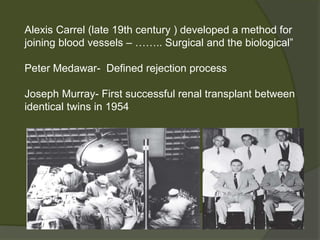
Alexis Carrel (late 19th century ) developed a method for
joining blood vessels – …….. Surgical and the biological”
Peter Medawar- Defined rejection process
Joseph Murray- First successful renal transplant between
identical twins in 1954
Gertrude Elion developed several new immunosuppressive
Compounds (6-MP and Aza)
Murray and Roy Calne introduced these agents into clinical
practice, permitting nonidentical transplantation to be
successful.
Allograft: From one individual to another
Xenograft: Between different species
 Orthotopic graft: Graft placed in its normal anatomical site
 Heterotopic graft: Graft placed in a site different from that
where the organ is normally located
Liver Transplantation
Dr. Thomas Starzl- 1963 – Biliary atresia, coagulopathy
Cyclosporin Major advancement
Increase demand & less donor - Based on need rather than
on time on the list
Advances that serve to increase the donor pool-
- Split liver transplantation
- Live donor liver transplantation
- Use of donors after cardiac death
Patient evaluation
 Extensive evaluation done
 Pulmonary, cardiac, renal, psychological assessement.
 Issue regarding candidacy for transplantation:
- Whether a given patient would benefit from liver
replacement
- Whether the patient can withstand the challenge of
a liver transplantation surgery
Indication
- Any patient with compromise of life from
- Chronic liver insufficiency
- Chronic liver disease with acute decompensation
- Acute liver failure
- Enzyme deficiencies
- Primary liver tumors
Common sign & symptom:
- Coagulopathy
- Thrombocytopenia
- Muscle wasting
- Gynecomastia
- Ascites
- Varices
- Encephalopathy
- Renal insufficiency
1) Fulminant Hepatic Failure
- Acute onset of liver failure with the absence of previous
liver disease.
-Encephalopathy within 8 weeks of jaundice.
- Acetaminophen overdose
King’s college criteria
Acetaminophen induced
ALF
o Ph- <7.3 or
o INR- >6.5 and
o S. creat- >3.4mg/dl
• Nonacetaminophen induced ALF
o INR> 6.5 or
Any three of the following
o Age- <10 or >40
o Duration of jaundice before
encephalopathy >7 days
o INR- >3.5
o S.Bilirubin - >17mg/dl
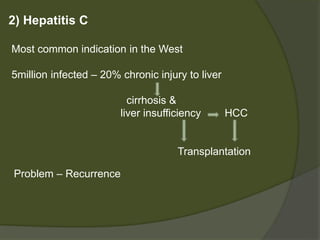
2) Hepatitis C
Most common indication in the West
5million infected – 20% chronic injury to liver
Cirrhosis &
liver insufficiency HCC
Transplantation
Problem – Recurrence
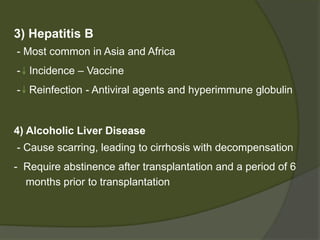
3) Hepatitis B
- Most common in Asia and Africa
- Incidence – Vaccine
- Reinfection - Antiviral agents and hyperimmune globulin
4) Alcoholic Liver Disease
- Cause scarring, leading to cirrhosis with decompensation
- Require abstinence after transplantation and a period of 6
months prior to transplantation
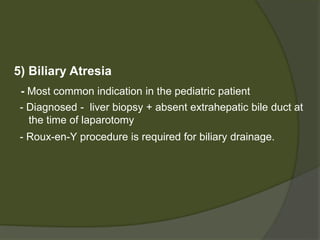
5) Biliary Atresia
- Most common indication in the pediatric patient
- Diagnosed - liver biopsy + absent extrahepatic bile duct
at the time of laparotomy
- Roux-en-Y procedure is required for biliary drainage.
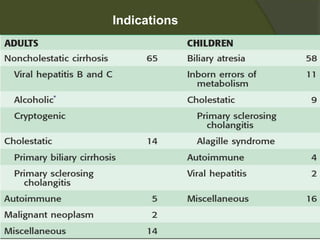
Indications
Contraindications
 Systemic infections: Uncontrolled bacterial and fungal
infections are absolute contraindication.
 Failure of another organ
 Portopulmonary hypertension : Persistent pulmonary
artery pressures >50 mm Hg in the presence of pulmonary
vascular resistance.
Contraindication contd…..
 Lack of commitment
 Portal vein thrombosis
 Metastatic HCC – Absolute contraindication
Milan’s criteria: - Single nodule <5 cm
- <3 nodules, largest measuring <3 cm
- No extrahepatic involvement
- No vascular invasion
UCSF criteria: Single nodule < 6.5cm
3 lesions total diameter <8cm
Model for End-Stage Liver Disease
(MELD)
 The MELD score assigns points that reflect the severity of
liver disease
 A patient’s priority on the waiting list is based on the
medical status as determined by MELD score
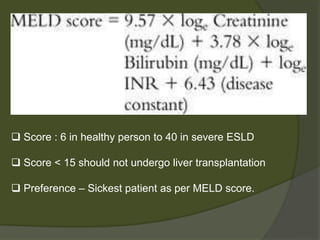
 The score is based on a formula that considers bilirubin,
INR,Creatinine
 Score : 6 in healthy person to 40 in severe ESLD
 Score < 15 should not undergo liver transplantation
 Preference – Sickest patient as per MELD score.
 Significant decrease in the rate of death of potential
recipients on the waiting list because it allows livers to be
directed to the sickest patients.
 The scoring used in pediatric patients is referred to as the
pediatric end-stage liver disease (PELD) score.
 Pediatric donors are distributed to pediatric patients
preferentially.
Exceptions of MELD score
 HCC, Hepatopulmonary syndrome, metabolic disease,
amyloidosis
 Status 1 : Top priority
- Acute fulminant hepatic failure
- Primary non function of transplanted graft
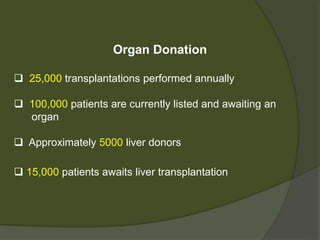
Organ Donation
 25,000 transplantations performed annually
 100,000 patients are currently listed and awaiting an
organ
 Approximately 5000 liver donors
 15,000 patients awaits liver transplantation
 Organs may be obtained from:
- Living donors (mostly Kidney)
- Deceased donors (DD)
- Brainstem-dead heart beating donors
(donation after brain death or DBD donors)
- Donation after circulatory death (DCD) donors
Evaluation of the deceased donor
 Transmissible infectious agents HIV Creutzfeldt–Jakob
disease Hepatitis B &C
 Malignancy- Malignancy within the past five years is an
absolute contraindication
 Liver donors - Should not have hepatic disease,
- Impaired liver function tests are common in
deceased donors and do not necessarily
preclude donation.
Organ recovery from deceased donors
 Aim - Preserve the functional integrity of the organs
- Careful monitoring and management of fluid
balance.
- Inotropic support ,Tri-iodothyronine,
Argipressin
 Warm ischaemia - Time between the diagnosis of death
(cardiorespiratory arrest) and cold perfusion
of the organ(up to 45 minutes is acceptable)
 Storage time- Liver - <12hrs(Optimal) , 18hrs(Max. time)
Procedure:
 A midline abdominal incision and median sternotomy is used
to obtain access.
 After dissection of the organs to be recovered, they are
perfused in situ
 Perfusion - Chilled organ preservation solution via an aortic
and portal cannula.
Uncontrolled donor – via femoral cutdown
 Removal - Heart and lungs - Liver and pancreas - kidneys
 After removal from the donor, the organs may undergo a
further flush with chilled preservation solution
 Organ is placed in double/ triple sterile bags and stored
at 4°C by immersion in ice while they are transported to
the recipient centre and await implantation.
 Preservative Solution : University of Wisconsin (UW)
solution and Euro-Collins solution
- impermeants to limit cell swelling, buffers to
counter acidosis and electrolytes
LIVE DONOR LIVER TRANSPLANTATION
 Alternative, developed to meet the demand
 Otte and colleagues - Pared down adult-sized livers for use in
pediatric patients
- Observed that the liver can regenerate
after major liver resection for cancer
 High risk of death to donor - Pulmonary emboli
 Current estimates are that the risk of death from liver
donation is 1 in 500 to 1000
Ideal weight of the graft - >0.8% of the recipient’s body
weight to prevent injury from
hyperperfusion
Right lobe graft (60-80% liver mass)
- Most commonly used
- More physiologic strains on the donor
- Emergent donor transplantation
- Better for recipient
Left lobe graft (30% to 40% liver mass)
- Less physiologic strains on the donor
- No report of emergent donor transplantation
- Injury to the graft from hyperperfusion and endothelial
damage due to:
- high portal flow generated by the enlarged spleen
- other vascular manifestations of portal hypertension
 Left lobe can be protected by decreasing portal vein blood
flow by
- Performing porta caval shunts
- Ligating the splenic artery
- Performing splenectomy
- Use of two left lobe donors for a single recipient
Donor’s post operative complication
- 30% to 40% suffer one or more postoperative
complications
- Most include pulmonary emboli
- Portal vein thrombosis
- Bile duct injury
- Liver insufficiency secondary to a resection that is too
extensive
Recipient outcomes from live liver donors
 Superior to those receiving deceased donor transplants
- Recipient is in relatively good health
- Free of preservation insult
- Avoidance of the negative effects of brain death on
organ viability
- Immunologic advantage of a live donor graft
 Complications in the recipient related to the bile duct
anastomosis is twice as high
Implantation of cadaver whole allograft
- Unlike the kidney transplant, the liver is placed
orthotopically in its native position within the abdomen
- The procedure involves removal of the host liver and
replacement with a whole or partial graft
- Removal of the host liver is challenging because of
the portal HTN and coagulopathy
- The anhepatic phase - Period during which the new liver is
sewn in and the patient is without a liver.
Procedure- (Classic approach)
a) Suprahepatic vena cava anastomosis
b) Infrahepatic vena cava anastomosis
c) Portal vein anastomosis
d) Arterial anastomosis
e) Biliary anastomosis
Piggyback technique - An alternative to the conventional
implantation technique
- Native retrohepatic cava is preserved
Advantage:
- Shorten the anhepatic phase
- Improve cardiovascular stability
The anhepatic phase ends with reperfusion of the graft
- Inflow from the portal vein
- Outflow through the vena cava
Venovenous bypass – Shunt tubing is placed in the host portal
vein and infrahepatic cava and returned to the central venous
circulation to maintain vascular stability during the anhepatic
phase.
Centers that do not use the bypass technique rely more on
anesthesia support of the blood pressure through volume
administration and pressers.
Split Liver Transplant
 Child (receive segments 2 & 3 /segments 2, 3,& 4
 Adult (receive segments1, 4, 5, 6, 7& 8 or 1, 5, 6, 7 &8
 Right lobe graft - includes the donor vena cava and right
hepatic artery
 Pediatric graft - Based on the celiac trunk providing
the left hepatic artery, left portal vein, and left hepatic vein
Live Donor Operation
 Segment 2-3 Hepatectomy
- Segments 2 and 3 is most appropriate for infants
and small children (up to 5 years of age)
- Midline incision - round ligament divided, retracted,
and mobilized
- Left hepatic artery & vein and left portal vein
mobilized.
- Resection line - Right edge of the left hepatic vein to
the bile duct plate
-Parenchymal dissection done and the segment 2-3 is
lifted superiorly and dissected free from segment 1
- Results in an isolated segment 2-3 with left hepatic
artery, left portal vein, and left hepatic vein, along with
the segment 2-3 duct.
- The segment 2-3 is flushed through the left portal vein
and left hepatic artery
 Right Lobe Dissection for Live Donor Liver Transplantation
- Most commonly used for adult to adult live donor liver
transplantation.
- Incision : A bilateral subcostal or midline
- Cholecystectomy is performed
- The right hepatic artery and right portal vein are
isolated and temporarily occluded which is used to plan
the plane of resection
- This line typically runs at the left edge of the
gallbladder fossa to the medial aspect of the right
hepatic vein
- Once the parenchymal dissection is complete and the
right duct divided, vascular clamps are placed on the
right hepatic artery, right portal vein and right
hepatic vein for resection of the right lobe
Left Lobe Dissection for Live Donor Liver Transplantation
- Based on segments 2, 3, 4, and 5
- Inflow from the left hepatic artery and left portal vein
and outflow from the middle and left hepatic veins
- The operation includes the parenchymal dissection
along Cantlie’s line, the same line as for the right
hepatic lobectomy.
- The parenchymal dissection is done in the same
manner as for right hepatic lobectomy
 Implantation of Partial Liver Graft
- The piggyback technique is the basis for implantation of
a graft from a live donor
- Venous anastomosis : Between the graft hepatic vein and
a wide cavotomy, using one of the recipient hepatic
vein orifices
- Depending on whether the donor graft is the right/left
lobe, either the right/left hepatic artery branches from
the recipient may be used for inflow
- Similarly, inflow may be from the right or left portal
vein branch
- Biliary drainage :
- Duct to duct anastomosis
- Roux-en-Y anastomosis to the donor duct
(depending on the duct sizes)
- Care must be taken to avoid tension on this
anastomosis.
COMPLICATIONS OF LIVER TRANSPLANTATION
 Primary nonfunction- Transplanted liver does not work. It
is rare (<2%) and is fatal without retransplantation
 Hepatic artery thrombosis (2% to 4%)
 Portal venous thrombosis- May present with
gastrointestinal bleeding or coagulopathy
 Bleeding, inadequate production of clotting factors (poor
initial function)
 Complication due to immunosuppressive therapy
GRAFT REJECTION
 Allografts provoke a powerful immune response that
results in rapid graft rejection unless immunosuppressive
therapy is given
 Allografts trigger a graft rejection through,
- ABO blood group antigens
- Human leukocyte antigens (HLA)
ABO blood group antigens
The ABO blood group antigens are expressed not only by red
blood cells, but by most other cell types as well
Permissible transplants are:
• group O donor to group O, A, B or AB recipient
• group A donor to group A or AB recipient
• group B donor to group B or AB recipient
• group AB donor to group AB recipient
There is no need to take account of rhesus antigen
compatibility in organ transplantation.
HLA antigens
 Most common cause of graft rejection
 HLA-I and HLA-II
 HLA antigens expressed by graft cells activate T cells and
stimulate them to proliferate in response to IL-2 and other T-
cell growth factors
Types of allograft rejection
a) Hyperacute rejection:
- Occur within minutes to days after transplantation
- Primarily mediated by ABO or preformed
anti-HLA antibodies
- Characterised by intravascular thrombosis and
interstitial haemorrhage
- Liver transplants are relatively resistant
b) Acute rejection
- Usually occurs during first six months
- T cell dependent
- May be cell-mediated, antibody-mediated or both
- Usually reversible with additional immunosuppressive
therapy.
c) Chronic rejection :
- Most common cause of long-term allograft loss
- Occurs over months to years
- Secondary to T and B cell processes
- Characterised by myointimal proliferation in graft
arteries leading to ischaemia and fibrosis
- Vanishing bile duct syndrome
Risk factors for chronic rejection
• previous episodes of acute rejection
• poor HLA match
• long warm ischaemia time
• cytomegalovirus (CMV) infection
• raised blood lipids
• inadequate immunosuppression (including poor compliance)
Graft-versus-host disease
- Reciprocal problem of graft-versus host reaction is
occasionally seen
- Common in liver and small bowel transplant
- Graft lymphocytes react against HLA antigens expressed by
recipient tissues
- Involves the skin, causing a characteristic rash on the palms
and soles
IMMUNOSUPPRESSION AFTER LIVER TRANSPLANTATION
Hurdles –
 Nonspecific to the alloimmune response- recipients need
number of agents to control the normal immune response
adequately
 Global immune target
 Targets any cells undergoing maturation or division
 Cost
Phase of immunosuppression
 Induction immunosuppression
- Intense immunosuppression
- Heightened state of inflammation
- Time of initial antigen exposure
- Involves complete deletion/aggressive
diminution of the T cell response
 Maintenance immunosuppressants
- Remainder of the patient’s life
 Rescue agents.
 Privileged organ(Liver) - Need for immunosuppression
decreases over time (unlike kidney and heart)
 Immunosuppression combination:
- Calcineurin inhibitor(tacrolimus or cyclosporine)
- Steroids (methylprednisolone)
- Antiproliferative agent (mycophenolate mofetil)
- Sirolimus rapamycin inhibitor – Immunosuppressive +
antineoplastic
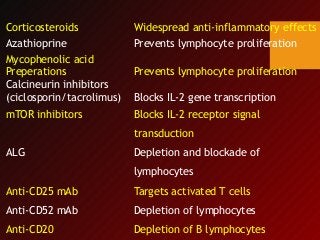
Corticosteroids Widespread anti-inflammatory effects
Azathioprine Prevents lymphocyte proliferation
Mycophenolic acid
Preperations Prevents lymphocyte proliferation
Calcineurin inhibitors
(ciclosporin/tacrolimus) Blocks IL-2 gene transcription
mTOR inhibitors Blocks IL-2 receptor signal
transduction
ALG Depletion and blockade of
lymphocytes
Anti-CD25 mAb Targets activated T cells
Anti-CD52 mAb Depletion of lymphocytes
Anti-CD20 Depletion of B lymphocytes
Side effects of non-specific immunosuppression
 Infection
 Viruses (Risk -greatest during first six months)
• Reactivation of latent virus or from primary infection
• Cytomegalovirus is a major problem
• Herpes simplex virus (HSV)
• Chemoprophylaxis - Antiviral
 Bacterial infection (Risk -highest during the first month)
• Wound, respiratory tract and urinary tract
• Perioperative broad-spectrum antibiotic cover
• Tuberculosis - Concern in previously infected patient &
from the Indian subcontinent
- Chemoprophylaxis for 6–12months
 Fungal infection
• Usually occurs in the first three months
• Pneumocystis jiroveci
• Candida/Aspergillus
• Chemoprophylaxis is highly effective and usually
continued for up to six months
 Malignancy
- Posttransplant lymphoproliferative disease (PTLD)
- Skin cancer
- Kaposi’s sarcoma
EVALUATION
 Abnormal LFT - Do not differentiate the specific problem that
may be present in the liver;
- Vascular occlusion
- Bile duct stricture
- Preservation injury
- Recurrent hepatitis
- Rejection
 Ultrasonography - Evaluate hepatic artery, portal vein
flow and bile duct caliber
 Percutaneous liver biopsy(If USG is normal)
- Acute rejection
- Recurrent hepatitis
- Preservation injury.
Outcome
 1-year survival rates - 88%
 5-year patient and 75%,
(Results depend on the specific disease for which the
transplantation is performed)
Early signs that a newly implanted liver is functioning:
- Acid clearance
- Normalization of clotting parameters
- Bile production
Thank
you

liver transplantation

  • 1.
    Liver Transplantation Kuotho TNyuwi Prof. A.D Sharma
  • 3.
    Alexis Carrel (late19th century ) developed a method for joining blood vessels – …….. Surgical and the biological” Peter Medawar- Defined rejection process Joseph Murray- First successful renal transplant between identical twins in 1954
  • 4.
    Gertrude Elion developedseveral new immunosuppressive Compounds (6-MP and Aza) Murray and Roy Calne introduced these agents into clinical practice, permitting nonidentical transplantation to be successful.
  • 5.
    Allograft: From oneindividual to another Xenograft: Between different species  Orthotopic graft: Graft placed in its normal anatomical site  Heterotopic graft: Graft placed in a site different from that where the organ is normally located
  • 6.
    Liver Transplantation Dr. ThomasStarzl- 1963 – Biliary atresia, coagulopathy Cyclosporin Major advancement Increase demand & less donor - Based on need rather than on time on the list Advances that serve to increase the donor pool- - Split liver transplantation - Live donor liver transplantation - Use of donors after cardiac death
  • 7.
    Patient evaluation  Extensiveevaluation done  Pulmonary, cardiac, renal, psychological assessement.  Issue regarding candidacy for transplantation: - Whether a given patient would benefit from liver replacement - Whether the patient can withstand the challenge of a liver transplantation surgery
  • 8.
    Indication - Any patientwith compromise of life from - Chronic liver insufficiency - Chronic liver disease with acute decompensation - Acute liver failure - Enzyme deficiencies - Primary liver tumors
  • 9.
    Common sign &symptom: - Coagulopathy - Thrombocytopenia - Muscle wasting - Gynecomastia - Ascites - Varices - Encephalopathy - Renal insufficiency
  • 10.
    1) Fulminant HepaticFailure - Acute onset of liver failure with the absence of previous liver disease. -Encephalopathy within 8 weeks of jaundice. - Acetaminophen overdose
  • 11.
    King’s college criteria Acetaminopheninduced ALF o Ph- <7.3 or o INR- >6.5 and o S. creat- >3.4mg/dl • Nonacetaminophen induced ALF o INR> 6.5 or Any three of the following o Age- <10 or >40 o Duration of jaundice before encephalopathy >7 days o INR- >3.5 o S.Bilirubin - >17mg/dl
  • 12.
    2) Hepatitis C Mostcommon indication in the West 5million infected – 20% chronic injury to liver Cirrhosis & liver insufficiency HCC Transplantation Problem – Recurrence
  • 13.
    3) Hepatitis B -Most common in Asia and Africa - Incidence – Vaccine - Reinfection - Antiviral agents and hyperimmune globulin 4) Alcoholic Liver Disease - Cause scarring, leading to cirrhosis with decompensation - Require abstinence after transplantation and a period of 6 months prior to transplantation
  • 14.
    5) Biliary Atresia -Most common indication in the pediatric patient - Diagnosed - liver biopsy + absent extrahepatic bile duct at the time of laparotomy - Roux-en-Y procedure is required for biliary drainage.
  • 15.
  • 16.
    Contraindications  Systemic infections:Uncontrolled bacterial and fungal infections are absolute contraindication.  Failure of another organ  Portopulmonary hypertension : Persistent pulmonary artery pressures >50 mm Hg in the presence of pulmonary vascular resistance.
  • 17.
    Contraindication contd…..  Lackof commitment  Portal vein thrombosis  Metastatic HCC – Absolute contraindication Milan’s criteria: - Single nodule <5 cm - <3 nodules, largest measuring <3 cm - No extrahepatic involvement - No vascular invasion UCSF criteria: Single nodule < 6.5cm 3 lesions total diameter <8cm
  • 18.
    Model for End-StageLiver Disease (MELD)  The MELD score assigns points that reflect the severity of liver disease  A patient’s priority on the waiting list is based on the medical status as determined by MELD score  The score is based on a formula that considers bilirubin, INR,Creatinine
  • 19.
     Score :6 in healthy person to 40 in severe ESLD  Score < 15 should not undergo liver transplantation  Preference – Sickest patient as per MELD score.
  • 20.
     Significant decreasein the rate of death of potential recipients on the waiting list because it allows livers to be directed to the sickest patients.  The scoring used in pediatric patients is referred to as the pediatric end-stage liver disease (PELD) score.  Pediatric donors are distributed to pediatric patients preferentially.
  • 21.
    Exceptions of MELDscore  HCC, Hepatopulmonary syndrome, metabolic disease, amyloidosis  Status 1 : Top priority - Acute fulminant hepatic failure - Primary non function of transplanted graft
  • 22.
    Organ Donation  25,000transplantations performed annually  100,000 patients are currently listed and awaiting an organ  Approximately 5000 liver donors  15,000 patients awaits liver transplantation
  • 23.
     Organs maybe obtained from: - Living donors (mostly Kidney) - Deceased donors (DD) - Brainstem-dead heart beating donors (donation after brain death or DBD donors) - Donation after circulatory death (DCD) donors
  • 24.
    Evaluation of thedeceased donor  Transmissible infectious agents HIV Creutzfeldt–Jakob disease Hepatitis B &C  Malignancy- Malignancy within the past five years is an absolute contraindication  Liver donors - Should not have hepatic disease, - Impaired liver function tests are common in deceased donors and do not necessarily preclude donation.
  • 25.
    Organ recovery fromdeceased donors  Aim - Preserve the functional integrity of the organs - Careful monitoring and management of fluid balance. - Inotropic support ,Tri-iodothyronine, Argipressin  Warm ischaemia - Time between the diagnosis of death (cardiorespiratory arrest) and cold perfusion of the organ(up to 45 minutes is acceptable)  Storage time- Liver - <12hrs(Optimal) , 18hrs(Max. time)
  • 26.
    Procedure:  A midlineabdominal incision and median sternotomy is used to obtain access.  After dissection of the organs to be recovered, they are perfused in situ  Perfusion - Chilled organ preservation solution via an aortic and portal cannula. Uncontrolled donor – via femoral cutdown  Removal - Heart and lungs - Liver and pancreas - kidneys
  • 29.
     After removalfrom the donor, the organs may undergo a further flush with chilled preservation solution  Organ is placed in double/ triple sterile bags and stored at 4°C by immersion in ice while they are transported to the recipient centre and await implantation.  Preservative Solution : University of Wisconsin (UW) solution and Euro-Collins solution - impermeants to limit cell swelling, buffers to counter acidosis and electrolytes
  • 30.
    LIVE DONOR LIVERTRANSPLANTATION  Alternative, developed to meet the demand  Otte and colleagues - Pared down adult-sized livers for use in pediatric patients - Observed that the liver can regenerate after major liver resection for cancer  High risk of death to donor - Pulmonary emboli  Current estimates are that the risk of death from liver donation is 1 in 500 to 1000
  • 31.
    Ideal weight ofthe graft - >0.8% of the recipient’s body weight to prevent injury from hyperperfusion Right lobe graft (60-80% liver mass) - Most commonly used - More physiologic strains on the donor - Emergent donor transplantation - Better for recipient
  • 32.
    Left lobe graft(30% to 40% liver mass) - Less physiologic strains on the donor - No report of emergent donor transplantation - Injury to the graft from hyperperfusion and endothelial damage due to: - high portal flow generated by the enlarged spleen - other vascular manifestations of portal hypertension
  • 33.
     Left lobecan be protected by decreasing portal vein blood flow by - Performing porta caval shunts - Ligating the splenic artery - Performing splenectomy - Use of two left lobe donors for a single recipient
  • 34.
    Donor’s post operativecomplication - 30% to 40% suffer one or more postoperative complications - Most include pulmonary emboli - Portal vein thrombosis - Bile duct injury - Liver insufficiency secondary to a resection that is too extensive
  • 35.
    Recipient outcomes fromlive liver donors  Superior to those receiving deceased donor transplants - Recipient is in relatively good health - Free of preservation insult - Avoidance of the negative effects of brain death on organ viability - Immunologic advantage of a live donor graft  Complications in the recipient related to the bile duct anastomosis is twice as high
  • 36.
    Implantation of cadaverwhole allograft - Unlike the kidney transplant, the liver is placed orthotopically in its native position within the abdomen
  • 37.
    - The procedureinvolves removal of the host liver and replacement with a whole or partial graft - Removal of the host liver is challenging because of the portal HTN and coagulopathy - The anhepatic phase - Period during which the new liver is sewn in and the patient is without a liver.
  • 38.
    Procedure- (Classic approach) a)Suprahepatic vena cava anastomosis b) Infrahepatic vena cava anastomosis c) Portal vein anastomosis d) Arterial anastomosis e) Biliary anastomosis
  • 39.
    Piggyback technique -An alternative to the conventional implantation technique - Native retrohepatic cava is preserved Advantage: - Shorten the anhepatic phase - Improve cardiovascular stability The anhepatic phase ends with reperfusion of the graft - Inflow from the portal vein - Outflow through the vena cava
  • 40.
    Venovenous bypass –Shunt tubing is placed in the host portal vein and infrahepatic cava and returned to the central venous circulation to maintain vascular stability during the anhepatic phase. Centers that do not use the bypass technique rely more on anesthesia support of the blood pressure through volume administration and pressers.
  • 42.
    Split Liver Transplant Child (receive segments 2 & 3 /segments 2, 3,& 4  Adult (receive segments1, 4, 5, 6, 7& 8 or 1, 5, 6, 7 &8  Right lobe graft - includes the donor vena cava and right hepatic artery  Pediatric graft - Based on the celiac trunk providing the left hepatic artery, left portal vein, and left hepatic vein
  • 44.
    Live Donor Operation Segment 2-3 Hepatectomy - Segments 2 and 3 is most appropriate for infants and small children (up to 5 years of age) - Midline incision - round ligament divided, retracted, and mobilized - Left hepatic artery & vein and left portal vein mobilized. - Resection line - Right edge of the left hepatic vein to the bile duct plate
  • 45.
    -Parenchymal dissection doneand the segment 2-3 is lifted superiorly and dissected free from segment 1 - Results in an isolated segment 2-3 with left hepatic artery, left portal vein, and left hepatic vein, along with the segment 2-3 duct. - The segment 2-3 is flushed through the left portal vein and left hepatic artery
  • 47.
     Right LobeDissection for Live Donor Liver Transplantation - Most commonly used for adult to adult live donor liver transplantation. - Incision : A bilateral subcostal or midline - Cholecystectomy is performed - The right hepatic artery and right portal vein are isolated and temporarily occluded which is used to plan the plane of resection
  • 48.
    - This linetypically runs at the left edge of the gallbladder fossa to the medial aspect of the right hepatic vein - Once the parenchymal dissection is complete and the right duct divided, vascular clamps are placed on the right hepatic artery, right portal vein and right hepatic vein for resection of the right lobe
  • 49.
    Left Lobe Dissectionfor Live Donor Liver Transplantation - Based on segments 2, 3, 4, and 5 - Inflow from the left hepatic artery and left portal vein and outflow from the middle and left hepatic veins - The operation includes the parenchymal dissection along Cantlie’s line, the same line as for the right hepatic lobectomy. - The parenchymal dissection is done in the same manner as for right hepatic lobectomy
  • 50.
     Implantation ofPartial Liver Graft - The piggyback technique is the basis for implantation of a graft from a live donor - Venous anastomosis : Between the graft hepatic vein and a wide cavotomy, using one of the recipient hepatic vein orifices - Depending on whether the donor graft is the right/left lobe, either the right/left hepatic artery branches from the recipient may be used for inflow
  • 51.
    - Similarly, inflowmay be from the right or left portal vein branch - Biliary drainage : - Duct to duct anastomosis - Roux-en-Y anastomosis to the donor duct (depending on the duct sizes) - Care must be taken to avoid tension on this anastomosis.
  • 52.
    COMPLICATIONS OF LIVERTRANSPLANTATION  Primary nonfunction- Transplanted liver does not work. It is rare (<2%) and is fatal without retransplantation  Hepatic artery thrombosis (2% to 4%)  Portal venous thrombosis- May present with gastrointestinal bleeding or coagulopathy  Bleeding, inadequate production of clotting factors (poor initial function)  Complication due to immunosuppressive therapy
  • 53.
    GRAFT REJECTION  Allograftsprovoke a powerful immune response that results in rapid graft rejection unless immunosuppressive therapy is given  Allografts trigger a graft rejection through, - ABO blood group antigens - Human leukocyte antigens (HLA)
  • 54.
    ABO blood groupantigens The ABO blood group antigens are expressed not only by red blood cells, but by most other cell types as well Permissible transplants are: • group O donor to group O, A, B or AB recipient • group A donor to group A or AB recipient • group B donor to group B or AB recipient • group AB donor to group AB recipient There is no need to take account of rhesus antigen compatibility in organ transplantation.
  • 55.
    HLA antigens  Mostcommon cause of graft rejection  HLA-I and HLA-II  HLA antigens expressed by graft cells activate T cells and stimulate them to proliferate in response to IL-2 and other T- cell growth factors
  • 56.
    Types of allograftrejection a) Hyperacute rejection: - Occur within minutes to days after transplantation - Primarily mediated by ABO or preformed anti-HLA antibodies - Characterised by intravascular thrombosis and interstitial haemorrhage - Liver transplants are relatively resistant
  • 57.
    b) Acute rejection -Usually occurs during first six months - T cell dependent - May be cell-mediated, antibody-mediated or both - Usually reversible with additional immunosuppressive therapy.
  • 58.
    c) Chronic rejection: - Most common cause of long-term allograft loss - Occurs over months to years - Secondary to T and B cell processes - Characterised by myointimal proliferation in graft arteries leading to ischaemia and fibrosis - Vanishing bile duct syndrome
  • 59.
    Risk factors forchronic rejection • previous episodes of acute rejection • poor HLA match • long warm ischaemia time • cytomegalovirus (CMV) infection • raised blood lipids • inadequate immunosuppression (including poor compliance)
  • 60.
    Graft-versus-host disease - Reciprocalproblem of graft-versus host reaction is occasionally seen - Common in liver and small bowel transplant - Graft lymphocytes react against HLA antigens expressed by recipient tissues - Involves the skin, causing a characteristic rash on the palms and soles
  • 61.
    IMMUNOSUPPRESSION AFTER LIVERTRANSPLANTATION Hurdles –  Nonspecific to the alloimmune response- recipients need number of agents to control the normal immune response adequately  Global immune target  Targets any cells undergoing maturation or division  Cost
  • 62.
    Phase of immunosuppression Induction immunosuppression - Intense immunosuppression - Heightened state of inflammation - Time of initial antigen exposure - Involves complete deletion/aggressive diminution of the T cell response  Maintenance immunosuppressants - Remainder of the patient’s life  Rescue agents.
  • 63.
     Privileged organ(Liver)- Need for immunosuppression decreases over time (unlike kidney and heart)  Immunosuppression combination: - Calcineurin inhibitor(tacrolimus or cyclosporine) - Steroids (methylprednisolone) - Antiproliferative agent (mycophenolate mofetil) - Sirolimus rapamycin inhibitor – Immunosuppressive + antineoplastic
  • 64.
    Corticosteroids Widespread anti-inflammatoryeffects Azathioprine Prevents lymphocyte proliferation Mycophenolic acid Preperations Prevents lymphocyte proliferation Calcineurin inhibitors (ciclosporin/tacrolimus) Blocks IL-2 gene transcription mTOR inhibitors Blocks IL-2 receptor signal transduction ALG Depletion and blockade of lymphocytes Anti-CD25 mAb Targets activated T cells Anti-CD52 mAb Depletion of lymphocytes Anti-CD20 Depletion of B lymphocytes
  • 65.
    Side effects ofnon-specific immunosuppression  Infection  Viruses (Risk -greatest during first six months) • Reactivation of latent virus or from primary infection • Cytomegalovirus is a major problem • Herpes simplex virus (HSV) • Chemoprophylaxis - Antiviral
  • 66.
     Bacterial infection(Risk -highest during the first month) • Wound, respiratory tract and urinary tract • Perioperative broad-spectrum antibiotic cover • Tuberculosis - Concern in previously infected patient & from the Indian subcontinent - Chemoprophylaxis for 6–12months
  • 67.
     Fungal infection •Usually occurs in the first three months • Pneumocystis jiroveci • Candida/Aspergillus • Chemoprophylaxis is highly effective and usually continued for up to six months
  • 68.
     Malignancy - Posttransplantlymphoproliferative disease (PTLD) - Skin cancer - Kaposi’s sarcoma
  • 69.
    EVALUATION  Abnormal LFT- Do not differentiate the specific problem that may be present in the liver; - Vascular occlusion - Bile duct stricture - Preservation injury - Recurrent hepatitis - Rejection
  • 70.
     Ultrasonography -Evaluate hepatic artery, portal vein flow and bile duct caliber  Percutaneous liver biopsy(If USG is normal) - Acute rejection - Recurrent hepatitis - Preservation injury.
  • 71.
    Outcome  1-year survivalrates - 88%  5-year patient and 75%, (Results depend on the specific disease for which the transplantation is performed) Early signs that a newly implanted liver is functioning: - Acid clearance - Normalization of clotting parameters - Bile production
  • 72.