International Journal of Computer Engineering and Technology (IJCET), ISSN 0976-6367(Print), 
ISSN 0976 - 6375(Online), Volume 5, Issue 8, August (2014), pp. 138-143 © IAEME 
INTERNATIONAL JOURNAL OF COMPUTER ENGINEERING  
TECHNOLOGY (IJCET) 
ISSN 0976 – 6367(Print) 
ISSN 0976 – 6375(Online) 
Volume 5, Issue 8, August (2014), pp. 138-143 
© IAEME: www.iaeme.com/IJCET.asp 
Journal Impact Factor (2014): 8.5328 (Calculated by GISI) 
www.jifactor.com 
IJCET 
© I A E M E 
AN OPTIMISTIC SECTOR ORIENTED APPROACH TO MITIGATE 
BROADCAST STORM PROBLEM IN MANETS 
N. Prathibha Bharathi 
Student of M. Tech (CSE), 
Department of CSE, 
Dr.K.V.S.R.C.E. for Women, Kurnool, A.P., India 
B. Mahesh 
Associate Professor, 
Dept of CSE, 
Dr.K.V.S.R.C.E. for Women, Kurnool, A.P., India 
138 
ABSTRACT 
In mobile ad hoc networks (MANETs), due to frequent changes in topology there exist more 
link breakages which lead to high rate of path failures and route discoveries, which cause an 
increased routing control overhead. Thus, it is necessary to reduce the overhead of route discovery in 
the design of routing protocols for MANETs. In a route discovery, broadcasting may be an 
elementary and effective data dissemination mechanism, wherever a mobile node blindly 
rebroadcasts the first received route request packets unless it has a route to the destination, and 
therefore it causes the broadcast storm problem. This paper proposes an optimistic approach OpSOA 
to mitigate the broadcasting storm problem and to scale back the communication overheads of 
routing protocols by forming sectors within the network and finding the route to destination by two 
sectors at a time. The simulation result shows that the proposed mechanism substantially reduces 
route requests. Since the proposed protocol searches for the destination sector wise thereby reducing 
network wide broadcast of routing requests, traffic, collision and contention. There by there can be 
an increase in the packet delivery ratio and decrease in the average end-to-end delay. 
Keywords: MANETs; Route Discovery; Broadcasting; Broadcast Storm; Optimistic Approach; 
Sectors.
International Journal of Computer Engineering and Technology (IJCET), ISSN 0976-6367(Print), 
ISSN 0976 - 6375(Online), Volume 5, Issue 8, August (2014), pp. 138-143 © IAEME 
139 
1. INTRODUCTION 
Mobile ad hoc networks (MANETs) consist of a collection of freely movable nodes which 
communicates using wireless links and which do not require any fixed infrastructure [1]. MANETs 
rely on the broadcasting capability or specialized flooding mechanism when performing route 
discovery or gathering some global information [2], [3]. Broadcasting is the most frequently used 
operation in MANETs for the dissemination of data and control messages in many applications. In 
broadcasting when a node receives the message for the first time then it will forward the messages to 
all other nodes connected in the network, message flooding, there arise a problem of redundant 
transmission which results in packet collision. The broadcast redundancy significantly rise as the 
average number of neighbors increases [4]. It is also difficult to reduce the number of forwarding 
nodes in broadcasting. In Ad-hoc network, a packet collision occurs when two or more nodes try to 
transmit a packet from corner to corner in the network at the same time. Packet collisions could end in 
the loss of packet reliability or will slow down the performance of a network. 
Once this redundancy will increase it ends up in severe network congestion and significant 
performance degradation, which is referred to as the broadcast storm problem [5]. In broadcast-based 
systems, we use message flooding to broadcast messages. There is no specific destination; thus each 
neighbor node is contacted then forwards the message to its own neighbors till the message’s lifespan 
expires. 
Thus the main objective of broadcasting algorithms is to reduce the redundant transmissions. 
The important aspect to achieve this is to limit the number of forwarding nodes. In MANETs, the 
forwarding node set for broadcasting is generally selected in a localized manner, wherever each node 
determines its own status of forwarding or non forwarding based on local information or the status of 
a node is selected by its neighbors. A limited forwarding node set is considered to be more efficient 
due to the reduced number of transmissions within the network. Therefore, to reduce the total number 
of transmissions we use sectors of nodes within the network and we transmit the broadcast messages 
two sectors at a time. 
The remainder of this paper is organized as follows. Section II reviews the present 
broadcasting mechanisms available in literature. Section III describes the proposed OpSOA approach. 
In Section IV we evaluate the performance of our proposed approach. Section V concludes the paper 
with an outlook to future research. 
2. RELATED WORK 
Broadcasting is an effective mechanism for route discovery but the routing overhead 
associated with the dissemination of routing control packets such as RREQ packets can be large, 
when the network density is high and the network topology frequently changes. One of the earliest 
and the classical way of broadcasting in MANETs is flooding. But with blind flooding broadcast 
storm occurs. 
Traditional on-demand routing protocols [6, 7, 8] produce a large amount of routing control 
traffic by blindly flooding the entire network with RREQ packets during route discovery. In 
traditional AODV, an intermediate node rebroadcasts all RREQ packets that are received for the first 
time. Assuming no intermediate node has a valid route to the destination and N is the total number of 
nodes in the network, the number of possible rebroadcast in AODV is N −1. In the basic probabilistic 
route discovery a source node sends an RREQ to its immediate neighbors with probability p =1. As an 
intermediate node first receives this RREQ packet, with probability p 1, it rebroadcasts the packet to 
its neighbors and with forwarding probability 1 − p it simply drop the packet. As the decision to 
rebroadcast a packet of each node is independent, the possible number of rebroadcasts is p x (N −1). 
This is referred as Fixed Probabilistic Route Discovery (FPR) [9].
International Journal of Computer Engineering and Technology (IJCET), ISSN 0976-6367(Print), 
ISSN 0976 - 6375(Online), Volume 5, Issue 8, August (2014), pp. 138-143 © IAEME 
In a network of random distribution of mobile nodes like MANETs, there are regions of 
varying degrees of node density. Thus the need for an appropriate adjustment of the forwarding 
probability arises. Therefore, FPR suffers from unfair distribution of forwarding probability; since 
every node is assigned the same value regardless of their local topological characteristics. It is critical 
to identify and categorize mobile nodes in the various regions of the network and appropriately adjust 
their forwarding probabilities. 
To overcome the disadvantages of FPR the authors in [9] proposed a generic probabilistic 
route discovery algorithm (DPR) that dynamically determines the forwarding probability of an RREQ 
taking into consideration the set of covered neighbors and the local density of the forwarding node. 
This scheme only considers the coverage ratio by the previous node, and neglects those neighbors 
which receive the duplicate RREQ packet. Thus, it needs further optimization and extension. Authors 
in [10] proposed an approach MobDHop-AODV to work on top of the stable, two-tier cluster 
structure formed by the MobDHop clustering algorithm. The goal of this protocol is to exploit the 
aggregated topology information stored at every cluster head to avoid the need to flood the network 
with route request (RREQ) packets in the search for intended destinations. 
In this paper, we propose an efficient optimistic sector oriented approach (OpSOA) to yield a 
significant performance improvement in terms of reduced network wide route requests by limiting the 
broadcasts to two sectors at a time. The proposed approach is simple enough for easy implementation. 
The detail of the scheme is described in the next section. 
140 
3. PROPOSED WORK 
A new approach namely Optimistic Sector Oriented Approach (OpSOA) is introduced in this 
work. The goal of this approach is to reduce the number of network wide route request (RREQ) 
packets by limiting them to two sectors at a time. By this approach the need to flood network wide 
RREQ packets to search for intended destination is reduced. Note that GPS assistance is necessary in 
the proposed algorithm. 
As we know that, in broadcasting when a node receives the message for the first time then it 
will forward the message to all other nodes connected in the network, message flooding, there arise a 
problem of redundant transmission which results in packet collision. Packet collisions may also result 
in the loss of packet reliability or can slow down the performance of a network. The broadcast 
redundancy significantly rise as the average number of neighbors increases [4]. When this redundancy 
increases it results in the severe network congestion and significant performance degradation, a fact 
called the broadcast storm problem [5]. 
To avoid this broadcast storm problem; instead of forwarding the received messages to all 
other nodes in the network, we forward the broadcast messages two sectors at a time only. Therefore, 
by reducing the total number of broadcast transmission through the sector approach broadcast storm 
problem can be alleviated. In the proposed mechanism smart antenna systems that form directional 
transmission/reception beams switched beam and steerable beam are used [11]. 
3.1 IMPLEMENTATION 
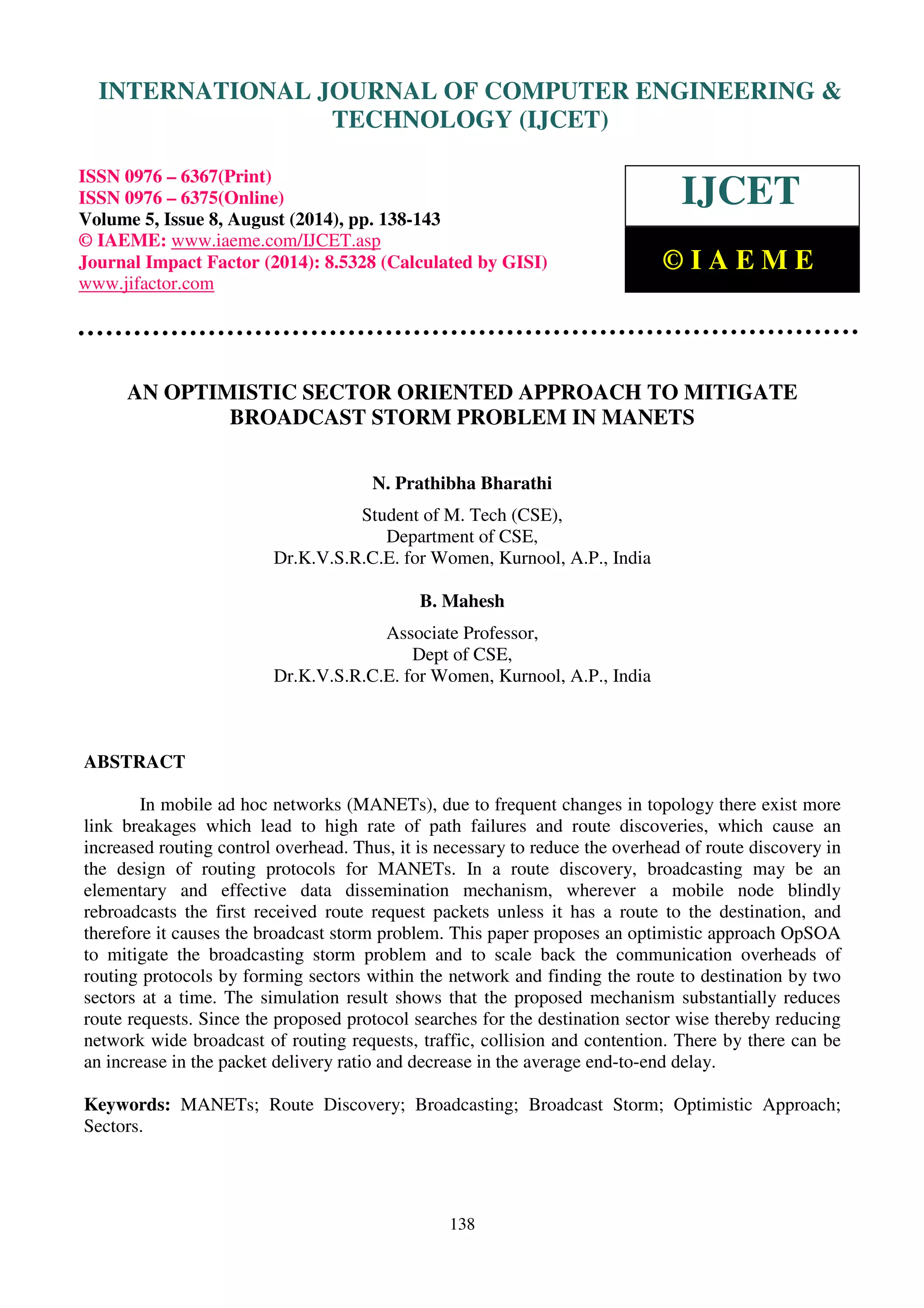
In the proposed approach, the source node divides its neighbors into eight sectors and informs 
its neighboring nodes about the sectoring information.
International Journal of Computer Engineering and Technology (IJCET), ISSN 0976-6367(Print), 
ISSN 0976 - 6375(Online), Volume 5, Issue 8, August (2014), pp. 138-143 © IAEME 
Figure 1: MANET divided in to sectors 
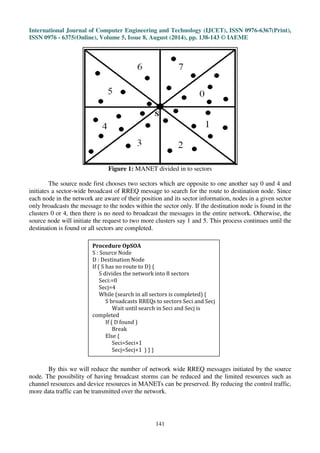
The source node first chooses two sectors which are opposite to one another say 0 and 4 and 
initiates a sector-wide broadcast of RREQ message to search for the route to destination node. Since 
each node in the network are aware of their position and its sector information, nodes in a given sector 
only broadcasts the message to the nodes within the sector only. If the destination node is found in the 
clusters 0 or 4, then there is no need to broadcast the messages in the entire network. Otherwise, the 
source node will initiate the request to two more clusters say 1 and 5. This process continues until the 
destination is found or all sectors are completed.
! 

 
#

An optimistic sector oriented approach to mitigate broadcast storm problem in manets

  • 1.
    International Journal ofComputer Engineering and Technology (IJCET), ISSN 0976-6367(Print), ISSN 0976 - 6375(Online), Volume 5, Issue 8, August (2014), pp. 138-143 © IAEME INTERNATIONAL JOURNAL OF COMPUTER ENGINEERING TECHNOLOGY (IJCET) ISSN 0976 – 6367(Print) ISSN 0976 – 6375(Online) Volume 5, Issue 8, August (2014), pp. 138-143 © IAEME: www.iaeme.com/IJCET.asp Journal Impact Factor (2014): 8.5328 (Calculated by GISI) www.jifactor.com IJCET © I A E M E AN OPTIMISTIC SECTOR ORIENTED APPROACH TO MITIGATE BROADCAST STORM PROBLEM IN MANETS N. Prathibha Bharathi Student of M. Tech (CSE), Department of CSE, Dr.K.V.S.R.C.E. for Women, Kurnool, A.P., India B. Mahesh Associate Professor, Dept of CSE, Dr.K.V.S.R.C.E. for Women, Kurnool, A.P., India 138 ABSTRACT In mobile ad hoc networks (MANETs), due to frequent changes in topology there exist more link breakages which lead to high rate of path failures and route discoveries, which cause an increased routing control overhead. Thus, it is necessary to reduce the overhead of route discovery in the design of routing protocols for MANETs. In a route discovery, broadcasting may be an elementary and effective data dissemination mechanism, wherever a mobile node blindly rebroadcasts the first received route request packets unless it has a route to the destination, and therefore it causes the broadcast storm problem. This paper proposes an optimistic approach OpSOA to mitigate the broadcasting storm problem and to scale back the communication overheads of routing protocols by forming sectors within the network and finding the route to destination by two sectors at a time. The simulation result shows that the proposed mechanism substantially reduces route requests. Since the proposed protocol searches for the destination sector wise thereby reducing network wide broadcast of routing requests, traffic, collision and contention. There by there can be an increase in the packet delivery ratio and decrease in the average end-to-end delay. Keywords: MANETs; Route Discovery; Broadcasting; Broadcast Storm; Optimistic Approach; Sectors.
  • 2.
    International Journal ofComputer Engineering and Technology (IJCET), ISSN 0976-6367(Print), ISSN 0976 - 6375(Online), Volume 5, Issue 8, August (2014), pp. 138-143 © IAEME 139 1. INTRODUCTION Mobile ad hoc networks (MANETs) consist of a collection of freely movable nodes which communicates using wireless links and which do not require any fixed infrastructure [1]. MANETs rely on the broadcasting capability or specialized flooding mechanism when performing route discovery or gathering some global information [2], [3]. Broadcasting is the most frequently used operation in MANETs for the dissemination of data and control messages in many applications. In broadcasting when a node receives the message for the first time then it will forward the messages to all other nodes connected in the network, message flooding, there arise a problem of redundant transmission which results in packet collision. The broadcast redundancy significantly rise as the average number of neighbors increases [4]. It is also difficult to reduce the number of forwarding nodes in broadcasting. In Ad-hoc network, a packet collision occurs when two or more nodes try to transmit a packet from corner to corner in the network at the same time. Packet collisions could end in the loss of packet reliability or will slow down the performance of a network. Once this redundancy will increase it ends up in severe network congestion and significant performance degradation, which is referred to as the broadcast storm problem [5]. In broadcast-based systems, we use message flooding to broadcast messages. There is no specific destination; thus each neighbor node is contacted then forwards the message to its own neighbors till the message’s lifespan expires. Thus the main objective of broadcasting algorithms is to reduce the redundant transmissions. The important aspect to achieve this is to limit the number of forwarding nodes. In MANETs, the forwarding node set for broadcasting is generally selected in a localized manner, wherever each node determines its own status of forwarding or non forwarding based on local information or the status of a node is selected by its neighbors. A limited forwarding node set is considered to be more efficient due to the reduced number of transmissions within the network. Therefore, to reduce the total number of transmissions we use sectors of nodes within the network and we transmit the broadcast messages two sectors at a time. The remainder of this paper is organized as follows. Section II reviews the present broadcasting mechanisms available in literature. Section III describes the proposed OpSOA approach. In Section IV we evaluate the performance of our proposed approach. Section V concludes the paper with an outlook to future research. 2. RELATED WORK Broadcasting is an effective mechanism for route discovery but the routing overhead associated with the dissemination of routing control packets such as RREQ packets can be large, when the network density is high and the network topology frequently changes. One of the earliest and the classical way of broadcasting in MANETs is flooding. But with blind flooding broadcast storm occurs. Traditional on-demand routing protocols [6, 7, 8] produce a large amount of routing control traffic by blindly flooding the entire network with RREQ packets during route discovery. In traditional AODV, an intermediate node rebroadcasts all RREQ packets that are received for the first time. Assuming no intermediate node has a valid route to the destination and N is the total number of nodes in the network, the number of possible rebroadcast in AODV is N −1. In the basic probabilistic route discovery a source node sends an RREQ to its immediate neighbors with probability p =1. As an intermediate node first receives this RREQ packet, with probability p 1, it rebroadcasts the packet to its neighbors and with forwarding probability 1 − p it simply drop the packet. As the decision to rebroadcast a packet of each node is independent, the possible number of rebroadcasts is p x (N −1). This is referred as Fixed Probabilistic Route Discovery (FPR) [9].
  • 3.
    International Journal ofComputer Engineering and Technology (IJCET), ISSN 0976-6367(Print), ISSN 0976 - 6375(Online), Volume 5, Issue 8, August (2014), pp. 138-143 © IAEME In a network of random distribution of mobile nodes like MANETs, there are regions of varying degrees of node density. Thus the need for an appropriate adjustment of the forwarding probability arises. Therefore, FPR suffers from unfair distribution of forwarding probability; since every node is assigned the same value regardless of their local topological characteristics. It is critical to identify and categorize mobile nodes in the various regions of the network and appropriately adjust their forwarding probabilities. To overcome the disadvantages of FPR the authors in [9] proposed a generic probabilistic route discovery algorithm (DPR) that dynamically determines the forwarding probability of an RREQ taking into consideration the set of covered neighbors and the local density of the forwarding node. This scheme only considers the coverage ratio by the previous node, and neglects those neighbors which receive the duplicate RREQ packet. Thus, it needs further optimization and extension. Authors in [10] proposed an approach MobDHop-AODV to work on top of the stable, two-tier cluster structure formed by the MobDHop clustering algorithm. The goal of this protocol is to exploit the aggregated topology information stored at every cluster head to avoid the need to flood the network with route request (RREQ) packets in the search for intended destinations. In this paper, we propose an efficient optimistic sector oriented approach (OpSOA) to yield a significant performance improvement in terms of reduced network wide route requests by limiting the broadcasts to two sectors at a time. The proposed approach is simple enough for easy implementation. The detail of the scheme is described in the next section. 140 3. PROPOSED WORK A new approach namely Optimistic Sector Oriented Approach (OpSOA) is introduced in this work. The goal of this approach is to reduce the number of network wide route request (RREQ) packets by limiting them to two sectors at a time. By this approach the need to flood network wide RREQ packets to search for intended destination is reduced. Note that GPS assistance is necessary in the proposed algorithm. As we know that, in broadcasting when a node receives the message for the first time then it will forward the message to all other nodes connected in the network, message flooding, there arise a problem of redundant transmission which results in packet collision. Packet collisions may also result in the loss of packet reliability or can slow down the performance of a network. The broadcast redundancy significantly rise as the average number of neighbors increases [4]. When this redundancy increases it results in the severe network congestion and significant performance degradation, a fact called the broadcast storm problem [5]. To avoid this broadcast storm problem; instead of forwarding the received messages to all other nodes in the network, we forward the broadcast messages two sectors at a time only. Therefore, by reducing the total number of broadcast transmission through the sector approach broadcast storm problem can be alleviated. In the proposed mechanism smart antenna systems that form directional transmission/reception beams switched beam and steerable beam are used [11]. 3.1 IMPLEMENTATION In the proposed approach, the source node divides its neighbors into eight sectors and informs its neighboring nodes about the sectoring information.
  • 4.
    International Journal ofComputer Engineering and Technology (IJCET), ISSN 0976-6367(Print), ISSN 0976 - 6375(Online), Volume 5, Issue 8, August (2014), pp. 138-143 © IAEME Figure 1: MANET divided in to sectors The source node first chooses two sectors which are opposite to one another say 0 and 4 and initiates a sector-wide broadcast of RREQ message to search for the route to destination node. Since each node in the network are aware of their position and its sector information, nodes in a given sector only broadcasts the message to the nodes within the sector only. If the destination node is found in the clusters 0 or 4, then there is no need to broadcast the messages in the entire network. Otherwise, the source node will initiate the request to two more clusters say 1 and 5. This process continues until the destination is found or all sectors are completed.
  • 5.