Impacts of Internal Network Contexts on
Performance of MANET Routing Protocols:
a Case Study
Rayhan Hattab
Study Contents
 What is MANET
Network Contexts
Mobility Models
Routing Protocols
Performance Metrics
Simulation and results
What is MANET ?
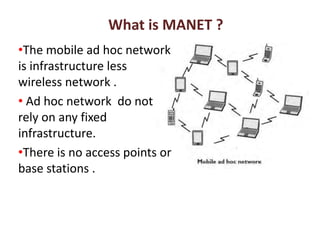
•The mobile ad hoc network
is infrastructure less
wireless network .
• Ad hoc network do not
rely on any fixed
infrastructure.
•There is no access points or
base stations .
What is MANET ?
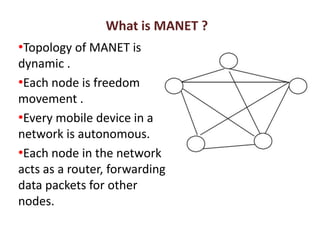
•Topology of MANET is
dynamic .
•Each node is freedom
movement .
•Every mobile device in a
network is autonomous.
•Each node in the network
acts as a router, forwarding
data packets for other
nodes.
Performance of Mobile Ad hoc NETwork
(MANET) routing protocols is greatly affected
by Network Contexts .
The network contexts actually contain external
and internal parts.
External Contexts Internal Contexts
Network Contexts
Network contexts
• For external network contexts, many
researches have been done.
• However, there is relatively little
research on the internal part.
External Network contexts
External network contexts mean a series of
external factors in practical applications
which can hardly be configured but
mainly adapted to, such as factors of
scenarios, mobility models and traffic
patterns.
They are randomly determined by the
environment, behaviors of users and the
given business for MANET.
Internal Network contexts
Internal network contexts mean a series of
internalparameters in MANET protocol
stack which can be configured in most
cases, such as update interval of routing
information in table-driven routing
protocols and the transmission range of
RREQ messages in on-demand routing
protocols
Mobility Models
The mobility model is external
network context which plays a very
important role in determining the
protocol performance in MANET.
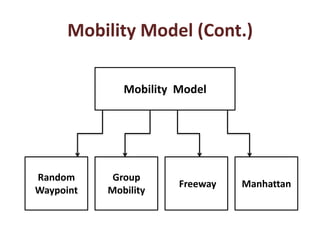
Mobility Model (Cont.)
Group
Mobility
Mobility Model
Freeway
Random
Waypoint
Manhattan
Random Waypoint Mobility Model
The random waypoint model has been
widely used in most simulation studies
and in performance comparison
studies of routing protocols.
Random Waypoint
In this model, nodes in a
large ‘‘room’’ choose some
destination, and move
towards it at a random
speed uniformly chosen
from (0,V_max] .
After reaching the
destination, a node pauses
for a constant time before
moving towards the next
chosen destination at a
newly chosen speed.
Random Point Group Mobility (RPGM)
Each group has a logical
centre (group leader) that
determines the group’s
motion behavior.
Given example scenario
contains sixteen nodes with
Node 1 and Node 9 as group
leaders.
Freeway Mobility Model
This model emulates the
motion behavior of
mobile nodes on a
freeway.
Manhattan Mobility Model
Manhattan model
emulates the movement
pattern of mobile nodes on
streets.
The scenario is composed
of a number of horizontal
and vertical streets.
Routing protocols
Routing protocols are divided in two approaches:
1. Table Driven Routing Protocol or Proactive
2. On Demand Routing or Reactive
Proactive (Table Driven ) Reactive (On Demand)
Routing Protocols
Routing protocols (Cont.)
OLSR , DBF, GSR
, WRP , ZRP ,
STAR, DSDV
In Proactive Routing Protocols
means all nodes have tables
with routing information
which are updated at
intervals.
Example : OLSR (Optimized
link state Routing protocol).
Proactive
(Table Driven)
Routing protocols (Cont.)
In On Demand routing or
reactive protocols, routes are
created as and when required.
When a transmission occurs from
source to destination, it invokes
the route discovery procedure.
Example : AODV (Ad hoc On
Demand Distance Vector).
Reactive
(On Demand)
DSR , DDR ,
TORA , RDMAR
, AODV
Routing protocols
• We will used AODV routing protocol
as case study , and
• Used OLSR routing protocol as
reference to comparison with AODV.
AODV
• The AODV protocol is reactive protocol
 AODV have 3 message types:
 Route Requests (RREQs)
(Prodcast from source to all other nodes )
 Route Replies (RREPs)
(Unicast from intermediate or destination node
to source node )
 Route Errors (RERRs) .
AODV (Cont.)
• The range of dissemination of such RREQs
is indicated by the TTL in the IP header .
AODV (Cont.)
• To prevent unnecessary network-wide
dissemination of RREQs, the originating node
SHOULD use an expanding ring search
technique.
• In an expanding ring search, the originating
node initially uses a TTL_START = TTL in RREQ
packet IP header , and sets the timeout for
receiving a RREP to RING_TRAVERSAL_TIME
milliseconds.
AODV (Cont.)
• If the RREQ times out without a corresponding
RREP, the originator broadcasts the RREQ
again with the TTL incremented by
TTL_INCREMENT.
• This continues until the TTL set in the RREQ
reaches TTL_THRESHOLD.
Each time, the timeout for receiving a RREP is
RING_TRAVERSAL_TIME.
Performances Metrics
 The following metrics are evaluated for the
routing protocols:
1. Packet delivery ratio (PDR) – The ratio of the
data packets delivered to the destinations
over the data packets generated by the traffic
sources;
2. Routing overhead – The number of control
packets transmitted, with each hop-wise
transmission of a control packet counted as
one transmission;
Simulation Scenario
 The basic
simulation
scenario
in NS2 is
Random waypoint.
Simulation Scenario
The contents of external and internal network
contexts in simulation are provided in Table 1 .
Simulation Scenario
 we choose the following parameters :
• External network contexts :
Node density and Pause time .
• Internal network contexts :
TTL_ INCREMENT in AODV .
• performance metrics :
Packet Delivery Fraction (PDF) and Overhead.
• For accuracy, each combination of external
and internal network contexts is simulated
five times and the average value is used.
Impact of PDF under Varied Node Density
There exist the following three phenomenon's:
1. The performance metric PDF of AODV shows better
than that of OLSR when TTL _INCREMENT is set to 2,
but worse in almost all cases when TTL_
INCREMENT is set to 8.
2. When node density increases to 8/km2, PDF of
AODV with TTL _INCREMENT=2 reaches the
maximum value.
3. The increase rate of PDF of TTL_INCREMENT=2 is
higher than that of TTL_ INCREMENT=8 with node
density increasing from 4/km2 to 8/km2; In
addition, the decrease rate is also lower than that of
TTL_ INCREMENT=8 with node density increasing
from 8/km2 to 20/km2.
 We can get the following conclusions:
1. When the node density is increased properly, the routes can
be established more quickly and stably because of the better
connectivity. Quick and stable routes establishment is
beneficial to deliver data packets timely and successfully,
namely raise PDF. In this case, a higher TTL_ INCREMENT may
sometimes make RREQ messages broadcasted with a long
TTL value, but not many nodes will be affected by these
control messages because the node density is not too high.
So, the overhead is still low.
2. When the node density is increased too much,
communication collisions will become ubiquitous. In this
case, a higher TTL_ INCREMENT can increase the collisions
further and cause higher overhead, which will lead PDF to
decrease faster.
Impact of PDF under Varied Pause Time
 There exist the following three phenomenon's:
1. There is almost no differentiation of PDF for different TTL_
INCREMENT with pause time increasing.
2. PDF of AODV is much lower than that of OLSR when pause time
is increasing from 0s to 15s.
3. When pause time increases to 20s, PDF of AODV is almost on
the same level with that of OLSR, and both reach their maximal
values.
From the result, we can get the conclusion that TTL_INCREMENT
almost brings no changes to the existing impacts of pause time on
performance.
From all the above, we can get the following solution that AODV
with TTL_INCREMENT set to 2 tends to be well suited for
accomplishing this mission under pause time = 17s, node density =
8/km2, this conclude relationship is qualitative .
Prove Impact of internal network contexts
on performance metrics quantitatively
The proof is based on the following three assumes:
1. Without using Hello mechanism, control
overhead is mainly caused by RREQ messages,
because RREP messages and Route ERRor (RERR)
messages work on unicast mode.
2. Topology of MANET in practical application has
certain characteristics and changing regularity.
3. Hops of established routes satisfy certain
distribution law.
Let : k is number of hops routs .
Bk is broadcast times of RREQ messages for
establishing a k hops route .
TS is TTL_START .
T1 is TTL_INREMENT(T1min ≤ T1 ≤ T1max) .
TTL_ THRESHOLD is ignored.
Ideal case,
Prove quantitatively
Example TS = 1 , T1= 2,4,6,8
Prove quantitatively (Cont.)
• If TTL value in the ith (i ≤ Bk) broadcast was
TS + (i − 1)TI.
• Then , TTL value in the last broadcast is TL .
Prove quantitatively (Cont.)
The above is discussed based on an ideal case.
In the real case, it is quite possible that a source node
has still not received a RREP message from the
destination when the value of TTL exceeds k hops.
Then an extra broadcast of RREQ message is needed.
This is usually caused by the joint impacts of node
density and movement , the value of TTL exceeds k
hops. We use Iα(x) to represent initiating an extra
broadcast or not. So Bk is modified as follows:
Prove quantitatively (Cont.)
In (5), x ∈ X and X ∼ U(0, 1).
Prove quantitatively (Cont.)
The α is mainly related with the degrees of nodes
involved in forwarding RREQ messages.
Example d=2,3,4,5,6 dmin=2 dmax=6
Based on the above, we get the relationship
between TTL_ INCREMENT and Overhead
―N is the total number of routes establishment times in MANET.
―Pk is the distribution law of hops :
P {H = k} = pk , (k = 1, 2, . . . , K)
― IF dij was the average degree of nodes involved ,
― So , d. Nij represents the total value of the degrees,
And Nij = d · Ni(j−1).
However, considering that not all the neighboring nodes are
meaningful for the forwarding, Then Nij is revised to : Nij’
= d · Ni’(j−1) · β,
in which β ∈ Y and Y ∼ U(a, b).
Prove quantitatively (Cont.)
Table 2 : distribution law of hops H
Table 3 : Parameters on the relationship
When we set the distribution law of hops H as Table 2 ,
and The other parameters are provided in Table 3.
We will get the simulation result in last Fig.
Impact of overhead under varied Node Degree
 We can get the following phenomenon's:
• For TTL_ INCREMENT = 4, when average node degree
increases from 2 to 5, overhead is relatively stable.
This means that routes establishment is quick and stable ,
, and connectivity and PDF is improvement .
• When average node degree increases from 5 to 6, overhead
increases greatly, which means trouble with routes
establishment. In this case, the increment of node degree can
only cause more collisions and decrease PDF.
So the point, where average node degree is set to 5, is an
“turning point”.
For different values of TTL _INCREMENT, the “turning points”
are different.
Future Work
1. Make simulation to study impact of other
internal network contexts such as proactive
protocols update universal on performance
metrics .
2. Make simulation to study impact of internal
network contexts on overhead performance
metrics that caused by Hello messages on
reactive routing protocols.
the result of all simulations we want to get
stable and quick route establishment .
Reference
• L. Yi, Y. Zhai, Y. Wang, J. Yuan and I. You , Impacts of Internal
Network Contexts on Performance of MANET Routing
Protocols: a Case Study, Sixth International Conference on
Innovative Mobile and Internet Services in Ubiquitous
Computing,2012.

MANET Routing Protocols , a case study

  • 1.
    Impacts of InternalNetwork Contexts on Performance of MANET Routing Protocols: a Case Study Rayhan Hattab
  • 2.
    Study Contents  Whatis MANET Network Contexts Mobility Models Routing Protocols Performance Metrics Simulation and results
  • 3.
    What is MANET? •The mobile ad hoc network is infrastructure less wireless network . • Ad hoc network do not rely on any fixed infrastructure. •There is no access points or base stations .
  • 4.
    What is MANET? •Topology of MANET is dynamic . •Each node is freedom movement . •Every mobile device in a network is autonomous. •Each node in the network acts as a router, forwarding data packets for other nodes.
  • 5.
    Performance of MobileAd hoc NETwork (MANET) routing protocols is greatly affected by Network Contexts . The network contexts actually contain external and internal parts. External Contexts Internal Contexts Network Contexts
  • 6.
    Network contexts • Forexternal network contexts, many researches have been done. • However, there is relatively little research on the internal part.
  • 7.
    External Network contexts Externalnetwork contexts mean a series of external factors in practical applications which can hardly be configured but mainly adapted to, such as factors of scenarios, mobility models and traffic patterns. They are randomly determined by the environment, behaviors of users and the given business for MANET.
  • 8.
    Internal Network contexts Internalnetwork contexts mean a series of internalparameters in MANET protocol stack which can be configured in most cases, such as update interval of routing information in table-driven routing protocols and the transmission range of RREQ messages in on-demand routing protocols
  • 10.
    Mobility Models The mobilitymodel is external network context which plays a very important role in determining the protocol performance in MANET.
  • 11.
    Mobility Model (Cont.) Group Mobility MobilityModel Freeway Random Waypoint Manhattan
  • 12.
    Random Waypoint MobilityModel The random waypoint model has been widely used in most simulation studies and in performance comparison studies of routing protocols.
  • 13.
    Random Waypoint In thismodel, nodes in a large ‘‘room’’ choose some destination, and move towards it at a random speed uniformly chosen from (0,V_max] . After reaching the destination, a node pauses for a constant time before moving towards the next chosen destination at a newly chosen speed.
  • 14.
    Random Point GroupMobility (RPGM) Each group has a logical centre (group leader) that determines the group’s motion behavior. Given example scenario contains sixteen nodes with Node 1 and Node 9 as group leaders.
  • 15.
    Freeway Mobility Model Thismodel emulates the motion behavior of mobile nodes on a freeway.
  • 16.
    Manhattan Mobility Model Manhattanmodel emulates the movement pattern of mobile nodes on streets. The scenario is composed of a number of horizontal and vertical streets.
  • 17.
    Routing protocols Routing protocolsare divided in two approaches: 1. Table Driven Routing Protocol or Proactive 2. On Demand Routing or Reactive Proactive (Table Driven ) Reactive (On Demand) Routing Protocols
  • 18.
    Routing protocols (Cont.) OLSR, DBF, GSR , WRP , ZRP , STAR, DSDV In Proactive Routing Protocols means all nodes have tables with routing information which are updated at intervals. Example : OLSR (Optimized link state Routing protocol). Proactive (Table Driven)
  • 19.
    Routing protocols (Cont.) InOn Demand routing or reactive protocols, routes are created as and when required. When a transmission occurs from source to destination, it invokes the route discovery procedure. Example : AODV (Ad hoc On Demand Distance Vector). Reactive (On Demand) DSR , DDR , TORA , RDMAR , AODV
  • 20.
    Routing protocols • Wewill used AODV routing protocol as case study , and • Used OLSR routing protocol as reference to comparison with AODV.
  • 21.
    AODV • The AODVprotocol is reactive protocol  AODV have 3 message types:  Route Requests (RREQs) (Prodcast from source to all other nodes )  Route Replies (RREPs) (Unicast from intermediate or destination node to source node )  Route Errors (RERRs) .
  • 22.
    AODV (Cont.) • Therange of dissemination of such RREQs is indicated by the TTL in the IP header .
  • 23.
    AODV (Cont.) • Toprevent unnecessary network-wide dissemination of RREQs, the originating node SHOULD use an expanding ring search technique. • In an expanding ring search, the originating node initially uses a TTL_START = TTL in RREQ packet IP header , and sets the timeout for receiving a RREP to RING_TRAVERSAL_TIME milliseconds.
  • 24.
    AODV (Cont.) • Ifthe RREQ times out without a corresponding RREP, the originator broadcasts the RREQ again with the TTL incremented by TTL_INCREMENT. • This continues until the TTL set in the RREQ reaches TTL_THRESHOLD. Each time, the timeout for receiving a RREP is RING_TRAVERSAL_TIME.
  • 25.
    Performances Metrics  Thefollowing metrics are evaluated for the routing protocols: 1. Packet delivery ratio (PDR) – The ratio of the data packets delivered to the destinations over the data packets generated by the traffic sources; 2. Routing overhead – The number of control packets transmitted, with each hop-wise transmission of a control packet counted as one transmission;
  • 26.
    Simulation Scenario  Thebasic simulation scenario in NS2 is Random waypoint.
  • 27.
    Simulation Scenario The contentsof external and internal network contexts in simulation are provided in Table 1 .
  • 28.
    Simulation Scenario  wechoose the following parameters : • External network contexts : Node density and Pause time . • Internal network contexts : TTL_ INCREMENT in AODV . • performance metrics : Packet Delivery Fraction (PDF) and Overhead. • For accuracy, each combination of external and internal network contexts is simulated five times and the average value is used.
  • 29.
    Impact of PDFunder Varied Node Density
  • 30.
    There exist thefollowing three phenomenon's: 1. The performance metric PDF of AODV shows better than that of OLSR when TTL _INCREMENT is set to 2, but worse in almost all cases when TTL_ INCREMENT is set to 8. 2. When node density increases to 8/km2, PDF of AODV with TTL _INCREMENT=2 reaches the maximum value. 3. The increase rate of PDF of TTL_INCREMENT=2 is higher than that of TTL_ INCREMENT=8 with node density increasing from 4/km2 to 8/km2; In addition, the decrease rate is also lower than that of TTL_ INCREMENT=8 with node density increasing from 8/km2 to 20/km2.
  • 31.
     We canget the following conclusions: 1. When the node density is increased properly, the routes can be established more quickly and stably because of the better connectivity. Quick and stable routes establishment is beneficial to deliver data packets timely and successfully, namely raise PDF. In this case, a higher TTL_ INCREMENT may sometimes make RREQ messages broadcasted with a long TTL value, but not many nodes will be affected by these control messages because the node density is not too high. So, the overhead is still low. 2. When the node density is increased too much, communication collisions will become ubiquitous. In this case, a higher TTL_ INCREMENT can increase the collisions further and cause higher overhead, which will lead PDF to decrease faster.
  • 32.
    Impact of PDFunder Varied Pause Time
  • 33.
     There existthe following three phenomenon's: 1. There is almost no differentiation of PDF for different TTL_ INCREMENT with pause time increasing. 2. PDF of AODV is much lower than that of OLSR when pause time is increasing from 0s to 15s. 3. When pause time increases to 20s, PDF of AODV is almost on the same level with that of OLSR, and both reach their maximal values. From the result, we can get the conclusion that TTL_INCREMENT almost brings no changes to the existing impacts of pause time on performance. From all the above, we can get the following solution that AODV with TTL_INCREMENT set to 2 tends to be well suited for accomplishing this mission under pause time = 17s, node density = 8/km2, this conclude relationship is qualitative .
  • 34.
    Prove Impact ofinternal network contexts on performance metrics quantitatively The proof is based on the following three assumes: 1. Without using Hello mechanism, control overhead is mainly caused by RREQ messages, because RREP messages and Route ERRor (RERR) messages work on unicast mode. 2. Topology of MANET in practical application has certain characteristics and changing regularity. 3. Hops of established routes satisfy certain distribution law.
  • 35.
    Let : kis number of hops routs . Bk is broadcast times of RREQ messages for establishing a k hops route . TS is TTL_START . T1 is TTL_INREMENT(T1min ≤ T1 ≤ T1max) . TTL_ THRESHOLD is ignored. Ideal case, Prove quantitatively Example TS = 1 , T1= 2,4,6,8
  • 36.
    Prove quantitatively (Cont.) •If TTL value in the ith (i ≤ Bk) broadcast was TS + (i − 1)TI. • Then , TTL value in the last broadcast is TL .
  • 37.
    Prove quantitatively (Cont.) Theabove is discussed based on an ideal case. In the real case, it is quite possible that a source node has still not received a RREP message from the destination when the value of TTL exceeds k hops. Then an extra broadcast of RREQ message is needed. This is usually caused by the joint impacts of node density and movement , the value of TTL exceeds k hops. We use Iα(x) to represent initiating an extra broadcast or not. So Bk is modified as follows:
  • 38.
    Prove quantitatively (Cont.) In(5), x ∈ X and X ∼ U(0, 1).
  • 39.
    Prove quantitatively (Cont.) Theα is mainly related with the degrees of nodes involved in forwarding RREQ messages. Example d=2,3,4,5,6 dmin=2 dmax=6
  • 40.
    Based on theabove, we get the relationship between TTL_ INCREMENT and Overhead ―N is the total number of routes establishment times in MANET. ―Pk is the distribution law of hops : P {H = k} = pk , (k = 1, 2, . . . , K) ― IF dij was the average degree of nodes involved , ― So , d. Nij represents the total value of the degrees, And Nij = d · Ni(j−1). However, considering that not all the neighboring nodes are meaningful for the forwarding, Then Nij is revised to : Nij’ = d · Ni’(j−1) · β, in which β ∈ Y and Y ∼ U(a, b).
  • 41.
    Prove quantitatively (Cont.) Table2 : distribution law of hops H Table 3 : Parameters on the relationship When we set the distribution law of hops H as Table 2 , and The other parameters are provided in Table 3. We will get the simulation result in last Fig.
  • 42.
    Impact of overheadunder varied Node Degree
  • 43.
     We canget the following phenomenon's: • For TTL_ INCREMENT = 4, when average node degree increases from 2 to 5, overhead is relatively stable. This means that routes establishment is quick and stable , , and connectivity and PDF is improvement . • When average node degree increases from 5 to 6, overhead increases greatly, which means trouble with routes establishment. In this case, the increment of node degree can only cause more collisions and decrease PDF. So the point, where average node degree is set to 5, is an “turning point”. For different values of TTL _INCREMENT, the “turning points” are different.
  • 44.
    Future Work 1. Makesimulation to study impact of other internal network contexts such as proactive protocols update universal on performance metrics . 2. Make simulation to study impact of internal network contexts on overhead performance metrics that caused by Hello messages on reactive routing protocols. the result of all simulations we want to get stable and quick route establishment .
  • 45.
    Reference • L. Yi,Y. Zhai, Y. Wang, J. Yuan and I. You , Impacts of Internal Network Contexts on Performance of MANET Routing Protocols: a Case Study, Sixth International Conference on Innovative Mobile and Internet Services in Ubiquitous Computing,2012.