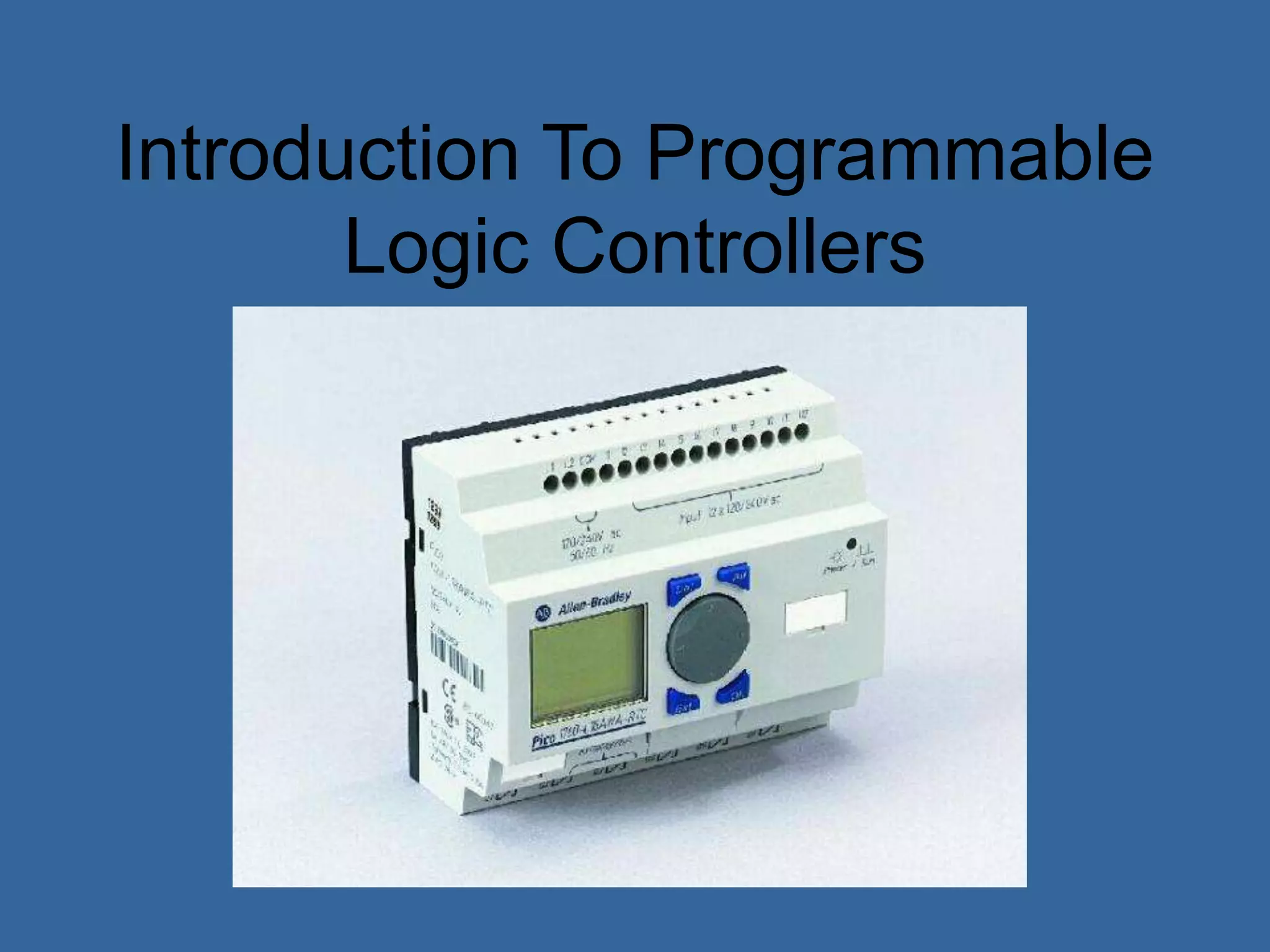
Introduction To Programmable
Logic Controllers
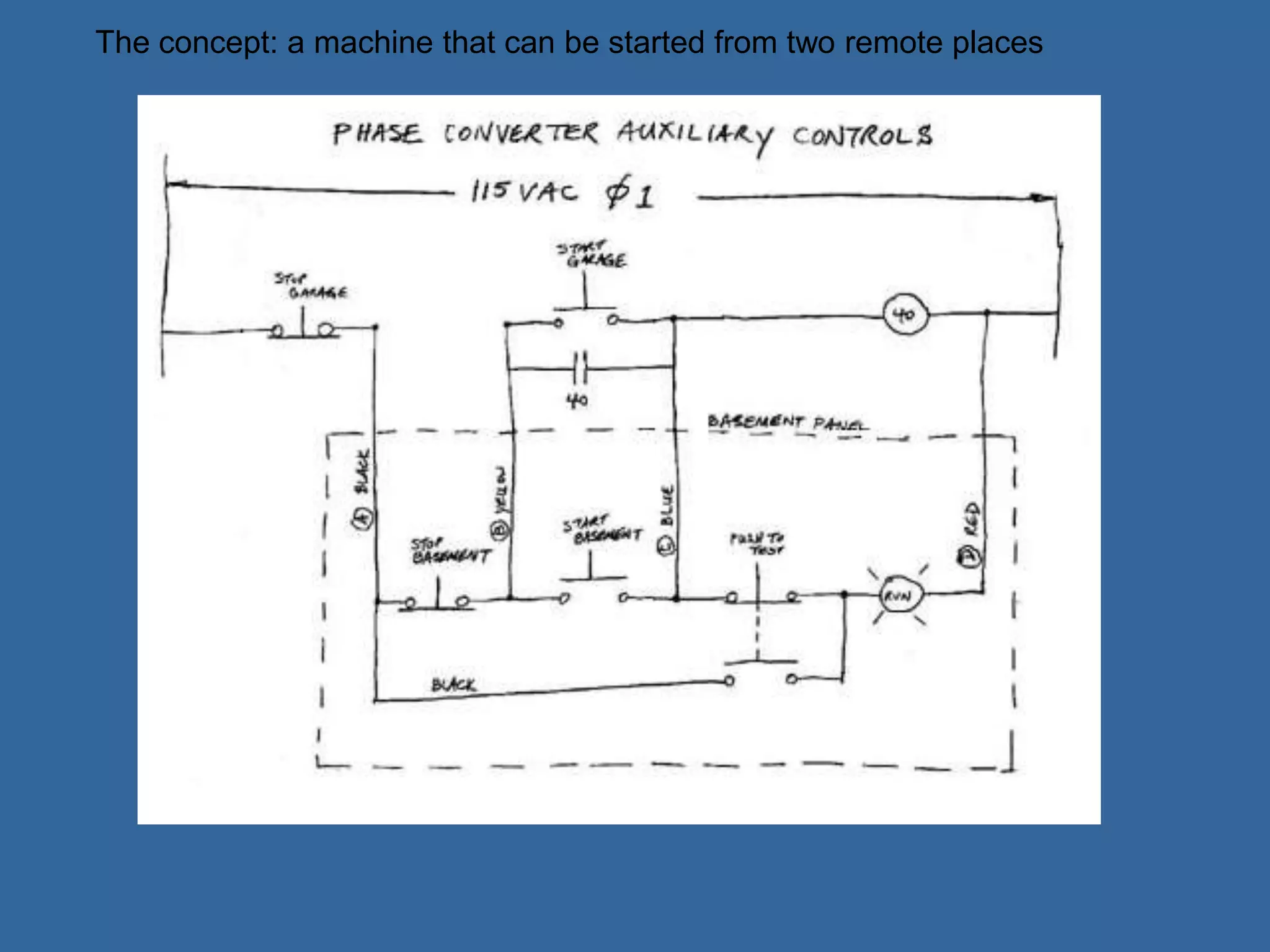
The concept: a machine that can be started from two remote places
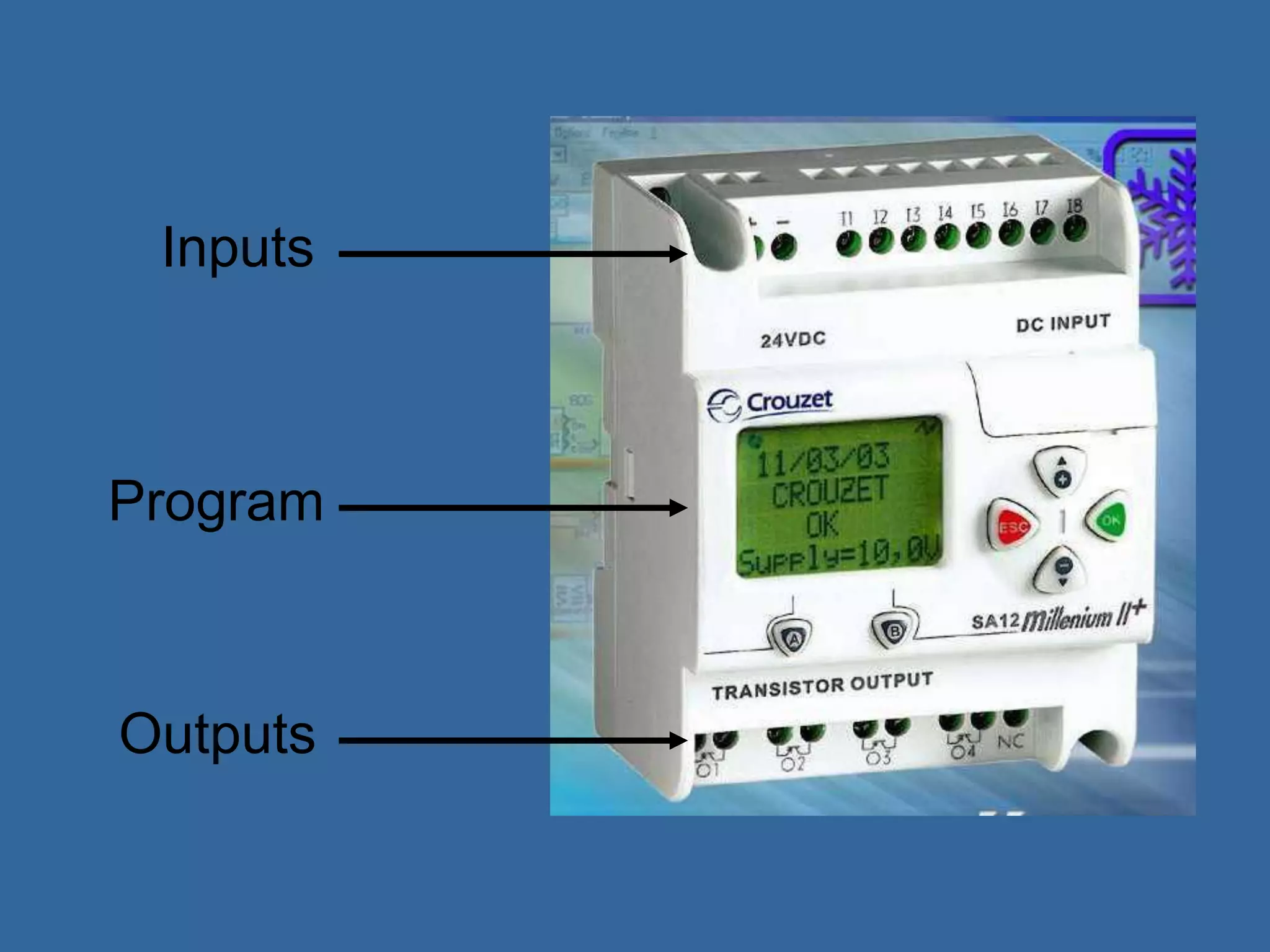
Inputs
Outputs
Program
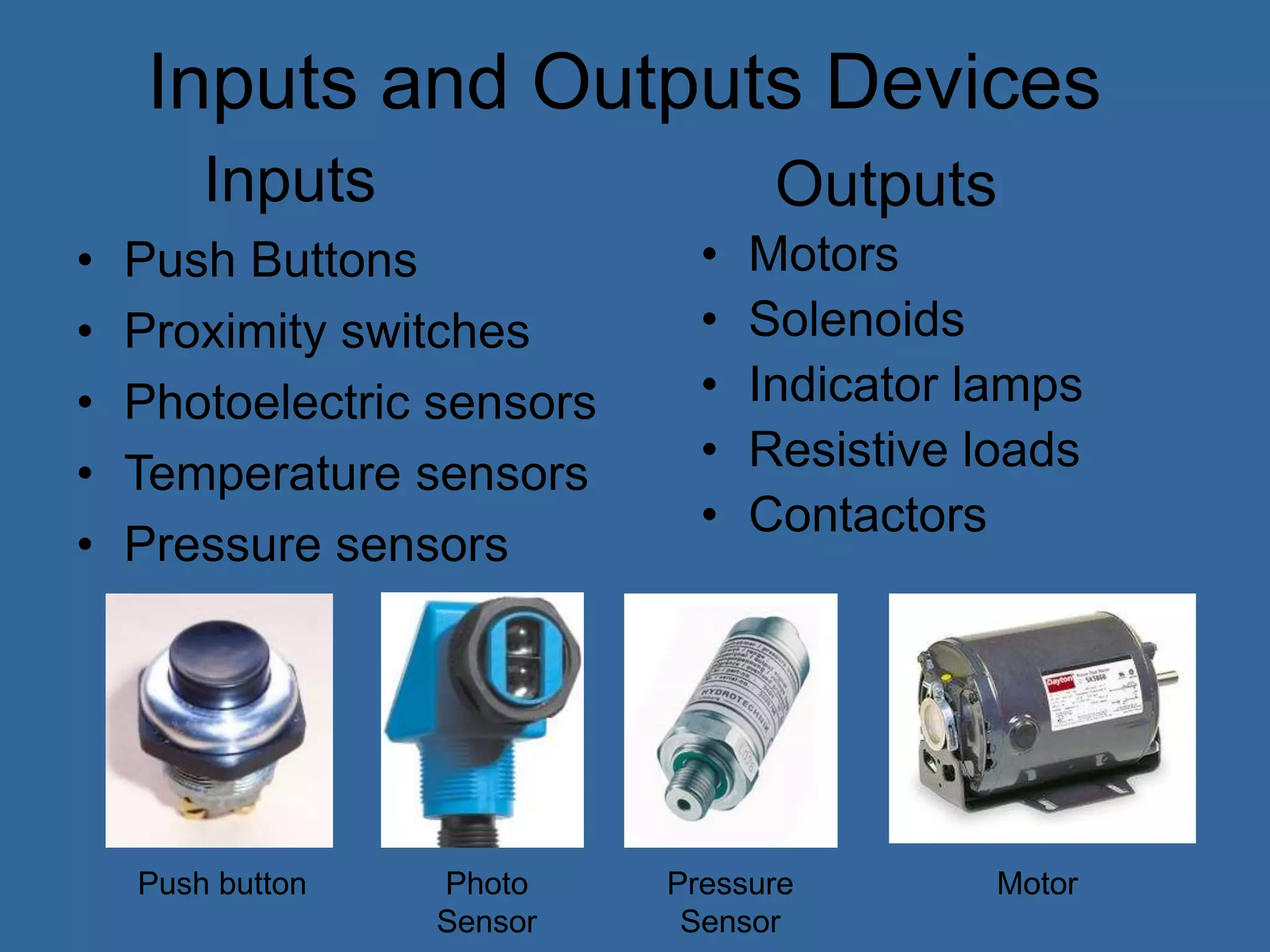
Inputs and Outputs Devices
• Push Buttons
• Proximity switches
• Photoelectric sensors
• Temperature sensors
• Pressure sensors
• Motors
• Solenoids
• Indicator lamps
• Resistive loads
• Contactors
Inputs Outputs
Push button Photo
Sensor
Pressure
Sensor
Motor
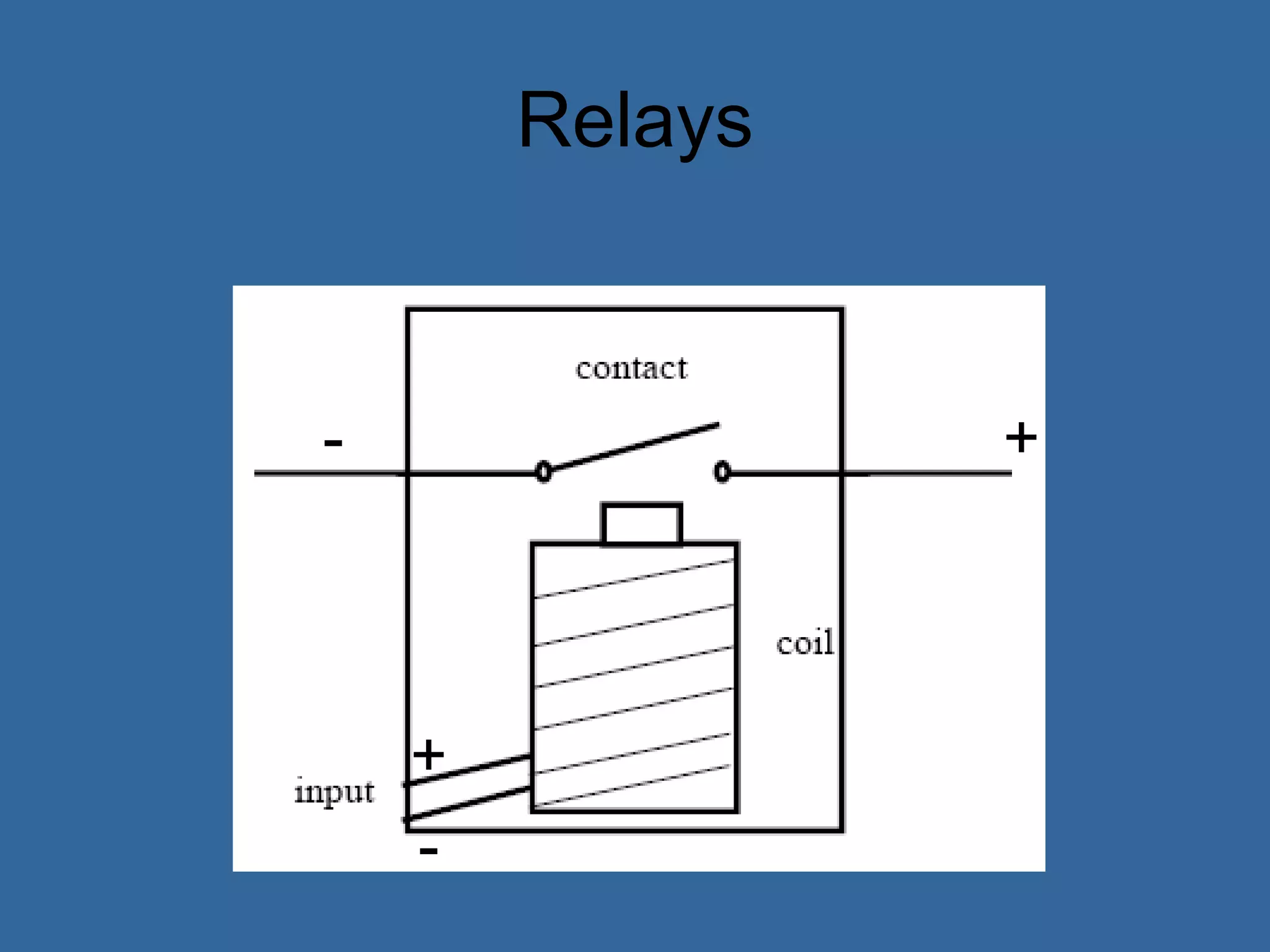
Relays
+
+
-
-
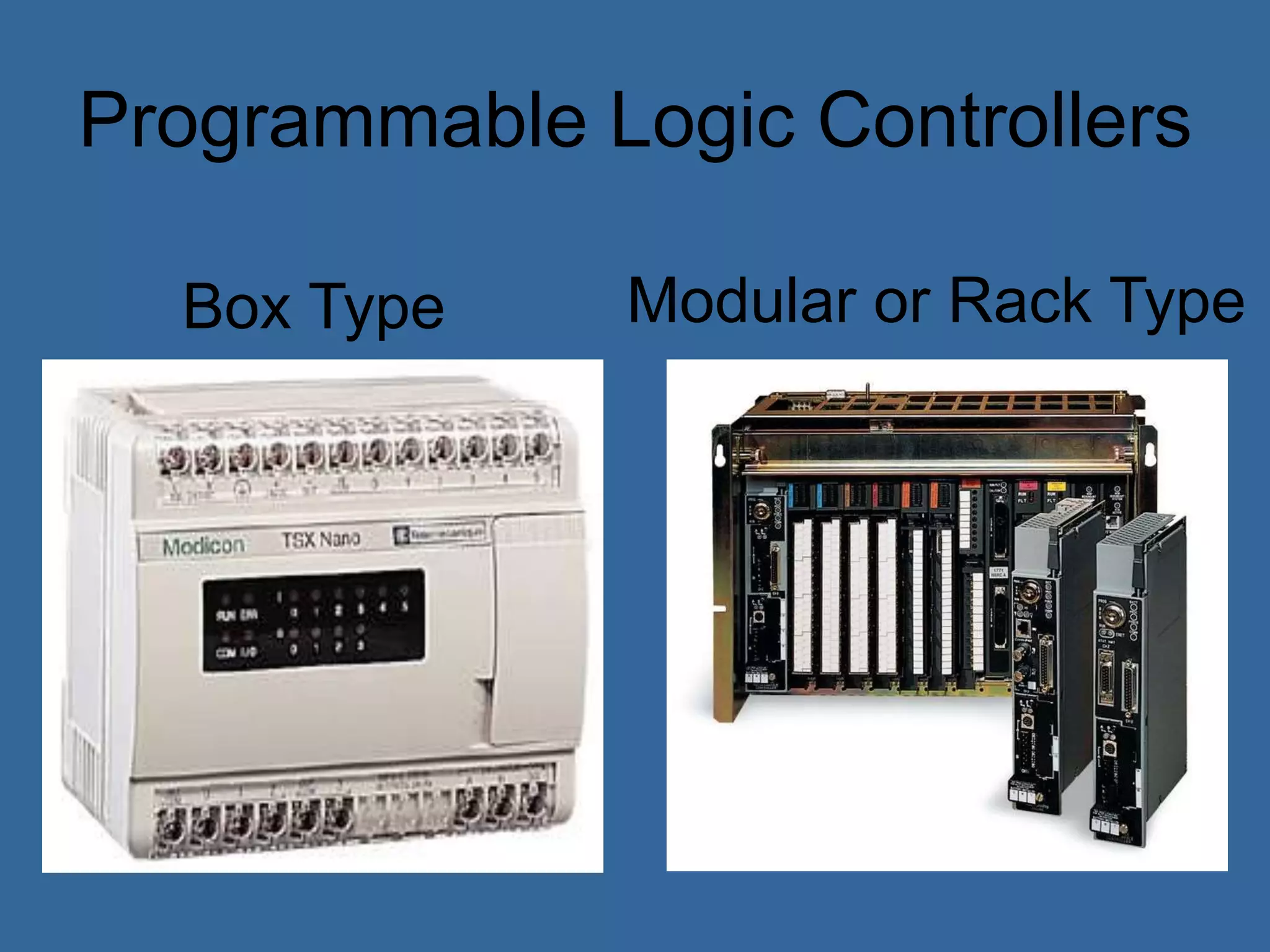
Programmable Logic Controllers
Box Type Modular or Rack Type
Typical PLC Applications
• Coin-Operated Carwash
• Conveyor Diverter Control
• Greenhouse Irrigation
• Lumber Mill Operation
• Oil recovery systems
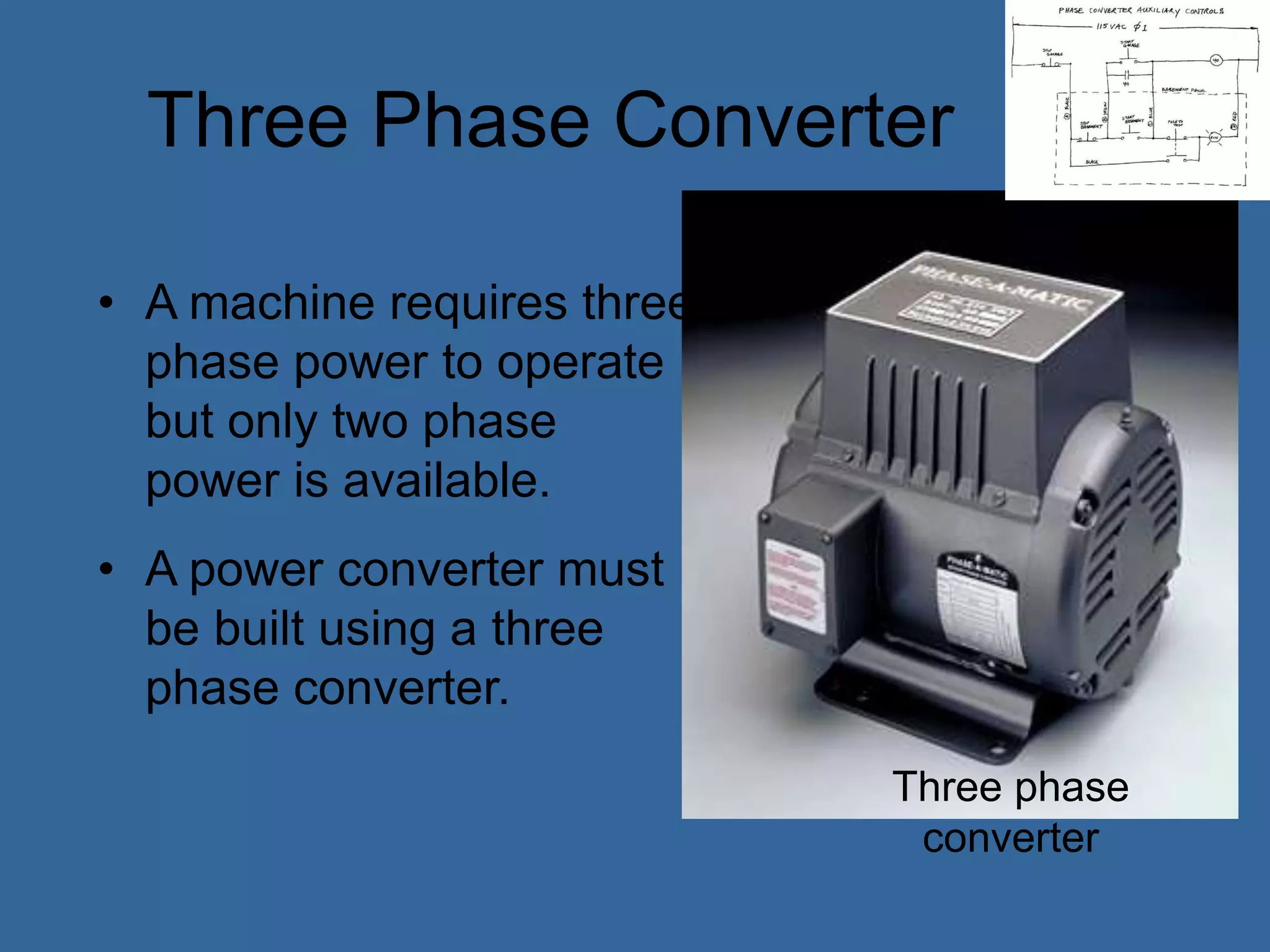
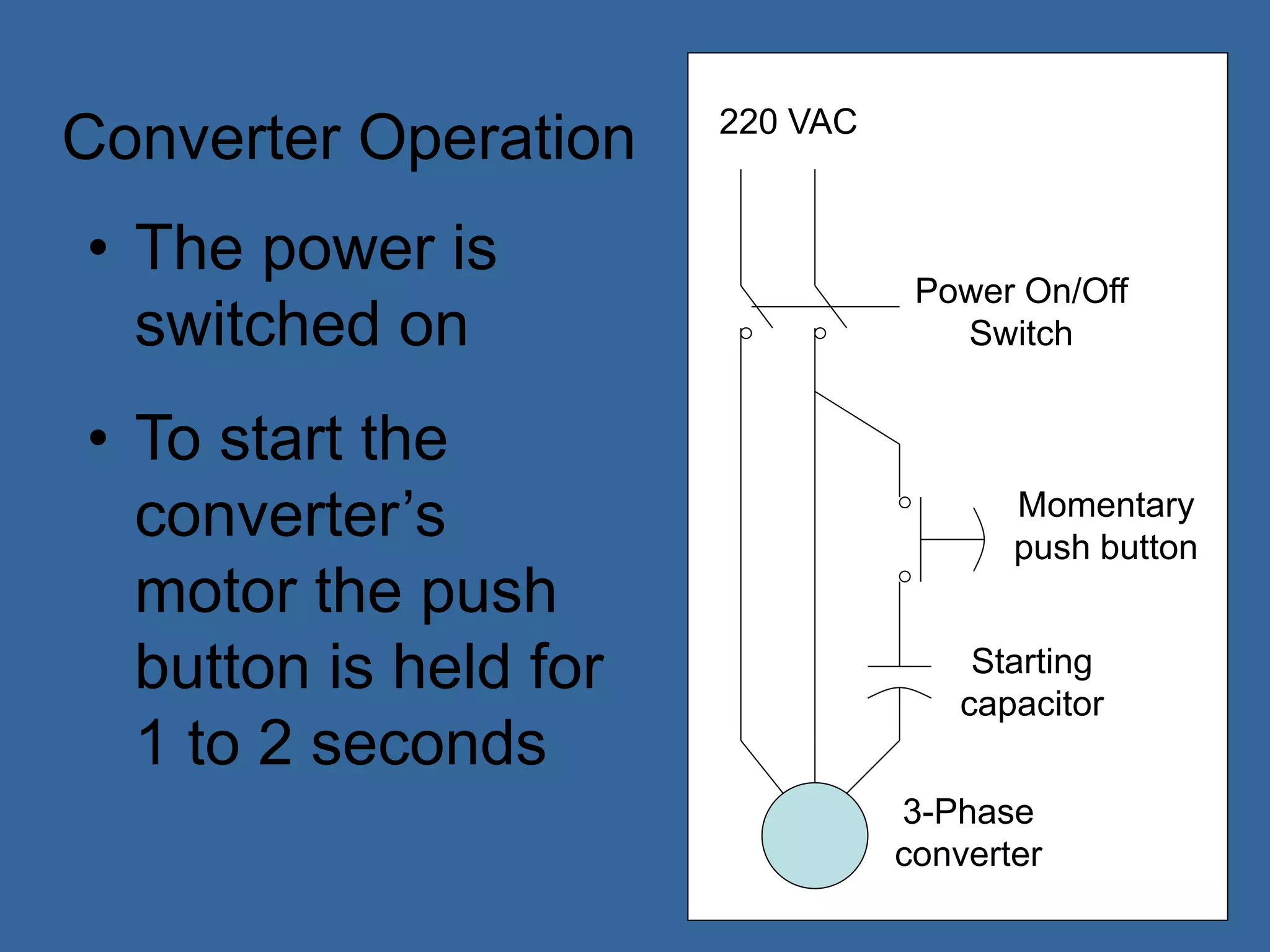
Three Phase Converter
• A machine requires three
phase power to operate
but only two phase
power is available.
• A power converter must
be built using a three
phase converter.
Three phase
converter
Starting
capacitor
Momentary
push button
3-Phase
converter
220 VAC
Power On/Off
Switch
Converter Operation
• The power is
switched on
• To start the
converter’s
motor the push
button is held for
1 to 2 seconds
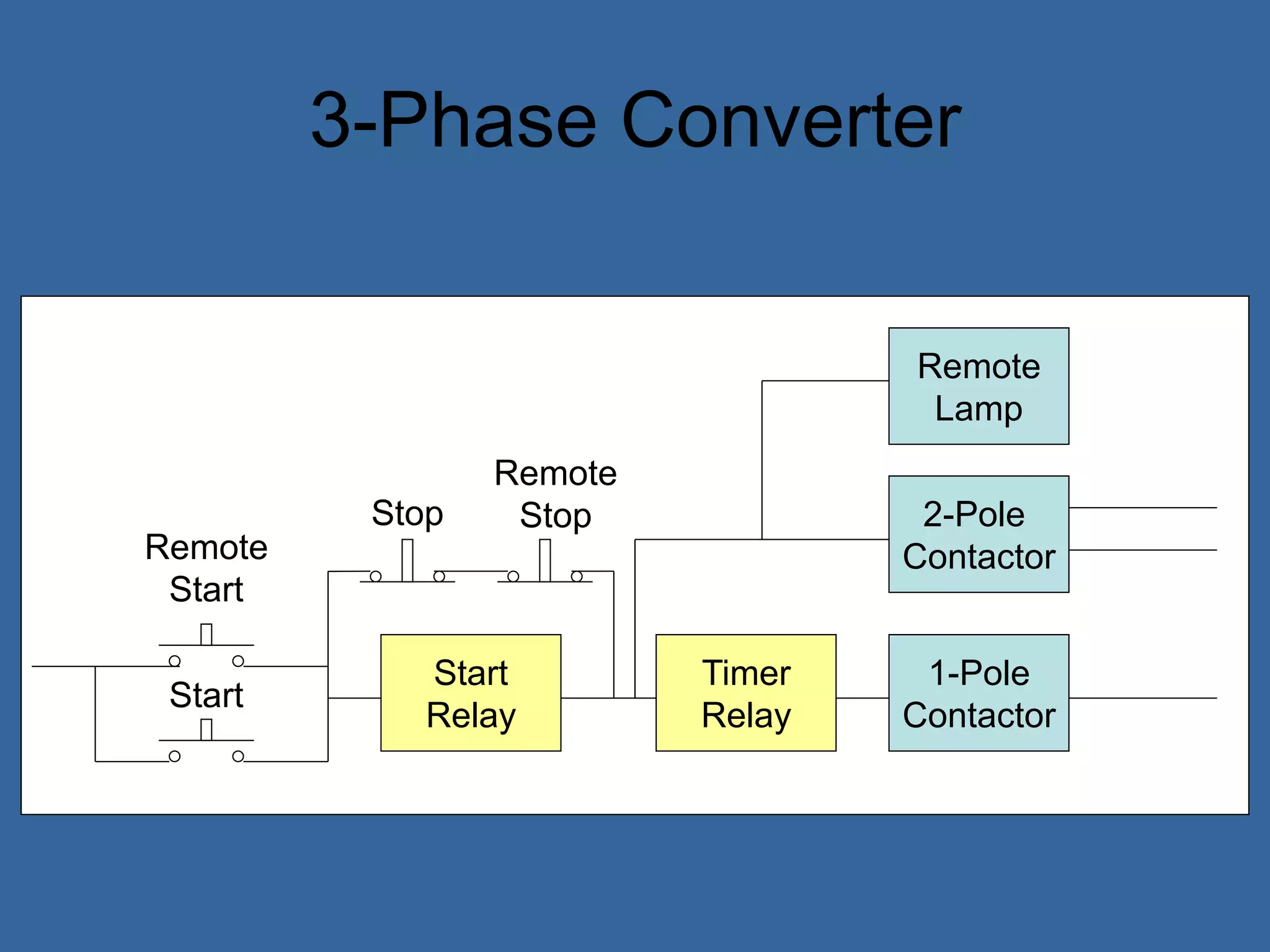
Start
Relay
1-Pole
Contactor
Timer
Relay
2-Pole
Contactor
Stop
Remote
Stop
Start
Remote
Start
Remote
Lamp
3-Phase Converter
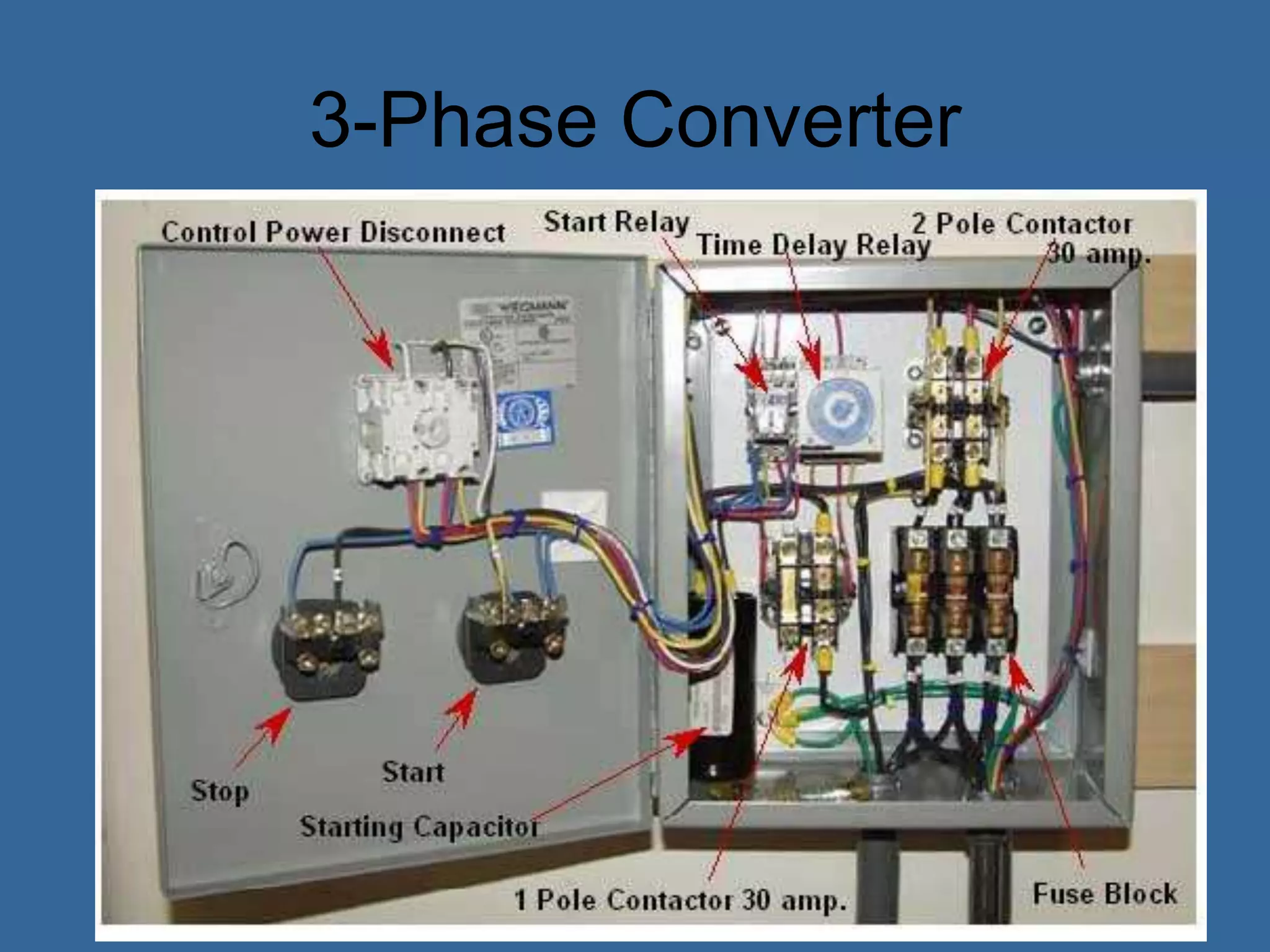
3-Phase Converter
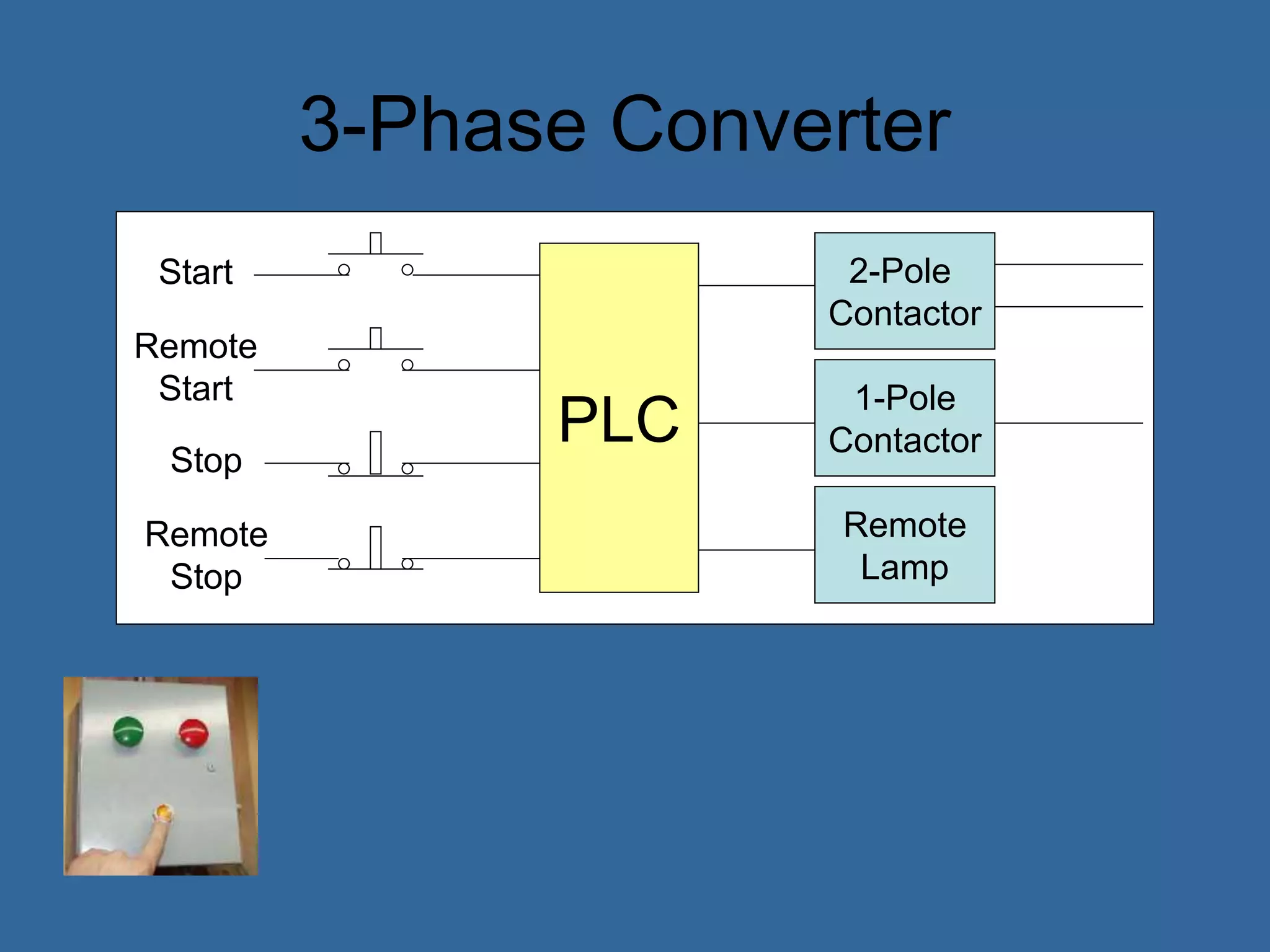
PLC
1-Pole
Contactor
2-Pole
Contactor
Stop
Remote
Stop
Start
Remote
Start
Remote
Lamp
3-Phase Converter
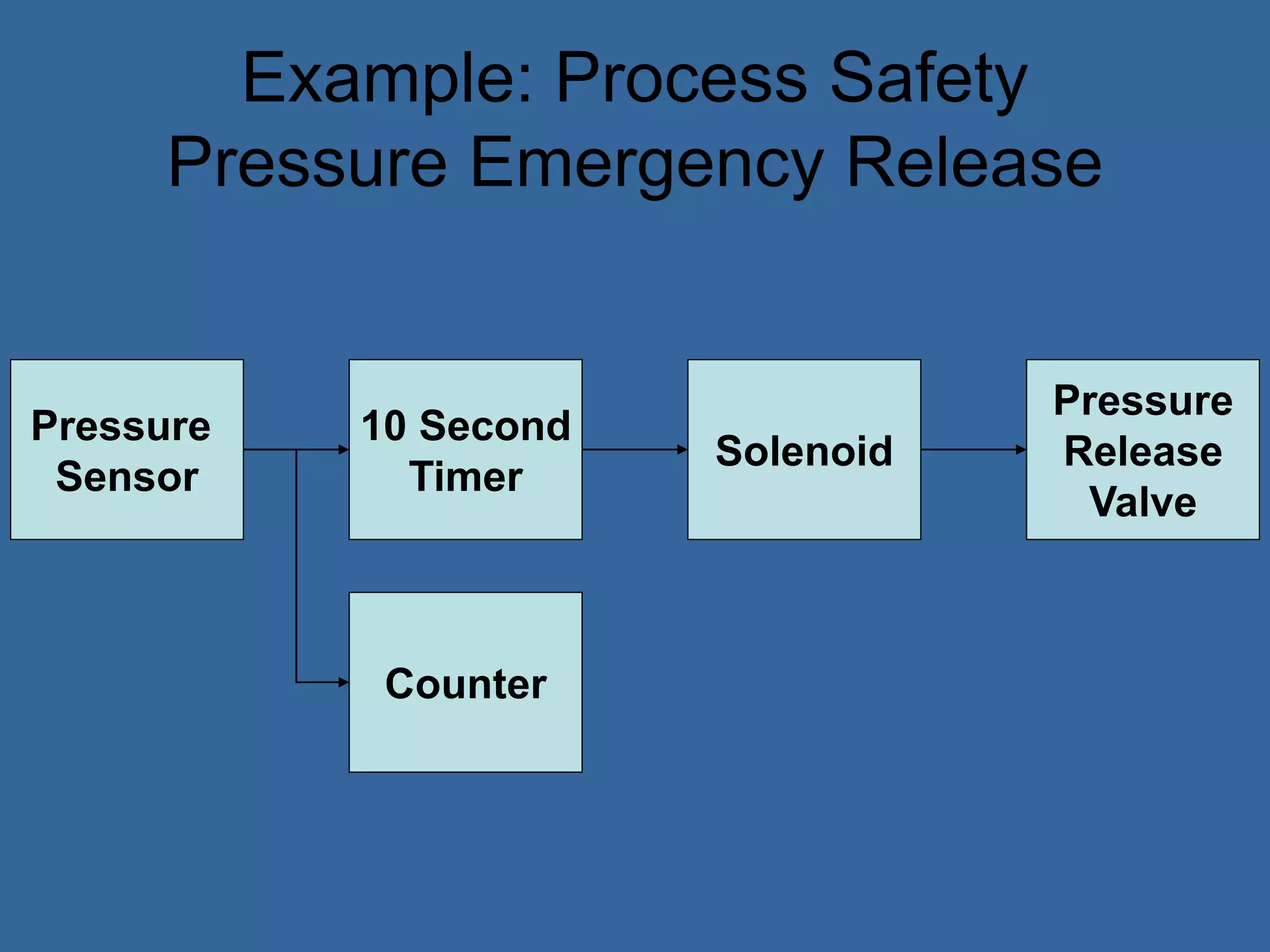
Example: Process Safety
Pressure Emergency Release
Solenoid
Counter
Pressure
Sensor
10 Second
Timer
Pressure
Release
Valve
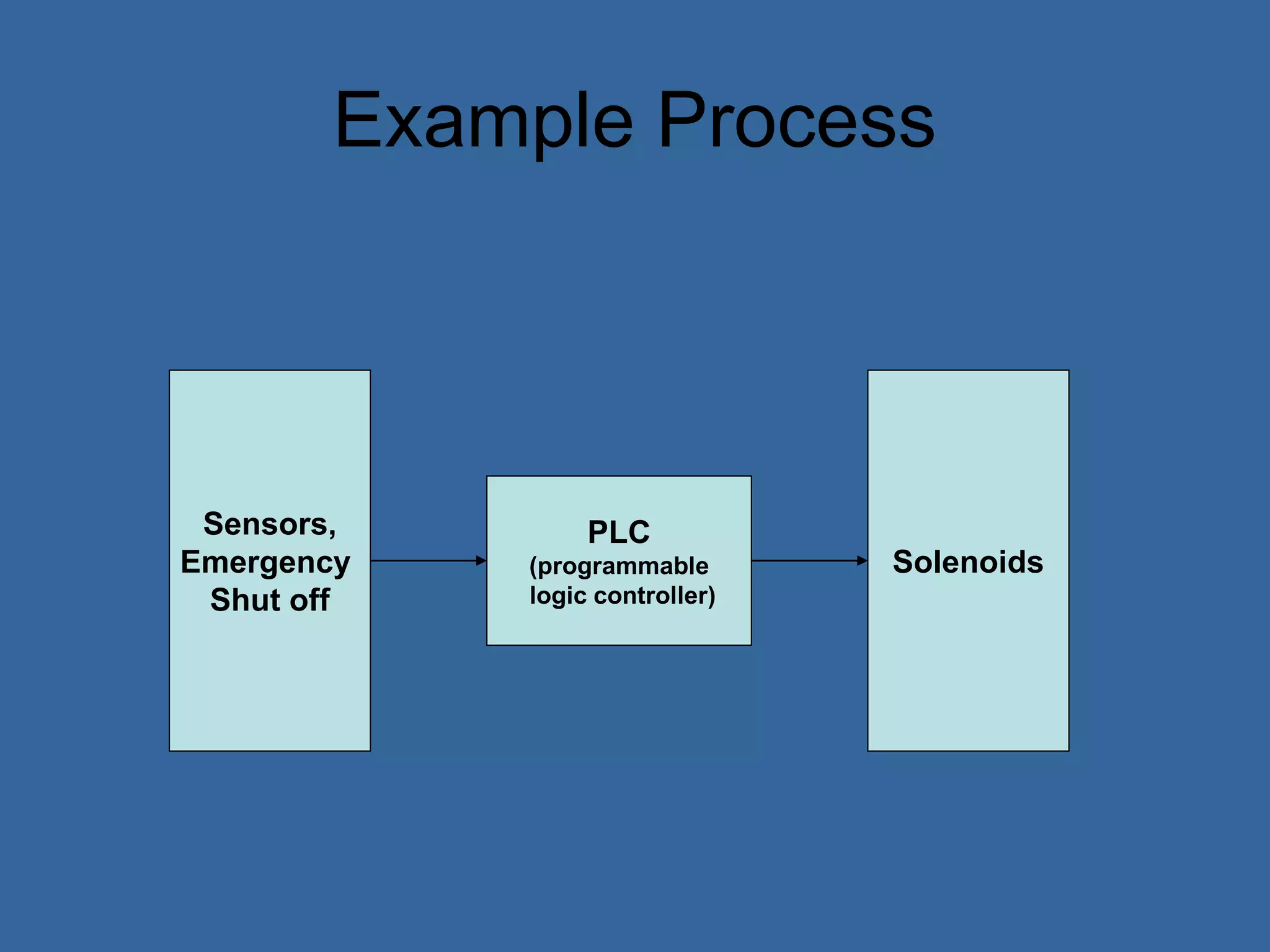
Example Process
Sensors,
Emergency
Shut off
Solenoids
PLC
(programmable
logic controller)
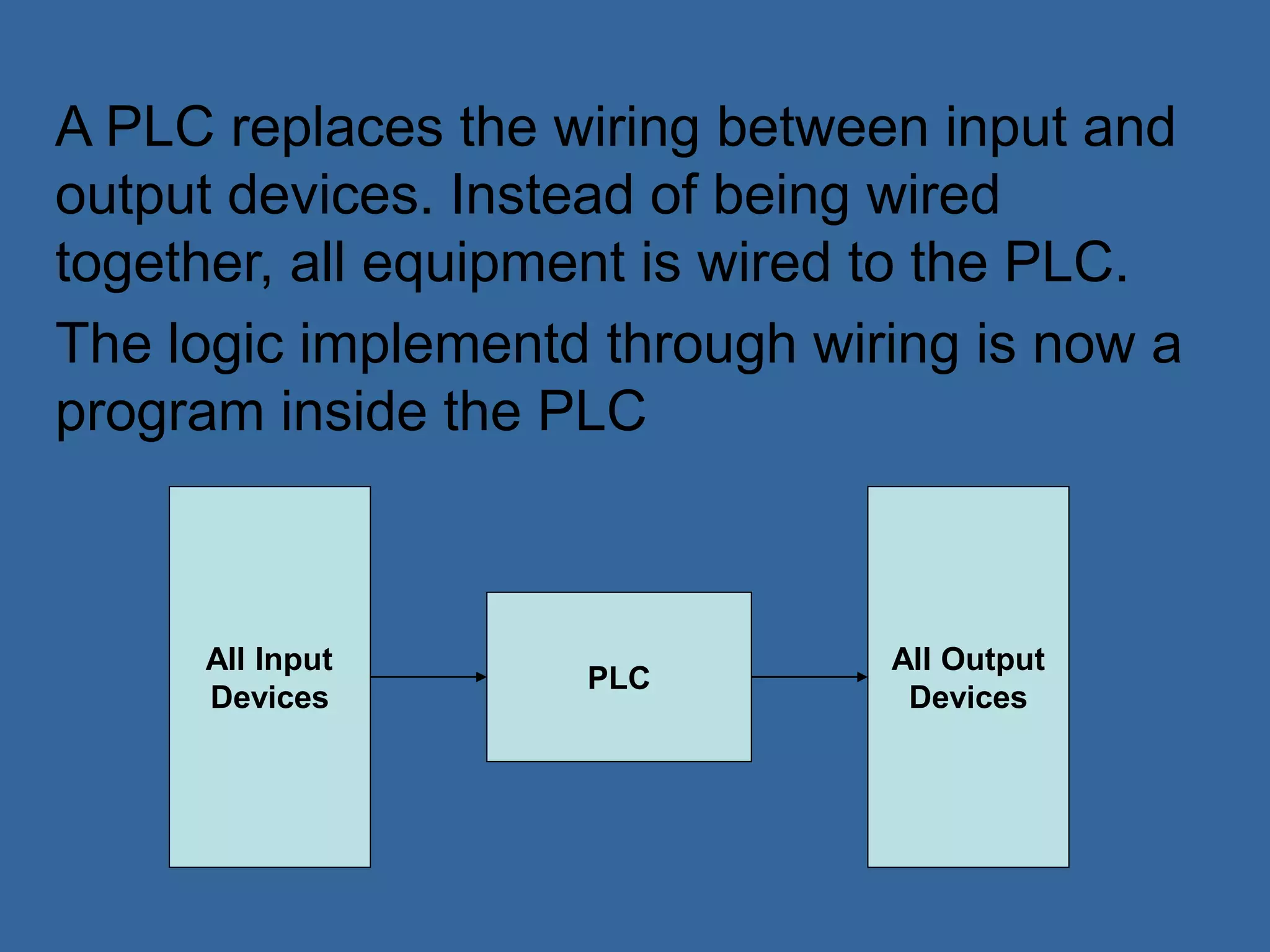
A PLC replaces the wiring between input and
output devices. Instead of being wired
together, all equipment is wired to the PLC.
The logic implementd through wiring is now a
program inside the PLC
All Input
Devices
All Output
Devices
PLC
Programmable Logic Controllers
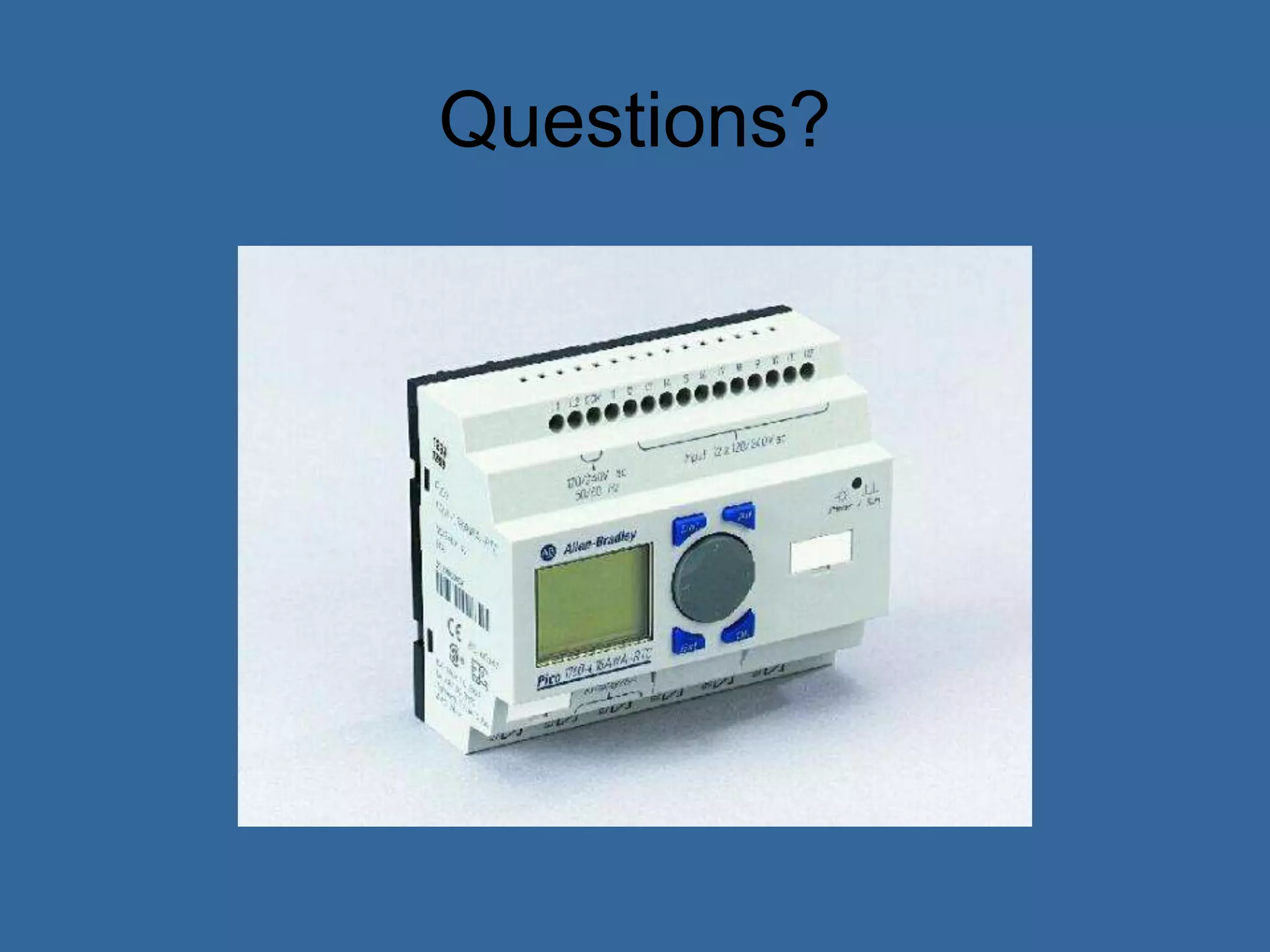
• PLCs (Programmable Logic Controllers) is
a miniature industrial computer performs
control functions [4]
• The first PLCs can be traced back to 1968
and became popular in the 1980’s [4]
• PLCs are rugged and designed to
withstand the industrial environment.
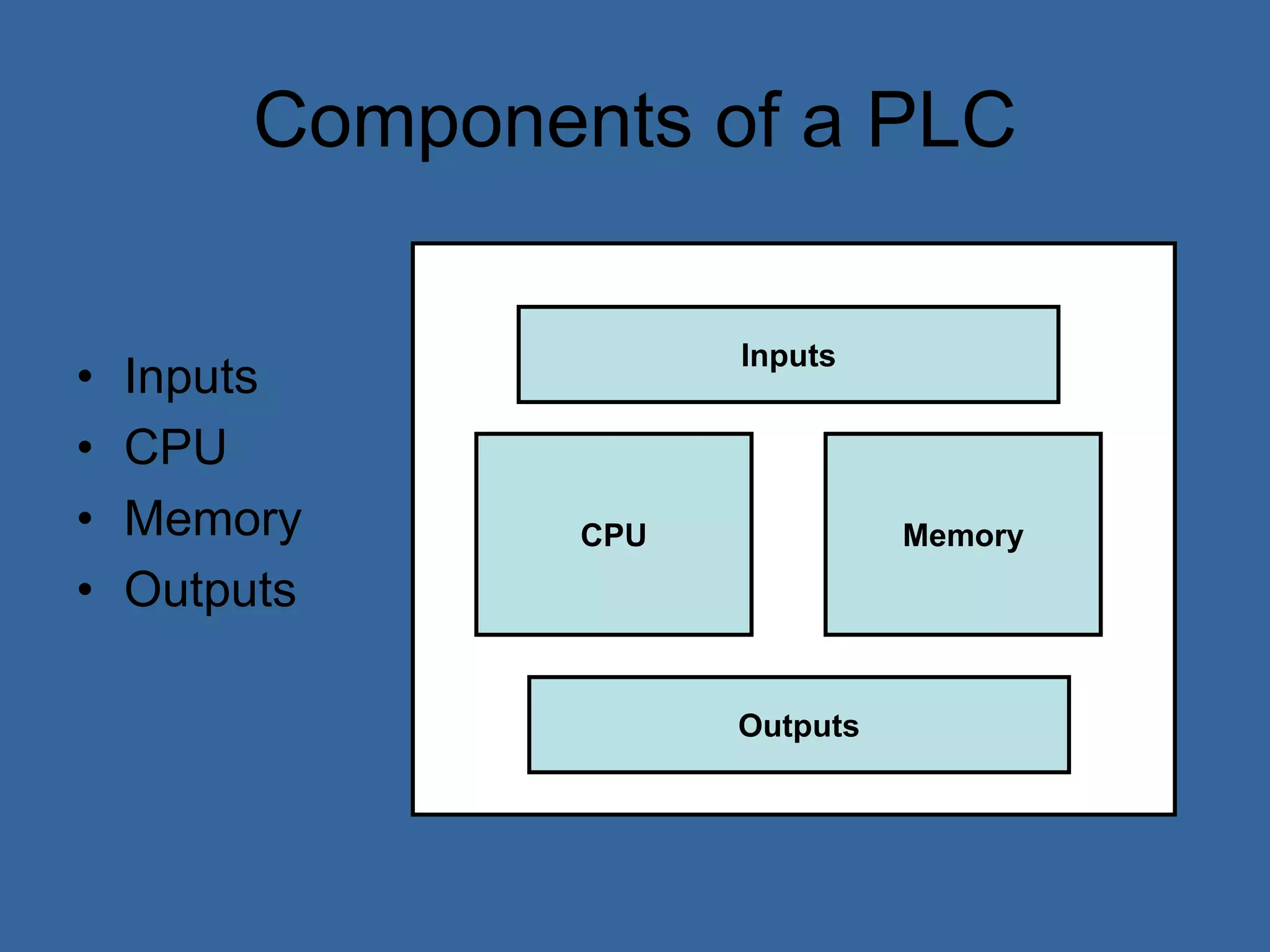
Components of a PLC
• Inputs
• CPU
• Memory
• Outputs
Inputs
Outputs
CPU Memory
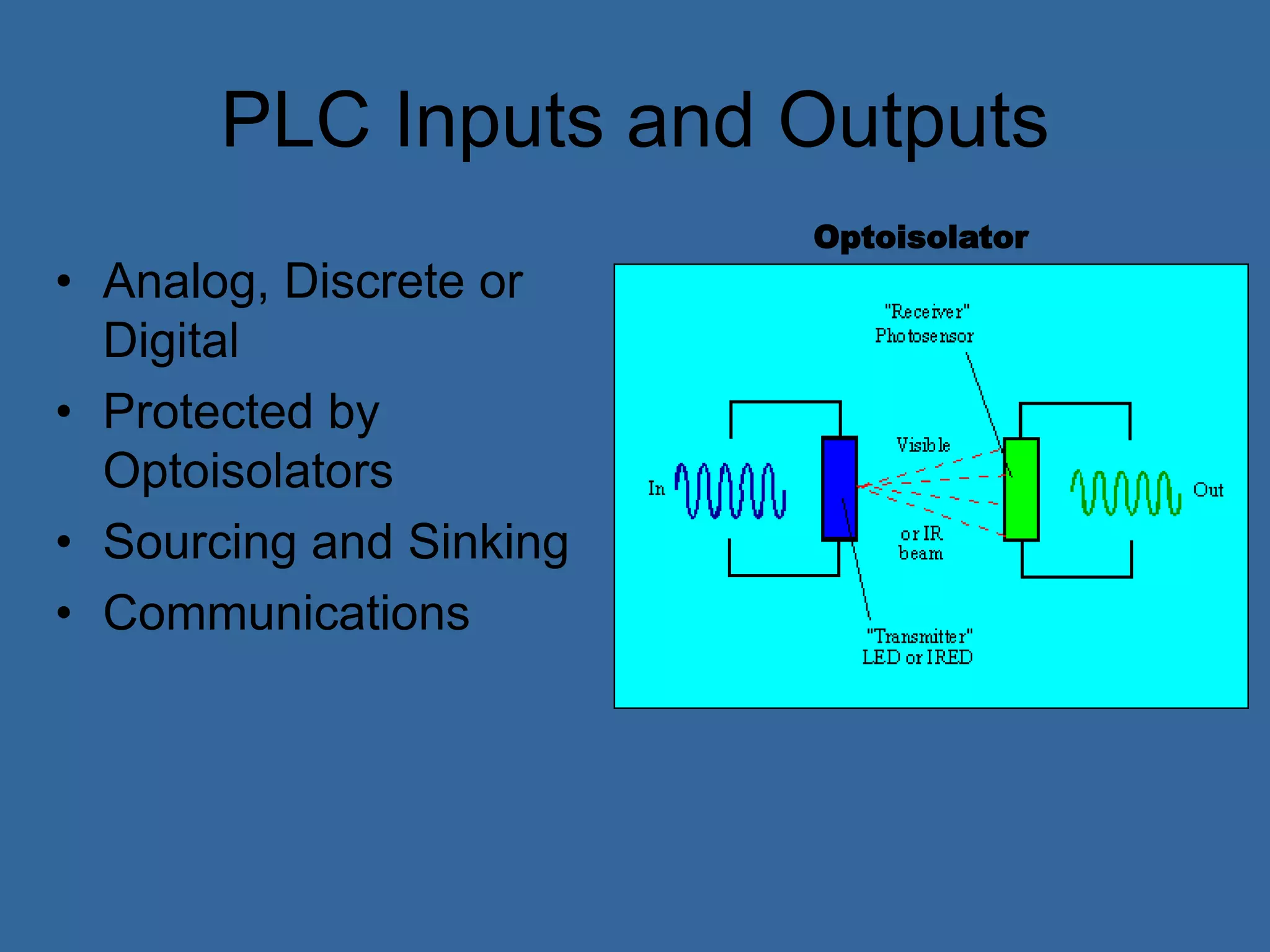
PLC Inputs and Outputs
• Analog, Discrete or
Digital
• Protected by
Optoisolators
• Sourcing and Sinking
• Communications
Optoisolator
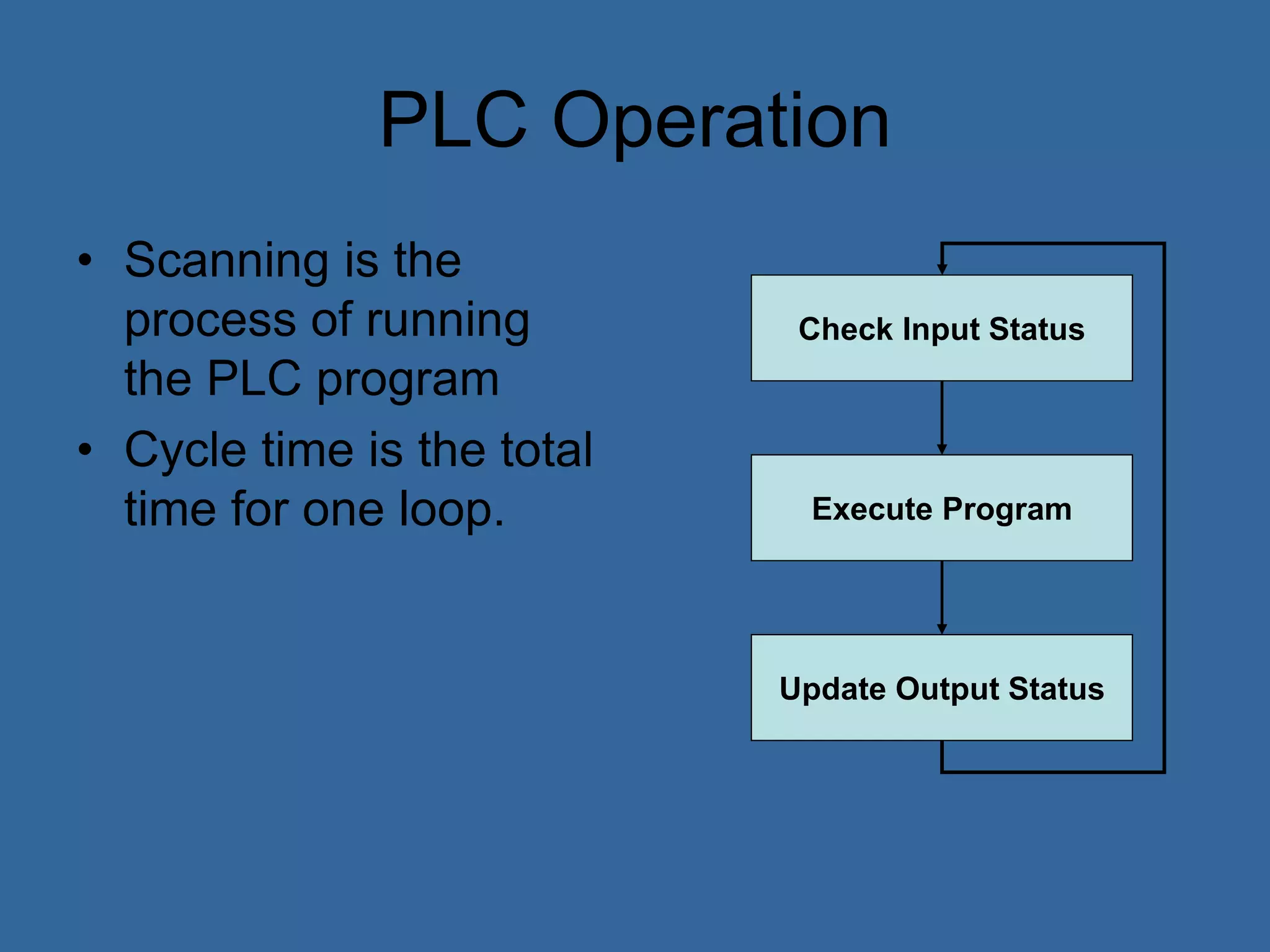
PLC Operation
• Scanning is the
process of running
the PLC program
• Cycle time is the total
time for one loop.
Check Input Status
Execute Program
Update Output Status
PLC Programming
• Ladder logic is the main programming
method used for PLCs [39]
• It is a visual and symbolic programming
language that resembles relays logic
diagrams
• Ladder logic has been developed to mimic
relay logic to reduce amount of retraining
needed for engineers and trades people
[39]
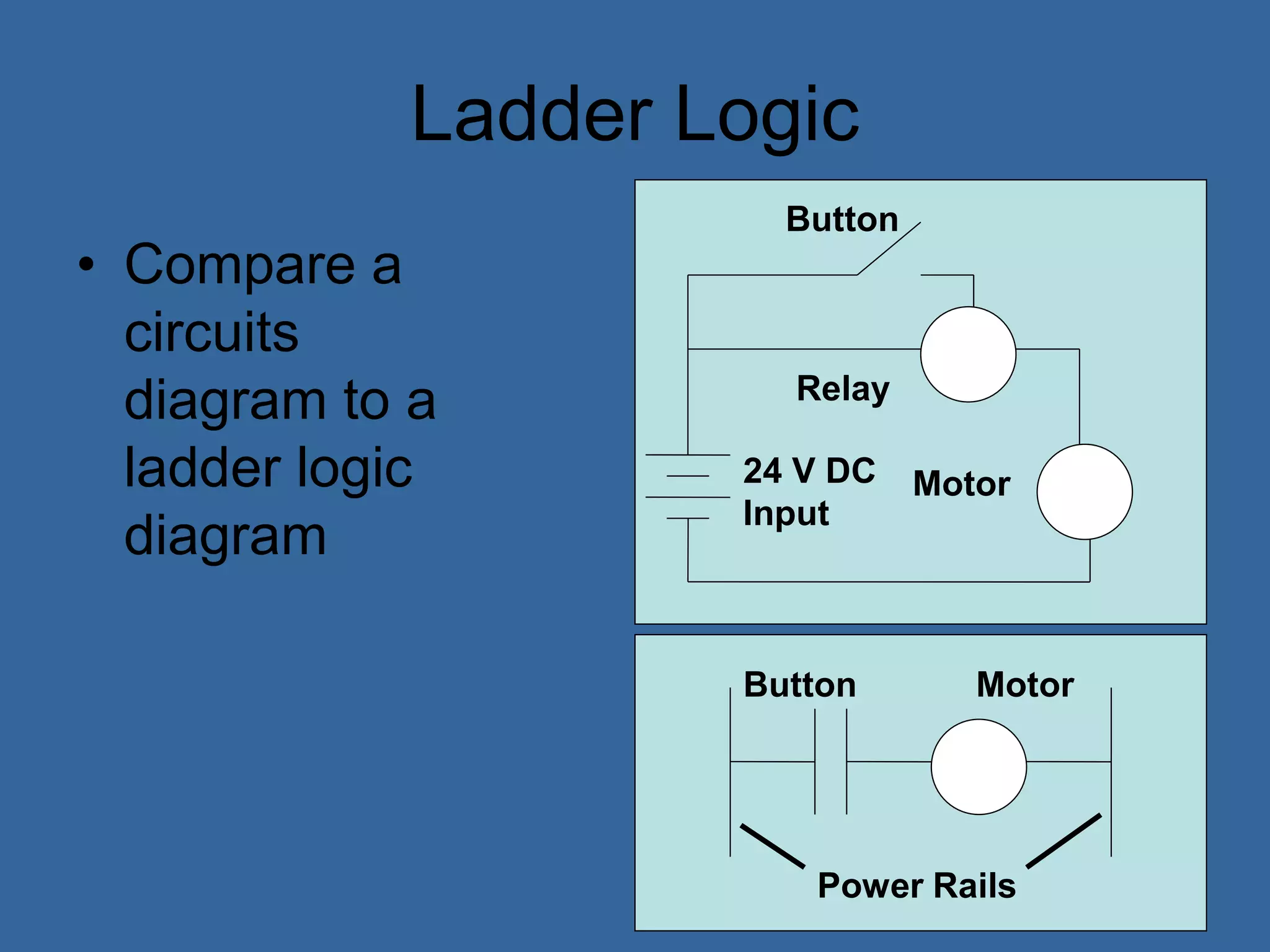
Ladder Logic
• Compare a
circuits
diagram to a
ladder logic
diagram
Relay
Button Motor
24 V DC
Input
Button
Power Rails
Motor
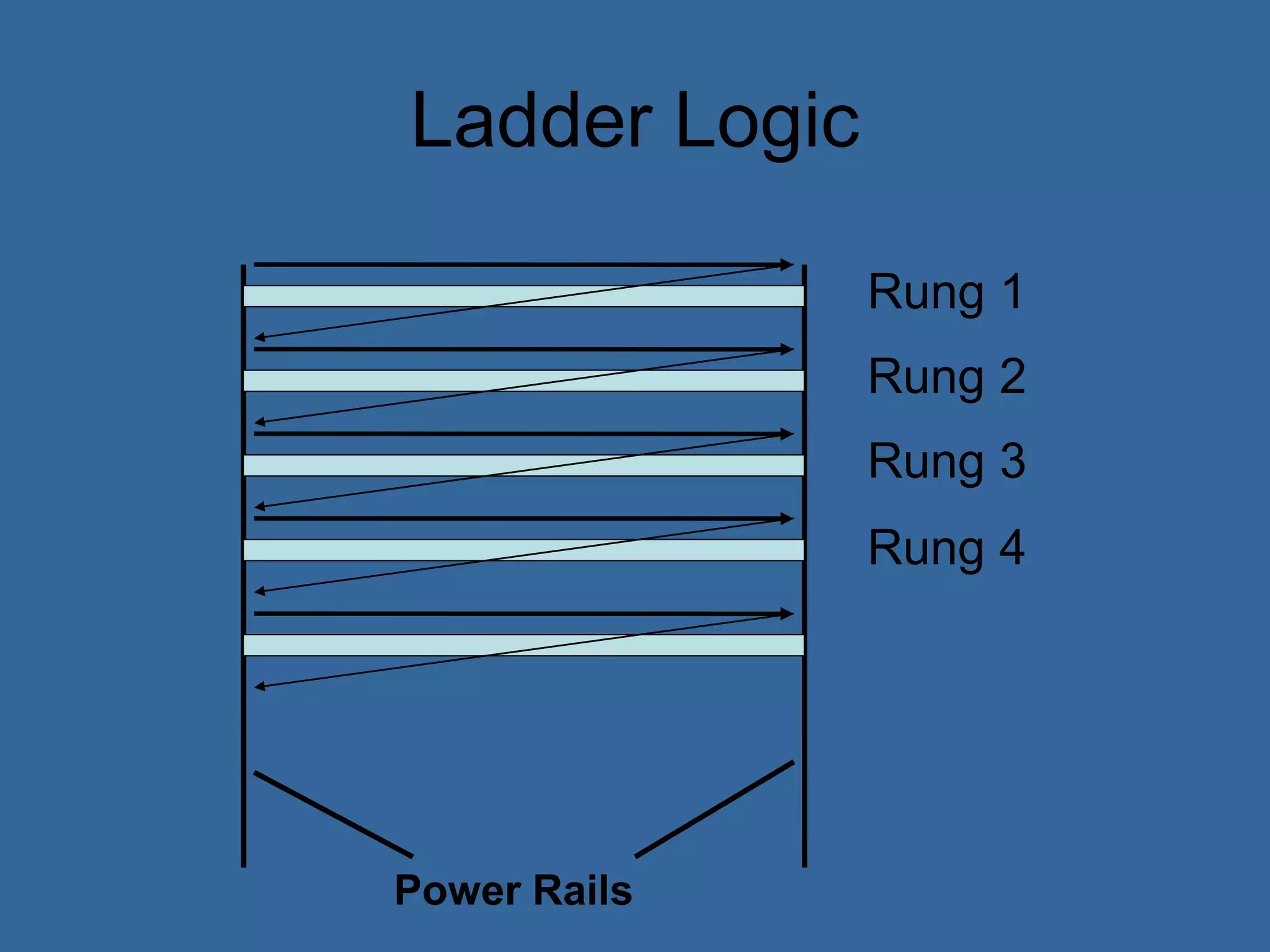
Ladder Logic
Rung 1
Rung 2
Rung 3
Rung 4
Power Rails
Ladder Logic
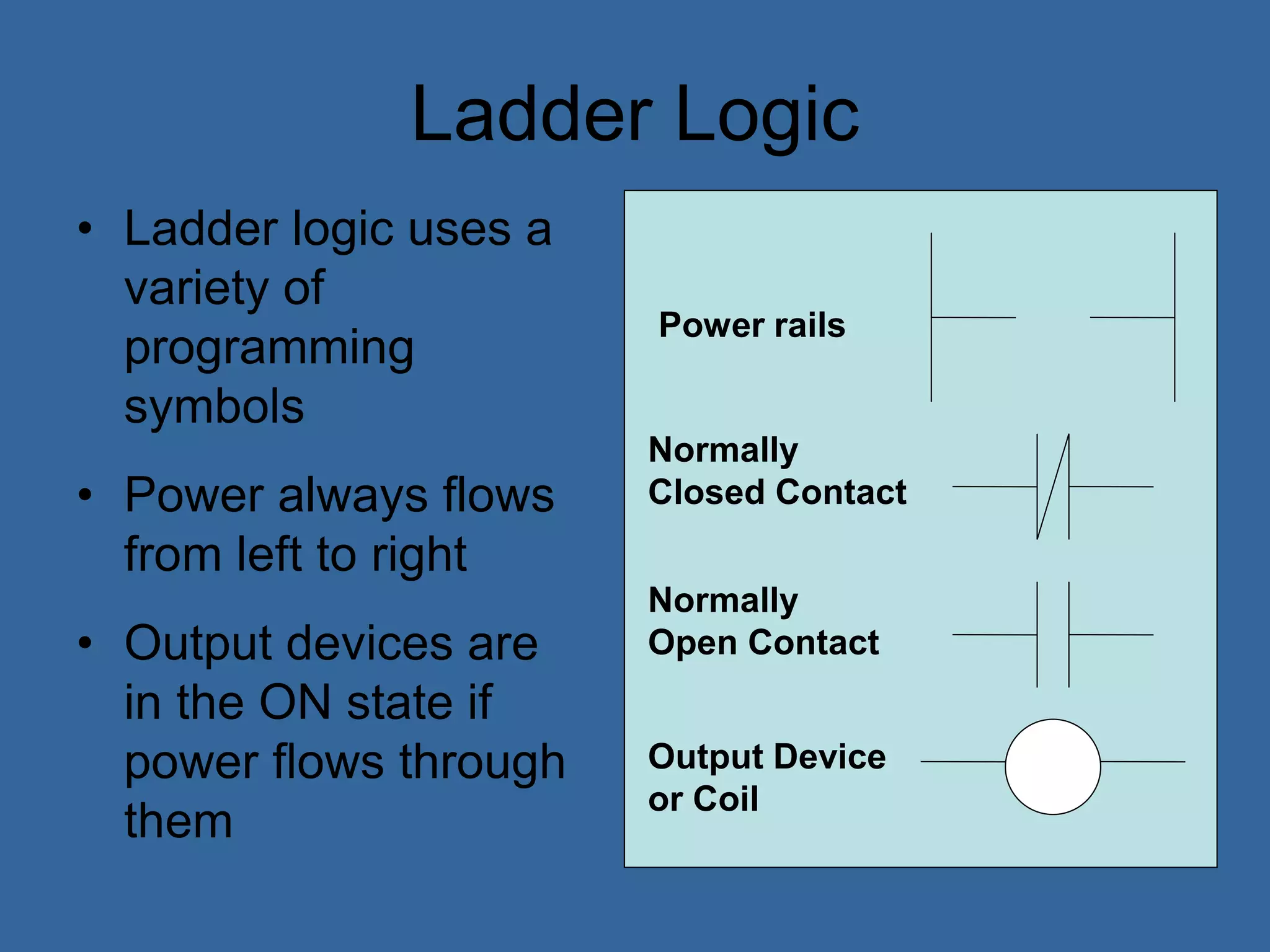
• Ladder logic uses a
variety of
programming
symbols
• Power always flows
from left to right
• Output devices are
in the ON state if
power flows through
them
Normally
Closed Contact
Normally
Open Contact
Output Device
or Coil
Power rails
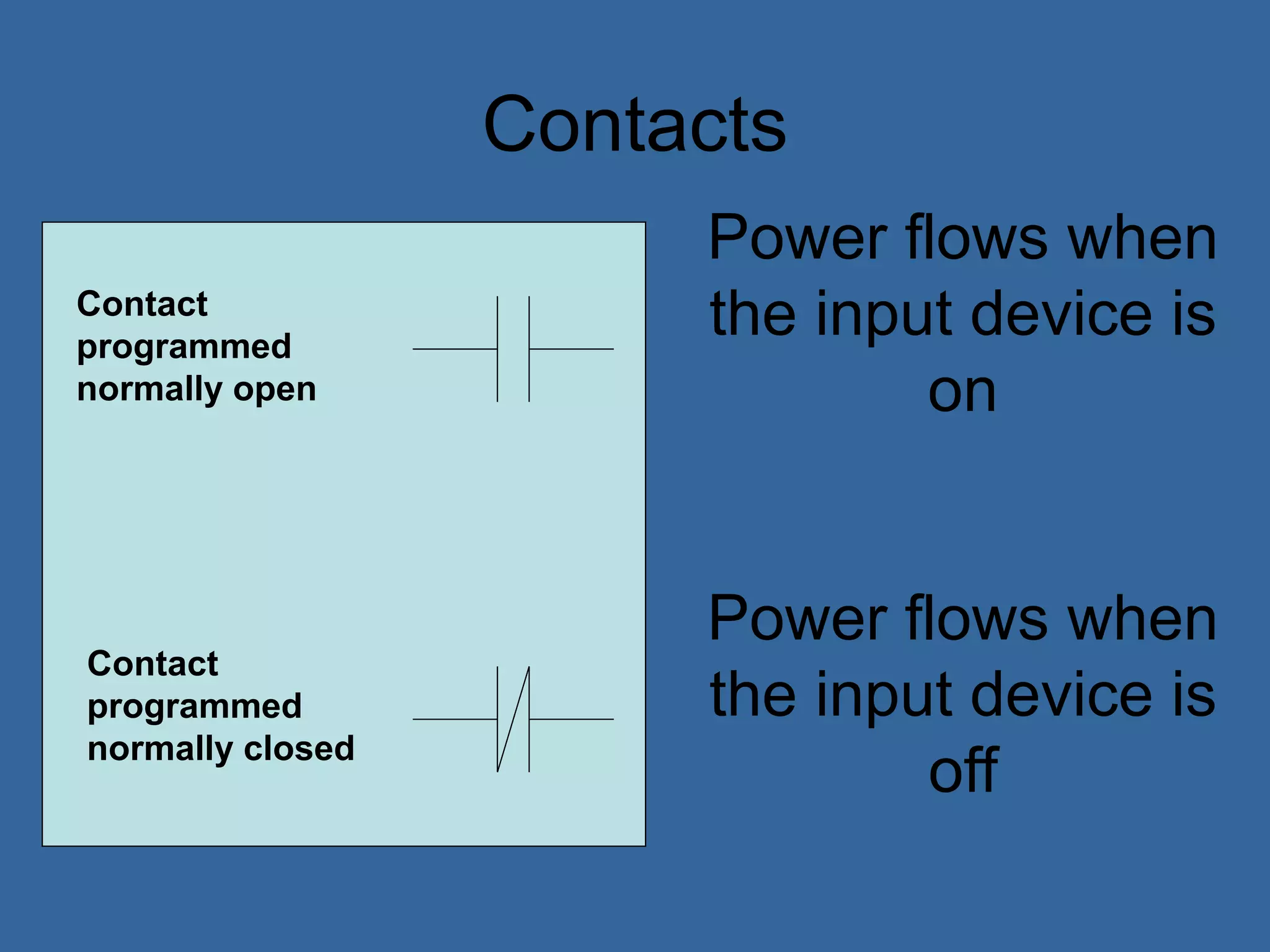
Contacts
Contact
programmed
normally open
Contact
programmed
normally closed
Power flows when
the input device is
on
Power flows when
the input device is
off
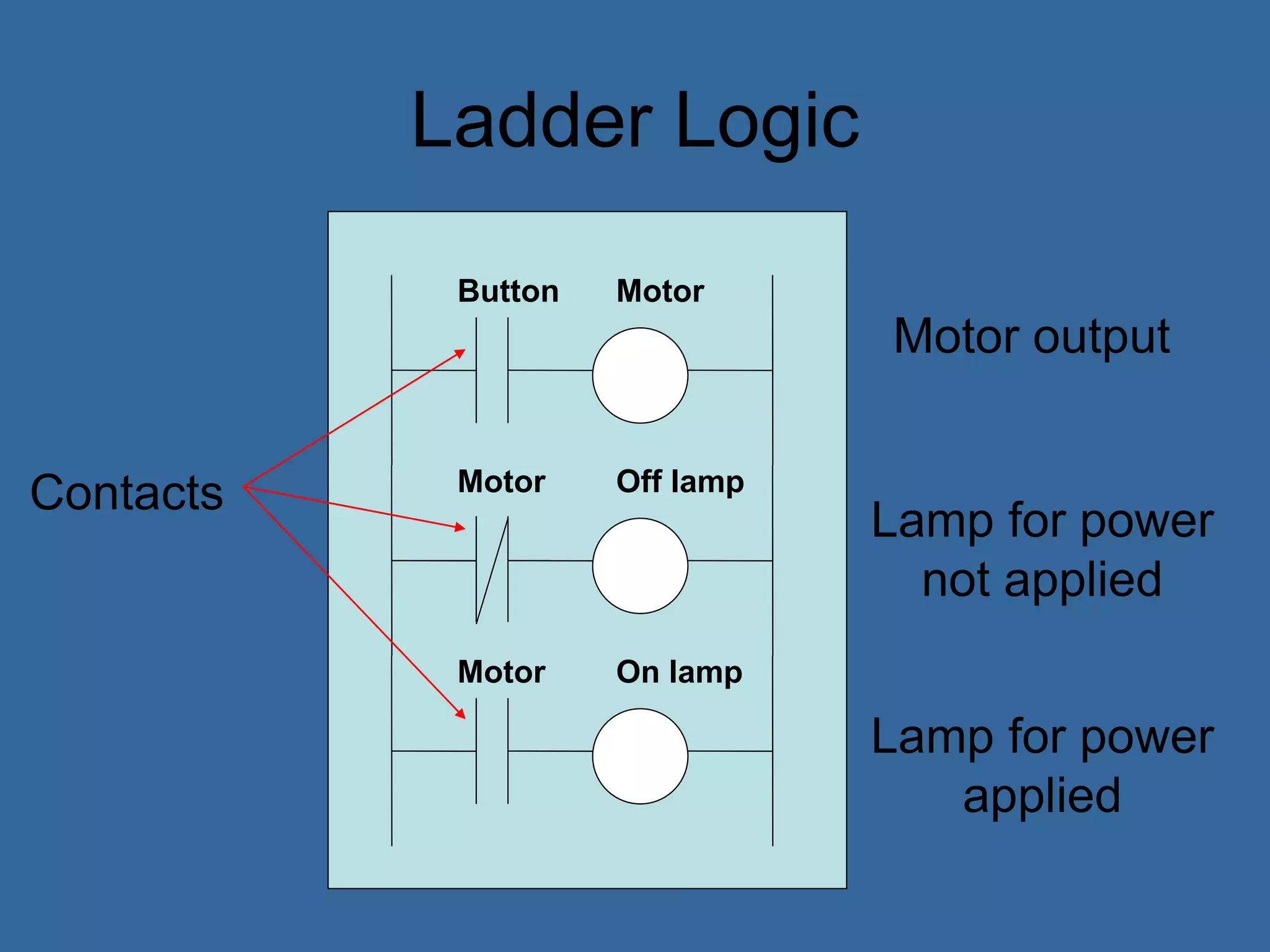
Ladder Logic
Button
Motor
Motor
Motor
On lamp
Off lamp
Motor output
Lamp for power
applied
Lamp for power
not applied
Contacts
Ladder Logic
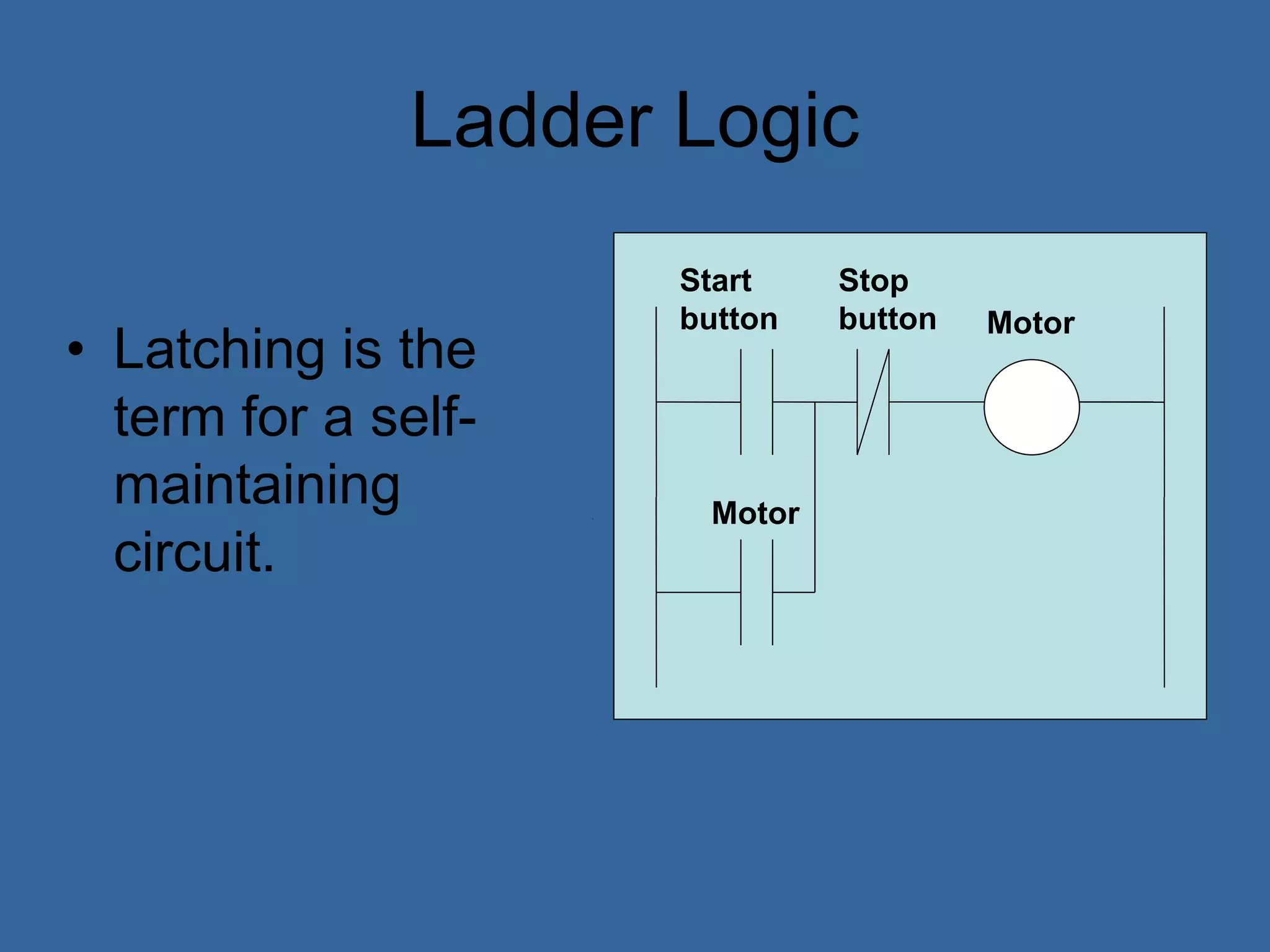
• Latching is the
term for a self-
maintaining
circuit.
Start
button
Motor
Motor
Stop
button
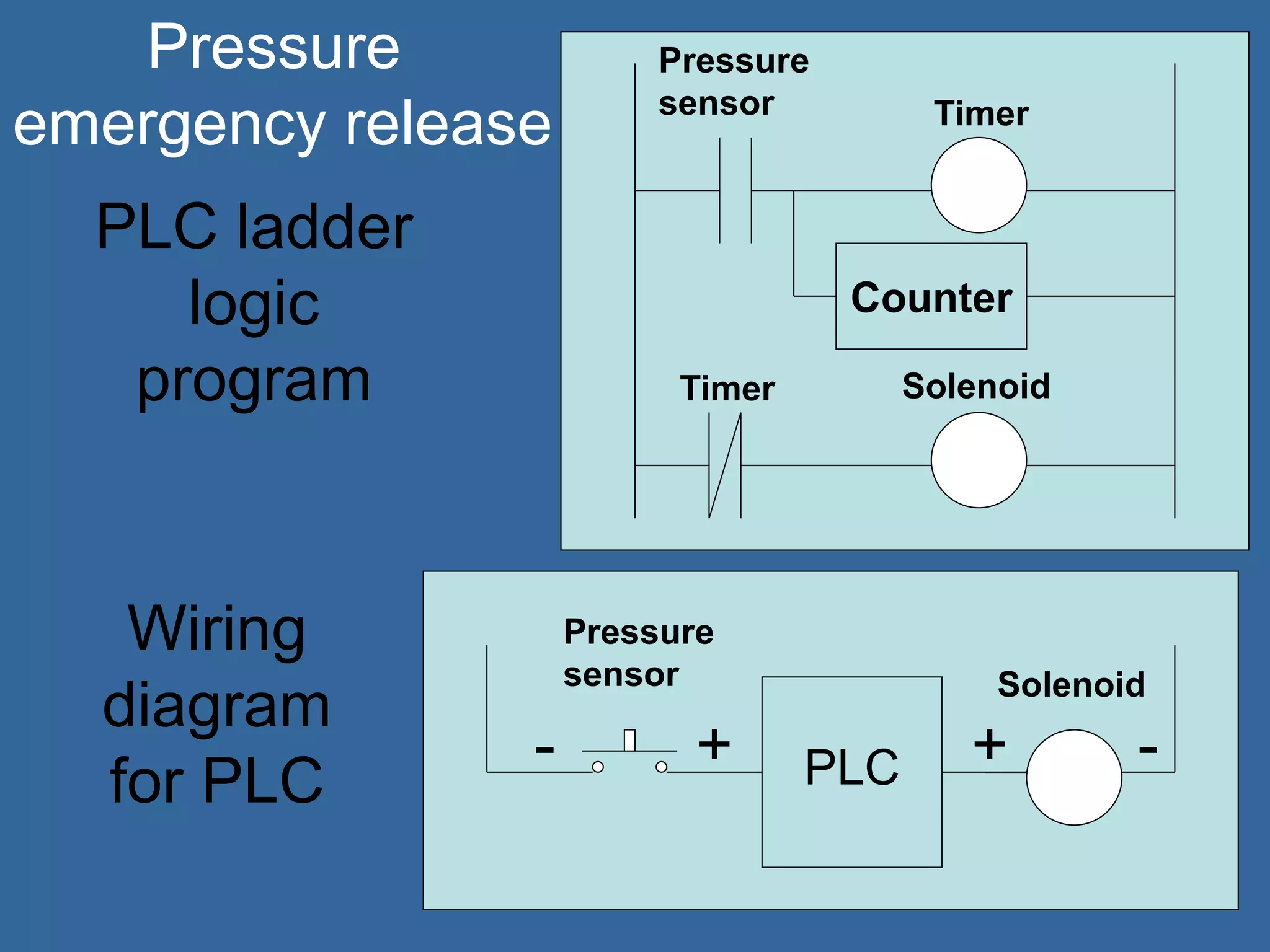
PLC
Pressure
sensor Solenoid
Counter
+- -+
Timer
SolenoidTimer
Pressure
sensor
PLC ladder
logic
program
Wiring
diagram
for PLC
Pressure
emergency release
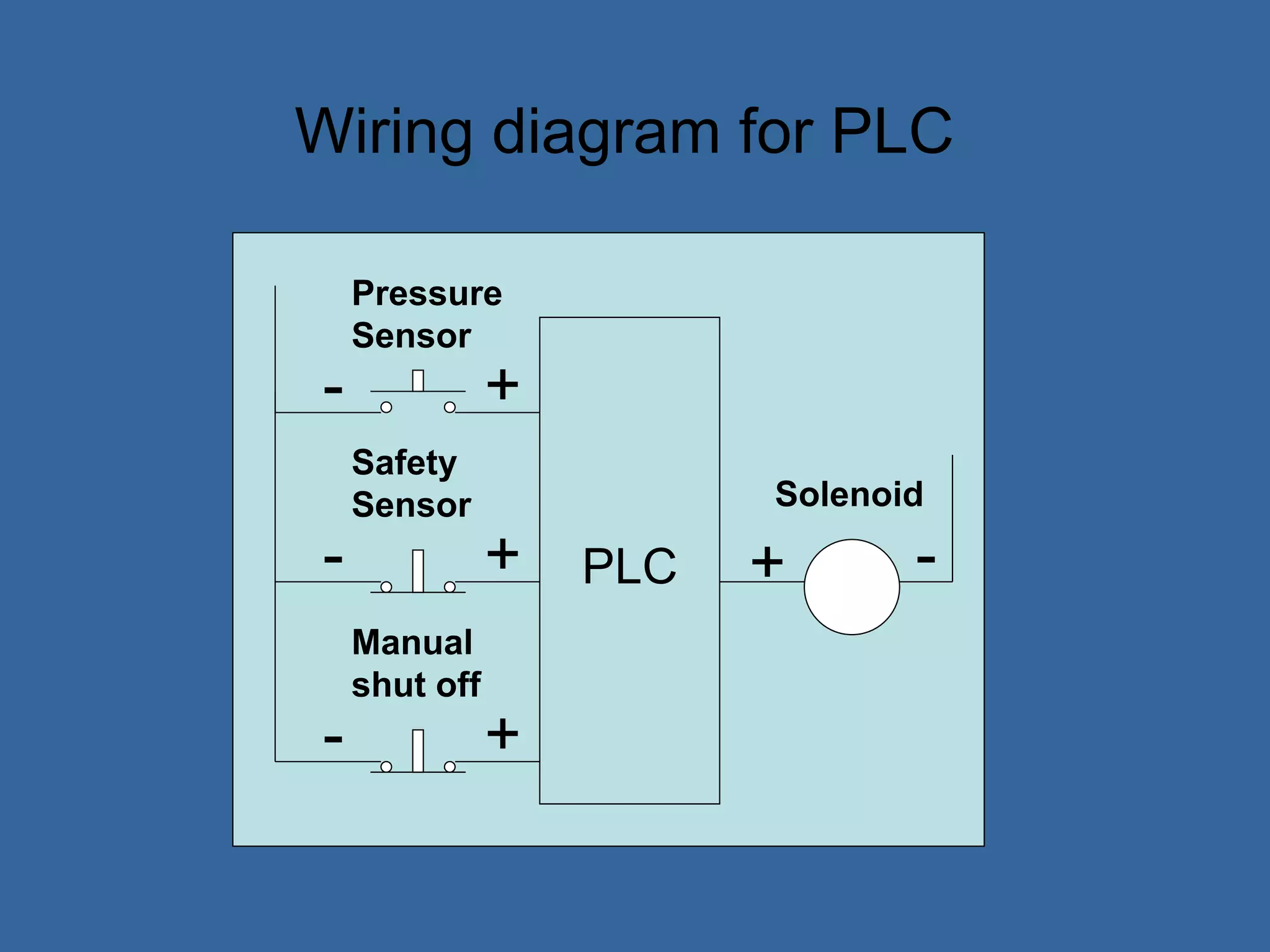
PLC
Pressure
Sensor
Solenoid
+
-
-
+
Safety
Sensor
- +
Manual
shut off
- +
Wiring diagram for PLC
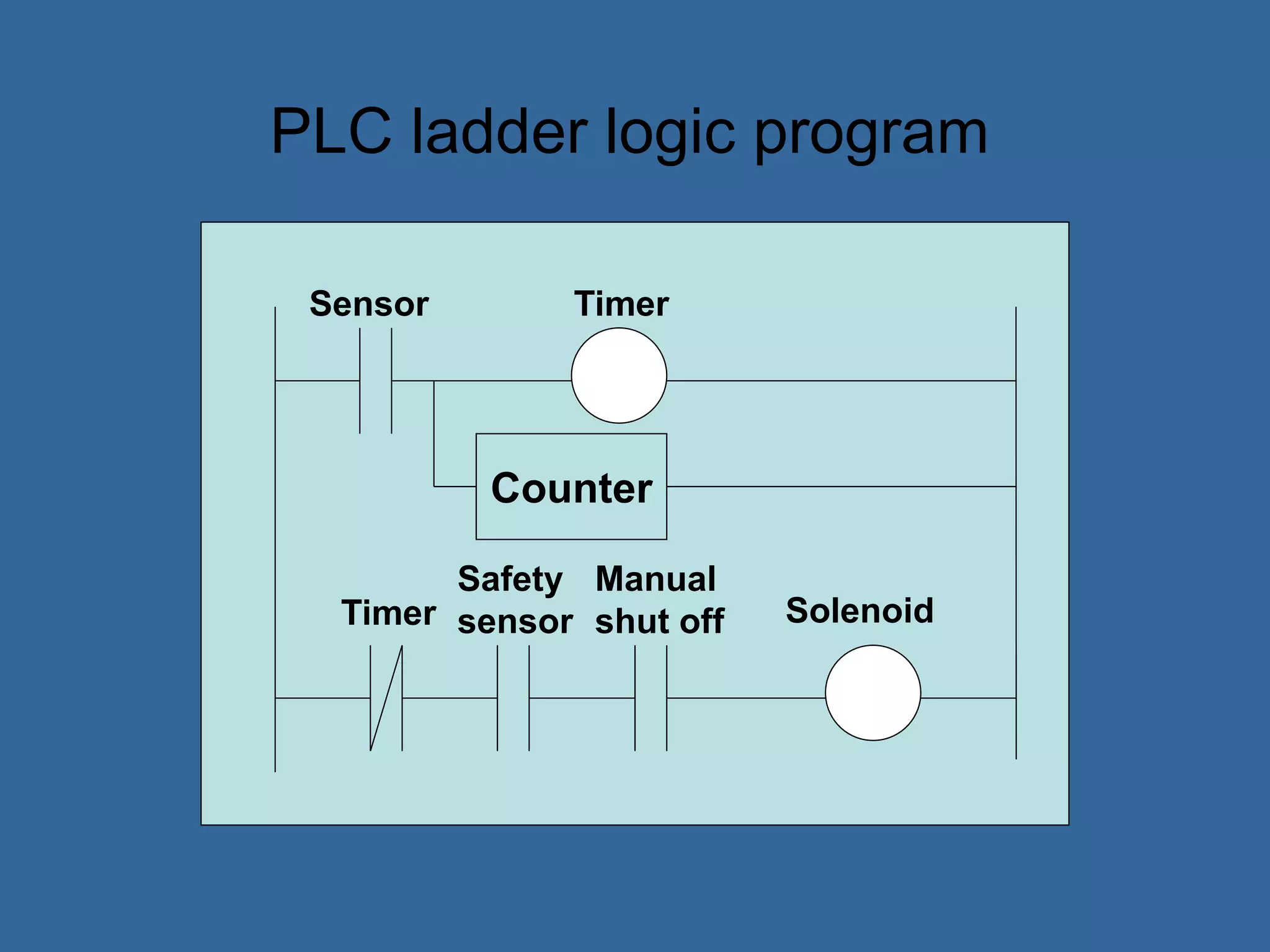
Manual
shut off
Safety
sensor
Sensor
Counter
Timer
SolenoidTimer
PLC ladder logic program
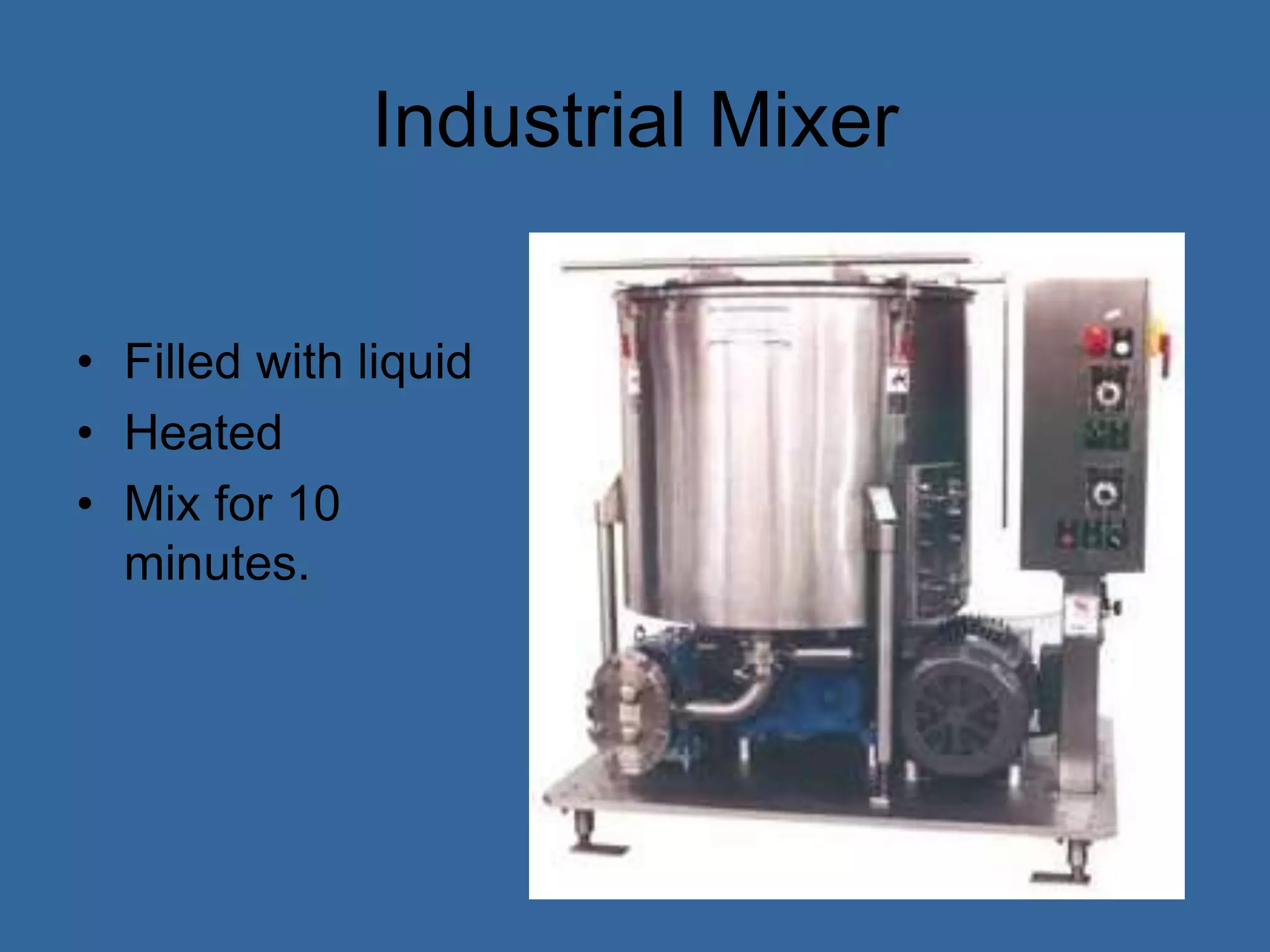
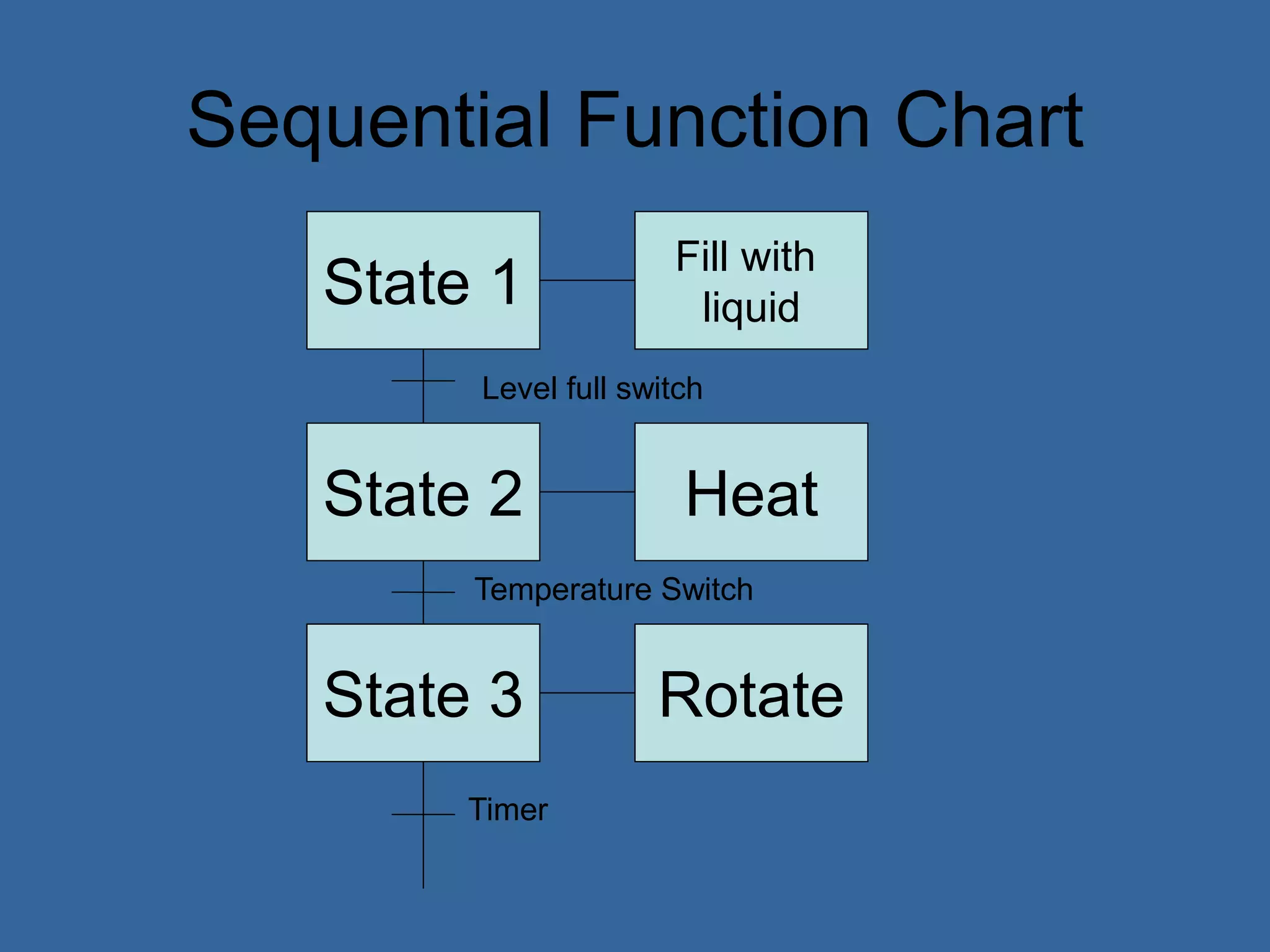
Industrial Mixer
• Filled with liquid
• Heated
• Mix for 10
minutes.
Sequential Function Chart
State 2
State 1
State 3 Rotate
Heat
Fill with
liquid
Level full switch
Timer
Temperature Switch
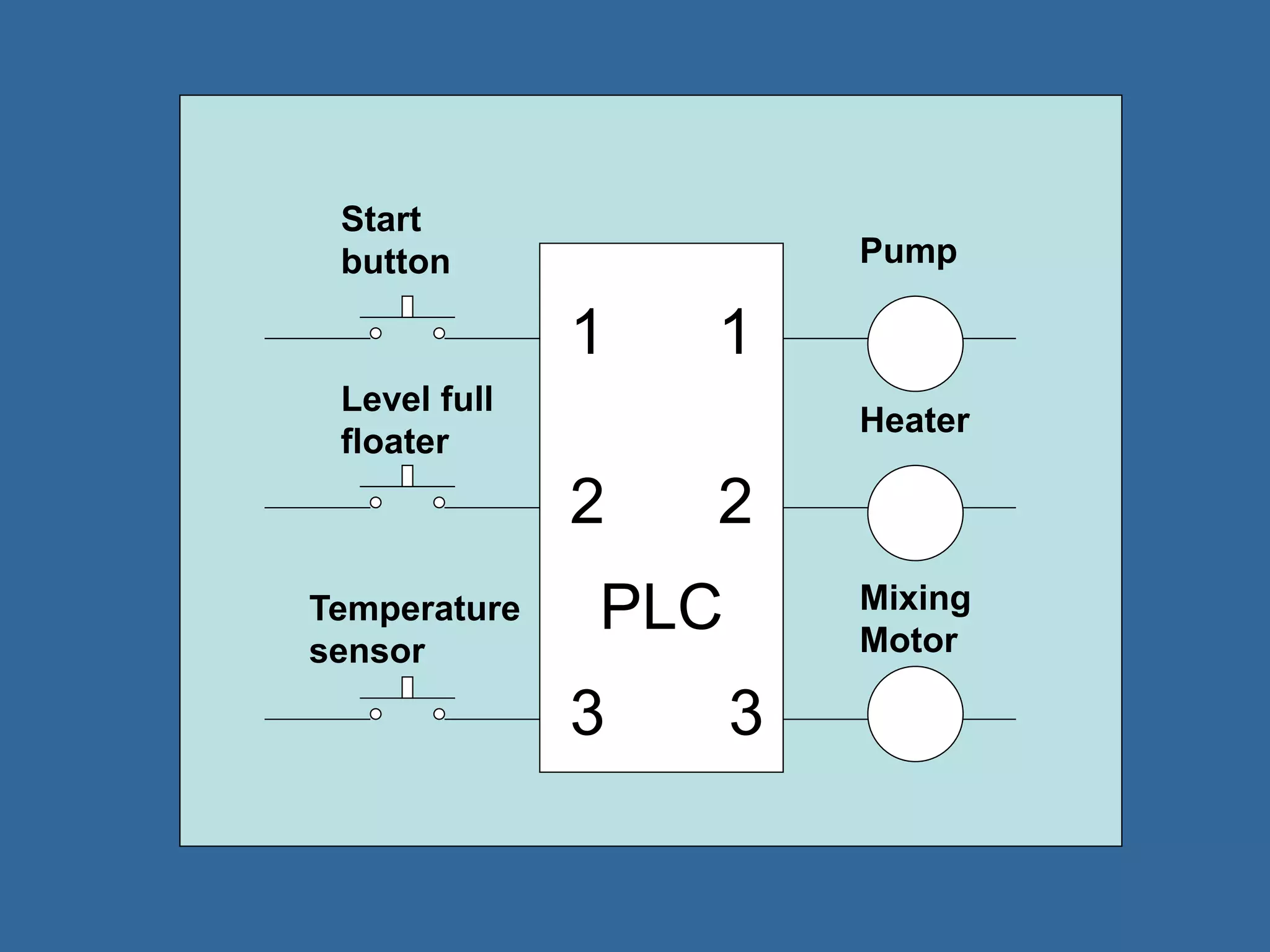
Start
button Pump
Level full
floater
Heater
Mixing
Motor
Temperature
sensor
2
1 1
2
3 3
PLC
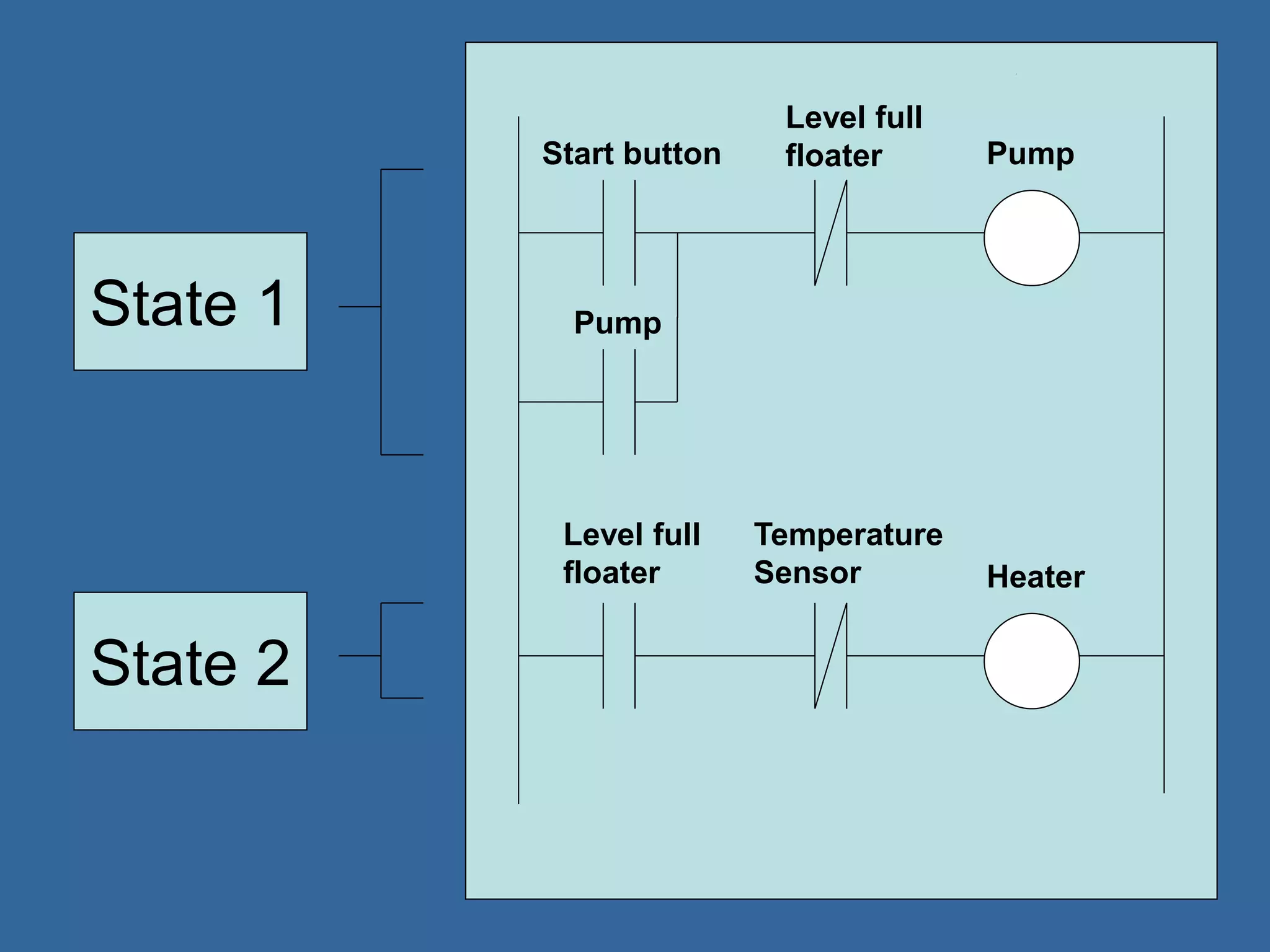
Start button
Pump
Pump
Level full
floater
Level full
floater Heater
Temperature
Sensor
State 1
State 2
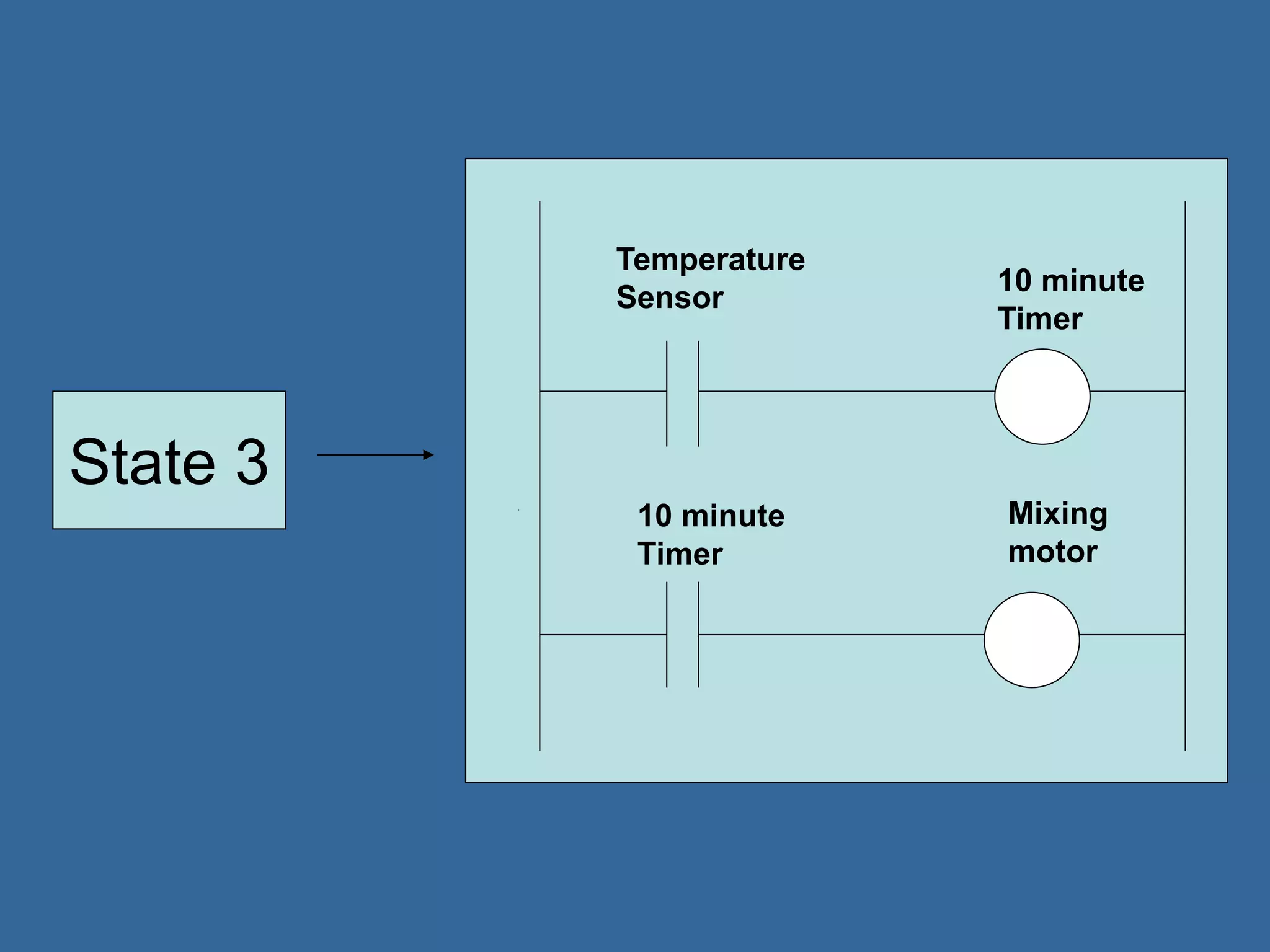
10 minute
Timer
10 minute
Timer
Mixing
motor
Temperature
Sensor
State 3
Ladder Logic
• Forcing
• Time checks
• Simulation
• Software testing
Ladder Logic
• Registers and bits
• Data comparison
• Arithmetic operations
• Functions
• PID control
PLCs solve problems
• Flexible
• Cost effective
• Computational abilities
• Trouble shooting
• Reliable
Questions?

An introduction to pl cs