Ethiopian Police University
Crime prevention and Public security college
Generic Degree in Crime Prevention (7th
R)
Social Anthropology
Course Code: Anth1012 ; 49 Hours
By:- Mesfin Goshimo (MSW, PGD, BA)
October:-2024
Sendafa: Ethiopia
Rapport
• Name:-------
• Region:-----
• Job sector:-
• Experience:-
• Hobbies:-----
• Vision:--------
• Attending the class (above 95%)
• Active participation/student center
• Avoid unethical issues(disturbing of any
form)
• Fulfill all assessments
• Punctuality
Course requirements
• Continuous assessment (60%)
Individual assignment-10%
Group assignment- 20%
Quiz – 10%
mid-exam-20%
o Final exam-40%
Course evaluation
 Unit one- Introducing anthropology and its subject matter
 Unit two-Human culture and ties that connect
 Unit three- Human diversity, Culture Areas and Contact in
Ethiopia
 Unit four-marginalized, minorities and vulnerable groups
 Unit five- identity, inter-ethnic relations and
multiculturalism in Ethiopia
 Unit six- customary and local governance systems and
peace making
 Unit seven-Indigenous knowledge systems and practice
Contents of the course
Module Introduction
 The course is expected to acquaint you with essential concept of
anthropology covering a wide array of questions revolving
around our very existence.
 It cover issues such as what makes human beings similar to each
other? How do we differ one another? What do anthropologist
mean when they talk about diversity, multiculturalism,
marginalization, inclusion and exclusion?
 The course will enable learners grasp the different ways of being
human by dealing with themes such as culture, kinship, marriage,
cultural relativism, ethnocentrism, humanity, human origins, race,
ethnicity, ethnic boundaries, marginalization, minorities,
indigenous knowledge systems, and indigenous practices and
development.
Unit One:-Introducing Anthropology and
its Subject Matter
Unit learning outcomes:
Up on the successful completion of this unit, you will be able to:
• Define the concepts in Anthropology
• Understand the historical development of anthropology
• Express the scope and subject matter of anthropology
• Explain the sub-disciplines of anthropology
• Internalize unique feature of anthropology
• Convert misconception held about anthropology
• Differentiate anthropology from other discipline
• Appraise the relevance of anthropology in our life
Brainstorming question
a. How do you define Anthropology?
b. How do you conceive the meaning of the
term ‘human’?
1.1 Definition, Scope and Subject Matter of
Anthropology
1.1.1 Concepts in Anthropology
To begin with the etymology of the term, the term anthropology is a
compound of two Greek words, ‘anthropos’ and ‘logos’, which can
be translated as ‘human being/mankind’ and ‘reason/study/science’.
So, anthropology means ‘reasoning about humans’ or ‘the study or
science of humankind or humanity’.
Moreover, man has two important characteristics: biological and
cultural: cxs are inseparable elements. Culture influences human
physical structures and the vise-versa.
Concepts in anthropology…
In more specific terms, anthropology is a science which:
• Investigates the strategies for living that are learned and
shared by people as members of human social groups;
• Examines the characteristics that human beings share as
members of one species (homo sapiens) and the diverse ways
that people live in different environments;
• Analyses the products of social groups -material objects
(material cultures) and non-material creations
(religion/beliefs, social values, institutions, practices, etc).
Concepts in anthropology…
• Anthropology’s ultimate goal is to develop an integrated picture
of humankind—a goal that encompasses an almost infinite
number of questions about all aspects of our existence.
• We ask, for example, what makes us human? Why do some groups
of people tend to be tall and lanky, while others tend to be short
and stocky? Why do some groups of people practice agriculture,
while others hunt for a living?
1.1.2 The Historical Development of Anthropology
• The present academic anthropology has its roots in the works
and ideas of the great ancient and Medieval Greek, Roman,
and Hebrew philosophers and social thinkers.-interested in
the nature, origin and destiny of man, and the morality and
ethics of human r/ships.
• anthropology as an academic discipline was born during the
19th century, out of the intellectual atmosphere of
Enlightenment-social philosophical movement that
emphasized human progress and the poser of reason-
Darwinian Theory of Evolution.
Historical…
• By the late 1870s, anthropology was beginning to emerge as a
profession.
• A major impetus for its growth was the expansion of western colonial
powers and their consequent desire to better understand the peoples
living under colonial domination.
• Anthropologists of the early 1900s emphasized the study of social and
cultural differences among human groups. Here, many of the
indigenous peoples of non-western world and their social and cultural
features were studied in detail and documented. This approach is
called ethnography.
Historical…
• By the mid-1900, however, anthropologists attempted to discover
universal human patterns and the common biopsychological traits
that bind all human beings. This approach is called ethnology.
• Ethnology aims at the comparative understanding and analysis of
different ethnic groups across time and space.
• In Ethiopia, professional anthropologists have been studying
culture and society on a more intensive level only since the late
1950s. Almost inevitably, the initial emphasis was on ethnography,
the description of specific customs, cultures and ways of life.
1.1.3 Scope and subject matter of anthropology
• The breadth and depth of anthropology is immense. There is no
time and space left as far as man exists. In other words, the
temporal dimension covers the past, the present and even the
future. In terms of the spatial dimension, anthropology studies
from Arctic to Desert, from Mega-polis to hunting gathering areas.
• Claude Lévi-Strauss, has expressed anthropology studies
humanity with its all aspects of existence, and in its all means of
differences (diversity) and similarities (commonality).
• Although anthropologists have wide-ranging and frequently highly
specialized interests, they all share a common concern in trying to
understand both connections within societies and connections
between societies.
• Anthropologists strive for an understanding of the biological and
cultural origins and evolutionary development of the species.
1.2 Sub-fields of anthropology
Anthropology has often categorized into four
major subfields:
1. Physical/Biological Anthropology
2. Archeology
3. Linguistic Anthropology and
4. Socio-Cultural Anthropology.
1. Physical/Biological Anthropology
• is the branch of anthropology most closely related to
the natural sciences, particularly biology; that is why
it is often called biological anthropology.
• Human biology affects or even explains some aspects
of behavior, society, and culture like marriage
patterns, sexual division of labor, gender ideology
etc.
• Genes are characteristics that carry biological traits
of an organism, including human beings.
• The major sources of biological variations are derived
from the interrelated effects of natural selection,
geographical isolation, genetic mutations.
physical…
• Physical anthropology is essentially concerned with two broad
areas of investigation: human evolution and genetics.
• Human evolution is the study of the gradual processes of
simple forms into more differentiated structures in hominid. It
is interested in reconstructing the evolutionary record of the
human species using fossils/bones.
• Human genetics- concerns to investigate how and why the
physical traits of contemporary human populations vary
throughout the world. It focuses to examine the genetic
materials of an organism such as DNA and RNA.
2. Archaeological Anthropology
• Reflect your views on the following questions.
1. What do we mean by the human past?
2. Which discipline tells you about the human
distance past?
3. What do we learn from our past?
Archaeological anthropology…
• Archaeological anthropology- studies the ways of lives of past
peoples by excavating and analysing the material
culture/physical remains (artefacts, features and eco-facts)
they left behind.
• Artefacts are material remains made and used by the past
peoples and that can be removed from the site and taken to
the laboratory for further analysis. Tools, ornaments,
arrowheads, coins, and fragments of pottery are examples of
artifacts.
• Eco-facts are non-artefactual, organic and environmental
remains such as soil, animal bones, and plant remains that
were not made or altered by humans; but were used by them.
Archaeology…
• Eco-facts provide archaeologists with important data
concerning the environment and how people used natural
resources in the past.
• Archaeology has also its own subfields or areas of specialties.
The most important ones are -Prehistoric Archaeology and
Historical Archaeology.
• Prehistoric archaeology investigates human prehistory and
prehistoric cultures. It focuses on entire period between 6,000
years ago and the time of the first stone tools (the first
artifacts), around 2.5 million years ago, is called prehistory.
• Historic archaeologists help to reconstruct the cultures of
people who used writing and about whom historical
documents have been written.
• We Ethiopian have very glorious past. Area logical findings in
North, south, east and western part of the country have
shown our county belonged to have old civilization.
3. Linguistic Anthropology
Brainstorming…
A. Do you speak a language other than your
mother tongue? If yes, what’s the similarity&
difference between the languages?
B. What distinguishes human communication
from any other animal communication?
C. What do languages functions?
Linguistic anthropology…
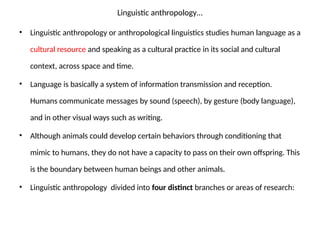
• Linguistic anthropology or anthropological linguistics studies human language as a
cultural resource and speaking as a cultural practice in its social and cultural
context, across space and time.
• Language is basically a system of information transmission and reception.
Humans communicate messages by sound (speech), by gesture (body language),
and in other visual ways such as writing.
• Although animals could develop certain behaviors through conditioning that
mimic to humans, they do not have a capacity to pass on their own offspring. This
is the boundary between human beings and other animals.
• Linguistic anthropology divided into four distinct branches or areas of research:
Linguistic anthropology…
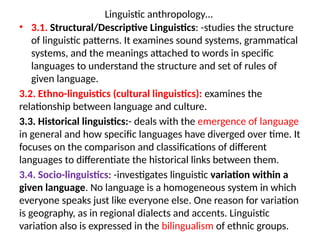
• 3.1. Structural/Descriptive Linguistics: -studies the structure
of linguistic patterns. It examines sound systems, grammatical
systems, and the meanings attached to words in specific
languages to understand the structure and set of rules of
given language.
3.2. Ethno-linguistics (cultural linguistics): examines the
relationship between language and culture.
3.3. Historical linguistics:- deals with the emergence of language
in general and how specific languages have diverged over time. It
focuses on the comparison and classifications of different
languages to differentiate the historical links between them.
3.4. Socio-linguistics: -investigates linguistic variation within a
given language. No language is a homogeneous system in which
everyone speaks just like everyone else. One reason for variation
is geography, as in regional dialects and accents. Linguistic
variation also is expressed in the bilingualism of ethnic groups.
4. Socio-Cultural Anthropology
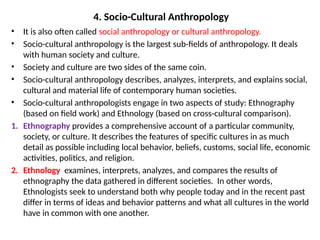
• It is also often called social anthropology or cultural anthropology.
• Socio-cultural anthropology is the largest sub-fields of anthropology. It deals
with human society and culture.
• Society and culture are two sides of the same coin.
• Socio-cultural anthropology describes, analyzes, interprets, and explains social,
cultural and material life of contemporary human societies.
• Socio-cultural anthropologists engage in two aspects of study: Ethnography
(based on field work) and Ethnology (based on cross-cultural comparison).
1. Ethnography provides a comprehensive account of a particular community,
society, or culture. It describes the features of specific cultures in as much
detail as possible including local behavior, beliefs, customs, social life, economic
activities, politics, and religion.
2. Ethnology examines, interprets, analyzes, and compares the results of
ethnography the data gathered in different societies. In other words,
Ethnologists seek to understand both why people today and in the recent past
differ in terms of ideas and behavior patterns and what all cultures in the world
have in common with one another.
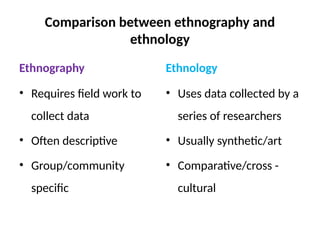
Comparison between ethnography and
ethnology
Ethnography
• Requires field work to
collect data
• Often descriptive
• Group/community
specific
Ethnology
• Uses data collected by a
series of researchers
• Usually synthetic/art
• Comparative/cross -
cultural
Socio-cultural anthropology…
• Socio-cultural anthropology uses ethnographical and
ethnological approaches to answer all sort of questions related to
culture and human societies.
• To properly address emerging questions related to culture and
societies, it has been sub-divided into many other specialized
fields as: Anthropology of Art, Medical Anthropology, Urban
Anthropology, Economic Anthropology, Political Anthropology,
Development Anthropology, Anthropology of Religion,
Demographic Anthropology, Ecological Anthropology,
Psychological Anthropology, Ethnomusicology, etc.
1.3 Unique (Basic) Features of Anthropology
• Several distinguishing characteristics that identify anthropology from
other discipline.
• Anthropology is unique in its scope, approach, focus and method of
study. Anthropology has a broad scope. It is interested in all human
beings, whether contemporary or past, ''primitive'' or '' civilized
 No place or time is too remote to escape the anthropologist's notice.
 No dimension of human kind, from genes to art styles, is outside the
anthropologist's attention.
 The second important feature, its approach is holistic, relativistic, and
focused one.
Unique features…
• Anthropological studies give attention to how people perceive
themselves and understand their world; how a particular group of
people explain about their action, or give meaning to their
behavior or cultural practices-emic perspective.
• Anthropology is highly dependent on qualitative research
approach to understand the meaning behind any human activity.
Extended fieldwork, participant observation, in-depth and key
informant interviews and focus-group discussion.
• Focusing more on the local than the big social processes has been
another exclusive approach in the discipline.
1.4 Misconceptions about anthropology
• Due to lack of appropriate awareness about the nature, scope and subject
matter of the discipline, different misconceptions are held about
anthropology.
• anthropology is limited to the study of "primitive" societies. However,
anthropologists nowadays study most advanced and most complex
societies as well.
• anthropologists only study the rural people and rural areas’. But now,
anthropologists are also interested in the study of urban people and urban
areas-Urban Anthropology.
Misconceptions...
• It is also wrongly misconceived that anthropology is the study/analysis of
fossil evidences of the proto-humans like that of Lucy/Dinkeneshe. However,
this doesn’t mean that anthropology is all about the study of human
evolution. It studies both the biological and the cultural aspects of humans.
• It is also misconceived that the purpose of anthropology is to study in order
to keep and preserve communities far from development and obsolete
cultural practices in museums. Rather, anthropologists’ duties are to support
those communities' capacity to empower themselves in development
processes. They assist peoples' initiatives instead of imposed policies and
ideas coming from outside.
1.5 The Relationship between Anthropology and Other Disciplines
• Anthropology is similar with other social sciences such as sociology,
psychology, political sciences, economics, history, etc.
• However, anthropology differs from other social sciences and the humanities
by its broad scope, unique approach, perspective, unit of analysis and
methods used.
• In its scope, anthropology studies humankind in its entirety. In its approach,
anthropology studies and analyzes human ways of life holistically,
comparatively and in a relativistic manner.
• In its perspective, anthropology approaches and locates dimensions of
people’s individual and communal lived experiences, their thoughts and their
feelings in terms of how these dimensions are interconnected and
1.6 The Contributions of anthropology
• By studying anthropology, we get the following benefits, among others.
• by its emphasis on the comparative study of cultures, should lead us to the
conclusion that our culture is just one way of life among many found in the world
and that it represents one way (among many possible ways).
• gives us an insight into different ways and modes of life of human society (social
and cultural diversity), which helps to understand the logic and justification behind
group behavior and cultural practices.
• Through its distinctive methodology of long-term, intensive, participant-
observation research, cultural anthropology offers a unique perspective on how
local cultural groups are engaging with the process of globalization.
• Because of its relativistic approach, anthropology helps us to be more sensitive to
and appreciative of cultural diversity and variability.
4_5814613148656735915.pptxLogic and Crit

4_5814613148656735915.pptxLogic and Crit

  • 1.
    Ethiopian Police University Crimeprevention and Public security college Generic Degree in Crime Prevention (7th R) Social Anthropology Course Code: Anth1012 ; 49 Hours By:- Mesfin Goshimo (MSW, PGD, BA) October:-2024 Sendafa: Ethiopia
  • 2.
    Rapport • Name:------- • Region:----- •Job sector:- • Experience:- • Hobbies:----- • Vision:--------
  • 3.
    • Attending theclass (above 95%) • Active participation/student center • Avoid unethical issues(disturbing of any form) • Fulfill all assessments • Punctuality Course requirements
  • 4.
    • Continuous assessment(60%) Individual assignment-10% Group assignment- 20% Quiz – 10% mid-exam-20% o Final exam-40% Course evaluation
  • 5.
     Unit one-Introducing anthropology and its subject matter  Unit two-Human culture and ties that connect  Unit three- Human diversity, Culture Areas and Contact in Ethiopia  Unit four-marginalized, minorities and vulnerable groups  Unit five- identity, inter-ethnic relations and multiculturalism in Ethiopia  Unit six- customary and local governance systems and peace making  Unit seven-Indigenous knowledge systems and practice Contents of the course
  • 7.
    Module Introduction  Thecourse is expected to acquaint you with essential concept of anthropology covering a wide array of questions revolving around our very existence.  It cover issues such as what makes human beings similar to each other? How do we differ one another? What do anthropologist mean when they talk about diversity, multiculturalism, marginalization, inclusion and exclusion?  The course will enable learners grasp the different ways of being human by dealing with themes such as culture, kinship, marriage, cultural relativism, ethnocentrism, humanity, human origins, race, ethnicity, ethnic boundaries, marginalization, minorities, indigenous knowledge systems, and indigenous practices and development.
  • 8.
    Unit One:-Introducing Anthropologyand its Subject Matter Unit learning outcomes: Up on the successful completion of this unit, you will be able to: • Define the concepts in Anthropology • Understand the historical development of anthropology • Express the scope and subject matter of anthropology • Explain the sub-disciplines of anthropology • Internalize unique feature of anthropology • Convert misconception held about anthropology • Differentiate anthropology from other discipline • Appraise the relevance of anthropology in our life
  • 9.
    Brainstorming question a. Howdo you define Anthropology? b. How do you conceive the meaning of the term ‘human’?
  • 10.
    1.1 Definition, Scopeand Subject Matter of Anthropology 1.1.1 Concepts in Anthropology To begin with the etymology of the term, the term anthropology is a compound of two Greek words, ‘anthropos’ and ‘logos’, which can be translated as ‘human being/mankind’ and ‘reason/study/science’. So, anthropology means ‘reasoning about humans’ or ‘the study or science of humankind or humanity’. Moreover, man has two important characteristics: biological and cultural: cxs are inseparable elements. Culture influences human physical structures and the vise-versa.
  • 11.
    Concepts in anthropology… Inmore specific terms, anthropology is a science which: • Investigates the strategies for living that are learned and shared by people as members of human social groups; • Examines the characteristics that human beings share as members of one species (homo sapiens) and the diverse ways that people live in different environments; • Analyses the products of social groups -material objects (material cultures) and non-material creations (religion/beliefs, social values, institutions, practices, etc).
  • 12.
    Concepts in anthropology… •Anthropology’s ultimate goal is to develop an integrated picture of humankind—a goal that encompasses an almost infinite number of questions about all aspects of our existence. • We ask, for example, what makes us human? Why do some groups of people tend to be tall and lanky, while others tend to be short and stocky? Why do some groups of people practice agriculture, while others hunt for a living?
  • 13.
    1.1.2 The HistoricalDevelopment of Anthropology • The present academic anthropology has its roots in the works and ideas of the great ancient and Medieval Greek, Roman, and Hebrew philosophers and social thinkers.-interested in the nature, origin and destiny of man, and the morality and ethics of human r/ships. • anthropology as an academic discipline was born during the 19th century, out of the intellectual atmosphere of Enlightenment-social philosophical movement that emphasized human progress and the poser of reason- Darwinian Theory of Evolution.
  • 14.
    Historical… • By thelate 1870s, anthropology was beginning to emerge as a profession. • A major impetus for its growth was the expansion of western colonial powers and their consequent desire to better understand the peoples living under colonial domination. • Anthropologists of the early 1900s emphasized the study of social and cultural differences among human groups. Here, many of the indigenous peoples of non-western world and their social and cultural features were studied in detail and documented. This approach is called ethnography.
  • 15.
    Historical… • By themid-1900, however, anthropologists attempted to discover universal human patterns and the common biopsychological traits that bind all human beings. This approach is called ethnology. • Ethnology aims at the comparative understanding and analysis of different ethnic groups across time and space. • In Ethiopia, professional anthropologists have been studying culture and society on a more intensive level only since the late 1950s. Almost inevitably, the initial emphasis was on ethnography, the description of specific customs, cultures and ways of life.
  • 16.
    1.1.3 Scope andsubject matter of anthropology • The breadth and depth of anthropology is immense. There is no time and space left as far as man exists. In other words, the temporal dimension covers the past, the present and even the future. In terms of the spatial dimension, anthropology studies from Arctic to Desert, from Mega-polis to hunting gathering areas. • Claude Lévi-Strauss, has expressed anthropology studies humanity with its all aspects of existence, and in its all means of differences (diversity) and similarities (commonality). • Although anthropologists have wide-ranging and frequently highly specialized interests, they all share a common concern in trying to understand both connections within societies and connections between societies. • Anthropologists strive for an understanding of the biological and cultural origins and evolutionary development of the species.
  • 17.
    1.2 Sub-fields ofanthropology Anthropology has often categorized into four major subfields: 1. Physical/Biological Anthropology 2. Archeology 3. Linguistic Anthropology and 4. Socio-Cultural Anthropology.
  • 18.
    1. Physical/Biological Anthropology •is the branch of anthropology most closely related to the natural sciences, particularly biology; that is why it is often called biological anthropology. • Human biology affects or even explains some aspects of behavior, society, and culture like marriage patterns, sexual division of labor, gender ideology etc. • Genes are characteristics that carry biological traits of an organism, including human beings. • The major sources of biological variations are derived from the interrelated effects of natural selection, geographical isolation, genetic mutations.
  • 19.
    physical… • Physical anthropologyis essentially concerned with two broad areas of investigation: human evolution and genetics. • Human evolution is the study of the gradual processes of simple forms into more differentiated structures in hominid. It is interested in reconstructing the evolutionary record of the human species using fossils/bones. • Human genetics- concerns to investigate how and why the physical traits of contemporary human populations vary throughout the world. It focuses to examine the genetic materials of an organism such as DNA and RNA.
  • 20.
    2. Archaeological Anthropology •Reflect your views on the following questions. 1. What do we mean by the human past? 2. Which discipline tells you about the human distance past? 3. What do we learn from our past?
  • 21.
    Archaeological anthropology… • Archaeologicalanthropology- studies the ways of lives of past peoples by excavating and analysing the material culture/physical remains (artefacts, features and eco-facts) they left behind. • Artefacts are material remains made and used by the past peoples and that can be removed from the site and taken to the laboratory for further analysis. Tools, ornaments, arrowheads, coins, and fragments of pottery are examples of artifacts. • Eco-facts are non-artefactual, organic and environmental remains such as soil, animal bones, and plant remains that were not made or altered by humans; but were used by them.
  • 22.
    Archaeology… • Eco-facts providearchaeologists with important data concerning the environment and how people used natural resources in the past. • Archaeology has also its own subfields or areas of specialties. The most important ones are -Prehistoric Archaeology and Historical Archaeology. • Prehistoric archaeology investigates human prehistory and prehistoric cultures. It focuses on entire period between 6,000 years ago and the time of the first stone tools (the first artifacts), around 2.5 million years ago, is called prehistory. • Historic archaeologists help to reconstruct the cultures of people who used writing and about whom historical documents have been written. • We Ethiopian have very glorious past. Area logical findings in North, south, east and western part of the country have shown our county belonged to have old civilization.
  • 23.
    3. Linguistic Anthropology Brainstorming… A.Do you speak a language other than your mother tongue? If yes, what’s the similarity& difference between the languages? B. What distinguishes human communication from any other animal communication? C. What do languages functions?
  • 24.
    Linguistic anthropology… • Linguisticanthropology or anthropological linguistics studies human language as a cultural resource and speaking as a cultural practice in its social and cultural context, across space and time. • Language is basically a system of information transmission and reception. Humans communicate messages by sound (speech), by gesture (body language), and in other visual ways such as writing. • Although animals could develop certain behaviors through conditioning that mimic to humans, they do not have a capacity to pass on their own offspring. This is the boundary between human beings and other animals. • Linguistic anthropology divided into four distinct branches or areas of research:
  • 25.
    Linguistic anthropology… • 3.1.Structural/Descriptive Linguistics: -studies the structure of linguistic patterns. It examines sound systems, grammatical systems, and the meanings attached to words in specific languages to understand the structure and set of rules of given language. 3.2. Ethno-linguistics (cultural linguistics): examines the relationship between language and culture. 3.3. Historical linguistics:- deals with the emergence of language in general and how specific languages have diverged over time. It focuses on the comparison and classifications of different languages to differentiate the historical links between them. 3.4. Socio-linguistics: -investigates linguistic variation within a given language. No language is a homogeneous system in which everyone speaks just like everyone else. One reason for variation is geography, as in regional dialects and accents. Linguistic variation also is expressed in the bilingualism of ethnic groups.
  • 26.
    4. Socio-Cultural Anthropology •It is also often called social anthropology or cultural anthropology. • Socio-cultural anthropology is the largest sub-fields of anthropology. It deals with human society and culture. • Society and culture are two sides of the same coin. • Socio-cultural anthropology describes, analyzes, interprets, and explains social, cultural and material life of contemporary human societies. • Socio-cultural anthropologists engage in two aspects of study: Ethnography (based on field work) and Ethnology (based on cross-cultural comparison). 1. Ethnography provides a comprehensive account of a particular community, society, or culture. It describes the features of specific cultures in as much detail as possible including local behavior, beliefs, customs, social life, economic activities, politics, and religion. 2. Ethnology examines, interprets, analyzes, and compares the results of ethnography the data gathered in different societies. In other words, Ethnologists seek to understand both why people today and in the recent past differ in terms of ideas and behavior patterns and what all cultures in the world have in common with one another.

  • 27.
    Comparison between ethnographyand ethnology Ethnography • Requires field work to collect data • Often descriptive • Group/community specific Ethnology • Uses data collected by a series of researchers • Usually synthetic/art • Comparative/cross - cultural
  • 28.
    Socio-cultural anthropology… • Socio-culturalanthropology uses ethnographical and ethnological approaches to answer all sort of questions related to culture and human societies. • To properly address emerging questions related to culture and societies, it has been sub-divided into many other specialized fields as: Anthropology of Art, Medical Anthropology, Urban Anthropology, Economic Anthropology, Political Anthropology, Development Anthropology, Anthropology of Religion, Demographic Anthropology, Ecological Anthropology, Psychological Anthropology, Ethnomusicology, etc.
  • 29.
    1.3 Unique (Basic)Features of Anthropology • Several distinguishing characteristics that identify anthropology from other discipline. • Anthropology is unique in its scope, approach, focus and method of study. Anthropology has a broad scope. It is interested in all human beings, whether contemporary or past, ''primitive'' or '' civilized  No place or time is too remote to escape the anthropologist's notice.  No dimension of human kind, from genes to art styles, is outside the anthropologist's attention.  The second important feature, its approach is holistic, relativistic, and focused one.
  • 30.
    Unique features… • Anthropologicalstudies give attention to how people perceive themselves and understand their world; how a particular group of people explain about their action, or give meaning to their behavior or cultural practices-emic perspective. • Anthropology is highly dependent on qualitative research approach to understand the meaning behind any human activity. Extended fieldwork, participant observation, in-depth and key informant interviews and focus-group discussion. • Focusing more on the local than the big social processes has been another exclusive approach in the discipline.
  • 31.
    1.4 Misconceptions aboutanthropology • Due to lack of appropriate awareness about the nature, scope and subject matter of the discipline, different misconceptions are held about anthropology. • anthropology is limited to the study of "primitive" societies. However, anthropologists nowadays study most advanced and most complex societies as well. • anthropologists only study the rural people and rural areas’. But now, anthropologists are also interested in the study of urban people and urban areas-Urban Anthropology.
  • 32.
    Misconceptions... • It isalso wrongly misconceived that anthropology is the study/analysis of fossil evidences of the proto-humans like that of Lucy/Dinkeneshe. However, this doesn’t mean that anthropology is all about the study of human evolution. It studies both the biological and the cultural aspects of humans. • It is also misconceived that the purpose of anthropology is to study in order to keep and preserve communities far from development and obsolete cultural practices in museums. Rather, anthropologists’ duties are to support those communities' capacity to empower themselves in development processes. They assist peoples' initiatives instead of imposed policies and ideas coming from outside.
  • 33.
    1.5 The Relationshipbetween Anthropology and Other Disciplines • Anthropology is similar with other social sciences such as sociology, psychology, political sciences, economics, history, etc. • However, anthropology differs from other social sciences and the humanities by its broad scope, unique approach, perspective, unit of analysis and methods used. • In its scope, anthropology studies humankind in its entirety. In its approach, anthropology studies and analyzes human ways of life holistically, comparatively and in a relativistic manner. • In its perspective, anthropology approaches and locates dimensions of people’s individual and communal lived experiences, their thoughts and their feelings in terms of how these dimensions are interconnected and
  • 34.
    1.6 The Contributionsof anthropology • By studying anthropology, we get the following benefits, among others. • by its emphasis on the comparative study of cultures, should lead us to the conclusion that our culture is just one way of life among many found in the world and that it represents one way (among many possible ways). • gives us an insight into different ways and modes of life of human society (social and cultural diversity), which helps to understand the logic and justification behind group behavior and cultural practices. • Through its distinctive methodology of long-term, intensive, participant- observation research, cultural anthropology offers a unique perspective on how local cultural groups are engaging with the process of globalization. • Because of its relativistic approach, anthropology helps us to be more sensitive to and appreciative of cultural diversity and variability.