All cultures all people have one. It answers many important questions. Anthropology tries to answer these questions scientifically. The Creation Myth
What questions does Anthroplogy answer? Why we are here. Explains life’s suffering Establishes or reveals a deity Explains the nature of that deity. Tells us about how we should live Explains the cause or origin of natural phenomenon Spoiled Paradise Establishes and explains social or hierarchical order. (Relationships)  Ex: men and women,  man and animals, man  and the gods, etc.  Gives  reasons  to follow the rules   
A Brief History of ANTHROPOLOGY Not a field of study in U.S. until 1879.  Why? No world travel Difficulty in sharing information. (compared to now) There was no belief in a common humanity. This idea changed after the ENLIGHTENMENT.
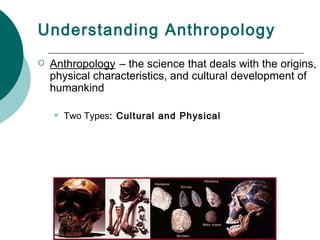
Understanding Anthropology Anthropology   – the science that deals with the origins, physical characteristics, and cultural development of humankind   Two Types : Cultural and Physical
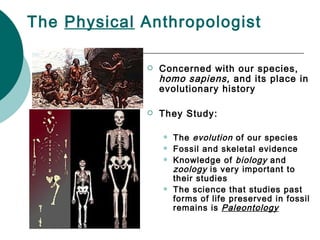
The  Physical  Anthropologist Concerned with our species,  homo sapiens,  and its place in evolutionary history They Study: The  evolution  of our species Fossil and skeletal evidence Knowledge of  biology  and  zoology  is very important to their studies The science that studies past forms of life preserved in fossil remains is  Paleontology
Cultural Anthropology Archeology Linguistics Ethnology- Often times referred to simply as cultural anthropology
Cultural Anthropology Seeks to understand how and why different people think and act similarly.  Concerned with patterns of thought, behaviors, customs, kinship organization, political and economic systems, religion, art, music etc. They compare cultures Remember: Ethnology = Cultural Anthropology!
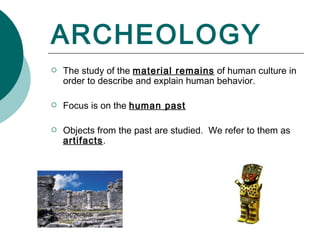
ARCHEOLOGY The study of the  material remains  of human culture in order to describe and explain human behavior. Focus is on the  human past Objects from the past are studied.  We refer to them as  artifacts .
LINGUISTIC ANTHROPOLOGY Language transmits  culture This field deals with the description of language and the history of languages. Language can tell you volumes about the way a group of people view the world.
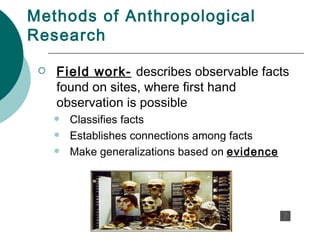
Methods of Anthropological Research Field work-   describes observable facts found on sites, where first hand observation is possible Classifies facts  Establishes connections among facts  Make generalizations based on  evidence
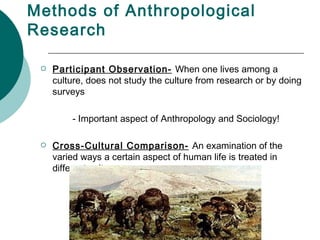
Methods of Anthropological Research Participant Observation-   When one lives among a culture, does not study the culture from research or by doing surveys - Important aspect of Anthropology and Sociology! Cross-Cultural Comparison-   An examination of the varied ways a certain aspect of human life is treated in different cultures
Holistic Perspective In order to understand the way that individual things work  in a system, you must understand the way that the  entire system  works
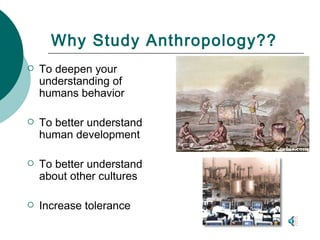
Why Study Anthropology?? To deepen your understanding of humans behavior  To better understand human development To better understand about other cultures Increase tolerance
Why is it important to understand more about other cultures? Studying anthropology helps to eliminate racism, encourage toleration and promote peaceful solutions to problems

Anthropology intro and types

  • 1.
    All cultures allpeople have one. It answers many important questions. Anthropology tries to answer these questions scientifically. The Creation Myth
  • 2.
    What questions doesAnthroplogy answer? Why we are here. Explains life’s suffering Establishes or reveals a deity Explains the nature of that deity. Tells us about how we should live Explains the cause or origin of natural phenomenon Spoiled Paradise Establishes and explains social or hierarchical order. (Relationships) Ex: men and women, man and animals, man and the gods, etc. Gives reasons to follow the rules  
  • 3.
    A Brief Historyof ANTHROPOLOGY Not a field of study in U.S. until 1879. Why? No world travel Difficulty in sharing information. (compared to now) There was no belief in a common humanity. This idea changed after the ENLIGHTENMENT.
  • 4.
    Understanding Anthropology Anthropology – the science that deals with the origins, physical characteristics, and cultural development of humankind Two Types : Cultural and Physical
  • 5.
    The Physical Anthropologist Concerned with our species, homo sapiens, and its place in evolutionary history They Study: The evolution of our species Fossil and skeletal evidence Knowledge of biology and zoology is very important to their studies The science that studies past forms of life preserved in fossil remains is Paleontology
  • 6.
    Cultural Anthropology ArcheologyLinguistics Ethnology- Often times referred to simply as cultural anthropology
  • 7.
    Cultural Anthropology Seeksto understand how and why different people think and act similarly. Concerned with patterns of thought, behaviors, customs, kinship organization, political and economic systems, religion, art, music etc. They compare cultures Remember: Ethnology = Cultural Anthropology!
  • 8.
    ARCHEOLOGY The studyof the material remains of human culture in order to describe and explain human behavior. Focus is on the human past Objects from the past are studied. We refer to them as artifacts .
  • 9.
    LINGUISTIC ANTHROPOLOGY Languagetransmits culture This field deals with the description of language and the history of languages. Language can tell you volumes about the way a group of people view the world.
  • 10.
    Methods of AnthropologicalResearch Field work- describes observable facts found on sites, where first hand observation is possible Classifies facts Establishes connections among facts Make generalizations based on evidence
  • 11.
    Methods of AnthropologicalResearch Participant Observation- When one lives among a culture, does not study the culture from research or by doing surveys - Important aspect of Anthropology and Sociology! Cross-Cultural Comparison- An examination of the varied ways a certain aspect of human life is treated in different cultures
  • 12.
    Holistic Perspective Inorder to understand the way that individual things work in a system, you must understand the way that the entire system works
  • 13.
    Why Study Anthropology??To deepen your understanding of humans behavior To better understand human development To better understand about other cultures Increase tolerance
  • 14.
    Why is itimportant to understand more about other cultures? Studying anthropology helps to eliminate racism, encourage toleration and promote peaceful solutions to problems