International Research Journal of Engineering and Technology (IRJET) e-ISSN: 2395-0056
Volume: 06 Issue: 06 | June 2019 www.irjet.net p-ISSN: 2395-0072
© 2019, IRJET | Impact Factor value: 7.211 | ISO 9001:2008 Certified Journal | Page 2125
Fault Detection and Maintenance Prediction for Gear of an Industrial
Gearbox using Machine Learning Approaches
Er. Ashish Kumar Srivastava1, Er. Abhishek Singh Gangwar2
1M.Tech. Scholar, Dept. of Mechanical Engineering, Goel Institute of Technology & Management, Lucknow,
U.P., India
2Assistant Professor, Dept. of Mechanical Engineering, Goel Institute of Technology & Management, Lucknow,
U.P., India
---------------------------------------------------------------------***----------------------------------------------------------------------
Abstract - Gear can be termed as a mechanical component
which is used to transfer amount of force and torque
generated by an engine (as in automobile) or from an electric
motor (as in industrial machine) to the desired output. It can
be termed as an integral part for any gearbox. Gear needs to
be monitored very carefully for any kind of signs which can
result in failure. For this many a times machine is neededto be
under shutdown so that proper inspection can be done, this
increases time of unproductive work by machine. Toavoidthis
time of unproductive work machine learning algorithms can
be used to provide a prediction based for a best suited
maintenance type according to the condition of gear so that it
can be done to avoid failure of the component. All experiments
have been performed on the gear dataset. This work explores
and analyze the different machine learningalgorithmsnamed
K-nearest neighbor algorithm, decision tree, random forest
algorithm, support vector machine algorithm and multilayer
perceptron algorithm. Waikato Environment for Knowledge
Analysis (WEKA) tool is used to perform these experiments.
According to our experiments, random forest algorithm is
performing the best with 89.15% accuracy and with 0.172
root mean square error.
Key Words: Fault Detection, Gear,MachineLearning, WEKA,
Decision tree, random forest algorithm, support vector
machine algorithm.
1. INTRODUCTION
In a gearbox there is always a surface contact between
gears so that the torque can be transmitted by them. This
results in many factors such as friction, vibration, heat
generation due to friction, etc. thatmayleadtofailureofgear
like bending, pitting, scoring, abrasive wear, corrosivewear.
For this material to be selected must have wear resistance,
good surface hardness, etc. and the best suited material for
any industrial gear is steel. But inspite of all the measures
(such as use of lubrication, proper ventilation, etc.) failure
may creep into gear, for this a proper and systematic
inspection is required.
This may be quite a hectic process for both man and
machine as no work can be taken while inspection thus,
reducing productivity for a certain time. To reduce such loss
Machine Learning concept can be used for monitoring
condition of gear while it is still in service and a suitable
maintenance type can be predicted according to the
condition of gear.
Many researchers have used machine learning
techniques for gear fault detection. Praveen Kumar et al. [2]
used vibration signals as features and for fault detection
support vector machine is used. Biswanath Samanta[3]also
did experiments using artificial neural network and SVM.
Sreenath et al. [4] have used Navie Bayes and decision tree
algorithm-s for classification. Many research articles used
tree-based methods like decision tree and SVM algorithm.
In this work, we are aiming to approach the machine
learning algorithm of different type. K-NN algorithm is
selected form instance-based learning algorithms. Two
algorithms are selected from tree-based algorithms named
decision tree and random forest algorithm. SVM algorithm
selected form kernel-basedalgorithmandfromdeeplearning
multilayer perceptron algorithm is selected.
The main objective of this paper is to predict the fault
detection with higheraccuracy.Toachievethis,wehavedone
experiment with different machine learning algorithms and
one deep learning algorithm. This paper also includes the
comparative study of these algorithms.
This paper is organised as follow: Section 2 describes
the machine learning algorithms that used in experiments.
Section 3 discussed the experimental results. Section 4
concludes this work and last section 5 explains the future
work.
2. MACHINE LEARNING ALGORITHMS
This section describes the different machine learning
algorithms.
2.1 K-Nearest Neighbor Algorithm
K-NN is an Instance based machinelearningalgorithm and
also know as lazy learning algorithm. There is no training
phase, at the time of inference an instance search for a K
nearest neighbors based on the distance metric like
Euclidean, Manhattan, city block etc. The value of k is
positive and odd number [7].
International Research Journal of Engineering and Technology (IRJET) e-ISSN: 2395-0056
Volume: 06 Issue: 06 | June 2019 www.irjet.net p-ISSN: 2395-0072
© 2019, IRJET | Impact Factor value: 7.211 | ISO 9001:2008 Certified Journal | Page 2126
2.2 Decision Tree
Decision tree is tree-based algorithm and also known as J48
algorithm. This tree is consisting of node and edges where
node is feature and edge represents the features value. This
tree can be build using information gain method.
Information gain method selects the best feature and this
feature is selected as root node. After that search for a
feature that is with root feature performing best using
information gain method [6].
2.3 Random Forest Algorithm
Leo Breiman has presented this algorithm and this is
improved version of decision tree. Decision tree algorithm
uses information gain method to find the best feature
whereas random forest algorithm gives equal priority to all
features. So, this algorithm will create as many trees as many
features a dataset has. At the time of inferencing, a new
instance go through all the trees and every tree will predict
the class label and majority voting method is used to find the
final class label. Thisalgorithm outperformstoascompareto
decision tree algorithm.
2.4 Support Vector Machine
Support vector machine is one of the famous algorithms.
This algorithm separates out two classes with maximum
margin. This algorithm work on the principle of linear
separable dataset [8]. In this work, we have used optimized
SVM algorithm named SMO [9]. Based onthisSVMalgorithm
can be of two types:
SVM linear classifier: If dataset is linearly separable and
SVM algorithms predict the linear hyper plane.
SVM nonlinear classifier:If datasetisnotlinearlyseparable
and SVM predicts the nonlinear hyper plane. Nonlinear
hyperplane can be polynomial kernel, radial basis kernel.
2.5 Multi-Layer perceptron
Multilayer perceptron is deep learning algorithm uses the
concept of biological nervous system.Simpleneural network
algorithm or perceptron algorithm work on the principle of
the linear separability [10].
If dataset is not linearseparablethenmultiplayerperceptron
is used. In multilayer perceptron algorithm, hidden layers
introduced in between input layer and output layer.
3. EXPERIMENTAL RESULTS
This section discusses experimental results for gear fault
detection. This section is subdivided into different
subsections named as Subsection 3.1 Dataset description.
Subsection 3.2 explains the performance metric used for
evaluation of the machine learning algorithms. Subsection
3.3 explains experimental setup of this work. Subsection 3.4
discuss the results of different machine learning algorithms.
3.1 Dataset Description
This work uses the gear fault detection dataset provided by
[5]. This dataset has ten features named as:
Table 1: Feature of Gear dataset
1: Motor Vibration 2: Vibration of planetary
gearbox in x direction
3: Vibration of planetary
gearbox in y direction
4: Vibration of planetary
gearbox in z direction
5: Motor torque 6: Vibration of parallel
gear box in x direction
7: Vibration of parallel
gear box in y direction
8: Vibration of parallel
gear box in z direction
9: Rotating speed of motor
spindle
10: Applied load
This dataset has five class labels. Table 2 has shown the
names as:
Table 2: Class labels of Gear Dataset
Class label 1: Chipped (crack in gearbox)
Class label 2: Miss (missing feet in gear)
Class label 3: Root (crack in root of gear)
Class label 4: surface (crack in surface of gear)
Class label 5: Heathy gear
3.2 Performance parameters
Evaluating the machine leaning algorithm is an
machine learning algorithms, we used accuracy and root
mean square error.
Accuracy can be calculatedwiththenumberofinstancesthat
classified correctly divided by number of total instances.
Confusion matrix is used to show how well instances are
classified in each class labels.
3.3 Experimental Setup
All experiments have been performed using WEKA tool [1].
WEKA is open source machine learning used for analysis.
Arff file format is used in this tool as input of dataset. We
have preprocessed the dataset and converted into arff
format for experiments.
3.4 Results and Discussion
This section explains and discuss the results. Experiments
have included four machine learning and one deep learning
algorithm. Machine learning algorithms includes K-nearest
International Research Journal of Engineering and Technology (IRJET) e-ISSN: 2395-0056
Volume: 06 Issue: 06 | June 2019 www.irjet.net p-ISSN: 2395-0072
© 2019, IRJET | Impact Factor value: 7.211 | ISO 9001:2008 Certified Journal | Page 2127
neighbor, decision tree algorithm, random forest algorithm
and support vector machine algorithm and one deep
learning algorithm name is multilayerperceptronalgorithm.
These results are obtained using 10-fold cross validation on
gear dataset.
K-NN algorithms used K is equal to five mean it considers
five neighbors to make final decision. Decision tree
algorithm uses information gain method to build tree. MLP
uses 20 hidden layers.
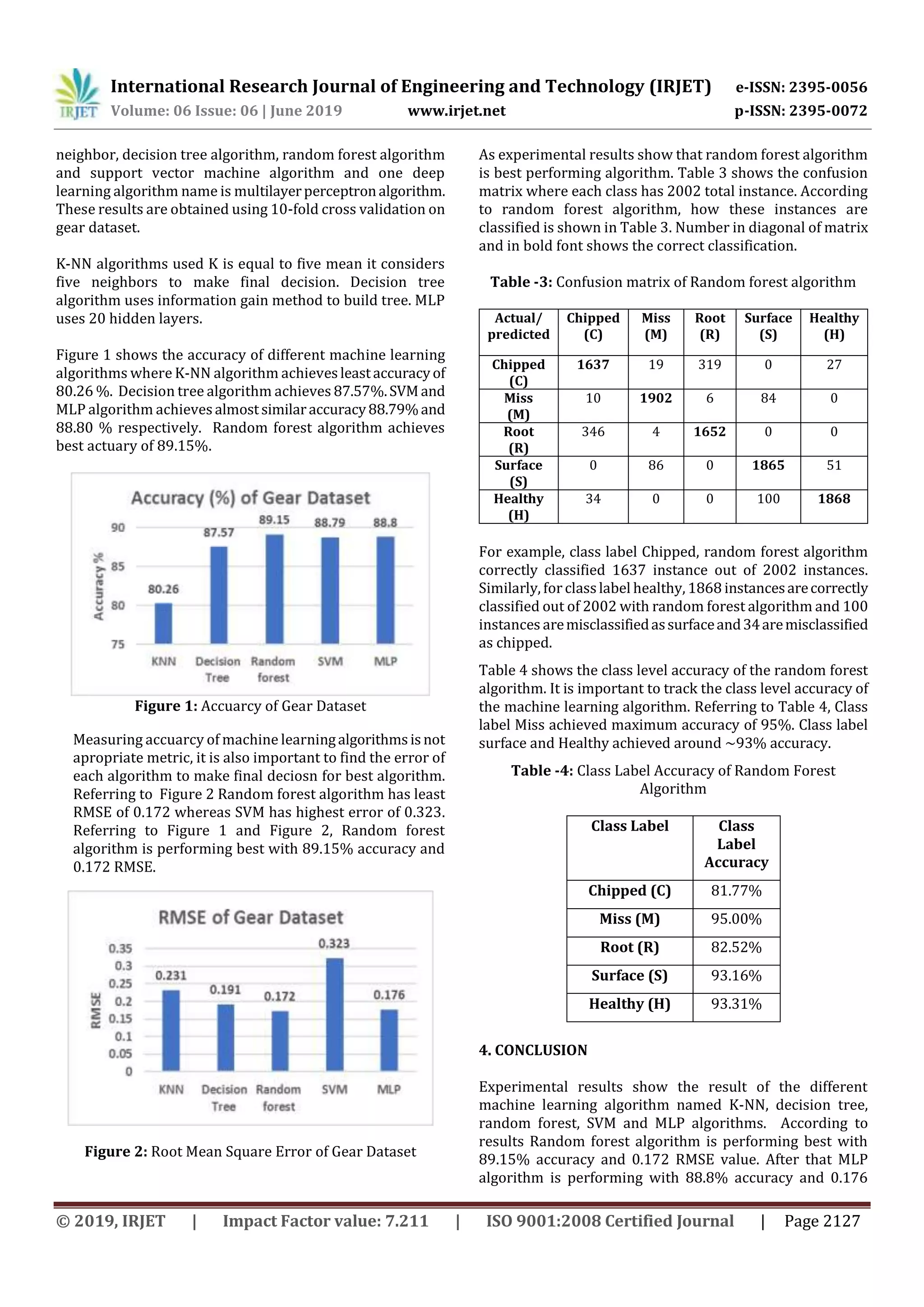
Figure 1 shows the accuracy of different machine learning
algorithms where K-NN algorithm achievesleastaccuracyof
80.26 %. Decision tree algorithm achieves 87.57%.SVMand
MLP algorithm achievesalmostsimilaraccuracy88.79%and
88.80 % respectively. Random forest algorithm achieves
best actuary of 89.15%.
Figure 1: Accuarcy of Gear Dataset
Measuring accuarcy of machine learningalgorithmsisnot
apropriate metric, it is also important to find the error of
each algorithm to make final deciosn for best algorithm.
Referring to Figure 2 Random forest algorithm has least
RMSE of 0.172 whereas SVM has highest error of 0.323.
Referring to Figure 1 and Figure 2, Random forest
algorithm is performing best with 89.15% accuracy and
0.172 RMSE.
Figure 2: Root Mean Square Error of Gear Dataset
As experimental results show that random forest algorithm
is best performing algorithm. Table 3 shows the confusion
matrix where each class has 2002 total instance. According
to random forest algorithm, how these instances are
classified is shown in Table 3. Number in diagonal of matrix
and in bold font shows the correct classification.
Table -3: Confusion matrix of Random forest algorithm
Actual/
predicted
Chipped
(C)
Miss
(M)
Root
(R)
Surface
(S)
Healthy
(H)
Chipped
(C)
1637 19 319 0 27
Miss
(M)
10 1902 6 84 0
Root
(R)
346 4 1652 0 0
Surface
(S)
0 86 0 1865 51
Healthy
(H)
34 0 0 100 1868
For example, class label Chipped, random forest algorithm
correctly classified 1637 instance out of 2002 instances.
Similarly, forclasslabel healthy, 1868 instancesarecorrectly
classified out of 2002 with random forest algorithm and 100
instances aremisclassifiedassurfaceand34aremisclassified
as chipped.
Table 4 shows the class level accuracy of the random forest
algorithm. It is important to track the class level accuracy of
the machine learning algorithm. Referring to Table 4, Class
label Miss achieved maximum accuracy of 95%. Class label
surface and Healthy achieved around ~93% accuracy.
Table -4: Class Label Accuracy of Random Forest
Algorithm
Class Label Class
Label
Accuracy
Chipped (C) 81.77%
Miss (M) 95.00%
Root (R) 82.52%
Surface (S) 93.16%
Healthy (H) 93.31%
4. CONCLUSION
Experimental results show the result of the different
machine learning algorithm named K-NN, decision tree,
random forest, SVM and MLP algorithms. According to
results Random forest algorithm is performing best with
89.15% accuracy and 0.172 RMSE value. After that MLP
algorithm is performing with 88.8% accuracy and 0.176
International Research Journal of Engineering and Technology (IRJET) e-ISSN: 2395-0056
Volume: 06 Issue: 06 | June 2019 www.irjet.net p-ISSN: 2395-0072
© 2019, IRJET | Impact Factor value: 7.211 | ISO 9001:2008 Certified Journal | Page 2128
RMSE value. SVM algorithm isnotperformingwell becauseit
encountered higher error. SVM achieves higher accuracy of
88.79% but RMSE value is high 0.323. These results have
sown that tree-based algorithms are performing best.
5. FUTURE SCOPES
This work can be extened by using deep learning algorithm
like using convolution neural network-based algorithms. It
may also be extended to develop a simulation model to
predict and diagnose the health condition for gear in an
industrial gearbox.
REFERENCES
[1] Eibe Frank, Mark A. Hall, and Ian H. Witten (2016). The
WEKA Workbench. Online Appendix for "Data Mining:
Practical Machine Learning Tools and Techniques",
Morgan Kaufmann, Fourth Edition, 2016.
[2] Praveenkumar, T., M. Saimurugan,P.Krishnakumar,and
K. I. Ramachandran. "Fault diagnosis of automobile
gearbox based on machine learning techniques."
Procedia Engineering 97 (2014): 2092-2098.
[3] Samanta, Biswanath, Khamis R. Al-Balushi, and SaeedA.
Al-Araimi. "Artificial neural networks and genetic
algorithm for bearing fault detection." Soft Computing
10, no. 3 (2006): 264-271.
[4] Sreenath, P. G., GopalakrishnanPraveenKumare,Sundar
Pravin, K. N. Vikram, and M. Saimurugan. "Automobile
Gearbox Fault DiagnosisUsingNaiveBayesandDecision
Tree Algorithm." In Applied Mechanics and Materials,
vol. 813, pp. 943-948. Trans Tech Publications, 2015.
[5] Shao, Siyu, et al. "Highly-accurate machine fault
diagnosis using deep transfer learning." IEEE
Transactions on Industrial Informatics (2018).
[6] S. K. Murthy, Automatic construction of decision trees
from data: A multi-disciplinary survey, Data mining and
knowledge discovery, vol. 2, no. 4, pp. 345-389, 1998.
[7] A.-L. Jousselme and P. Maupin, Distances in evidence
theory: Comprehensive survey and generalizations,
International Journal of ApproximateReasoning,vol.53,
no. 2, pp. 118-145, 2012.
[8] J. C. Platt, 12 fast training of support vector machines
using sequential minimal optimization, Advances in
kernel methods, pp. 185-208, 1999.
[9] Wu, Xiujun. "Support Vector Machine SMO Algorithms
and Their Optimization." In 3rd International
Conference on Mechatronics Engineering and
Information Technology (ICMEIT 2019). Atlantis Press,
2019.
[10] Marsland, Stephen. Machine learning: an algorithmic
perspective. Chapman and Hall/CRC, 2011.

IRJET- Fault Detection and Maintenance Prediction for Gear of an Industrial Gearbox using Machine Learning Approaches

  • 1.
    International Research Journalof Engineering and Technology (IRJET) e-ISSN: 2395-0056 Volume: 06 Issue: 06 | June 2019 www.irjet.net p-ISSN: 2395-0072 © 2019, IRJET | Impact Factor value: 7.211 | ISO 9001:2008 Certified Journal | Page 2125 Fault Detection and Maintenance Prediction for Gear of an Industrial Gearbox using Machine Learning Approaches Er. Ashish Kumar Srivastava1, Er. Abhishek Singh Gangwar2 1M.Tech. Scholar, Dept. of Mechanical Engineering, Goel Institute of Technology & Management, Lucknow, U.P., India 2Assistant Professor, Dept. of Mechanical Engineering, Goel Institute of Technology & Management, Lucknow, U.P., India ---------------------------------------------------------------------***---------------------------------------------------------------------- Abstract - Gear can be termed as a mechanical component which is used to transfer amount of force and torque generated by an engine (as in automobile) or from an electric motor (as in industrial machine) to the desired output. It can be termed as an integral part for any gearbox. Gear needs to be monitored very carefully for any kind of signs which can result in failure. For this many a times machine is neededto be under shutdown so that proper inspection can be done, this increases time of unproductive work by machine. Toavoidthis time of unproductive work machine learning algorithms can be used to provide a prediction based for a best suited maintenance type according to the condition of gear so that it can be done to avoid failure of the component. All experiments have been performed on the gear dataset. This work explores and analyze the different machine learningalgorithmsnamed K-nearest neighbor algorithm, decision tree, random forest algorithm, support vector machine algorithm and multilayer perceptron algorithm. Waikato Environment for Knowledge Analysis (WEKA) tool is used to perform these experiments. According to our experiments, random forest algorithm is performing the best with 89.15% accuracy and with 0.172 root mean square error. Key Words: Fault Detection, Gear,MachineLearning, WEKA, Decision tree, random forest algorithm, support vector machine algorithm. 1. INTRODUCTION In a gearbox there is always a surface contact between gears so that the torque can be transmitted by them. This results in many factors such as friction, vibration, heat generation due to friction, etc. thatmayleadtofailureofgear like bending, pitting, scoring, abrasive wear, corrosivewear. For this material to be selected must have wear resistance, good surface hardness, etc. and the best suited material for any industrial gear is steel. But inspite of all the measures (such as use of lubrication, proper ventilation, etc.) failure may creep into gear, for this a proper and systematic inspection is required. This may be quite a hectic process for both man and machine as no work can be taken while inspection thus, reducing productivity for a certain time. To reduce such loss Machine Learning concept can be used for monitoring condition of gear while it is still in service and a suitable maintenance type can be predicted according to the condition of gear. Many researchers have used machine learning techniques for gear fault detection. Praveen Kumar et al. [2] used vibration signals as features and for fault detection support vector machine is used. Biswanath Samanta[3]also did experiments using artificial neural network and SVM. Sreenath et al. [4] have used Navie Bayes and decision tree algorithm-s for classification. Many research articles used tree-based methods like decision tree and SVM algorithm. In this work, we are aiming to approach the machine learning algorithm of different type. K-NN algorithm is selected form instance-based learning algorithms. Two algorithms are selected from tree-based algorithms named decision tree and random forest algorithm. SVM algorithm selected form kernel-basedalgorithmandfromdeeplearning multilayer perceptron algorithm is selected. The main objective of this paper is to predict the fault detection with higheraccuracy.Toachievethis,wehavedone experiment with different machine learning algorithms and one deep learning algorithm. This paper also includes the comparative study of these algorithms. This paper is organised as follow: Section 2 describes the machine learning algorithms that used in experiments. Section 3 discussed the experimental results. Section 4 concludes this work and last section 5 explains the future work. 2. MACHINE LEARNING ALGORITHMS This section describes the different machine learning algorithms. 2.1 K-Nearest Neighbor Algorithm K-NN is an Instance based machinelearningalgorithm and also know as lazy learning algorithm. There is no training phase, at the time of inference an instance search for a K nearest neighbors based on the distance metric like Euclidean, Manhattan, city block etc. The value of k is positive and odd number [7].
  • 2.
    International Research Journalof Engineering and Technology (IRJET) e-ISSN: 2395-0056 Volume: 06 Issue: 06 | June 2019 www.irjet.net p-ISSN: 2395-0072 © 2019, IRJET | Impact Factor value: 7.211 | ISO 9001:2008 Certified Journal | Page 2126 2.2 Decision Tree Decision tree is tree-based algorithm and also known as J48 algorithm. This tree is consisting of node and edges where node is feature and edge represents the features value. This tree can be build using information gain method. Information gain method selects the best feature and this feature is selected as root node. After that search for a feature that is with root feature performing best using information gain method [6]. 2.3 Random Forest Algorithm Leo Breiman has presented this algorithm and this is improved version of decision tree. Decision tree algorithm uses information gain method to find the best feature whereas random forest algorithm gives equal priority to all features. So, this algorithm will create as many trees as many features a dataset has. At the time of inferencing, a new instance go through all the trees and every tree will predict the class label and majority voting method is used to find the final class label. Thisalgorithm outperformstoascompareto decision tree algorithm. 2.4 Support Vector Machine Support vector machine is one of the famous algorithms. This algorithm separates out two classes with maximum margin. This algorithm work on the principle of linear separable dataset [8]. In this work, we have used optimized SVM algorithm named SMO [9]. Based onthisSVMalgorithm can be of two types: SVM linear classifier: If dataset is linearly separable and SVM algorithms predict the linear hyper plane. SVM nonlinear classifier:If datasetisnotlinearlyseparable and SVM predicts the nonlinear hyper plane. Nonlinear hyperplane can be polynomial kernel, radial basis kernel. 2.5 Multi-Layer perceptron Multilayer perceptron is deep learning algorithm uses the concept of biological nervous system.Simpleneural network algorithm or perceptron algorithm work on the principle of the linear separability [10]. If dataset is not linearseparablethenmultiplayerperceptron is used. In multilayer perceptron algorithm, hidden layers introduced in between input layer and output layer. 3. EXPERIMENTAL RESULTS This section discusses experimental results for gear fault detection. This section is subdivided into different subsections named as Subsection 3.1 Dataset description. Subsection 3.2 explains the performance metric used for evaluation of the machine learning algorithms. Subsection 3.3 explains experimental setup of this work. Subsection 3.4 discuss the results of different machine learning algorithms. 3.1 Dataset Description This work uses the gear fault detection dataset provided by [5]. This dataset has ten features named as: Table 1: Feature of Gear dataset 1: Motor Vibration 2: Vibration of planetary gearbox in x direction 3: Vibration of planetary gearbox in y direction 4: Vibration of planetary gearbox in z direction 5: Motor torque 6: Vibration of parallel gear box in x direction 7: Vibration of parallel gear box in y direction 8: Vibration of parallel gear box in z direction 9: Rotating speed of motor spindle 10: Applied load This dataset has five class labels. Table 2 has shown the names as: Table 2: Class labels of Gear Dataset Class label 1: Chipped (crack in gearbox) Class label 2: Miss (missing feet in gear) Class label 3: Root (crack in root of gear) Class label 4: surface (crack in surface of gear) Class label 5: Heathy gear 3.2 Performance parameters Evaluating the machine leaning algorithm is an machine learning algorithms, we used accuracy and root mean square error. Accuracy can be calculatedwiththenumberofinstancesthat classified correctly divided by number of total instances. Confusion matrix is used to show how well instances are classified in each class labels. 3.3 Experimental Setup All experiments have been performed using WEKA tool [1]. WEKA is open source machine learning used for analysis. Arff file format is used in this tool as input of dataset. We have preprocessed the dataset and converted into arff format for experiments. 3.4 Results and Discussion This section explains and discuss the results. Experiments have included four machine learning and one deep learning algorithm. Machine learning algorithms includes K-nearest
  • 3.
    International Research Journalof Engineering and Technology (IRJET) e-ISSN: 2395-0056 Volume: 06 Issue: 06 | June 2019 www.irjet.net p-ISSN: 2395-0072 © 2019, IRJET | Impact Factor value: 7.211 | ISO 9001:2008 Certified Journal | Page 2127 neighbor, decision tree algorithm, random forest algorithm and support vector machine algorithm and one deep learning algorithm name is multilayerperceptronalgorithm. These results are obtained using 10-fold cross validation on gear dataset. K-NN algorithms used K is equal to five mean it considers five neighbors to make final decision. Decision tree algorithm uses information gain method to build tree. MLP uses 20 hidden layers. Figure 1 shows the accuracy of different machine learning algorithms where K-NN algorithm achievesleastaccuracyof 80.26 %. Decision tree algorithm achieves 87.57%.SVMand MLP algorithm achievesalmostsimilaraccuracy88.79%and 88.80 % respectively. Random forest algorithm achieves best actuary of 89.15%. Figure 1: Accuarcy of Gear Dataset Measuring accuarcy of machine learningalgorithmsisnot apropriate metric, it is also important to find the error of each algorithm to make final deciosn for best algorithm. Referring to Figure 2 Random forest algorithm has least RMSE of 0.172 whereas SVM has highest error of 0.323. Referring to Figure 1 and Figure 2, Random forest algorithm is performing best with 89.15% accuracy and 0.172 RMSE. Figure 2: Root Mean Square Error of Gear Dataset As experimental results show that random forest algorithm is best performing algorithm. Table 3 shows the confusion matrix where each class has 2002 total instance. According to random forest algorithm, how these instances are classified is shown in Table 3. Number in diagonal of matrix and in bold font shows the correct classification. Table -3: Confusion matrix of Random forest algorithm Actual/ predicted Chipped (C) Miss (M) Root (R) Surface (S) Healthy (H) Chipped (C) 1637 19 319 0 27 Miss (M) 10 1902 6 84 0 Root (R) 346 4 1652 0 0 Surface (S) 0 86 0 1865 51 Healthy (H) 34 0 0 100 1868 For example, class label Chipped, random forest algorithm correctly classified 1637 instance out of 2002 instances. Similarly, forclasslabel healthy, 1868 instancesarecorrectly classified out of 2002 with random forest algorithm and 100 instances aremisclassifiedassurfaceand34aremisclassified as chipped. Table 4 shows the class level accuracy of the random forest algorithm. It is important to track the class level accuracy of the machine learning algorithm. Referring to Table 4, Class label Miss achieved maximum accuracy of 95%. Class label surface and Healthy achieved around ~93% accuracy. Table -4: Class Label Accuracy of Random Forest Algorithm Class Label Class Label Accuracy Chipped (C) 81.77% Miss (M) 95.00% Root (R) 82.52% Surface (S) 93.16% Healthy (H) 93.31% 4. CONCLUSION Experimental results show the result of the different machine learning algorithm named K-NN, decision tree, random forest, SVM and MLP algorithms. According to results Random forest algorithm is performing best with 89.15% accuracy and 0.172 RMSE value. After that MLP algorithm is performing with 88.8% accuracy and 0.176
  • 4.
    International Research Journalof Engineering and Technology (IRJET) e-ISSN: 2395-0056 Volume: 06 Issue: 06 | June 2019 www.irjet.net p-ISSN: 2395-0072 © 2019, IRJET | Impact Factor value: 7.211 | ISO 9001:2008 Certified Journal | Page 2128 RMSE value. SVM algorithm isnotperformingwell becauseit encountered higher error. SVM achieves higher accuracy of 88.79% but RMSE value is high 0.323. These results have sown that tree-based algorithms are performing best. 5. FUTURE SCOPES This work can be extened by using deep learning algorithm like using convolution neural network-based algorithms. It may also be extended to develop a simulation model to predict and diagnose the health condition for gear in an industrial gearbox. REFERENCES [1] Eibe Frank, Mark A. Hall, and Ian H. Witten (2016). The WEKA Workbench. Online Appendix for "Data Mining: Practical Machine Learning Tools and Techniques", Morgan Kaufmann, Fourth Edition, 2016. [2] Praveenkumar, T., M. Saimurugan,P.Krishnakumar,and K. I. Ramachandran. "Fault diagnosis of automobile gearbox based on machine learning techniques." Procedia Engineering 97 (2014): 2092-2098. [3] Samanta, Biswanath, Khamis R. Al-Balushi, and SaeedA. Al-Araimi. "Artificial neural networks and genetic algorithm for bearing fault detection." Soft Computing 10, no. 3 (2006): 264-271. [4] Sreenath, P. G., GopalakrishnanPraveenKumare,Sundar Pravin, K. N. Vikram, and M. Saimurugan. "Automobile Gearbox Fault DiagnosisUsingNaiveBayesandDecision Tree Algorithm." In Applied Mechanics and Materials, vol. 813, pp. 943-948. Trans Tech Publications, 2015. [5] Shao, Siyu, et al. "Highly-accurate machine fault diagnosis using deep transfer learning." IEEE Transactions on Industrial Informatics (2018). [6] S. K. Murthy, Automatic construction of decision trees from data: A multi-disciplinary survey, Data mining and knowledge discovery, vol. 2, no. 4, pp. 345-389, 1998. [7] A.-L. Jousselme and P. Maupin, Distances in evidence theory: Comprehensive survey and generalizations, International Journal of ApproximateReasoning,vol.53, no. 2, pp. 118-145, 2012. [8] J. C. Platt, 12 fast training of support vector machines using sequential minimal optimization, Advances in kernel methods, pp. 185-208, 1999. [9] Wu, Xiujun. "Support Vector Machine SMO Algorithms and Their Optimization." In 3rd International Conference on Mechatronics Engineering and Information Technology (ICMEIT 2019). Atlantis Press, 2019. [10] Marsland, Stephen. Machine learning: an algorithmic perspective. Chapman and Hall/CRC, 2011.