Crop Image Classification using Machine Learning and
Deep Learning Techniques
Course No. : STAT 591
Course title : MASTER’S SEMINAR
Course in-charge
Dr. K. Kiran Prakash
Professor and Head
Presentation by
G. Amrutha Lakshmi,
BAM/22-75
ACHARYA N. G. RANGAAGRICULTURAL
UNIVERSITY
AGRICULTURAL COLLEGE, BAPATLA
DEPARTMENT OF STATISTICS AND COMPUTER
APPLICATIONS
SEMINAR ON
04.04.2024
OUTLINE
Introduction
Methodology
Case Studies
Conclusion
References
2
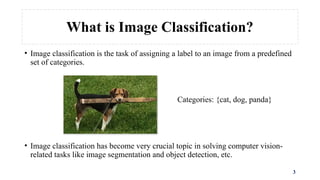
What is Image Classification?
• Image classification is the task of assigning a label to an image from a predefined
set of categories.
• Image classification has become very crucial topic in solving computer vision-
related tasks like image segmentation and object detection, etc.
Categories: {cat, dog, panda}
3
4
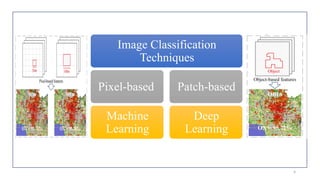
Image Classification
Techniques
Pixel-based
Machine
Learning
Patch-based
Deep
Learning
5
Machine Learning:
• Machine Learning is a powerful tool that is transforming industries and enhancing our
everyday lives.
• It is a subset of Artificial Intelligence (AI) that enables computers to learn from data and
make decisions or predictions.
Learning from Data: ML algorithms learn patterns from data, improving their performance
as the amount of data increases.
Predictions and Decisions: ML can be used to predict future outcomes or make decisions
based on data.
No Explicit Programming: Unlike traditional programming, ML does not require explicit
instructions. Instead, it learns from data.
Introduction to Machine Learning and Deep
Learning in Crop Classification
6
Advantages of Machine learning
• Easily identifies trends and patterns
• No human intervention needed (automation)
• Continuous Improvement
• Handling multi-dimensional and multi-variety data
7
Limitations of Machine learning
• Data Acquisition
• Time and Resources
• Interpretation of Results
• High error-susceptibility
8
Deep Learning:
• DL is a subset of Machine Learning (ML) that uses neural networks with
multiple layers to analyze complex patterns and relationships in data.
ANN: DL is based on artificial neural networks (ANNs), also known as deep
neural networks (DNNs).
Learning from Data: DL algorithms can automatically learn and improve from
data without the need for manual feature engineering.
Complex Problem Solving: DL has achieved significant success in various fields,
including image recognition, natural language processing, speech recognition, and
recommendation systems.
Introduction to Machine Learning and Deep
Learning in Crop Classification
9
10
Why do we need Deep Learning?
• Perform huge amount of data
ML algorithms work with huge amount of structured data but Deep Learning
algorithms can work with enormous amount of structures and unstructured data.
• Perform complex algorithms
ML algorithms cannot perform complex operations, to do that we need DL
algorithms.
• To achieve the best performance with large amounts of data
As the amount of data increases, the performance of ML algorithms decreases, to
make sure the performance of a model is good, we need DL.
• Feature extraction
ML algorithms extract patterns based on labelled sample data, while DL algorithms
take large volumes of data as input to extract features out of an object and identifies
similar objects.
11
 Applications:
• Predictive analytics in finance, healthcare, and marketing.
• Image and speech recognition in technology.
• Natural language processing in chatbots and virtual assistants.
• Computer Vision in image recognition and processing.
Introduction to Machine Learning and Deep
Learning in Crop Classification
12
• Crop Yield Prediction: ML models analyze historical data (such as weather patterns, soil quality,
and crop health) to predict future crop yields. This helps farmers optimize resource allocation.
• Pest and Disease Detection: ML algorithms process images of crops to identify signs of pests or
diseases early. This enables timely intervention and reduces crop losses.
• Precision Farming: ML-driven sensors collect real-time data on soil moisture, temperature, and
nutrient levels. Farmers can then make informed decisions about irrigation, fertilization, and
planting.
• Weed Management: ML models differentiate between crops and weeds, allowing targeted
herbicide application. This minimizes chemical use and promotes sustainable farming.
• Livestock Monitoring: ML algorithms track animal behavior, health, and feeding patterns. This
enhances livestock management and welfare.
• Supply Chain Optimization: ML aids in logistics, inventory management, and demand
forecasting, ensuring efficient distribution of agricultural products.
Applications of ML & DL in Agriculture
13
Why Use Machine Learning and Deep
Learning in Crop Classification?
• Traditional methods of crop classification face several challenges such as
Manual Intervention - leads to a large workload and low efficiency
Insufficient Automation and Intelligence - leads to poor real-time
performance
Feature Selection - computational cost and high correlation between features
These challenges make traditional methods of crop classification time-
consuming, labor-intensive, and often inaccurate. As a result, there is a
growing need for precise and automatic crop classification to help overcome
the challenges in traditional methods of crop classification.
14
Precise and automatic crop classification:
• It is crucial for several reasons:
Efficiency: Process large amounts of data quickly, reducing the need for labor-
intensive manual methods.
Precision: Essential for accurate crop management, including yield estimation,
crop monitoring, and precise application of pesticides and fertilizers.
Real-Time Monitoring: Crucial for timely intervention in case of crop diseases or
other issues.
Strategic Decision Making: Helps Farmers, food suppliers, and food producers
improve their strategic decisions regarding futures contracts where knowledge of
the expected supply for specific crops is essential for economic planning.
Why Use Machine Learning and Deep
Learning in Crop Classification?
15
• Machine Learning and Deep Learning are precise and automatic crop
classification techniques.
• They offer a powerful solution to the challenges faced by traditional methods of
crop classification.
• They provide an automated, efficient, and accurate approach to crop classification,
making them an essential tool in modern agriculture.
• These techniques can automatically select the most relevant features for crop
classification, reducing the computational cost and improving the accuracy.
Why Use Machine Learning and Deep
Learning in Crop Classification?
16
Methodology
17
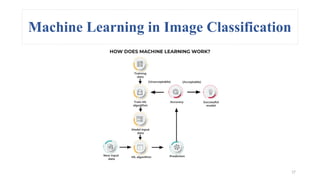
Machine Learning in Image Classification
18
Supervised Learning
Unsupervised Learning
Types of Machine Learning
19
Machine learning algorithms
• K-Nearest Neighbour (k-NN)
• Support Vector Machine (SVM)
• Decision Tree (DT)
• Random Forest (RF)
• Neural Networks (NN)
• Naïve Bayes classifier (NB)
20
K-NEAREST NEIGHBORS
Tell me about your friends (who your neighbors are)
and I will tell you who you are.
21
What is KNN?
• A supervised non-parametric lazy
learning algorithm (An Instance-
based Learning method)
• Stores all available cases and
classifies new cases based on a
similarity measure (e.g. distance
function)
22
KNN : Classification Approach
• An object (a new instance) is classified
by a majority vote for its neighbor
classes.
• The object is assigned to the most
common class amongst its K nearest
neighbors (measured by a distant
function such as Euclidean Distance or
Manhattan Distance).
23
K-Nearest Neighbour Algorithm
24
Support Vector Machine
• Supervised machine learning algorithm
• Used for both classification and regression.
• The main objective is to find the optimal hyperplane in an N-
dimensional space that can separate the data points in different classes
in the feature space.
25
26
Support Vector Machine Terminology
• Hyperplane: Hyperplane is the decision boundary that is used to separate
the data points of different classes in a feature space.
• Support Vectors: Support vectors are the closest data points to the
hyperplane, which makes a critical role in deciding the hyperplane and
margin.
• Margin: Margin is the distance between the support vector and hyperplane.
The main objective of the support vector machine algorithm is to maximize
the margin. The wider margin indicates better classification performance.
• Kernel: Kernel is the mathematical function, which is used in SVM to map
the original input data points into high-dimensional feature spaces, so, that
the hyperplane can be easily found out even if the data points are not
linearly separable in the original input space. Some of the common kernel
functions are linear, polynomial, radial basis function(RBF), and sigmoid.
27
28
• Supervised machine learning algorithm
• A Decision tree (DT) is a tree-like structure that represents a set of
decisions and their possible consequences.
• Each node in the tree represents a decision, and each branch represents
an outcome of that decision. The leaves of the tree represent the final
decisions or predictions.
Decision Tree
29
Key Components of Decision Tree
• Root Node: The decision tree’s starting
node, which stands for the complete
dataset.
• Branch Nodes: Internal nodes that
represent decision points, where the data is
split based on a specific attribute.
• Leaf Nodes: Final categorization or
prediction-representing terminal nodes.
• Decision Rules: Rules that govern the
splitting of data at each branch node.
30
Splitting Criteria
• Metrics like information gain, entropy, or the Gini Index are used to calculate the
optimal split.
• Gini Index: Gini Index is a metric to measure how often a randomly chosen
element would be incorrectly identified. It means an attribute with a lower Gini
index should be preferred.
• Entropy: Entropy is the measure of uncertainty of a random variable, it
characterizes the impurity of an arbitrary collection of examples. The higher the
entropy the more the information content.
• Information gain: The entropy typically changes when we use a node in a Python
decision tree to partition the training instances into smaller subsets. Information
gain is a measure of this change in entropy.
31
High Entropy (E1)
Lower Entropy (E2)
After split
Gain = E1 – E2
32
• Supervised machine learning algorithm
• It can be used for solving regression (numeric target variable) and
classification (categorical target variable) problems.
• Random forests are an ensemble method, meaning they combine
predictions from other models.
• Each of the smaller models in the random forest ensemble is a
decision tree.
• The Decision of the majority of the trees is chosen by the random
forest as the final decision.
Random Forest
33
Random Forest
34
Hyperparameter Tuning
• n_estimators: the number of decision trees in the forest. Increasing this
hyperparameter generally improves the performance of the model but also
increases the computational cost of training and predicting.
• max_depth: the maximum depth of each decision tree in the forest. Setting a
higher value for max_depth can lead to overfitting while setting it too low can
lead to underfitting.
35
Neural Network
• In recent years, neural networks have emerged
as a powerful tool for image classification,
revolutionizing the field of computer vision.
• Neural networks are computational models
inspired by the structure and function of the
human brain, consisting of interconnected
layers of artificial neurons that process and
analyze complex patterns in data.
• These layers can be broadly categorized into
three types: input layer, hidden layers and
output layer.
General visualization of a neural network
36
• At its core, a neural network classifier is designed to recognize patterns and
make predictions from input data.
• It learns to map input features to corresponding output labels through a
process known as training.
• During training, the neural network adjusts its internal parameters (weights
and biases) based on the input-output pairs provided in a labeled dataset, to
minimize the difference between its predictions and the true labels.
• When applied to image classification tasks, neural networks demonstrate
remarkable capabilities in recognizing and categorizing objects, scenes, or
patterns within images with high accuracy and efficiency.
Neural Network
37
• Naive Bayes classifier is a simple yet powerful probabilistic model commonly
used in machine learning for classification tasks, including image classification.
• It is based on Bayes' theorem, which describes the probability of each class given
the observed features.
• The "naive" assumption underlying the model is that the features are conditionally
independent given the class label, meaning that the presence or absence of one
feature does not affect the presence or absence of another feature.
Naïve Bayes Classifier
38
• In image classification, the Naive Bayes classifier can be applied by considering a
set of predefined features extracted from the image as independent variables.
• It calculates the probability of each class given the extracted features using Bayes'
theorem.
• The class with the highest probability is then assigned as the predicted label for
the image.
• The formula for Bayes' theorem is given as:
Naïve Bayes Classifier
39
Naïve Bayes Classifier
P(Yes | Sunny) = P( Sunny | Yes) * P(Yes) / P (Sunny)
P (Sunny |Yes) = 3/9 = 0.33, P(Sunny) = 5/14 = 0.36, P( Yes)= 9/14 = 0.64
P (Yes | Sunny) = 0.33 * 0.64 / 0.36 = 0.60
40
Deep Learning in Image Classification
41
• YOLO v5 is a deep learning architecture primarily designed for object detection
tasks, but it can also be adapted for image classification.
• By modifying the output layer of the model to predict class probabilities for a given
set of classes instead of bounding boxes, YOLO v5 can serve as a powerful image
classifier.
• This adaptation enables YOLO v5 to leverage its efficient architecture and robust
feature extraction capabilities for accurate image classification tasks.
• It represents an evolution of the YOLO (You Only Look Once) series of object
detection models, known for their real-time performance and high accuracy.
• With its efficient architecture and robust feature extraction capabilities, YOLOv5
offers high accuracy and speed in image classification tasks across various domains.
YOLO v5
42
• The network architecture of Yolov5 consists of three parts: (1) Backbone:
CSPDarknet, (2) Neck: PANet, and (3) Head: Yolo Layer.
• The data are first input to CSPDarknet for feature extraction, and then fed to
PANet for feature fusion.
• Finally, Yolo Layer outputs detection results.
YOLO v5
Neck Head
Backbone
43
Case study
44
Machine learning and handcrafted
image processing methods for
classifying common weeds in cornfield
45
Introduction
• Weed management practices strive to reduce weeds, which compete with
crops for nutrients, sunlight, and water and are thus important for
maintaining yield.
• In most weed management practices, the first step is to identify or classify
weeds.
• However, efficient identification and classification of weeds are challenging
using conventional manual methods such as field visits.
• Therefore, in this study, they proposed to classify four common weeds in the
corn field of North Dakota (common lambsquarters, common purslane,
horseweed, and redroot pigweed), using computer vision methods.
46
Methodology
• Weeds were grown in plastic trays under natural conditions from the field soil,
and images were collected using an RGB camera.
• A dataset of 200 images of each weed species was obtained (total: 4 × 200 =
800).
• The cropped images were resized to 256 × 256 to have a uniform set of images
for further processing (Fig. 1A).
• The data augmentation methods such as shear, rotation, horizontal and vertical
flips, and zoom were also employed to increase the size of the dataset for
feeding into the ML classifiers to increase the robustness of the model.
• In total, sets of 1000 images were created for each of the weed species.
47
48
• For each weed species, 21 shape features were extracted through a developed
ImageJ plugin.
49
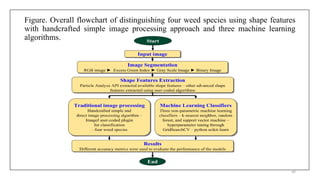
Figure. Overall flowchart of distinguishing four weed species using shape features
with handcrafted simple image processing approach and three machine learning
algorithms.
50
Handcrafted image processing model
• The traditional image processing method (handcrafted approach) uses
a set of features and corresponding thresholds for classifying four
weeds. The thresholds and features were decided based on density
plots and spread factor (SF).
• The data for each of the features were plotted on the graph, and the
features whose density plots overlap the least were used to classify the
weeds.
• A lower SF indicates high overlap and higher values indicate better
spread and separation of features leading to accurate classification.
51
Machine Learning models
52
• The results show that circularity, compactness, and length perimeter ratio were the top
three features that can be used for classification.
• Area compactness and log height-width ratio have the lowest SF and therefore, cannot be
used for the classification.
• The handcrafted model algorithm efficiently classified horseweed and redroot pigweed
with an accuracy of 95 % and 80 %, respectively.
• But seven out of twenty common lambsquarters were identified as redroot pigweed,
similarly, seven out of twenty common purslanes were identified as horseweed because of
the shape resemblance as a whole plant, although they all have different leaf structures.
• So, to gain more accuracy in classifying the weeds, advanced techniques such as ML
should be tested.
Results - Handcrafted image processing
model
53
54
Performance of machine learning models
• The 21 extracted shape features were further used to train and test the
three non-parametric ML classifiers, namely, kNN, RF, and SVM, to
classify four weed species.
• The relevant features were selected using principal component
analysis (PCA) and different sets were made to train and test the
classifier.
• Features such as hollowness, FMA, circularity, EPR, and some other
features were in the top 10 ranks
• Hyperparameters of the classifier were tuned for different sets of data
and the corresponding accuracy metrics were evaluated and reported.
55
Table. Feature importance score and corresponding rank using principal component analysis of the
shape features.
56
57
58
Conclusion
• The handcrafted simple image processing approach was highly
successful with a few weed species in distinguishing each other
(common lambsquarters vs horseweed; accuracy ≥95 %), while did not
perform well with other species combinations.
• However, all the ML models resulted in high precision, recall, F1-score,
and testing accuracies in classifying all the weed species considered.
• Out of the different ML models, RF performed best in the present
study, followed by SVM and kNN.
59
Detection of mold on the food
surface using YOLOv5
60
Introduction
• The study aimed to identify different molds that grow on various food
surfaces.
• So, they conducted a case study for the detection of mold on food
surfaces based on the “you only look once (YOLO) v5” principle.
• In this context, a dataset of 2050 food images i.e., from their own
laboratory (850 images) and from the internet (1200 images) with
mold growing on their surfaces was created.
• A laboratory test was also performed to confirm that the grown
organisms were mold.
61
62
Methodology
• Initially, they annotated the 2050 images manually with the precise
locations of the objects.
• The data file was divided into two folders: train and valid.
• The dataset preparation consists of four steps: 1) data collection, 2)
data preprocessing, 3) data annotation, and 4) data augmentation.
• The Model building and detection consist of eight steps: 1) importing
libraries, 2) importing dataset, 3) cloning YOLOv5 repository, 4)
installing required libraries for YOLOv5, 5) training YOLOv5 model
with mold dataset, 6) plotting metrics in tensor board, 7) detecting
mold in images using trained model, and 8) plotting detected images.
63
Results
• YOLOv5 was tested to detect mold on various food surfaces after the
data set was created.
• The YOLOv5 model performed very well with 150 epochs.
• The detected molds’ precision, recall, and F1 score were calculated
and compared to other models (YOLOv3 and YOLOv4).
• The results concluded that overall performance of YOLOv5 was better
than YOLOv4 and YOLOv3.
• It was also discovered that when the image quality was high, the
performance was better.
64
Model Precision Recall F1 score
YOLOv3 96.00 95.20 95.00
YOLOv4 98.00 99.05 99.00
YOLOv5 98.10 100.00 99.50
Results
Table 1: Model performance evaluation with raw dataset under 500 ×
500 pixels’ resolution
65
Insect classification and detection
in field crops using modern
machine learning techniques
66
• Crop insect detection is a challenging task for farmers as a significant portion of the
crops are damaged, and the quality is degraded due to the pest attack.
• Traditional insect identification has the drawback of requiring well-trained taxonomists
to identify insects based on morphological features accurately.
• Experiments were conducted for classification on 9 and 24 insect classes of Wang and
Xie dataset using the shape features and applying machine learning techniques such as
artificial neural networks (ANN), support vector machine (SVM), k-nearest neighbors
(KNN), naive bayes (NB) and convolutional neural network (CNN) model.
• The results of classification accuracy are used to recognize the crop insects in the early
stages and reduce the time to enhance the crop yield and crop quality in agriculture.
Introduction
67
• Insect dataset for classification
• Wang dataset with nine insect classes and Xie dataset with 24 classes used in
this work.
• Wang dataset has a total of 225 images, which means that there are 25 insect
images per class, and it was divided into 70–30% train-test ratio.
• In Wang dataset, the training set contains 162 insect images, and testing set
contains 63 insect images.
• Xie dataset contains 785 insect images in the training set and 612 insect
images in the testing set, in which each class has about 60 insect images
Methodology
68
69
70
Sample images Sample of insect detection results
71
• The classification accuracy of the model is calculated by
Classification accuracy =
• The insect that appears in the image is considered TP if it is classified
correctly; otherwise, it is regarded as FN. The insect that is not present
in the image is considered as TN if the classification is done
incorrectly; otherwise, it is referred to as FP.
72
Results
• In ANN classifier, the number of neurons in the input, hidden1, hidden2, and
output layer are 9,150,60 and 9 for Wang dataset and 9,150,60 and 24 for Xie
dataset; Activation function applied in input and hidden layers are sigmoid, and
softmax used in the output layer.
• SVM classifier uses a radial basis function (RBF) kernel.
• In KNN, the number of neighbors selected as 10 and Euclidean distance metric is
applied.
• The Gaussian Naive Bayes algorithm adapted to generate classification results
with minimum training time.
• The CNN model trained with a batch size of 64, the number of epochs as 50, and
a learning rate of 0.001.
73
• The results prove that higher classification accuracy is achieved with five
convolutional layers and three max-pooling layers with a learning rate of 0.001.
CNN model has brought to 93.9% and 91.5% accuracy for 5 and 9 insect classes.
Insect classification results for Wang dataset Insect classification results for Xie dataset
74
Smart insect monitoring based on
YOLOV5 case study: Mediterranean fruit
fly Ceratitis capitata and Peach fruit fly
Bactrocera zonata
75
Introduction
• The agricultural sector in Egypt is adversely affected by factors such
as inadequate soil fertility and environmental hazards such as
pestilence and diseases.
• The implementation of early pest prediction techniques has the
potential to enhance agricultural yield.
• Bactrocera zonata and Ceratitis capitata, known as peach fruit fly and
Mediterranean fruit fly, respectively, are the predominant pests that
cause significant damage to fruits on a global scale.
• The present study proposes a deep learning-based approach for the
detection and quantification of pests.
76
Methodology
• The proposed approach is composed of three main parts, which are respectively
responsible for data collection, deep learning model, and user-friendly mobile
application.
• Dataset collection
• The experiment was conducted in an orange orchard with a high C.capitata,
Mediterranean fruit fly (medfly), and Peach fruit fly (B.zonata) infestation in
Egypt.
• The sex pheromones Trimedlure and Methyl Eugenol were utilized to attract
the Mediterranean fruit fly, C.capitata and the Peach fruit fly, B.zonata.
• The smartphone camera was adopted to collect images and Roboflow
opensource application was used for image annotation by experts, and two
types of insects were labeled.
77
78
Methodology
• Deep learning model
• The YOLOV5 model has been implemented for the purpose of pest
classification, localization, and quantification.
• YOLOV5 is divided into four parts: input, backbone, neck, and head.
• The majority of the backbone portion is made up of modules that use spatial
pyramid pooling (SPP) and cross-stage partial network (CSP) for feature
extraction.
• In the neck section, PANet is used to aggregate the image.
• Finally, the head section generates target predictions and then outputs them.
79
• Insect identification mobile app
• An application for smartphones has been developed to aid farmers and
agricultural professionals in the management and treatment of pests.
• The mobile app is created to capture the image of insects and send it to the
cloud.
• This application captures an image via mobile camera or the gallery and sends
a request to the cloud.
• The cloud hosts the trained YOLOV5 model and sends back the result
including the total number of insects for each type.
Methodology
80
81
Results
• As per the results of the conducted experiments, the proposed
approach demonstrates a noteworthy increase in performance.
• The weighted average accuracy reaches 84%, while precision (P),
mean average precision (mAP), and F1-score show enhancements of
up to 15%, 18%, and 7% respectively.
• The proposed approach has the potential to aid farmers in identifying
the existence of pests, thereby diminishing the duration and resources
needed for farm inspection.
82
• Description of the dataset
• Collected a dataset that contains both healthy (501) and unhealthy (506) images
of paddy crop from the Kaggle website.
https://www.kaggle.com/datasets/rajkumar898/rice-plant-dataset
• The healthy dataset is the images in which the crop is not infected with any
disease but in the unhealthy dataset, the crop is damaged with multiple diseases.
Data analysis
83
Model Accuracy (%)
KNN 85.3
SVM 90.2
DT 80.04
RF 88.3
NN 90.1
NB 80.4
Yolo v5 87.1
Results
KNN SVM DT RF NN NB Yolo v5
74
76
78
80
82
84
86
88
90
92
Model
Overall
accuracy
(%)
Bar Diagram of overall accuracy of the models
Table: Overall accuracy of the models
84
• Image classification, powered by machine learning and deep learning algorithms,
offers a novel approach to analyzing vast amounts of visual data captured from
agricultural fields.
• By enabling rapid and accurate analysis of imagery data, it empowers
stakeholders, including farmers, agronomists, policymakers, and researchers, to
make informed decisions regarding crop management, resource allocation, disease
detection, yield estimation, and environmental monitoring.
Conclusion
85
References
• Pathak, H., Igathinathane, C., Howatt, K. and Zhang, Z., 2023. Machine learning and handcrafted
image processing methods for classifying common weeds in corn field. Smart Agricultural
Technology, 5, p.100249.
• Jubayer, F., Soeb, J.A., Mojumder, A.N., Paul, M.K., Barua, P., Kayshar, S., Akter, S.S., Rahman,
M. and Islam, A., 2021. Detection of mold on the food surface using YOLOv5. Current Research
in Food Science, 4, pp.724-728.
• Kasinathan, T., Singaraju, D. and Uyyala, S.R., 2021. Insect classification and detection in field
crops using modern machine learning techniques. Information Processing in Agriculture, 8(3),
pp.446-457.
• Yadav, P.K., Thomasson, J.A., Searcy, S.W., Hardin, R.G., Braga-Neto, U., Popescu, S.C., Martin,
D.E., Rodriguez, R., Meza, K., Enciso, J. and Diaz, J.S., 2022. Assessing the performance of
YOLOv5 algorithm for detecting volunteer cotton plants in corn fields at three different growth
stages. Artificial Intelligence in Agriculture, 6, pp.292-303.
• Slim, S.O., Abdelnaby, I.A., Moustafa, M.S., Zahran, M.B., Dahi, H.F. and Yones, M.S., 2023.
Smart insect monitoring based on YOLOV5 case study: Mediterranean fruit fly Ceratitis capitata
and Peach fruit fly Bactrocera zonata. The Egyptian Journal of Remote Sensing and Space
Sciences, 26(4), pp.881-891.
86
Thank you…

Crop Image Classification using Machine Learning and Deep Learning Techniques.pptx

  • 1.
    Crop Image Classificationusing Machine Learning and Deep Learning Techniques Course No. : STAT 591 Course title : MASTER’S SEMINAR Course in-charge Dr. K. Kiran Prakash Professor and Head Presentation by G. Amrutha Lakshmi, BAM/22-75 ACHARYA N. G. RANGAAGRICULTURAL UNIVERSITY AGRICULTURAL COLLEGE, BAPATLA DEPARTMENT OF STATISTICS AND COMPUTER APPLICATIONS SEMINAR ON 04.04.2024
  • 2.
  • 3.
    What is ImageClassification? • Image classification is the task of assigning a label to an image from a predefined set of categories. • Image classification has become very crucial topic in solving computer vision- related tasks like image segmentation and object detection, etc. Categories: {cat, dog, panda} 3
  • 4.
  • 5.
    5 Machine Learning: • MachineLearning is a powerful tool that is transforming industries and enhancing our everyday lives. • It is a subset of Artificial Intelligence (AI) that enables computers to learn from data and make decisions or predictions. Learning from Data: ML algorithms learn patterns from data, improving their performance as the amount of data increases. Predictions and Decisions: ML can be used to predict future outcomes or make decisions based on data. No Explicit Programming: Unlike traditional programming, ML does not require explicit instructions. Instead, it learns from data. Introduction to Machine Learning and Deep Learning in Crop Classification
  • 6.
    6 Advantages of Machinelearning • Easily identifies trends and patterns • No human intervention needed (automation) • Continuous Improvement • Handling multi-dimensional and multi-variety data
  • 7.
    7 Limitations of Machinelearning • Data Acquisition • Time and Resources • Interpretation of Results • High error-susceptibility
  • 8.
    8 Deep Learning: • DLis a subset of Machine Learning (ML) that uses neural networks with multiple layers to analyze complex patterns and relationships in data. ANN: DL is based on artificial neural networks (ANNs), also known as deep neural networks (DNNs). Learning from Data: DL algorithms can automatically learn and improve from data without the need for manual feature engineering. Complex Problem Solving: DL has achieved significant success in various fields, including image recognition, natural language processing, speech recognition, and recommendation systems. Introduction to Machine Learning and Deep Learning in Crop Classification
  • 9.
  • 10.
    10 Why do weneed Deep Learning? • Perform huge amount of data ML algorithms work with huge amount of structured data but Deep Learning algorithms can work with enormous amount of structures and unstructured data. • Perform complex algorithms ML algorithms cannot perform complex operations, to do that we need DL algorithms. • To achieve the best performance with large amounts of data As the amount of data increases, the performance of ML algorithms decreases, to make sure the performance of a model is good, we need DL. • Feature extraction ML algorithms extract patterns based on labelled sample data, while DL algorithms take large volumes of data as input to extract features out of an object and identifies similar objects.
  • 11.
    11  Applications: • Predictiveanalytics in finance, healthcare, and marketing. • Image and speech recognition in technology. • Natural language processing in chatbots and virtual assistants. • Computer Vision in image recognition and processing. Introduction to Machine Learning and Deep Learning in Crop Classification
  • 12.
    12 • Crop YieldPrediction: ML models analyze historical data (such as weather patterns, soil quality, and crop health) to predict future crop yields. This helps farmers optimize resource allocation. • Pest and Disease Detection: ML algorithms process images of crops to identify signs of pests or diseases early. This enables timely intervention and reduces crop losses. • Precision Farming: ML-driven sensors collect real-time data on soil moisture, temperature, and nutrient levels. Farmers can then make informed decisions about irrigation, fertilization, and planting. • Weed Management: ML models differentiate between crops and weeds, allowing targeted herbicide application. This minimizes chemical use and promotes sustainable farming. • Livestock Monitoring: ML algorithms track animal behavior, health, and feeding patterns. This enhances livestock management and welfare. • Supply Chain Optimization: ML aids in logistics, inventory management, and demand forecasting, ensuring efficient distribution of agricultural products. Applications of ML & DL in Agriculture
  • 13.
    13 Why Use MachineLearning and Deep Learning in Crop Classification? • Traditional methods of crop classification face several challenges such as Manual Intervention - leads to a large workload and low efficiency Insufficient Automation and Intelligence - leads to poor real-time performance Feature Selection - computational cost and high correlation between features These challenges make traditional methods of crop classification time- consuming, labor-intensive, and often inaccurate. As a result, there is a growing need for precise and automatic crop classification to help overcome the challenges in traditional methods of crop classification.
  • 14.
    14 Precise and automaticcrop classification: • It is crucial for several reasons: Efficiency: Process large amounts of data quickly, reducing the need for labor- intensive manual methods. Precision: Essential for accurate crop management, including yield estimation, crop monitoring, and precise application of pesticides and fertilizers. Real-Time Monitoring: Crucial for timely intervention in case of crop diseases or other issues. Strategic Decision Making: Helps Farmers, food suppliers, and food producers improve their strategic decisions regarding futures contracts where knowledge of the expected supply for specific crops is essential for economic planning. Why Use Machine Learning and Deep Learning in Crop Classification?
  • 15.
    15 • Machine Learningand Deep Learning are precise and automatic crop classification techniques. • They offer a powerful solution to the challenges faced by traditional methods of crop classification. • They provide an automated, efficient, and accurate approach to crop classification, making them an essential tool in modern agriculture. • These techniques can automatically select the most relevant features for crop classification, reducing the computational cost and improving the accuracy. Why Use Machine Learning and Deep Learning in Crop Classification?
  • 16.
  • 17.
    17 Machine Learning inImage Classification
  • 18.
  • 19.
    19 Machine learning algorithms •K-Nearest Neighbour (k-NN) • Support Vector Machine (SVM) • Decision Tree (DT) • Random Forest (RF) • Neural Networks (NN) • Naïve Bayes classifier (NB)
  • 20.
    20 K-NEAREST NEIGHBORS Tell meabout your friends (who your neighbors are) and I will tell you who you are.
  • 21.
    21 What is KNN? •A supervised non-parametric lazy learning algorithm (An Instance- based Learning method) • Stores all available cases and classifies new cases based on a similarity measure (e.g. distance function)
  • 22.
    22 KNN : ClassificationApproach • An object (a new instance) is classified by a majority vote for its neighbor classes. • The object is assigned to the most common class amongst its K nearest neighbors (measured by a distant function such as Euclidean Distance or Manhattan Distance).
  • 23.
  • 24.
    24 Support Vector Machine •Supervised machine learning algorithm • Used for both classification and regression. • The main objective is to find the optimal hyperplane in an N- dimensional space that can separate the data points in different classes in the feature space.
  • 25.
  • 26.
    26 Support Vector MachineTerminology • Hyperplane: Hyperplane is the decision boundary that is used to separate the data points of different classes in a feature space. • Support Vectors: Support vectors are the closest data points to the hyperplane, which makes a critical role in deciding the hyperplane and margin. • Margin: Margin is the distance between the support vector and hyperplane. The main objective of the support vector machine algorithm is to maximize the margin. The wider margin indicates better classification performance. • Kernel: Kernel is the mathematical function, which is used in SVM to map the original input data points into high-dimensional feature spaces, so, that the hyperplane can be easily found out even if the data points are not linearly separable in the original input space. Some of the common kernel functions are linear, polynomial, radial basis function(RBF), and sigmoid.
  • 27.
  • 28.
    28 • Supervised machinelearning algorithm • A Decision tree (DT) is a tree-like structure that represents a set of decisions and their possible consequences. • Each node in the tree represents a decision, and each branch represents an outcome of that decision. The leaves of the tree represent the final decisions or predictions. Decision Tree
  • 29.
    29 Key Components ofDecision Tree • Root Node: The decision tree’s starting node, which stands for the complete dataset. • Branch Nodes: Internal nodes that represent decision points, where the data is split based on a specific attribute. • Leaf Nodes: Final categorization or prediction-representing terminal nodes. • Decision Rules: Rules that govern the splitting of data at each branch node.
  • 30.
    30 Splitting Criteria • Metricslike information gain, entropy, or the Gini Index are used to calculate the optimal split. • Gini Index: Gini Index is a metric to measure how often a randomly chosen element would be incorrectly identified. It means an attribute with a lower Gini index should be preferred. • Entropy: Entropy is the measure of uncertainty of a random variable, it characterizes the impurity of an arbitrary collection of examples. The higher the entropy the more the information content. • Information gain: The entropy typically changes when we use a node in a Python decision tree to partition the training instances into smaller subsets. Information gain is a measure of this change in entropy.
  • 31.
    31 High Entropy (E1) LowerEntropy (E2) After split Gain = E1 – E2
  • 32.
    32 • Supervised machinelearning algorithm • It can be used for solving regression (numeric target variable) and classification (categorical target variable) problems. • Random forests are an ensemble method, meaning they combine predictions from other models. • Each of the smaller models in the random forest ensemble is a decision tree. • The Decision of the majority of the trees is chosen by the random forest as the final decision. Random Forest
  • 33.
  • 34.
    34 Hyperparameter Tuning • n_estimators:the number of decision trees in the forest. Increasing this hyperparameter generally improves the performance of the model but also increases the computational cost of training and predicting. • max_depth: the maximum depth of each decision tree in the forest. Setting a higher value for max_depth can lead to overfitting while setting it too low can lead to underfitting.
  • 35.
    35 Neural Network • Inrecent years, neural networks have emerged as a powerful tool for image classification, revolutionizing the field of computer vision. • Neural networks are computational models inspired by the structure and function of the human brain, consisting of interconnected layers of artificial neurons that process and analyze complex patterns in data. • These layers can be broadly categorized into three types: input layer, hidden layers and output layer. General visualization of a neural network
  • 36.
    36 • At itscore, a neural network classifier is designed to recognize patterns and make predictions from input data. • It learns to map input features to corresponding output labels through a process known as training. • During training, the neural network adjusts its internal parameters (weights and biases) based on the input-output pairs provided in a labeled dataset, to minimize the difference between its predictions and the true labels. • When applied to image classification tasks, neural networks demonstrate remarkable capabilities in recognizing and categorizing objects, scenes, or patterns within images with high accuracy and efficiency. Neural Network
  • 37.
    37 • Naive Bayesclassifier is a simple yet powerful probabilistic model commonly used in machine learning for classification tasks, including image classification. • It is based on Bayes' theorem, which describes the probability of each class given the observed features. • The "naive" assumption underlying the model is that the features are conditionally independent given the class label, meaning that the presence or absence of one feature does not affect the presence or absence of another feature. Naïve Bayes Classifier
  • 38.
    38 • In imageclassification, the Naive Bayes classifier can be applied by considering a set of predefined features extracted from the image as independent variables. • It calculates the probability of each class given the extracted features using Bayes' theorem. • The class with the highest probability is then assigned as the predicted label for the image. • The formula for Bayes' theorem is given as: Naïve Bayes Classifier
  • 39.
    39 Naïve Bayes Classifier P(Yes| Sunny) = P( Sunny | Yes) * P(Yes) / P (Sunny) P (Sunny |Yes) = 3/9 = 0.33, P(Sunny) = 5/14 = 0.36, P( Yes)= 9/14 = 0.64 P (Yes | Sunny) = 0.33 * 0.64 / 0.36 = 0.60
  • 40.
    40 Deep Learning inImage Classification
  • 41.
    41 • YOLO v5is a deep learning architecture primarily designed for object detection tasks, but it can also be adapted for image classification. • By modifying the output layer of the model to predict class probabilities for a given set of classes instead of bounding boxes, YOLO v5 can serve as a powerful image classifier. • This adaptation enables YOLO v5 to leverage its efficient architecture and robust feature extraction capabilities for accurate image classification tasks. • It represents an evolution of the YOLO (You Only Look Once) series of object detection models, known for their real-time performance and high accuracy. • With its efficient architecture and robust feature extraction capabilities, YOLOv5 offers high accuracy and speed in image classification tasks across various domains. YOLO v5
  • 42.
    42 • The networkarchitecture of Yolov5 consists of three parts: (1) Backbone: CSPDarknet, (2) Neck: PANet, and (3) Head: Yolo Layer. • The data are first input to CSPDarknet for feature extraction, and then fed to PANet for feature fusion. • Finally, Yolo Layer outputs detection results. YOLO v5 Neck Head Backbone
  • 43.
  • 44.
    44 Machine learning andhandcrafted image processing methods for classifying common weeds in cornfield
  • 45.
    45 Introduction • Weed managementpractices strive to reduce weeds, which compete with crops for nutrients, sunlight, and water and are thus important for maintaining yield. • In most weed management practices, the first step is to identify or classify weeds. • However, efficient identification and classification of weeds are challenging using conventional manual methods such as field visits. • Therefore, in this study, they proposed to classify four common weeds in the corn field of North Dakota (common lambsquarters, common purslane, horseweed, and redroot pigweed), using computer vision methods.
  • 46.
    46 Methodology • Weeds weregrown in plastic trays under natural conditions from the field soil, and images were collected using an RGB camera. • A dataset of 200 images of each weed species was obtained (total: 4 × 200 = 800). • The cropped images were resized to 256 × 256 to have a uniform set of images for further processing (Fig. 1A). • The data augmentation methods such as shear, rotation, horizontal and vertical flips, and zoom were also employed to increase the size of the dataset for feeding into the ML classifiers to increase the robustness of the model. • In total, sets of 1000 images were created for each of the weed species.
  • 47.
  • 48.
    48 • For eachweed species, 21 shape features were extracted through a developed ImageJ plugin.
  • 49.
    49 Figure. Overall flowchartof distinguishing four weed species using shape features with handcrafted simple image processing approach and three machine learning algorithms.
  • 50.
    50 Handcrafted image processingmodel • The traditional image processing method (handcrafted approach) uses a set of features and corresponding thresholds for classifying four weeds. The thresholds and features were decided based on density plots and spread factor (SF). • The data for each of the features were plotted on the graph, and the features whose density plots overlap the least were used to classify the weeds. • A lower SF indicates high overlap and higher values indicate better spread and separation of features leading to accurate classification.
  • 51.
  • 52.
    52 • The resultsshow that circularity, compactness, and length perimeter ratio were the top three features that can be used for classification. • Area compactness and log height-width ratio have the lowest SF and therefore, cannot be used for the classification. • The handcrafted model algorithm efficiently classified horseweed and redroot pigweed with an accuracy of 95 % and 80 %, respectively. • But seven out of twenty common lambsquarters were identified as redroot pigweed, similarly, seven out of twenty common purslanes were identified as horseweed because of the shape resemblance as a whole plant, although they all have different leaf structures. • So, to gain more accuracy in classifying the weeds, advanced techniques such as ML should be tested. Results - Handcrafted image processing model
  • 53.
  • 54.
    54 Performance of machinelearning models • The 21 extracted shape features were further used to train and test the three non-parametric ML classifiers, namely, kNN, RF, and SVM, to classify four weed species. • The relevant features were selected using principal component analysis (PCA) and different sets were made to train and test the classifier. • Features such as hollowness, FMA, circularity, EPR, and some other features were in the top 10 ranks • Hyperparameters of the classifier were tuned for different sets of data and the corresponding accuracy metrics were evaluated and reported.
  • 55.
    55 Table. Feature importancescore and corresponding rank using principal component analysis of the shape features.
  • 56.
  • 57.
  • 58.
    58 Conclusion • The handcraftedsimple image processing approach was highly successful with a few weed species in distinguishing each other (common lambsquarters vs horseweed; accuracy ≥95 %), while did not perform well with other species combinations. • However, all the ML models resulted in high precision, recall, F1-score, and testing accuracies in classifying all the weed species considered. • Out of the different ML models, RF performed best in the present study, followed by SVM and kNN.
  • 59.
    59 Detection of moldon the food surface using YOLOv5
  • 60.
    60 Introduction • The studyaimed to identify different molds that grow on various food surfaces. • So, they conducted a case study for the detection of mold on food surfaces based on the “you only look once (YOLO) v5” principle. • In this context, a dataset of 2050 food images i.e., from their own laboratory (850 images) and from the internet (1200 images) with mold growing on their surfaces was created. • A laboratory test was also performed to confirm that the grown organisms were mold.
  • 61.
  • 62.
    62 Methodology • Initially, theyannotated the 2050 images manually with the precise locations of the objects. • The data file was divided into two folders: train and valid. • The dataset preparation consists of four steps: 1) data collection, 2) data preprocessing, 3) data annotation, and 4) data augmentation. • The Model building and detection consist of eight steps: 1) importing libraries, 2) importing dataset, 3) cloning YOLOv5 repository, 4) installing required libraries for YOLOv5, 5) training YOLOv5 model with mold dataset, 6) plotting metrics in tensor board, 7) detecting mold in images using trained model, and 8) plotting detected images.
  • 63.
    63 Results • YOLOv5 wastested to detect mold on various food surfaces after the data set was created. • The YOLOv5 model performed very well with 150 epochs. • The detected molds’ precision, recall, and F1 score were calculated and compared to other models (YOLOv3 and YOLOv4). • The results concluded that overall performance of YOLOv5 was better than YOLOv4 and YOLOv3. • It was also discovered that when the image quality was high, the performance was better.
  • 64.
    64 Model Precision RecallF1 score YOLOv3 96.00 95.20 95.00 YOLOv4 98.00 99.05 99.00 YOLOv5 98.10 100.00 99.50 Results Table 1: Model performance evaluation with raw dataset under 500 × 500 pixels’ resolution
  • 65.
    65 Insect classification anddetection in field crops using modern machine learning techniques
  • 66.
    66 • Crop insectdetection is a challenging task for farmers as a significant portion of the crops are damaged, and the quality is degraded due to the pest attack. • Traditional insect identification has the drawback of requiring well-trained taxonomists to identify insects based on morphological features accurately. • Experiments were conducted for classification on 9 and 24 insect classes of Wang and Xie dataset using the shape features and applying machine learning techniques such as artificial neural networks (ANN), support vector machine (SVM), k-nearest neighbors (KNN), naive bayes (NB) and convolutional neural network (CNN) model. • The results of classification accuracy are used to recognize the crop insects in the early stages and reduce the time to enhance the crop yield and crop quality in agriculture. Introduction
  • 67.
    67 • Insect datasetfor classification • Wang dataset with nine insect classes and Xie dataset with 24 classes used in this work. • Wang dataset has a total of 225 images, which means that there are 25 insect images per class, and it was divided into 70–30% train-test ratio. • In Wang dataset, the training set contains 162 insect images, and testing set contains 63 insect images. • Xie dataset contains 785 insect images in the training set and 612 insect images in the testing set, in which each class has about 60 insect images Methodology
  • 68.
  • 69.
  • 70.
    70 Sample images Sampleof insect detection results
  • 71.
    71 • The classificationaccuracy of the model is calculated by Classification accuracy = • The insect that appears in the image is considered TP if it is classified correctly; otherwise, it is regarded as FN. The insect that is not present in the image is considered as TN if the classification is done incorrectly; otherwise, it is referred to as FP.
  • 72.
    72 Results • In ANNclassifier, the number of neurons in the input, hidden1, hidden2, and output layer are 9,150,60 and 9 for Wang dataset and 9,150,60 and 24 for Xie dataset; Activation function applied in input and hidden layers are sigmoid, and softmax used in the output layer. • SVM classifier uses a radial basis function (RBF) kernel. • In KNN, the number of neighbors selected as 10 and Euclidean distance metric is applied. • The Gaussian Naive Bayes algorithm adapted to generate classification results with minimum training time. • The CNN model trained with a batch size of 64, the number of epochs as 50, and a learning rate of 0.001.
  • 73.
    73 • The resultsprove that higher classification accuracy is achieved with five convolutional layers and three max-pooling layers with a learning rate of 0.001. CNN model has brought to 93.9% and 91.5% accuracy for 5 and 9 insect classes. Insect classification results for Wang dataset Insect classification results for Xie dataset
  • 74.
    74 Smart insect monitoringbased on YOLOV5 case study: Mediterranean fruit fly Ceratitis capitata and Peach fruit fly Bactrocera zonata
  • 75.
    75 Introduction • The agriculturalsector in Egypt is adversely affected by factors such as inadequate soil fertility and environmental hazards such as pestilence and diseases. • The implementation of early pest prediction techniques has the potential to enhance agricultural yield. • Bactrocera zonata and Ceratitis capitata, known as peach fruit fly and Mediterranean fruit fly, respectively, are the predominant pests that cause significant damage to fruits on a global scale. • The present study proposes a deep learning-based approach for the detection and quantification of pests.
  • 76.
    76 Methodology • The proposedapproach is composed of three main parts, which are respectively responsible for data collection, deep learning model, and user-friendly mobile application. • Dataset collection • The experiment was conducted in an orange orchard with a high C.capitata, Mediterranean fruit fly (medfly), and Peach fruit fly (B.zonata) infestation in Egypt. • The sex pheromones Trimedlure and Methyl Eugenol were utilized to attract the Mediterranean fruit fly, C.capitata and the Peach fruit fly, B.zonata. • The smartphone camera was adopted to collect images and Roboflow opensource application was used for image annotation by experts, and two types of insects were labeled.
  • 77.
  • 78.
    78 Methodology • Deep learningmodel • The YOLOV5 model has been implemented for the purpose of pest classification, localization, and quantification. • YOLOV5 is divided into four parts: input, backbone, neck, and head. • The majority of the backbone portion is made up of modules that use spatial pyramid pooling (SPP) and cross-stage partial network (CSP) for feature extraction. • In the neck section, PANet is used to aggregate the image. • Finally, the head section generates target predictions and then outputs them.
  • 79.
    79 • Insect identificationmobile app • An application for smartphones has been developed to aid farmers and agricultural professionals in the management and treatment of pests. • The mobile app is created to capture the image of insects and send it to the cloud. • This application captures an image via mobile camera or the gallery and sends a request to the cloud. • The cloud hosts the trained YOLOV5 model and sends back the result including the total number of insects for each type. Methodology
  • 80.
  • 81.
    81 Results • As perthe results of the conducted experiments, the proposed approach demonstrates a noteworthy increase in performance. • The weighted average accuracy reaches 84%, while precision (P), mean average precision (mAP), and F1-score show enhancements of up to 15%, 18%, and 7% respectively. • The proposed approach has the potential to aid farmers in identifying the existence of pests, thereby diminishing the duration and resources needed for farm inspection.
  • 82.
    82 • Description ofthe dataset • Collected a dataset that contains both healthy (501) and unhealthy (506) images of paddy crop from the Kaggle website. https://www.kaggle.com/datasets/rajkumar898/rice-plant-dataset • The healthy dataset is the images in which the crop is not infected with any disease but in the unhealthy dataset, the crop is damaged with multiple diseases. Data analysis
  • 83.
    83 Model Accuracy (%) KNN85.3 SVM 90.2 DT 80.04 RF 88.3 NN 90.1 NB 80.4 Yolo v5 87.1 Results KNN SVM DT RF NN NB Yolo v5 74 76 78 80 82 84 86 88 90 92 Model Overall accuracy (%) Bar Diagram of overall accuracy of the models Table: Overall accuracy of the models
  • 84.
    84 • Image classification,powered by machine learning and deep learning algorithms, offers a novel approach to analyzing vast amounts of visual data captured from agricultural fields. • By enabling rapid and accurate analysis of imagery data, it empowers stakeholders, including farmers, agronomists, policymakers, and researchers, to make informed decisions regarding crop management, resource allocation, disease detection, yield estimation, and environmental monitoring. Conclusion
  • 85.
    85 References • Pathak, H.,Igathinathane, C., Howatt, K. and Zhang, Z., 2023. Machine learning and handcrafted image processing methods for classifying common weeds in corn field. Smart Agricultural Technology, 5, p.100249. • Jubayer, F., Soeb, J.A., Mojumder, A.N., Paul, M.K., Barua, P., Kayshar, S., Akter, S.S., Rahman, M. and Islam, A., 2021. Detection of mold on the food surface using YOLOv5. Current Research in Food Science, 4, pp.724-728. • Kasinathan, T., Singaraju, D. and Uyyala, S.R., 2021. Insect classification and detection in field crops using modern machine learning techniques. Information Processing in Agriculture, 8(3), pp.446-457. • Yadav, P.K., Thomasson, J.A., Searcy, S.W., Hardin, R.G., Braga-Neto, U., Popescu, S.C., Martin, D.E., Rodriguez, R., Meza, K., Enciso, J. and Diaz, J.S., 2022. Assessing the performance of YOLOv5 algorithm for detecting volunteer cotton plants in corn fields at three different growth stages. Artificial Intelligence in Agriculture, 6, pp.292-303. • Slim, S.O., Abdelnaby, I.A., Moustafa, M.S., Zahran, M.B., Dahi, H.F. and Yones, M.S., 2023. Smart insect monitoring based on YOLOV5 case study: Mediterranean fruit fly Ceratitis capitata and Peach fruit fly Bactrocera zonata. The Egyptian Journal of Remote Sensing and Space Sciences, 26(4), pp.881-891.
  • 86.