RING GEAR PRODUCTION
MPT AMTEK AUTOMOTIVE LTD.
Presentation By:
Aman Kumar
Roll No: 11-ME-06
MECHANICAL-A VIII SEM
ABOUT MPT AMTEK AUTO LTD
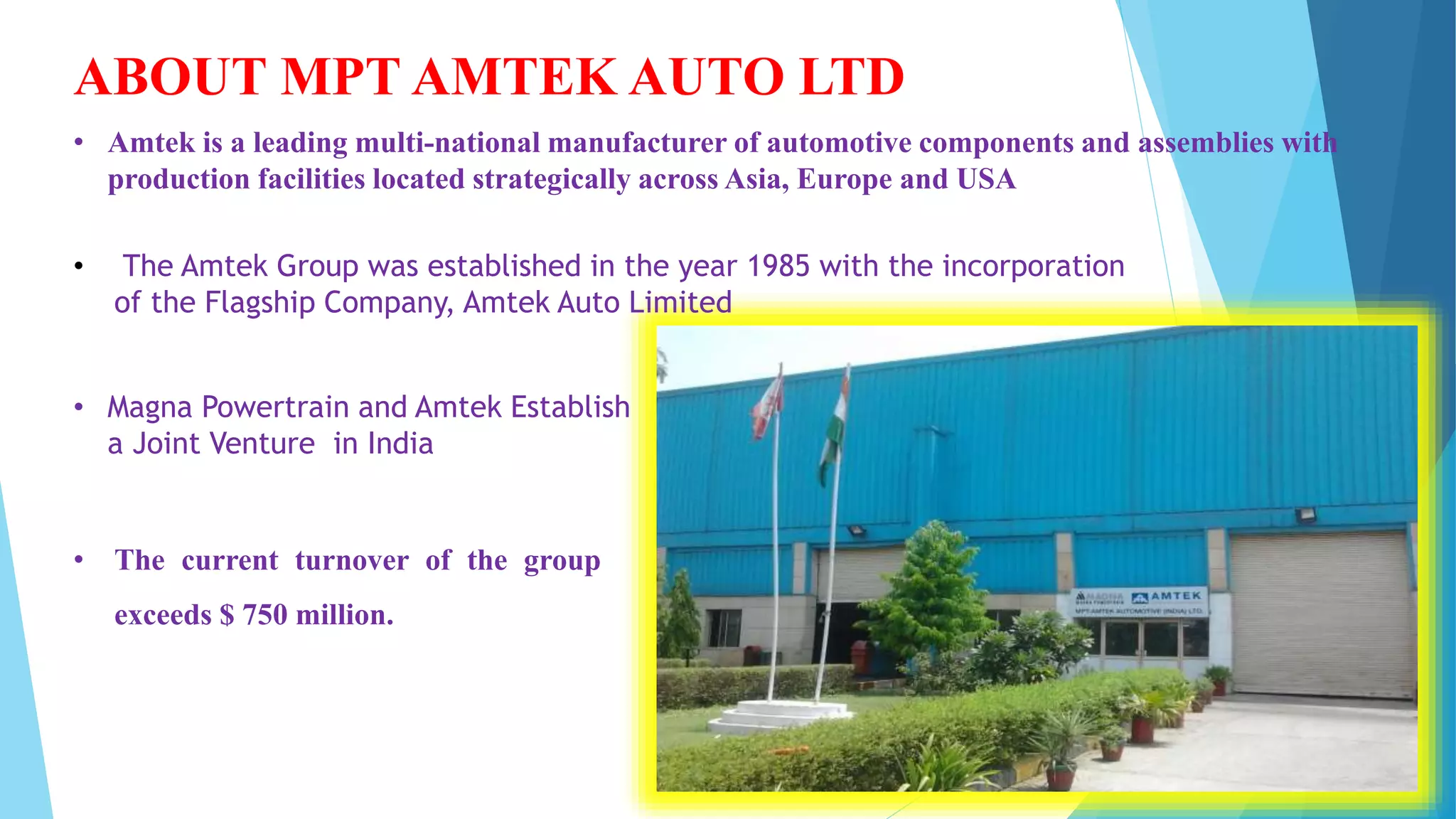
• Magna Powertrain and Amtek Establish
a Joint Venture in India
• The Amtek Group was established in the year 1985 with the incorporation
of the Flagship Company, Amtek Auto Limited
• Amtek is a leading multi-national manufacturer of automotive components and assemblies with
production facilities located strategically across Asia, Europe and USA
• The current turnover of the group
exceeds $ 750 million.
ACHIEVEMENTS
Amtek Auto recently won the best investor of the year
award 2008 – UK Trade & Investment.
Adjudged ‘Best Performing Vendor 'Technology group
Machine Parts Maruti Suzuki (1994–95)
• TVS Motors Ltd to Amtek Bhopal(2002–03)
• Forging and Casting group from Honda Motor Cycles & Scooters India Ltd to Amtek
Bhopal (2005–06)
• Honda Motor Cycles Scooters India Ltd (2005–06 & 2006–07) to Amtek Bhopal
Won ‘Supplier of the Year’ Award
• Prestigious ‘ET– Best Emerging Company of the Year 2006’ at ‘The Economic Times
Awards For Corporate Excellence’
Declared ‘ET– Best Emerging Company of the Year’
MANUFACTURING PLANTS
Technology and Transcends Boundaries
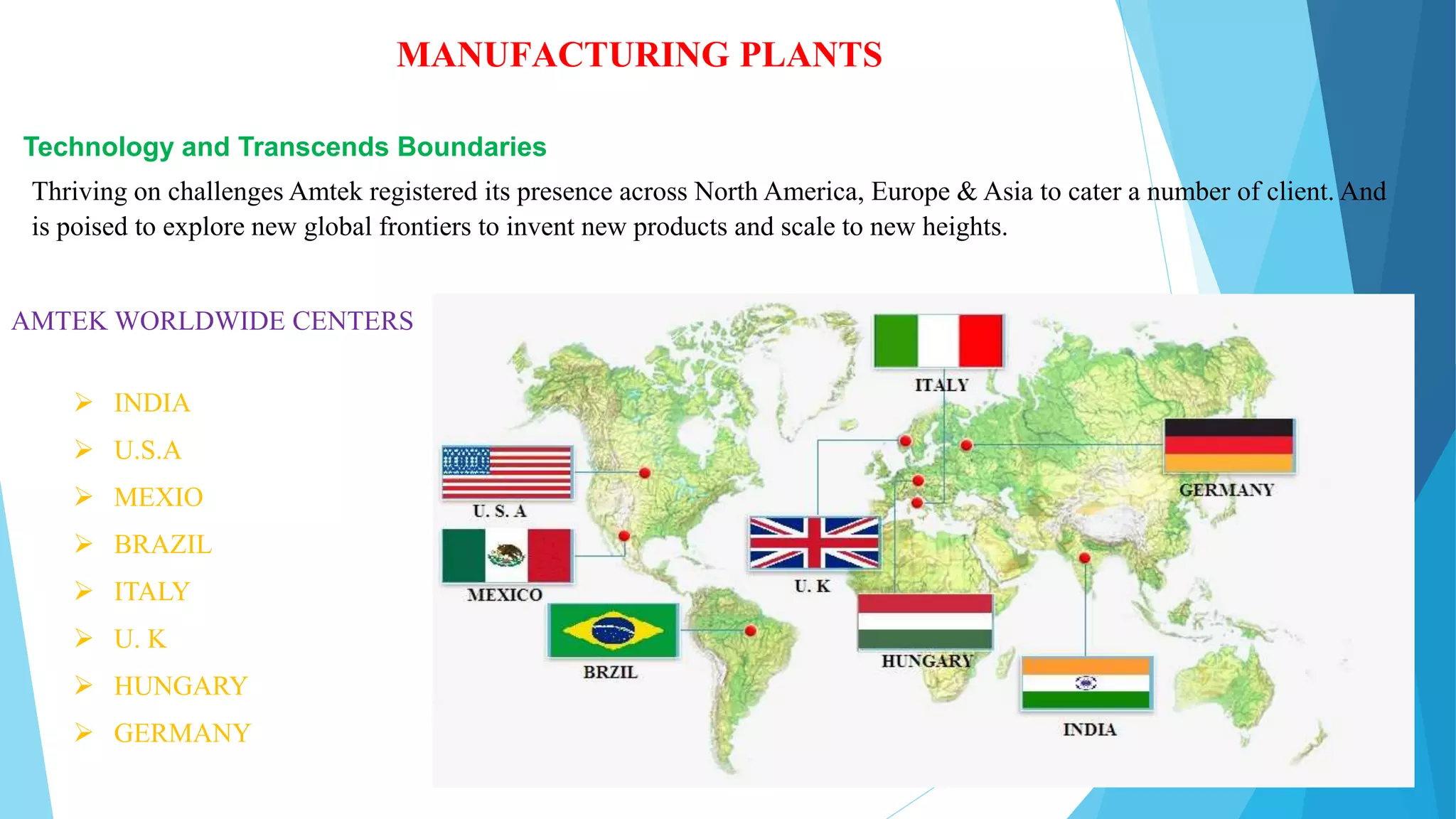
Thriving on challenges Amtek registered its presence across North America, Europe & Asia to cater a number of client. And
is poised to explore new global frontiers to invent new products and scale to new heights.
AMTEK WORLDWIDE CENTERS
 INDIA
 U.S.A
 MEXIO
 BRAZIL
 ITALY
 U. K
 HUNGARY
 GERMANY
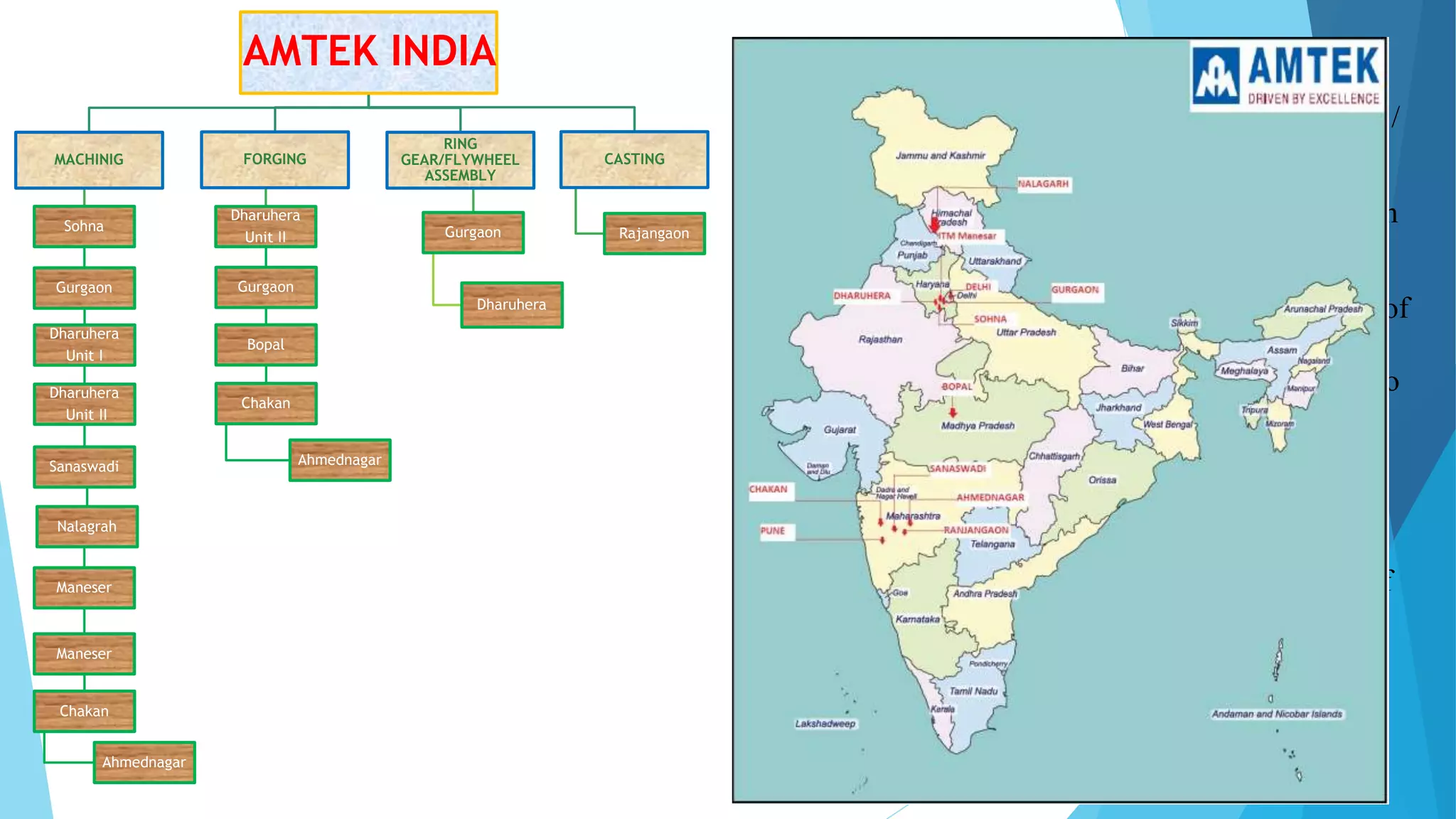
AMTEK INDIA
RING
GEAR/FLYWHEEL
ASSEMBLY
Gurgaon
Dharuhera
CASTING
Rajangaon
FORGING
Dharuhera
Unit II
Gurgaon
Bopal
Chakan
Ahmednagar
MACHINIG
Sohna
Gurgaon
Dharuhera
Unit I
Dharuhera
Unit II
Sanaswadi
Nalagrah
Maneser
Maneser
Chakan
Ahmednagar
 FORGING is the process of forming hot /
cold metal
 CASTING is the process of forming from
molten metal.
 MACHINING is the term used for a set of
metal – cutting processes which are
performed on Forgings and / or Castings to
give them the exact shape and size for
assembling in the vehicle
 ASSEMBLY is the processes making a
product by the combination attachment of
different elements
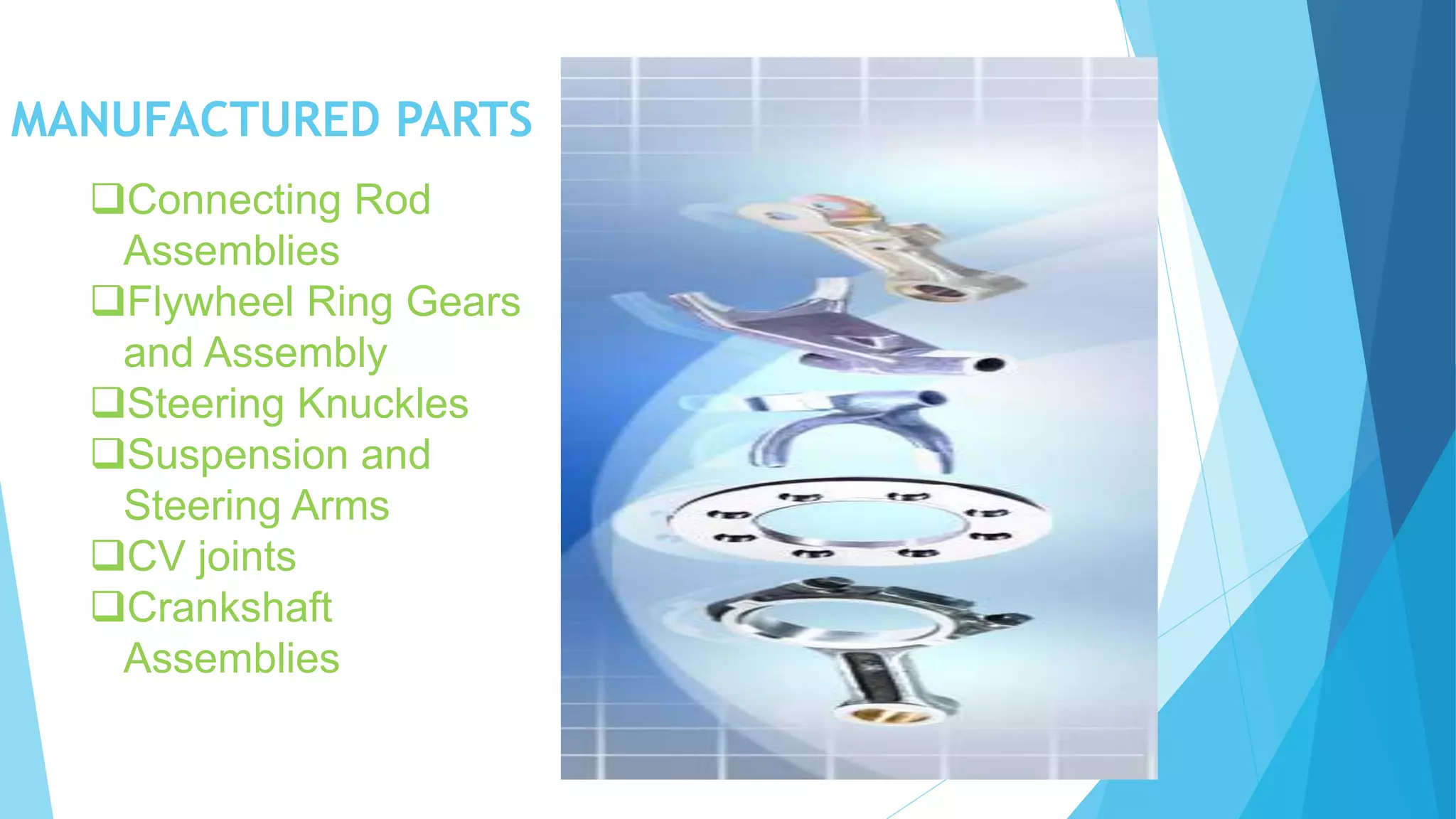
MANUFACTURED PARTS
Connecting Rod
Assemblies
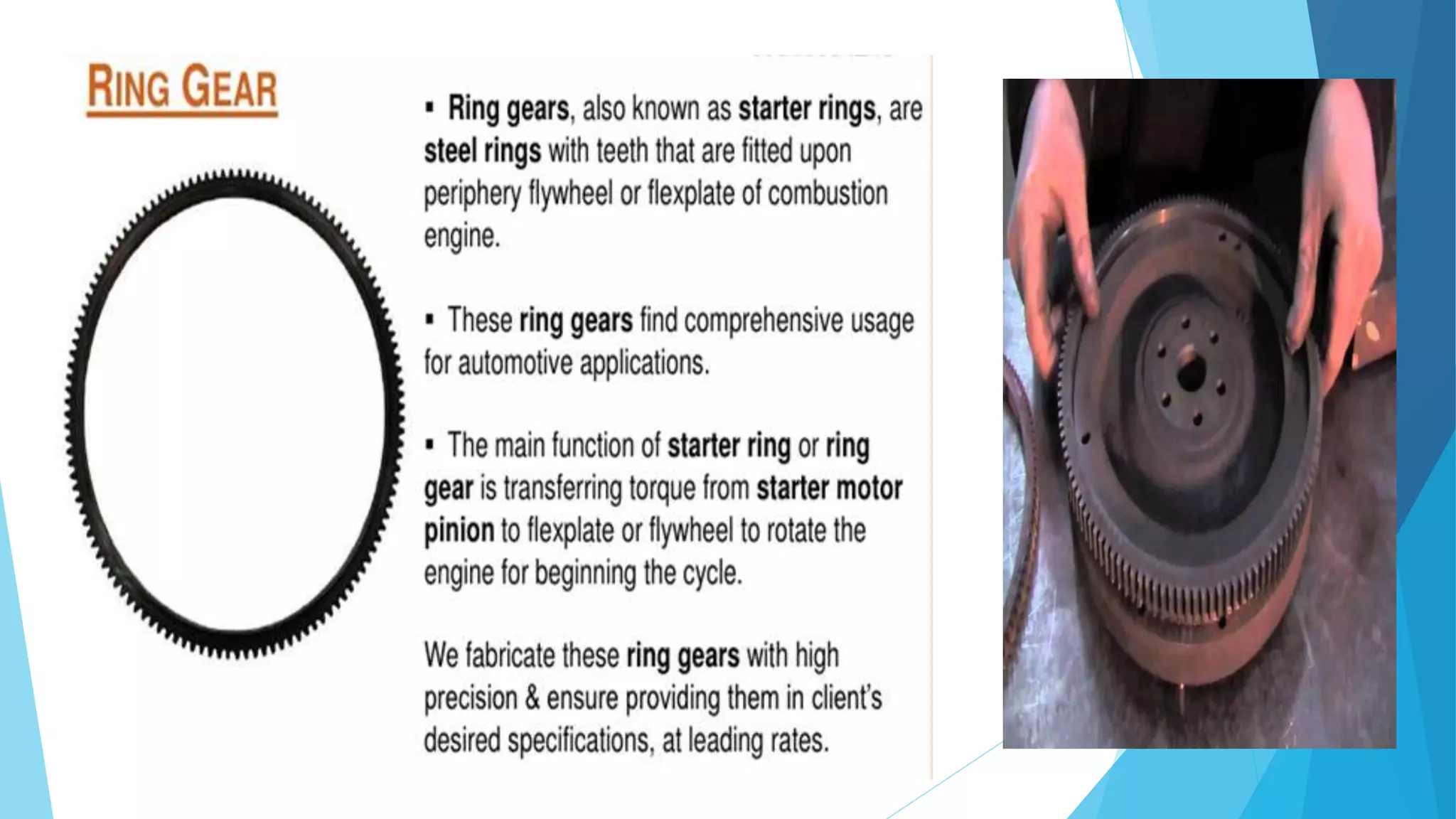
Flywheel Ring Gears
and Assembly
Steering Knuckles
Suspension and
Steering Arms
CV joints
Crankshaft
Assemblies
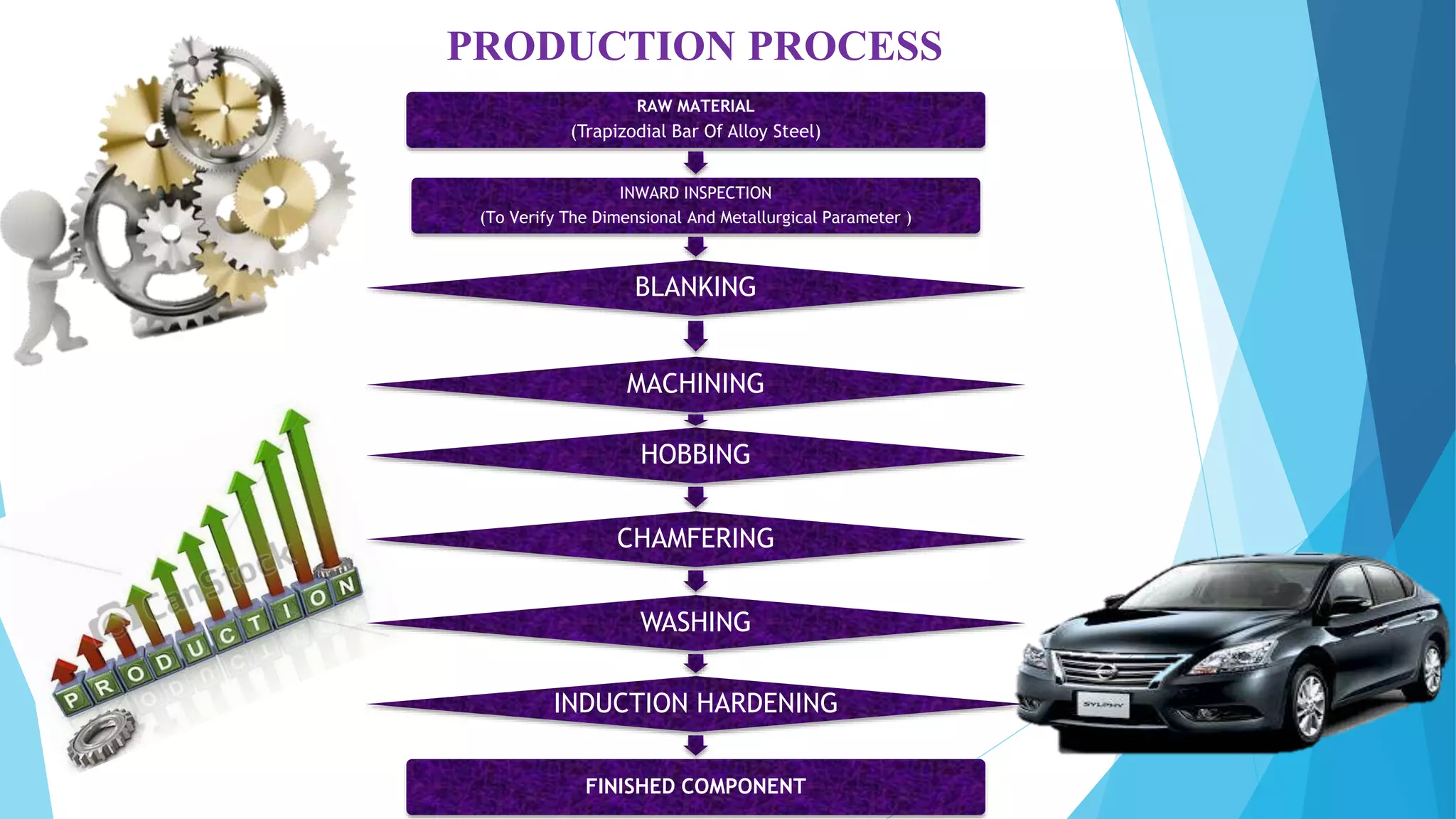
PRODUCTION PROCESS
RAW MATERIAL
(Trapizodial Bar Of Alloy Steel)
INWARD INSPECTION
(To Verify The Dimensional And Metallurgical Parameter )
BLANKING
MACHINING
HOBBING
CHAMFERING
WASHING
INDUCTION HARDENING
FINISHED COMPONENT
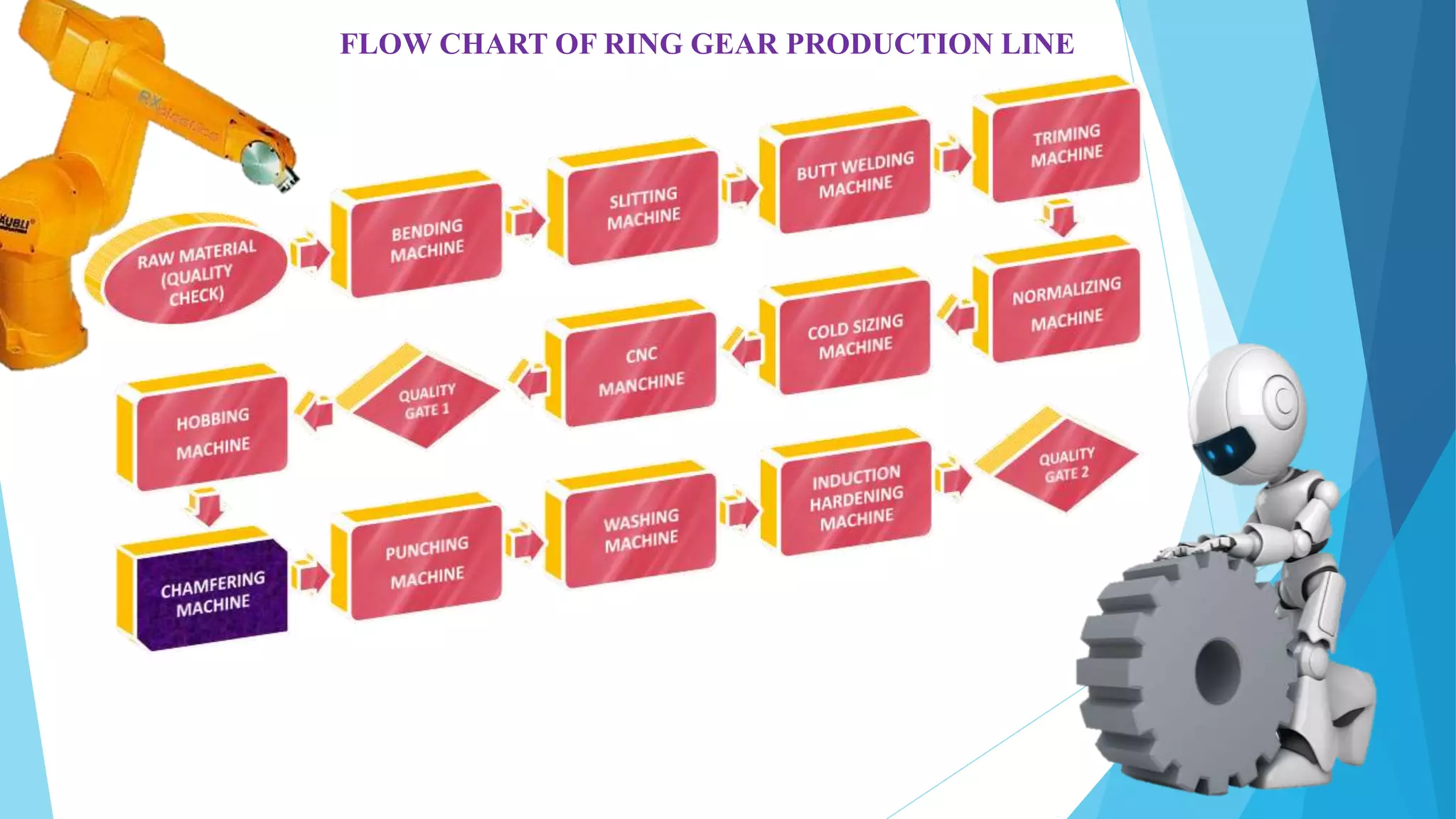
FLOW CHART OF RING GEAR PRODUCTION LINE
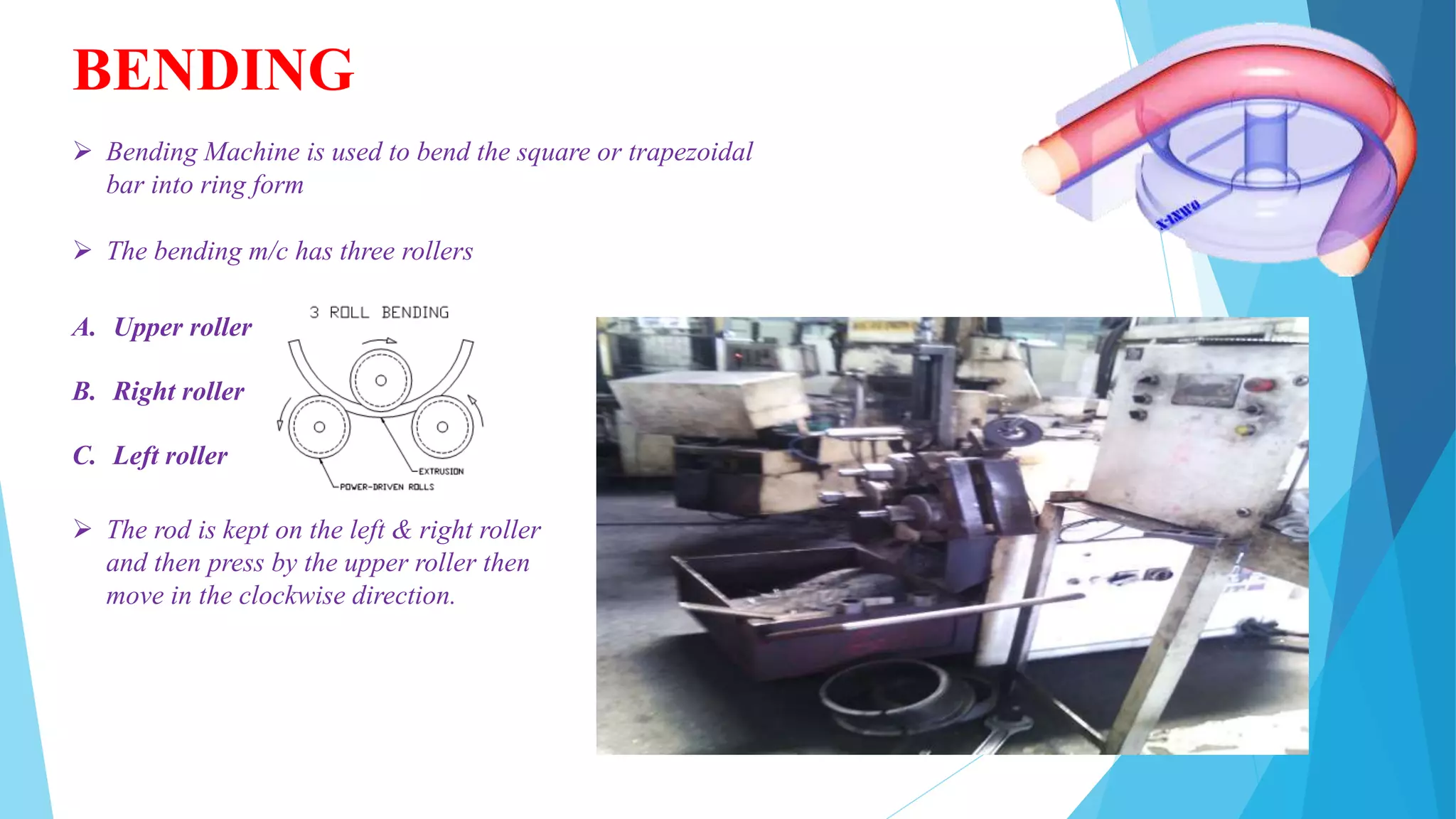
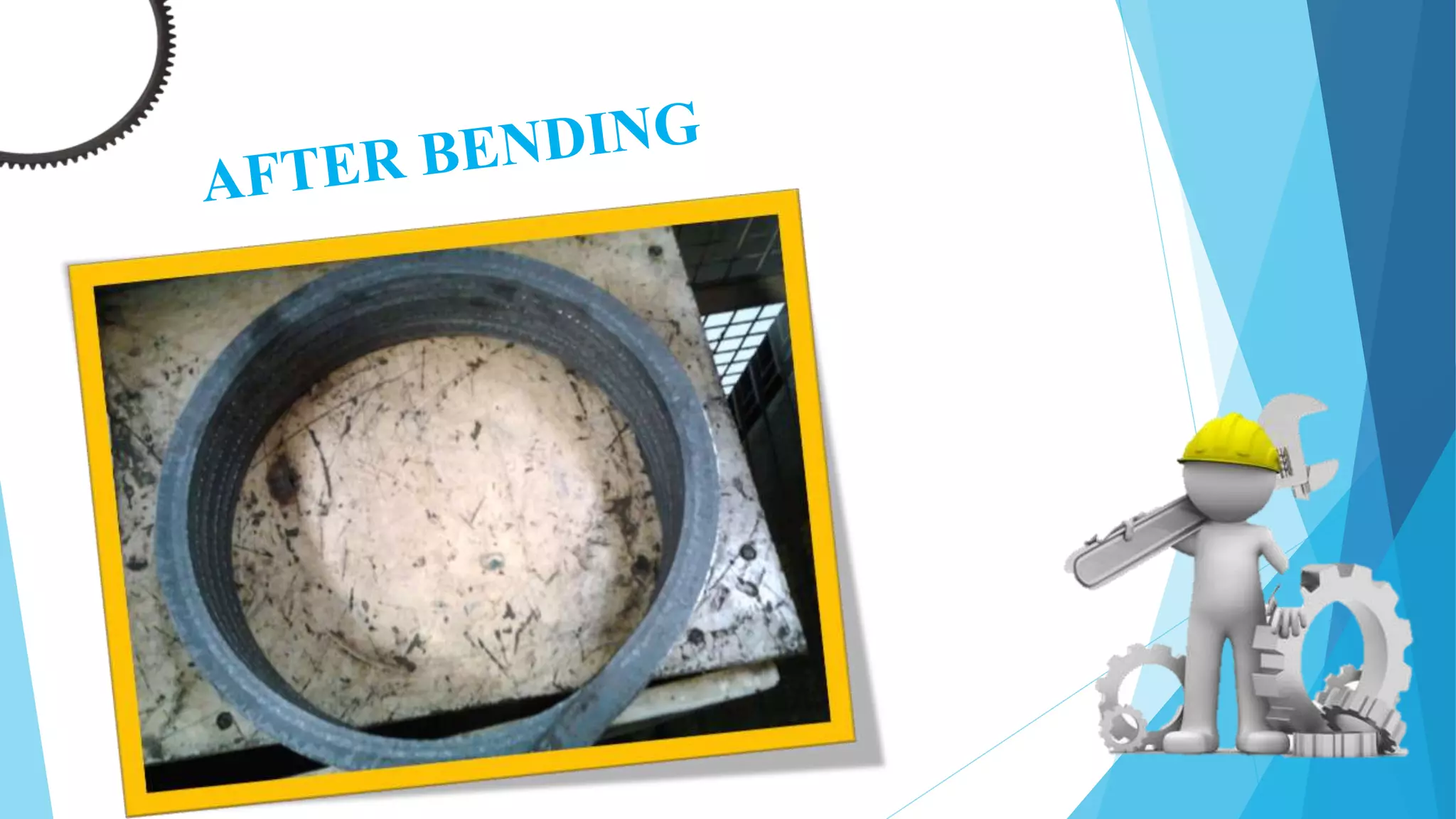
BENDING
 Bending Machine is used to bend the square or trapezoidal
bar into ring form
 The bending m/c has three rollers
A. Upper roller
B. Right roller
C. Left roller
 The rod is kept on the left & right roller
and then press by the upper roller then
move in the clockwise direction.
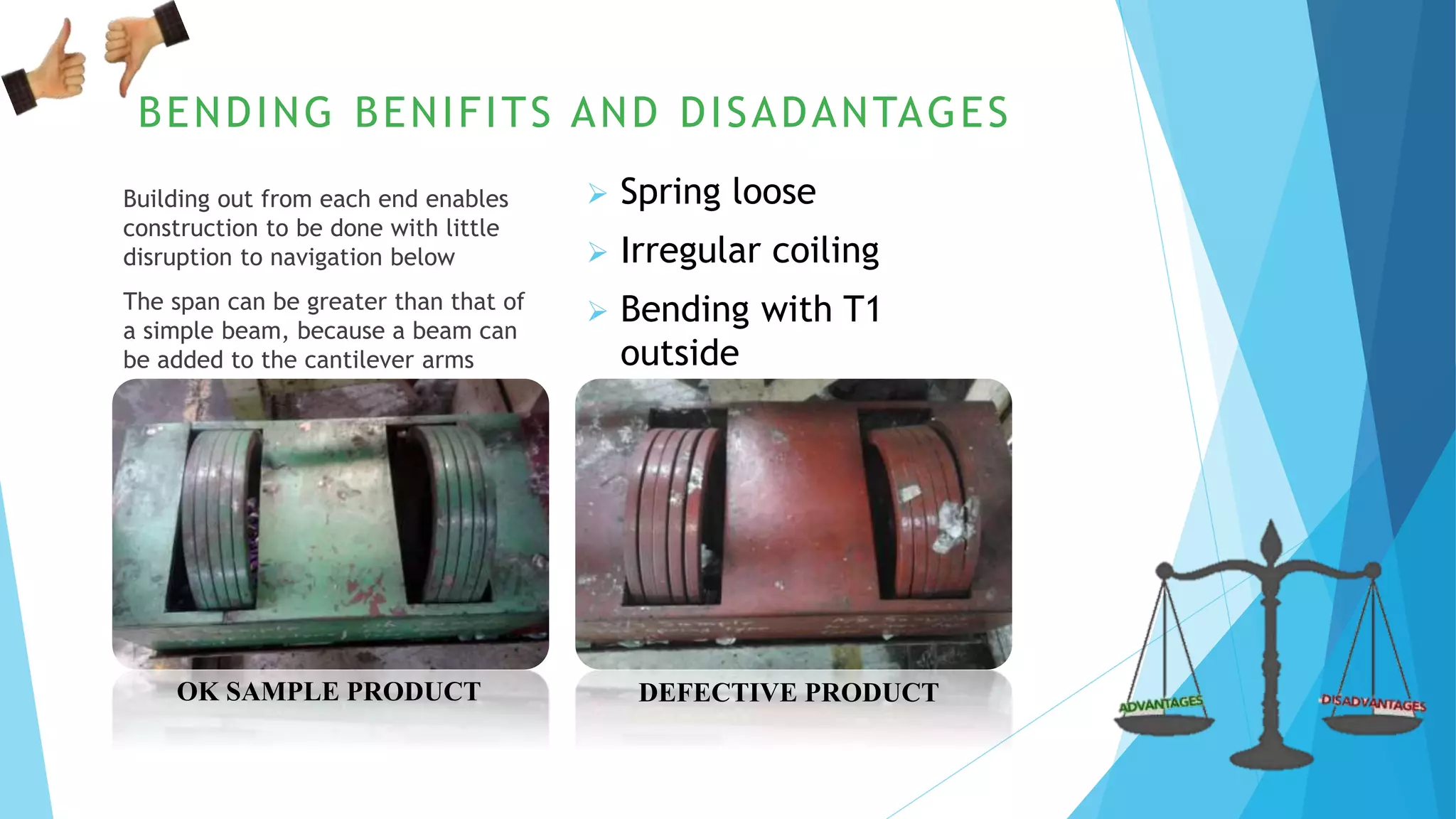
BENDING BENIFITS AND DISADANTAGES
Building out from each end enables
construction to be done with little
disruption to navigation below
The span can be greater than that of
a simple beam, because a beam can
be added to the cantilever arms
 Spring loose
 Irregular coiling
 Bending with T1
outside
OK SAMPLE PRODUCT DEFECTIVE PRODUCT
SLITTING
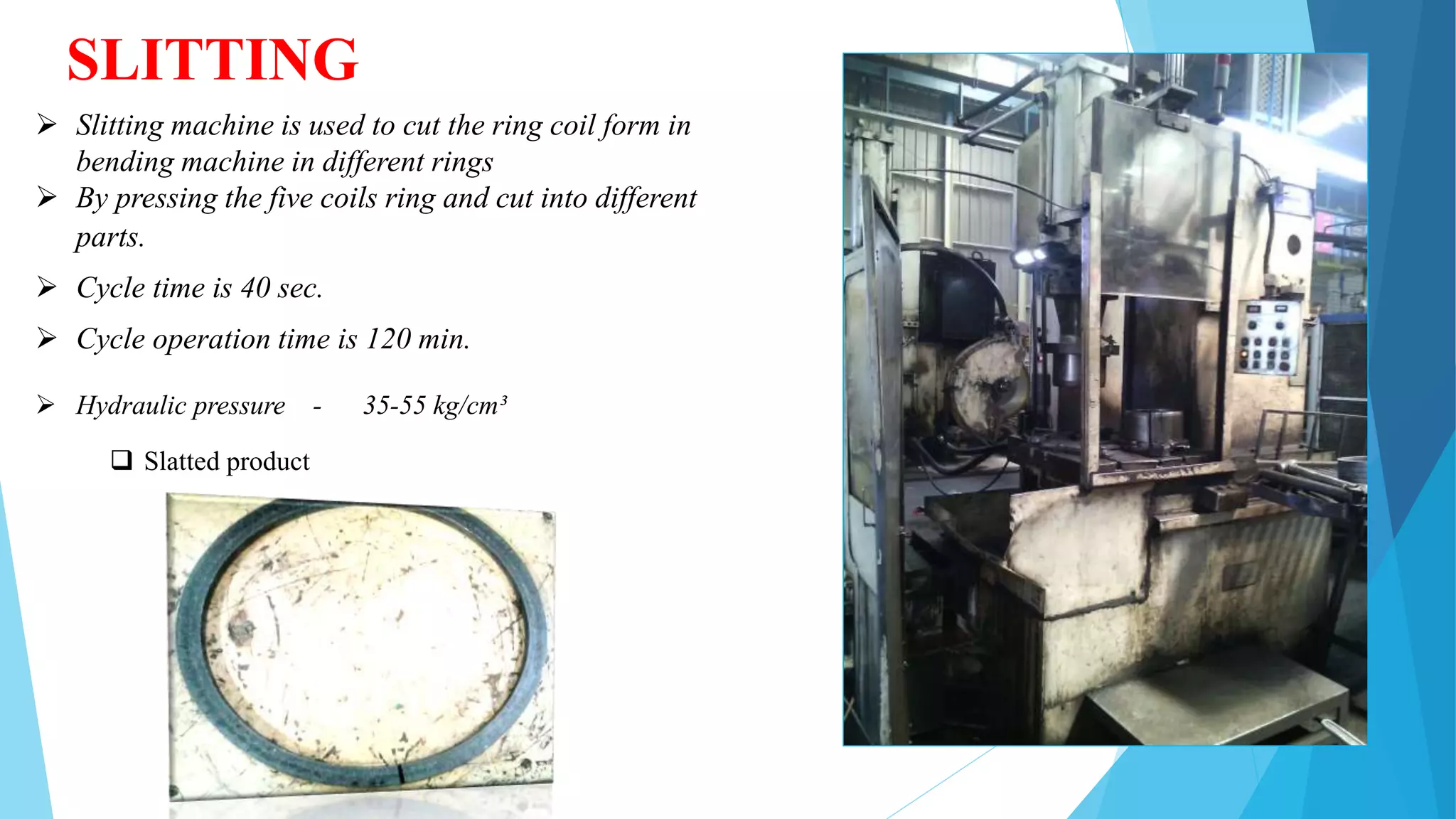
 Slitting machine is used to cut the ring coil form in
bending machine in different rings
 By pressing the five coils ring and cut into different
parts.
 Cycle time is 40 sec.
 Cycle operation time is 120 min.
 Hydraulic pressure - 35-55 kg/cm³
 Slatted product
FLASH BUTT WELDING & TRIMMING
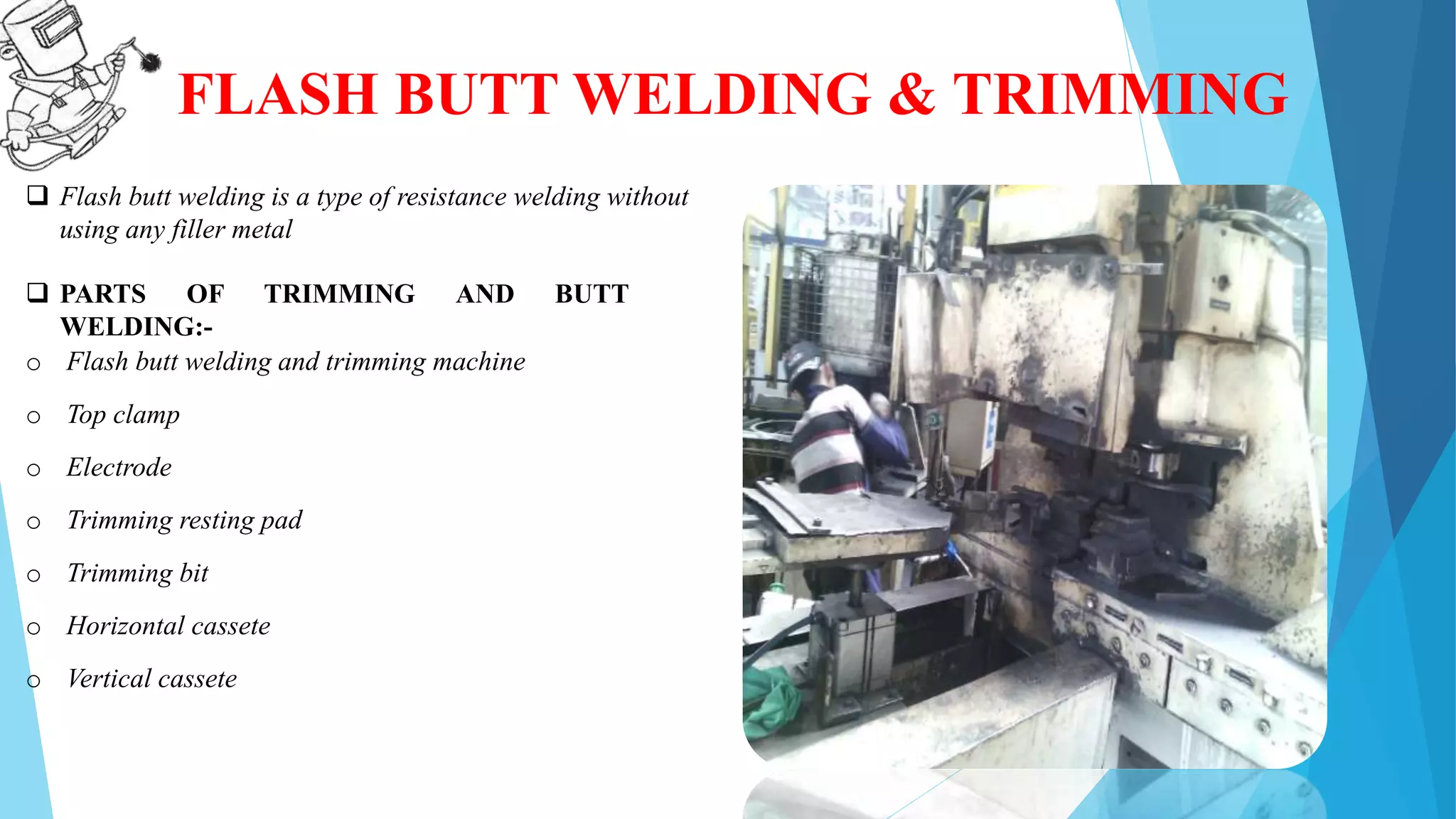
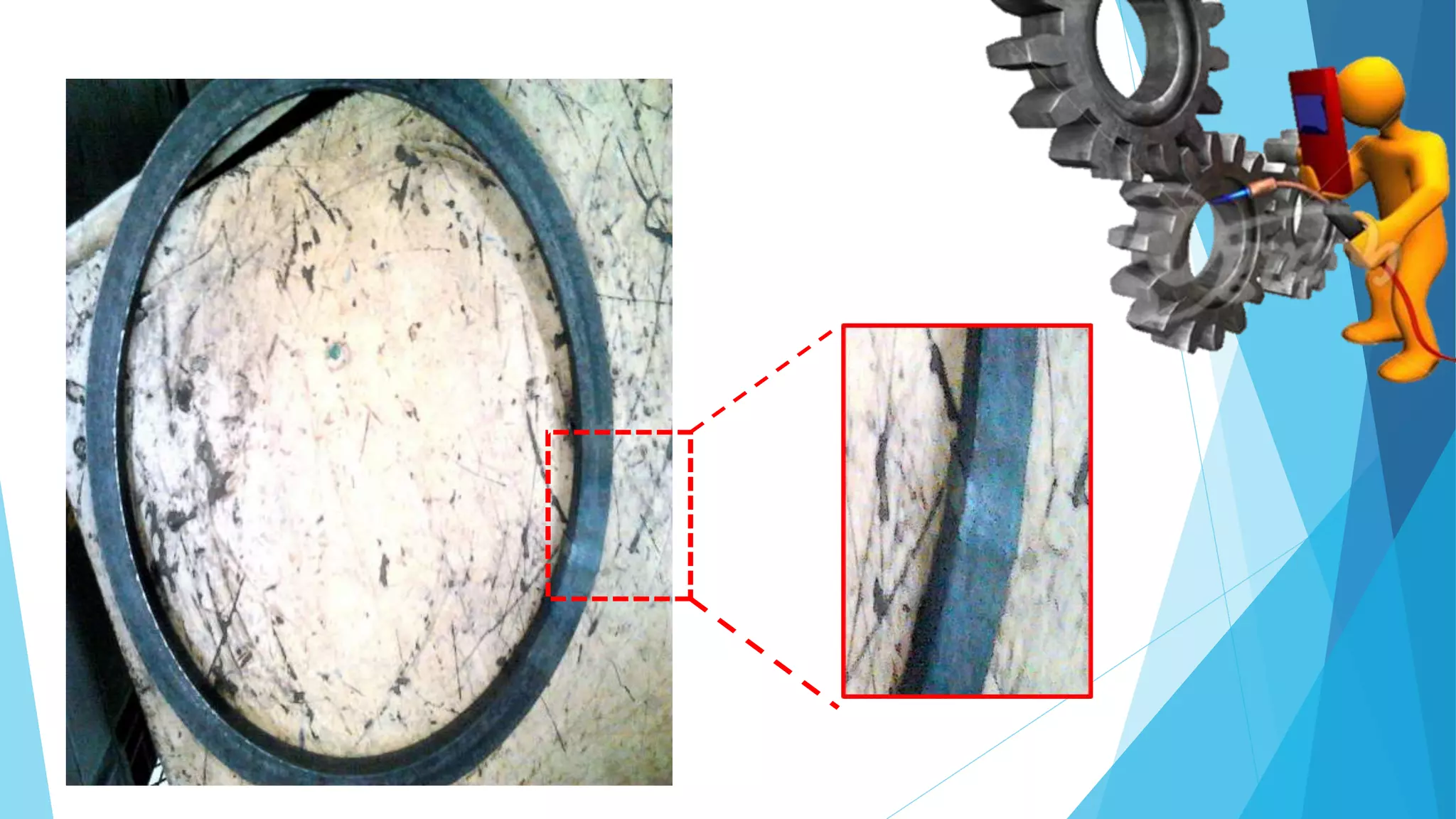
 Flash butt welding is a type of resistance welding without
using any filler metal
 PARTS OF TRIMMING AND BUTT
WELDING:-
o Flash butt welding and trimming machine
o Top clamp
o Electrode
o Trimming resting pad
o Trimming bit
o Horizontal cassete
o Vertical cassete
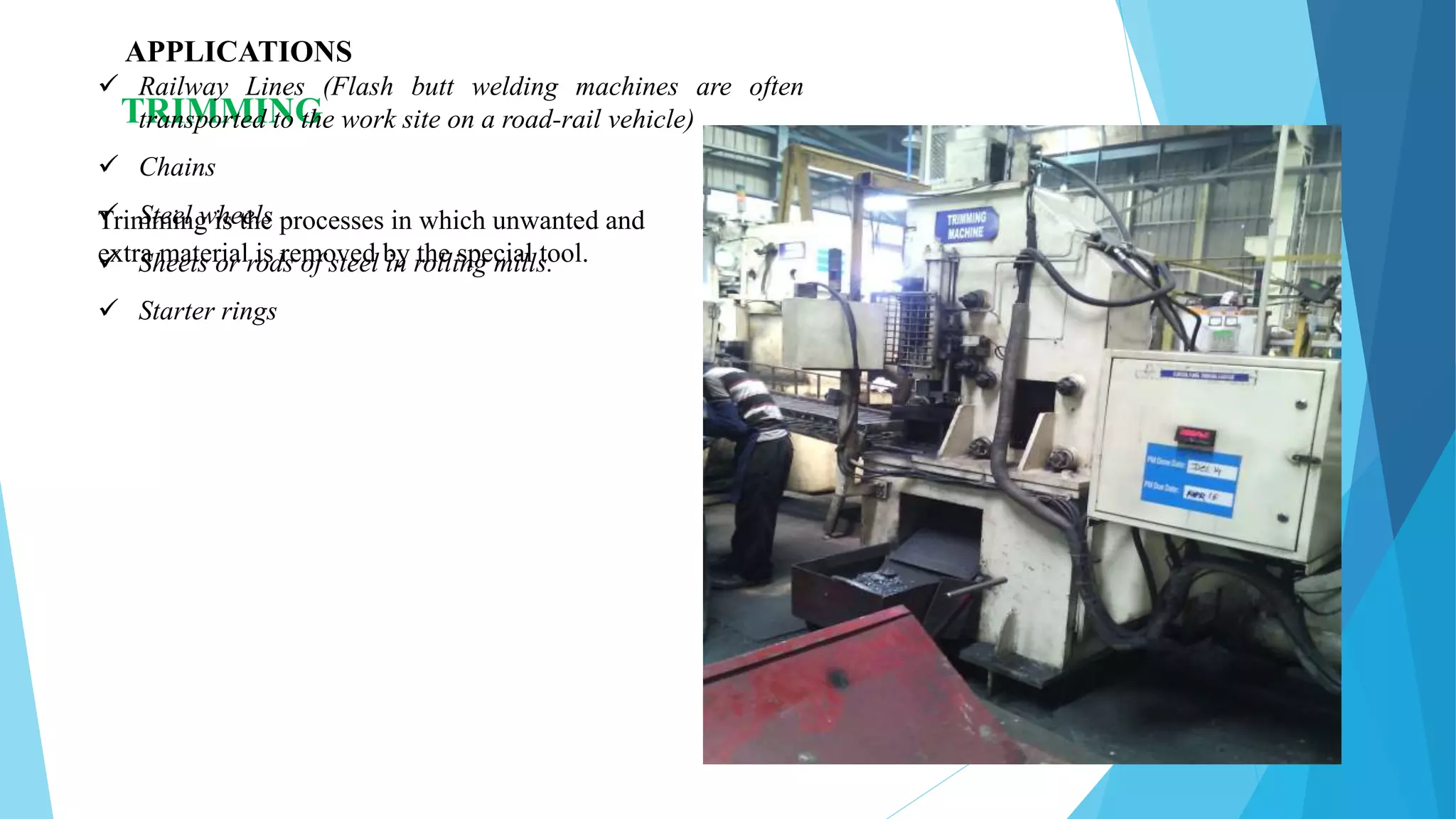
Trimming is the processes in which unwanted and
extra material is removed by the special tool.
TRIMMING
APPLICATIONS
 Railway Lines (Flash butt welding machines are often
transported to the work site on a road-rail vehicle)
 Chains
 Steel wheels
 Sheets or rods of steel in rolling mills.
 Starter rings
NORMALIZING
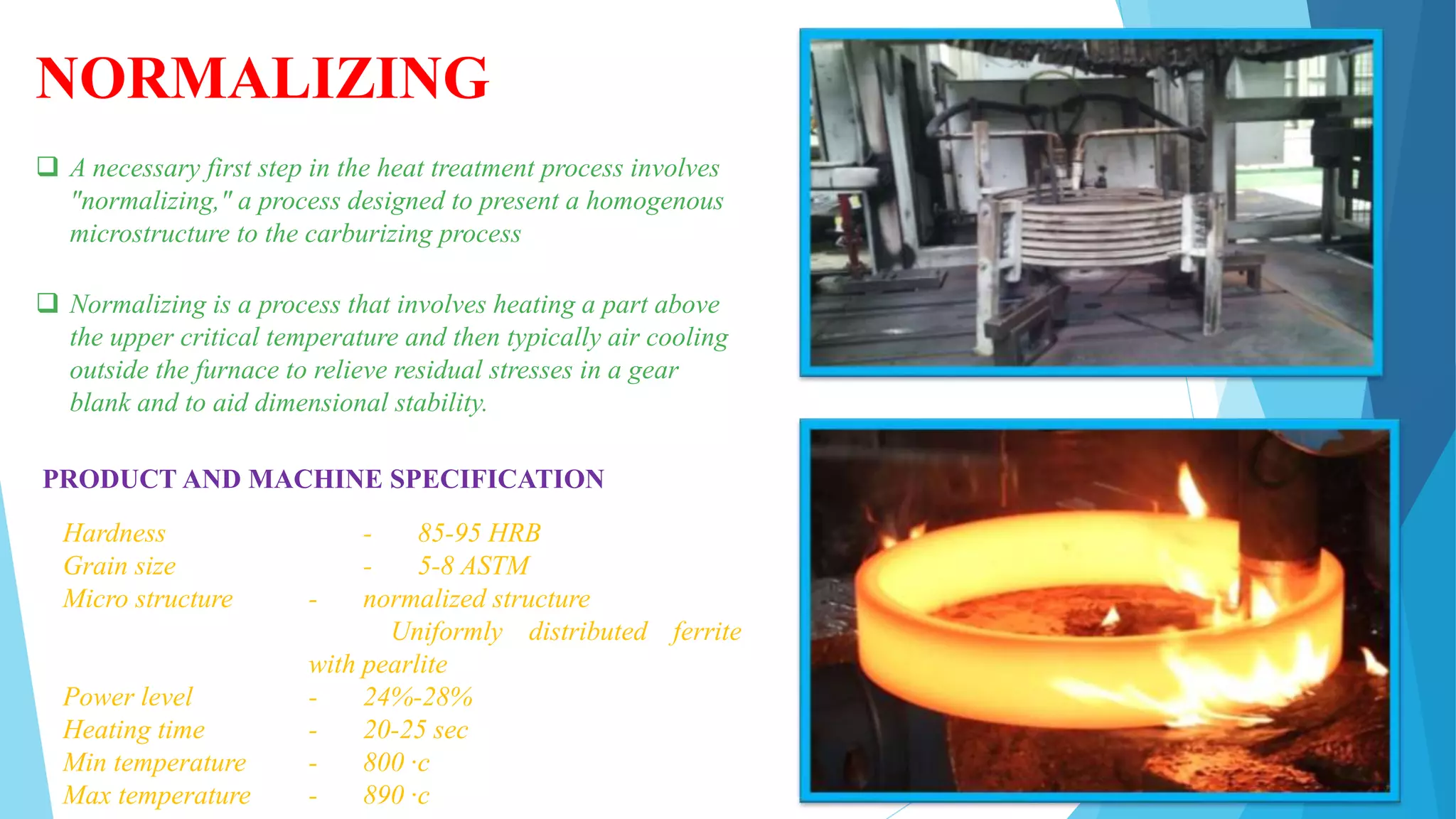
 A necessary first step in the heat treatment process involves
"normalizing," a process designed to present a homogenous
microstructure to the carburizing process
 Normalizing is a process that involves heating a part above
the upper critical temperature and then typically air cooling
outside the furnace to relieve residual stresses in a gear
blank and to aid dimensional stability.
PRODUCT AND MACHINE SPECIFICATION
Hardness - 85-95 HRB
Grain size - 5-8 ASTM
Micro structure - normalized structure
Uniformly distributed ferrite
with pearlite
Power level - 24%-28%
Heating time - 20-25 sec
Min temperature - 800 ·c
Max temperature - 890 ·c
COLD SIZING
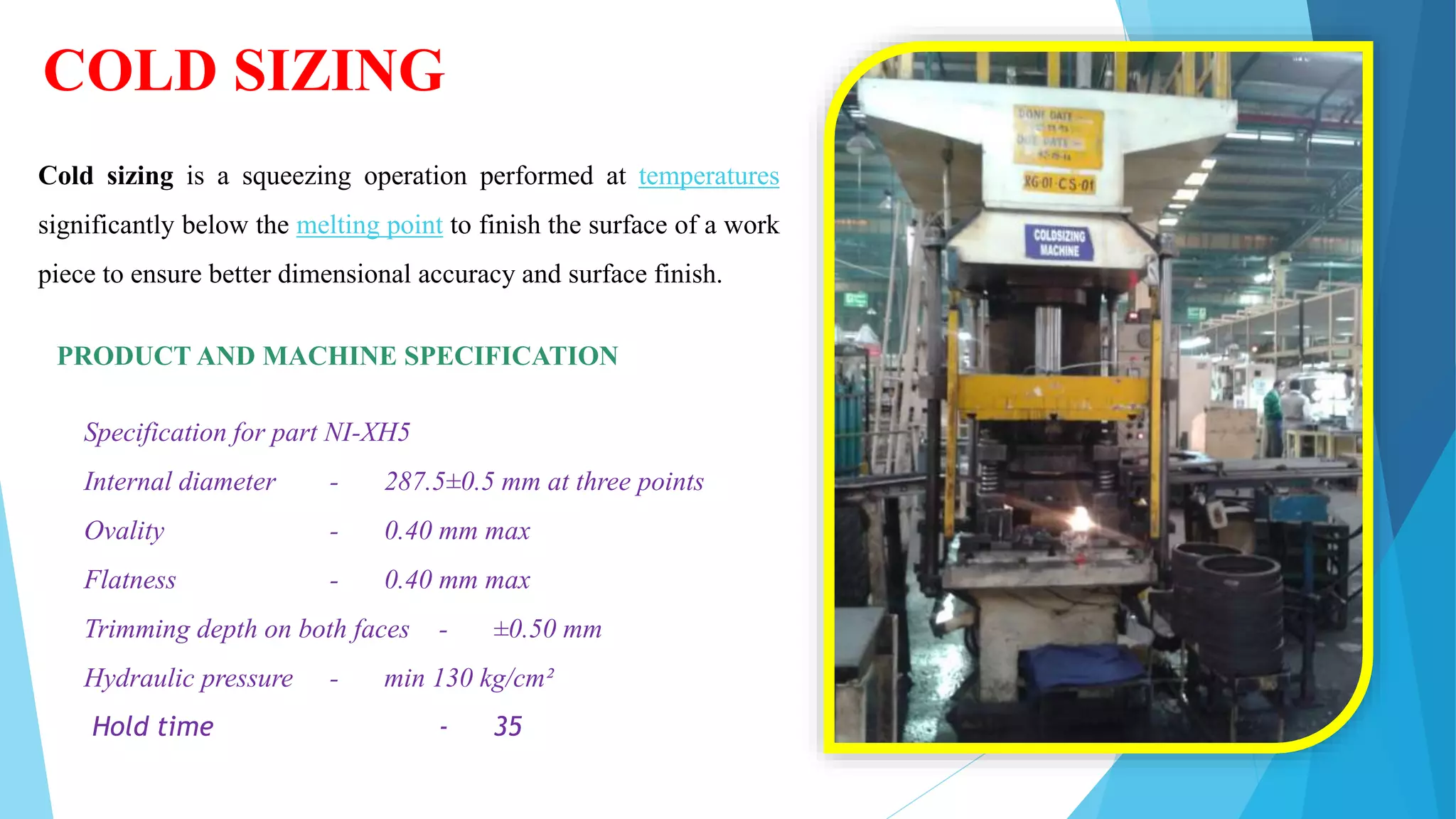
Cold sizing is a squeezing operation performed at temperatures
significantly below the melting point to finish the surface of a work
piece to ensure better dimensional accuracy and surface finish.
PRODUCT AND MACHINE SPECIFICATION
Specification for part NI-XH5
Internal diameter - 287.5±0.5 mm at three points
Ovality - 0.40 mm max
Flatness - 0.40 mm max
Trimming depth on both faces - ±0.50 mm
Hydraulic pressure - min 130 kg/cm²
Hold time - 35
CNC MACHINE
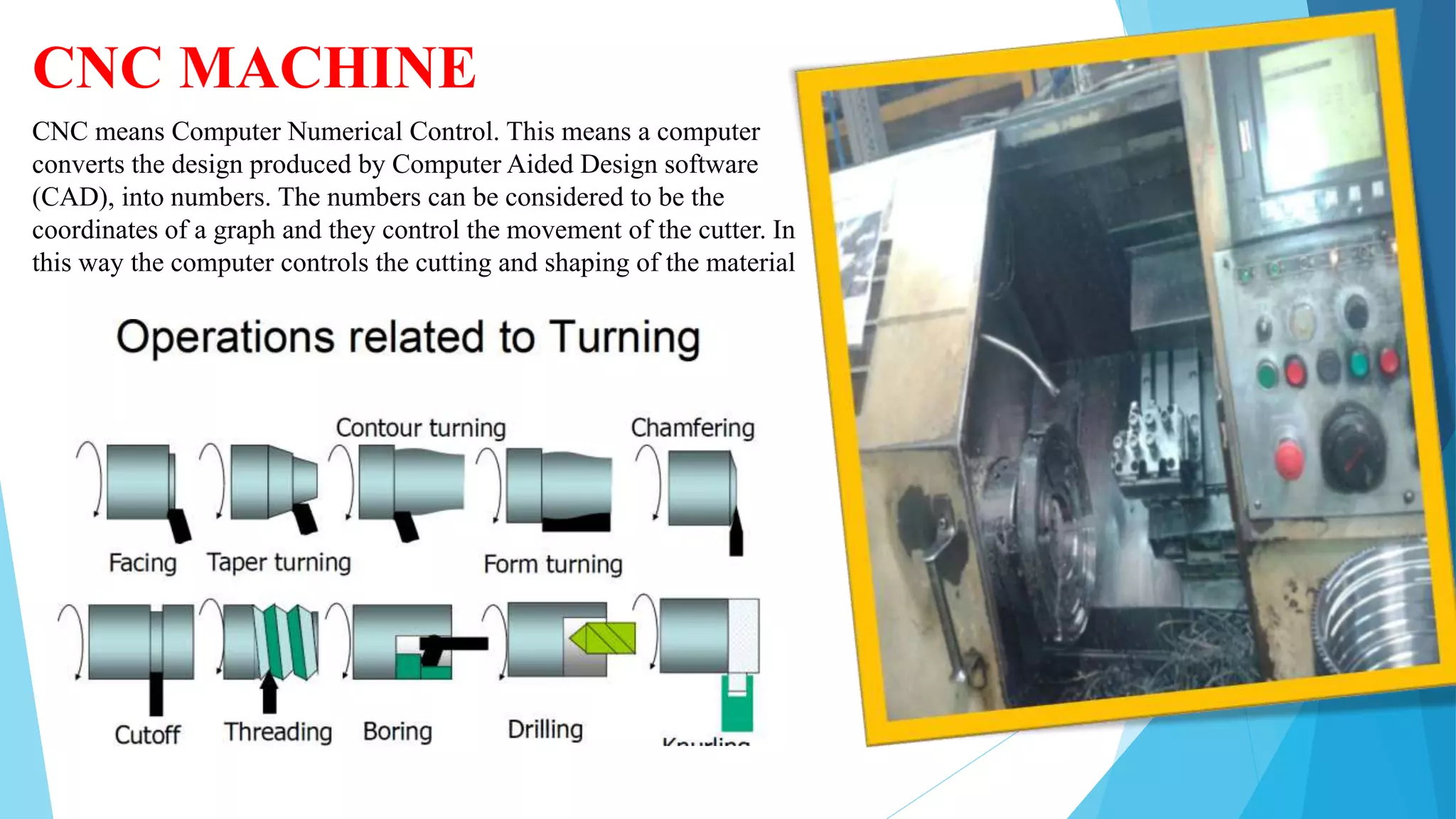
CNC means Computer Numerical Control. This means a computer
converts the design produced by Computer Aided Design software
(CAD), into numbers. The numbers can be considered to be the
coordinates of a graph and they control the movement of the cutter. In
this way the computer controls the cutting and shaping of the material
ADVANTAGES
CNC machines are programmed with a
design which can then be manufactured
hundreds or even thousands of times.
Each manufactured product will be
exactly the same.
CNC machines can be updated by
improving the software used to drive the
machines
Less skilled/trained people can operate
CNCs unlike manual lathes / milling
machines etc. which need skilled
engineers
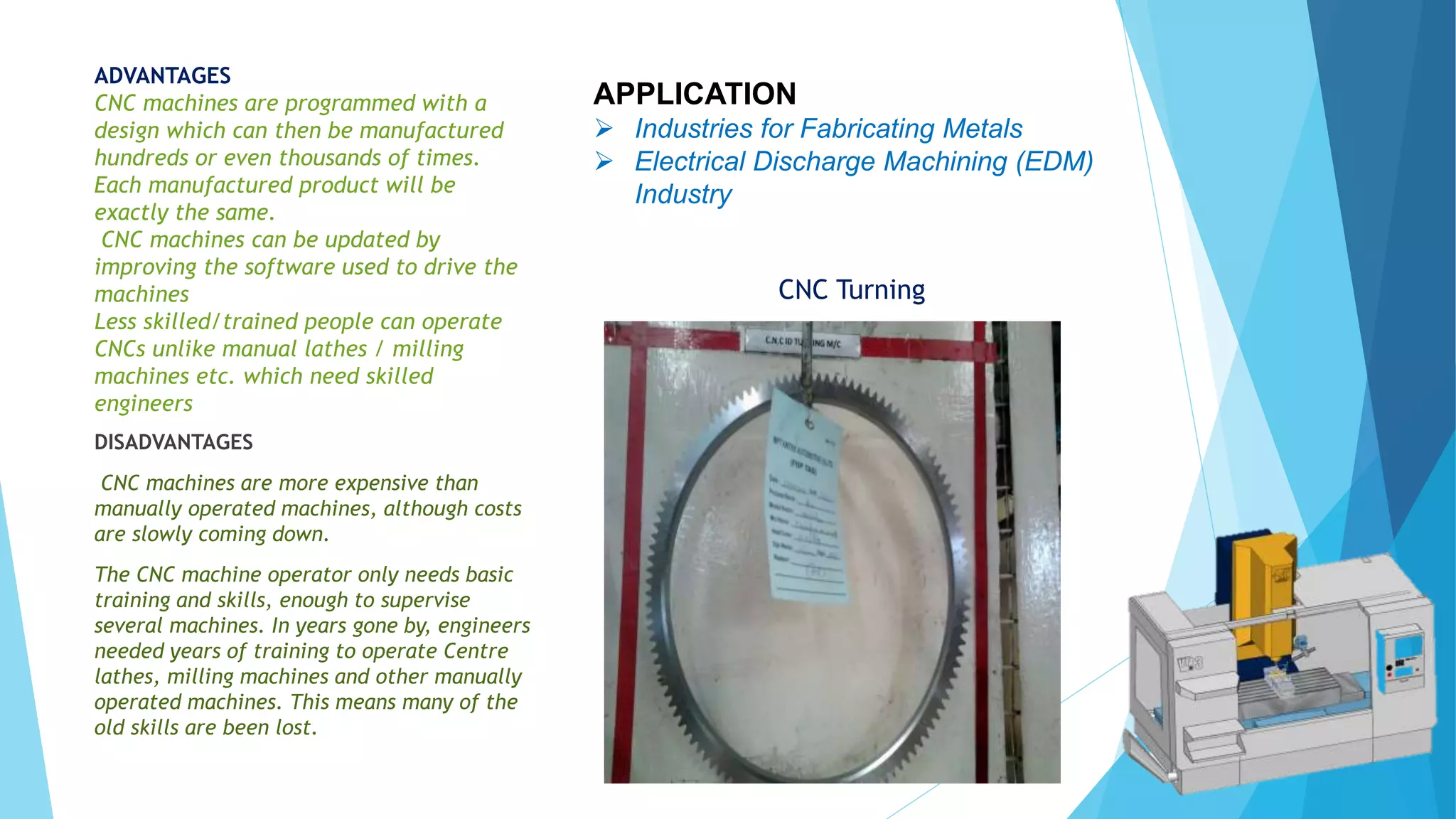
APPLICATION
 Industries for Fabricating Metals
 Electrical Discharge Machining (EDM)
Industry
CNC Turning
DISADVANTAGES
CNC machines are more expensive than
manually operated machines, although costs
are slowly coming down.
The CNC machine operator only needs basic
training and skills, enough to supervise
several machines. In years gone by, engineers
needed years of training to operate Centre
lathes, milling machines and other manually
operated machines. This means many of the
old skills are been lost.
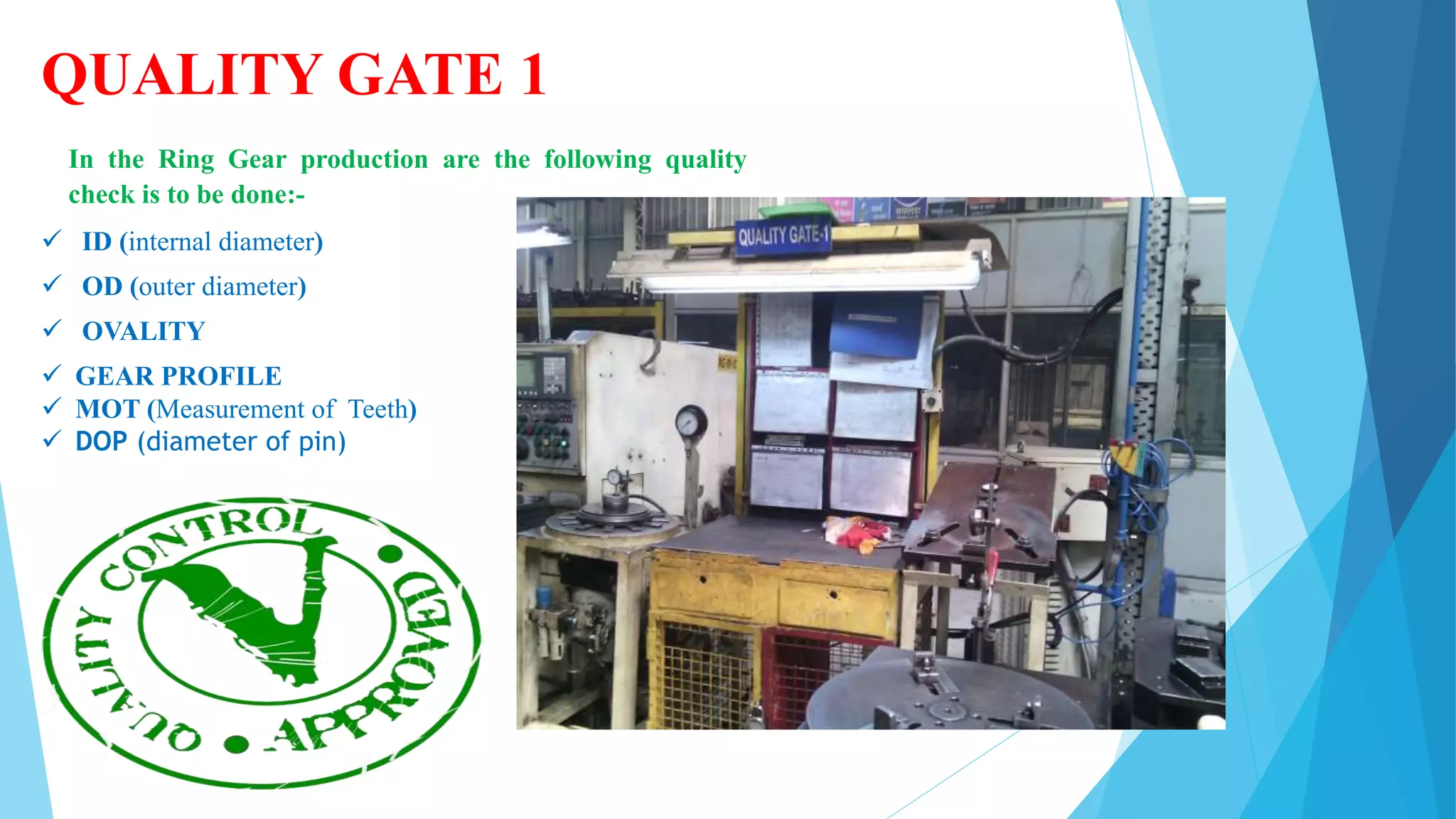
QUALITY GATE 1
In the Ring Gear production are the following quality
check is to be done:-
 ID (internal diameter)
 OD (outer diameter)
 OVALITY
 GEAR PROFILE
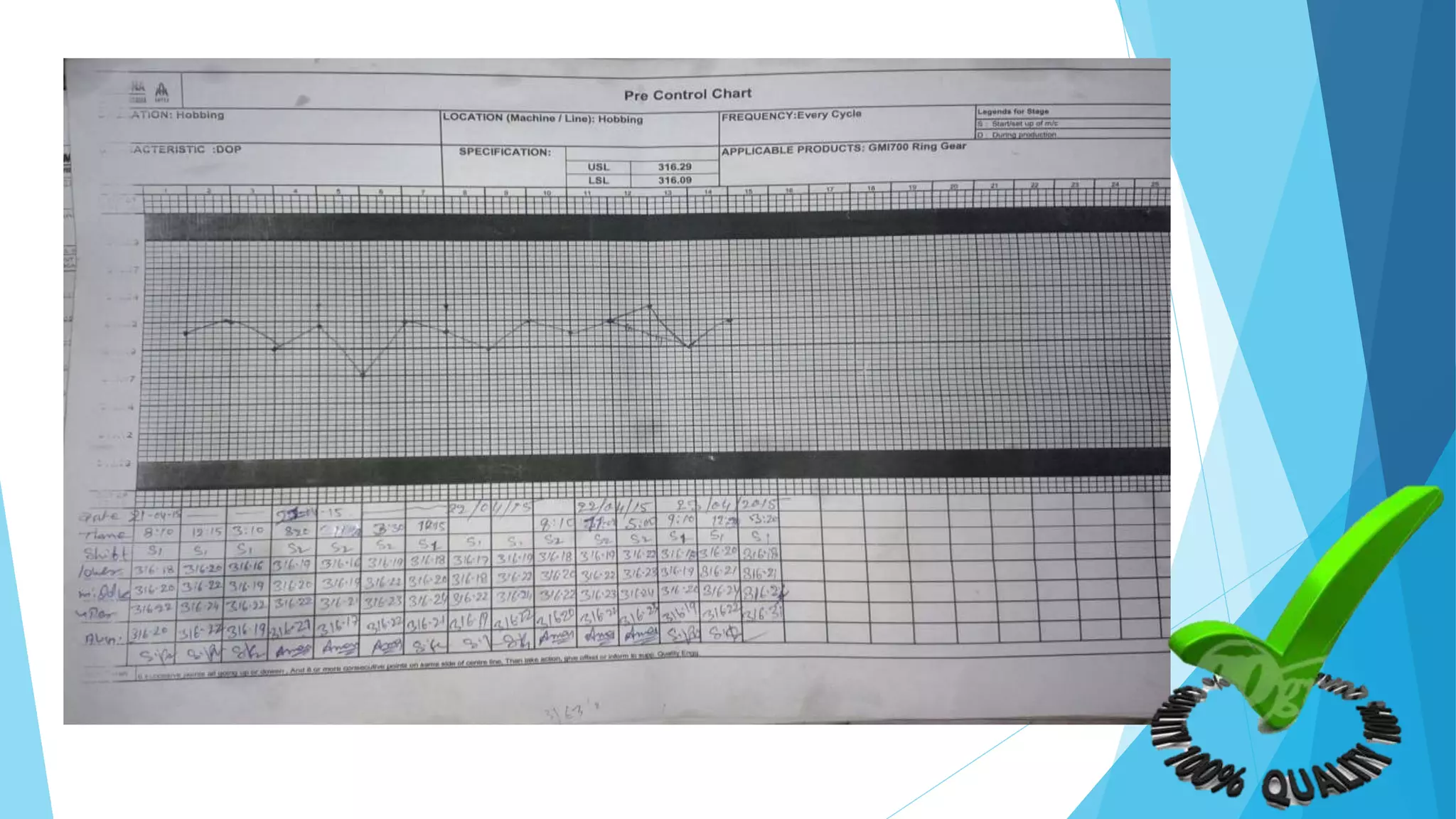
 MOT (Measurement of Teeth)
 DOP (diameter of pin)
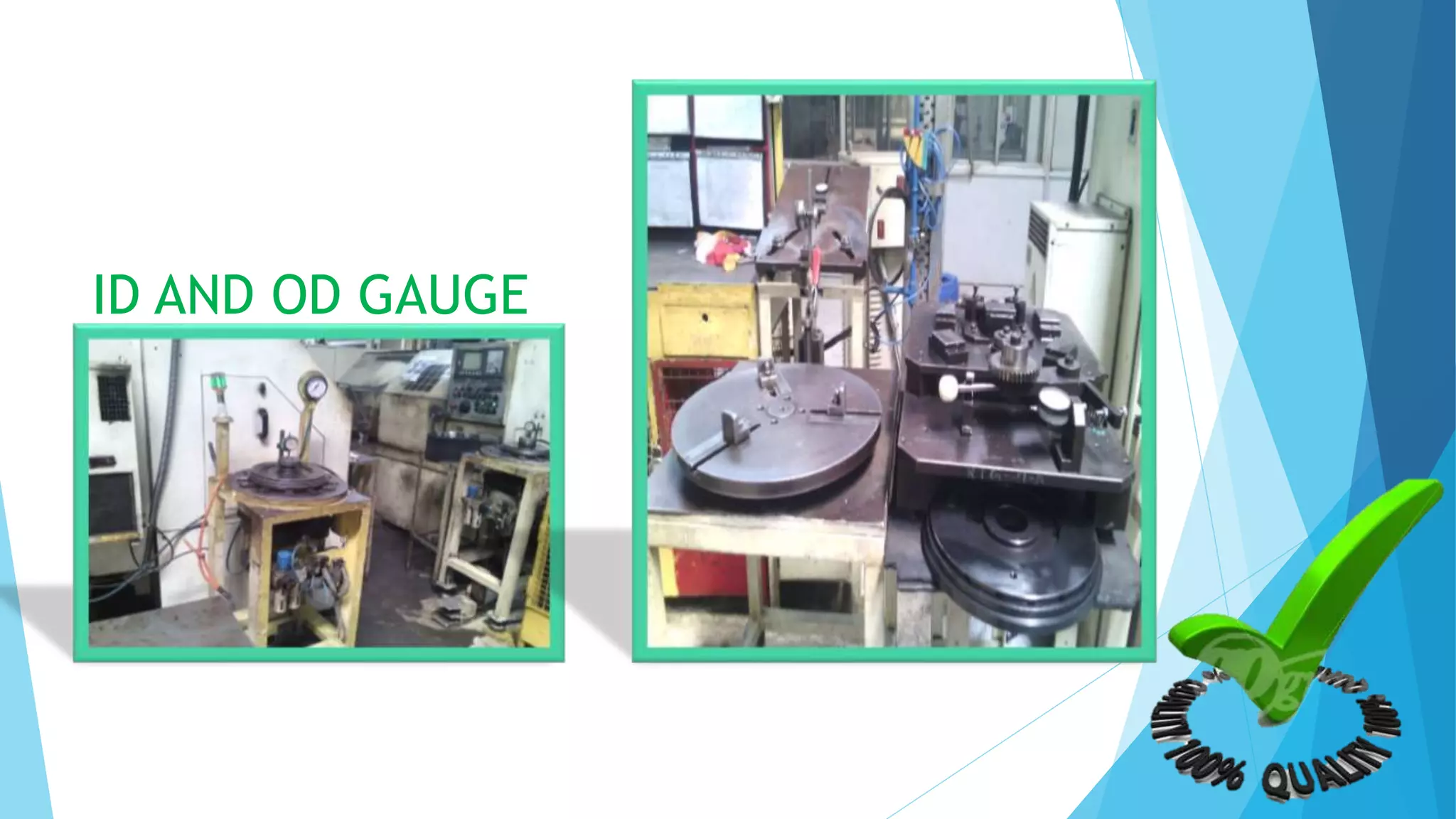
ID AND OD GAUGE
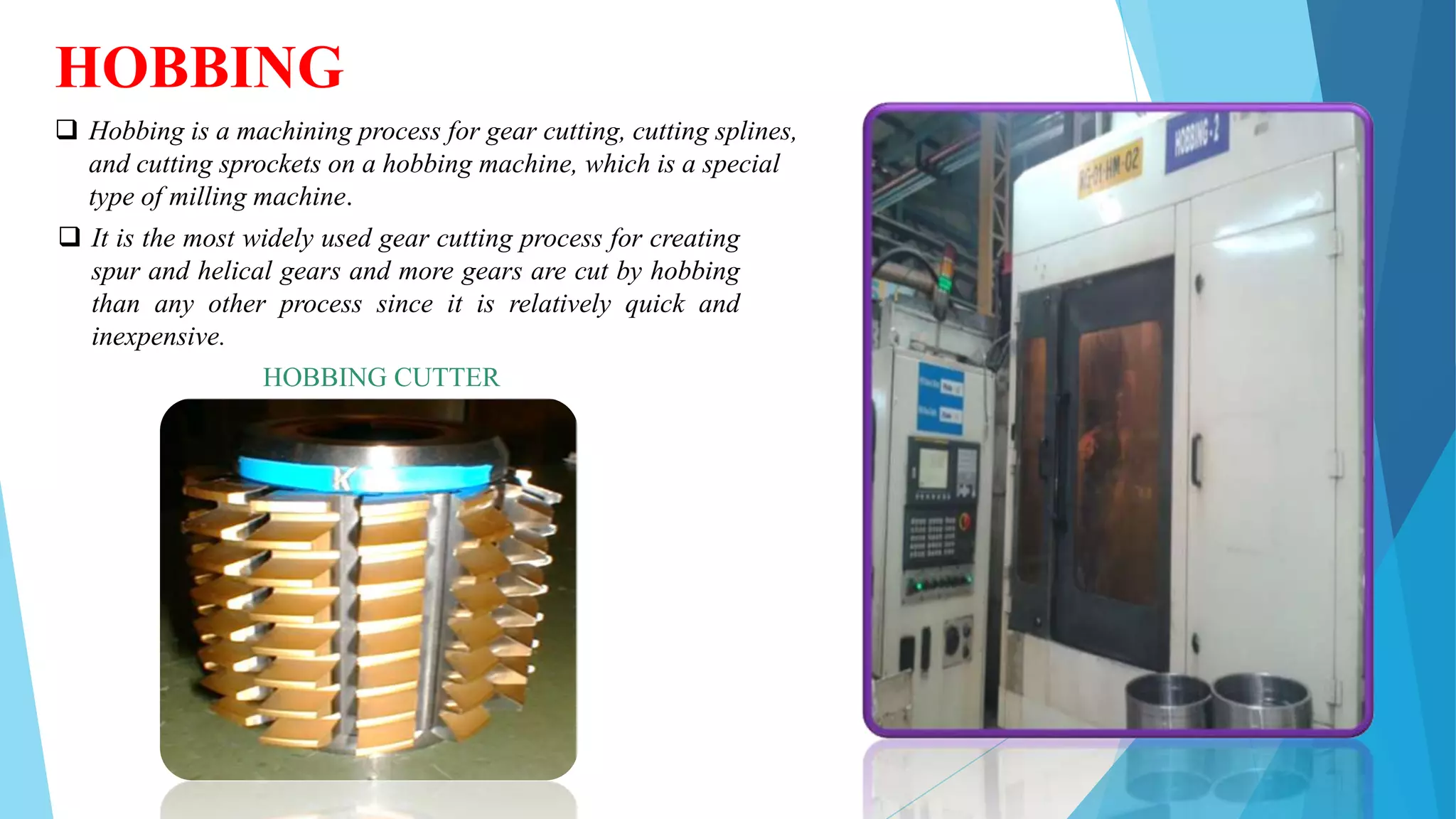
HOBBING
 Hobbing is a machining process for gear cutting, cutting splines,
and cutting sprockets on a hobbing machine, which is a special
type of milling machine.
 It is the most widely used gear cutting process for creating
spur and helical gears and more gears are cut by hobbing
than any other process since it is relatively quick and
inexpensive.
HOBBING CUTTER
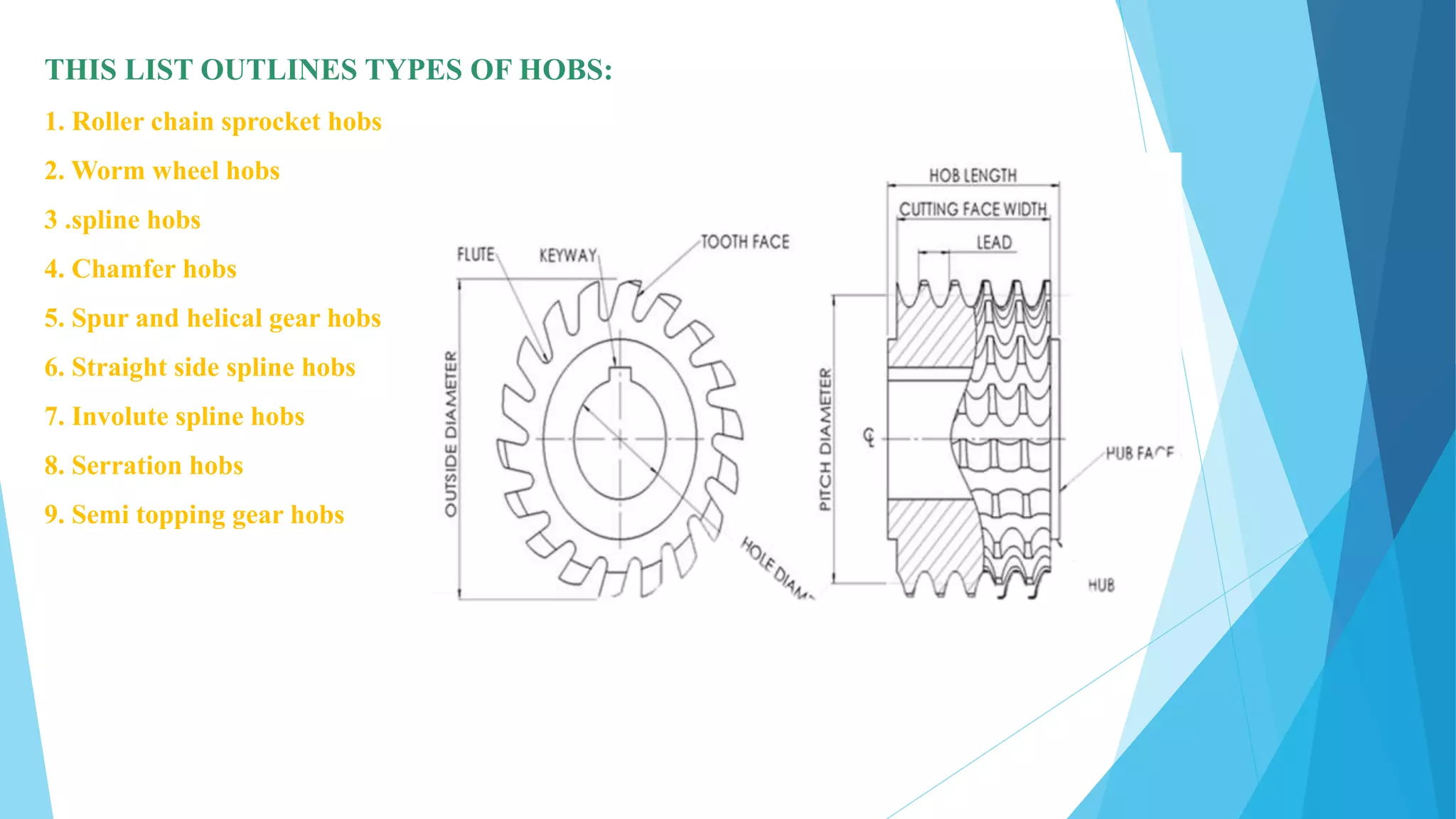
THIS LIST OUTLINES TYPES OF HOBS:
1. Roller chain sprocket hobs
2. Worm wheel hobs
3 .spline hobs
4. Chamfer hobs
5. Spur and helical gear hobs
6. Straight side spline hobs
7. Involute spline hobs
8. Serration hobs
9. Semi topping gear hobs
PRODUCT AND MACHINE SPECIFICATION
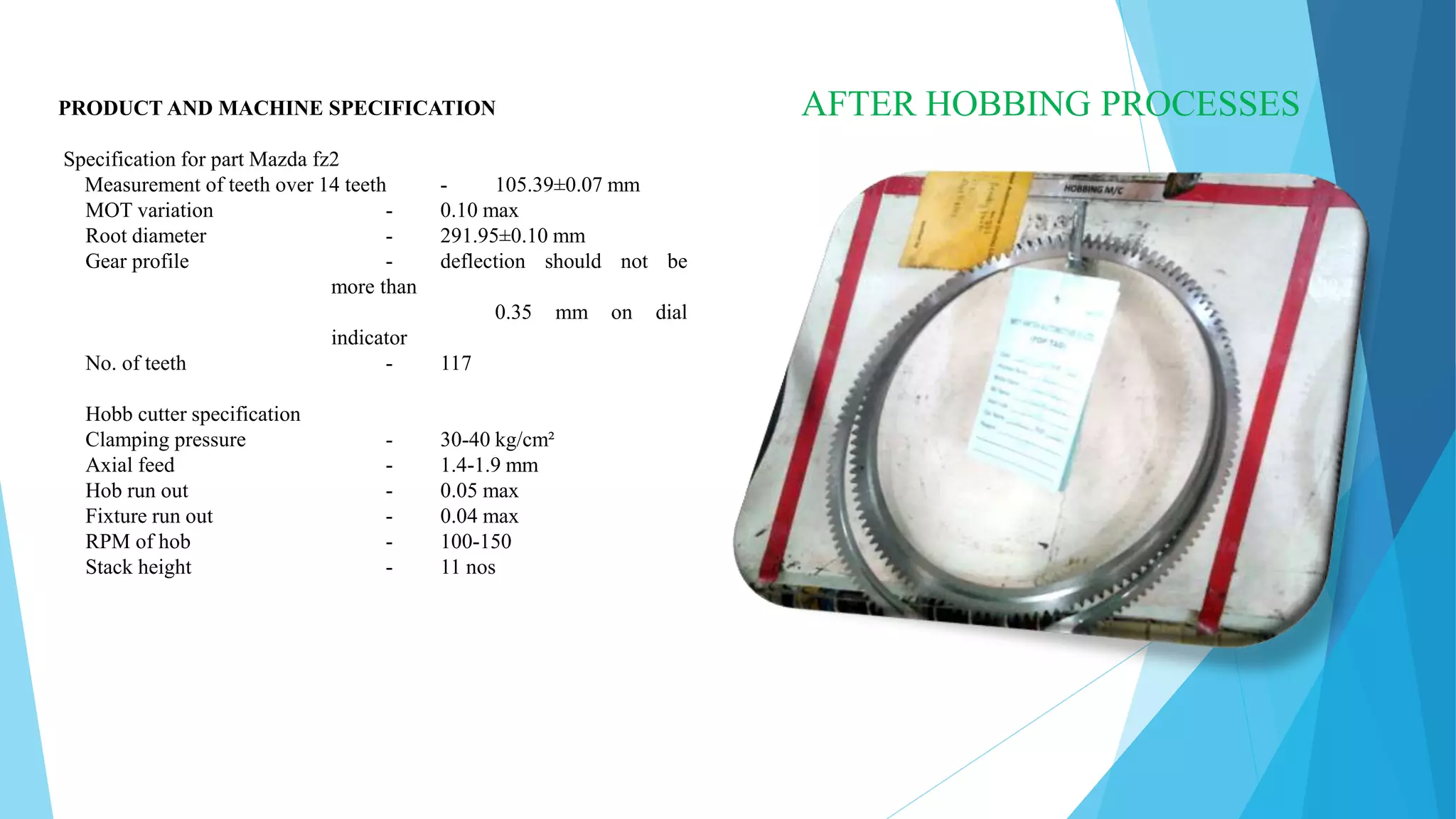
Specification for part Mazda fz2
Measurement of teeth over 14 teeth - 105.39±0.07 mm
MOT variation - 0.10 max
Root diameter - 291.95±0.10 mm
Gear profile - deflection should not be
more than
0.35 mm on dial
indicator
No. of teeth - 117
Hobb cutter specification
Clamping pressure - 30-40 kg/cm²
Axial feed - 1.4-1.9 mm
Hob run out - 0.05 max
Fixture run out - 0.04 max
RPM of hob - 100-150
Stack height - 11 nos
AFTER HOBBING PROCESSES
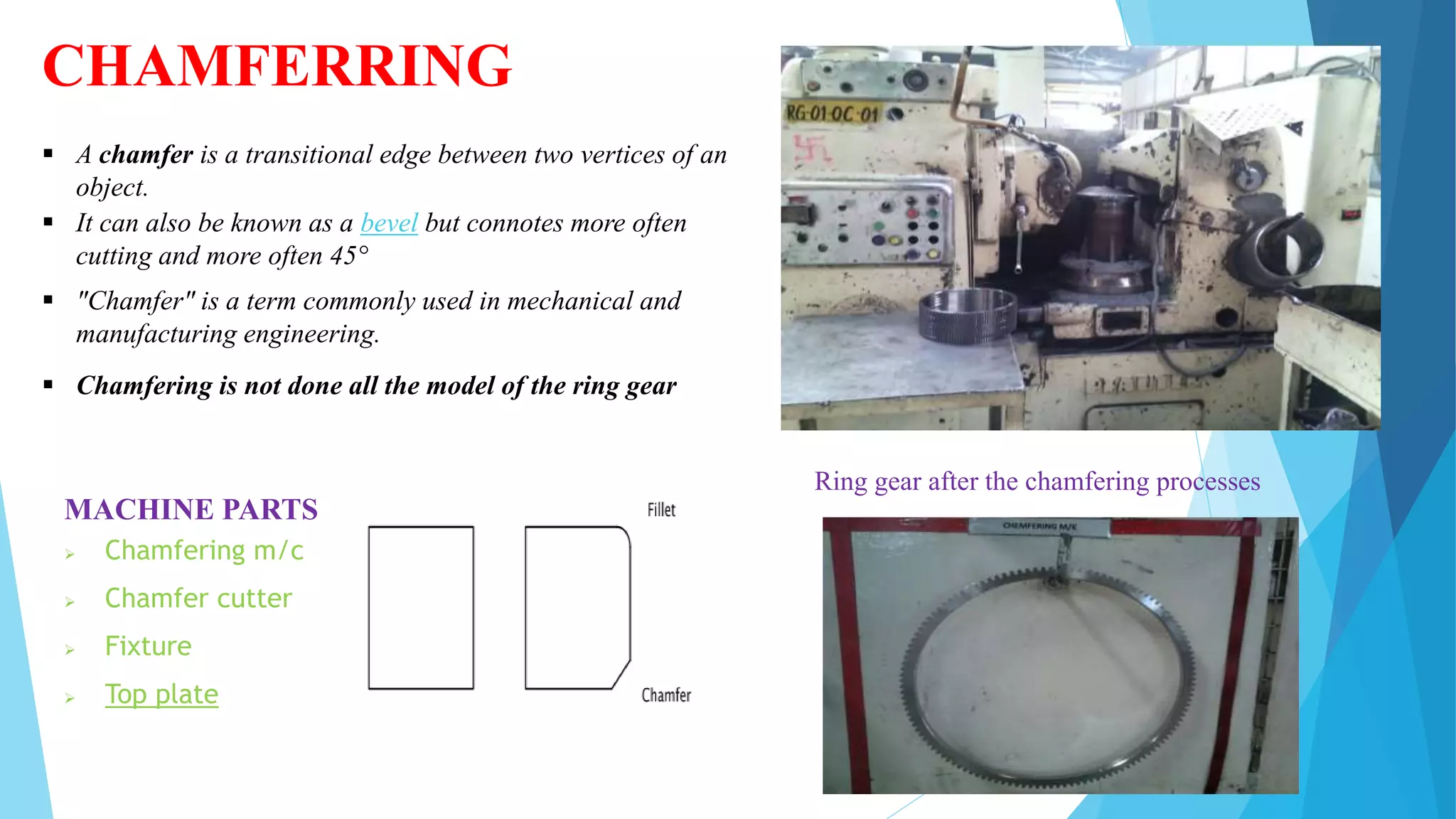
CHAMFERRING
 A chamfer is a transitional edge between two vertices of an
object.
 It can also be known as a bevel but connotes more often
cutting and more often 45°
 "Chamfer" is a term commonly used in mechanical and
manufacturing engineering.
MACHINE PARTS
 Chamfering m/c
 Chamfer cutter
 Fixture
 Top plate
 Chamfering is not done all the model of the ring gear
Ring gear after the chamfering processes
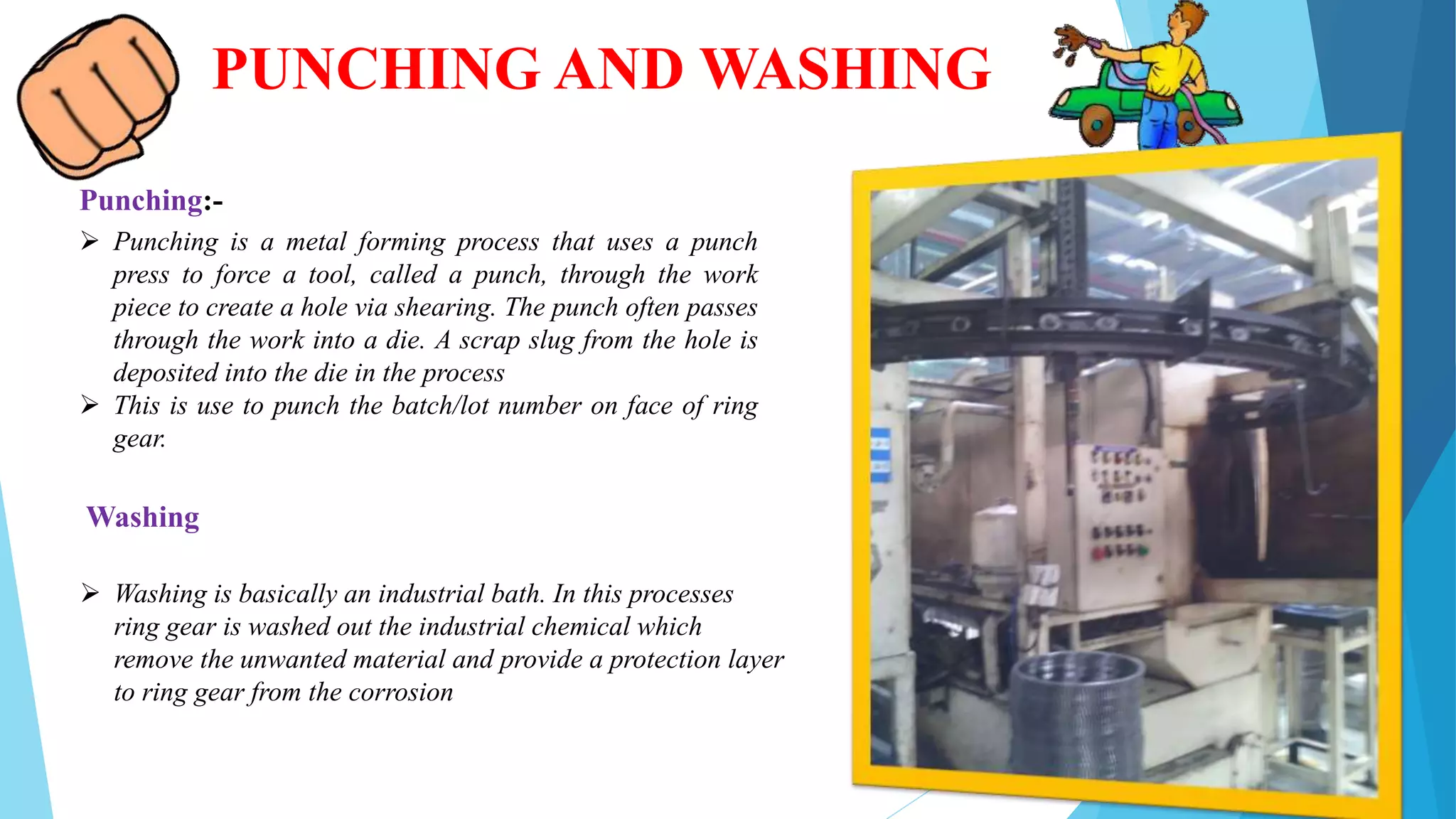
PUNCHING AND WASHING
Punching:-
 Punching is a metal forming process that uses a punch
press to force a tool, called a punch, through the work
piece to create a hole via shearing. The punch often passes
through the work into a die. A scrap slug from the hole is
deposited into the die in the process
 This is use to punch the batch/lot number on face of ring
gear.
Washing
 Washing is basically an industrial bath. In this processes
ring gear is washed out the industrial chemical which
remove the unwanted material and provide a protection layer
to ring gear from the corrosion
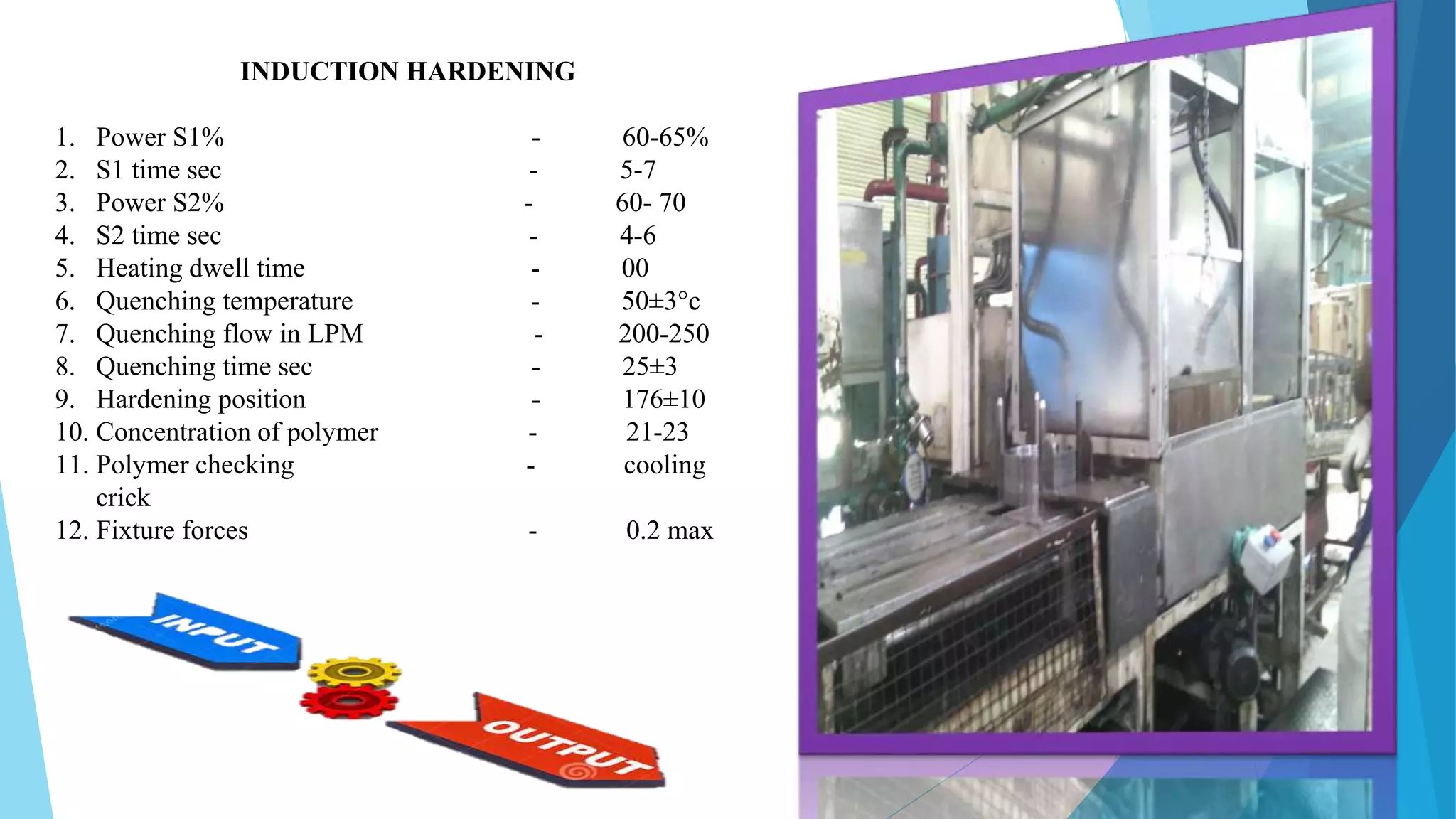
INDUCTION HARDENING
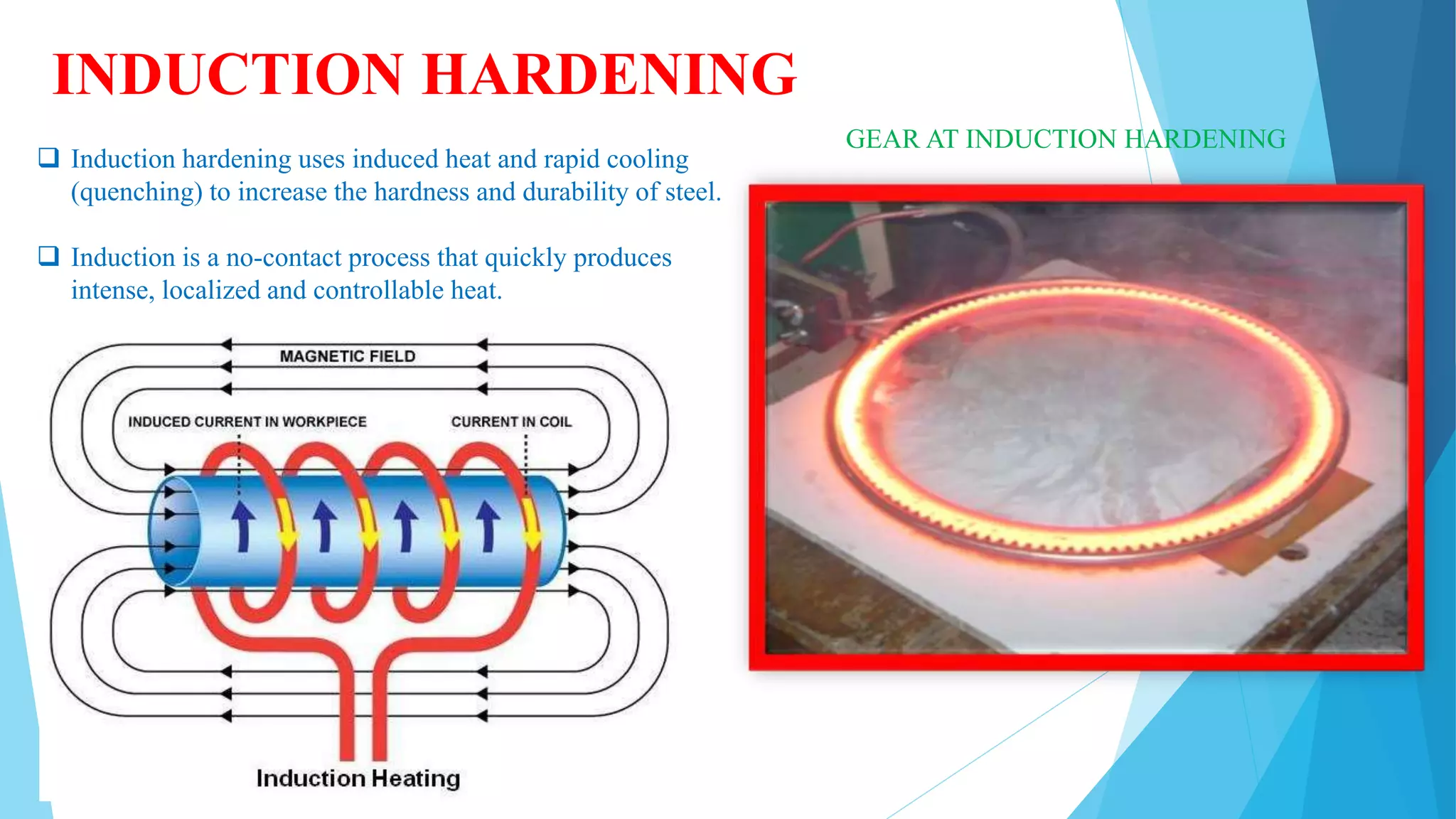
 Induction hardening uses induced heat and rapid cooling
(quenching) to increase the hardness and durability of steel.
 Induction is a no-contact process that quickly produces
intense, localized and controllable heat.
GEAR AT INDUCTION HARDENING
INDUCTION HARDENING
1. Power S1% - 60-65%
2. S1 time sec - 5-7
3. Power S2% - 60- 70
4. S2 time sec - 4-6
5. Heating dwell time - 00
6. Quenching temperature - 50±3°c
7. Quenching flow in LPM - 200-250
8. Quenching time sec - 25±3
9. Hardening position - 176±10
10. Concentration of polymer - 21-23
11. Polymer checking - cooling
crick
12. Fixture forces - 0.2 max
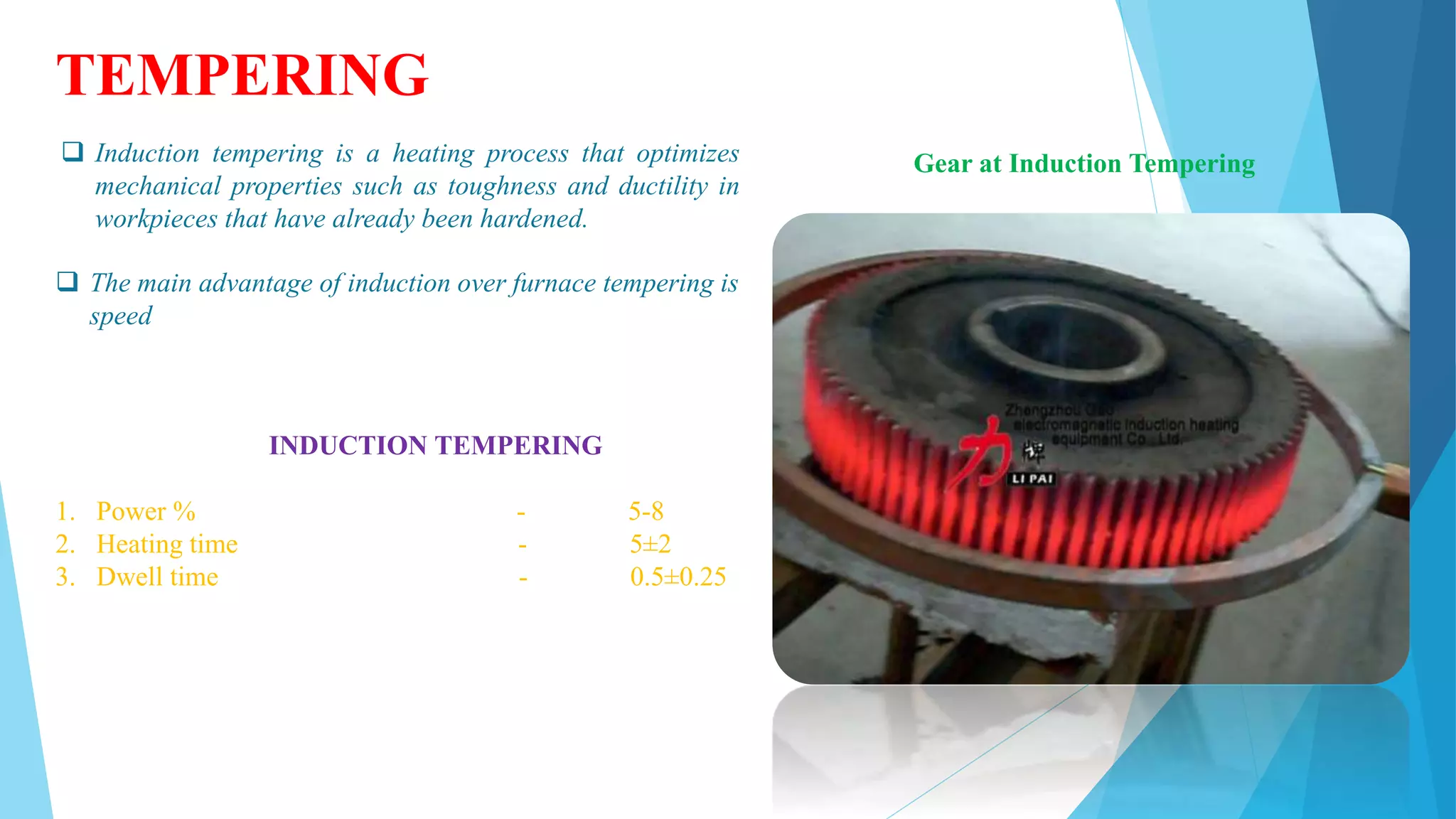
TEMPERING
 Induction tempering is a heating process that optimizes
mechanical properties such as toughness and ductility in
workpieces that have already been hardened.
 The main advantage of induction over furnace tempering is
speed
Gear at Induction Tempering
INDUCTION TEMPERING
1. Power % - 5-8
2. Heating time - 5±2
3. Dwell time - 0.5±0.25
QUALITY GATE 2
Quality control, or QC for short, is a process by which entities review the quality of all
factors involved in production. ISO 9000 defines quality control as "A part of quality
management focused on fulfilling quality requirements"
This approach places an emphasis on three aspects
1. Elements such as controls, job management, defined and well managed
processes, performance and integrity criteria, and identification of records
2. Competence, such as knowledge, skills, experience, and qualifications
3. Soft elements, such as personnel, integrity, confidence, organizational
culture, motivation, team spirit, and quality relationships.
Controls include product inspection, where every product is examined visually, and
often using a stereo microscope for fine detail before the product is sold into the
external market. Inspectors will be provided with lists and descriptions of
unacceptable product defects such as cracks or surface blemishes for example
Amtek persentation aman (11 me-06)

Amtek persentation aman (11 me-06)

  • 1.
    RING GEAR PRODUCTION MPTAMTEK AUTOMOTIVE LTD. Presentation By: Aman Kumar Roll No: 11-ME-06 MECHANICAL-A VIII SEM
  • 2.
    ABOUT MPT AMTEKAUTO LTD • Magna Powertrain and Amtek Establish a Joint Venture in India • The Amtek Group was established in the year 1985 with the incorporation of the Flagship Company, Amtek Auto Limited • Amtek is a leading multi-national manufacturer of automotive components and assemblies with production facilities located strategically across Asia, Europe and USA • The current turnover of the group exceeds $ 750 million.
  • 3.
    ACHIEVEMENTS Amtek Auto recentlywon the best investor of the year award 2008 – UK Trade & Investment. Adjudged ‘Best Performing Vendor 'Technology group Machine Parts Maruti Suzuki (1994–95) • TVS Motors Ltd to Amtek Bhopal(2002–03) • Forging and Casting group from Honda Motor Cycles & Scooters India Ltd to Amtek Bhopal (2005–06) • Honda Motor Cycles Scooters India Ltd (2005–06 & 2006–07) to Amtek Bhopal Won ‘Supplier of the Year’ Award • Prestigious ‘ET– Best Emerging Company of the Year 2006’ at ‘The Economic Times Awards For Corporate Excellence’ Declared ‘ET– Best Emerging Company of the Year’
  • 4.
    MANUFACTURING PLANTS Technology andTranscends Boundaries Thriving on challenges Amtek registered its presence across North America, Europe & Asia to cater a number of client. And is poised to explore new global frontiers to invent new products and scale to new heights. AMTEK WORLDWIDE CENTERS  INDIA  U.S.A  MEXIO  BRAZIL  ITALY  U. K  HUNGARY  GERMANY
  • 5.
    AMTEK INDIA RING GEAR/FLYWHEEL ASSEMBLY Gurgaon Dharuhera CASTING Rajangaon FORGING Dharuhera Unit II Gurgaon Bopal Chakan Ahmednagar MACHINIG Sohna Gurgaon Dharuhera UnitI Dharuhera Unit II Sanaswadi Nalagrah Maneser Maneser Chakan Ahmednagar  FORGING is the process of forming hot / cold metal  CASTING is the process of forming from molten metal.  MACHINING is the term used for a set of metal – cutting processes which are performed on Forgings and / or Castings to give them the exact shape and size for assembling in the vehicle  ASSEMBLY is the processes making a product by the combination attachment of different elements
  • 6.
    MANUFACTURED PARTS Connecting Rod Assemblies FlywheelRing Gears and Assembly Steering Knuckles Suspension and Steering Arms CV joints Crankshaft Assemblies
  • 8.
    PRODUCTION PROCESS RAW MATERIAL (TrapizodialBar Of Alloy Steel) INWARD INSPECTION (To Verify The Dimensional And Metallurgical Parameter ) BLANKING MACHINING HOBBING CHAMFERING WASHING INDUCTION HARDENING FINISHED COMPONENT
  • 9.
    FLOW CHART OFRING GEAR PRODUCTION LINE
  • 10.
    BENDING  Bending Machineis used to bend the square or trapezoidal bar into ring form  The bending m/c has three rollers A. Upper roller B. Right roller C. Left roller  The rod is kept on the left & right roller and then press by the upper roller then move in the clockwise direction.
  • 11.
    BENDING BENIFITS ANDDISADANTAGES Building out from each end enables construction to be done with little disruption to navigation below The span can be greater than that of a simple beam, because a beam can be added to the cantilever arms  Spring loose  Irregular coiling  Bending with T1 outside OK SAMPLE PRODUCT DEFECTIVE PRODUCT
  • 13.
    SLITTING  Slitting machineis used to cut the ring coil form in bending machine in different rings  By pressing the five coils ring and cut into different parts.  Cycle time is 40 sec.  Cycle operation time is 120 min.  Hydraulic pressure - 35-55 kg/cm³  Slatted product
  • 14.
    FLASH BUTT WELDING& TRIMMING  Flash butt welding is a type of resistance welding without using any filler metal  PARTS OF TRIMMING AND BUTT WELDING:- o Flash butt welding and trimming machine o Top clamp o Electrode o Trimming resting pad o Trimming bit o Horizontal cassete o Vertical cassete
  • 15.
    Trimming is theprocesses in which unwanted and extra material is removed by the special tool. TRIMMING APPLICATIONS  Railway Lines (Flash butt welding machines are often transported to the work site on a road-rail vehicle)  Chains  Steel wheels  Sheets or rods of steel in rolling mills.  Starter rings
  • 17.
    NORMALIZING  A necessaryfirst step in the heat treatment process involves "normalizing," a process designed to present a homogenous microstructure to the carburizing process  Normalizing is a process that involves heating a part above the upper critical temperature and then typically air cooling outside the furnace to relieve residual stresses in a gear blank and to aid dimensional stability. PRODUCT AND MACHINE SPECIFICATION Hardness - 85-95 HRB Grain size - 5-8 ASTM Micro structure - normalized structure Uniformly distributed ferrite with pearlite Power level - 24%-28% Heating time - 20-25 sec Min temperature - 800 ·c Max temperature - 890 ·c
  • 18.
    COLD SIZING Cold sizingis a squeezing operation performed at temperatures significantly below the melting point to finish the surface of a work piece to ensure better dimensional accuracy and surface finish. PRODUCT AND MACHINE SPECIFICATION Specification for part NI-XH5 Internal diameter - 287.5±0.5 mm at three points Ovality - 0.40 mm max Flatness - 0.40 mm max Trimming depth on both faces - ±0.50 mm Hydraulic pressure - min 130 kg/cm² Hold time - 35
  • 19.
    CNC MACHINE CNC meansComputer Numerical Control. This means a computer converts the design produced by Computer Aided Design software (CAD), into numbers. The numbers can be considered to be the coordinates of a graph and they control the movement of the cutter. In this way the computer controls the cutting and shaping of the material
  • 20.
    ADVANTAGES CNC machines areprogrammed with a design which can then be manufactured hundreds or even thousands of times. Each manufactured product will be exactly the same. CNC machines can be updated by improving the software used to drive the machines Less skilled/trained people can operate CNCs unlike manual lathes / milling machines etc. which need skilled engineers APPLICATION  Industries for Fabricating Metals  Electrical Discharge Machining (EDM) Industry CNC Turning DISADVANTAGES CNC machines are more expensive than manually operated machines, although costs are slowly coming down. The CNC machine operator only needs basic training and skills, enough to supervise several machines. In years gone by, engineers needed years of training to operate Centre lathes, milling machines and other manually operated machines. This means many of the old skills are been lost.
  • 21.
    QUALITY GATE 1 Inthe Ring Gear production are the following quality check is to be done:-  ID (internal diameter)  OD (outer diameter)  OVALITY  GEAR PROFILE  MOT (Measurement of Teeth)  DOP (diameter of pin)
  • 22.
    ID AND ODGAUGE
  • 23.
    HOBBING  Hobbing isa machining process for gear cutting, cutting splines, and cutting sprockets on a hobbing machine, which is a special type of milling machine.  It is the most widely used gear cutting process for creating spur and helical gears and more gears are cut by hobbing than any other process since it is relatively quick and inexpensive. HOBBING CUTTER
  • 24.
    THIS LIST OUTLINESTYPES OF HOBS: 1. Roller chain sprocket hobs 2. Worm wheel hobs 3 .spline hobs 4. Chamfer hobs 5. Spur and helical gear hobs 6. Straight side spline hobs 7. Involute spline hobs 8. Serration hobs 9. Semi topping gear hobs
  • 25.
    PRODUCT AND MACHINESPECIFICATION Specification for part Mazda fz2 Measurement of teeth over 14 teeth - 105.39±0.07 mm MOT variation - 0.10 max Root diameter - 291.95±0.10 mm Gear profile - deflection should not be more than 0.35 mm on dial indicator No. of teeth - 117 Hobb cutter specification Clamping pressure - 30-40 kg/cm² Axial feed - 1.4-1.9 mm Hob run out - 0.05 max Fixture run out - 0.04 max RPM of hob - 100-150 Stack height - 11 nos AFTER HOBBING PROCESSES
  • 26.
    CHAMFERRING  A chamferis a transitional edge between two vertices of an object.  It can also be known as a bevel but connotes more often cutting and more often 45°  "Chamfer" is a term commonly used in mechanical and manufacturing engineering. MACHINE PARTS  Chamfering m/c  Chamfer cutter  Fixture  Top plate  Chamfering is not done all the model of the ring gear Ring gear after the chamfering processes
  • 27.
    PUNCHING AND WASHING Punching:- Punching is a metal forming process that uses a punch press to force a tool, called a punch, through the work piece to create a hole via shearing. The punch often passes through the work into a die. A scrap slug from the hole is deposited into the die in the process  This is use to punch the batch/lot number on face of ring gear. Washing  Washing is basically an industrial bath. In this processes ring gear is washed out the industrial chemical which remove the unwanted material and provide a protection layer to ring gear from the corrosion
  • 28.
    INDUCTION HARDENING  Inductionhardening uses induced heat and rapid cooling (quenching) to increase the hardness and durability of steel.  Induction is a no-contact process that quickly produces intense, localized and controllable heat. GEAR AT INDUCTION HARDENING
  • 29.
    INDUCTION HARDENING 1. PowerS1% - 60-65% 2. S1 time sec - 5-7 3. Power S2% - 60- 70 4. S2 time sec - 4-6 5. Heating dwell time - 00 6. Quenching temperature - 50±3°c 7. Quenching flow in LPM - 200-250 8. Quenching time sec - 25±3 9. Hardening position - 176±10 10. Concentration of polymer - 21-23 11. Polymer checking - cooling crick 12. Fixture forces - 0.2 max
  • 30.
    TEMPERING  Induction temperingis a heating process that optimizes mechanical properties such as toughness and ductility in workpieces that have already been hardened.  The main advantage of induction over furnace tempering is speed Gear at Induction Tempering INDUCTION TEMPERING 1. Power % - 5-8 2. Heating time - 5±2 3. Dwell time - 0.5±0.25
  • 31.
    QUALITY GATE 2 Qualitycontrol, or QC for short, is a process by which entities review the quality of all factors involved in production. ISO 9000 defines quality control as "A part of quality management focused on fulfilling quality requirements" This approach places an emphasis on three aspects 1. Elements such as controls, job management, defined and well managed processes, performance and integrity criteria, and identification of records 2. Competence, such as knowledge, skills, experience, and qualifications 3. Soft elements, such as personnel, integrity, confidence, organizational culture, motivation, team spirit, and quality relationships. Controls include product inspection, where every product is examined visually, and often using a stereo microscope for fine detail before the product is sold into the external market. Inspectors will be provided with lists and descriptions of unacceptable product defects such as cracks or surface blemishes for example