INSPECTION PRINCIPLES AND
PRACTICES, INSPECTION
TECHNOLOGIES
Presented By
Sonu Steephen
Roll no. 15
&
Vignesh M S
Roll no. 16
INSPECTION
TECHNOLOGIES
● The inspection procedures are enabled by various sensors,
instruments, and gages.
● Some of these inspection techniques involve manually operated
devices
● Other techniques are based on modern technologies such as
coordinate measuring machines and machine vision.
● These newer techniques require computer systems to control their
operation and analyze the data collected
INSPECTION
METROLOGY
● Metrology is the science of measurement.
● Measurement is defined as a procedure in which an unknown quantity
is compared to a known standard, using an accepted and consistent
system of units.
● Two aspects of a standard are critical:
(1) it must be constant, not changing over time.
(2)it must be based on a system of units that is consistent and
accepted by users.
CHARACTERISTICS OF MEASURING
INSTRUMENTS
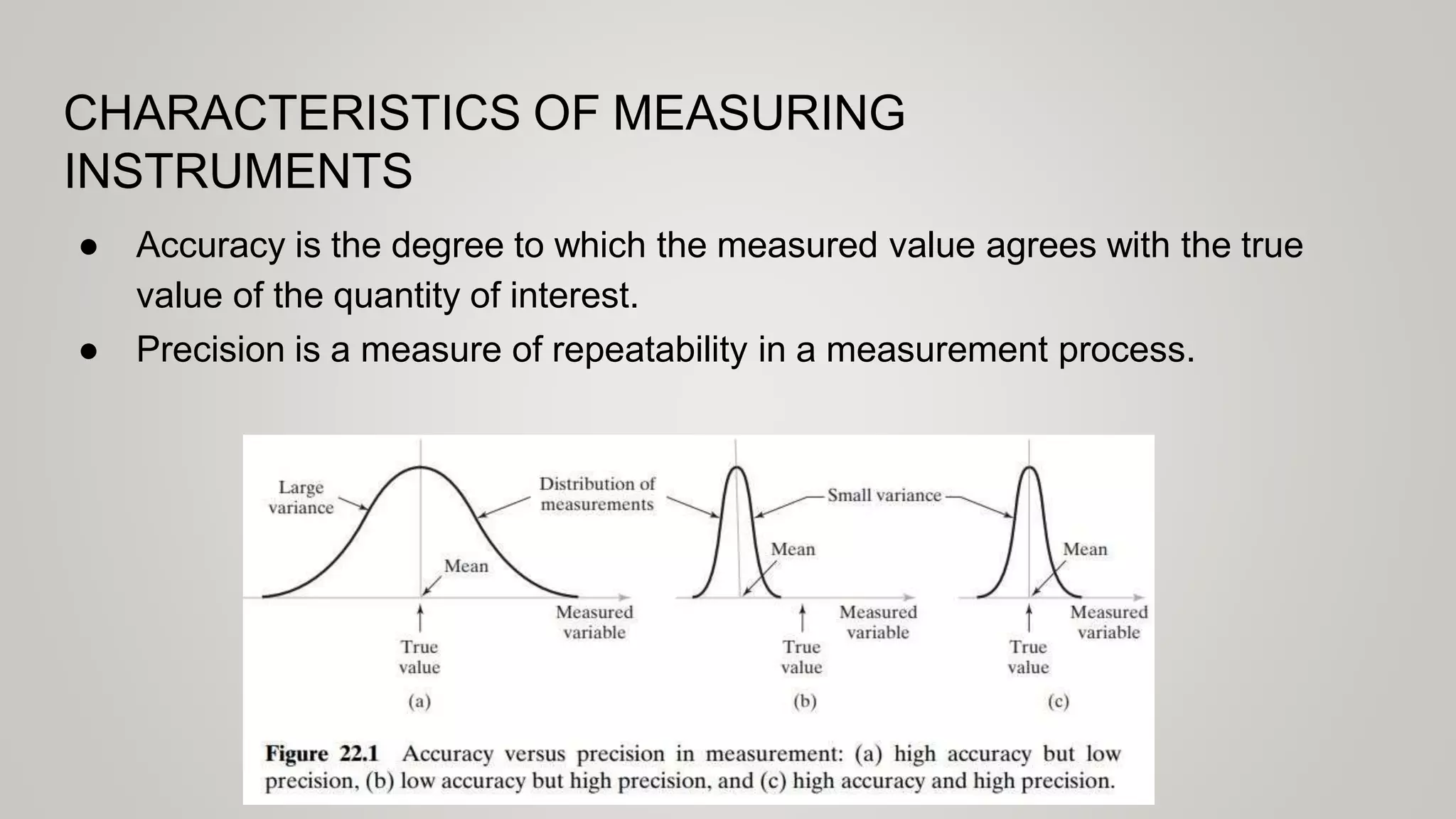
● Accuracy is the degree to which the measured value agrees with the true
value of the quantity of interest.
● Precision is a measure of repeatability in a measurement process.
● Resolution and sensitivity describe capacity to distinguish very
small differences in the quantity of interest. The indication of this
characteristic is the smallest variation of the quantity that can be
detected by the instrument
● Other desirable features include stability, speed of response, wide
operating range, high reliability, and low cost.
● The ability of a measuring instrument to indicate the quantity with a
minimum time lag is called its speed of response
[contd..]
CONTACT VERSUS NON-CONTACT INSPECTION
TECHNIQUES
● Contact inspection involves the use of a mechanical probe or other device
that makes contact with the object being inspected.
● These techniques are widely used in the manufacturing industries, in
particular in the production of metal parts (machining, stamping, and other
metalworking processes).
● Contact inspection is also used in electrical circuit testing.
The general application ranges for the different types of inspection and
measurement equipment are presented in the PQ chart
[contd..]
Non-contact Inspection Technologies
● Non-contact inspection methods utilize a sensor located at a certain
distance from the object to measure or gage the desired features.
● They are classified into two categories: optical and non-optical.
● Optical inspection technologies use light to accomplish the
measurement or gaging cycle. The most important optical
technology is machine vision.
● Non optical inspection technologies utilize energy forms other than
light to perform the inspection; these other energies include various
electrical fields, radiation (other than light), and ultrasonics.
[contd..]
Non-contact inspection advantages over contact inspection
● They avoid damage to the part surface that might result from contact
inspection.
● Inspection cycle times are inherently faster. Contact inspection procedures
require the contacting probe to be positioned against the part, which takes
time. Most of the noncontact methods use a stationary probe that does not
need repositioning for each part.
● Non-contact methods can often be accomplished on the production line
without the need for any additional handling of the parts, whereas contact
inspection usually requires special handling and positioning of the parts.
● It is more feasible to conduct 100% automated inspection, since non-contact
methods have faster cycle times and reduced need for special handling.
Measuring devices provide a quantitative value
of the part feature of interest
Gages determine whether the part feature falls
within a certain acceptable range of values.
Measuring takes more time but provides more
information about the part feature
Gaging can be accomplished more quickly but
does not provide as much information.
Measuring devices tend to be used on a
sampling inspection basis
Gages are used either for sampling or 100%
inspection.
Some devices are portable and can be used at
the production operation. Others require bench
setups accurately on a flat reference surface
called a surface plate.
Gages tend to be more portable and lend
themselves to application at the production
operation
[contd..] COMPARISON
GAGIN
G
MEASURING
COORDINATE MEASURING MACHINES(CMM)
● A coordinate measuring machine (CMM) is an electromechanical system
designed to perform coordinate metrology.
● Coordinate metrology is concerned with measuring the actual shape and
dimensions of an object and comparing these results with the desired shape
and dimensions, as might be specified on a part drawing.
[CONTD..]
CMM HAS A CONTACT PROBE THAT CAN BE POSITIONED IN THREE
DIMENSIONS RELATIVE TO THE SURFACES OF A WORK PART.
[contd..]
To accomplish measurements in three-dimensional space, the basic CMM
consists of the following components:
● Probe head and probe to contact the work part surfaces
● Mechanical structure that provides motion of the probe in three Cartesian
axes and displacement transducers to measure the coordinate values of each
axis.
● Drive system and control unit to move each of the three axes
● Digital computer system with application software.
SURFACE MEASUREMENT
● The measurement of surfaces is usually accomplished by instruments that
use a contacting stylus, hence surface measurement comes within the scope
of contact inspection technologies.
● Stylus-type instruments are commercially available to measure surface
roughness. These electronic devices have a cone-shaped diamond stylus
with point radius of about 0.005 mm (0.0002 in) and a 90° tip angle that is
traversed across the test surface at a constant slow speed.
● The vertical movements are converted into an electronic signal that
represents the topography of the surface along the path taken by the stylus.
Vertical movement is converted into either: (1) a profile of the surface or (2) the
average roughness value.
[CONTD..]
MACHINE VISION
Machine vision consists of the acquisition of image data, followed by the
processing and interpretation of these data by computer for some industrial
application
The operation of a machine vision system can be divided into the following three
functions:
(1) Image acquisition and digitization,
(2) Image processing and analysis, and
(3) Interpretation
BASIC FUNCTIONS OF MACHINE
VISION SYSTEM
[contd..]
[contd..]
Image acquisition and digitization
● Image acquisition and digitization is accomplished using a digital camera and
a digitizing system to store the image data for subsequent analysis.
● The camera is focused on the subject of interest, and an image is obtained by
dividing the viewing area into a matrix of discrete picture elements (called
pixels), in which each element has a value that is proportional to the light
intensity of that portion of the scene.
● The intensity value for each pixel is converted into its equivalent digital value
by an ADC .
[contd..]
Image Processing and Analysis
● One category of techniques in image processing and analysis, called
segmentation, is intended to define and separate regions of interest within the
image.
● Two of the common segmentation techniques are thresholding and edge
detection
● Another set of techniques in image processing and analysis that normally
follows segmentation is feature extraction.
● Feature extraction methods are designed to determine the features of an
image( area, length, width, diameter, perimeter, center of gravity, and aspect
ratio) based on the area and boundaries of the object.
[contd..]
Interpretation
● The interpretation function is usually concerned with recognizing the object, a
task called object recognition or pattern recognition.
● The objective in this task is to identify the object in the image by comparing it
with predefined models or standard values.
● Two commonly used interpretation techniques are template matching and
feature weighting.
Machine Vision for Inspection
● Machine vision installations in industry perform a variety of automated
inspection tasks, most of which are either on-line/in-process or
on-line/post-process.
● The applications are almost always in mass production where the time
required to program and set up the vision system can be spread over many
thousands of units.
● Vision inspection can be accomplished at much higher speeds than
inspection with CMMs.
Typical industrial inspection tasks include the following:
● Dimensional measurement.
● Dimensional gaging.
● Verification of the presence of components.
● Verification of hole location and number of holes.
● Detection of surface flaws and defects.
● Detection of flaws in a printed label.
All of the preceding inspection applications can be accomplished using 2-D vision
systems.
[COND..]
Conventional Optical Instruments.
Optical Comparator
● An optical comparator projects the shadow of an object (e.g., a work part)
against a large screen in front of an operator.
● The object can be moved in the x–y directions, permitting the operator to
obtain dimensional data using crosshairs on the screen.
● Also known as contour projectors and shadowgraphs, they are easier to use
than CMM.
[contd..]
Microscope
● A microscope is usually a benchtop unit, thus requiring less space in the shop
floor.
● Microscopes can be equipped with an optical projection system instead of an
eyepiece, providing ergonomic benefits for the operator.
● A significant advantage over the optical comparator is that the projection
system shows the actual surface of the object rather than its shadow.
● The user can see its color, texture, and other features rather than just an
outline.
[contd..]
Laser Systems
● The scanning laser uses a laser beam that is deflected by a rotating mirror to
produce a beam of light that can be focused to sweep past an object.
● A photodetector on the far side of the object senses the light beam except for
the time period during the sweep when it is interrupted by the object.
● This time period can be measured with great accuracy and related to the size
of the object in the path of the laser beam.
A microprocessor counts the time interruption of the scanning laser beam as it
sweeps past the object, makes the conversion from time to a linear dimension,
and signals other equipment to make adjustments in the manufacturing process
and/or activate a sortation device on the production line.
[CONTD..]
[contd..]
Linear Array Devices
The operation of a linear array for automated inspection is similar in some
respects to machine vision, except that the pixels are arranged in only one
dimension rather than two.
Optical Triangulation Techniques
Triangulation techniques are based on the trigonometric relationships of a right
triangle.
Triangulation is used for range-finding, that is, determining the distance or range
of an object from two known points.
[CONTD..]
The angle A of the beam directed at the object is fixed and known, and so is the
distance L between the light source and the photosensitive detector.The range R
of the object is
R = L cot A
[contd..]
NON-CONTACT NON-OPTICAL INSPECTION TECHNIQUES
In addition to noncontact optical inspection methods, there is also a variety of
non-optical technologies used for inspection tasks in manufacturing.
They are sensor techniques based on electrical fields, radiation, and ultrasonics.
REFERENC
ES
GROOVER, M. P
. (2001). Automation, production systems and
computer-integrated manufacturing. Upper Saddle River, NJ, Prentice Hall.

Inspection Principles and practices, Inspection technologies.pptx

  • 1.
    INSPECTION PRINCIPLES AND PRACTICES,INSPECTION TECHNOLOGIES Presented By Sonu Steephen Roll no. 15 & Vignesh M S Roll no. 16
  • 2.
    INSPECTION TECHNOLOGIES ● The inspectionprocedures are enabled by various sensors, instruments, and gages. ● Some of these inspection techniques involve manually operated devices ● Other techniques are based on modern technologies such as coordinate measuring machines and machine vision. ● These newer techniques require computer systems to control their operation and analyze the data collected
  • 3.
    INSPECTION METROLOGY ● Metrology isthe science of measurement. ● Measurement is defined as a procedure in which an unknown quantity is compared to a known standard, using an accepted and consistent system of units. ● Two aspects of a standard are critical: (1) it must be constant, not changing over time. (2)it must be based on a system of units that is consistent and accepted by users.
  • 4.
    CHARACTERISTICS OF MEASURING INSTRUMENTS ●Accuracy is the degree to which the measured value agrees with the true value of the quantity of interest. ● Precision is a measure of repeatability in a measurement process.
  • 5.
    ● Resolution andsensitivity describe capacity to distinguish very small differences in the quantity of interest. The indication of this characteristic is the smallest variation of the quantity that can be detected by the instrument ● Other desirable features include stability, speed of response, wide operating range, high reliability, and low cost. ● The ability of a measuring instrument to indicate the quantity with a minimum time lag is called its speed of response [contd..]
  • 6.
    CONTACT VERSUS NON-CONTACTINSPECTION TECHNIQUES ● Contact inspection involves the use of a mechanical probe or other device that makes contact with the object being inspected. ● These techniques are widely used in the manufacturing industries, in particular in the production of metal parts (machining, stamping, and other metalworking processes). ● Contact inspection is also used in electrical circuit testing.
  • 7.
    The general applicationranges for the different types of inspection and measurement equipment are presented in the PQ chart [contd..]
  • 8.
    Non-contact Inspection Technologies ●Non-contact inspection methods utilize a sensor located at a certain distance from the object to measure or gage the desired features. ● They are classified into two categories: optical and non-optical. ● Optical inspection technologies use light to accomplish the measurement or gaging cycle. The most important optical technology is machine vision. ● Non optical inspection technologies utilize energy forms other than light to perform the inspection; these other energies include various electrical fields, radiation (other than light), and ultrasonics.
  • 9.
    [contd..] Non-contact inspection advantagesover contact inspection ● They avoid damage to the part surface that might result from contact inspection. ● Inspection cycle times are inherently faster. Contact inspection procedures require the contacting probe to be positioned against the part, which takes time. Most of the noncontact methods use a stationary probe that does not need repositioning for each part. ● Non-contact methods can often be accomplished on the production line without the need for any additional handling of the parts, whereas contact inspection usually requires special handling and positioning of the parts. ● It is more feasible to conduct 100% automated inspection, since non-contact methods have faster cycle times and reduced need for special handling.
  • 10.
    Measuring devices providea quantitative value of the part feature of interest Gages determine whether the part feature falls within a certain acceptable range of values. Measuring takes more time but provides more information about the part feature Gaging can be accomplished more quickly but does not provide as much information. Measuring devices tend to be used on a sampling inspection basis Gages are used either for sampling or 100% inspection. Some devices are portable and can be used at the production operation. Others require bench setups accurately on a flat reference surface called a surface plate. Gages tend to be more portable and lend themselves to application at the production operation [contd..] COMPARISON GAGIN G MEASURING
  • 11.
    COORDINATE MEASURING MACHINES(CMM) ●A coordinate measuring machine (CMM) is an electromechanical system designed to perform coordinate metrology. ● Coordinate metrology is concerned with measuring the actual shape and dimensions of an object and comparing these results with the desired shape and dimensions, as might be specified on a part drawing.
  • 12.
    [CONTD..] CMM HAS ACONTACT PROBE THAT CAN BE POSITIONED IN THREE DIMENSIONS RELATIVE TO THE SURFACES OF A WORK PART.
  • 13.
    [contd..] To accomplish measurementsin three-dimensional space, the basic CMM consists of the following components: ● Probe head and probe to contact the work part surfaces ● Mechanical structure that provides motion of the probe in three Cartesian axes and displacement transducers to measure the coordinate values of each axis. ● Drive system and control unit to move each of the three axes ● Digital computer system with application software.
  • 14.
    SURFACE MEASUREMENT ● Themeasurement of surfaces is usually accomplished by instruments that use a contacting stylus, hence surface measurement comes within the scope of contact inspection technologies. ● Stylus-type instruments are commercially available to measure surface roughness. These electronic devices have a cone-shaped diamond stylus with point radius of about 0.005 mm (0.0002 in) and a 90° tip angle that is traversed across the test surface at a constant slow speed. ● The vertical movements are converted into an electronic signal that represents the topography of the surface along the path taken by the stylus.
  • 15.
    Vertical movement isconverted into either: (1) a profile of the surface or (2) the average roughness value. [CONTD..]
  • 16.
    MACHINE VISION Machine visionconsists of the acquisition of image data, followed by the processing and interpretation of these data by computer for some industrial application The operation of a machine vision system can be divided into the following three functions: (1) Image acquisition and digitization, (2) Image processing and analysis, and (3) Interpretation
  • 17.
    BASIC FUNCTIONS OFMACHINE VISION SYSTEM [contd..]
  • 18.
    [contd..] Image acquisition anddigitization ● Image acquisition and digitization is accomplished using a digital camera and a digitizing system to store the image data for subsequent analysis. ● The camera is focused on the subject of interest, and an image is obtained by dividing the viewing area into a matrix of discrete picture elements (called pixels), in which each element has a value that is proportional to the light intensity of that portion of the scene. ● The intensity value for each pixel is converted into its equivalent digital value by an ADC .
  • 19.
    [contd..] Image Processing andAnalysis ● One category of techniques in image processing and analysis, called segmentation, is intended to define and separate regions of interest within the image. ● Two of the common segmentation techniques are thresholding and edge detection ● Another set of techniques in image processing and analysis that normally follows segmentation is feature extraction. ● Feature extraction methods are designed to determine the features of an image( area, length, width, diameter, perimeter, center of gravity, and aspect ratio) based on the area and boundaries of the object.
  • 20.
    [contd..] Interpretation ● The interpretationfunction is usually concerned with recognizing the object, a task called object recognition or pattern recognition. ● The objective in this task is to identify the object in the image by comparing it with predefined models or standard values. ● Two commonly used interpretation techniques are template matching and feature weighting.
  • 21.
    Machine Vision forInspection ● Machine vision installations in industry perform a variety of automated inspection tasks, most of which are either on-line/in-process or on-line/post-process. ● The applications are almost always in mass production where the time required to program and set up the vision system can be spread over many thousands of units. ● Vision inspection can be accomplished at much higher speeds than inspection with CMMs.
  • 22.
    Typical industrial inspectiontasks include the following: ● Dimensional measurement. ● Dimensional gaging. ● Verification of the presence of components. ● Verification of hole location and number of holes. ● Detection of surface flaws and defects. ● Detection of flaws in a printed label. All of the preceding inspection applications can be accomplished using 2-D vision systems. [COND..]
  • 23.
    Conventional Optical Instruments. OpticalComparator ● An optical comparator projects the shadow of an object (e.g., a work part) against a large screen in front of an operator. ● The object can be moved in the x–y directions, permitting the operator to obtain dimensional data using crosshairs on the screen. ● Also known as contour projectors and shadowgraphs, they are easier to use than CMM.
  • 24.
    [contd..] Microscope ● A microscopeis usually a benchtop unit, thus requiring less space in the shop floor. ● Microscopes can be equipped with an optical projection system instead of an eyepiece, providing ergonomic benefits for the operator. ● A significant advantage over the optical comparator is that the projection system shows the actual surface of the object rather than its shadow. ● The user can see its color, texture, and other features rather than just an outline.
  • 25.
    [contd..] Laser Systems ● Thescanning laser uses a laser beam that is deflected by a rotating mirror to produce a beam of light that can be focused to sweep past an object. ● A photodetector on the far side of the object senses the light beam except for the time period during the sweep when it is interrupted by the object. ● This time period can be measured with great accuracy and related to the size of the object in the path of the laser beam.
  • 26.
    A microprocessor countsthe time interruption of the scanning laser beam as it sweeps past the object, makes the conversion from time to a linear dimension, and signals other equipment to make adjustments in the manufacturing process and/or activate a sortation device on the production line. [CONTD..]
  • 27.
    [contd..] Linear Array Devices Theoperation of a linear array for automated inspection is similar in some respects to machine vision, except that the pixels are arranged in only one dimension rather than two.
  • 28.
    Optical Triangulation Techniques Triangulationtechniques are based on the trigonometric relationships of a right triangle. Triangulation is used for range-finding, that is, determining the distance or range of an object from two known points. [CONTD..]
  • 29.
    The angle Aof the beam directed at the object is fixed and known, and so is the distance L between the light source and the photosensitive detector.The range R of the object is R = L cot A [contd..]
  • 30.
    NON-CONTACT NON-OPTICAL INSPECTIONTECHNIQUES In addition to noncontact optical inspection methods, there is also a variety of non-optical technologies used for inspection tasks in manufacturing. They are sensor techniques based on electrical fields, radiation, and ultrasonics.
  • 31.
    REFERENC ES GROOVER, M. P .(2001). Automation, production systems and computer-integrated manufacturing. Upper Saddle River, NJ, Prentice Hall.