Visit-www.engineering-grs.com
UNIT I
AMPLITUDE MODULATION SYSTEM
Review of Spectral Characteristics of Periodic and aperiodic
signals.
Why use modulation?
• “Carrying one signal on another” - uses carrier
• Modulated carrier transmitted
• Problems with transmitting baseband signals
– Antennas difficult at low frequencies
– Noise and interference at low frequencies
– Can’t share with others
• Easier to transmit carrier at higher frequency
– Can choose convenient frequency
• Antennas can be smaller
• May be useful propagation effects
– Fractional bandwidth much smaller
• Antennas and other components easier to design
• Can have many frequency channels
Visit-www.engineering-grs.com
GENERATION OF AMPLITUDE MODULATION AND
DEMODULATION
Introduction
• Amplitude Modulation is the simplest and earliest form of
transmitters
• AM applications include broadcasting in medium- and high-
frequency applications, CB radio, and aircraft communications
Basic Amplitude Modulation
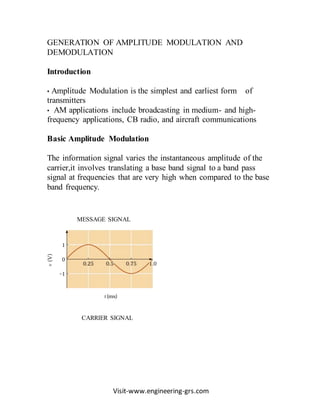
The information signal varies the instantaneous amplitude of the
carrier,it involves translating a base band signal to a band pass
signal at frequencies that are very high when compared to the base
band frequency.
MESSAGE SIGNAL
CARRIER SIGNAL
Visit-www.engineering-grs.com
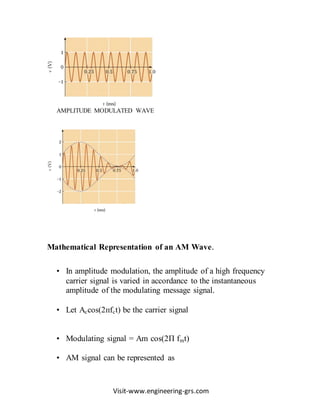
AMPLITUDE MODULATED WAVE
Mathematical Representation of an AM Wave.
• In amplitude modulation, the amplitude of a high frequency
carrier signal is varied in accordance to the instantaneous
amplitude of the modulating message signal.
• Let Accos(2пfct) be the carrier signal
• Modulating signal = Am cos(2П fmt)
• AM signal can be represented as
Visit-www.engineering-grs.com
SAM(t)=Ac[1+ Am/ Ac cos(2П fmt) ] cos(2П fct)
SAM (t)=Ac[1+m(t)]cos(2П fct)
• The modulation index k is given as the ratio of max
amplitude of the modulating signal and the max amplitude of
the carrier signal. It is also sometime expressed as %
modulation
• K = Am/Ac
• Ac[1+ Am/ Ac cos(2П fmt) ] cos(2П fct)
Visit-www.engineering-grs.com
= Ac cos(2П fct) +Am/2 cos(2П (Fc+ Fm)t)+ Am/2
cos(2П (Fc- Fm)t)
• The modulated signal has a carrier freq, and upper and lower
side bands.
• SAM(t)=Ac[1+m(t)]cos(2П fct)
• The power = Ac2/2+Am2/4+Am2/4
SAM(f)=1/2Ac[δ(f-fc)+M(f-fc)+ δ(f+fc)+M(f+fc)]
AM Characteristics
• AM is a nonlinear process
• Sum and difference frequencies are created that carry the
information.
Full-Carrier AM: Time Domain
•Modulation Index - The ratio between the amplitudes between the
amplitudes of the modulating signal and carrier, expressed by the
equation:
m = Em/Ec
Visit-www.engineering-grs.com
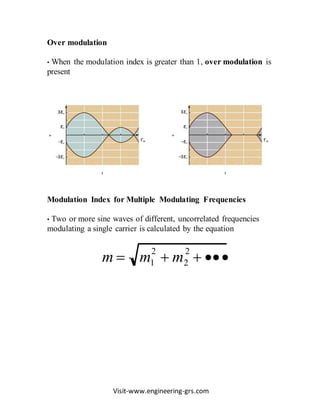
Over modulation
• When the modulation index is greater than 1, over modulation is
present
Modulation Index for Multiple Modulating Frequencies
• Two or more sine waves of different, uncorrelated frequencies
modulating a single carrier is calculated by the equation
m  m1
2
 m2
2
 
Visit-www.engineering-grs.com
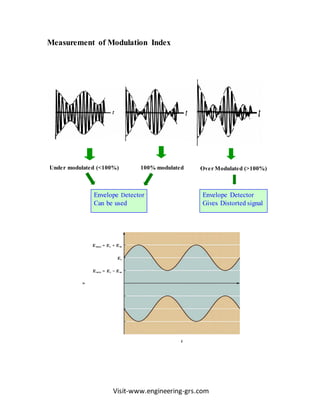
Measurement of Modulation Index
Under modulated (<100%) 100% modulated
Envelope Detector
Can be used
Envelope Detector
Gives Distorted signal
Over Modulated (>100%)
Visit-www.engineering-grs.com
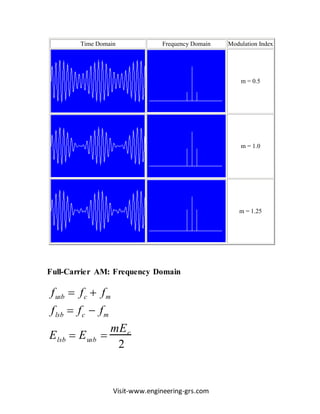
Full-Carrier AM: Frequency Domain
fusb  fc  fm
flsb  fc  fm
Elsb  Eusb 
mEc
2
Time Domain Frequency Domain Modulation Index
m = 0.5
m = 1.0
m = 1.25
Visit-www.engineering-grs.com
Bandwidth
•Signal bandwidth is an important characteristic of any modulation
scheme
•In general, a narrow bandwidth is desirable
•Bandwidth is calculated by:
Power Relationships
•Power in a transmitter is important, but the most important power
measurement is that of the portion that transmits the information
•AM carriers remain unchanged with modulation and therefore are
wasteful
•Power in an AM transmitter is calculated according to the formula
at the right.
Pt  Pc 1
m2
2






• The total power in an AM signal is
PAM= (½)Ac2 [1+2 <m(t)> + <m2(t)>]
Where <> represents the average value.
• If the modulating signal is m(t)=kcos(2Πfmt),then total
power is
mFB 2
Visit-www.engineering-grs.com
PAM= (½)Ac2[1+Pm]=Pc[1+(k2/2)]
Where Pc=Ac2/2 is the power in the carrier signal.
Pm=<m2(t)> is the power in the modulating signal.
and k is the modulation index.
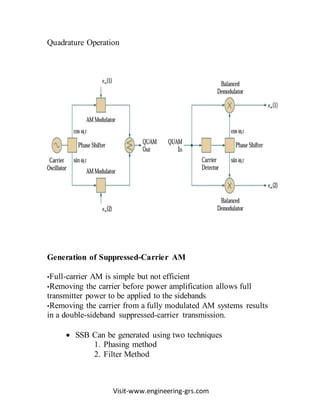
Quadrature AM and AM Stereo
•Two carriers generated at the same frequency but 90º out of phase
with each other allow transmission of two separate signals.
•This approach is known as Quadrature AM (QUAM or QAM)
•Recovery of the two signals is accomplished by synchronous
detection by two balanced modulator
Visit-www.engineering-grs.com
Quadrature Operation
Generation of Suppressed-Carrier AM
•Full-carrier AM is simple but not efficient
•Removing the carrier before power amplification allows full
transmitter power to be applied to the sidebands
•Removing the carrier from a fully modulated AM systems results
in a double-sideband suppressed-carrier transmission.
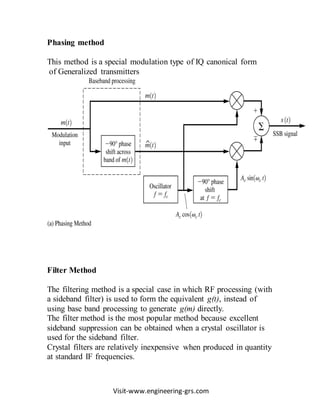
 SSB Can be generated using two techniques
1. Phasing method
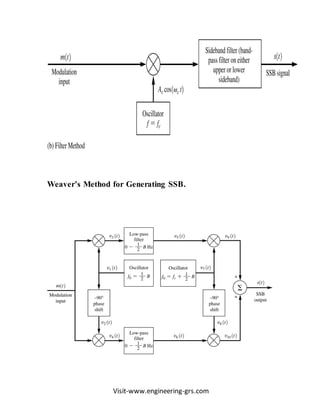
2. Filter Method
Visit-www.engineering-grs.com
Phasing method
This method is a special modulation type of IQ canonical form
of Generalized transmitters
Filter Method
The filtering method is a special case in which RF processing (with
a sideband filter) is used to form the equivalent g(t), instead of
using base band processing to generate g(m) directly.
The filter method is the most popular method because excellent
sideband suppression can be obtained when a crystal oscillator is
used for the sideband filter.
Crystal filters are relatively inexpensive when produced in quantity
at standard IF frequencies.
Visit-www.engineering-grs.com
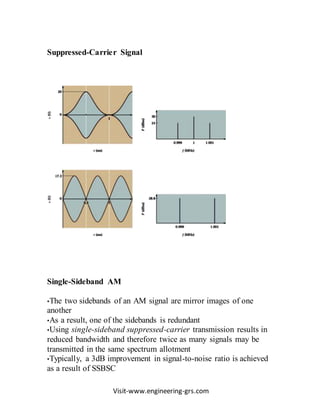
Weaver’s Method for Generating SSB.
Visit-www.engineering-grs.com
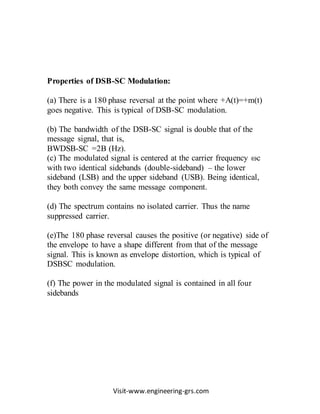
Suppressed-Carrier Signal
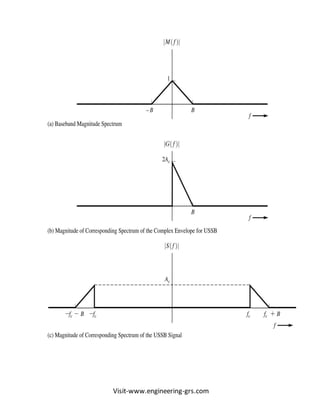
Single-Sideband AM
•The two sidebands of an AM signal are mirror images of one
another
•As a result, one of the sidebands is redundant
•Using single-sideband suppressed-carrier transmission results in
reduced bandwidth and therefore twice as many signals may be
transmitted in the same spectrum allotment
•Typically, a 3dB improvement in signal-to-noise ratio is achieved
as a result of SSBSC
Visit-www.engineering-grs.com
DSBSC and SSB Transmission
Ring Modulator
 The DSB-SC can be generated using either the balanced
modulator or the ‗ring-modulator‘.
 The balanced modulator uses two identical AM generators
along with an adder.
 The two amplitude modulators have a common carrier
with one of them modulating the input message , and the
other modulating the inverted message .
 Generation of AM is not simple, and to have two AM
generators with identical operating conditions is extremely
difficult.
]
Visit-www.engineering-grs.com
Properties of DSB-SC Modulation:
(a) There is a 180 phase reversal at the point where +A(t)=+m(t)
goes negative. This is typical of DSB-SC modulation.
(b) The bandwidth of the DSB-SC signal is double that of the
message signal, that is,
BWDSB-SC =2B (Hz).
(c) The modulated signal is centered at the carrier frequency ωc
with two identical sidebands (double-sideband) – the lower
sideband (LSB) and the upper sideband (USB). Being identical,
they both convey the same message component.
(d) The spectrum contains no isolated carrier. Thus the name
suppressed carrier.
(e)The 180 phase reversal causes the positive (or negative) side of
the envelope to have a shape different from that of the message
signal. This is known as envelope distortion, which is typical of
DSBSC modulation.
(f) The power in the modulated signal is contained in all four
sidebands
Visit-www.engineering-grs.com
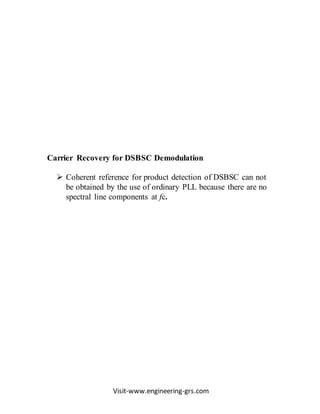
Carrier Recovery for DSBSC Demodulation
 Coherent reference for product detection of DSBSC can not
be obtained by the use of ordinary PLL because there are no
spectral line components at fc.
Visit-www.engineering-grs.com
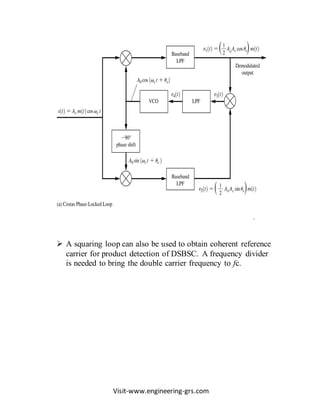
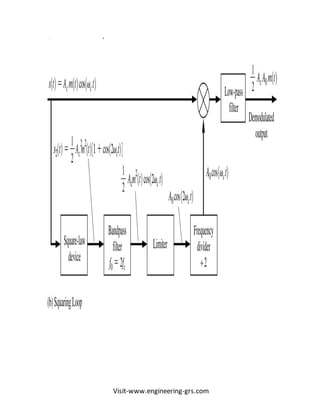
 A squaring loop can also be used to obtain coherent reference
carrier for product detection of DSBSC. A frequency divider
is needed to bring the double carrier frequency to fc.
Visit-www.engineering-grs.com
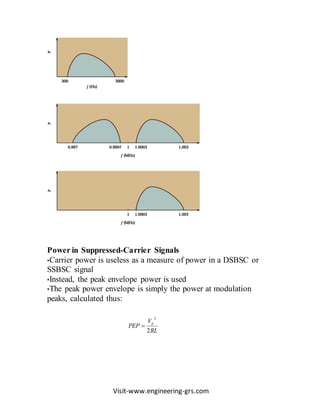
Power in Suppressed-Carrier Signals
•Carrier power is useless as a measure of power in a DSBSC or
SSBSC signal
•Instead, the peak envelope power is used
•The peak power envelope is simply the power at modulation
peaks, calculated thus:
RL
V
PEP
p
2
2

Visit-www.engineering-grs.com
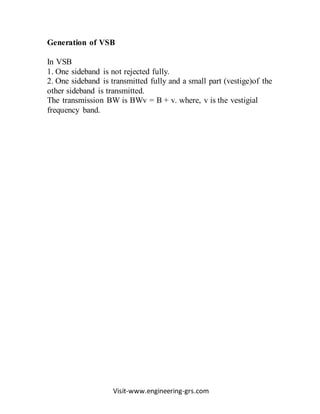
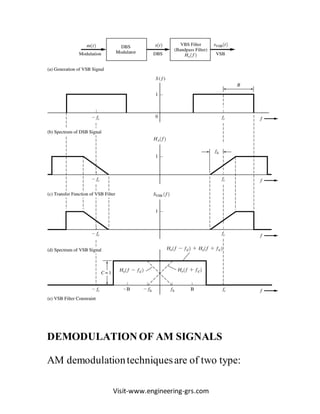
Generation of VSB
In VSB
1. One sideband is not rejected fully.
2. One sideband is transmitted fully and a small part (vestige)of the
other sideband is transmitted.
The transmission BW is BWv = B + v. where, v is the vestigial
frequency band.
Visit-www.engineering-grs.com
DEMODULATION OF AM SIGNALS
AM demodulationtechniquesare of two type:
Visit-www.engineering-grs.com
– coherent demodulation
– non coherent demodulation(Envelope
detection)
• Coherent demodulationrequires knowledge of
the transmitted carrier frequency and phase at the
receiver
• whereas non coherent detectionrequires no
phase information.
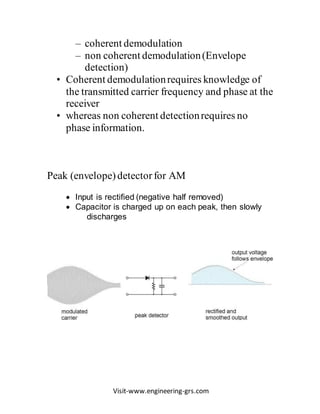
Peak (envelope)detectorfor AM
 Input is rectified (negative half removed)
 Capacitor is charged up on each peak, then slowly
discharges
Visit-www.engineering-grs.com
Product Detector:
Coherent demodulator
• It is a down converter circuit which converts the input band
pass signal to a base band signal
• If the input to the product detector is an AM signal of the
form R(t)cos(2Πfct+θr),the output of the multiplier can be
expressed as
v1(t)=R(t) cos(2Πfct+θr)A0 cos(2Πfct+θ0)
• where fc is the oscillator carrier frequency, and θr and θ0 are
the
• received signal phase and oscillator phases respectively.
• v1(t)=1/2 A0 R(t)cos(θr - θ0)+ 1/2 A0
R(t)cos[2Π2fct+θr+θ0]
• The output obtained after passing through a LPF is
Vout(t)=1/2 A0 R(t)cos(θr - θ0)=KR(t)
• Where K is a gain constant
Visit-www.engineering-grs.com
Non-coherent Envelope Detector:
• If the input to the envelope detector is represented as
R(t)cos(2Πfct+θr),then the output is given by
• Vout(t) = K|R(t)|
• where K is a gain constant.
• Envelope detectors are useful when the input signal power is
at least10dB greater than the noise power, whereas product
detectors are able to process AM signals within signal-to-
noise ratio well below 0 dB.
Visit-www.engineering-grs.com
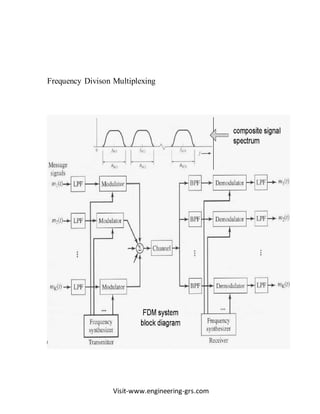
Frequency Divison Multiplexing

1 unit

  • 1.
    Visit-www.engineering-grs.com UNIT I AMPLITUDE MODULATIONSYSTEM Review of Spectral Characteristics of Periodic and aperiodic signals. Why use modulation? • “Carrying one signal on another” - uses carrier • Modulated carrier transmitted • Problems with transmitting baseband signals – Antennas difficult at low frequencies – Noise and interference at low frequencies – Can’t share with others • Easier to transmit carrier at higher frequency – Can choose convenient frequency • Antennas can be smaller • May be useful propagation effects – Fractional bandwidth much smaller • Antennas and other components easier to design • Can have many frequency channels
  • 2.
    Visit-www.engineering-grs.com GENERATION OF AMPLITUDEMODULATION AND DEMODULATION Introduction • Amplitude Modulation is the simplest and earliest form of transmitters • AM applications include broadcasting in medium- and high- frequency applications, CB radio, and aircraft communications Basic Amplitude Modulation The information signal varies the instantaneous amplitude of the carrier,it involves translating a base band signal to a band pass signal at frequencies that are very high when compared to the base band frequency. MESSAGE SIGNAL CARRIER SIGNAL
  • 3.
    Visit-www.engineering-grs.com AMPLITUDE MODULATED WAVE MathematicalRepresentation of an AM Wave. • In amplitude modulation, the amplitude of a high frequency carrier signal is varied in accordance to the instantaneous amplitude of the modulating message signal. • Let Accos(2пfct) be the carrier signal • Modulating signal = Am cos(2П fmt) • AM signal can be represented as
  • 4.
    Visit-www.engineering-grs.com SAM(t)=Ac[1+ Am/ Accos(2П fmt) ] cos(2П fct) SAM (t)=Ac[1+m(t)]cos(2П fct) • The modulation index k is given as the ratio of max amplitude of the modulating signal and the max amplitude of the carrier signal. It is also sometime expressed as % modulation • K = Am/Ac • Ac[1+ Am/ Ac cos(2П fmt) ] cos(2П fct)
  • 5.
    Visit-www.engineering-grs.com = Ac cos(2Пfct) +Am/2 cos(2П (Fc+ Fm)t)+ Am/2 cos(2П (Fc- Fm)t) • The modulated signal has a carrier freq, and upper and lower side bands. • SAM(t)=Ac[1+m(t)]cos(2П fct) • The power = Ac2/2+Am2/4+Am2/4 SAM(f)=1/2Ac[δ(f-fc)+M(f-fc)+ δ(f+fc)+M(f+fc)] AM Characteristics • AM is a nonlinear process • Sum and difference frequencies are created that carry the information. Full-Carrier AM: Time Domain •Modulation Index - The ratio between the amplitudes between the amplitudes of the modulating signal and carrier, expressed by the equation: m = Em/Ec
  • 6.
    Visit-www.engineering-grs.com Over modulation • Whenthe modulation index is greater than 1, over modulation is present Modulation Index for Multiple Modulating Frequencies • Two or more sine waves of different, uncorrelated frequencies modulating a single carrier is calculated by the equation m  m1 2  m2 2  
  • 7.
    Visit-www.engineering-grs.com Measurement of ModulationIndex Under modulated (<100%) 100% modulated Envelope Detector Can be used Envelope Detector Gives Distorted signal Over Modulated (>100%)
  • 8.
    Visit-www.engineering-grs.com Full-Carrier AM: FrequencyDomain fusb  fc  fm flsb  fc  fm Elsb  Eusb  mEc 2 Time Domain Frequency Domain Modulation Index m = 0.5 m = 1.0 m = 1.25
  • 9.
    Visit-www.engineering-grs.com Bandwidth •Signal bandwidth isan important characteristic of any modulation scheme •In general, a narrow bandwidth is desirable •Bandwidth is calculated by: Power Relationships •Power in a transmitter is important, but the most important power measurement is that of the portion that transmits the information •AM carriers remain unchanged with modulation and therefore are wasteful •Power in an AM transmitter is calculated according to the formula at the right. Pt  Pc 1 m2 2       • The total power in an AM signal is PAM= (½)Ac2 [1+2 <m(t)> + <m2(t)>] Where <> represents the average value. • If the modulating signal is m(t)=kcos(2Πfmt),then total power is mFB 2
  • 10.
    Visit-www.engineering-grs.com PAM= (½)Ac2[1+Pm]=Pc[1+(k2/2)] Where Pc=Ac2/2is the power in the carrier signal. Pm=<m2(t)> is the power in the modulating signal. and k is the modulation index. Quadrature AM and AM Stereo •Two carriers generated at the same frequency but 90º out of phase with each other allow transmission of two separate signals. •This approach is known as Quadrature AM (QUAM or QAM) •Recovery of the two signals is accomplished by synchronous detection by two balanced modulator
  • 11.
    Visit-www.engineering-grs.com Quadrature Operation Generation ofSuppressed-Carrier AM •Full-carrier AM is simple but not efficient •Removing the carrier before power amplification allows full transmitter power to be applied to the sidebands •Removing the carrier from a fully modulated AM systems results in a double-sideband suppressed-carrier transmission.  SSB Can be generated using two techniques 1. Phasing method 2. Filter Method
  • 12.
    Visit-www.engineering-grs.com Phasing method This methodis a special modulation type of IQ canonical form of Generalized transmitters Filter Method The filtering method is a special case in which RF processing (with a sideband filter) is used to form the equivalent g(t), instead of using base band processing to generate g(m) directly. The filter method is the most popular method because excellent sideband suppression can be obtained when a crystal oscillator is used for the sideband filter. Crystal filters are relatively inexpensive when produced in quantity at standard IF frequencies.
  • 13.
  • 14.
    Visit-www.engineering-grs.com Suppressed-Carrier Signal Single-Sideband AM •Thetwo sidebands of an AM signal are mirror images of one another •As a result, one of the sidebands is redundant •Using single-sideband suppressed-carrier transmission results in reduced bandwidth and therefore twice as many signals may be transmitted in the same spectrum allotment •Typically, a 3dB improvement in signal-to-noise ratio is achieved as a result of SSBSC
  • 15.
    Visit-www.engineering-grs.com DSBSC and SSBTransmission Ring Modulator  The DSB-SC can be generated using either the balanced modulator or the ‗ring-modulator‘.  The balanced modulator uses two identical AM generators along with an adder.  The two amplitude modulators have a common carrier with one of them modulating the input message , and the other modulating the inverted message .  Generation of AM is not simple, and to have two AM generators with identical operating conditions is extremely difficult. ]
  • 16.
    Visit-www.engineering-grs.com Properties of DSB-SCModulation: (a) There is a 180 phase reversal at the point where +A(t)=+m(t) goes negative. This is typical of DSB-SC modulation. (b) The bandwidth of the DSB-SC signal is double that of the message signal, that is, BWDSB-SC =2B (Hz). (c) The modulated signal is centered at the carrier frequency ωc with two identical sidebands (double-sideband) – the lower sideband (LSB) and the upper sideband (USB). Being identical, they both convey the same message component. (d) The spectrum contains no isolated carrier. Thus the name suppressed carrier. (e)The 180 phase reversal causes the positive (or negative) side of the envelope to have a shape different from that of the message signal. This is known as envelope distortion, which is typical of DSBSC modulation. (f) The power in the modulated signal is contained in all four sidebands
  • 17.
    Visit-www.engineering-grs.com Carrier Recovery forDSBSC Demodulation  Coherent reference for product detection of DSBSC can not be obtained by the use of ordinary PLL because there are no spectral line components at fc.
  • 18.
    Visit-www.engineering-grs.com  A squaringloop can also be used to obtain coherent reference carrier for product detection of DSBSC. A frequency divider is needed to bring the double carrier frequency to fc.
  • 19.
  • 20.
  • 21.
    Visit-www.engineering-grs.com Power in Suppressed-CarrierSignals •Carrier power is useless as a measure of power in a DSBSC or SSBSC signal •Instead, the peak envelope power is used •The peak power envelope is simply the power at modulation peaks, calculated thus: RL V PEP p 2 2 
  • 22.
    Visit-www.engineering-grs.com Generation of VSB InVSB 1. One sideband is not rejected fully. 2. One sideband is transmitted fully and a small part (vestige)of the other sideband is transmitted. The transmission BW is BWv = B + v. where, v is the vestigial frequency band.
  • 23.
    Visit-www.engineering-grs.com DEMODULATION OF AMSIGNALS AM demodulationtechniquesare of two type:
  • 24.
    Visit-www.engineering-grs.com – coherent demodulation –non coherent demodulation(Envelope detection) • Coherent demodulationrequires knowledge of the transmitted carrier frequency and phase at the receiver • whereas non coherent detectionrequires no phase information. Peak (envelope)detectorfor AM  Input is rectified (negative half removed)  Capacitor is charged up on each peak, then slowly discharges
  • 25.
    Visit-www.engineering-grs.com Product Detector: Coherent demodulator •It is a down converter circuit which converts the input band pass signal to a base band signal • If the input to the product detector is an AM signal of the form R(t)cos(2Πfct+θr),the output of the multiplier can be expressed as v1(t)=R(t) cos(2Πfct+θr)A0 cos(2Πfct+θ0) • where fc is the oscillator carrier frequency, and θr and θ0 are the • received signal phase and oscillator phases respectively. • v1(t)=1/2 A0 R(t)cos(θr - θ0)+ 1/2 A0 R(t)cos[2Π2fct+θr+θ0] • The output obtained after passing through a LPF is Vout(t)=1/2 A0 R(t)cos(θr - θ0)=KR(t) • Where K is a gain constant
  • 26.
    Visit-www.engineering-grs.com Non-coherent Envelope Detector: •If the input to the envelope detector is represented as R(t)cos(2Πfct+θr),then the output is given by • Vout(t) = K|R(t)| • where K is a gain constant. • Envelope detectors are useful when the input signal power is at least10dB greater than the noise power, whereas product detectors are able to process AM signals within signal-to- noise ratio well below 0 dB.
  • 27.