
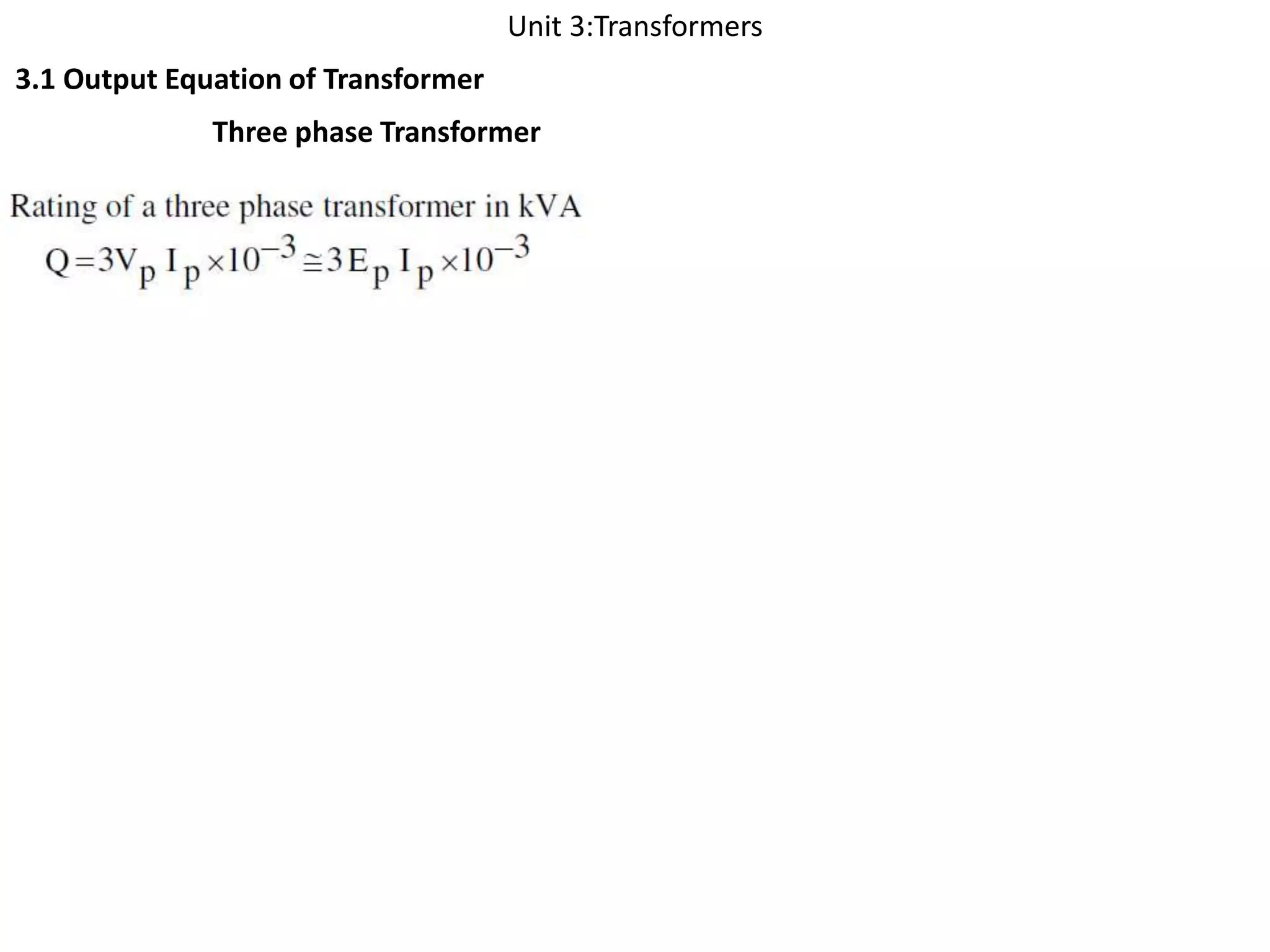
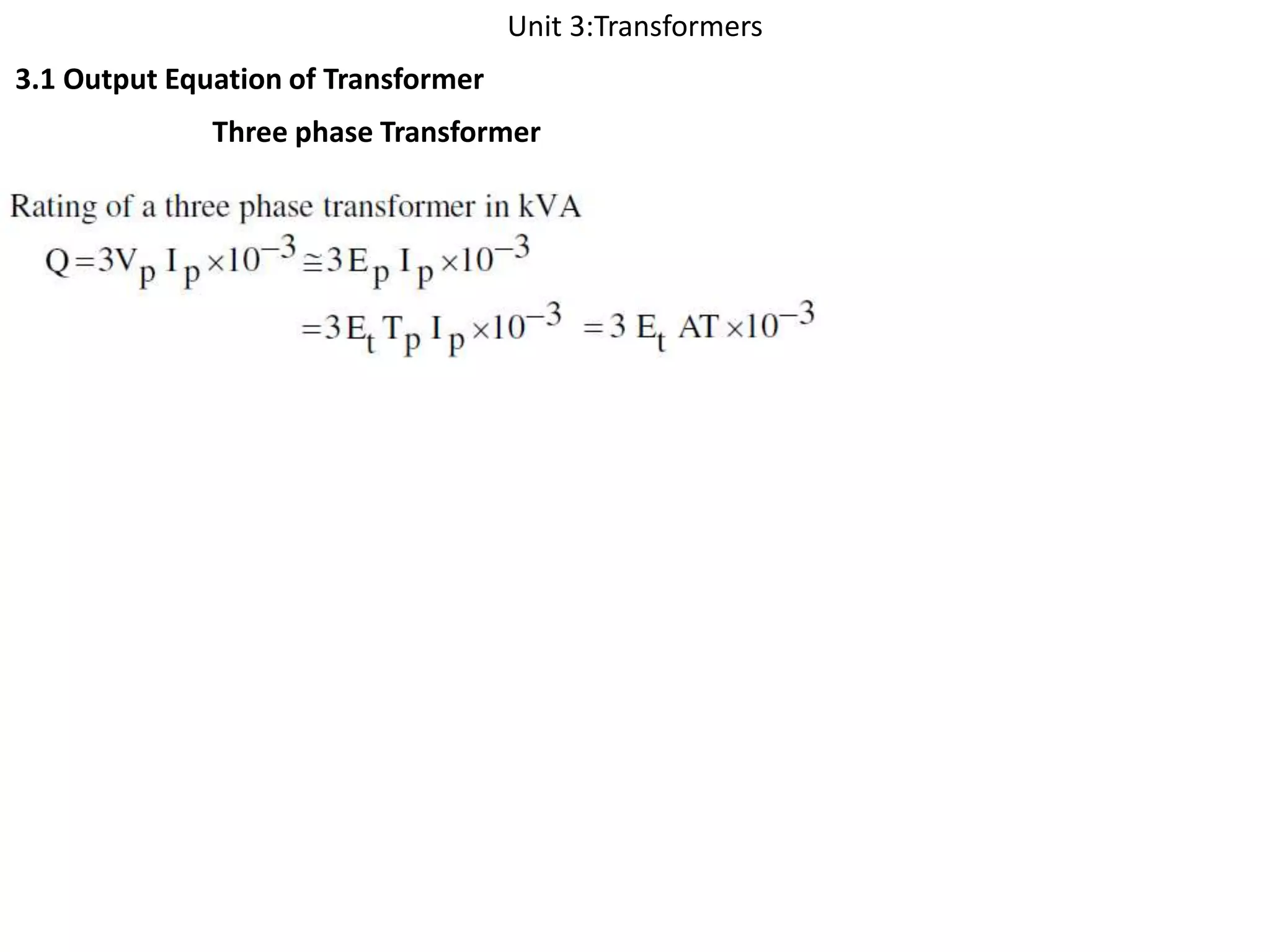
The document discusses the output equation of transformers. It explains that the voltage induced in a transformer winding is determined by factors like the number of turns and the source frequency. It also describes components of a single-phase and three-phase transformer like the primary and secondary windings contained in the transformer window. Equations are provided for calculating the copper area required based on current density and turns ratio between windings.
Unit 3:Transformers
3.1 OutputEquation of Transformer
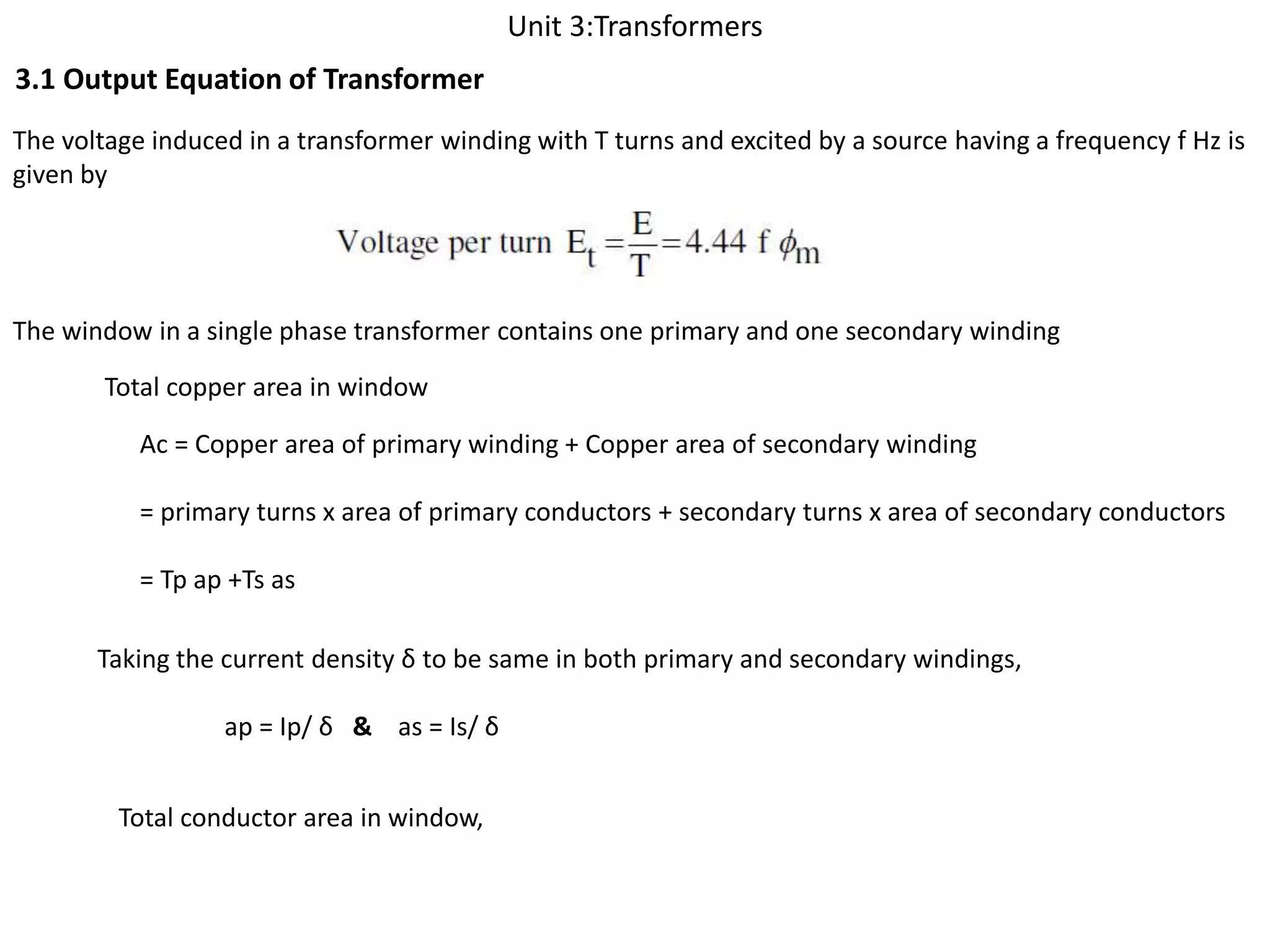
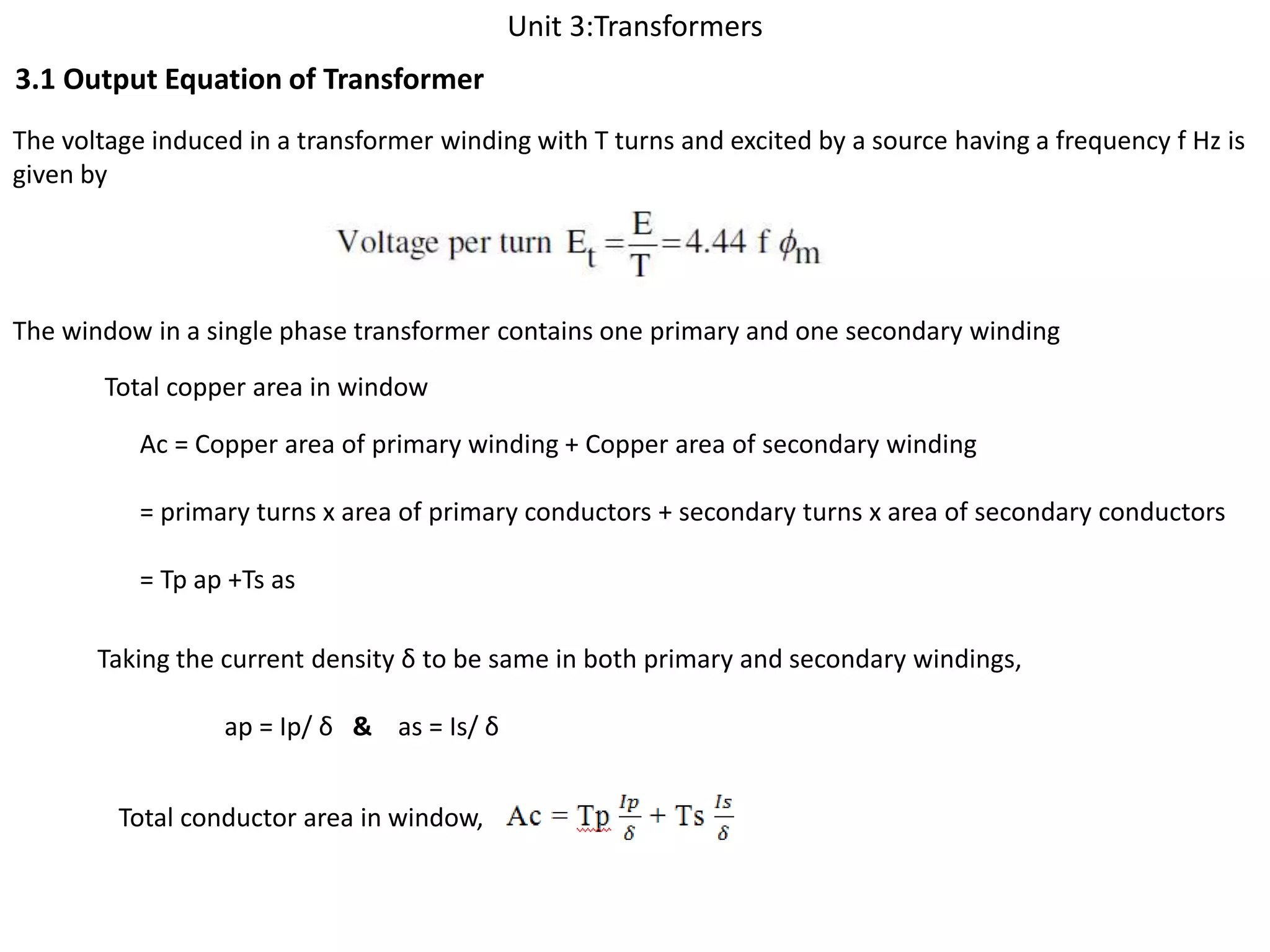
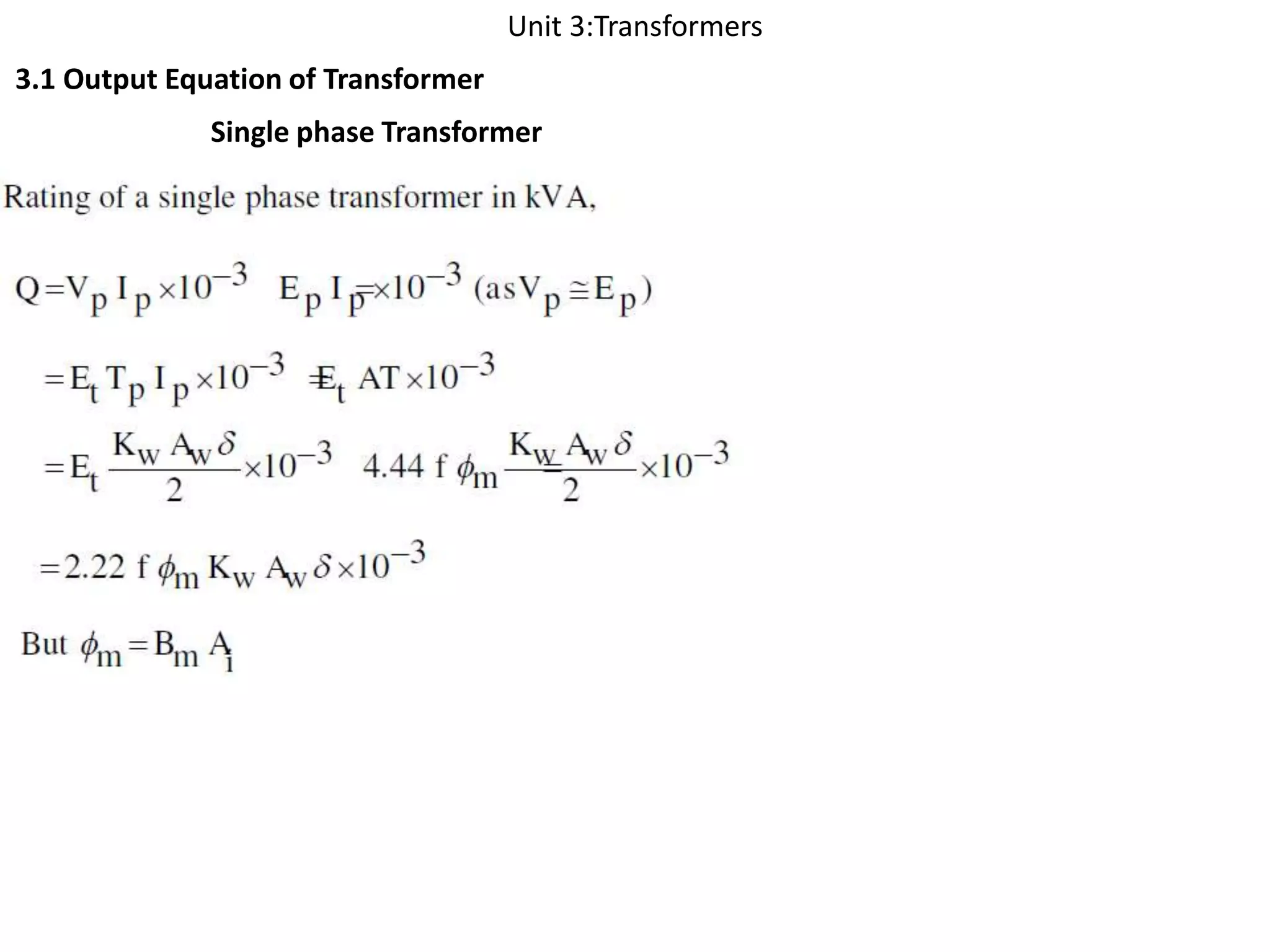
The voltage induced in a transformer winding with T turns and excited by a source having a frequency f Hz is
given by
3.
Unit 3:Transformers
3.1 OutputEquation of Transformer
The voltage induced in a transformer winding with T turns and excited by a source having a frequency f Hz is
given by
4.
Unit 3:Transformers
3.1 OutputEquation of Transformer
The voltage induced in a transformer winding with T turns and excited by a source having a frequency f Hz is
given by
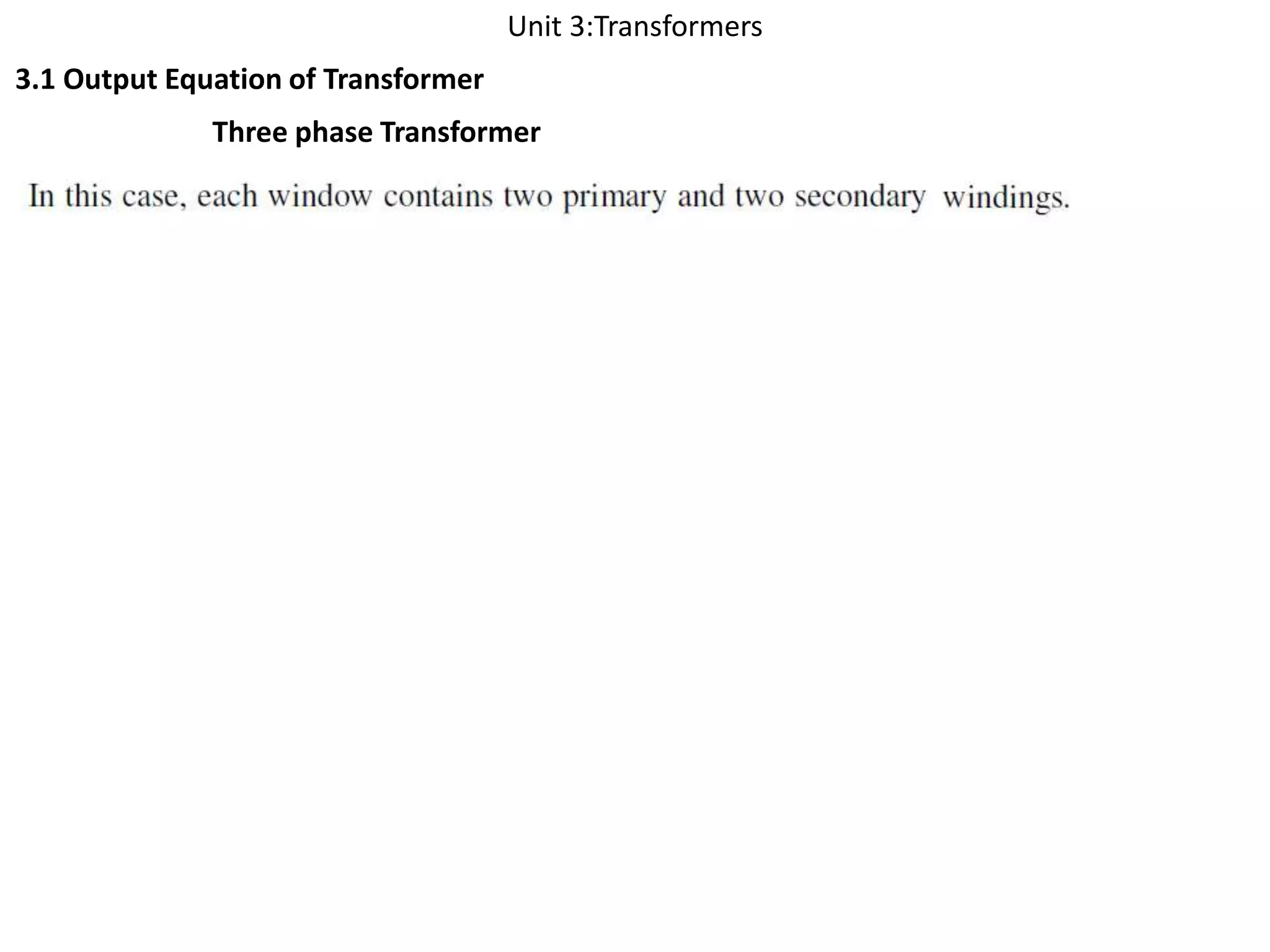
The window in a single phase transformer contains one primary and one secondary winding
5.
Unit 3:Transformers
3.1 OutputEquation of Transformer
The voltage induced in a transformer winding with T turns and excited by a source having a frequency f Hz is
given by
The window in a single phase transformer contains one primary and one secondary winding
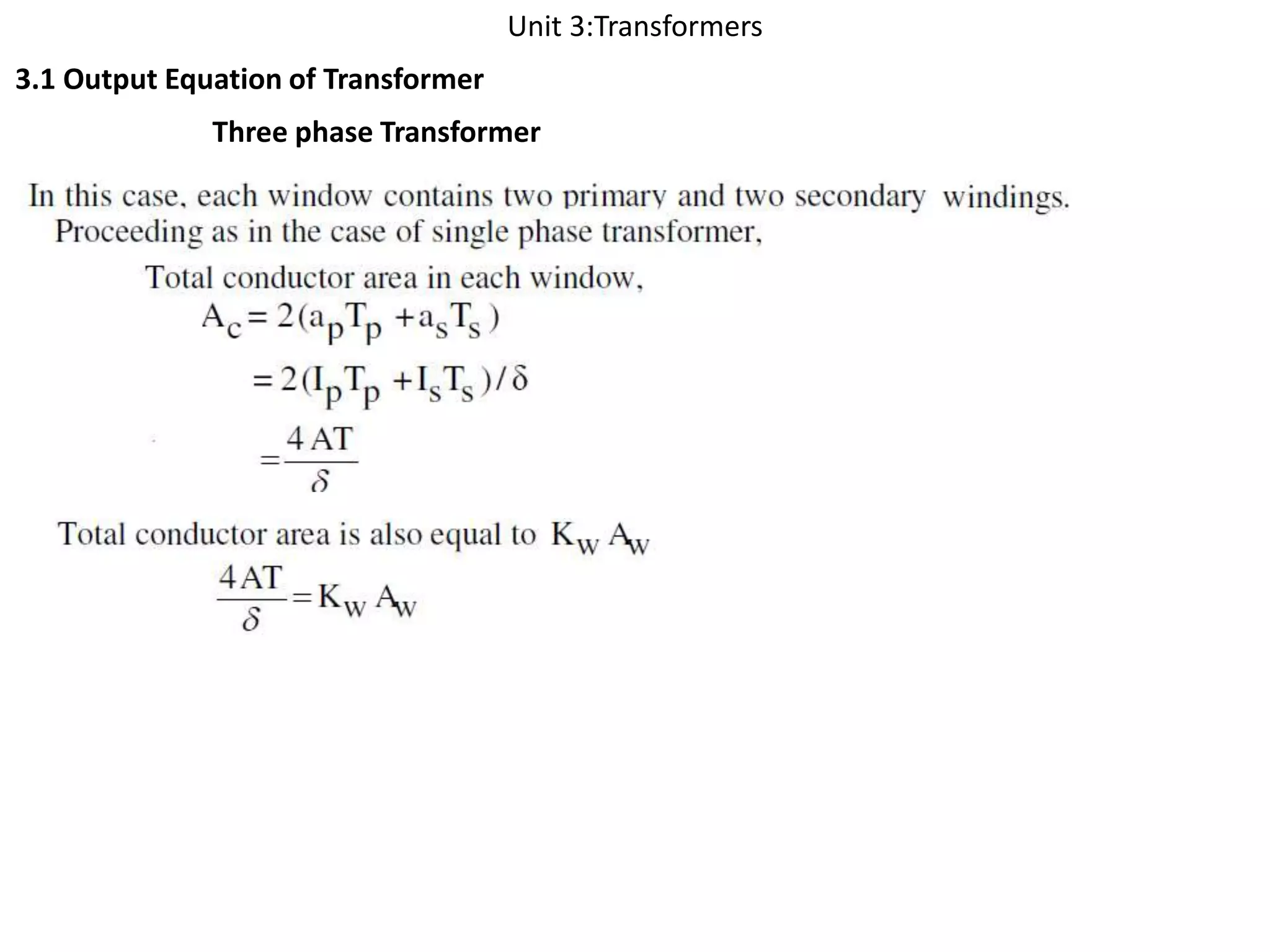
Total copper area in window
Ac = Copper area of primary winding + Copper area of secondary winding
= primary turns x area of primary conductors + secondary turns x area of secondary conductors
= Tp ap +Ts as
6.
Unit 3:Transformers
3.1 OutputEquation of Transformer
The voltage induced in a transformer winding with T turns and excited by a source having a frequency f Hz is
given by
The window in a single phase transformer contains one primary and one secondary winding
Total copper area in window
Ac = Copper area of primary winding + Copper area of secondary winding
= primary turns x area of primary conductors + secondary turns x area of secondary conductors
= Tp ap +Ts as
Taking the current density δ to be same in both primary and secondary windings,
ap = Ip/ δ & as = Is/ δ
7.
Unit 3:Transformers
3.1 OutputEquation of Transformer
The voltage induced in a transformer winding with T turns and excited by a source having a frequency f Hz is
given by
The window in a single phase transformer contains one primary and one secondary winding
Total copper area in window
Ac = Copper area of primary winding + Copper area of secondary winding
= primary turns x area of primary conductors + secondary turns x area of secondary conductors
= Tp ap +Ts as
Taking the current density δ to be same in both primary and secondary windings,
ap = Ip/ δ & as = Is/ δ
Total conductor area in window,
8.
Unit 3:Transformers
3.1 OutputEquation of Transformer
The voltage induced in a transformer winding with T turns and excited by a source having a frequency f Hz is
given by
The window in a single phase transformer contains one primary and one secondary winding
Total copper area in window
Ac = Copper area of primary winding + Copper area of secondary winding
= primary turns x area of primary conductors + secondary turns x area of secondary conductors
= Tp ap +Ts as
Taking the current density δ to be same in both primary and secondary windings,
ap = Ip/ δ & as = Is/ δ
Total conductor area in window,
Unit 3:Transformers
3.1 OutputEquation of Transformer
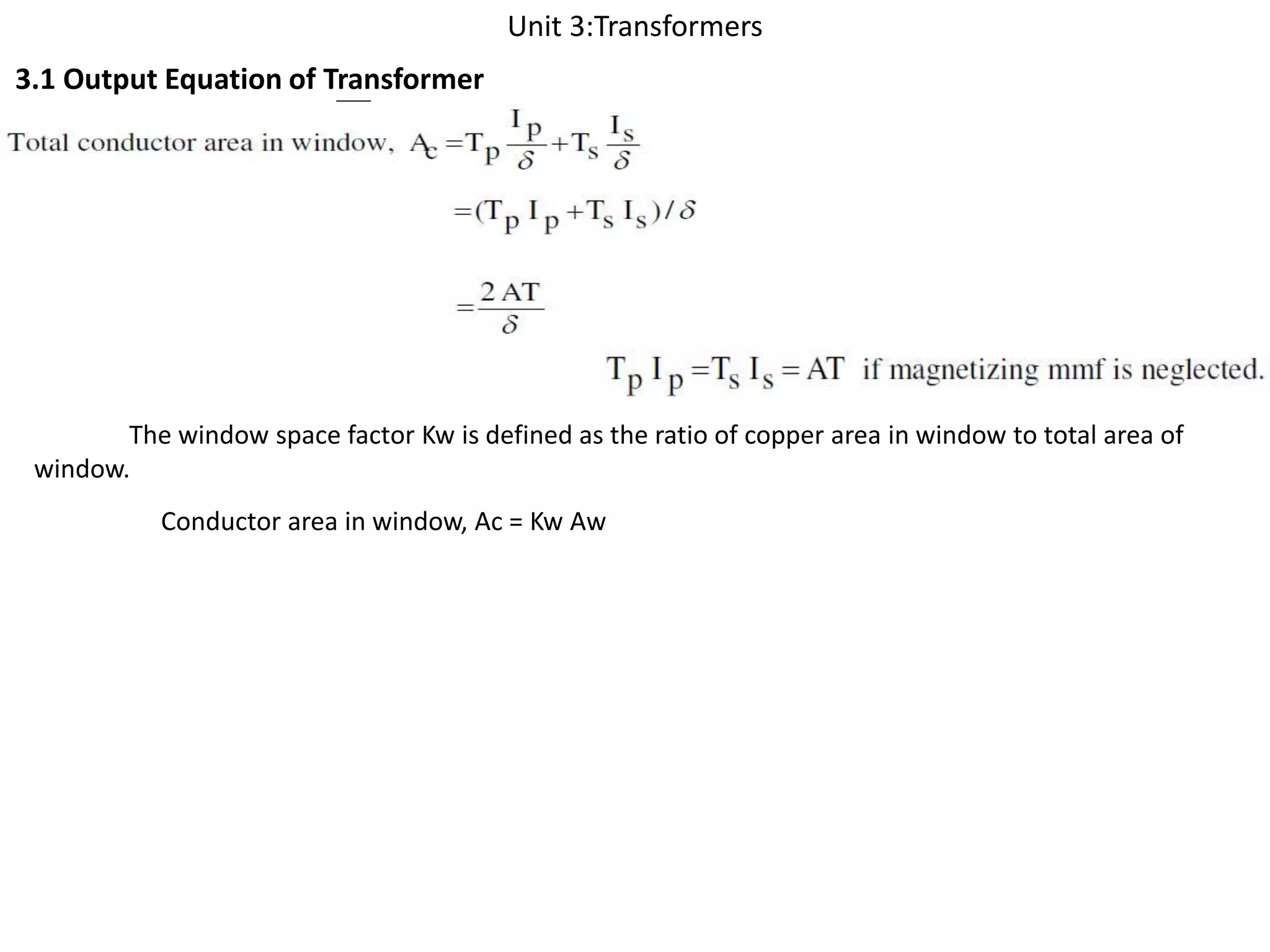
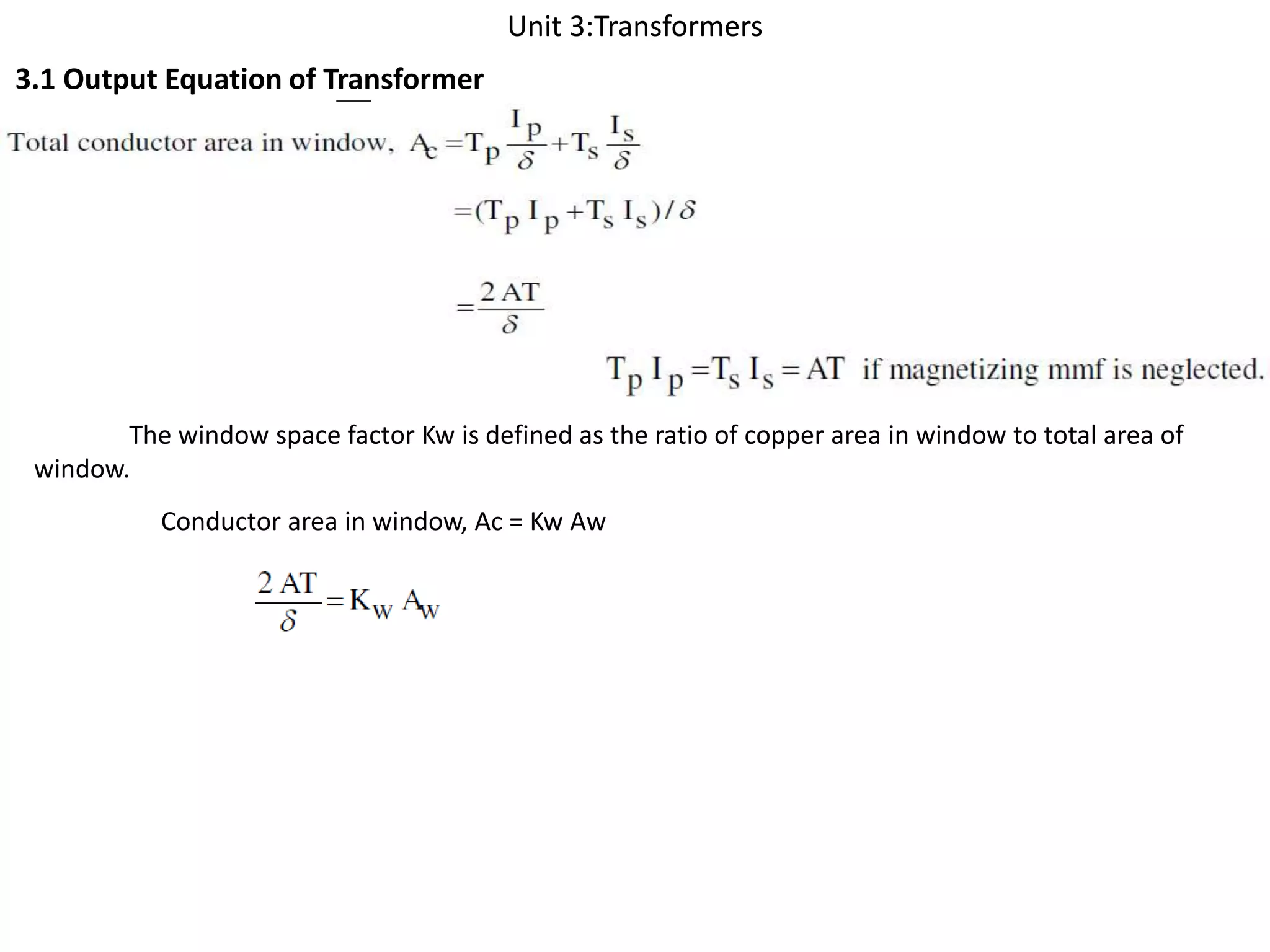
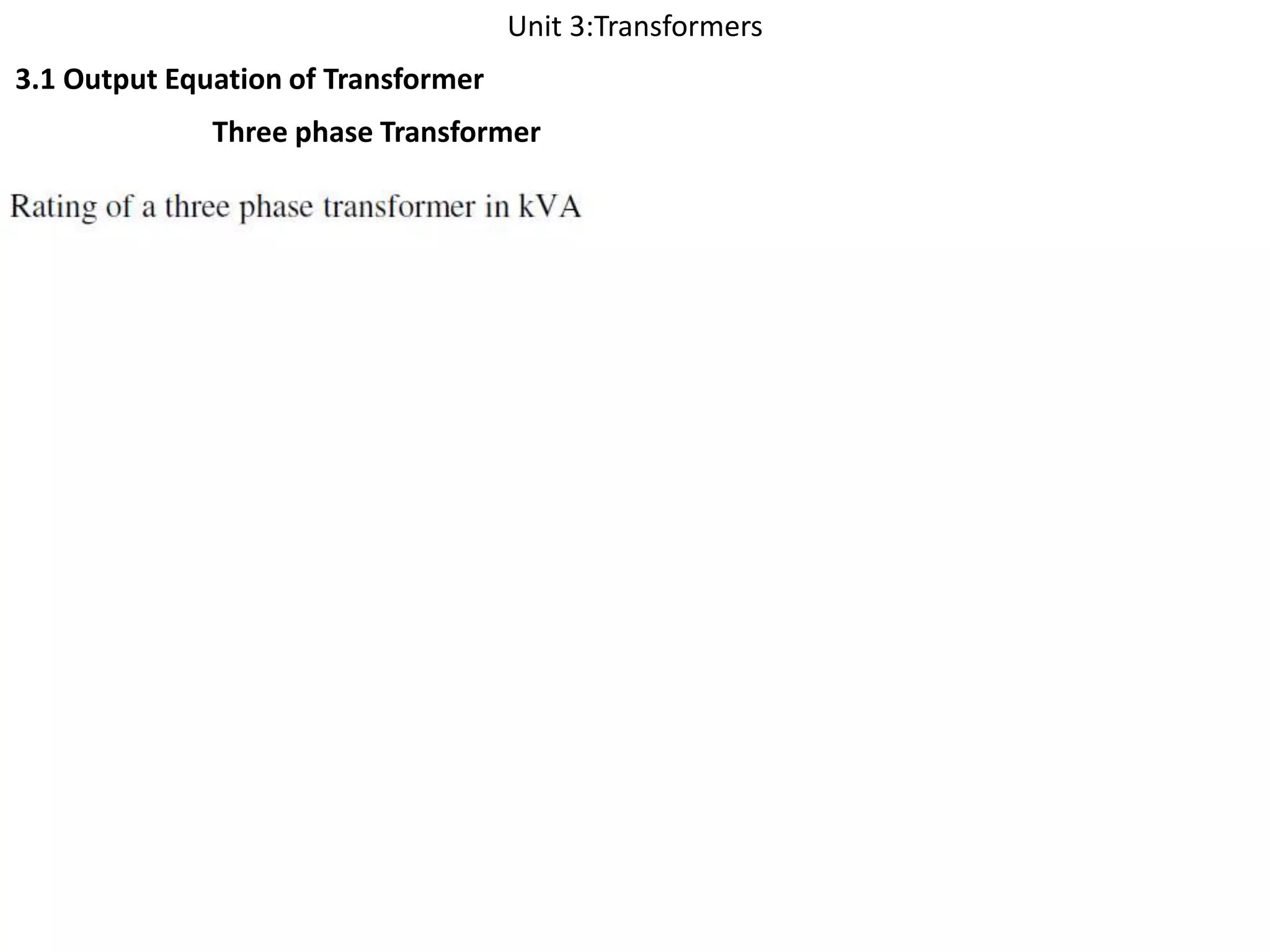
The window space factor Kw is defined as the ratio of copper area in window to total area of
window.
Conductor area in window, Ac = Kw Aw
12.
Unit 3:Transformers
3.1 OutputEquation of Transformer
The window space factor Kw is defined as the ratio of copper area in window to total area of
window.
Conductor area in window, Ac = Kw Aw
13.
Unit 3:Transformers
3.1 OutputEquation of Transformer
The window space factor Kw is defined as the ratio of copper area in window to total area of
window.
Conductor area in window, Ac = Kw Aw