TO PIC:
PATHOLOGY OF
MEMORY &
INTELACTUAL
PATHOLOGY
NAME: MODI SHIVAM
WHAT IS MEMORY?
• “Memory is the process of maintaining information over
time.”
• “Memory is the means by which we draw on our past
experiences in order to use this information in the
present’ (Sternberg, 1999)
• STAGES OF MEMORIS:
ENCODING STORAGE RETRIEVAL
STAGES OF MEMORY
Encoding
Transforming information into a form that can be stored
in short-term or long-term memory
• Encoding or Registration is the processing and combining of
received information.
• The process of encoding need not be deliberate one wherein a
person tries to commit something to memory by rehearsal.
• Instead encoding happens even without a person’s awareness.
STAGES OF MEMORIES
STORAGE
The act of maintaining information in memory
• Consolidation
–A physiological change in the brain that must take
place for encoded information to be stored in
memory
• Storage is the creation of permanent record of the encoded
information
• This process involves maintaining the coded information within
memory system.
• Many pieces of information are stored over long period of time.
STAGES OF MEMORIES
Retrieval or Recall
–The act of bringing to mind material that has
been stored in memory
• Retrieval or recall is calling back the stored
information in response to some cue for use in
process or activity
• This is the final process of memory that involves
finding the information in storage and then bringing
to awareness or consciousness
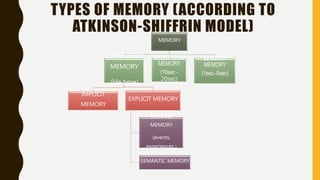
TYPES OF MEMORY (ACCORDING TO
ATKINSON-SHIFFRIN MODEL)
MEMORY
SENSORY
MEMORY
(1sec.-5sec)
SHORT-TERM
MEMORY
(10sec -
20sec)
LONG-TERM
MEMORY
(life time)
EXPLICIT MEMORY
EPISODIC
MEMORY
(events,
experiences )
SEMANTIC MEMORY
IMPLICIT
MEMORY
SEQUENCE OF MEMORY PATH IN THE
BRAIN
SENSORY MEMORY
• Sensory memory is affiliated with the
transduction of energy.
• The memory system that holds information
coming in through the senses for a period
ranging from a fraction of a second to
several seconds
–Visual sensory memory--less than ½
second
–Auditory sensory memory--lasts 2 to 3
seconds
SHORT TERM MEMORY
• Also called working memory--the mental workspace a person uses to keep in mind tasks
being thought about at any given moment
• Limits
– 5 + 2 units (earlier thought to be 7 + 2
– 15-30 seconds without rehearsal
• Chunking
• Grouping information to make it easier to remember
• Getting information into STM
– Attention
• Keeping information in STM
– Organization (advance organizer)
– Repetition (maintenance rehearsal)
– An interruption to repetition can cause information to be lost in just a few seconds
• Displacement
– The event that occurs when short-term memory is holding its maximum and each
new item entering short-term memory pushes out an existing item
LONG TERM MEMORY
•The relatively permanent memory system with a
virtually unlimited capacity
•Elaborative rehearsal
–A technique used to encode information into
long-term memory by considering its
meaning and associating it with other
information already stored in long-term
memory
PROCESS OF REMEMBER
1. Registration is the capacity to add new materials to the memory
store. It can take place by a process of learning in which there is a
continuous presentation or material, or registration.
2. Retention is the ability to store knowledge which can
subsequently be returned to consciousness.
3. Retrieval is the capacity to obtain stored material from the
memory, its loss denotes an organic impairment.
4. Recall is the return of the stored, remembered information into
consciousness at the chosen moment.
5. Recognition is the sense of familiarity which accompanies the
return of stored material to consciousness.
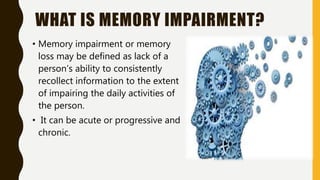
WHAT IS MEMORY IMPAIRMENT?
• Memory impairment or memory
loss may be defined as lack of a
person’s ability to consistently
recollect information to the extent
of impairing the daily activities of
the person.
• It can be acute or progressive and
chronic.
CAUSES OF MEMORY IMPAIRMENT:
• Acute or sudden memory loss is usually caused by brain trauma,
stroke, or as a side effect of medications like statin drugs and
chemotherapy, brain infections, brain surgery, or Electroconvulsive
Therapy. Acute memory impairment is not as prevalent as
progressive as chronic memory loss.
• Most progressive memory impairments are permanent and may be
caused by various underlying factors including:
• Long standing diseases like meningitis or epilepsy.
• Abuse of psychedelic drugs
• Certain forms of mental illnesses
• Certain types of brain tumours or cancers.
• As a symptom of diseases such as Alzheimer’s disease, Parkinson’s
disease, and Huntington’s disease.
• Pregnancy can at times cause transient mild memory impairment.
TYPES OF MEMORY IMPAIRMENT
MEMORY
IMPAIRMENT
AMNESIA
PARAMNESIA
HYPERAMNESIA
WHAT IS AMNESIA?
• Amnesia is defined as partial or
total inability to recall past
experiences and events and its
origin may be organic or
psychogenic.
• Failure to recall occur DUE TO :
normal memory decay
interference from related
material
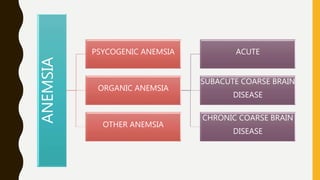
ANEMSIA PSYCOGENIC ANEMSIA
ORGANIC ANEMSIA
ACUTE
SUBACUTE COARSE BRAIN
DISEASE
CHRONIC COARSE BRAIN
DISEASE
OTHER ANEMSIA
PSYCHOGENIC AMNESIA
• Dissociative or hysterical amnesia is the sudden amnesia that occurs
during periods of extreme trauma and can last for hours or even days.
• Associated fugue or wandering state in which the subject travels to
another town or country
• Katathymic amnesia/motivated forgetting is the inability to recall specific
painful memories(occur due to defence mechanism of repression)
personal identity such as name, address and history
personal events
the ability to perform complex behaviours is maintained.
the person behaves appropriately to their background and education.
ORGANIC AMNESIA
•Organic amnesia has 3 subtypes
includes,
1. Acute brain disease
+ Retrograde amnesia
+ Anterograde amnesia
2. Subzcute brain disease
3. Chronic brain disease
ORGANIC AMNESIA:
• Acute brain disease
+ In this condition memory is poor owing to disorders of
perception and attention.
+ In acute head injury there is a amnesia, known as retrograde
amnesia, that embraces the events just before the injury.
+ This period is no longer than a few minutes but occasionally
may be longer, especially in subacute conditions.
+ Anterograde amnesia is amnesia for events occuring after the
injury.
+ Black outs are circumscribed periods of anterograde amnesia
experienced particularly by those who are alcohol dependent
during and following bouts of drinking
ORGANIC AMNESIA
• SUBACUTE BRAIN DISEASE
• The characteristic memory disorder is the amnestic
state in which the patient is unable to register new
memories.
• Korsakoff’s syndrome is the amnestic syndrome
caused by thiamine deficiency, but other causes
include cerebrovascular disease, multiple sclerosis,
transient global amnesia, head injury and
electroconvulsive treatment (ECT).
ORGANIC AMNESIA
• CHRONIC BRAIN DISEASE
Patients with amnesia or those with korsakoff’s syndrome
usually have a loss of memory extending back into the recent
past for a year or so.
Patients with a progressive chronic brain disease have an
amnesia extending over many years, though the memory for
recent events is lost before that for remote events.
This was pointed by Ribot and is known as Ribot’s law
memory regression.
OTHER AMNISIAS
• Anxiety amnesia occurs when there is anxious
preoccupation or poor concentration in disorders such
as depressive illness or generalized anxiety.
• More severe forms of amnesia in depressive disorders
resemble dementia and are known as depressive
pseudodementia.
• Amnesia’s in anxiety and depressive disorders are
generally caused by impaired concentration and
resolve once the underlying disorder is treated
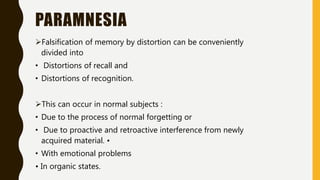
PARAMNESIA
Falsification of memory by distortion can be conveniently
divided into
• Distortions of recall and
• Distortions of recognition.
This can occur in normal subjects :
• Due to the process of normal forgetting or
• Due to proactive and retroactive interference from newly
acquired material. •
• With emotional problems
• In organic states.
DISTORTION OF RECOGNITION
• False reconnaissance
• False reconnaissance is defined as false recognition or misidentification
and it can occur in organic psychoses and in acute and chronic
schizophrenia. It may be positive when the patient recognises strangers
as their friends and relatives. In confusional states and acute
schizophrenia, at most, a few people are positively
• In negative misidentification the patient insists that friends and relatives
are not whom they say they are and that they are strangers in disguise.
Some patients assert that some or all people are doubles of the real
people whom they claim to be. This is known as Capgras syndrome and
occurs in schizophrenia and in dementia
HYPERAMNISIA
• The opposite of amnesia and paramnesia can also occur and is termed
hyperamnesia, or exaggerated registration, retention and recall.
• Flashbulb memories are those memories that are associated with
intense emotion. They are unusually vivid, detailed and long-lasting. For
e.g., many people can recall where and what they were doing when they
heard of some news.
• Flashbacks are sudden intrusive memories that are associated with the
cognitive and emotional experiences of a traumatic event such as an
accident. It may lead to acting and/or feeling that the event is recurring
and attempts have been made to use this as a defence in some murder
trials. It is regarded as one of the characteristic symptoms of post-
traumatic stress disorder but is also associated with substance misuse
STRATEGIES TO IMPROVE MEMORY
1. Biological ways.
Biologically, the best way to improve memory seems
to be to increase the supply of oxygen to the brain.
2. Cognitive Strategies
There are several principles that are relevant to
improve your memory about different things. Relevant
to this concern include elaborative rehearsal, level of
processing, organization and chunking, encoding,
minimizing interference and detection of discrepant
information
Memorydisorder psycology

Memorydisorder psycology

  • 1.
    TO PIC: PATHOLOGY OF MEMORY& INTELACTUAL PATHOLOGY NAME: MODI SHIVAM
  • 2.
    WHAT IS MEMORY? •“Memory is the process of maintaining information over time.” • “Memory is the means by which we draw on our past experiences in order to use this information in the present’ (Sternberg, 1999) • STAGES OF MEMORIS: ENCODING STORAGE RETRIEVAL
  • 3.
    STAGES OF MEMORY Encoding Transforminginformation into a form that can be stored in short-term or long-term memory • Encoding or Registration is the processing and combining of received information. • The process of encoding need not be deliberate one wherein a person tries to commit something to memory by rehearsal. • Instead encoding happens even without a person’s awareness.
  • 4.
    STAGES OF MEMORIES STORAGE Theact of maintaining information in memory • Consolidation –A physiological change in the brain that must take place for encoded information to be stored in memory • Storage is the creation of permanent record of the encoded information • This process involves maintaining the coded information within memory system. • Many pieces of information are stored over long period of time.
  • 5.
    STAGES OF MEMORIES Retrievalor Recall –The act of bringing to mind material that has been stored in memory • Retrieval or recall is calling back the stored information in response to some cue for use in process or activity • This is the final process of memory that involves finding the information in storage and then bringing to awareness or consciousness
  • 6.
    TYPES OF MEMORY(ACCORDING TO ATKINSON-SHIFFRIN MODEL) MEMORY SENSORY MEMORY (1sec.-5sec) SHORT-TERM MEMORY (10sec - 20sec) LONG-TERM MEMORY (life time) EXPLICIT MEMORY EPISODIC MEMORY (events, experiences ) SEMANTIC MEMORY IMPLICIT MEMORY
  • 7.
    SEQUENCE OF MEMORYPATH IN THE BRAIN
  • 8.
    SENSORY MEMORY • Sensorymemory is affiliated with the transduction of energy. • The memory system that holds information coming in through the senses for a period ranging from a fraction of a second to several seconds –Visual sensory memory--less than ½ second –Auditory sensory memory--lasts 2 to 3 seconds
  • 9.
    SHORT TERM MEMORY •Also called working memory--the mental workspace a person uses to keep in mind tasks being thought about at any given moment • Limits – 5 + 2 units (earlier thought to be 7 + 2 – 15-30 seconds without rehearsal • Chunking • Grouping information to make it easier to remember • Getting information into STM – Attention • Keeping information in STM – Organization (advance organizer) – Repetition (maintenance rehearsal) – An interruption to repetition can cause information to be lost in just a few seconds • Displacement – The event that occurs when short-term memory is holding its maximum and each new item entering short-term memory pushes out an existing item
  • 10.
    LONG TERM MEMORY •Therelatively permanent memory system with a virtually unlimited capacity •Elaborative rehearsal –A technique used to encode information into long-term memory by considering its meaning and associating it with other information already stored in long-term memory
  • 11.
    PROCESS OF REMEMBER 1.Registration is the capacity to add new materials to the memory store. It can take place by a process of learning in which there is a continuous presentation or material, or registration. 2. Retention is the ability to store knowledge which can subsequently be returned to consciousness. 3. Retrieval is the capacity to obtain stored material from the memory, its loss denotes an organic impairment. 4. Recall is the return of the stored, remembered information into consciousness at the chosen moment. 5. Recognition is the sense of familiarity which accompanies the return of stored material to consciousness.
  • 12.
    WHAT IS MEMORYIMPAIRMENT? • Memory impairment or memory loss may be defined as lack of a person’s ability to consistently recollect information to the extent of impairing the daily activities of the person. • It can be acute or progressive and chronic.
  • 13.
    CAUSES OF MEMORYIMPAIRMENT: • Acute or sudden memory loss is usually caused by brain trauma, stroke, or as a side effect of medications like statin drugs and chemotherapy, brain infections, brain surgery, or Electroconvulsive Therapy. Acute memory impairment is not as prevalent as progressive as chronic memory loss. • Most progressive memory impairments are permanent and may be caused by various underlying factors including: • Long standing diseases like meningitis or epilepsy. • Abuse of psychedelic drugs • Certain forms of mental illnesses • Certain types of brain tumours or cancers. • As a symptom of diseases such as Alzheimer’s disease, Parkinson’s disease, and Huntington’s disease. • Pregnancy can at times cause transient mild memory impairment.
  • 14.
    TYPES OF MEMORYIMPAIRMENT MEMORY IMPAIRMENT AMNESIA PARAMNESIA HYPERAMNESIA
  • 15.
    WHAT IS AMNESIA? •Amnesia is defined as partial or total inability to recall past experiences and events and its origin may be organic or psychogenic. • Failure to recall occur DUE TO : normal memory decay interference from related material
  • 16.
    ANEMSIA PSYCOGENIC ANEMSIA ORGANICANEMSIA ACUTE SUBACUTE COARSE BRAIN DISEASE CHRONIC COARSE BRAIN DISEASE OTHER ANEMSIA
  • 17.
    PSYCHOGENIC AMNESIA • Dissociativeor hysterical amnesia is the sudden amnesia that occurs during periods of extreme trauma and can last for hours or even days. • Associated fugue or wandering state in which the subject travels to another town or country • Katathymic amnesia/motivated forgetting is the inability to recall specific painful memories(occur due to defence mechanism of repression) personal identity such as name, address and history personal events the ability to perform complex behaviours is maintained. the person behaves appropriately to their background and education.
  • 18.
    ORGANIC AMNESIA •Organic amnesiahas 3 subtypes includes, 1. Acute brain disease + Retrograde amnesia + Anterograde amnesia 2. Subzcute brain disease 3. Chronic brain disease
  • 19.
    ORGANIC AMNESIA: • Acutebrain disease + In this condition memory is poor owing to disorders of perception and attention. + In acute head injury there is a amnesia, known as retrograde amnesia, that embraces the events just before the injury. + This period is no longer than a few minutes but occasionally may be longer, especially in subacute conditions. + Anterograde amnesia is amnesia for events occuring after the injury. + Black outs are circumscribed periods of anterograde amnesia experienced particularly by those who are alcohol dependent during and following bouts of drinking
  • 20.
    ORGANIC AMNESIA • SUBACUTEBRAIN DISEASE • The characteristic memory disorder is the amnestic state in which the patient is unable to register new memories. • Korsakoff’s syndrome is the amnestic syndrome caused by thiamine deficiency, but other causes include cerebrovascular disease, multiple sclerosis, transient global amnesia, head injury and electroconvulsive treatment (ECT).
  • 21.
    ORGANIC AMNESIA • CHRONICBRAIN DISEASE Patients with amnesia or those with korsakoff’s syndrome usually have a loss of memory extending back into the recent past for a year or so. Patients with a progressive chronic brain disease have an amnesia extending over many years, though the memory for recent events is lost before that for remote events. This was pointed by Ribot and is known as Ribot’s law memory regression.
  • 22.
    OTHER AMNISIAS • Anxietyamnesia occurs when there is anxious preoccupation or poor concentration in disorders such as depressive illness or generalized anxiety. • More severe forms of amnesia in depressive disorders resemble dementia and are known as depressive pseudodementia. • Amnesia’s in anxiety and depressive disorders are generally caused by impaired concentration and resolve once the underlying disorder is treated
  • 23.
    PARAMNESIA Falsification of memoryby distortion can be conveniently divided into • Distortions of recall and • Distortions of recognition. This can occur in normal subjects : • Due to the process of normal forgetting or • Due to proactive and retroactive interference from newly acquired material. • • With emotional problems • In organic states.
  • 25.
    DISTORTION OF RECOGNITION •False reconnaissance • False reconnaissance is defined as false recognition or misidentification and it can occur in organic psychoses and in acute and chronic schizophrenia. It may be positive when the patient recognises strangers as their friends and relatives. In confusional states and acute schizophrenia, at most, a few people are positively • In negative misidentification the patient insists that friends and relatives are not whom they say they are and that they are strangers in disguise. Some patients assert that some or all people are doubles of the real people whom they claim to be. This is known as Capgras syndrome and occurs in schizophrenia and in dementia
  • 26.
    HYPERAMNISIA • The oppositeof amnesia and paramnesia can also occur and is termed hyperamnesia, or exaggerated registration, retention and recall. • Flashbulb memories are those memories that are associated with intense emotion. They are unusually vivid, detailed and long-lasting. For e.g., many people can recall where and what they were doing when they heard of some news. • Flashbacks are sudden intrusive memories that are associated with the cognitive and emotional experiences of a traumatic event such as an accident. It may lead to acting and/or feeling that the event is recurring and attempts have been made to use this as a defence in some murder trials. It is regarded as one of the characteristic symptoms of post- traumatic stress disorder but is also associated with substance misuse
  • 27.
    STRATEGIES TO IMPROVEMEMORY 1. Biological ways. Biologically, the best way to improve memory seems to be to increase the supply of oxygen to the brain. 2. Cognitive Strategies There are several principles that are relevant to improve your memory about different things. Relevant to this concern include elaborative rehearsal, level of processing, organization and chunking, encoding, minimizing interference and detection of discrepant information