Aminoglycosides and
Macrolides
Dr Mohit Kher
Assistant Professor
Pharmacology, ESIC
Aminoglycosides
Drugs includes:
• Streptomycin
• Gentamicin
• Kanamycin
• Tobramycin
• Amikacin
• Sisomicin
• Netilmicin
• Neomycin
• Framycetin.
Common properties
• These drugs exhibit CDK and have prolonged PAE, therefore are administered as
single daily dose.
• Aminoglycosides are bactericidal inhibitors of protein synthesis (faulty protein).
• These bind to 30S and 50S ribosomes and freeze initiation, interfere with polysome
formation and cause misreading of mRNA code.
• Their penetration across the cell wall is dependent on the oxygen dependent transport,
therefore these drugs are inactive against anaerobes.
• Activity only against gram negative organisms.
• Ionized or water soluble → Poor oral absorption → IV/IM route
• Cell wall synthesis inhibitors (penicillin & vancomycin) → Increase
entry of aminoglycosides into bacteria → Frequently prescribed
• In a solution penicillin can inactivates aminoglycosides
Pharmacokinetics
• These are not absorbed orally and do not cross blood brain barrier.
• These are excreted primarily by glomerular filtration and the dose should be decreased in renal
insufficiency.
• Resistance to these drugs develops due to the formation of inactivating enzymes which acetylate,
phosphorylate or adenylate the aminoglycosides.
• All aminoglycosides except amikacin and netilmicin are susceptible to these enzymes.
• Amikacin and netilmicin may be effective against organisms resistant to other aminoglycosides.
Clinical uses:
• Gentamicin, tobramycin (inhalational) and amikacin are effective against gram negative organisms
including pseudomonas (except salmonella). However these are not reliable for gram positive
organisms if used alone.
• Aminoglycosides produce synergistic effects against gram positive bacteria when combined with β-
lactams or vancomycin.
• Streptomycin is the first line drug for the treatment of tuberculosis, plague and tularemia.
• Amikacin is a second line drug for the treatment of tuberculosis and is also used for MDR
tuberculosis.
• Netilmicin is used for serious infections only.
• Neomycin and framycetin are used only topically because of their high toxic
potential.
• Neomycin can also be used orally for gut sterilization in hepatic encephalopathy.
(Current DOC: Rifaximin)
• Spectinomycin is a structurally related drug to aminoglycosides, which act on 30S
subunit and inhibits translocation. It is DOC for resistant gonorrhea.
TOXICITY
Ototoxicity
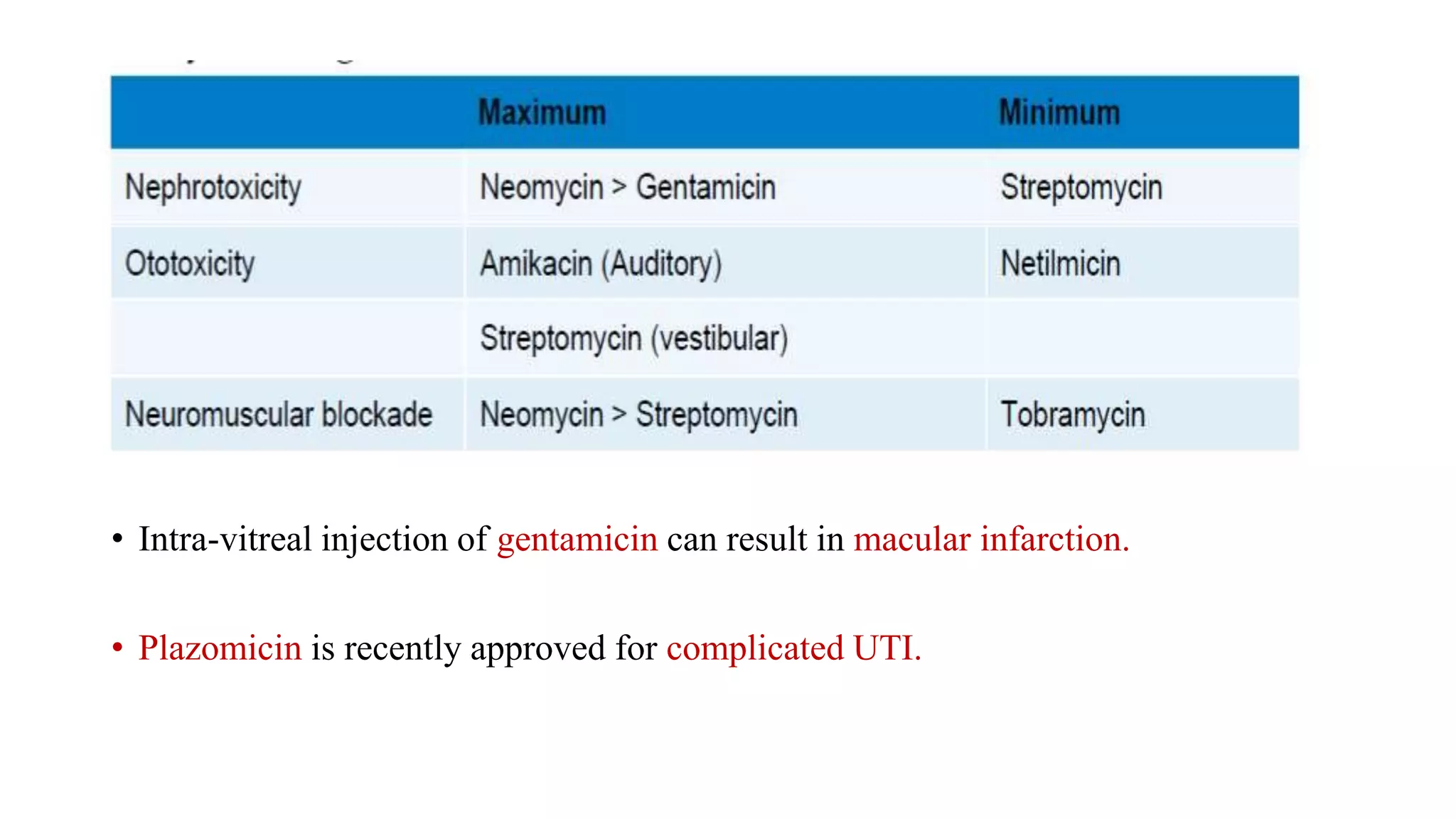
• Hearing loss: Kanamycin, amikacin (max) and neomycin (KAN)
• Vestibular dysfunction: Streptomycin (max) and gentamicin
• Tobramycin cause both abnormalities equally.
• Ototoxicity is largely irreversible.
• Very early changes can be reversed by Ca2+.
Nephrotoxicity
• Reversible
• Risk factors: Hypokalemia, pre-existing renal disease and concomitant nephrotoxic
medications (like AMB, vancomycin etc.).
• Neomycin is most nephrototoxic and is not indicated for systemic use.
• Among the systemically used aminoglycosides, gentamicin is most nephrotoxic
followed by tobramycin.
• Streptomycin is least nephrotoxic.
Neuromuscular blockade
• Inhibition of pre-synaptic release of ACh and partly by decreased sensitivity of post-
synaptic receptors → Respiratory depression (rare).
• Risk factors: Hypocalcemia, peritoneal administration, use of neuromuscular blockers
and pre-existing respiratory depression.
• This complication can be avoided by slow i.v. infusion (over 30 min.) or by i.m. route.
• If respiratory depression occurs, it is reversed by i.v. administration of calcium.
• Neomycin and streptomycin: Max
• Tobramycin: least
• Therefore C/I in myasthenia gravis
• Intra-vitreal injection of gentamicin can result in macular infarction.
• Plazomicin is recently approved for complicated UTI.
PRECAUTIONS AND INTERACTIONS
• Avoid aminoglycosides during pregnancy: risk of fetal ototoxicity.
• Avoid concurrent use of other nephrotoxic drugs, e.g. NSAIDs, amphotericin B,
vancomycin, cyclosporine and cisplatin.
• Cautious use in patients >60 years age and in those with kidney damage.
• Do not mix aminoglycoside with any drug in the same syringe/infusion bottle.
MACROLIDES
• These drugs bind to 50S ribosome and block the translocation of peptide chain
from A to P site.
• They are primarily bacteriostatic drugs but can be bactericidal at high doses.
Active against:
• Gram positive organism
• Gram negative organism
• Atypical organisms
• Resistance to macrolides can be seen by either mutation of ribosome,
drug efflux & enzymatic break down by esterases.
• An immunosuppressant drug, tacrolimus is also a macrolide antibiotic.
• Ketolides and lincosamides have similar mechanism of action.
DRUGS
• Erythromycin
• Clarithromycin
• Roxithromycin
• Azithromycin
• Fidaxomycin
DOC for:
• C: Chancroid
• L: Legionella
• A: Atypical pneumonia
• P: Pertussis
• Mild to moderate pseudomembranous colitis
• 2nd line drug to penicillin
Clinical uses
Azithromycin:
• More active against H. influenza and Neisseria
• Long t1/2 → Single dose in urogenital infections and trachoma caused by chlamydia
• Clarithromycin: Prophylaxis and treatment of MAC and in the treatment of peptic
ulcer caused by H. pylori.
• All macrolides: Anti-inflammatory & immunomodulatory action
• Spiramycin: DOC for toxoplasmosis in pregnancy.
• Fidaxomycin is a non-absorbed macrolide approved for treatment of C. difficile
infection.
Toxicity
• Macrolides can stimulates motilin receptors. GI effects are most common side
effects of all macrolides.
• Erythromycin estolate is implicated in the causation of acute cholestatic hepatitis
especially in pregnant females.
• Use of erythromycin in infants < 6 weeks of age increases the risk of developing
infantile hypertrophic pyloric stenosis.
• Erythromycin, roxithromycin and clarithromycin (CYP3A4 inhibitor) +
terfenadine, astemizole or cisapride (substrates of CYP3A4) → QT prolongation
(torsade's de pointes).
• IV erythromycin (not oral) can cause dose dependent reversible ototoxicity.
• Erythromycin also increases the plasma concentration of theophylline by
inhibiting CYP1A2.
Adverse effects
• M: Motilin receptor agonists
• A: Allergy
• C: Cholestasis
• R: Reversible
• O: Ototoxicity
MISCELLANEOUS
•Diphtheria (Carriers)
•Erythromycin
There is growing resistance to cephalosporins and hence current dual therapy is
recommended for gonorrhea:
• Ceftriaxone 250 mg IM + Azithromycin 1 gm oral – Single dose
• Cefixime 400 mg oral + Azithromycin 1 gm oral – Single dose
• Alternative: Azithromycin 2 gm oral single dose
• Erythromycin: Used in gastroparesis & paralytic ileus
• Loop diuretics: Reversible deafness due to change in ions of endolymph.
• Penicillinase resistant → Methicillin → MRSA → Vancomycin → VRSA & VRE →
Daptomycin
• Doxycycline → DOC in chlamydial infection → Doxycycline is C/I in pregnancy
→ Azithromycin is currently DOC in chlamydial infections in pregnancy.
Legionella:
• Earlier DOC: Erythromycin
• Current DOC: Azithromycin
Current DOC:
• Mycoplasma genitalium: Doxycycline
• Mycoplasma pneumoniae: Azithromycin
• Streptomycin: Require dose adjustment in renal failure
• Doxycycline, rifampicin and cefoperazone: Secreted in bile and do not
require dose adjustment in renal failure.
• Azithromycin is effective against both gonococcal and non-gonococcal
(chlamydial) urethritis. Single dose is used for treatment of urethritis.
Thank You

Aminoglycosides and Macrolides

  • 1.
    Aminoglycosides and Macrolides Dr MohitKher Assistant Professor Pharmacology, ESIC
  • 2.
  • 3.
    Drugs includes: • Streptomycin •Gentamicin • Kanamycin • Tobramycin • Amikacin • Sisomicin • Netilmicin • Neomycin • Framycetin.
  • 4.
    Common properties • Thesedrugs exhibit CDK and have prolonged PAE, therefore are administered as single daily dose. • Aminoglycosides are bactericidal inhibitors of protein synthesis (faulty protein). • These bind to 30S and 50S ribosomes and freeze initiation, interfere with polysome formation and cause misreading of mRNA code. • Their penetration across the cell wall is dependent on the oxygen dependent transport, therefore these drugs are inactive against anaerobes.
  • 5.
    • Activity onlyagainst gram negative organisms. • Ionized or water soluble → Poor oral absorption → IV/IM route • Cell wall synthesis inhibitors (penicillin & vancomycin) → Increase entry of aminoglycosides into bacteria → Frequently prescribed • In a solution penicillin can inactivates aminoglycosides
  • 6.
    Pharmacokinetics • These arenot absorbed orally and do not cross blood brain barrier. • These are excreted primarily by glomerular filtration and the dose should be decreased in renal insufficiency. • Resistance to these drugs develops due to the formation of inactivating enzymes which acetylate, phosphorylate or adenylate the aminoglycosides. • All aminoglycosides except amikacin and netilmicin are susceptible to these enzymes. • Amikacin and netilmicin may be effective against organisms resistant to other aminoglycosides.
  • 7.
    Clinical uses: • Gentamicin,tobramycin (inhalational) and amikacin are effective against gram negative organisms including pseudomonas (except salmonella). However these are not reliable for gram positive organisms if used alone. • Aminoglycosides produce synergistic effects against gram positive bacteria when combined with β- lactams or vancomycin. • Streptomycin is the first line drug for the treatment of tuberculosis, plague and tularemia. • Amikacin is a second line drug for the treatment of tuberculosis and is also used for MDR tuberculosis.
  • 8.
    • Netilmicin isused for serious infections only. • Neomycin and framycetin are used only topically because of their high toxic potential. • Neomycin can also be used orally for gut sterilization in hepatic encephalopathy. (Current DOC: Rifaximin) • Spectinomycin is a structurally related drug to aminoglycosides, which act on 30S subunit and inhibits translocation. It is DOC for resistant gonorrhea.
  • 9.
  • 10.
    Ototoxicity • Hearing loss:Kanamycin, amikacin (max) and neomycin (KAN) • Vestibular dysfunction: Streptomycin (max) and gentamicin • Tobramycin cause both abnormalities equally. • Ototoxicity is largely irreversible. • Very early changes can be reversed by Ca2+.
  • 11.
    Nephrotoxicity • Reversible • Riskfactors: Hypokalemia, pre-existing renal disease and concomitant nephrotoxic medications (like AMB, vancomycin etc.). • Neomycin is most nephrototoxic and is not indicated for systemic use. • Among the systemically used aminoglycosides, gentamicin is most nephrotoxic followed by tobramycin. • Streptomycin is least nephrotoxic.
  • 12.
    Neuromuscular blockade • Inhibitionof pre-synaptic release of ACh and partly by decreased sensitivity of post- synaptic receptors → Respiratory depression (rare). • Risk factors: Hypocalcemia, peritoneal administration, use of neuromuscular blockers and pre-existing respiratory depression. • This complication can be avoided by slow i.v. infusion (over 30 min.) or by i.m. route. • If respiratory depression occurs, it is reversed by i.v. administration of calcium. • Neomycin and streptomycin: Max • Tobramycin: least • Therefore C/I in myasthenia gravis
  • 13.
    • Intra-vitreal injectionof gentamicin can result in macular infarction. • Plazomicin is recently approved for complicated UTI.
  • 14.
    PRECAUTIONS AND INTERACTIONS •Avoid aminoglycosides during pregnancy: risk of fetal ototoxicity. • Avoid concurrent use of other nephrotoxic drugs, e.g. NSAIDs, amphotericin B, vancomycin, cyclosporine and cisplatin. • Cautious use in patients >60 years age and in those with kidney damage. • Do not mix aminoglycoside with any drug in the same syringe/infusion bottle.
  • 15.
    MACROLIDES • These drugsbind to 50S ribosome and block the translocation of peptide chain from A to P site. • They are primarily bacteriostatic drugs but can be bactericidal at high doses. Active against: • Gram positive organism • Gram negative organism • Atypical organisms
  • 16.
    • Resistance tomacrolides can be seen by either mutation of ribosome, drug efflux & enzymatic break down by esterases. • An immunosuppressant drug, tacrolimus is also a macrolide antibiotic. • Ketolides and lincosamides have similar mechanism of action.
  • 17.
    DRUGS • Erythromycin • Clarithromycin •Roxithromycin • Azithromycin • Fidaxomycin
  • 18.
    DOC for: • C:Chancroid • L: Legionella • A: Atypical pneumonia • P: Pertussis • Mild to moderate pseudomembranous colitis • 2nd line drug to penicillin
  • 19.
    Clinical uses Azithromycin: • Moreactive against H. influenza and Neisseria • Long t1/2 → Single dose in urogenital infections and trachoma caused by chlamydia • Clarithromycin: Prophylaxis and treatment of MAC and in the treatment of peptic ulcer caused by H. pylori. • All macrolides: Anti-inflammatory & immunomodulatory action • Spiramycin: DOC for toxoplasmosis in pregnancy. • Fidaxomycin is a non-absorbed macrolide approved for treatment of C. difficile infection.
  • 20.
    Toxicity • Macrolides canstimulates motilin receptors. GI effects are most common side effects of all macrolides. • Erythromycin estolate is implicated in the causation of acute cholestatic hepatitis especially in pregnant females. • Use of erythromycin in infants < 6 weeks of age increases the risk of developing infantile hypertrophic pyloric stenosis.
  • 21.
    • Erythromycin, roxithromycinand clarithromycin (CYP3A4 inhibitor) + terfenadine, astemizole or cisapride (substrates of CYP3A4) → QT prolongation (torsade's de pointes). • IV erythromycin (not oral) can cause dose dependent reversible ototoxicity. • Erythromycin also increases the plasma concentration of theophylline by inhibiting CYP1A2.
  • 22.
    Adverse effects • M:Motilin receptor agonists • A: Allergy • C: Cholestasis • R: Reversible • O: Ototoxicity
  • 23.
  • 25.
  • 26.
    There is growingresistance to cephalosporins and hence current dual therapy is recommended for gonorrhea: • Ceftriaxone 250 mg IM + Azithromycin 1 gm oral – Single dose • Cefixime 400 mg oral + Azithromycin 1 gm oral – Single dose • Alternative: Azithromycin 2 gm oral single dose • Erythromycin: Used in gastroparesis & paralytic ileus • Loop diuretics: Reversible deafness due to change in ions of endolymph. • Penicillinase resistant → Methicillin → MRSA → Vancomycin → VRSA & VRE → Daptomycin
  • 27.
    • Doxycycline →DOC in chlamydial infection → Doxycycline is C/I in pregnancy → Azithromycin is currently DOC in chlamydial infections in pregnancy. Legionella: • Earlier DOC: Erythromycin • Current DOC: Azithromycin Current DOC: • Mycoplasma genitalium: Doxycycline • Mycoplasma pneumoniae: Azithromycin
  • 28.
    • Streptomycin: Requiredose adjustment in renal failure • Doxycycline, rifampicin and cefoperazone: Secreted in bile and do not require dose adjustment in renal failure. • Azithromycin is effective against both gonococcal and non-gonococcal (chlamydial) urethritis. Single dose is used for treatment of urethritis.
  • 29.