Aminoglycoside antibiotics
Aminoglycosides
• Streptomycin – 1944
• Actinomycetes – Streptomyces griseus
• Bactericidal antibiotics
• Interfere with protein synthesis
• Used to treat aerobic Gram –ve bacteria
• Resemble each other in MOA, pharmacokinetic
therapeutic and toxic properties
• Relatively low margin of safety
• Exhibit ototoxicity and nephrotoxicity
Chemistry
Amino sugar 2-deoxystreptamine Amino sugar
-o- -o-
Aminoglycosides Structure
Streptidine Streptose amino
sugar
N-Methyl-L
glucosamine
amino sugar
-o- -o-
Streptobiosamine
Streptomycin structure
Aminoglycosides
• Systemic
– Streptomycin
– Gentamicin
– Kanamycin
– Amikacin
– Sisomicin
– Tobramycin
– Netilimicin
• Topical
– Neomycin
– Framycetin
Mechanism of Protein synthesis
Formation of the Initiation Complex
Joining of 50S Ribosomal Subunit
Protein Elongation
Termination of Translation
Mechanism of action
• Initially they penetrate
bacterial cell wall, to reach
periplasmic space through
porin channels (passive
diffusion)
• Further transport across
cytoplasmic membrane takes
place by active transport by
proton pump; an oxygen-
dependent process
Mechanism of Action
• Bind 30S ribosomal
subunits and interfere
the initiation complex
• Induce misreading of
genetic code on
mRNA
• Breakup of polysomes
into monosomes
Post antibiotic effect
• Aminoglycosides exhibit concentration
dependent killing.
• They also possess significant Post-antibiotic
effect.
• Single daily dosing at least as effective as and
no more toxic than multiple dosing.
Mechanism of resistance
• Synthesis of plasmid mediated bacterial
transferase enzyme: Inactivate aminoglycosides
• ↓ transport into bacterial cytosol
• Deletion/alteration of receptor protein on 30 S
ribosomal unit by mutation: prevents
attachment
Antibacterial spectrum
• Primarily against Gm –ve aerobic bacilli
– Proteus, pseudomonas
– E.Coli,enterobacter
– Klebsiella
– Shigella
• Only few Gm +ve cocci:
– staph aureus, strepto viridans
• Not effective against Gm +ve bacilli, Gm-ve
cocci and anaerobes
Pharmacokinetics
• Highly polar basic drugs: poor oral BA
• Administered parenterally or applied locally
• Poorly distributed and poorly protein bound
• Do not undergo any significant metabolism
• Nearly all IV dose is excreted unchanged in
urine
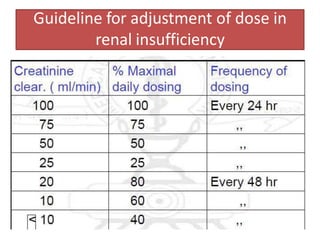
• Dose adjustment is needed in renal
insufficiency
Pharmacokinetics
Dose for a case of renal insufficiency
= Normal therapeutic dose
Sr creatinine value (mg/dl)
Dose for a case of renal insufficiency
• Cockroft gault formula:
CrCl = (140-age) x weight [kg]
(sCr x 72)
– For females multiply above value by 0.85
• Corrected dose = Normal dose x pt CrCl
Normal CrCl
Clinical uses
• Gram –ve bacillary infection
– Septicaemia, pelvic & abdominal sepsis
• Bacterial endocarditis –
– enterococcal, streptococcal or staphylococcal infection of
heart valves
• Pneumonias, Tuberculosis
• Tularemia
• Plague, Brucellosis
• Topical – Neomycin, Framycetin.
• Infections of conjunctiva or external ear
• Tosterilize the bowel of patients who receive
immunosuppressive therapy, before surgery & in
hepatic coma
Shared toxicities
• Ototoxicity
– Vestibular damage
– Cochlear damage
• Nephrotoxicity
• Neuromuscular blockade
Ototoxicity
• Impairment of VIII cranial nerve function
• May be irreversible
• Cochlear damage
– Hearing loss and tinnitus
– More with neomycin , amikacin and kanamycin
• Vestibular damage
– Vertigo, ataxia, loss of balance
– More with Streptomycin, gentamycin
• Tobramycin has both types of toxicity
• Netilimycin claimed to have low ototoxicity
Nephrotoxicity
• Gentamicin, amikacin and tobramycin are
more toxic than streptomycin
• Responsible for 10-15% of all renal failure
cases
• Reversible if drug promptly discontinued
• ↓ GFR, ↑ sr creatinine
• ↓clearance of antibiotic → ↑ ototoxicity
Neuromuscular blockade
• Cause N-M junction blockade by
– Displacing Ca2+ from NM junction
– By blocking post synaptic NM receptors
– Inhibiting Ach release from motor nerve
• Neomycin & streptomycin: more propensity
• Tobramycin least likely to produce it
• Myasthenic weakness ↑by these drugs
Precautions / Contraindications
• Pregnancy: foetal ototoxicity
• With other ototoxic drugs: furosemide, minocycline
• With nephrotoxic drugs: vancomycin ,cisplatin
• Elderly patients
• Those with kidney disease
• Cautious use of muscle relaxants
• Do not mix with any other drug in same
syringe
Streptomycin
• Ribosomal resistance develops fast
• Limited usefulness as single agent
• Plague, tularemia and brucellosis
– In combination with tetracycline
• SABE: due to Streptococcus Viridans & faecalis
– With penicillin but gentamicin preferred
• Reserve first line drug for tuberculosis used
only in combination
Gentamicin
• Obtained from Micromonospora purpurea
• Most commonly used aminoglycoside
– More potent than Streptomycin
– Broader spectrum: pseudomonas, proteus, E.coli,
klebsiella, enterobacter, serratia
– Low cost, reliability of use, long experience
– Acts synergistically with ampicillin, penicillin G,
Ticarcillin, ceftriaxone, Vancomycin
• Ineffective against M.tuberculosis
• Relatively more nephrotoxic
Gentamicin (Uses)
• Use restricted to serious Gm-ve bacillary infections
• Septicaemia, sepsis, fever in immunocompromised
patients
– Used with penicillins
• Pelvic infections : with metronidazole
• SABE: with Penicillin G or ampicillin or vancomycin
• Coliform infection: with ampicillin or ceftriaxone
• Pseudomonal infections: with ticarcillin
• Meningitis by Gm-ve bacilli : III generation
cephalosporin alone or with gentamicin
Guideline for adjustment of dose in
renal insufficiency
Tobramycin
• Identical to gentamicin
• Used in pseudomonas and proteus infections
• Ototoxicty and nephrotoxicity probably lower
Sisomicin
• Identical to gentamicin
• More potent on pseudomonas and
streptococci
-hemolytic
• Used interchangeably with gentamicin
Amikacin
• Less toxic semisynthetic derivative of kanamycin
• Resistant to enzymes that inactivate gentamicin
and tobramcyin
• Widest spectrum of activity
• Uses:
– Same as gentamicin
– Reserve drug for hospital acquired Gm-ve bacillary
infections
– Multidrug resistant TB along with other drugs
• Dose : 15mg/kg/day in 1-3 doses
Netilimicin
• Semisynthetic derivative of sisomicin
• Relatively resistant to aminoglycoside
inactivating enzymes
• More active against klebsiella, enterobacter &
staphylococci
• Less active against pseudomonas aeruginosa
• Doses and pharmacokinetics similar to
gentamicin
Neomycin
• wide spectrum active against Gm-ve bacilli
and some gm+ve cocci
• Pseudomonas and strep.pyogenes not
sensitive
• Too toxic for parenteral use , limited to topical
use
Neomycin (uses)
• Topically used in skin, eye and external ear infections
combined with bacitracin or polymyxin-B to widen
antibacterial spectrum and to prevent emergence of
resistant strains
• Orally
– Preparation of bowel before surgery 1 gm TDS
– Hepatic coma: Supresses ammonia forming
coliforms prevents encephalopathy (Lactulose
more preferred)
• Bladder irrigation along with polymyxin B
Framycetin
• Very similar to neomycin
• Too toxic for systemic administration
• Used topically on skin, eye ear

aminoglycosides-121209052919-phpapp02.pptx

  • 1.
  • 2.
    Aminoglycosides • Streptomycin –1944 • Actinomycetes – Streptomyces griseus • Bactericidal antibiotics • Interfere with protein synthesis • Used to treat aerobic Gram –ve bacteria • Resemble each other in MOA, pharmacokinetic therapeutic and toxic properties • Relatively low margin of safety • Exhibit ototoxicity and nephrotoxicity
  • 3.
    Chemistry Amino sugar 2-deoxystreptamineAmino sugar -o- -o- Aminoglycosides Structure Streptidine Streptose amino sugar N-Methyl-L glucosamine amino sugar -o- -o- Streptobiosamine Streptomycin structure
  • 4.
    Aminoglycosides • Systemic – Streptomycin –Gentamicin – Kanamycin – Amikacin – Sisomicin – Tobramycin – Netilimicin • Topical – Neomycin – Framycetin
  • 5.
  • 6.
    Formation of theInitiation Complex
  • 7.
    Joining of 50SRibosomal Subunit
  • 8.
  • 9.
  • 10.
    Mechanism of action •Initially they penetrate bacterial cell wall, to reach periplasmic space through porin channels (passive diffusion) • Further transport across cytoplasmic membrane takes place by active transport by proton pump; an oxygen- dependent process
  • 11.
    Mechanism of Action •Bind 30S ribosomal subunits and interfere the initiation complex • Induce misreading of genetic code on mRNA • Breakup of polysomes into monosomes
  • 12.
    Post antibiotic effect •Aminoglycosides exhibit concentration dependent killing. • They also possess significant Post-antibiotic effect. • Single daily dosing at least as effective as and no more toxic than multiple dosing.
  • 13.
    Mechanism of resistance •Synthesis of plasmid mediated bacterial transferase enzyme: Inactivate aminoglycosides • ↓ transport into bacterial cytosol • Deletion/alteration of receptor protein on 30 S ribosomal unit by mutation: prevents attachment
  • 14.
    Antibacterial spectrum • Primarilyagainst Gm –ve aerobic bacilli – Proteus, pseudomonas – E.Coli,enterobacter – Klebsiella – Shigella • Only few Gm +ve cocci: – staph aureus, strepto viridans • Not effective against Gm +ve bacilli, Gm-ve cocci and anaerobes
  • 15.
    Pharmacokinetics • Highly polarbasic drugs: poor oral BA • Administered parenterally or applied locally • Poorly distributed and poorly protein bound • Do not undergo any significant metabolism • Nearly all IV dose is excreted unchanged in urine • Dose adjustment is needed in renal insufficiency
  • 16.
  • 17.
    Dose for acase of renal insufficiency = Normal therapeutic dose Sr creatinine value (mg/dl)
  • 18.
    Dose for acase of renal insufficiency • Cockroft gault formula: CrCl = (140-age) x weight [kg] (sCr x 72) – For females multiply above value by 0.85 • Corrected dose = Normal dose x pt CrCl Normal CrCl
  • 19.
    Clinical uses • Gram–ve bacillary infection – Septicaemia, pelvic & abdominal sepsis • Bacterial endocarditis – – enterococcal, streptococcal or staphylococcal infection of heart valves • Pneumonias, Tuberculosis • Tularemia • Plague, Brucellosis • Topical – Neomycin, Framycetin. • Infections of conjunctiva or external ear • Tosterilize the bowel of patients who receive immunosuppressive therapy, before surgery & in hepatic coma
  • 20.
    Shared toxicities • Ototoxicity –Vestibular damage – Cochlear damage • Nephrotoxicity • Neuromuscular blockade
  • 21.
    Ototoxicity • Impairment ofVIII cranial nerve function • May be irreversible • Cochlear damage – Hearing loss and tinnitus – More with neomycin , amikacin and kanamycin • Vestibular damage – Vertigo, ataxia, loss of balance – More with Streptomycin, gentamycin • Tobramycin has both types of toxicity • Netilimycin claimed to have low ototoxicity
  • 22.
    Nephrotoxicity • Gentamicin, amikacinand tobramycin are more toxic than streptomycin • Responsible for 10-15% of all renal failure cases • Reversible if drug promptly discontinued • ↓ GFR, ↑ sr creatinine • ↓clearance of antibiotic → ↑ ototoxicity
  • 23.
    Neuromuscular blockade • CauseN-M junction blockade by – Displacing Ca2+ from NM junction – By blocking post synaptic NM receptors – Inhibiting Ach release from motor nerve • Neomycin & streptomycin: more propensity • Tobramycin least likely to produce it • Myasthenic weakness ↑by these drugs
  • 24.
    Precautions / Contraindications •Pregnancy: foetal ototoxicity • With other ototoxic drugs: furosemide, minocycline • With nephrotoxic drugs: vancomycin ,cisplatin • Elderly patients • Those with kidney disease • Cautious use of muscle relaxants • Do not mix with any other drug in same syringe
  • 25.
    Streptomycin • Ribosomal resistancedevelops fast • Limited usefulness as single agent • Plague, tularemia and brucellosis – In combination with tetracycline • SABE: due to Streptococcus Viridans & faecalis – With penicillin but gentamicin preferred • Reserve first line drug for tuberculosis used only in combination
  • 26.
    Gentamicin • Obtained fromMicromonospora purpurea • Most commonly used aminoglycoside – More potent than Streptomycin – Broader spectrum: pseudomonas, proteus, E.coli, klebsiella, enterobacter, serratia – Low cost, reliability of use, long experience – Acts synergistically with ampicillin, penicillin G, Ticarcillin, ceftriaxone, Vancomycin • Ineffective against M.tuberculosis • Relatively more nephrotoxic
  • 27.
    Gentamicin (Uses) • Userestricted to serious Gm-ve bacillary infections • Septicaemia, sepsis, fever in immunocompromised patients – Used with penicillins • Pelvic infections : with metronidazole • SABE: with Penicillin G or ampicillin or vancomycin • Coliform infection: with ampicillin or ceftriaxone • Pseudomonal infections: with ticarcillin • Meningitis by Gm-ve bacilli : III generation cephalosporin alone or with gentamicin
  • 28.
    Guideline for adjustmentof dose in renal insufficiency
  • 29.
    Tobramycin • Identical togentamicin • Used in pseudomonas and proteus infections • Ototoxicty and nephrotoxicity probably lower Sisomicin • Identical to gentamicin • More potent on pseudomonas and streptococci -hemolytic • Used interchangeably with gentamicin
  • 30.
    Amikacin • Less toxicsemisynthetic derivative of kanamycin • Resistant to enzymes that inactivate gentamicin and tobramcyin • Widest spectrum of activity • Uses: – Same as gentamicin – Reserve drug for hospital acquired Gm-ve bacillary infections – Multidrug resistant TB along with other drugs • Dose : 15mg/kg/day in 1-3 doses
  • 31.
    Netilimicin • Semisynthetic derivativeof sisomicin • Relatively resistant to aminoglycoside inactivating enzymes • More active against klebsiella, enterobacter & staphylococci • Less active against pseudomonas aeruginosa • Doses and pharmacokinetics similar to gentamicin
  • 32.
    Neomycin • wide spectrumactive against Gm-ve bacilli and some gm+ve cocci • Pseudomonas and strep.pyogenes not sensitive • Too toxic for parenteral use , limited to topical use
  • 33.
    Neomycin (uses) • Topicallyused in skin, eye and external ear infections combined with bacitracin or polymyxin-B to widen antibacterial spectrum and to prevent emergence of resistant strains • Orally – Preparation of bowel before surgery 1 gm TDS – Hepatic coma: Supresses ammonia forming coliforms prevents encephalopathy (Lactulose more preferred) • Bladder irrigation along with polymyxin B
  • 34.
    Framycetin • Very similarto neomycin • Too toxic for systemic administration • Used topically on skin, eye ear