RISK BENEFIT ASSESSEMENT
Dr Mohit Kher
Pharmacology,
LHMC
INTRODUCTION
• The term risk refers to the probability of a harm resulting from an activity and to its
magnitude.
• Dimension of risks includes the safety profile observed in the form of the sum of all
ADRs, includes the potential risk of unobserved ADRs.
• Types of Risks:
• Physical risks - Bodily harm, simple inconvenience
• Psychological risks - Emotional suffering, breach of confidentiality
• Social risks - Employment or social discrimination
• Economic risks - Financial costs related to participation
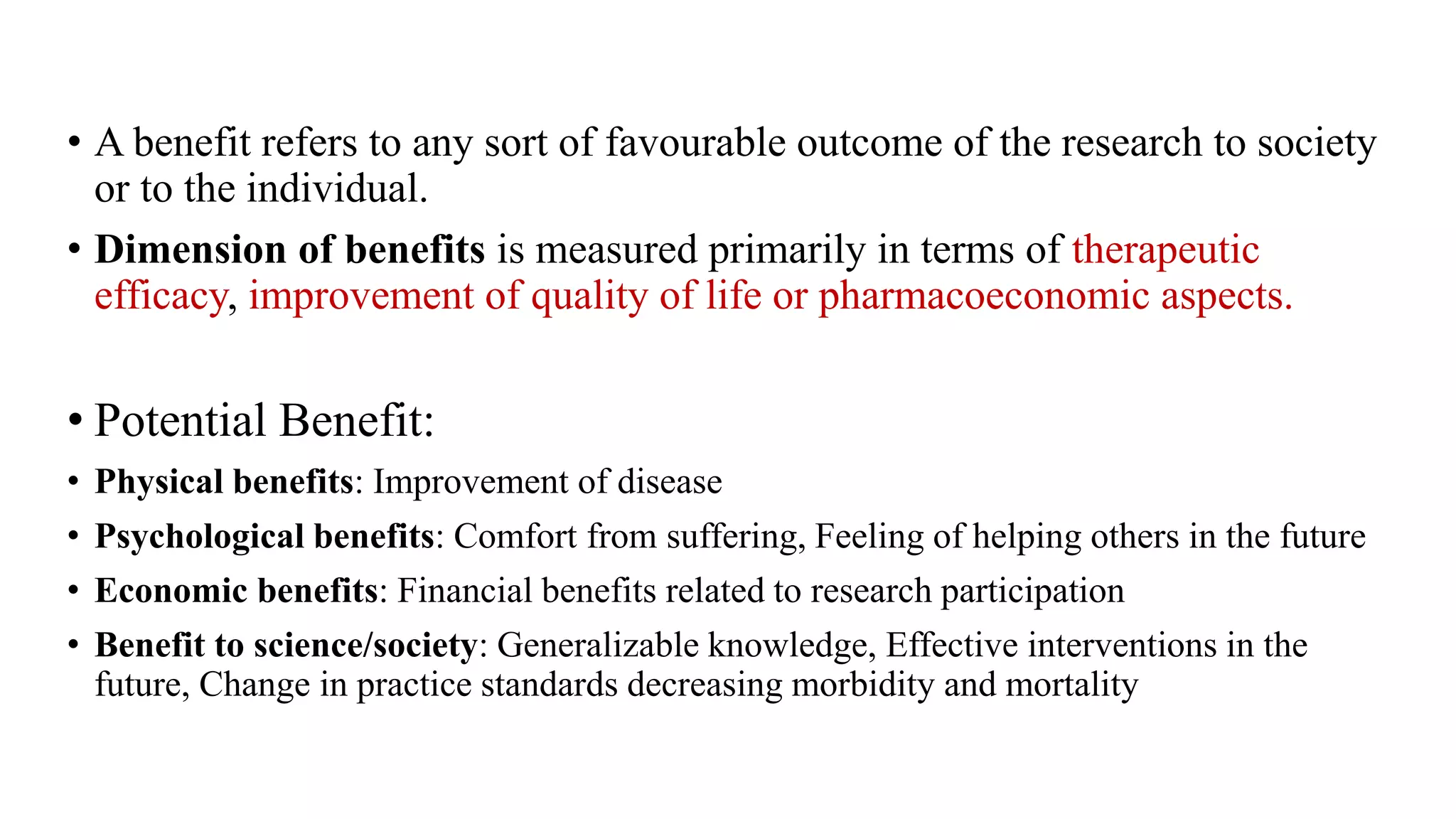
• A benefit refers to any sort of favourable outcome of the research to society
or to the individual.
• Dimension of benefits is measured primarily in terms of therapeutic
efficacy, improvement of quality of life or pharmacoeconomic aspects.
• Potential Benefit:
• Physical benefits: Improvement of disease
• Psychological benefits: Comfort from suffering, Feeling of helping others in the future
• Economic benefits: Financial benefits related to research participation
• Benefit to science/society: Generalizable knowledge, Effective interventions in the
future, Change in practice standards decreasing morbidity and mortality
Magnitude & Duration of Risks and Benefits
• Magnitude of potential harm and potential benefits:
• Organ dysfunction versus slight discomfort
• Cure versus tumor shrinkage
• Duration of potential harm and potential benefits:
• One time harm versus long-term level of harm
• Acute infection versus chronic infection
Categories of Risk
• Category 1 - Minimal Risk
• Category 2 - Greater than Minimal Risk with prospect of direct
benefit
• Category 3 - Minor increase over minimal Risk but no prospect of
direct benefit to individual but likely to yield generalizable knowledge
to subjects
• Category 4 - Research not fitting in any category, but presents an
opportunity to understand, prevent, alleviate a serious problem
affecting the health or welfare
Risk Assessment in Protocol Review
• Scientific Review
• Ethical Review
• Continuing review/ monitoring
Reducing Risk and Enhancing Benefits
• Conducting research consistent with the standards of good clinical
practice.
• Use of qualified personnel
• Monitoring
• Excluding subjects that are especially susceptible to harms
associated with study
• Allow rescue medications and procedures
• Provide serious adverse events management
• The evaluation of the risk:benefit ratio of a drug is essential throughout the whole life
cycle of a drug.
• Discovery phase: Allow selection of lead molecules with the best RBA potential over
hundreds of candidate molecules.
• Peclinical RBA will determine whether a candidate drug will be administered for the
first time in humans.
• RBA is not a static process, and it evolves during the clinical development, the
registration process, and the marketing period, when the drug is administered to
patients.
• Exceptionally, there are examples where unfavorable RBAs have turned positive.
• Relaunch of thalidomide in the indications of multiple myeloma and erythema nodosum
leprosum is an example.
• In the late 1990s and early 2000s, while there was an increasing pressure from
regulatory agencies for pharmaceutical companies to perform BR evaluation more
routinely and systematically.
• In 1998, more systematic and consistent approach was first introduced by the Council
for International Organizations of Medical Sciences (CIOMS), in the report of CIOMS
Working Group IV, Benefit–risk balance for marketed drugs: evaluating safety signals.
• By 1999, there was still no guidance from the regulatory perspective.
• In 2006, following the publication of the paper by Holden and colleagues, the Benefit–
Risk Action Team (BRAT), a collaborative project on BR evaluation sponsored by The
Pharmaceutical Research and Manufacturers of America was initiated, followed by
several other regulatory.
FREQUENCY DESIRABILITY
Well established in PV/PEpi Alien concept in PV/PEpi
Always measured (if possible) Rarely measured
Natural scale No natural scale
METHODS
• PrOACT-URL (Problem, Objectives, Alternatives, Consequences, Trade-Offs, Uncertainities, Risk,
Linked decisions)
• BRAT (Benefit Risk Action Team)
• MCDA (Multi-Criteria Decision Analysis)
• SMAA (Stochastic Multicriteria Acceptability Analysis)
• Decision tree
• Markov model
• Discrete event simulation
Steps of clinical decision analysis by using
Decision tree method
Benefits
SUMMARY
• Risk benefit assessment is important but very challenging.
• Dynamic process
• Key dimensions: Frequency, seriousness and duration
• Key methods: MCDA and Decision tree
• Key examples: Natalizumab and Alosetron
REFERENCES
• Juhaeri J. Benefit-risk evaluation: the past, present and future. Ther Adv Drug Saf.
2019;10:2042098619871180. Published 2019 Aug 26. doi:10.1177/2042098619871180
• Kremer IEH, Jongen PJ, Evers SMAA, Hoogervorst ELJ, Verhagen WIM, Hiligsmann M. Patient
decision aid based on multi-criteria decision analysis for disease-modifying drugs for multiple
sclerosis: prototype development. BMC Med Inform Decis Mak. 2021;21(1):123. Published 2021
Apr 9. doi:10.1186/s12911-021-01479-w
• Frazão TDC, Camilo DGG, Cabral ELS, Souza RP. Multicriteria decision analysis (MCDA) in
health care: a systematic review of the main characteristics and methodological steps. BMC Med
Inform Decis Mak. 2018;18(1):90. Published 2018 Nov 1. doi:10.1186/s12911-018-0663-1
• Song YY, Lu Y. Decision tree methods: applications for classification and prediction. Shanghai
Arch Psychiatry. 2015;27(2):130-135. doi:10.11919/j.issn.1002-0829.215044
Risk benefit assessment

Risk benefit assessment

  • 1.
    RISK BENEFIT ASSESSEMENT DrMohit Kher Pharmacology, LHMC
  • 2.
    INTRODUCTION • The termrisk refers to the probability of a harm resulting from an activity and to its magnitude. • Dimension of risks includes the safety profile observed in the form of the sum of all ADRs, includes the potential risk of unobserved ADRs. • Types of Risks: • Physical risks - Bodily harm, simple inconvenience • Psychological risks - Emotional suffering, breach of confidentiality • Social risks - Employment or social discrimination • Economic risks - Financial costs related to participation
  • 3.
    • A benefitrefers to any sort of favourable outcome of the research to society or to the individual. • Dimension of benefits is measured primarily in terms of therapeutic efficacy, improvement of quality of life or pharmacoeconomic aspects. • Potential Benefit: • Physical benefits: Improvement of disease • Psychological benefits: Comfort from suffering, Feeling of helping others in the future • Economic benefits: Financial benefits related to research participation • Benefit to science/society: Generalizable knowledge, Effective interventions in the future, Change in practice standards decreasing morbidity and mortality
  • 4.
    Magnitude & Durationof Risks and Benefits • Magnitude of potential harm and potential benefits: • Organ dysfunction versus slight discomfort • Cure versus tumor shrinkage • Duration of potential harm and potential benefits: • One time harm versus long-term level of harm • Acute infection versus chronic infection
  • 5.
    Categories of Risk •Category 1 - Minimal Risk • Category 2 - Greater than Minimal Risk with prospect of direct benefit • Category 3 - Minor increase over minimal Risk but no prospect of direct benefit to individual but likely to yield generalizable knowledge to subjects • Category 4 - Research not fitting in any category, but presents an opportunity to understand, prevent, alleviate a serious problem affecting the health or welfare
  • 6.
    Risk Assessment inProtocol Review • Scientific Review • Ethical Review • Continuing review/ monitoring
  • 7.
    Reducing Risk andEnhancing Benefits • Conducting research consistent with the standards of good clinical practice. • Use of qualified personnel • Monitoring • Excluding subjects that are especially susceptible to harms associated with study • Allow rescue medications and procedures • Provide serious adverse events management
  • 8.
    • The evaluationof the risk:benefit ratio of a drug is essential throughout the whole life cycle of a drug. • Discovery phase: Allow selection of lead molecules with the best RBA potential over hundreds of candidate molecules. • Peclinical RBA will determine whether a candidate drug will be administered for the first time in humans. • RBA is not a static process, and it evolves during the clinical development, the registration process, and the marketing period, when the drug is administered to patients. • Exceptionally, there are examples where unfavorable RBAs have turned positive. • Relaunch of thalidomide in the indications of multiple myeloma and erythema nodosum leprosum is an example.
  • 10.
    • In thelate 1990s and early 2000s, while there was an increasing pressure from regulatory agencies for pharmaceutical companies to perform BR evaluation more routinely and systematically. • In 1998, more systematic and consistent approach was first introduced by the Council for International Organizations of Medical Sciences (CIOMS), in the report of CIOMS Working Group IV, Benefit–risk balance for marketed drugs: evaluating safety signals. • By 1999, there was still no guidance from the regulatory perspective. • In 2006, following the publication of the paper by Holden and colleagues, the Benefit– Risk Action Team (BRAT), a collaborative project on BR evaluation sponsored by The Pharmaceutical Research and Manufacturers of America was initiated, followed by several other regulatory.
  • 19.
    FREQUENCY DESIRABILITY Well establishedin PV/PEpi Alien concept in PV/PEpi Always measured (if possible) Rarely measured Natural scale No natural scale
  • 24.
    METHODS • PrOACT-URL (Problem,Objectives, Alternatives, Consequences, Trade-Offs, Uncertainities, Risk, Linked decisions) • BRAT (Benefit Risk Action Team) • MCDA (Multi-Criteria Decision Analysis) • SMAA (Stochastic Multicriteria Acceptability Analysis) • Decision tree • Markov model • Discrete event simulation
  • 35.
    Steps of clinicaldecision analysis by using Decision tree method
  • 40.
  • 41.
    SUMMARY • Risk benefitassessment is important but very challenging. • Dynamic process • Key dimensions: Frequency, seriousness and duration • Key methods: MCDA and Decision tree • Key examples: Natalizumab and Alosetron
  • 42.
    REFERENCES • Juhaeri J.Benefit-risk evaluation: the past, present and future. Ther Adv Drug Saf. 2019;10:2042098619871180. Published 2019 Aug 26. doi:10.1177/2042098619871180 • Kremer IEH, Jongen PJ, Evers SMAA, Hoogervorst ELJ, Verhagen WIM, Hiligsmann M. Patient decision aid based on multi-criteria decision analysis for disease-modifying drugs for multiple sclerosis: prototype development. BMC Med Inform Decis Mak. 2021;21(1):123. Published 2021 Apr 9. doi:10.1186/s12911-021-01479-w • Frazão TDC, Camilo DGG, Cabral ELS, Souza RP. Multicriteria decision analysis (MCDA) in health care: a systematic review of the main characteristics and methodological steps. BMC Med Inform Decis Mak. 2018;18(1):90. Published 2018 Nov 1. doi:10.1186/s12911-018-0663-1 • Song YY, Lu Y. Decision tree methods: applications for classification and prediction. Shanghai Arch Psychiatry. 2015;27(2):130-135. doi:10.11919/j.issn.1002-0829.215044

Editor's Notes

  • #7 Benefits and Risks must be “balanced” and shown to have a “Favorable Ratio” Scientific Review Identify and minimize risks as much as possible by using procedures that are consistent with sound research design. It is important to emphasize that study design might affect risks and hence, ethics committee must be knowledgeable about methodology Ethical Review a holistic process that examines risks and benefits in all relevant parts of the protocol Objectives „ Research Design „ Number of Subjects „ Distribution and method of randomisation „ Inclusion exclusion criteria „ SAE management and reporting „ Consent form & questionnaires if any „ Source of funding
  • #9 During the discovery phase, the analysis of the biological targets as well as medical chemistry will allow selection of lead molecules with the best BRA potential over hundreds of candidate molecules..
  • #11 there were only a few publications in the literature and a few guidelines from the regulators on how to perform BR analyses. The majority of the publications in the literature were line listings of benefits and risks which might be useful for clinicians but, without taking into account the relative importance of benefits to risks (or preference weight), these could be interpreted differently by different stakeholders, leading to inconsistency in the interpretation. If the benefits of the various options under consideration can be assumed to be equal, benefit–risk evaluation can rely on measures of relative risk. Otherwise, in the absence of a readily available and quantitative relationship between benefits and risks, which is commonly the case, evaluation usually comes down to analyses and conclusions that rely on indirect, informal and unavoidably subjective processes.’