Amino acids, peptides, and
proteins
Properties of Amino Acids
• capacity to polymerize
• novel acid-base properties
• varied structure and chemical
functionality
• chirality
Basic Amino Acid Structure
carboxyl group

 a-carbon is
chiral (except for
glycine)
 at pH 7.0
uncharged amino
acids are
zwitterions
 amino acids have
a tetrahedral
structure

amino group

a-carbon
side chain
Amino Acid Enantiomers

•Steroisomers / enantiomers
•Biological system only
synthesize and use L-aminoacids
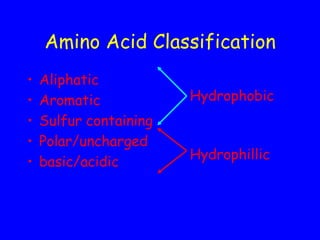
Amino Acid Classification
•
•
•
•
•

Aliphatic
Aromatic
Sulfur containing
Polar/uncharged
basic/acidic

Hydrophobic

Hydrophillic
Aliphatic (alkane) Amino Acids

Hydrophobicity

•Proline (pro, P)- cyclic “imino acid”

•Glycine(gly, G)-only non-chiral amino acid, not hydrophobic
•Alanine (ala, A) – R-group = methyl-group
•Valine (Val, V) –Think V!
•Leucine (Leu, L) –

•Isoleucine (Ile, I) -2 chiral carbons
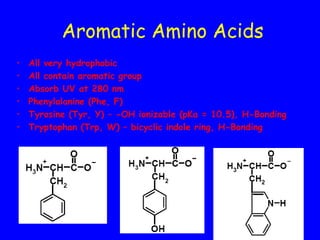
Aromatic Amino Acids
•
•
•
•
•
•

All very hydrophobic
All contain aromatic group
Absorb UV at 280 nm
Phenylalanine (Phe, F)
Tyrosine (Tyr, Y) – -OH ionizable (pKa = 10.5), H-Bonding
Tryptophan (Trp, W) – bicyclic indole ring, H-Bonding
Sulfur Containing Amino
Acids
• Methionine (Met, M) – “start” amino
acid, very hydrophobic
• Cysteine (Cys, C) – sulfur in form of
sulfhydroyl, important in disulfide
linkages, weak acid, can form
hydrogen bonds.
Acidic Amino Acids
• Contain carboxyl groups (weaker acids than a-carboxylgroup)
• Negatively charged at physiological pH, present as conjugate
bases (therefore –ate not –ic acids)
• Carboxyl groups function as nucleophiles in some enzymatic
reactions
• Aspartate –

• Glutamate –
Basic Amino Acids
• Hydrophillic nitrogenous bases
• Positively charged at physiological pH
• Histidine – imidazole ring protonated/ionized, only amino
acid that functions as buffer in physiol range.
• Lysine - diamino acid, protonated at pH 7.0
• Arginine - guianidinium ion always protonated, most basic
amino acid
Polar Uncharged Amino Acids
• Polar side groups, hydrophillic in nature, can form hydrogen
bonds
• Hydroxyls of Ser and Thr weakly ionizable
• Serine (Ser, S) – looks like Ala w/ -OH

• Threonine (Thr, T) – 2 chiral carbons

• Asparagine (Asn, N) – amide of aspartic acid

• Glutamine (Gln, Q) – amide of glutamic acid
Essential/Non-Essential Amino Acids

• Essential –histidine, isoleucine,
leucine, lysine, methionine,
phenylalanine, threonine, tryptophan,
valine
• Non-essential – alanine, arginine*,
aspartate, asparagine, cysteine*,
glutamate, glutamine, glycine*,
proline*, serine, tyrosine*
Titration Curve for Alanine
pK1 carboxylic acid = 2
pK2 amino group = 10
pI = (pK1+ pK2)/2

pI (isoelectric point) = the pH at which the number of positive and
negative charges on a population of molecules is equal (i.e. no net charge).
Titration Curve for
Glutamic Acid
pK1 carboxylic acid = 2.2
pK2 R group = 4.3
pK3 amino group = 9.7
pI = (pK1+ pK2)/2

pI = (2.2+4.3)/2
pI = 3.25
Titration Curve
for Lysine
pK1 carboxylic acid = 2.2
pK2 amino group = 9.0
pK3 R group = 10.5
pI = (pK2+ pK3)/2

pI = (9+10.5)/2
pI = 9.75
pKa’s of charged amino acids R-groups

•
•
•
•
•
•

Aspartate/Glutamate = 4.0
Histidine = 6.0
Cysteine = 8.4
Tyrosine = 10.5
Lysine = 10.5
Arginine = 12.5
Protein Nomenclature
• Peptides 2 – 50 amino acids
• Proteins >50 amino acids
• Amino acid with free a-amino group is the
amino-terminal or N-terminal residue
• Amino acid with free a-carboxyl group is the
carboxyl-terminal or C-terminal residue
• Three letter code – Met-Gly-Glu-Thr-Arg-His
• Single letter code – M-G-E-T-R-H
Peptide Bond Formation
Partial double bond nature of peptide bond
Stability and Formation of the Peptide Bond
• Hydrolysis of peptide bond favored energetically,
but uncatalyzed reaction very slow.
• Strong mineral acid, such as 6 M HCl, good
catalyst for hydrolysis
• Amino acids must be "activated" by ATP-driven
reaction to be incorporated into proteins
Enzymatic and Chemical
Cleavage of Peptide Linkage
Titration Curve of a Tetrapeptide
+H3N-Glu-Gly-Ala-Lys-COO-

Proteins have pIs
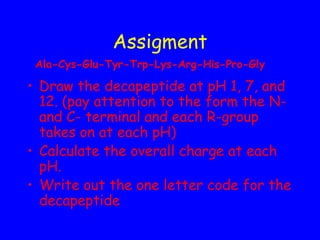
Assigment
Ala-Cys-Glu-Tyr-Trp-Lys-Arg-His-Pro-Gly

• Draw the decapeptide at pH 1, 7, and
12. (pay attention to the form the Nand C- terminal and each R-group
takes on at each pH)
• Calculate the overall charge at each
pH.
• Write out the one letter code for the
decapeptide

Amino acids

  • 1.
  • 2.
    Properties of AminoAcids • capacity to polymerize • novel acid-base properties • varied structure and chemical functionality • chirality
  • 3.
    Basic Amino AcidStructure carboxyl group  a-carbon is chiral (except for glycine)  at pH 7.0 uncharged amino acids are zwitterions  amino acids have a tetrahedral structure amino group a-carbon side chain
  • 4.
    Amino Acid Enantiomers •Steroisomers/ enantiomers •Biological system only synthesize and use L-aminoacids
  • 5.
    Amino Acid Classification • • • • • Aliphatic Aromatic Sulfurcontaining Polar/uncharged basic/acidic Hydrophobic Hydrophillic
  • 6.
    Aliphatic (alkane) AminoAcids Hydrophobicity •Proline (pro, P)- cyclic “imino acid” •Glycine(gly, G)-only non-chiral amino acid, not hydrophobic •Alanine (ala, A) – R-group = methyl-group •Valine (Val, V) –Think V! •Leucine (Leu, L) – •Isoleucine (Ile, I) -2 chiral carbons
  • 7.
    Aromatic Amino Acids • • • • • • Allvery hydrophobic All contain aromatic group Absorb UV at 280 nm Phenylalanine (Phe, F) Tyrosine (Tyr, Y) – -OH ionizable (pKa = 10.5), H-Bonding Tryptophan (Trp, W) – bicyclic indole ring, H-Bonding
  • 8.
    Sulfur Containing Amino Acids •Methionine (Met, M) – “start” amino acid, very hydrophobic • Cysteine (Cys, C) – sulfur in form of sulfhydroyl, important in disulfide linkages, weak acid, can form hydrogen bonds.
  • 9.
    Acidic Amino Acids •Contain carboxyl groups (weaker acids than a-carboxylgroup) • Negatively charged at physiological pH, present as conjugate bases (therefore –ate not –ic acids) • Carboxyl groups function as nucleophiles in some enzymatic reactions • Aspartate – • Glutamate –
  • 10.
    Basic Amino Acids •Hydrophillic nitrogenous bases • Positively charged at physiological pH • Histidine – imidazole ring protonated/ionized, only amino acid that functions as buffer in physiol range. • Lysine - diamino acid, protonated at pH 7.0 • Arginine - guianidinium ion always protonated, most basic amino acid
  • 11.
    Polar Uncharged AminoAcids • Polar side groups, hydrophillic in nature, can form hydrogen bonds • Hydroxyls of Ser and Thr weakly ionizable • Serine (Ser, S) – looks like Ala w/ -OH • Threonine (Thr, T) – 2 chiral carbons • Asparagine (Asn, N) – amide of aspartic acid • Glutamine (Gln, Q) – amide of glutamic acid
  • 12.
    Essential/Non-Essential Amino Acids •Essential –histidine, isoleucine, leucine, lysine, methionine, phenylalanine, threonine, tryptophan, valine • Non-essential – alanine, arginine*, aspartate, asparagine, cysteine*, glutamate, glutamine, glycine*, proline*, serine, tyrosine*
  • 13.
    Titration Curve forAlanine pK1 carboxylic acid = 2 pK2 amino group = 10 pI = (pK1+ pK2)/2 pI (isoelectric point) = the pH at which the number of positive and negative charges on a population of molecules is equal (i.e. no net charge).
  • 14.
    Titration Curve for GlutamicAcid pK1 carboxylic acid = 2.2 pK2 R group = 4.3 pK3 amino group = 9.7 pI = (pK1+ pK2)/2 pI = (2.2+4.3)/2 pI = 3.25
  • 15.
    Titration Curve for Lysine pK1carboxylic acid = 2.2 pK2 amino group = 9.0 pK3 R group = 10.5 pI = (pK2+ pK3)/2 pI = (9+10.5)/2 pI = 9.75
  • 16.
    pKa’s of chargedamino acids R-groups • • • • • • Aspartate/Glutamate = 4.0 Histidine = 6.0 Cysteine = 8.4 Tyrosine = 10.5 Lysine = 10.5 Arginine = 12.5
  • 17.
    Protein Nomenclature • Peptides2 – 50 amino acids • Proteins >50 amino acids • Amino acid with free a-amino group is the amino-terminal or N-terminal residue • Amino acid with free a-carboxyl group is the carboxyl-terminal or C-terminal residue • Three letter code – Met-Gly-Glu-Thr-Arg-His • Single letter code – M-G-E-T-R-H
  • 18.
  • 19.
    Partial double bondnature of peptide bond
  • 20.
    Stability and Formationof the Peptide Bond • Hydrolysis of peptide bond favored energetically, but uncatalyzed reaction very slow. • Strong mineral acid, such as 6 M HCl, good catalyst for hydrolysis • Amino acids must be "activated" by ATP-driven reaction to be incorporated into proteins
  • 21.
  • 22.
    Titration Curve ofa Tetrapeptide +H3N-Glu-Gly-Ala-Lys-COO- Proteins have pIs
  • 23.
    Assigment Ala-Cys-Glu-Tyr-Trp-Lys-Arg-His-Pro-Gly • Draw thedecapeptide at pH 1, 7, and 12. (pay attention to the form the Nand C- terminal and each R-group takes on at each pH) • Calculate the overall charge at each pH. • Write out the one letter code for the decapeptide