ABSOLUTE
AND
RELATIVE CONFIGURATION
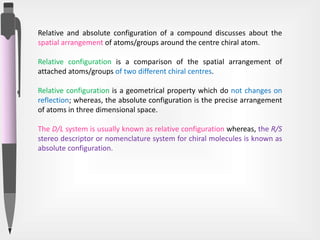
Relative and absolute configuration of a compound discusses about the
spatial arrangement of atoms/groups around the centre chiral atom.
Relative configuration is a comparison of the spatial arrangement of
attached atoms/groups of two different chiral centres.
Relative configuration is a geometrical property which do not changes on
reflection; whereas, the absolute configuration is the precise arrangement
of atoms in three dimensional space.
The D/L system is usually known as relative configuration whereas, the R/S
stereo descriptor or nomenclature system for chiral molecules is known as
absolute configuration.
Cahn and coworkers (1956, 1966) have proposed a new and universally applicable
nomenclature pattern for the determination of absolute configuration of any
chiral molecule. This is known as the R/S system or Cahn- Ingold-Prelog (CIP)
nomenclature.
The actual configuration of the molecules, that is, absolute configuration is
assigned by a set of sequence rules CIP rule.
These sequence rules give nomenclature of stereoisomers in terms of R and S
configurations.
Sequence rules:
Rule 1. Write the stereoisomer in terms of Fischer projection formula.
Rule 2. Identify the atoms attached to chiral carbon, Now assign priority order in
accordance with their atomic numbers.
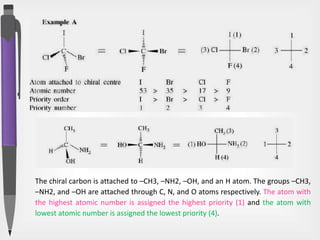
The chiral carbon is attached to –CH3, –NH2, –OH, and an H atom. The groups –CH3,
–NH2, and –OH are attached through C, N, and O atoms respectively. The atom with
the highest atomic number is assigned the highest priority (1) and the atom with
lowest atomic number is assigned the lowest priority (4).
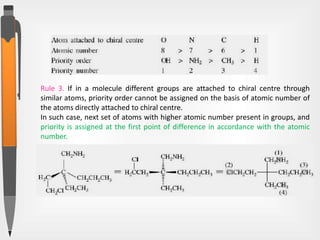
Rule 3. If in a molecule different groups are attached to chiral centre through
similar atoms, priority order cannot be assigned on the basis of atomic number of
the atoms directly attached to chiral centre.
In such case, next set of atoms with higher atomic number present in groups, and
priority is assigned at the first point of difference in accordance with the atomic
number.
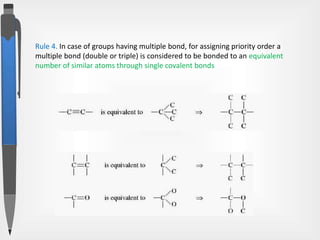
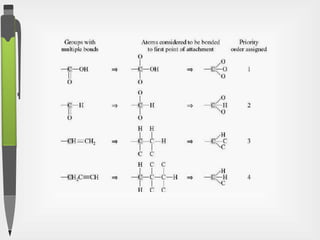
Rule 4. In case of groups having multiple bond, for assigning priority order a
multiple bond (double or triple) is considered to be bonded to an equivalent
number of similar atoms through single covalent bonds
Assigning R and S Configuration:
According to Sequence rules, (1–4), priority order is assigned to different
groups and atoms attached to chiral carbon.
The group or atom with least priority is placed at a position vertically
downward in the Fischer projection.
Then the arrangement of rest of the three groups or atoms is considered
according to their decreasing priority order.
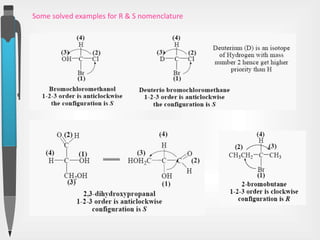
Some solved examples for R & S nomenclature
Relative Configuration (D- and L- Nomenclature):
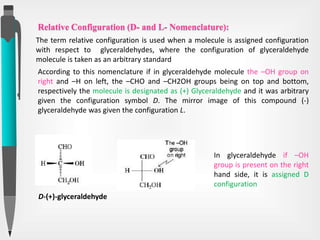
According to this nomenclature if in glyceraldehyde molecule the –OH group on
right and –H on left, the –CHO and –CH2OH groups being on top and bottom,
respectively the molecule is designated as (+) Glyceraldehyde and it was arbitrary
given the configuration symbol D. The mirror image of this compound (-)
glyceraldehyde was given the configuration L.
D-(+)-glyceraldehyde
In glyceraldehyde if –OH
group is present on the right
hand side, it is assigned D
configuration
The term relative configuration is used when a molecule is assigned configuration
with respect to glyceraldehydes, where the configuration of glyceraldehyde
molecule is taken as an arbitrary standard
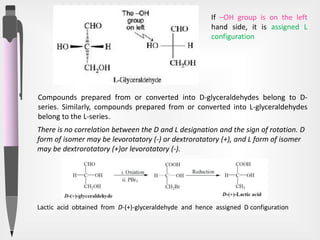
If –OH group is on the left
hand side, it is assigned L
configuration
Compounds prepared from or converted into D-glyceraldehydes belong to D-
series. Similarly, compounds prepared from or converted into L-glyceraldehydes
belong to the L-series.
Lactic acid obtained from D-(+)-glyceraldehyde and hence assigned D configuration
There is no correlation between the D and L designation and the sign of rotation. D
form of isomer may be levorotatory (-) or dextrorotatory (+), and L form of isomer
may be dextrorotatory (+)or levorotatory (-).
Chirality in a molecule with no stereogenic (chiral) centre
The most common cause of asymmetry in a molecule is presence of an asymmetric
carbon (stereocentre).
The molecules with one stereocentre exist in two steroisomeric forms, which are
optically active.
Tartaric acid (a molecules with two stereocentres), meso structure exhibits a plane
of symmetry and does not show optically activity.
There are compounds where stereocentre (chiral carbon) is not present yet they
exhibit optical activity.
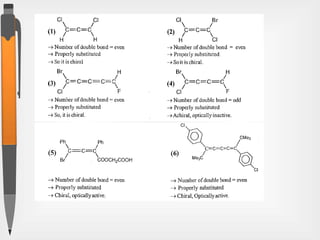
These molecules possess asymmetry for entirely different reasons. Eg: Allene and
Biphenyls.
Allenes:
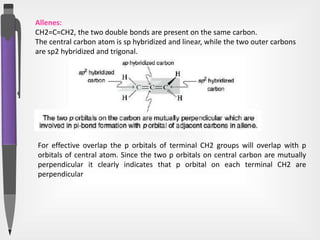
CH2=C=CH2, the two double bonds are present on the same carbon.
The central carbon atom is sp hybridized and linear, while the two outer carbons
are sp2 hybridized and trigonal.
For effective overlap the p orbitals of terminal CH2 groups will overlap with p
orbitals of central atom. Since the two p orbitals on central carbon are mutually
perpendicular it clearly indicates that p orbital on each terminal CH2 are
perpendicular
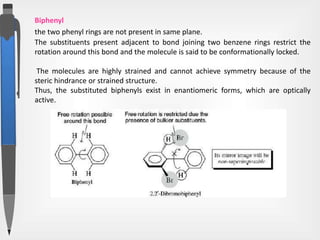
Biphenyl
the two phenyl rings are not present in same plane.
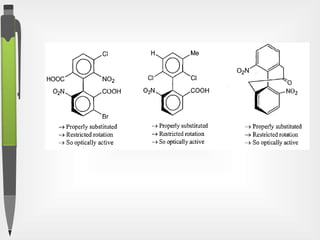
The substituents present adjacent to bond joining two benzene rings restrict the
rotation around this bond and the molecule is said to be conformationally locked.
The molecules are highly strained and cannot achieve symmetry because of the
steric hindrance or strained structure.
Thus, the substituted biphenyls exist in enantiomeric forms, which are optically
active.
Stereochemistry part 2 Isomerism 2

Stereochemistry part 2 Isomerism 2

  • 1.
  • 2.
    Relative and absoluteconfiguration of a compound discusses about the spatial arrangement of atoms/groups around the centre chiral atom. Relative configuration is a comparison of the spatial arrangement of attached atoms/groups of two different chiral centres. Relative configuration is a geometrical property which do not changes on reflection; whereas, the absolute configuration is the precise arrangement of atoms in three dimensional space. The D/L system is usually known as relative configuration whereas, the R/S stereo descriptor or nomenclature system for chiral molecules is known as absolute configuration.
  • 3.
    Cahn and coworkers(1956, 1966) have proposed a new and universally applicable nomenclature pattern for the determination of absolute configuration of any chiral molecule. This is known as the R/S system or Cahn- Ingold-Prelog (CIP) nomenclature. The actual configuration of the molecules, that is, absolute configuration is assigned by a set of sequence rules CIP rule. These sequence rules give nomenclature of stereoisomers in terms of R and S configurations. Sequence rules: Rule 1. Write the stereoisomer in terms of Fischer projection formula. Rule 2. Identify the atoms attached to chiral carbon, Now assign priority order in accordance with their atomic numbers.
  • 4.
    The chiral carbonis attached to –CH3, –NH2, –OH, and an H atom. The groups –CH3, –NH2, and –OH are attached through C, N, and O atoms respectively. The atom with the highest atomic number is assigned the highest priority (1) and the atom with lowest atomic number is assigned the lowest priority (4).
  • 5.
    Rule 3. Ifin a molecule different groups are attached to chiral centre through similar atoms, priority order cannot be assigned on the basis of atomic number of the atoms directly attached to chiral centre. In such case, next set of atoms with higher atomic number present in groups, and priority is assigned at the first point of difference in accordance with the atomic number.
  • 6.
    Rule 4. Incase of groups having multiple bond, for assigning priority order a multiple bond (double or triple) is considered to be bonded to an equivalent number of similar atoms through single covalent bonds
  • 8.
    Assigning R andS Configuration: According to Sequence rules, (1–4), priority order is assigned to different groups and atoms attached to chiral carbon. The group or atom with least priority is placed at a position vertically downward in the Fischer projection. Then the arrangement of rest of the three groups or atoms is considered according to their decreasing priority order.
  • 9.
    Some solved examplesfor R & S nomenclature
  • 10.
    Relative Configuration (D-and L- Nomenclature): According to this nomenclature if in glyceraldehyde molecule the –OH group on right and –H on left, the –CHO and –CH2OH groups being on top and bottom, respectively the molecule is designated as (+) Glyceraldehyde and it was arbitrary given the configuration symbol D. The mirror image of this compound (-) glyceraldehyde was given the configuration L. D-(+)-glyceraldehyde In glyceraldehyde if –OH group is present on the right hand side, it is assigned D configuration The term relative configuration is used when a molecule is assigned configuration with respect to glyceraldehydes, where the configuration of glyceraldehyde molecule is taken as an arbitrary standard
  • 11.
    If –OH groupis on the left hand side, it is assigned L configuration Compounds prepared from or converted into D-glyceraldehydes belong to D- series. Similarly, compounds prepared from or converted into L-glyceraldehydes belong to the L-series. Lactic acid obtained from D-(+)-glyceraldehyde and hence assigned D configuration There is no correlation between the D and L designation and the sign of rotation. D form of isomer may be levorotatory (-) or dextrorotatory (+), and L form of isomer may be dextrorotatory (+)or levorotatory (-).
  • 12.
    Chirality in amolecule with no stereogenic (chiral) centre The most common cause of asymmetry in a molecule is presence of an asymmetric carbon (stereocentre). The molecules with one stereocentre exist in two steroisomeric forms, which are optically active. Tartaric acid (a molecules with two stereocentres), meso structure exhibits a plane of symmetry and does not show optically activity. There are compounds where stereocentre (chiral carbon) is not present yet they exhibit optical activity. These molecules possess asymmetry for entirely different reasons. Eg: Allene and Biphenyls.
  • 13.
    Allenes: CH2=C=CH2, the twodouble bonds are present on the same carbon. The central carbon atom is sp hybridized and linear, while the two outer carbons are sp2 hybridized and trigonal. For effective overlap the p orbitals of terminal CH2 groups will overlap with p orbitals of central atom. Since the two p orbitals on central carbon are mutually perpendicular it clearly indicates that p orbital on each terminal CH2 are perpendicular
  • 15.
    Biphenyl the two phenylrings are not present in same plane. The substituents present adjacent to bond joining two benzene rings restrict the rotation around this bond and the molecule is said to be conformationally locked. The molecules are highly strained and cannot achieve symmetry because of the steric hindrance or strained structure. Thus, the substituted biphenyls exist in enantiomeric forms, which are optically active.