Aliphatic Alcohols
Sanjaya Mani Dixit
Assistant Prof of Pharmacology
Contents
• Asian Flush Syndrome
• Introduction
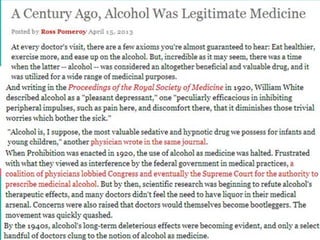
• History of alcohol in medicine
• Ethanol
• Pharmacological actions- Uses- Toxicity
• Acute Alcohol Intoxication
• Chronic Alcoholism
• Aversion Drugs in Alcoholics
• Methanol
• Methanol Poisoning
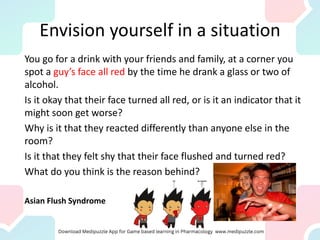
Envision yourself in a situation
You go for a drink with your friends and family, at a corner you
spot a guy’s face all red by the time he drank a glass or two of
alcohol.
Is it okay that their face turned all red, or is it an indicator that it
might soon get worse?
Why is it that they reacted differently than anyone else in the
room?
Is it that they felt shy that their face flushed and turned red?
What do you think is the reason behind?
Asian Flush Syndrome
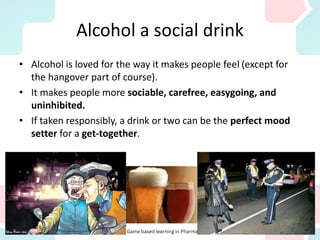
Alcohol a social drink
• Alcohol is loved for the way it makes people feel (except for
the hangover part of course).
• It makes people more sociable, carefree, easygoing, and
uninhibited.
• If taken responsibly, a drink or two can be the perfect mood
setter for a get-together.
Ethanol in Beverages
 Ethanol Concentrations Vary By Beverage Class
Beer or ale - 3-6% v/v or 12g/12oz
Table wines - 8-14% v/v or 12g/4oz
Fortified wine (distilled ethanol added -
sherry, port, vermouth, etc.) - 15-20% v/v
or 12g/2.5oz
Distilled spirits (vodka, gin, rum, bourbon,
etc.) ~40% v/v or 12g/1oz
Ethanol in Beverages
 Alcohol Use / Abuse levels - Assuming 8 g ethanol per
drink:
 light = 1.1 drinks / day;
 moderate = 2.2 drinks per day;
 heavy = 3.5 drinks / day;
 Abusive > 5.4 drinks per day
 (source Michigan Medical Society 1996 physicians survey).
"Risky use" for women and those > 65 yrs > 7 drinks per
week or > 3 drinks per occasion;
 for men <65 yrs >14 drinks per week
 or > 4 drinks per occasion
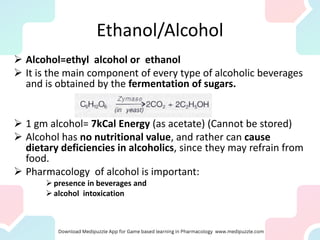
Ethanol/Alcohol
➢ Alcohol=ethyl alcohol or ethanol
➢ It is the main component of every type of alcoholic beverages
and is obtained by the fermentation of sugars.
➢ 1 gm alcohol= 7kCal Energy (as acetate) (Cannot be stored)
➢ Alcohol has no nutritional value, and rather can cause
dietary deficiencies in alcoholics, since they may refrain from
food.
➢ Pharmacology of alcohol is important:
➢ presence in beverages and
➢ alcohol intoxication
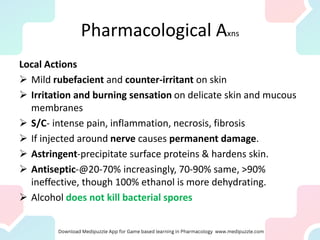
Pharmacological Axns
Local Actions
➢ Mild rubefacient and counter-irritant on skin
➢ Irritation and burning sensation on delicate skin and mucous
membranes
➢ S/C- intense pain, inflammation, necrosis, fibrosis
➢ If injected around nerve causes permanent damage.
➢ Astringent-precipitate surface proteins & hardens skin.
➢ Antiseptic-@20-70% increasingly, 70-90% same, >90%
ineffective, though 100% ethanol is more dehydrating.
➢ Alcohol does not kill bacterial spores
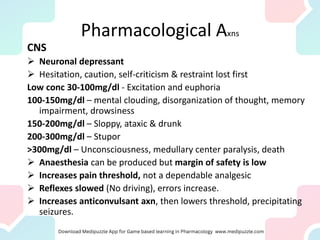
Pharmacological Axns
CNS
➢ Neuronal depressant
➢ Hesitation, caution, self-criticism & restraint lost first
Low conc 30-100mg/dl - Excitation and euphoria
100-150mg/dl – mental clouding, disorganization of thought, memory
impairment, drowsiness
150-200mg/dl – Sloppy, ataxic & drunk
200-300mg/dl – Stupor
>300mg/dl – Unconsciousness, medullary center paralysis, death
➢ Anaesthesia can be produced but margin of safety is low
➢ Increases pain threshold, not a dependable analgesic
➢ Reflexes slowed (No driving), errors increase.
➢ Increases anticonvulsant axn, then lowers threshold, precipitating
seizures.
Pharmacological Axns
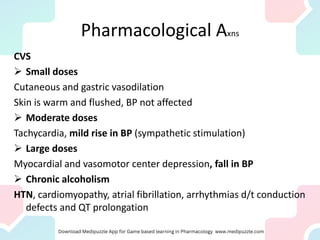
CVS
➢ Small doses
Cutaneous and gastric vasodilation
Skin is warm and flushed, BP not affected
➢ Moderate doses
Tachycardia, mild rise in BP (sympathetic stimulation)
➢ Large doses
Myocardial and vasomotor center depression, fall in BP
➢ Chronic alcoholism
HTN, cardiomyopathy, atrial fibrillation, arrhythmias d/t conduction
defects and QT prolongation
Pharmacological Axns
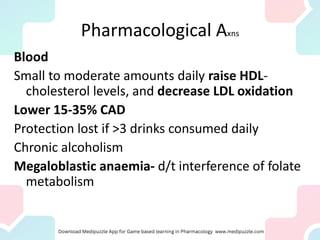
Blood
Small to moderate amounts daily raise HDL-
cholesterol levels, and decrease LDL oxidation
Lower 15-35% CAD
Protection lost if >3 drinks consumed daily
Chronic alcoholism
Megaloblastic anaemia- d/t interference of folate
metabolism
Pharmacological Axns
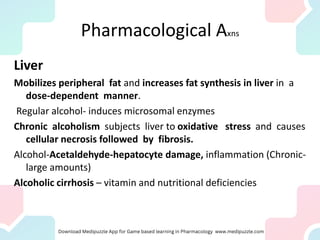
Liver
Mobilizes peripheral fat and increases fat synthesis in liver in a
dose-dependent manner.
Regular alcohol- induces microsomal enzymes
Chronic alcoholism subjects liver to oxidative stress and causes
cellular necrosis followed by fibrosis.
Alcohol-Acetaldehyde-hepatocyte damage, inflammation (Chronic-
large amounts)
Alcoholic cirrhosis – vitamin and nutritional deficiencies
Pharmacological Axns
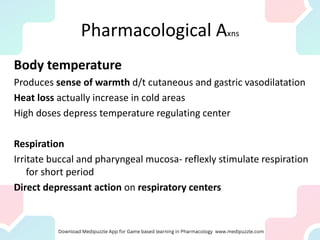
Body temperature
Produces sense of warmth d/t cutaneous and gastric vasodilatation
Heat loss actually increase in cold areas
High doses depress temperature regulating center
Respiration
Irritate buccal and pharyngeal mucosa- reflexly stimulate respiration
for short period
Direct depressant action on respiratory centers
Pharmacological Axns
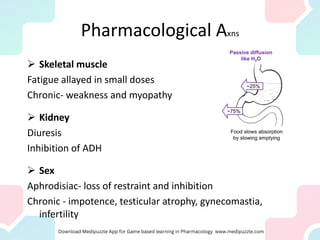
➢ Skeletal muscle
Fatigue allayed in small doses
Chronic- weakness and myopathy
➢ Kidney
Diuresis
Inhibition of ADH
➢ Sex
Aphrodisiac- loss of restraint and inhibition
Chronic - impotence, testicular atrophy, gynecomastia,
infertility
MCQs
1. Which of following effect is least likely to
occur after acute ingestion of alcohol?
a. Additive CNS depression with antihistamine
b. Hypertension
c. Inhibition of liver microsomal drug-
metabolizing enzyme
d. Myocardial depression
e. Relaxation of uterine muscle
MCQs
A. Antihistamines effects on central H1
receptors cause drowsiness and hence both
have additive CNS depressing results.
B. Acute alcohol intoxication in large doses causes
myocardial and vasomotor center depression, hence
fall in BP (Hypotension)
C. Alcohol is a potent inhibitor of liver microsomal
enzymes
D. As mentioned in B it is a myocardial depressant
E. Alcohol is known to suppress the uterine
contractions at moderate blood levels.
CLINICAL USES
• Antiseptic
• Rubefacient & counterirritant for sprains, joint pains, etc.
• Rubbed into the skin to prevent bedsores.
• Astringent - antiperspirant and aftershave
• Alcoholic sponges to reduce body temperature in fever.
(Cold water/ice better)
• Intractable neuralgias, severe cancer pain-alcohol injection
around the nerve-permanent loss of transmission.
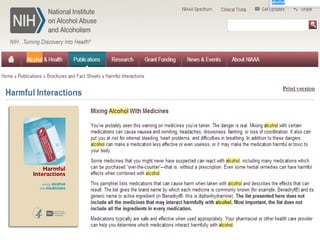
• Methanol and ethylene glycol poisoning
• Reflex stimulation in fainting/hysteria- 1 drop in nose
• To ward off cold- but long exposure to cold causes
hypothermia-loss d/t cutaneous vasodilatation.
Toxicity
S/E of moderate drinking
Nausea, vomiting
Flushing, hangover, traffic accidents
Acute alcohol intoxication
Hypotension, Hypoglycaemia, Gastritis
Collapse, Respiratory depression, Coma, Death
Chronic Alcoholism
Tolerance to subjective & behavioral effects
[reduced rate of absorption d/t gastritis, enzyme induction]
Psychic dependence with moderate drinking
Alcohol Dependence
• Physical dependence refers to a state resulting
from chronic use of a drug that has produced
tolerance and where negative physical symptoms
of withdrawal result from abrupt
discontinuation or dosage reduction.
• Psychological dependence is defined as
"dependence on a psychoactive substance for the
reinforcement it provides." Most times
psychological dependence is classified
under addiction.
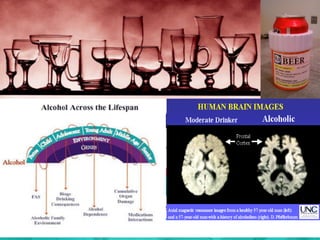
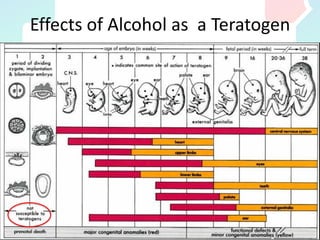
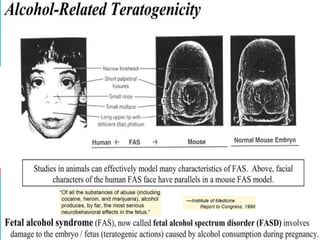
Effects of Alcohol as a Teratogen
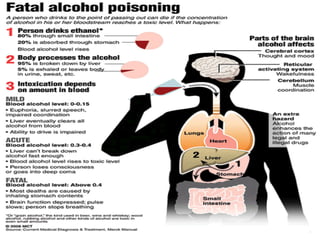
Acute Alcohol Intoxication
• An idea of degree of acute alcohol intoxication can be
obtained from chemical analysis of blood and urine.
• The detoxification of alcohol ceases after death, so brain
and blood levels of alcohol give reliable estimates about
degree of intoxication at time of death.
• CNS depressant effect-coma
Treatment
– General nursing care
– Maintenance of vitals
– IV glucose 50%, 50ml for hypoglycemia
– IV Thiamine 100mg (bolus)
– IV MgSO4 2-4 g over 1-2 hrs.
Acute Alcohol Intoxication
• Treatment consists of immediate administration of
thiamine 100 mg IV or IM, continued daily for at least 3 to
5 days.
• Mg is a necessary cofactor in thiamine-dependent
metabolism, and hypomagnesemia should be corrected
using Mg sulfate 1 to 2 g IM or IV q 6 to 8 h or Mg oxide
400 to 800 mg po once/day.
• Supportive treatment includes
➢ rehydration,
➢ correction of electrolyte abnormalities, and
➢ general nutritional therapy, including multivitamins.
• Alcohol cessation is mandatory.
MCQs
A medical student weight 70 kg attends the college party
where he rapidly consumed a quantity of alcoholic
beverages that results a blood level of 5 mg/ml. Assuming
that this young men has not had opportunity to develop
tolerance to ethanol, his present condition is best
characterized as:
 a. Alert and competent to drive a car
 b. Slightly inebriated.
 c. Sedated with increase reaction
 d. Able to walk, but not in a straight line.
 e. Comatose and near death.
MCQs
• 5 mg/ml
• dl = 100ml
• 5 mg/ml = 500 mg/dl
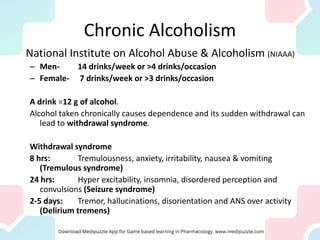
Chronic Alcoholism
National Institute on Alcohol Abuse & Alcoholism (NIAAA)
– Men- 14 drinks/week or >4 drinks/occasion
– Female- 7 drinks/week or >3 drinks/occasion
A drink =12 g of alcohol.
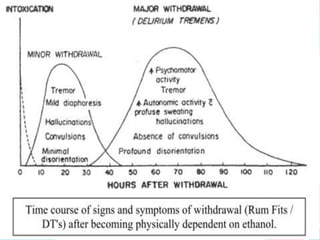
Alcohol taken chronically causes dependence and its sudden withdrawal can
lead to withdrawal syndrome.
Withdrawal syndrome
8 hrs: Tremulousness, anxiety, irritability, nausea & vomiting
(Tremulous syndrome)
24 hrs: Hyper excitability, insomnia, disordered perception and
convulsions (Seizure syndrome)
2-5 days: Tremor, hallucinations, disorientation and ANS over activity
(Delirium tremens)
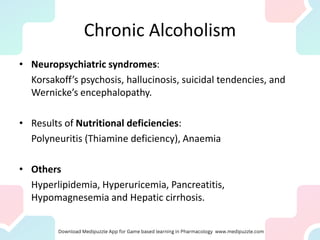
Chronic Alcoholism
• Neuropsychiatric syndromes:
Korsakoff’s psychosis, hallucinosis, suicidal tendencies, and
Wernicke’s encephalopathy.
• Results of Nutritional deficiencies:
Polyneuritis (Thiamine deficiency), Anaemia
• Others
Hyperlipidemia, Hyperuricemia, Pancreatitis,
Hypomagnesemia and Hepatic cirrhosis.
Treatment of Alcohol Dependence
Detoxification drugs
Aversion drugs
Disulfiram, Carbimide
Opioid antagonists
Naltrexone, Nalmephene
Dopaminergic Antagonists
Tiapride
Miscellaneous
Acamprosate
Supporting Drugs
Lithium, Carbamazepine, SSRIs
Disulfiram
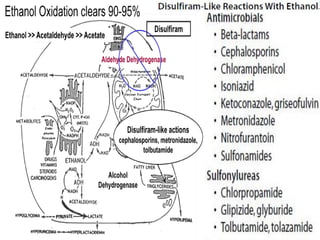
• Aldehyde dehydrogenase inhibitor
• When alcohol is ingested after taking disulfiram, the
concentration of acetaldehyde in tissues and blood rises
and aldehyde syndrome is precipitated.
• These are
– flushing, burning sensation, throbbing headache,
– perspiration, uneasiness, tightness in chest,
– dizziness, vomiting, visual disturbances, mental confusion,
– postural fainting and circulatory collapse.
• These symptoms last for 1-4 hrs depending upon amount of
alcohol consumed.
Disulfiram: Uses
• Disulfiram has been used as an aversion
technique in chronic alcoholics who are
motivated and sincerely desire to leave the
habit.
• After abstaining from alcohol overnight,
disulfiram is given 1 g on 1st day,0.75 g on 2nd
day, 0.5 g on 3rd and 0.25 g subsequently.
• Sensitization to alcohol develops after 2-3
hours of first dose, reaches its peak at -12
hours and lasts for 7-14 days because of
irreversible inhibition of alcohol dehydrogenase.
Disulfiram: S/E
Infrequent S/Es
• Rashes, metallic taste,
• Nervousness, malaise and
• Abdominal upset.
It inhibits a number of other enzymes as well:
• Alcohol dehydrogenase,
• Dopamine B hydroxylase and
• Several cytochrome P450 iso-enzymes.
Dysgeusia- Hypogeusia- Ageusia
• Dysgeusia- distortion of the sense of taste
• Hypogeusia -decrease in taste sensitivity
• Ageusia- lack of sense of taste- (no salivation)
• Metallic taste-
– Lithium carbonate, TTCs (drugs in saliva)
– Sulfhydryl group drugs- Penicillamine and Captopril (react with Zinc and cause Zinc
deficiency, hence dysgeusia)
– Metronidazole and Chlorhexidine, interact with metal ions associated with cell
membrane in mouth cells.
• Amiloride- inhibit taste receptors
Naltrexone
• Opioid system is involved in the pleasurable reinforcing
effects of alcohol probably by blunting dopamine
mediated reward function.
• Trials among post-addicts have shown that the long acting
opioid antagonist naltrexone helps prevent relapse of
alcoholism.
• It reduced alcohol craving, number of drinking days and
chances of resumed heavy drinking.
• Naltrexone is approved by US-FDA for use as adjuvant in
comprehensive treatment programmes for alcohol
dependent subjects and is being used in Nepal and India
at most de-addiction centers, after the individual has
undergone withdrawal and is motivated.
Acamprostate
• It is a weak NMDA-receptor antagonist (glutamate
antagonist) with modest GABAA receptor agonistic
activity that is being used in Europe for
maintenance therapy of alcohol abstinence.
• In conjunction with social and motivational
therapy, it has been found to reduce relapse of
the drinking behaviour.
• The efficacy of acamprostate in this regard is rated
comparable to naltrexone.
• Reduces intensity of craving on exposure to high-risk
drinking situations
Others
• The 5-HT3 antagonist ondansetron decreases
rewarding effect
• Reduces drinking and relapse among early
onset, but not late onset, alcoholics
• and the antiepileptic topiramate have also
shown some promise in treating alcoholism.
MCQs
2. Which one of following statement about bio-
disposition of ethanol is false?
a. Ethanol is absorbed at all levels of GIT.
b. Acetaldehyde is the initial product of ethanol
metabolism.
c. After IV dose, plasma levels of ethanol are higher in
women than in men.
d. Elimination of ethanol follows zero order kinetics.
e. Aldehyde dehydrogenase exhibits genetic variability,
hence the Asian Flush syndrome.
MCQs
• A. Ethanol does not have any tissue barriers, and
is absorbed at all levels of GIT.
• B. The first product of metabolism of alcohol is
Acetaldehyde
• C. In women metabolism of alcohol occurs much
slowly then in men, however, just following IV
dosing the concentration is rather similar.
• D. Ethanol follows zero order kinetics
• E. Aldehyde dehydrogenase exhibits generic
variability.
METHANOL
It is added to rectified spirit (90%) to make spirit unfit for drinking
Poisoning can occur from:
• Unintentional mixing of methanol in drinks
• Inadvertent ingestion
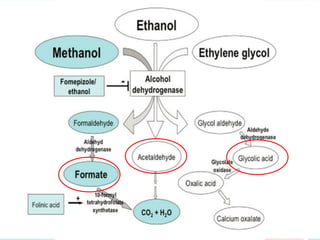
Methanol– Formaldehyde– Formic acid
Toxic effects are largely due to formic acid, since its further metabolism is
slow and folate dependent.
Zero order kinetics, T1/2 20-60 hrs
Blood level > 50mg/dl methanol – severe poisoning
15 ml of methanol- blindness
30ml might also cause death
Fatal dose 75-100 ml.
Methanol poisoning
 Methanol is the most toxic of the aliphatic alcohols.
 Its oxidation leads to formaldehyde and formic acid.
 Typical symptoms of methanol poisoning are visual
disorders (e.g., the impression of a snowstorm), which
can lead to blindness and even death.
[Loss of sight news from Nepal & Pakistan]
 In the case of serious poisoning, one can actually smell
formaldehyde on the subject’s exhaled breath.
METHANOL
Poisoning manifestations
Vomiting, headache, epigastric pain, uneasiness,
Dyspnoea, bradycardia, hypotension
Delerium---coma
Acidosis (formic acid)
Formic acid- Retinal damage, blurring of vision, congestion of optic disc,
blindness
Death d/t respiratory failure
Products containing methanol
- Anti-freeze
- De-icing solutions
- Varnish
- Paint remover
- Windshield wiper fluid
Management of methanol poisoning
➢ Keep the patient in a quiet, dark room; protect the eyes
from light.
➢ Gastric lavage with sod. bicarbonate if the patient is
brought within 2hrs of ingesting methanol.
➢ Supportive measures to maintain ventilation and BP
should be instituted.
➢ Combat acidosis by I.V. Sod. bicarbonate infusion-the
most important measure; prevents retinal damage and
other symptoms; large quantities may be needed.
➢ KCl infusion is needed only when hypokalemia occurs due
to alkali therapy.
Management of methanol poisoning
➢ Ethanol 100 mg/dl in blood saturates alcohol
dehydrogenase and retards methanol metabolism.
Ethanol 10% in water given through nasogastric tube;
loading dose 0.7ml/kg followed by 0.15ml/kg/hr drip.
➢ Haemodialysis- helps clear methanol as well as
formate and hastens recovery.
➢ Fomepizole (4-methyl pryazole), a specific inhibitor of
alcohol dehydrogenase-retards methanol metabolism.
➢ Folate therapy: Leucovorin calcium 50mg injected 6
hourly enhances oxidation of blood formate this
reducing its blood levels.
www.medipuzzle.com
That’s All
ENJOY
53
CNS-_Alcohols.pdf

CNS-_Alcohols.pdf

  • 1.
    Aliphatic Alcohols Sanjaya ManiDixit Assistant Prof of Pharmacology
  • 2.
    Contents • Asian FlushSyndrome • Introduction • History of alcohol in medicine • Ethanol • Pharmacological actions- Uses- Toxicity • Acute Alcohol Intoxication • Chronic Alcoholism • Aversion Drugs in Alcoholics • Methanol • Methanol Poisoning
  • 3.
    Envision yourself ina situation You go for a drink with your friends and family, at a corner you spot a guy’s face all red by the time he drank a glass or two of alcohol. Is it okay that their face turned all red, or is it an indicator that it might soon get worse? Why is it that they reacted differently than anyone else in the room? Is it that they felt shy that their face flushed and turned red? What do you think is the reason behind? Asian Flush Syndrome
  • 5.
    Alcohol a socialdrink • Alcohol is loved for the way it makes people feel (except for the hangover part of course). • It makes people more sociable, carefree, easygoing, and uninhibited. • If taken responsibly, a drink or two can be the perfect mood setter for a get-together.
  • 7.
    Ethanol in Beverages Ethanol Concentrations Vary By Beverage Class Beer or ale - 3-6% v/v or 12g/12oz Table wines - 8-14% v/v or 12g/4oz Fortified wine (distilled ethanol added - sherry, port, vermouth, etc.) - 15-20% v/v or 12g/2.5oz Distilled spirits (vodka, gin, rum, bourbon, etc.) ~40% v/v or 12g/1oz
  • 8.
    Ethanol in Beverages Alcohol Use / Abuse levels - Assuming 8 g ethanol per drink:  light = 1.1 drinks / day;  moderate = 2.2 drinks per day;  heavy = 3.5 drinks / day;  Abusive > 5.4 drinks per day  (source Michigan Medical Society 1996 physicians survey). "Risky use" for women and those > 65 yrs > 7 drinks per week or > 3 drinks per occasion;  for men <65 yrs >14 drinks per week  or > 4 drinks per occasion
  • 10.
    Ethanol/Alcohol ➢ Alcohol=ethyl alcoholor ethanol ➢ It is the main component of every type of alcoholic beverages and is obtained by the fermentation of sugars. ➢ 1 gm alcohol= 7kCal Energy (as acetate) (Cannot be stored) ➢ Alcohol has no nutritional value, and rather can cause dietary deficiencies in alcoholics, since they may refrain from food. ➢ Pharmacology of alcohol is important: ➢ presence in beverages and ➢ alcohol intoxication
  • 11.
    Pharmacological Axns Local Actions ➢Mild rubefacient and counter-irritant on skin ➢ Irritation and burning sensation on delicate skin and mucous membranes ➢ S/C- intense pain, inflammation, necrosis, fibrosis ➢ If injected around nerve causes permanent damage. ➢ Astringent-precipitate surface proteins & hardens skin. ➢ Antiseptic-@20-70% increasingly, 70-90% same, >90% ineffective, though 100% ethanol is more dehydrating. ➢ Alcohol does not kill bacterial spores
  • 12.
    Pharmacological Axns CNS ➢ Neuronaldepressant ➢ Hesitation, caution, self-criticism & restraint lost first Low conc 30-100mg/dl - Excitation and euphoria 100-150mg/dl – mental clouding, disorganization of thought, memory impairment, drowsiness 150-200mg/dl – Sloppy, ataxic & drunk 200-300mg/dl – Stupor >300mg/dl – Unconsciousness, medullary center paralysis, death ➢ Anaesthesia can be produced but margin of safety is low ➢ Increases pain threshold, not a dependable analgesic ➢ Reflexes slowed (No driving), errors increase. ➢ Increases anticonvulsant axn, then lowers threshold, precipitating seizures.
  • 13.
    Pharmacological Axns CVS ➢ Smalldoses Cutaneous and gastric vasodilation Skin is warm and flushed, BP not affected ➢ Moderate doses Tachycardia, mild rise in BP (sympathetic stimulation) ➢ Large doses Myocardial and vasomotor center depression, fall in BP ➢ Chronic alcoholism HTN, cardiomyopathy, atrial fibrillation, arrhythmias d/t conduction defects and QT prolongation
  • 14.
    Pharmacological Axns Blood Small tomoderate amounts daily raise HDL- cholesterol levels, and decrease LDL oxidation Lower 15-35% CAD Protection lost if >3 drinks consumed daily Chronic alcoholism Megaloblastic anaemia- d/t interference of folate metabolism
  • 15.
    Pharmacological Axns Liver Mobilizes peripheralfat and increases fat synthesis in liver in a dose-dependent manner. Regular alcohol- induces microsomal enzymes Chronic alcoholism subjects liver to oxidative stress and causes cellular necrosis followed by fibrosis. Alcohol-Acetaldehyde-hepatocyte damage, inflammation (Chronic- large amounts) Alcoholic cirrhosis – vitamin and nutritional deficiencies
  • 16.
    Pharmacological Axns Body temperature Producessense of warmth d/t cutaneous and gastric vasodilatation Heat loss actually increase in cold areas High doses depress temperature regulating center Respiration Irritate buccal and pharyngeal mucosa- reflexly stimulate respiration for short period Direct depressant action on respiratory centers
  • 17.
    Pharmacological Axns ➢ Skeletalmuscle Fatigue allayed in small doses Chronic- weakness and myopathy ➢ Kidney Diuresis Inhibition of ADH ➢ Sex Aphrodisiac- loss of restraint and inhibition Chronic - impotence, testicular atrophy, gynecomastia, infertility
  • 18.
    MCQs 1. Which offollowing effect is least likely to occur after acute ingestion of alcohol? a. Additive CNS depression with antihistamine b. Hypertension c. Inhibition of liver microsomal drug- metabolizing enzyme d. Myocardial depression e. Relaxation of uterine muscle
  • 19.
    MCQs A. Antihistamines effectson central H1 receptors cause drowsiness and hence both have additive CNS depressing results. B. Acute alcohol intoxication in large doses causes myocardial and vasomotor center depression, hence fall in BP (Hypotension) C. Alcohol is a potent inhibitor of liver microsomal enzymes D. As mentioned in B it is a myocardial depressant E. Alcohol is known to suppress the uterine contractions at moderate blood levels.
  • 21.
    CLINICAL USES • Antiseptic •Rubefacient & counterirritant for sprains, joint pains, etc. • Rubbed into the skin to prevent bedsores. • Astringent - antiperspirant and aftershave • Alcoholic sponges to reduce body temperature in fever. (Cold water/ice better) • Intractable neuralgias, severe cancer pain-alcohol injection around the nerve-permanent loss of transmission. • Methanol and ethylene glycol poisoning • Reflex stimulation in fainting/hysteria- 1 drop in nose • To ward off cold- but long exposure to cold causes hypothermia-loss d/t cutaneous vasodilatation.
  • 22.
    Toxicity S/E of moderatedrinking Nausea, vomiting Flushing, hangover, traffic accidents Acute alcohol intoxication Hypotension, Hypoglycaemia, Gastritis Collapse, Respiratory depression, Coma, Death Chronic Alcoholism Tolerance to subjective & behavioral effects [reduced rate of absorption d/t gastritis, enzyme induction] Psychic dependence with moderate drinking
  • 23.
    Alcohol Dependence • Physicaldependence refers to a state resulting from chronic use of a drug that has produced tolerance and where negative physical symptoms of withdrawal result from abrupt discontinuation or dosage reduction. • Psychological dependence is defined as "dependence on a psychoactive substance for the reinforcement it provides." Most times psychological dependence is classified under addiction.
  • 24.
    Effects of Alcoholas a Teratogen
  • 26.
    Acute Alcohol Intoxication •An idea of degree of acute alcohol intoxication can be obtained from chemical analysis of blood and urine. • The detoxification of alcohol ceases after death, so brain and blood levels of alcohol give reliable estimates about degree of intoxication at time of death. • CNS depressant effect-coma Treatment – General nursing care – Maintenance of vitals – IV glucose 50%, 50ml for hypoglycemia – IV Thiamine 100mg (bolus) – IV MgSO4 2-4 g over 1-2 hrs.
  • 27.
    Acute Alcohol Intoxication •Treatment consists of immediate administration of thiamine 100 mg IV or IM, continued daily for at least 3 to 5 days. • Mg is a necessary cofactor in thiamine-dependent metabolism, and hypomagnesemia should be corrected using Mg sulfate 1 to 2 g IM or IV q 6 to 8 h or Mg oxide 400 to 800 mg po once/day. • Supportive treatment includes ➢ rehydration, ➢ correction of electrolyte abnormalities, and ➢ general nutritional therapy, including multivitamins. • Alcohol cessation is mandatory.
  • 28.
    MCQs A medical studentweight 70 kg attends the college party where he rapidly consumed a quantity of alcoholic beverages that results a blood level of 5 mg/ml. Assuming that this young men has not had opportunity to develop tolerance to ethanol, his present condition is best characterized as:  a. Alert and competent to drive a car  b. Slightly inebriated.  c. Sedated with increase reaction  d. Able to walk, but not in a straight line.  e. Comatose and near death.
  • 29.
    MCQs • 5 mg/ml •dl = 100ml • 5 mg/ml = 500 mg/dl
  • 31.
    Chronic Alcoholism National Instituteon Alcohol Abuse & Alcoholism (NIAAA) – Men- 14 drinks/week or >4 drinks/occasion – Female- 7 drinks/week or >3 drinks/occasion A drink =12 g of alcohol. Alcohol taken chronically causes dependence and its sudden withdrawal can lead to withdrawal syndrome. Withdrawal syndrome 8 hrs: Tremulousness, anxiety, irritability, nausea & vomiting (Tremulous syndrome) 24 hrs: Hyper excitability, insomnia, disordered perception and convulsions (Seizure syndrome) 2-5 days: Tremor, hallucinations, disorientation and ANS over activity (Delirium tremens)
  • 33.
    Chronic Alcoholism • Neuropsychiatricsyndromes: Korsakoff’s psychosis, hallucinosis, suicidal tendencies, and Wernicke’s encephalopathy. • Results of Nutritional deficiencies: Polyneuritis (Thiamine deficiency), Anaemia • Others Hyperlipidemia, Hyperuricemia, Pancreatitis, Hypomagnesemia and Hepatic cirrhosis.
  • 34.
    Treatment of AlcoholDependence Detoxification drugs Aversion drugs Disulfiram, Carbimide Opioid antagonists Naltrexone, Nalmephene Dopaminergic Antagonists Tiapride Miscellaneous Acamprosate Supporting Drugs Lithium, Carbamazepine, SSRIs
  • 35.
    Disulfiram • Aldehyde dehydrogenaseinhibitor • When alcohol is ingested after taking disulfiram, the concentration of acetaldehyde in tissues and blood rises and aldehyde syndrome is precipitated. • These are – flushing, burning sensation, throbbing headache, – perspiration, uneasiness, tightness in chest, – dizziness, vomiting, visual disturbances, mental confusion, – postural fainting and circulatory collapse. • These symptoms last for 1-4 hrs depending upon amount of alcohol consumed.
  • 37.
    Disulfiram: Uses • Disulfiramhas been used as an aversion technique in chronic alcoholics who are motivated and sincerely desire to leave the habit. • After abstaining from alcohol overnight, disulfiram is given 1 g on 1st day,0.75 g on 2nd day, 0.5 g on 3rd and 0.25 g subsequently. • Sensitization to alcohol develops after 2-3 hours of first dose, reaches its peak at -12 hours and lasts for 7-14 days because of irreversible inhibition of alcohol dehydrogenase.
  • 38.
    Disulfiram: S/E Infrequent S/Es •Rashes, metallic taste, • Nervousness, malaise and • Abdominal upset. It inhibits a number of other enzymes as well: • Alcohol dehydrogenase, • Dopamine B hydroxylase and • Several cytochrome P450 iso-enzymes.
  • 39.
    Dysgeusia- Hypogeusia- Ageusia •Dysgeusia- distortion of the sense of taste • Hypogeusia -decrease in taste sensitivity • Ageusia- lack of sense of taste- (no salivation) • Metallic taste- – Lithium carbonate, TTCs (drugs in saliva) – Sulfhydryl group drugs- Penicillamine and Captopril (react with Zinc and cause Zinc deficiency, hence dysgeusia) – Metronidazole and Chlorhexidine, interact with metal ions associated with cell membrane in mouth cells. • Amiloride- inhibit taste receptors
  • 40.
    Naltrexone • Opioid systemis involved in the pleasurable reinforcing effects of alcohol probably by blunting dopamine mediated reward function. • Trials among post-addicts have shown that the long acting opioid antagonist naltrexone helps prevent relapse of alcoholism. • It reduced alcohol craving, number of drinking days and chances of resumed heavy drinking. • Naltrexone is approved by US-FDA for use as adjuvant in comprehensive treatment programmes for alcohol dependent subjects and is being used in Nepal and India at most de-addiction centers, after the individual has undergone withdrawal and is motivated.
  • 41.
    Acamprostate • It isa weak NMDA-receptor antagonist (glutamate antagonist) with modest GABAA receptor agonistic activity that is being used in Europe for maintenance therapy of alcohol abstinence. • In conjunction with social and motivational therapy, it has been found to reduce relapse of the drinking behaviour. • The efficacy of acamprostate in this regard is rated comparable to naltrexone. • Reduces intensity of craving on exposure to high-risk drinking situations
  • 42.
    Others • The 5-HT3antagonist ondansetron decreases rewarding effect • Reduces drinking and relapse among early onset, but not late onset, alcoholics • and the antiepileptic topiramate have also shown some promise in treating alcoholism.
  • 44.
    MCQs 2. Which oneof following statement about bio- disposition of ethanol is false? a. Ethanol is absorbed at all levels of GIT. b. Acetaldehyde is the initial product of ethanol metabolism. c. After IV dose, plasma levels of ethanol are higher in women than in men. d. Elimination of ethanol follows zero order kinetics. e. Aldehyde dehydrogenase exhibits genetic variability, hence the Asian Flush syndrome.
  • 45.
    MCQs • A. Ethanoldoes not have any tissue barriers, and is absorbed at all levels of GIT. • B. The first product of metabolism of alcohol is Acetaldehyde • C. In women metabolism of alcohol occurs much slowly then in men, however, just following IV dosing the concentration is rather similar. • D. Ethanol follows zero order kinetics • E. Aldehyde dehydrogenase exhibits generic variability.
  • 46.
    METHANOL It is addedto rectified spirit (90%) to make spirit unfit for drinking Poisoning can occur from: • Unintentional mixing of methanol in drinks • Inadvertent ingestion Methanol– Formaldehyde– Formic acid Toxic effects are largely due to formic acid, since its further metabolism is slow and folate dependent. Zero order kinetics, T1/2 20-60 hrs Blood level > 50mg/dl methanol – severe poisoning 15 ml of methanol- blindness 30ml might also cause death Fatal dose 75-100 ml.
  • 47.
    Methanol poisoning  Methanolis the most toxic of the aliphatic alcohols.  Its oxidation leads to formaldehyde and formic acid.  Typical symptoms of methanol poisoning are visual disorders (e.g., the impression of a snowstorm), which can lead to blindness and even death. [Loss of sight news from Nepal & Pakistan]  In the case of serious poisoning, one can actually smell formaldehyde on the subject’s exhaled breath.
  • 48.
    METHANOL Poisoning manifestations Vomiting, headache,epigastric pain, uneasiness, Dyspnoea, bradycardia, hypotension Delerium---coma Acidosis (formic acid) Formic acid- Retinal damage, blurring of vision, congestion of optic disc, blindness Death d/t respiratory failure Products containing methanol - Anti-freeze - De-icing solutions - Varnish - Paint remover - Windshield wiper fluid
  • 49.
    Management of methanolpoisoning ➢ Keep the patient in a quiet, dark room; protect the eyes from light. ➢ Gastric lavage with sod. bicarbonate if the patient is brought within 2hrs of ingesting methanol. ➢ Supportive measures to maintain ventilation and BP should be instituted. ➢ Combat acidosis by I.V. Sod. bicarbonate infusion-the most important measure; prevents retinal damage and other symptoms; large quantities may be needed. ➢ KCl infusion is needed only when hypokalemia occurs due to alkali therapy.
  • 50.
    Management of methanolpoisoning ➢ Ethanol 100 mg/dl in blood saturates alcohol dehydrogenase and retards methanol metabolism. Ethanol 10% in water given through nasogastric tube; loading dose 0.7ml/kg followed by 0.15ml/kg/hr drip. ➢ Haemodialysis- helps clear methanol as well as formate and hastens recovery. ➢ Fomepizole (4-methyl pryazole), a specific inhibitor of alcohol dehydrogenase-retards methanol metabolism. ➢ Folate therapy: Leucovorin calcium 50mg injected 6 hourly enhances oxidation of blood formate this reducing its blood levels.
  • 52.
  • 53.