
UNIT IV
P r e p a r e d B y : M s . D i v y a K a n o j i y a
A s s i s t a n t P r o f e s s o r, D e p a r t m e n t o f P h a r m a c o g n o s y
D e p a r t m e n t o f P h a r m a c y, S u m a n d e e p V i d y a p e e t h
D e e m e d t o b e U n i v e r s i t y, P i p a r i a , V a d o d a r a .
1
CONTENT:
• Brief outline of occurrence, distribution,
isolation, identification tests, therapeutic activity
and pharmaceutical applications of alkaloids,
terpenoids, glycosides, volatile oils, tannins and
resins.
2
ALKALOIDS
• Definition:
• The alkaloids are organic, basic, nitrogenous compound
containing one or more nitrogen atom.
• They are very potent in nature and found generally in
plants.
• The first alkaloid was isolated by Derosne known as
Narcotine in 1803.
3
• Properties:
1. They are generally colourless but Berberine alkaloids are yellow in
colour.
2. They are solid, crystalline in nature (e.g. Quinine sulphate) but some of
them are liquid in nature. (e.g. Conine, Nicotine)
3. The alkaloidal bases are soluble in non-polar solvent like benzene,
acetone, chloroform but they are insoluble in polar solvent like water
whereas alkaloidal salt are soluble in poplar solvent and they are
insoluble in non-polar solvent.
4. most of the alkaloids are optically active but levo rotating (l-form) of
alkaloid is physiologically more active.
5. They are bitter in test.
4
CHEMISTRY
• Alkaloids contain C, H, O and one or more nitrogen (N)
atom, the nitrogen atom is present in heterocyclic ring (e.g.
Atropine, Reserpine) but some time it is also present outside
the ring (e.g. Ephedrine). In plant, alkaloids occur in both
form free form and salt form of an organic acid.
5
CLASSIFICATION
1. The alkaloids are classified as follows:
2. Pharmacological classification
3. Taxonomic classification
4. Bio-synthetic classification
5. Chemical classification
6
PHARMACOLOGICAL CLASSIFICATION
• In this alkaloids are classified on the bases of pharmacological
action. For example
1. CNS stimulant or depressant
2. Analgesic
3. Antitussive and expectorant
• It does not take into account the chemical nature of the drug within
the same drug. The individual alkaloids may have different action.
• For example
7
• Opium alkaloids:
• Morphine: Analgesic
• Codeine: Antitussive
• Cinchona alkaloids:
• Quinine: Antimalarial
• Quinidine: Cardiac depressant
8
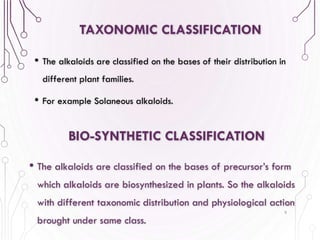
TAXONOMIC CLASSIFICATION
• The alkaloids are classified on the bases of their distribution in
different plant families.
• For example Solaneous alkaloids.
BIO-SYNTHETIC CLASSIFICATION
• The alkaloids are classified on the bases of precursor’s form
which alkaloids are biosynthesized in plants. So the alkaloids
with different taxonomic distribution and physiological action
brought under same class.
9
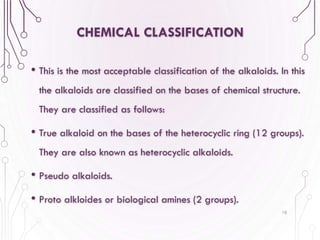
CHEMICAL CLASSIFICATION
• This is the most acceptable classification of the alkaloids. In this
the alkaloids are classified on the bases of chemical structure.
They are classified as follows:
• True alkaloid on the bases of the heterocyclic ring (12 groups).
They are also known as heterocyclic alkaloids.
• Pseudo alkaloids.
• Proto alkloides or biological amines (2 groups).
10
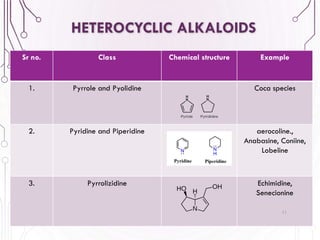
HETEROCYCLIC ALKALOIDS
Sr no. Class Chemical structure Example
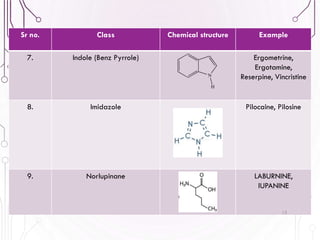
1. Pyrrole and Pyolidine Coca species
2. Pyridine and Piperidine aerocoline.,
Anabasine, Coniine,
Lobeline
3. Pyrrolizidine Echimidine,
Senecionine
11
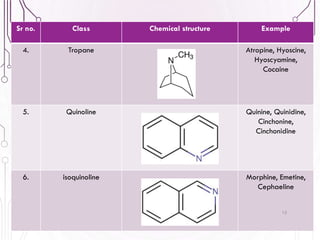
Sr no. Class Chemical structure Example
4. Tropane Atropine, Hyoscine,
Hyoscyamine,
Cocaine
5. Quinoline Quinine, Quinidine,
Cinchonine,
Cinchonidine
6. isoquinoline Morphine, Emetine,
Cephaeline
12
Sr no. Class Chemical structure Example
7. Indole (Benz Pyrrole) Ergometrine,
Ergotamine,
Reserpine, Vincristine
8. Imidazole Pilocaine, Pilosine
9. Norlupinane LABURNINE,
lUPANINE
13
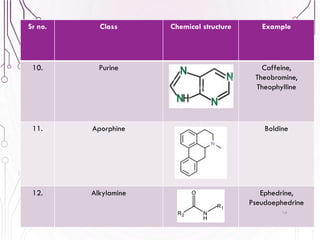
Sr no. Class Chemical structure Example
10. Purine Caffeine,
Theobromine,
Theophylline
11. Aporphine Boldine
12. Alkylamine Ephedrine,
Pseudoephedrine
14
DISTRIBUTION
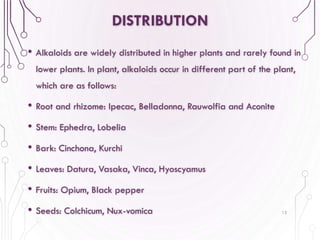
• Alkaloids are widely distributed in higher plants and rarely found in
lower plants. In plant, alkaloids occur in different part of the plant,
which are as follows:
• Root and rhizome: Ipecac, Belladonna, Rauwolfia and Aconite
• Stem: Ephedra, Lobelia
• Bark: Cinchona, Kurchi
• Leaves: Datura, Vasaka, Vinca, Hyoscyamus
• Fruits: Opium, Black pepper
• Seeds: Colchicum, Nux-vomica 15
EXTRACTION AND ISOLATION
• Extraction:
16
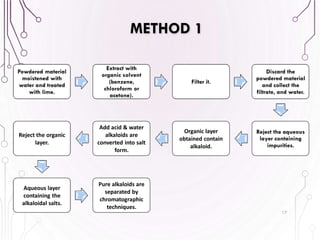
METHOD 1
17
Powdered material
moistened with
water and treated
with lime.
Extract with
organic solvent
(benzene,
chloroform or
acetone).
Filter it.
Discard the
powdered material
and collect the
filtrate, and water.
Reject the aqueous
layer containing
impurities.
Organic layer
obtained contain
alkaloid.
Add acid & water
alkaloids are
converted into salt
form.
Reject the organic
layer.
Aqueous layer
containing the
alkaloidal salts.
Pure alkaloids are
separated by
chromatographic
techniques.
18
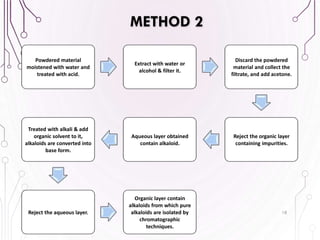
METHOD 2
Powdered material
moistened with water and
treated with acid.
Extract with water or
alcohol & filter it.
Discard the powdered
material and collect the
filtrate, and add acetone.
Reject the organic layer
containing impurities.
Aqueous layer obtained
contain alkaloid.
Treated with alkali & add
organic solvent to it,
alkaloids are converted into
base form.
Reject the aqueous layer.
Organic layer contain
alkaloids from which pure
alkaloids are isolated by
chromatographic
techniques.
IDENTIFICATION TEST
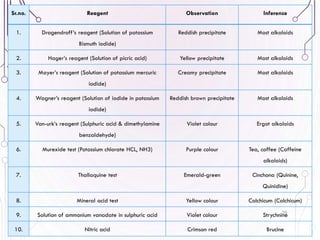
• Alkaloids are detected by precipitate or colour
appearance by the suitable reagent. Following are
the general identification test for alkaloids.
19
20
Sr.no. Reagent Observation Inference
1. Dragendroff’s reagent (Solution of potassium
Bismuth iodide)
Reddish precipitate Most alkaloids
2. Hager’s reagent (Solution of picric acid) Yellow precipitate Most alkaloids
3. Mayer’s reagent (Solution of potassium mercuric
iodide)
Creamy precipitate Most alkaloids
4. Wagner’s reagent (Solution of iodide in potassium
iodide)
Reddish brown precipitate Most alkaloids
5. Van-urk’s reagent (Sulphuric acid & dimethylamine
benzaldehyde)
Violet colour Ergot alkaloids
6. Murexide test (Potassium chlorate HCL, NH3) Purple colour Tea, coffee (Caffeine
alkaloids)
7. Thallaquine test Emerald-green Cinchona (Quinine,
Quinidine)
8. Mineral acid test Yellow colour Colchicum (Colchicum)
9. Solution of ammonium vanadate in sulphuric acid Violet colour Strychnine
10. Nitric acid Crimson red Brucine
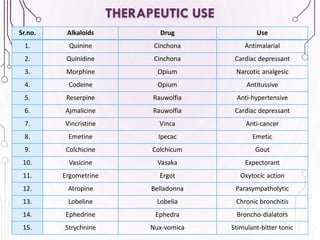
THERAPEUTIC USE
21
Sr.no. Alkaloids Drug Use
1. Quinine Cinchona Antimalarial
2. Quinidine Cinchona Cardiac depressant
3. Morphine Opium Narcotic analgesic
4. Codeine Opium Antitussive
5. Reserpine Rauwolfia Anti-hypertensive
6. Ajmalicine Rauwolfia Cardiac depressant
7. Vincristine Vinca Anti-cancer
8. Emetine Ipecac Emetic
9. Colchicine Colchicum Gout
10. Vasicine Vasaka Expectorant
11. Ergometrine Ergot Oxytocic action
12. Atropine Belladonna Parasympatholytic
13. Lobeline Lobelia Chronic bronchitis
14. Ephedrine Ephedra Broncho-dialators
15. Strychnine Nux-vomica Stimulant-bitter tonic
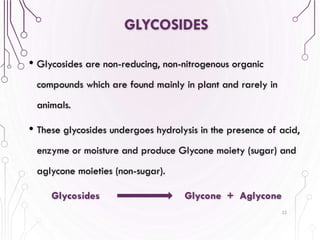
GLYCOSIDES
• Glycosides are non-reducing, non-nitrogenous organic
compounds which are found mainly in plant and rarely in
animals.
• These glycosides undergoes hydrolysis in the presence of acid,
enzyme or moisture and produce Glycone moiety (sugar) and
aglycone moieties (non-sugar).
Glycosides Glycone + Aglycone
22
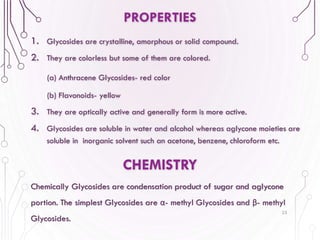
PROPERTIES
1. Glycosides are crystalline, amorphous or solid compound.
2. They are colorless but some of them are colored.
(a) Anthracene Glycosides- red color
(b) Flavonoids- yellow
3. They are optically active and generally form is more active.
4. Glycosides are soluble in water and alcohol whereas aglycone moieties are
soluble in inorganic solvent such an acetone, benzene, chloroform etc.
23
CHEMISTRY
Chemically Glycosides are condensation product of sugar and aglycone
portion. The simplest Glycosides are α- methyl Glycosides and β- methyl
Glycosides.
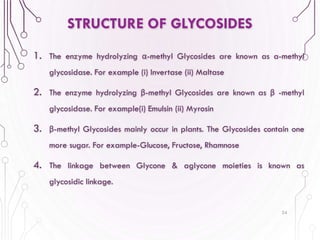
1. The enzyme hydrolyzing α-methyl Glycosides are known as a-methyl
glycosidase. For example (i) Invertase (ii) Maltase
2. The enzyme hydrolyzing β-methyl Glycosides are known as β -methyl
glycosidase. For example(i) Emulsin (ii) Myrosin
3. β-methyl Glycosides mainly occur in plants. The Glycosides contain one
more sugar. For example-Glucose, Fructose, Rhamnose
4. The linkage between Glycone & aglycone moieties is known as
glycosidic linkage.
24
STRUCTURE OF GLYCOSIDES
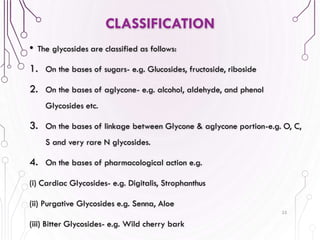
• The glycosides are classified as follows:
1. On the bases of sugars- e.g. Glucosides, fructoside, riboside
2. On the bases of aglycone- e.g. alcohol, aldehyde, and phenol
Glycosides etc.
3. On the bases of linkage between Glycone & aglycone portion-e.g. O, C,
S and very rare N glycosides.
4. On the bases of pharmacological action e.g.
(i) Cardiac Glycosides- e.g. Digitalis, Strophanthus
(ii) Purgative Glycosides e.g. Senna, Aloe
(iii) Bitter Glycosides- e.g. Wild cherry bark
25
CLASSIFICATION
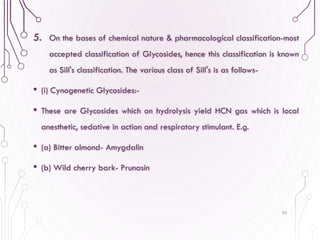
5. On the bases of chemical nature & pharmacological classification-most
accepted classification of Glycosides, hence this classification is known
as Sill's classification. The various class of Sill's is as follows-
• (i) Cynogenetic Glycosides:-
• These are Glycosides which on hydrolysis yield HCN gas which is local
anesthetic, sedative in action and respiratory stimulant. E.g.
• (a) Bitter almond- Amygdalin
• (b) Wild cherry bark- Prunasin
26
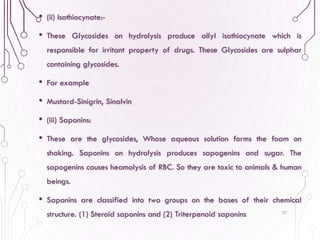
• (ii) Isothiocynate:-
• These Glycosides on hydrolysis produce allyl isothiocynate which is
responsible for irritant property of drugs. These Glycosides are sulphar
containing glycosides.
• For example
• Mustard-Sinigrin, Sinalvin
• (iii) Saponins:
• These are the glycosides, Whose aqueous solution forms the foam on
shaking. Saponins on hydrolysis produces sapogenins and sugar. The
sapogenins causes heamolysis of RBC. So they are toxic to animals & human
beings.
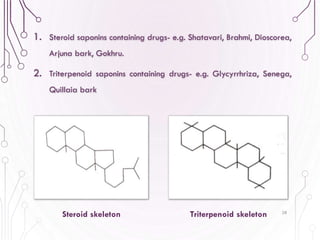
• Saponins are classified into two groups on the bases of their chemical
structure. (1) Steroid saponins and (2) Triterpenoid saponins 27
1. Steroid saponins containing drugs- e.g. Shatavari, Brahmi, Dioscorea,
Arjuna bark, Gokhru.
2. Triterpenoid saponins containing drugs- e.g. Glycyrrhriza, Senega,
Quillaia bark
28
Steroid skeleton Triterpenoid skeleton
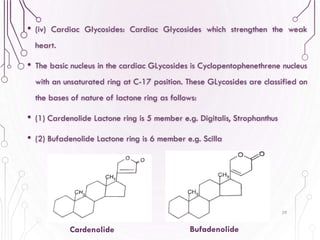
• (iv) Cardiac Glycosides: Cardiac Glycosides which strengthen the weak
heart.
• The basic nucleus in the cardiac GLycosides is Cyclopentophenethrene nucleus
with an unsaturated ring at C-17 position. These GLycosides are classified on
the bases of nature of lactone ring as follows:
• (1) Cardenolide Lactone ring is 5 member e.g. Digitalis, Strophanthus
• (2) Bufadenolide Lactone ring is 6 member e.g. Scilla
29
Cardenolide Bufadenolide
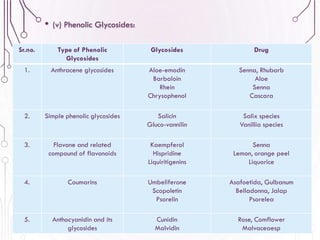
• (v) Phenolic Glycosides:
30
Sr.no. Type of Phenolic
Glycosides
Glycosides Drug
1. Anthracene glycosides Aloe-emodin
Barbaloin
Rhein
Chrysophenol
Senna, Rhubarb
Aloe
Senna
Cascara
2. Simple phenolic glycosides Salicin
Gluco-vannilin
Salix species
Vanillia species
3. Flavone and related
compound of flavonoids
Kaempferol
Hispridine
Liquiritigenins
Senna
Lemon, orange peel
Liquorice
4. Coumarins Umbeliferone
Scopoletin
Psorelin
Asafoetida, Gulbanum
Belladonna, Jalap
Psorelea
5. Anthocyanidin and its
glycosides
Cunidin
Malvidin
Rose, Comflower
Malvaceaesp
31
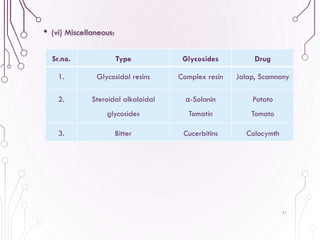
• (vi) Miscellaneous:
Sr.no. Type Glycosides Drug
1. Glycosidal resins Complex resin Jalap, Scamnony
2. Steroidal alkaloidal
glycosides
α-Solanin
Tomatin
Potato
Tomato
3. Bitter Cucerbitins Colocymth
• The Glycosides are widely distributed in higher plants and rarely found in
animals. In plants they are found in various families such as Apocynaceae,
Rubaceae, Laguminaseae, Zygophylaceae, Crucifereae etc. In plant, Glycosides
occur in different parts which are as follows:
1. Root: Senega, Shatavari
2. Rhizome: Rhubarb, Diosgennins, Picrorrhiza
3. Wood: Quassia
4. Bark: Arjuna bark, Wild cherry bark
5. Leaf: Senna, Gokhru, Digitalis, Stropanthus
6. Fruit: Gokhru
7. Seeds: Bitter almond, Mustard
8. Entire herb: Brahmi, Chirata
32
DISTRIBUTION
33
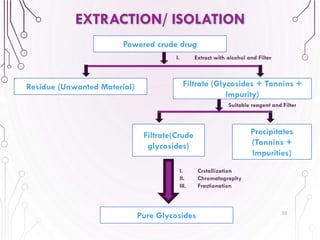
EXTRACTION/ ISOLATION
Powered crude drug
Filtrate (Glycosides + Tannins +
Impurity)
Residue (Unwanted Material)
Precipitates
(Tannins +
Impurities)
Filtrate(Crude
glycosides)
Pure Glycosides
I. Crstallization
II. Chromatography
III. Fractionation
I. Extract with alcohol and Filter
Suitable reagent and Filter
34
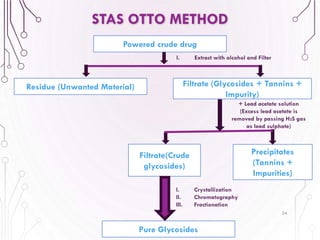
STAS OTTO METHOD
Powered crude drug
Filtrate (Glycosides + Tannins +
Impurity)
Residue (Unwanted Material)
Precipitates
(Tannins +
Impurities)
Filtrate(Crude
glycosides)
Pure Glycosides
I. Crystallization
II. Chromatography
III. Fractionation
I. Extract with alcohol and Filter
+ Lead acetate solution
(Excess lead acetate is
removed by passing H2S gas
as lead sulphate)
• There is no simple identification test for Glycosides but the
Glycone and aglycone moiety can be detected easily. For this
hydrolysis is carried out by boiling the drug powder with acid
or by the action of enzyme. Depending on the nature of
glycone and aglycone , moiety specific chemical tests are
performed. The various chemical tests which are performed to
detect the glycosides and aglycone moiety are as follows:
35
IDENTIFICATION TEST
36
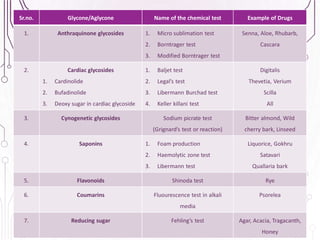
Sr.no. Glycone/Aglycone Name of the chemical test Example of Drugs
1. Anthraquinone glycosides 1. Micro sublimation test
2. Borntrager test
3. Modified Borntrager test
Senna, Aloe, Rhubarb,
Cascara
2. Cardiac glycosides
1. Cardinolide
2. Bufadinolide
3. Deoxy sugar in cardiac glycoside
1. Baljet test
2. Legal’s test
3. Libermann Burchad test
4. Keller killani test
Digitalis
Thevetia, Verium
Scilla
All
3. Cynogenetic glycosides Sodium picrate test
(Grignard’s test or reaction)
Bitter almond, Wild
cherry bark, Linseed
4. Saponins 1. Foam production
2. Haemolytic zone test
3. Libermann test
Liquorice, Gokhru
Satavari
Quallaria bark
5. Flavonoids Shinoda test Rye
6. Coumarins Fluourescence test in alkali
media
Psorelea
7. Reducing sugar Fehling’s test Agar, Acacia, Tragacanth,
Honey
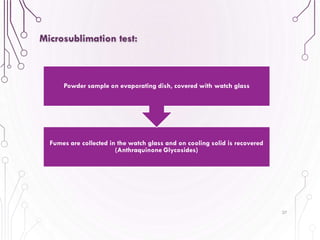
Microsublimation test:
37
Fumes are collected in the watch glass and on cooling solid is recovered
(Anthraquinone Glycosides)
Powder sample on evaporating dish, covered with watch glass
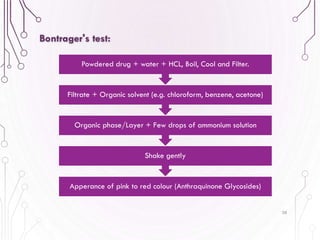
38
Bontrager's test:
Apperance of pink to red colour (Anthraquinone Glycosides)
Shake gently
Organic phase/Layer + Few drops of ammonium solution
Filtrate + Organic solvent (e.g. chloroform, benzene, acetone)
Powdered drug + water + HCL, Boil, Cool and Filter.
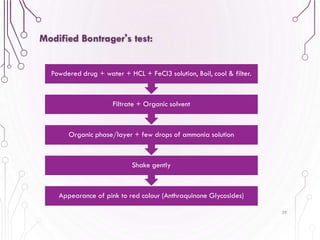
39
Modified Bontrager's test:
Appearance of pink to red colour (Anthraquinone Glycosides)
Shake gently
Organic phase/layer + few drops of ammonia solution
Filtrate + Organic solvent
Powdered drug + water + HCL + FeCl3 solution, Boil, cool & filter.
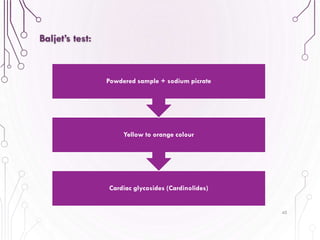
40
Baljet’s test:
Cardiac glycosides (Cardinolides)
Yellow to orange colour
Powdered sample + sodium picrate
41
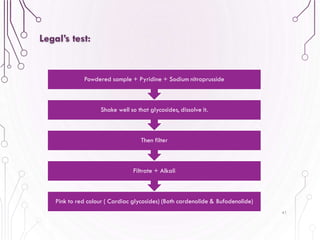
Legal’s test:
Pink to red colour ( Cardiac glycosides) (Both cardenolide & Bufodenolide)
Filtrate + Alkali
Then filter
Shake well so that glycosides, dissolve it.
Powdered sample + Pyridine + Sodium nitroprusside
42
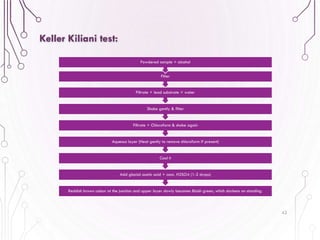
Keller Kiliani test:
Reddish brown colour at the junction and upper layer slowly becomes Bluish green, which darkens on standing.
Add glacial acetic acid + conc. H2SO4 (1-2 drops)
Cool it
Aqueous layer (Heat gently to remove chloroform if present)
Filtrate + Chloroform & shake again
Shake gently & filter
Filtrate + lead substrate + water
Filter
Powdered sample + alcohol
43
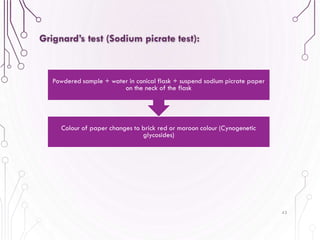
Grignard’s test (Sodium picrate test):
Colour of paper changes to brick red or maroon colour (Cynogenetic
glycosides)
Powdered sample + water in conical flask + suspend sodium picrate paper
on the neck of the flask
44
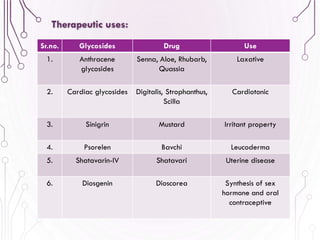
Therapeutic uses:
Sr.no. Glycosides Drug Use
1. Anthracene
glycosides
Senna, Aloe, Rhubarb,
Quassia
Laxative
2. Cardiac glycosides Digitalis, Strophanthus,
Scilla
Cardiotonic
3. Sinigrin Mustard Irritant property
4. Psorelen Bavchi Leucoderma
5. Shatavarin-IV Shatavari Uterine disease
6. Diosgenin Dioscorea Synthesis of sex
hormone and oral
contraceptive
VOLATILE OIL
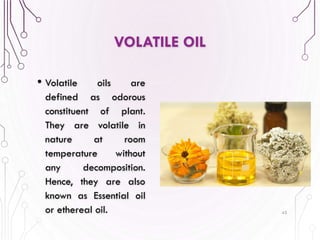
• Volatile oils are
defined as odorous
constituent of plant.
They are volatile in
nature at room
temperature without
any decomposition.
Hence, they are also
known as Essential oil
or ethereal oil. 45
1. They evaporate at room temperature and do not leave any permanent
spot-on paper.
2. Generally, they are liquid in nature, except camphor and menthol.
3. They are very slightly soluble in water just to impart odour and taste
but they are freely soluble in chloroform, ether and other organic
solvents.
4. There specific gravity is always less then one except clove oil due to
which it is heavier than water.
5. They have high refractive index.
6. They are optically active.
46
Properties:
1. Chemically volatile oils are mixture of terpenes, sesquiterpenes,
monoterpenes, diterpenes and polyterpenes.
2. In some oil hydrocarbon is oxygenated derivative. The oxygenated
constituents are responsible for taste and odour of volatile oil. When
terpenes and sesquiterpenes are removed from oil then it is termed
as terpenesless & sesquiterpene less volatile oil. Such oil has good
flavouring properties so they are used in perfumeries.
47
Chemistry:
48
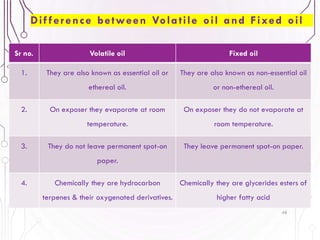
Difference between Volatile oil and Fixed oil
Sr no. Volatile oil Fixed oil
1. They are also known as essential oil or
ethereal oil.
They are also known as non-essential oil
or non-ethereal oil.
2. On exposer they evaporate at room
temperature.
On exposer they do not evaporate at
room temperature.
3. They do not leave permanent spot-on
paper.
They leave permanent spot-on paper.
4. Chemically they are hydrocarbon
terpenes & their oxygenated derivatives.
Chemically they are glycerides esters of
higher fatty acid
49
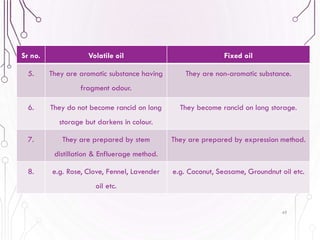
Sr no. Volatile oil Fixed oil
5. They are aromatic substance having
fragment odour.
They are non-aromatic substance.
6. They do not become rancid on long
storage but darkens in colour.
They become rancid on long storage.
7. They are prepared by stem
distillation & Enfluerage method.
They are prepared by expression method.
8. e.g. Rose, Clove, Fennel, Lavender
oil etc.
e.g. Coconut, Seasame, Groundnut oil etc.
50
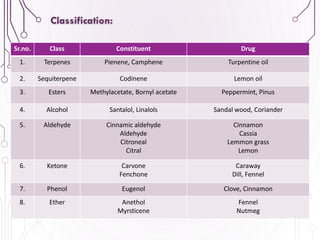
Classification:
Sr.no. Class Constituent Drug
1. Terpenes Pienene, Camphene Turpentine oil
2. Sequiterpene Codinene Lemon oil
3. Esters Methylacetate, Bornyl acetate Peppermint, Pinus
4. Alcohol Santalol, Linalols Sandal wood, Coriander
5. Aldehyde Cinnamic aldehyde
Aldehyde
Citroneal
Citral
Cinnamon
Cassia
Lemmon grass
Lemon
6. Ketone Carvone
Fenchone
Caraway
Dill, Fennel
7. Phenol Eugenol Clove, Cinnamon
8. Ether Anethol
Myrsticene
Fennel
Nutmeg
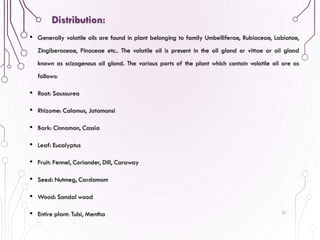
• Generally volatile oils are found in plant belonging to family Umbelliferae, Rubiaceae, Labiatae,
Zingiberaceae, Pinaceae etc.. The volatile oil is present in the oil gland or vittae or oil gland
known as scizogenous oil gland. The various parts of the plant which contain volatile oil are as
follows:
• Root: Saussurea
• Rhizome: Calamus, Jatamansi
• Bark: Cinnamon, Cassia
• Leaf: Eucalyptus
• Fruit: Fennel, Coriander, Dill, Caraway
• Seed: Nutmeg, Cardamom
• Wood: Sandal wood
• Entire plant: Tulsi, Mentha 51
Distribution:
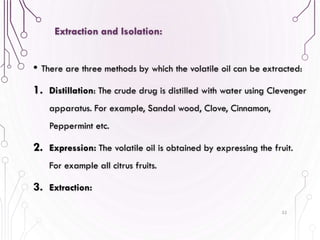
• There are three methods by which the volatile oil can be extracted:
1. Distillation: The crude drug is distilled with water using Clevenger
apparatus. For example, Sandal wood, Clove, Cinnamon,
Peppermint etc.
2. Expression: The volatile oil is obtained by expressing the fruit.
For example all citrus fruits.
3. Extraction:
52
Extraction and Isolation:
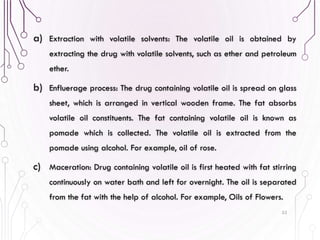
a) Extraction with volatile solvents: The volatile oil is obtained by
extracting the drug with volatile solvents, such as ether and petroleum
ether.
b) Enfluerage process: The drug containing volatile oil is spread on glass
sheet, which is arranged in vertical wooden frame. The fat absorbs
volatile oil constituents. The fat containing volatile oil is known as
pomade which is collected. The volatile oil is extracted from the
pomade using alcohol. For example, oil of rose.
c) Maceration: Drug containing volatile oil is first heated with fat stirring
continuously on water bath and left for overnight. The oil is separated
from the fat with the help of alcohol. For example, Oils of Flowers.
53
• Identification of volatile oil can be done by 2 types of test:
1. Physical test: Like odour, colour, melting point, boiling point, refractive
index, optical rotation because different volatile oil have different
physical test which help in identification of volatile oil.
2. Chemical test: There are various specific chemical reagents for the
specific volatile oil containing drugs, which help in identification of
volatile oil, such as Terpenes, Sesquiterpenes, esters etc.
54
Identification test:
55
Therapeutic use:
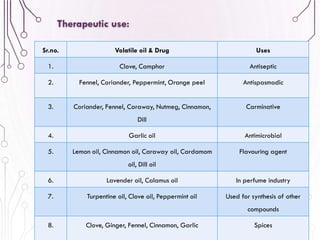
Sr.no. Volatile oil & Drug Uses
1. Clove, Camphor Antiseptic
2. Fennel, Coriander, Peppermint, Orange peel Antispasmodic
3. Coriander, Fennel, Caraway, Nutmeg, Cinnamon,
Dill
Carminative
4. Garlic oil Antimicrobial
5. Lemon oil, Cinnamon oil, Caraway oil, Cardamom
oil, Dill oil
Flavouring agent
6. Lavender oil, Calamus oil In perfume industry
7. Turpentine oil, Clove oil, Peppermint oil Used for synthesis of other
compounds
8. Clove, Ginger, Fennel, Cinnamon, Garlic Spices
TANNIN
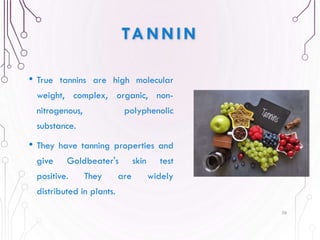
• True tannins are high molecular
weight, complex, organic, non-
nitrogenous, polyphenolic
substance.
• They have tanning properties and
give Goldbeater's skin test
positive. They are widely
distributed in plants.
56
• Tannins combine with animal protein in hide and prevent
their decay and convert them into leather.
• This property of tannins is known as tanning property.
• e.g.
1. Rhubarb - Gallic acid
2. Catechu - Catechinins
3. Nuxvomica - Chlorogenic acid
4. Ipecac - Ipecacuanhic acid. 57
Tanning Properties:
1. They have tanning properties.
2. They are soluble in water, alkali, alcohol, glysone and acetone but they
insoluble in organic solvents.
3. The aqueous solution of tannins is acidic in reaction and astringent in
taste.
4. With ferric salt they give green, blue, violet or black colour or
precipitate.
5. They give precipitate with heavy metals and alkaloids hence they are
Antidote in heavy metal and alkaloidal poison.
58
Properties:
• There are mainly two types of tannins. The tannins are
classified on the basis of chemical nature as follows:
1. Hydrolysable tannins
2. Condensed tannins
59
Classification:
60
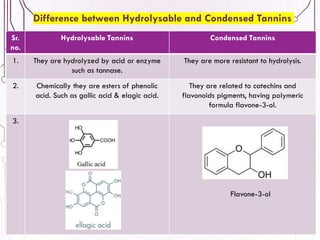
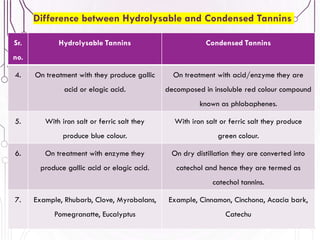
Difference between Hydrolysable and Condensed Tannins
Sr.
no.
Hydrolysable Tannins Condensed Tannins
1. They are hydrolyzed by acid or enzyme
such as tannase.
They are more resistant to hydrolysis.
2. Chemically they are esters of phenolic
acid. Such as gallic acid & elagic acid.
They are related to catechins and
flavonoids pigments, having polymeric
formula flavone-3-ol.
3.
Flavone-3-ol
61
Sr.
no.
Hydrolysable Tannins Condensed Tannins
4. On treatment with they produce gallic
acid or elagic acid.
On treatment with acid/enzyme they are
decomposed in insoluble red colour compound
known as phlobaphenes.
5. With iron salt or ferric salt they
produce blue colour.
With iron salt or ferric salt they produce
green colour.
6. On treatment with enzyme they
produce gallic acid or elagic acid.
On dry distillation they are converted into
catechol and hence they are termed as
catechol tannins.
7. Example, Rhubarb, Clove, Myrobalans,
Pomegranatte, Eucalyptus
Example, Cinnamon, Cinchona, Acacia bark,
Catechu
Difference between Hydrolysable and Condensed Tannins
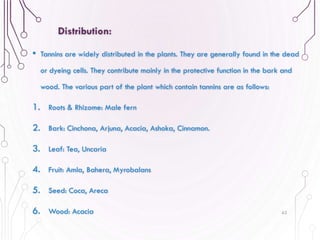
• Tannins are widely distributed in the plants. They are generally found in the dead
or dyeing cells. They contribute mainly in the protective function in the bark and
wood. The various part of the plant which contain tannins are as follows:
1. Roots & Rhizome: Male fern
2. Bark: Cinchona, Arjuna, Acacia, Ashoka, Cinnamon.
3. Leaf: Tea, Uncaria
4. Fruit: Amla, Bahera, Myrobalans
5. Seed: Coca, Areca
6. Wood: Acacia 62
Distribution:
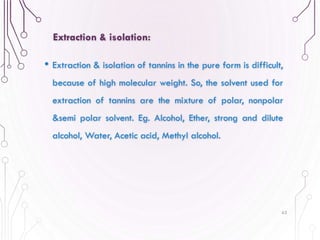
• Extraction & isolation of tannins in the pure form is difficult,
because of high molecular weight. So, the solvent used for
extraction of tannins are the mixture of polar, nonpolar
&semi polar solvent. Eg. Alcohol, Ether, strong and dilute
alcohol, Water, Acetic acid, Methyl alcohol.
63
Extraction & isolation:
64
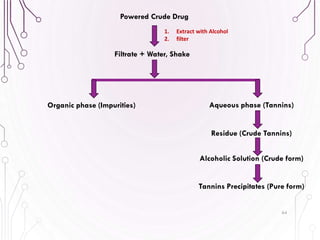
Powered Crude Drug
Filtrate + Water, Shake
Aqueous phase (Tannins)
Residue (Crude Tannins)
Organic phase (Impurities)
Alcoholic Solution (Crude form)
Tannins Precipitates (Pure form)
1. Extract with Alcohol
2. filter
65
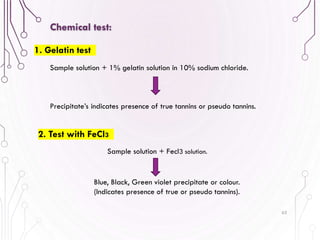
1. Gelatin test
2. Test with FeCl3
Sample solution + 1% gelatin solution in 10% sodium chloride.
Precipitate’s indicates presence of true tannins or pseudo tannins.
Sample solution + Fecl3 solution.
Blue, Black, Green violet precipitate or colour.
(Indicates presence of true or pseudo tannins).
Chemical test:
66
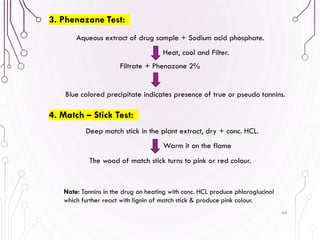
3. Phenazone Test:
4. Match – Stick Test:
Aqueous extract of drug sample + Sodium acid phosphate.
Filtrate + Phenazone 2%
Blue colored precipitate indicates presence of true or pseudo tannins.
Heat, cool and Filter.
Deep match stick in the plant extract, dry + conc. HCL.
Warm it on the flame
The wood of match stick turns to pink or red colour.
Note: Tannins in the drug on heating with conc. HCL produce phloroglucinol
which further react with lignin of match stick & produce pink colour.
67
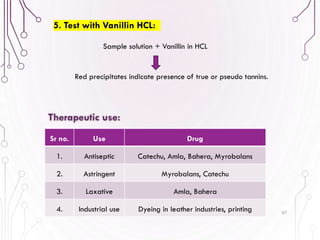
5. Test with Vanillin HCL:
Sample solution + Vanillin in HCL
Red precipitates indicate presence of true or pseudo tannins.
Therapeutic use:
Sr no. Use Drug
1. Antiseptic Catechu, Amla, Bahera, Myrobalans
2. Astringent Myrobalans, Catechu
3. Laxative Amla, Bahera
4. Industrial use Dyeing in leather industries, printing
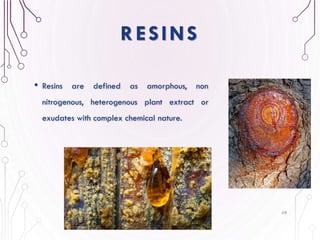
RESINS
• Resins are defined as amorphous, non
nitrogenous, heterogenous plant extract or
exudates with complex chemical nature.
68
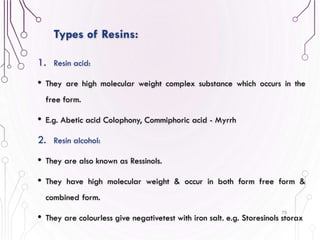
1. They are solid, semisolid or liquid in nature.
2. They are transparent substance.
3. They are heavier than water.
4. They burns with smoky flame because of higher number of carbon atom.
5. On heating they are fused & form soft mass.
6. Insoluble in water but they are soluble in acetone, chloroform, ether.
7. On boiling with alkali some resin form soap.
8. On keeping undergo slow change & due to this darkens in colour.
69
Properties:
1. Resin acid:
• They are high molecular weight complex substance which occurs in the
free form.
• E.g. Abetic acid Colophony, Commiphoric acid - Myrrh
2. Resin alcohol:
• They are also known as Ressinols.
• They have high molecular weight & occur in both form free form &
combined form.
• They are colourless give negativetest with iron salt. e.g. Storesinols storax
70
Types of Resins:
3. Resin phenol:
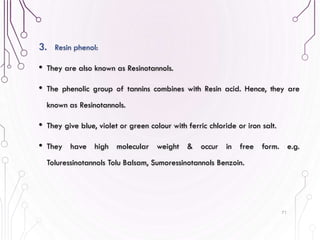
• They are also known as Resinotannols.
• The phenolic group of tannins combines with Resin acid. Hence, they are
known as Resinotannols.
• They give blue, violet or green colour with ferric chloride or iron salt.
• They have high molecular weight & occur in free form. e.g.
Toluressinotannols Tolu Balsam, Sumoressinotannols Benzoin.
71
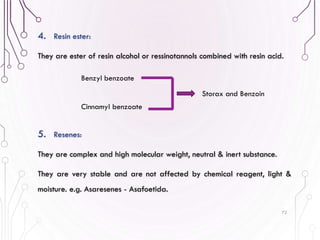
4. Resin ester:
They are ester of resin alcohol or ressinotannols combined with resin acid.
5. Resenes:
They are complex and high molecular weight, neutral & inert substance.
They are very stable and are not affected by chemical reagent, light &
moisture. e.g. Asaresenes - Asafoetida.
72
Benzyl benzoate
Cinnamyl benzoate
Storax and Benzoin
73
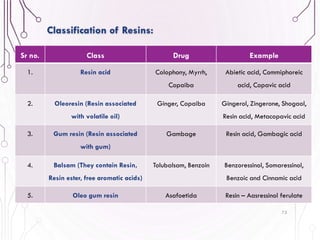
Classification of Resins:
Sr no. Class Drug Example
1. Resin acid Colophony, Myrrh,
Copaiba
Abietic acid, Commiphoreic
acid, Copavic acid
2. Oleoresin (Resin associated
with volatile oil)
Ginger, Copaiba Gingerol, Zingerone, Shogaol,
Resin acid, Metacopavic acid
3. Gum resin (Resin associated
with gum)
Gambage Resin acid, Gambagic acid
4. Balsam (They contain Resin,
Resin ester, free aromatic acids)
Tolubalsam, Benzoin Benzoressinol, Somaressinol,
Benzoic and Cinnamic acid
5. Oleo gum resin Asafoetida Resin – Aasressinol ferulate
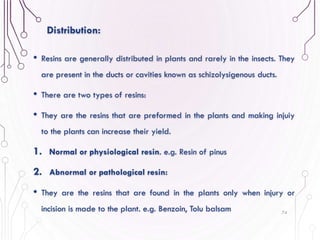
• Resins are generally distributed in plants and rarely in the insects. They
are present in the ducts or cavities known as schizolysigenous ducts.
• There are two types of resins:
• They are the resins that are preformed in the plants and making injuiy
to the plants can increase their yield.
1. Normal or physiological resin. e.g. Resin of pinus
2. Abnormal or pathological resin:
• They are the resins that are found in the plants only when injury or
incision is made to the plant. e.g. Benzoin, Tolu balsam 74
Distribution:
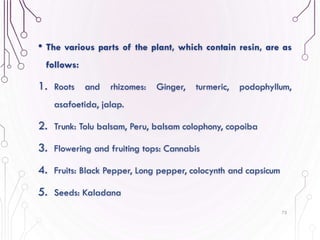
• The various parts of the plant, which contain resin, are as
follows:
1. Roots and rhizomes: Ginger, turmeric, podophyllum,
asafoetida, jalap.
2. Trunk: Tolu balsam, Peru, balsam colophony, copoiba
3. Flowering and fruiting tops: Cannabis
4. Fruits: Black Pepper, Long pepper, colocynth and capsicum
5. Seeds: Kaladana
75
76
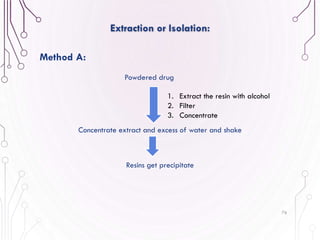
Extraction or Isolation:
Method A:
1. Extract the resin with alcohol
2. Filter
3. Concentrate
Powdered drug
Concentrate extract and excess of water and shake
Resins get precipitate
77
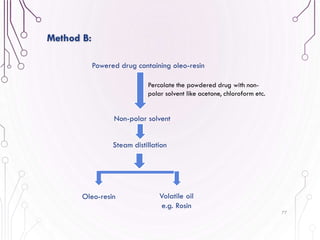
Method B:
Percolate the powdered drug with non-
polar solvent like acetone, chloroform etc.
Powered drug containing oleo-resin
Non-polar solvent
Volatile oil
e.g. Rosin
Steam distillation
Oleo-resin
78
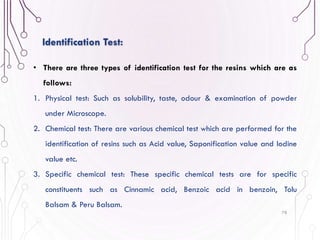
Identification Test:
• There are three types of identification test for the resins which are as
follows:
1. Physical test: Such as solubility, taste, odour & examination of powder
under Microscope.
2. Chemical test: There are various chemical test which are performed for the
identification of resins such as Acid value, Saponification value and Iodine
value etc.
3. Specific chemical test: These specific chemical tests are for specific
constituents such as Cinnamic acid, Benzoic acid in benzoin, Tolu
Balsam & Peru Balsam.
79
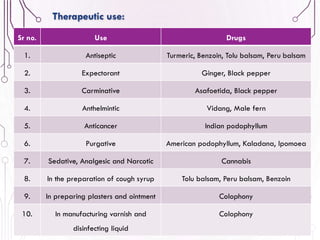
Therapeutic use:
Sr no. Use Drugs
1. Antiseptic Turmeric, Benzoin, Tolu balsam, Peru balsam
2. Expectorant Ginger, Black pepper
3. Carminative Asafoetida, Black pepper
4. Anthelmintic Vidang, Male fern
5. Anticancer Indian podophyllum
6. Purgative American podophyllum, Kaladana, Ipomoea
7. Sedative, Analgesic and Narcotic Cannabis
8. In the preparation of cough syrup Tolu balsam, Peru balsam, Benzoin
9. In preparing plasters and ointment Colophony
10. In manufacturing varnish and
disinfecting liquid
Colophony
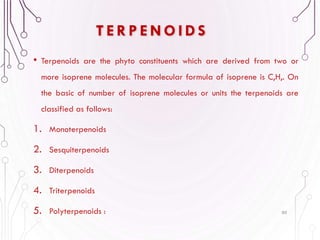
T E R P E N O I D S
• Terpenoids are the phyto constituents which are derived from two or
more isoprene molecules. The molecular formula of isoprene is C,H,. On
the basic of number of isoprene molecules or units the terpenoids are
classified as follows:
1. Monoterpenoids
2. Sesquiterpenoids
3. Diterpenoids
4. Triterpenoids
5. Polyterpenoids : 80
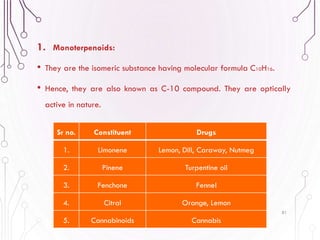
1. Monoterpenoids:
• They are the isomeric substance having molecular formula C10H16.
• Hence, they are also known as C-10 compound. They are optically
active in nature.
81
Sr no. Constituent Drugs
1. Limonene Lemon, Dill, Caraway, Nutmeg
2. Pinene Turpentine oil
3. Fenchone Fennel
4. Citral Orange, Lemon
5. Cannabinoids Cannabis
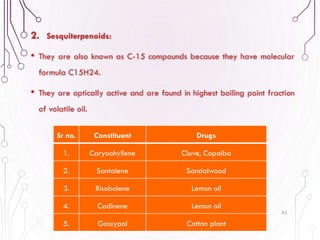
2. Sesquiterpenoids:
• They are also known as C-15 compounds because they have molecular
formula C15H24.
• They are optically active and are found in highest boiling point fraction
of volatile oil.
82
Sr no. Constituent Drugs
1. Caryoohyllene Clove, Copaiba
2. Santalene Sandalwood
3. Bisobolene Lemon oil
4. Cadinene Lemon oil
5. Gossypol Cotton plant
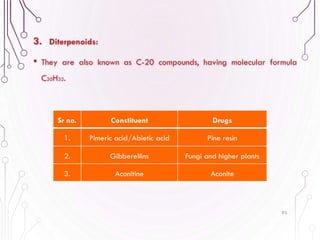
3. Diterpenoids:
• They are also known as C-20 compounds, having molecular formula
C20H32.
83
Sr no. Constituent Drugs
1. Pimeric acid/Abietic acid Pine resin
2. Gibberellins Fungi and higher plants
3. Aconitine Aconite
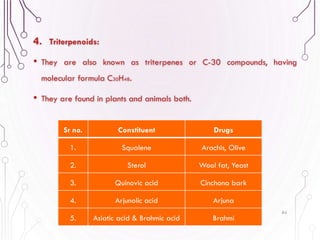
4. Triterpenoids:
• They are also known as triterpenes or C-30 compounds, having
molecular formula C30H48.
• They are found in plants and animals both.
84
Sr no. Constituent Drugs
1. Squalene Arachis, Olive
2. Sterol Wool fat, Yeast
3. Quinovic acid Cinchona bark
4. Arjunolic acid Arjuna
5. Asiatic acid & Brahmic acid Brahmi
5. Sesquiterpenoids:
• They have the molecular formula (C5H8)n where the n is the number of
isoprene molecules. E.g. Solanesol, Tobacco
85
Identification Test:
• There are different method for isolation & specific chemical test for
identification of individual constituent depending upon the chemical group
to which they belong such as alkaloids, glycoside, saponins, volatile oil,
Resin etc.
1. Volatile constituents:- Used as flavouring agent.
2. Cannabinoids:- Anticancer activity.
3. Gossypol:- Male antifertility agent.
4. Arjunolic acid:- Diuretic activity.
5. Asitic acid & Brahmic acid:- Anti bacterial & wound healing
property.
86
Therapeutic use:
T H A N K Y O U !
87

Alkaloids, Terpenoids, Glycosides ......

  • 1.
    UNIT IV P re p a r e d B y : M s . D i v y a K a n o j i y a A s s i s t a n t P r o f e s s o r, D e p a r t m e n t o f P h a r m a c o g n o s y D e p a r t m e n t o f P h a r m a c y, S u m a n d e e p V i d y a p e e t h D e e m e d t o b e U n i v e r s i t y, P i p a r i a , V a d o d a r a . 1
  • 2.
    CONTENT: • Brief outlineof occurrence, distribution, isolation, identification tests, therapeutic activity and pharmaceutical applications of alkaloids, terpenoids, glycosides, volatile oils, tannins and resins. 2
  • 3.
    ALKALOIDS • Definition: • Thealkaloids are organic, basic, nitrogenous compound containing one or more nitrogen atom. • They are very potent in nature and found generally in plants. • The first alkaloid was isolated by Derosne known as Narcotine in 1803. 3
  • 4.
    • Properties: 1. Theyare generally colourless but Berberine alkaloids are yellow in colour. 2. They are solid, crystalline in nature (e.g. Quinine sulphate) but some of them are liquid in nature. (e.g. Conine, Nicotine) 3. The alkaloidal bases are soluble in non-polar solvent like benzene, acetone, chloroform but they are insoluble in polar solvent like water whereas alkaloidal salt are soluble in poplar solvent and they are insoluble in non-polar solvent. 4. most of the alkaloids are optically active but levo rotating (l-form) of alkaloid is physiologically more active. 5. They are bitter in test. 4
  • 5.
    CHEMISTRY • Alkaloids containC, H, O and one or more nitrogen (N) atom, the nitrogen atom is present in heterocyclic ring (e.g. Atropine, Reserpine) but some time it is also present outside the ring (e.g. Ephedrine). In plant, alkaloids occur in both form free form and salt form of an organic acid. 5
  • 6.
    CLASSIFICATION 1. The alkaloidsare classified as follows: 2. Pharmacological classification 3. Taxonomic classification 4. Bio-synthetic classification 5. Chemical classification 6
  • 7.
    PHARMACOLOGICAL CLASSIFICATION • Inthis alkaloids are classified on the bases of pharmacological action. For example 1. CNS stimulant or depressant 2. Analgesic 3. Antitussive and expectorant • It does not take into account the chemical nature of the drug within the same drug. The individual alkaloids may have different action. • For example 7
  • 8.
    • Opium alkaloids: •Morphine: Analgesic • Codeine: Antitussive • Cinchona alkaloids: • Quinine: Antimalarial • Quinidine: Cardiac depressant 8
  • 9.
    TAXONOMIC CLASSIFICATION • Thealkaloids are classified on the bases of their distribution in different plant families. • For example Solaneous alkaloids. BIO-SYNTHETIC CLASSIFICATION • The alkaloids are classified on the bases of precursor’s form which alkaloids are biosynthesized in plants. So the alkaloids with different taxonomic distribution and physiological action brought under same class. 9
  • 10.
    CHEMICAL CLASSIFICATION • Thisis the most acceptable classification of the alkaloids. In this the alkaloids are classified on the bases of chemical structure. They are classified as follows: • True alkaloid on the bases of the heterocyclic ring (12 groups). They are also known as heterocyclic alkaloids. • Pseudo alkaloids. • Proto alkloides or biological amines (2 groups). 10
  • 11.
    HETEROCYCLIC ALKALOIDS Sr no.Class Chemical structure Example 1. Pyrrole and Pyolidine Coca species 2. Pyridine and Piperidine aerocoline., Anabasine, Coniine, Lobeline 3. Pyrrolizidine Echimidine, Senecionine 11
  • 12.
    Sr no. ClassChemical structure Example 4. Tropane Atropine, Hyoscine, Hyoscyamine, Cocaine 5. Quinoline Quinine, Quinidine, Cinchonine, Cinchonidine 6. isoquinoline Morphine, Emetine, Cephaeline 12
  • 13.
    Sr no. ClassChemical structure Example 7. Indole (Benz Pyrrole) Ergometrine, Ergotamine, Reserpine, Vincristine 8. Imidazole Pilocaine, Pilosine 9. Norlupinane LABURNINE, lUPANINE 13
  • 14.
    Sr no. ClassChemical structure Example 10. Purine Caffeine, Theobromine, Theophylline 11. Aporphine Boldine 12. Alkylamine Ephedrine, Pseudoephedrine 14
  • 15.
    DISTRIBUTION • Alkaloids arewidely distributed in higher plants and rarely found in lower plants. In plant, alkaloids occur in different part of the plant, which are as follows: • Root and rhizome: Ipecac, Belladonna, Rauwolfia and Aconite • Stem: Ephedra, Lobelia • Bark: Cinchona, Kurchi • Leaves: Datura, Vasaka, Vinca, Hyoscyamus • Fruits: Opium, Black pepper • Seeds: Colchicum, Nux-vomica 15
  • 16.
  • 17.
    METHOD 1 17 Powdered material moistenedwith water and treated with lime. Extract with organic solvent (benzene, chloroform or acetone). Filter it. Discard the powdered material and collect the filtrate, and water. Reject the aqueous layer containing impurities. Organic layer obtained contain alkaloid. Add acid & water alkaloids are converted into salt form. Reject the organic layer. Aqueous layer containing the alkaloidal salts. Pure alkaloids are separated by chromatographic techniques.
  • 18.
    18 METHOD 2 Powdered material moistenedwith water and treated with acid. Extract with water or alcohol & filter it. Discard the powdered material and collect the filtrate, and add acetone. Reject the organic layer containing impurities. Aqueous layer obtained contain alkaloid. Treated with alkali & add organic solvent to it, alkaloids are converted into base form. Reject the aqueous layer. Organic layer contain alkaloids from which pure alkaloids are isolated by chromatographic techniques.
  • 19.
    IDENTIFICATION TEST • Alkaloidsare detected by precipitate or colour appearance by the suitable reagent. Following are the general identification test for alkaloids. 19
  • 20.
    20 Sr.no. Reagent ObservationInference 1. Dragendroff’s reagent (Solution of potassium Bismuth iodide) Reddish precipitate Most alkaloids 2. Hager’s reagent (Solution of picric acid) Yellow precipitate Most alkaloids 3. Mayer’s reagent (Solution of potassium mercuric iodide) Creamy precipitate Most alkaloids 4. Wagner’s reagent (Solution of iodide in potassium iodide) Reddish brown precipitate Most alkaloids 5. Van-urk’s reagent (Sulphuric acid & dimethylamine benzaldehyde) Violet colour Ergot alkaloids 6. Murexide test (Potassium chlorate HCL, NH3) Purple colour Tea, coffee (Caffeine alkaloids) 7. Thallaquine test Emerald-green Cinchona (Quinine, Quinidine) 8. Mineral acid test Yellow colour Colchicum (Colchicum) 9. Solution of ammonium vanadate in sulphuric acid Violet colour Strychnine 10. Nitric acid Crimson red Brucine
  • 21.
    THERAPEUTIC USE 21 Sr.no. AlkaloidsDrug Use 1. Quinine Cinchona Antimalarial 2. Quinidine Cinchona Cardiac depressant 3. Morphine Opium Narcotic analgesic 4. Codeine Opium Antitussive 5. Reserpine Rauwolfia Anti-hypertensive 6. Ajmalicine Rauwolfia Cardiac depressant 7. Vincristine Vinca Anti-cancer 8. Emetine Ipecac Emetic 9. Colchicine Colchicum Gout 10. Vasicine Vasaka Expectorant 11. Ergometrine Ergot Oxytocic action 12. Atropine Belladonna Parasympatholytic 13. Lobeline Lobelia Chronic bronchitis 14. Ephedrine Ephedra Broncho-dialators 15. Strychnine Nux-vomica Stimulant-bitter tonic
  • 22.
    GLYCOSIDES • Glycosides arenon-reducing, non-nitrogenous organic compounds which are found mainly in plant and rarely in animals. • These glycosides undergoes hydrolysis in the presence of acid, enzyme or moisture and produce Glycone moiety (sugar) and aglycone moieties (non-sugar). Glycosides Glycone + Aglycone 22
  • 23.
    PROPERTIES 1. Glycosides arecrystalline, amorphous or solid compound. 2. They are colorless but some of them are colored. (a) Anthracene Glycosides- red color (b) Flavonoids- yellow 3. They are optically active and generally form is more active. 4. Glycosides are soluble in water and alcohol whereas aglycone moieties are soluble in inorganic solvent such an acetone, benzene, chloroform etc. 23 CHEMISTRY Chemically Glycosides are condensation product of sugar and aglycone portion. The simplest Glycosides are α- methyl Glycosides and β- methyl Glycosides.
  • 24.
    1. The enzymehydrolyzing α-methyl Glycosides are known as a-methyl glycosidase. For example (i) Invertase (ii) Maltase 2. The enzyme hydrolyzing β-methyl Glycosides are known as β -methyl glycosidase. For example(i) Emulsin (ii) Myrosin 3. β-methyl Glycosides mainly occur in plants. The Glycosides contain one more sugar. For example-Glucose, Fructose, Rhamnose 4. The linkage between Glycone & aglycone moieties is known as glycosidic linkage. 24 STRUCTURE OF GLYCOSIDES
  • 25.
    • The glycosidesare classified as follows: 1. On the bases of sugars- e.g. Glucosides, fructoside, riboside 2. On the bases of aglycone- e.g. alcohol, aldehyde, and phenol Glycosides etc. 3. On the bases of linkage between Glycone & aglycone portion-e.g. O, C, S and very rare N glycosides. 4. On the bases of pharmacological action e.g. (i) Cardiac Glycosides- e.g. Digitalis, Strophanthus (ii) Purgative Glycosides e.g. Senna, Aloe (iii) Bitter Glycosides- e.g. Wild cherry bark 25 CLASSIFICATION
  • 26.
    5. On thebases of chemical nature & pharmacological classification-most accepted classification of Glycosides, hence this classification is known as Sill's classification. The various class of Sill's is as follows- • (i) Cynogenetic Glycosides:- • These are Glycosides which on hydrolysis yield HCN gas which is local anesthetic, sedative in action and respiratory stimulant. E.g. • (a) Bitter almond- Amygdalin • (b) Wild cherry bark- Prunasin 26
  • 27.
    • (ii) Isothiocynate:- •These Glycosides on hydrolysis produce allyl isothiocynate which is responsible for irritant property of drugs. These Glycosides are sulphar containing glycosides. • For example • Mustard-Sinigrin, Sinalvin • (iii) Saponins: • These are the glycosides, Whose aqueous solution forms the foam on shaking. Saponins on hydrolysis produces sapogenins and sugar. The sapogenins causes heamolysis of RBC. So they are toxic to animals & human beings. • Saponins are classified into two groups on the bases of their chemical structure. (1) Steroid saponins and (2) Triterpenoid saponins 27
  • 28.
    1. Steroid saponinscontaining drugs- e.g. Shatavari, Brahmi, Dioscorea, Arjuna bark, Gokhru. 2. Triterpenoid saponins containing drugs- e.g. Glycyrrhriza, Senega, Quillaia bark 28 Steroid skeleton Triterpenoid skeleton
  • 29.
    • (iv) CardiacGlycosides: Cardiac Glycosides which strengthen the weak heart. • The basic nucleus in the cardiac GLycosides is Cyclopentophenethrene nucleus with an unsaturated ring at C-17 position. These GLycosides are classified on the bases of nature of lactone ring as follows: • (1) Cardenolide Lactone ring is 5 member e.g. Digitalis, Strophanthus • (2) Bufadenolide Lactone ring is 6 member e.g. Scilla 29 Cardenolide Bufadenolide
  • 30.
    • (v) PhenolicGlycosides: 30 Sr.no. Type of Phenolic Glycosides Glycosides Drug 1. Anthracene glycosides Aloe-emodin Barbaloin Rhein Chrysophenol Senna, Rhubarb Aloe Senna Cascara 2. Simple phenolic glycosides Salicin Gluco-vannilin Salix species Vanillia species 3. Flavone and related compound of flavonoids Kaempferol Hispridine Liquiritigenins Senna Lemon, orange peel Liquorice 4. Coumarins Umbeliferone Scopoletin Psorelin Asafoetida, Gulbanum Belladonna, Jalap Psorelea 5. Anthocyanidin and its glycosides Cunidin Malvidin Rose, Comflower Malvaceaesp
  • 31.
    31 • (vi) Miscellaneous: Sr.no.Type Glycosides Drug 1. Glycosidal resins Complex resin Jalap, Scamnony 2. Steroidal alkaloidal glycosides α-Solanin Tomatin Potato Tomato 3. Bitter Cucerbitins Colocymth
  • 32.
    • The Glycosidesare widely distributed in higher plants and rarely found in animals. In plants they are found in various families such as Apocynaceae, Rubaceae, Laguminaseae, Zygophylaceae, Crucifereae etc. In plant, Glycosides occur in different parts which are as follows: 1. Root: Senega, Shatavari 2. Rhizome: Rhubarb, Diosgennins, Picrorrhiza 3. Wood: Quassia 4. Bark: Arjuna bark, Wild cherry bark 5. Leaf: Senna, Gokhru, Digitalis, Stropanthus 6. Fruit: Gokhru 7. Seeds: Bitter almond, Mustard 8. Entire herb: Brahmi, Chirata 32 DISTRIBUTION
  • 33.
    33 EXTRACTION/ ISOLATION Powered crudedrug Filtrate (Glycosides + Tannins + Impurity) Residue (Unwanted Material) Precipitates (Tannins + Impurities) Filtrate(Crude glycosides) Pure Glycosides I. Crstallization II. Chromatography III. Fractionation I. Extract with alcohol and Filter Suitable reagent and Filter
  • 34.
    34 STAS OTTO METHOD Poweredcrude drug Filtrate (Glycosides + Tannins + Impurity) Residue (Unwanted Material) Precipitates (Tannins + Impurities) Filtrate(Crude glycosides) Pure Glycosides I. Crystallization II. Chromatography III. Fractionation I. Extract with alcohol and Filter + Lead acetate solution (Excess lead acetate is removed by passing H2S gas as lead sulphate)
  • 35.
    • There isno simple identification test for Glycosides but the Glycone and aglycone moiety can be detected easily. For this hydrolysis is carried out by boiling the drug powder with acid or by the action of enzyme. Depending on the nature of glycone and aglycone , moiety specific chemical tests are performed. The various chemical tests which are performed to detect the glycosides and aglycone moiety are as follows: 35 IDENTIFICATION TEST
  • 36.
    36 Sr.no. Glycone/Aglycone Nameof the chemical test Example of Drugs 1. Anthraquinone glycosides 1. Micro sublimation test 2. Borntrager test 3. Modified Borntrager test Senna, Aloe, Rhubarb, Cascara 2. Cardiac glycosides 1. Cardinolide 2. Bufadinolide 3. Deoxy sugar in cardiac glycoside 1. Baljet test 2. Legal’s test 3. Libermann Burchad test 4. Keller killani test Digitalis Thevetia, Verium Scilla All 3. Cynogenetic glycosides Sodium picrate test (Grignard’s test or reaction) Bitter almond, Wild cherry bark, Linseed 4. Saponins 1. Foam production 2. Haemolytic zone test 3. Libermann test Liquorice, Gokhru Satavari Quallaria bark 5. Flavonoids Shinoda test Rye 6. Coumarins Fluourescence test in alkali media Psorelea 7. Reducing sugar Fehling’s test Agar, Acacia, Tragacanth, Honey
  • 37.
    Microsublimation test: 37 Fumes arecollected in the watch glass and on cooling solid is recovered (Anthraquinone Glycosides) Powder sample on evaporating dish, covered with watch glass
  • 38.
    38 Bontrager's test: Apperance ofpink to red colour (Anthraquinone Glycosides) Shake gently Organic phase/Layer + Few drops of ammonium solution Filtrate + Organic solvent (e.g. chloroform, benzene, acetone) Powdered drug + water + HCL, Boil, Cool and Filter.
  • 39.
    39 Modified Bontrager's test: Appearanceof pink to red colour (Anthraquinone Glycosides) Shake gently Organic phase/layer + few drops of ammonia solution Filtrate + Organic solvent Powdered drug + water + HCL + FeCl3 solution, Boil, cool & filter.
  • 40.
    40 Baljet’s test: Cardiac glycosides(Cardinolides) Yellow to orange colour Powdered sample + sodium picrate
  • 41.
    41 Legal’s test: Pink tored colour ( Cardiac glycosides) (Both cardenolide & Bufodenolide) Filtrate + Alkali Then filter Shake well so that glycosides, dissolve it. Powdered sample + Pyridine + Sodium nitroprusside
  • 42.
    42 Keller Kiliani test: Reddishbrown colour at the junction and upper layer slowly becomes Bluish green, which darkens on standing. Add glacial acetic acid + conc. H2SO4 (1-2 drops) Cool it Aqueous layer (Heat gently to remove chloroform if present) Filtrate + Chloroform & shake again Shake gently & filter Filtrate + lead substrate + water Filter Powdered sample + alcohol
  • 43.
    43 Grignard’s test (Sodiumpicrate test): Colour of paper changes to brick red or maroon colour (Cynogenetic glycosides) Powdered sample + water in conical flask + suspend sodium picrate paper on the neck of the flask
  • 44.
    44 Therapeutic uses: Sr.no. GlycosidesDrug Use 1. Anthracene glycosides Senna, Aloe, Rhubarb, Quassia Laxative 2. Cardiac glycosides Digitalis, Strophanthus, Scilla Cardiotonic 3. Sinigrin Mustard Irritant property 4. Psorelen Bavchi Leucoderma 5. Shatavarin-IV Shatavari Uterine disease 6. Diosgenin Dioscorea Synthesis of sex hormone and oral contraceptive
  • 45.
    VOLATILE OIL • Volatileoils are defined as odorous constituent of plant. They are volatile in nature at room temperature without any decomposition. Hence, they are also known as Essential oil or ethereal oil. 45
  • 46.
    1. They evaporateat room temperature and do not leave any permanent spot-on paper. 2. Generally, they are liquid in nature, except camphor and menthol. 3. They are very slightly soluble in water just to impart odour and taste but they are freely soluble in chloroform, ether and other organic solvents. 4. There specific gravity is always less then one except clove oil due to which it is heavier than water. 5. They have high refractive index. 6. They are optically active. 46 Properties:
  • 47.
    1. Chemically volatileoils are mixture of terpenes, sesquiterpenes, monoterpenes, diterpenes and polyterpenes. 2. In some oil hydrocarbon is oxygenated derivative. The oxygenated constituents are responsible for taste and odour of volatile oil. When terpenes and sesquiterpenes are removed from oil then it is termed as terpenesless & sesquiterpene less volatile oil. Such oil has good flavouring properties so they are used in perfumeries. 47 Chemistry:
  • 48.
    48 Difference between Volatileoil and Fixed oil Sr no. Volatile oil Fixed oil 1. They are also known as essential oil or ethereal oil. They are also known as non-essential oil or non-ethereal oil. 2. On exposer they evaporate at room temperature. On exposer they do not evaporate at room temperature. 3. They do not leave permanent spot-on paper. They leave permanent spot-on paper. 4. Chemically they are hydrocarbon terpenes & their oxygenated derivatives. Chemically they are glycerides esters of higher fatty acid
  • 49.
    49 Sr no. Volatileoil Fixed oil 5. They are aromatic substance having fragment odour. They are non-aromatic substance. 6. They do not become rancid on long storage but darkens in colour. They become rancid on long storage. 7. They are prepared by stem distillation & Enfluerage method. They are prepared by expression method. 8. e.g. Rose, Clove, Fennel, Lavender oil etc. e.g. Coconut, Seasame, Groundnut oil etc.
  • 50.
    50 Classification: Sr.no. Class ConstituentDrug 1. Terpenes Pienene, Camphene Turpentine oil 2. Sequiterpene Codinene Lemon oil 3. Esters Methylacetate, Bornyl acetate Peppermint, Pinus 4. Alcohol Santalol, Linalols Sandal wood, Coriander 5. Aldehyde Cinnamic aldehyde Aldehyde Citroneal Citral Cinnamon Cassia Lemmon grass Lemon 6. Ketone Carvone Fenchone Caraway Dill, Fennel 7. Phenol Eugenol Clove, Cinnamon 8. Ether Anethol Myrsticene Fennel Nutmeg
  • 51.
    • Generally volatileoils are found in plant belonging to family Umbelliferae, Rubiaceae, Labiatae, Zingiberaceae, Pinaceae etc.. The volatile oil is present in the oil gland or vittae or oil gland known as scizogenous oil gland. The various parts of the plant which contain volatile oil are as follows: • Root: Saussurea • Rhizome: Calamus, Jatamansi • Bark: Cinnamon, Cassia • Leaf: Eucalyptus • Fruit: Fennel, Coriander, Dill, Caraway • Seed: Nutmeg, Cardamom • Wood: Sandal wood • Entire plant: Tulsi, Mentha 51 Distribution:
  • 52.
    • There arethree methods by which the volatile oil can be extracted: 1. Distillation: The crude drug is distilled with water using Clevenger apparatus. For example, Sandal wood, Clove, Cinnamon, Peppermint etc. 2. Expression: The volatile oil is obtained by expressing the fruit. For example all citrus fruits. 3. Extraction: 52 Extraction and Isolation:
  • 53.
    a) Extraction withvolatile solvents: The volatile oil is obtained by extracting the drug with volatile solvents, such as ether and petroleum ether. b) Enfluerage process: The drug containing volatile oil is spread on glass sheet, which is arranged in vertical wooden frame. The fat absorbs volatile oil constituents. The fat containing volatile oil is known as pomade which is collected. The volatile oil is extracted from the pomade using alcohol. For example, oil of rose. c) Maceration: Drug containing volatile oil is first heated with fat stirring continuously on water bath and left for overnight. The oil is separated from the fat with the help of alcohol. For example, Oils of Flowers. 53
  • 54.
    • Identification ofvolatile oil can be done by 2 types of test: 1. Physical test: Like odour, colour, melting point, boiling point, refractive index, optical rotation because different volatile oil have different physical test which help in identification of volatile oil. 2. Chemical test: There are various specific chemical reagents for the specific volatile oil containing drugs, which help in identification of volatile oil, such as Terpenes, Sesquiterpenes, esters etc. 54 Identification test:
  • 55.
    55 Therapeutic use: Sr.no. Volatileoil & Drug Uses 1. Clove, Camphor Antiseptic 2. Fennel, Coriander, Peppermint, Orange peel Antispasmodic 3. Coriander, Fennel, Caraway, Nutmeg, Cinnamon, Dill Carminative 4. Garlic oil Antimicrobial 5. Lemon oil, Cinnamon oil, Caraway oil, Cardamom oil, Dill oil Flavouring agent 6. Lavender oil, Calamus oil In perfume industry 7. Turpentine oil, Clove oil, Peppermint oil Used for synthesis of other compounds 8. Clove, Ginger, Fennel, Cinnamon, Garlic Spices
  • 56.
    TANNIN • True tanninsare high molecular weight, complex, organic, non- nitrogenous, polyphenolic substance. • They have tanning properties and give Goldbeater's skin test positive. They are widely distributed in plants. 56
  • 57.
    • Tannins combinewith animal protein in hide and prevent their decay and convert them into leather. • This property of tannins is known as tanning property. • e.g. 1. Rhubarb - Gallic acid 2. Catechu - Catechinins 3. Nuxvomica - Chlorogenic acid 4. Ipecac - Ipecacuanhic acid. 57 Tanning Properties:
  • 58.
    1. They havetanning properties. 2. They are soluble in water, alkali, alcohol, glysone and acetone but they insoluble in organic solvents. 3. The aqueous solution of tannins is acidic in reaction and astringent in taste. 4. With ferric salt they give green, blue, violet or black colour or precipitate. 5. They give precipitate with heavy metals and alkaloids hence they are Antidote in heavy metal and alkaloidal poison. 58 Properties:
  • 59.
    • There aremainly two types of tannins. The tannins are classified on the basis of chemical nature as follows: 1. Hydrolysable tannins 2. Condensed tannins 59 Classification:
  • 60.
    60 Difference between Hydrolysableand Condensed Tannins Sr. no. Hydrolysable Tannins Condensed Tannins 1. They are hydrolyzed by acid or enzyme such as tannase. They are more resistant to hydrolysis. 2. Chemically they are esters of phenolic acid. Such as gallic acid & elagic acid. They are related to catechins and flavonoids pigments, having polymeric formula flavone-3-ol. 3. Flavone-3-ol
  • 61.
    61 Sr. no. Hydrolysable Tannins CondensedTannins 4. On treatment with they produce gallic acid or elagic acid. On treatment with acid/enzyme they are decomposed in insoluble red colour compound known as phlobaphenes. 5. With iron salt or ferric salt they produce blue colour. With iron salt or ferric salt they produce green colour. 6. On treatment with enzyme they produce gallic acid or elagic acid. On dry distillation they are converted into catechol and hence they are termed as catechol tannins. 7. Example, Rhubarb, Clove, Myrobalans, Pomegranatte, Eucalyptus Example, Cinnamon, Cinchona, Acacia bark, Catechu Difference between Hydrolysable and Condensed Tannins
  • 62.
    • Tannins arewidely distributed in the plants. They are generally found in the dead or dyeing cells. They contribute mainly in the protective function in the bark and wood. The various part of the plant which contain tannins are as follows: 1. Roots & Rhizome: Male fern 2. Bark: Cinchona, Arjuna, Acacia, Ashoka, Cinnamon. 3. Leaf: Tea, Uncaria 4. Fruit: Amla, Bahera, Myrobalans 5. Seed: Coca, Areca 6. Wood: Acacia 62 Distribution:
  • 63.
    • Extraction &isolation of tannins in the pure form is difficult, because of high molecular weight. So, the solvent used for extraction of tannins are the mixture of polar, nonpolar &semi polar solvent. Eg. Alcohol, Ether, strong and dilute alcohol, Water, Acetic acid, Methyl alcohol. 63 Extraction & isolation:
  • 64.
    64 Powered Crude Drug Filtrate+ Water, Shake Aqueous phase (Tannins) Residue (Crude Tannins) Organic phase (Impurities) Alcoholic Solution (Crude form) Tannins Precipitates (Pure form) 1. Extract with Alcohol 2. filter
  • 65.
    65 1. Gelatin test 2.Test with FeCl3 Sample solution + 1% gelatin solution in 10% sodium chloride. Precipitate’s indicates presence of true tannins or pseudo tannins. Sample solution + Fecl3 solution. Blue, Black, Green violet precipitate or colour. (Indicates presence of true or pseudo tannins). Chemical test:
  • 66.
    66 3. Phenazone Test: 4.Match – Stick Test: Aqueous extract of drug sample + Sodium acid phosphate. Filtrate + Phenazone 2% Blue colored precipitate indicates presence of true or pseudo tannins. Heat, cool and Filter. Deep match stick in the plant extract, dry + conc. HCL. Warm it on the flame The wood of match stick turns to pink or red colour. Note: Tannins in the drug on heating with conc. HCL produce phloroglucinol which further react with lignin of match stick & produce pink colour.
  • 67.
    67 5. Test withVanillin HCL: Sample solution + Vanillin in HCL Red precipitates indicate presence of true or pseudo tannins. Therapeutic use: Sr no. Use Drug 1. Antiseptic Catechu, Amla, Bahera, Myrobalans 2. Astringent Myrobalans, Catechu 3. Laxative Amla, Bahera 4. Industrial use Dyeing in leather industries, printing
  • 68.
    RESINS • Resins aredefined as amorphous, non nitrogenous, heterogenous plant extract or exudates with complex chemical nature. 68
  • 69.
    1. They aresolid, semisolid or liquid in nature. 2. They are transparent substance. 3. They are heavier than water. 4. They burns with smoky flame because of higher number of carbon atom. 5. On heating they are fused & form soft mass. 6. Insoluble in water but they are soluble in acetone, chloroform, ether. 7. On boiling with alkali some resin form soap. 8. On keeping undergo slow change & due to this darkens in colour. 69 Properties:
  • 70.
    1. Resin acid: •They are high molecular weight complex substance which occurs in the free form. • E.g. Abetic acid Colophony, Commiphoric acid - Myrrh 2. Resin alcohol: • They are also known as Ressinols. • They have high molecular weight & occur in both form free form & combined form. • They are colourless give negativetest with iron salt. e.g. Storesinols storax 70 Types of Resins:
  • 71.
    3. Resin phenol: •They are also known as Resinotannols. • The phenolic group of tannins combines with Resin acid. Hence, they are known as Resinotannols. • They give blue, violet or green colour with ferric chloride or iron salt. • They have high molecular weight & occur in free form. e.g. Toluressinotannols Tolu Balsam, Sumoressinotannols Benzoin. 71
  • 72.
    4. Resin ester: Theyare ester of resin alcohol or ressinotannols combined with resin acid. 5. Resenes: They are complex and high molecular weight, neutral & inert substance. They are very stable and are not affected by chemical reagent, light & moisture. e.g. Asaresenes - Asafoetida. 72 Benzyl benzoate Cinnamyl benzoate Storax and Benzoin
  • 73.
    73 Classification of Resins: Srno. Class Drug Example 1. Resin acid Colophony, Myrrh, Copaiba Abietic acid, Commiphoreic acid, Copavic acid 2. Oleoresin (Resin associated with volatile oil) Ginger, Copaiba Gingerol, Zingerone, Shogaol, Resin acid, Metacopavic acid 3. Gum resin (Resin associated with gum) Gambage Resin acid, Gambagic acid 4. Balsam (They contain Resin, Resin ester, free aromatic acids) Tolubalsam, Benzoin Benzoressinol, Somaressinol, Benzoic and Cinnamic acid 5. Oleo gum resin Asafoetida Resin – Aasressinol ferulate
  • 74.
    • Resins aregenerally distributed in plants and rarely in the insects. They are present in the ducts or cavities known as schizolysigenous ducts. • There are two types of resins: • They are the resins that are preformed in the plants and making injuiy to the plants can increase their yield. 1. Normal or physiological resin. e.g. Resin of pinus 2. Abnormal or pathological resin: • They are the resins that are found in the plants only when injury or incision is made to the plant. e.g. Benzoin, Tolu balsam 74 Distribution:
  • 75.
    • The variousparts of the plant, which contain resin, are as follows: 1. Roots and rhizomes: Ginger, turmeric, podophyllum, asafoetida, jalap. 2. Trunk: Tolu balsam, Peru, balsam colophony, copoiba 3. Flowering and fruiting tops: Cannabis 4. Fruits: Black Pepper, Long pepper, colocynth and capsicum 5. Seeds: Kaladana 75
  • 76.
    76 Extraction or Isolation: MethodA: 1. Extract the resin with alcohol 2. Filter 3. Concentrate Powdered drug Concentrate extract and excess of water and shake Resins get precipitate
  • 77.
    77 Method B: Percolate thepowdered drug with non- polar solvent like acetone, chloroform etc. Powered drug containing oleo-resin Non-polar solvent Volatile oil e.g. Rosin Steam distillation Oleo-resin
  • 78.
    78 Identification Test: • Thereare three types of identification test for the resins which are as follows: 1. Physical test: Such as solubility, taste, odour & examination of powder under Microscope. 2. Chemical test: There are various chemical test which are performed for the identification of resins such as Acid value, Saponification value and Iodine value etc. 3. Specific chemical test: These specific chemical tests are for specific constituents such as Cinnamic acid, Benzoic acid in benzoin, Tolu Balsam & Peru Balsam.
  • 79.
    79 Therapeutic use: Sr no.Use Drugs 1. Antiseptic Turmeric, Benzoin, Tolu balsam, Peru balsam 2. Expectorant Ginger, Black pepper 3. Carminative Asafoetida, Black pepper 4. Anthelmintic Vidang, Male fern 5. Anticancer Indian podophyllum 6. Purgative American podophyllum, Kaladana, Ipomoea 7. Sedative, Analgesic and Narcotic Cannabis 8. In the preparation of cough syrup Tolu balsam, Peru balsam, Benzoin 9. In preparing plasters and ointment Colophony 10. In manufacturing varnish and disinfecting liquid Colophony
  • 80.
    T E RP E N O I D S • Terpenoids are the phyto constituents which are derived from two or more isoprene molecules. The molecular formula of isoprene is C,H,. On the basic of number of isoprene molecules or units the terpenoids are classified as follows: 1. Monoterpenoids 2. Sesquiterpenoids 3. Diterpenoids 4. Triterpenoids 5. Polyterpenoids : 80
  • 81.
    1. Monoterpenoids: • Theyare the isomeric substance having molecular formula C10H16. • Hence, they are also known as C-10 compound. They are optically active in nature. 81 Sr no. Constituent Drugs 1. Limonene Lemon, Dill, Caraway, Nutmeg 2. Pinene Turpentine oil 3. Fenchone Fennel 4. Citral Orange, Lemon 5. Cannabinoids Cannabis
  • 82.
    2. Sesquiterpenoids: • Theyare also known as C-15 compounds because they have molecular formula C15H24. • They are optically active and are found in highest boiling point fraction of volatile oil. 82 Sr no. Constituent Drugs 1. Caryoohyllene Clove, Copaiba 2. Santalene Sandalwood 3. Bisobolene Lemon oil 4. Cadinene Lemon oil 5. Gossypol Cotton plant
  • 83.
    3. Diterpenoids: • Theyare also known as C-20 compounds, having molecular formula C20H32. 83 Sr no. Constituent Drugs 1. Pimeric acid/Abietic acid Pine resin 2. Gibberellins Fungi and higher plants 3. Aconitine Aconite
  • 84.
    4. Triterpenoids: • Theyare also known as triterpenes or C-30 compounds, having molecular formula C30H48. • They are found in plants and animals both. 84 Sr no. Constituent Drugs 1. Squalene Arachis, Olive 2. Sterol Wool fat, Yeast 3. Quinovic acid Cinchona bark 4. Arjunolic acid Arjuna 5. Asiatic acid & Brahmic acid Brahmi
  • 85.
    5. Sesquiterpenoids: • Theyhave the molecular formula (C5H8)n where the n is the number of isoprene molecules. E.g. Solanesol, Tobacco 85 Identification Test: • There are different method for isolation & specific chemical test for identification of individual constituent depending upon the chemical group to which they belong such as alkaloids, glycoside, saponins, volatile oil, Resin etc.
  • 86.
    1. Volatile constituents:-Used as flavouring agent. 2. Cannabinoids:- Anticancer activity. 3. Gossypol:- Male antifertility agent. 4. Arjunolic acid:- Diuretic activity. 5. Asitic acid & Brahmic acid:- Anti bacterial & wound healing property. 86 Therapeutic use:
  • 87.
    T H AN K Y O U ! 87