PHARMACOGNOSY &PHYTOCHEMISTRY-II
TOPIC : RESINS- BENJOIN, GUGGUL, GINGER
-: PREPARED BY:-
AHIRRAO SANKET RAVINDRA
(T.Y.B.PHARM)
GUIDANCE BY: PROF.NAMITA JADHAV MAM
(DEPARTMENT: PHARMACOGNOSY)
PROF. RAVINDRANIKAM COLLEGE OF PHARMACY, GONDUR, DHULE
424002
Resins:
 Introduction:
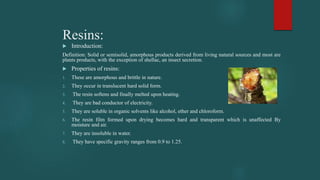
Definition: Solid or semisolid, amorphous products derived from living natural sources and most are
plants products, with the exception of shellac, an insect secretion.
 Properties of resins:
1. These are amorphous and brittle in nature.
2. They occur in translucent hard solid form.
3. The resin softens and finally melted upon heating.
4. They are bad conductor of electricity.
5. They are soluble in organic solvents like alcohol, ether and chloroform.
6. The resin film formed upon drying becomes hard and transparent which is unaffected By
moisture and air.
7. They are insoluble in water.
8. They have specific gravity ranges from 0.9 to 1.25.
 Classification of Resins:
1. Resin acid: carboxylic acid group containing resinous substances e.g. abietic
acid (colophony) & commiphoric acid (myrrh)
2. Resin ester: esters of resin acids or the other aromatic acids like benzoic,
cinnamic, salicylic acid etc. e.g. dragon' blood and benzoin
3. Resin alcohol (resinol): alcoholic compound with high mol. wt. e.g.
benzoresinol in benzoin & storesinol in storax.
4. Resin phenol (resino tannols): contains phenol group e.g. peru- resinotannol in
peru balsam & tolu-resinotannol in tolu balsam & siaresinotannol in benzoin
5. Gluco resins: resins when get combined with sugars by glycosylation e.g.
Convolvulaceae family drugs
6. Oleo resin: resin+ volatile oil e.g. Turpentine, ginger, copaiba, Canada
7. Gum resin: resin+ gum e.g. Ammoniacum
8. Balsam: contains aromatic acids like benzoin & cinnamic e.g. Tolu balsam,
peru balsam, storax
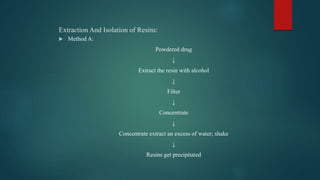
Extraction And Isolation of Resins:
 Method A:
Powdered drug
↓
Extract the resin with alcohol
↓
Filter
↓
Concentrate
↓
Concentrate extract an excess of water; shake
↓
Resins get precipitated
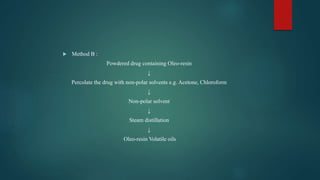
 Method B :
Powdered drug containing Oleo-resin
↓
Percolate the drug with non-polar solvents e.g. Acetone, Chloroform
↓
Non-polar solvent
↓
Steam distillation
↓
Oleo-resin Volatile oils
 Identification Test:
1) Solubility test: Resin dissolves when treated with organic solvents like alcohol, ether Or
chloroform etc.
2) Ignition test: They produces smoky flame upon burning.
3) HCl test: Drug is treated with hydrochloric acid which forms pink colour, ensures the Presence
of resins.
4)Ferric chloride test: The greenish blue colour develops when drug is treated with Ferric chloride
solution. This indicates the presence of resins
 Uses of Resins:
•It reflects light. This decreases the heat on the flowers, thereby protecting them.
•They are used in the preparation of emulsions
• Solid resenes are available as adhesives.
•They are used externally as mild antiseptic agents in the form of ointments and plasters.
•Resins are local irritant and hence act as local cathartics (e.g. Jalap
andIpomea)
•As anti cancer (Podophyllum)
•In bronchial asthma (e.g. Cannabis)
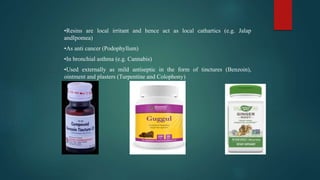
•Used externally as mild antiseptic in the form of tinctures (Benzoin),
ointment and plasters (Turpentine and Colophony)
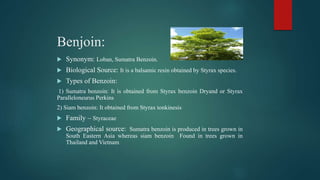
Benjoin:
 Synonym: Loban, Sumatra Benzoin.
 Biological Source: It is a balsamic resin obtained by Styrax species.
 Types of Benzoin:
1) Sumatra benzoin: It is obtained from Styrax benzoin Dryand or Styrax
Paralleloneurus Perkins
2) Siam benzoin: It obtained from Styrax tonkinesis
 Family – Styraceae
 Geographical source: Sumatra benzoin is produced in trees grown in
South Eastern Asia whereas siam benzoin Found in trees grown in
Thailand and Vietnam
 Cultivation and Collection :
1. It belongs to pathological resin category.
2. It is collected by making the incision on the Trunk part near the base of the tree.
3. It is collected from 5 to 6 year old plants gown wildly or Cultivated.
4. The resin is formed only after incision.
5. The initial product obtained after incision is Discarded into medicines.
6. The second or next flow is collected which oozes out of the plant And uses
medicinally.
7. The collected resinous matter is allowing to sun dry and becomes Solidify.
8. Approximately 10 kg of benzoin is collected per tree.
9. Benzoin trees are not found in India hence drug is imported from other countries
like Indonesia
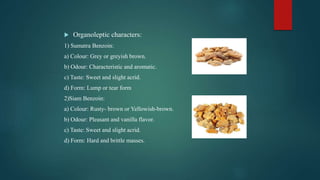
 Organoleptic characters:
1) Sumatra Benzoin:
a) Colour: Grey or greyish brown.
b) Odour: Characteristic and aromatic.
c) Taste: Sweet and slight acrid.
d) Form: Lump or tear form
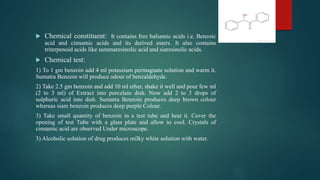
2)Siam Benzoin:
a) Colour: Rusty- brown or Yellowish-brown.
b) Odour: Pleasant and vanilla flavor.
c) Taste: Sweet and slight acrid.
d) Form: Hard and brittle masses.
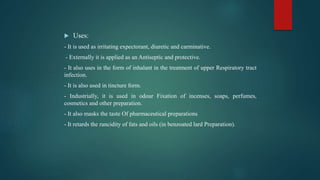
 Chemical constituent: It contains free balsamic acids i.e. Benzoic
acid and cinnamic acids and its derived esters. It also contains
triterpenoid acids like summaresinolic acid and siaresinolic acids.
 Chemical test:
1) To 1 gm benzoin add 4 ml potassium permagnate solution and warm it.
Sumatra Benzoin will produce odour of benzaldehyde.
2) Take 2.5 gm benzoin and add 10 ml ether, shake it well and pour few ml
(2 to 3 ml) of Extract into porcelain dish. Now add 2 to 3 drops of
sulphuric acid into dish. Sumatra Benzoin produces deep brown colour
whereas siam benzoin produces deep purple Colour.
3) Take small quantity of benzoin in a test tube and heat it. Cover the
opening of test Tube with a glass plate and allow to cool. Crystals of
cinnamic acid are observed Under microscope.
3) Alcoholic solution of drug produces milky white solution with water.
 Uses:
- It is used as irritating expectorant, diuretic and carminative.
- Externally it is applied as an Antiseptic and protective.
- It also uses in the form of inhalant in the treatment of upper Respiratory tract
infection.
- It is also used in tincture form.
- Industrially, it is used in odour Fixation of incenses, soaps, perfumes,
cosmetics and other preparation.
- It also masks the taste Of pharmaceutical preparations
- It retards the rancidity of fats and oils (in benzoated lard Preparation).
Guggul:
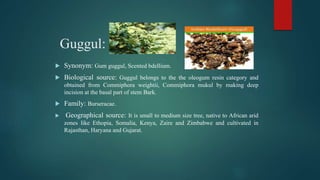
 Synonym: Gum guggul, Scented bdellium.
 Biological source: Guggul belongs to the the oleogum resin category and
obtained from Commiphora weightii, Commiphora mukul by making deep
incision at the basal part of stem Bark.
 Family: Burseracae.
 Geographical source: It is small to medium size tree, native to African arid
zones like Ethopia, Somalia, Kenya, Zaire and Zimbabwe and cultivated in
Rajasthan, Haryana and Gujarat.
 Cultivation and Collection:
1. The cultivation is mainly done by seeds and stem cuttings but seeds
are more preferable.
2. It grows well in sandy loam soil with high amount of gypsum (pH 7
to 9).
3. It is up to 2-4 meter In height occurs as a woody tree and shows
spines cut branches on pale yellow to brownish Stem.
4. The peels of bark are silvery and papery. In the arid and semiarid
zones sloppy well Drained highly degraded lands are most preferred
for cultivation.
5. The seeds are collected From fully developed red berries in July to
September because at this time the viability is More.
6. The plant are raised through nursery beds and transplanted into field
after six month.
7. The 25-30 cm long stem cuttings are planted in June or October, November for
vegetative Propagation.
8. The resin is collected by making deep circular incision on the stem of at least 5
Years old plant.
9. It is tapped and guggal secreted out as yellowish white aromatic latex like Matter.
10. The average yield is about 0.5-1 kg guggul per tree per year.
 Organoleptic Characters :
- Colour: Brown or pale yellow or dull green.
- Odour: Aromatic, balsamic and Pleasant.
- Taste: Bitter and Characteristic.
- Shape: Circular, irregular masses or agglomerated tears.
- Solubility: Forms white emulsion with water, partly soluble in alcohol.
 Chemical Constituent:
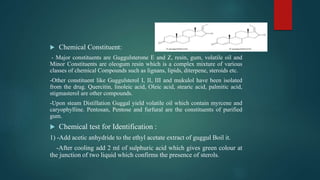
- Major constituents are Guggulsterone E and Z, resin, gum, volatile oil and
Minor Constituents are oleogum resin which is a complex mixture of various
classes of chemical Compounds such as lignans, lipids, diterpene, steroids etc.
-Other constituent like Guggulsterol I, II, III and mukulol have been isolated
from the drug. Quercitin, linoleic acid, Oleic acid, stearic acid, palmitic acid,
stigmasterol are other compounds.
-Upon steam Distillation Guggal yield volatile oil which contain myrcene and
caryophylline. Pentosan, Pentose and furfural are the constituents of purified
gum.
 Chemical test for Identification :
1) -Add acetic anhydride to the ethyl acetate extract of guggul Boil it.
-After cooling add 2 ml of sulphuric acid which gives green colour at
the junction of two liquid which confirms the presence of sterols.
 Uses:
1. Guggul used as anti inflammatory, hypolipidemic, antirheumatic and
hypocholesteremic drug.
2. Guggul extract lowers total lipid, serum cholesterol and triglyceride level
and reduces the serum p- lipoprotein level and to alter the lipoprotein ratio
significantly.
3. The Oleogum Portion shows antiarthritic and anti-inflammatory activities.
4. It also shows anti obesity, Antiinflammatory, antiacne, platelet aggregration
inhibition and immunomodulatory effect.
5. Crude gum, oleo gum resin, alcohol extract and petroleum ether extract have
showed Some side effect like skin rashes and diarrhea.
6. It enhances the menstrual discharge so it Should not be taken during
pregnancy.
Ginger:
 Synonyms: Adarak, Zingiber.
 Biological source: Ginger belongs to oleo gum resin category and is obtained
from the rhizomes of Zingiber Officinale Roscoe.
 Family: Zingiberaceae.
 Geographical source: It is indigenous to South East Asia and cultivated in
Caribbean Island, Jamaica, Taiwan, Africa, Australia, Mauritius and India. In India
it is cultivated in nearly All states like Kerala, Assam, Himanchal Pradesh, Orissa,
West Bengal and Karnataka.
 Cultivation and Collection:
1. The basic requirement of soil for the cultivation of ginger is sandy loam, clay or red
loam Soil.
2. It needs warm humid climate and heavy rainfall.
3. It grows well at an altitude of 1000 to 1500 meter from sea level.
4. The propagation is mainly done from rhizomes in the month of June.
5. The seed rhizome having bud are sowed into soil and supplemented with
adequate amount of manures and fertilizers viz.
6. Superphosphate, potash and ammonium sulphate.
7. If rainfall is not enough than proper irrigation arrangements are done.
8. Ginger is ready for Harvesting in six months or when leaves become yellowish.
9. Harvesting is done by digging Method.
10. Rhizomes are washed properly and then dried.
11. Then rhizomes are scrapped, dried And coated with inert material such as
calcium sulphate.
12. The average yield of green ginger is About 1500 kg per hectare.
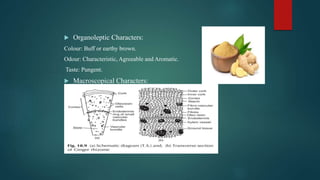
 Organoleptic Characters:
Colour: Buff or earthy brown.
Odour: Characteristic, Agreeable and Aromatic.
Taste: Pungent.
 Macroscopical Characters:
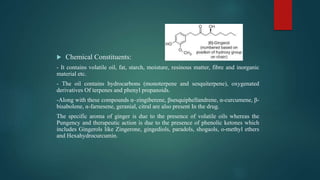
 Chemical Constituents:
- It contains volatile oil, fat, starch, moisture, resinous matter, fibre and inorganic
material etc.
- The oil contains hydrocarbons (monoterpene and sesquiterpene), oxygenated
derivatives Of terpenes and phenyl propanoids.
-Along with these compounds α–zingiberene, βsesquiphellandrene, α-curcumene, β-
bisabolene, α-farnesene, geranial, citral are also present In the drug.
The specific aroma of ginger is due to the presence of volatile oils whereas the
Pungency and therapeutic action is due to the presence of phenolic ketones which
includes Gingerols like Zingerone, gingediols, paradols, shogaols, ο-methyl ethers
and Hexahydrocurcumin.
 Chemical Tests for Identification :
To identify the adulterant, the tincture of ginger is heated with caustic alkali at
90-100°C And evaporates the liquid. Then it is dissolved in dilute HCl and
extracted with ether. The Ethereal layer is evaporated and left residue should
have no pungency (indicates the presence of Gingerol)
 Uses:
1. It is used as stomachic, carminative, aromatic, stimulant and flavouring agent.
2. Its oil is Used in mouth washes, beverages and liquor preparation.
3. Ginger has molluscicidal effects and controls parasitic infections.
4 It also blocks the gastro intestinal reactions and nausea Feeling.
5. It causes adsorption of toxins and increases the gastric motility.
6. It is also effective in The control of nausea and vomiting in
Hyperemesis gravidarum as well as postoperative Nausea and vomiting.
7. Ginger also possess cardiovascular activity, antiplatelet aggregation
property, analgesic, Antipyretic, antitussive, antibacterial, anthelmintic,
fungicidal and antiulcer activity.
8. Limed ginger is the coated ginger with lime which improves its colour
and quality. It is Mainly done for long storage of ginger.
 Questions :
1. Define resins. Write its uses in therapy.
2. Classify resins with examples.
3. What are the chemical tests for resin identification?
4. How resins are extracted and isolated?
5. Write physicochemical properties of resins.
6. Write synonym, biological source, family and geographical source of Benzoin.
7. What are the distinguish features of Sumatra and Siam benzoin? Explain.
8. Write biological source, family and geographical source of Guggul.
9. What are the main constituents of Guggul? Draw it chemical structure.
10. Write chemical test and uses of Guggul.
11. Write biological source, family and geographical source of ginger.
12. What is the main constituent of Ginger? Draw it chemical structure.
13. Write chemical test and uses of Ginger
 References:
1. Textbook of Pharmacognosy and Phytochemistry-II by Dr. Prabodh Shukla,
Dr. Padmini Shukla and Dr. Shashi Aalok published by Nirali Prakashan.
2. Textbook of Pharmacognosy and Phytochemistry by Gokhale Lokate and
Purohit published by Nirali Prakashan.
3. Practicalbook of Pharmacognosy and Phytochemistry by K.R.khadelwal
published by Nirali Prakashan.
Thank You For You Attention!
Resins Pharmacognosy-II